F.No.11013/9/2014-Estt.A. III
Government of India
Ministry of Personnel, Public Grievances and Pensions
(Department of Personnel and Training)
North Block, New Delhi
Dated the 5th June, 2020
OFFICE MEMORANDUM
Subject : Counting of the limitation period for the diverse purposes under CCS (CCA) Rules, 1965, CCS (Pension) Rules, 1972 regarding.
The undersigned is directed to refer to OM of even number dated 30 March, 2020 whereby, considering the unprecedented situation of lockdown w.e.f. 24th March, 2020, the period of lockdown was decided to be excluded from the time-limits prescribed in various Rules/instructions. While in the initial periods of lockdown, the Government offices were directed to work either with skeletal staff or with 1/3rd of its strength, DoPT’s extant instructions provide for attendance of 100% officers of the level of DS & above and 50% below DS on all working days. Ministry of Home Affairs vide its Order dated 30th May, 2020 has also issued instructions for phase-wise reopening of prohibited activities outside the containment zone. In view of this, it has now been decided that the exclusion of lockdown period w.e.f. 24th March, 2020 shall cease to have further effect with the issue of this O.M. Therefore, after exclusion of lockdown period, action as per time-lines provided under various Rules/instructions may be completed within the period as explained in paras 2 & 3 of O.M. dated 30th March, 2020 referred above.
Sd/-
(Umesh Kumar Bhatia)
Deputy Secretary to the Govt. of India
2. Consequent upon the outbreak of COVID-19, and considering the unprecedented situation of the Lockdown w.e.f. 24th March 2020, it may not be feasible to adhere to the timelines prescribed in the said Rules and to the instructions issued under the Rules. It has accordingly been decided not to count the period of the Lockdown for the purposes of adherence to the prescribed timelines, including those listed above. For example, if the due date for completing a process/work/event at the start of the Lockdown falls after 20 days, then the due date will get postponed by the number of Lockdown days and the same number (20) of days will be available to complete the work after the Lockdown is lifted.
3. However, after the Lockdown is lifted, if the time left to complete the task is less than 15 days, then the processes may be allowed to be completed within 15 days
F.No.11013/9/2014-Estt.A.III
Government of India
Ministry of Personnel, Public Grievances and Pensions
(Department of Personnel and Training)
North Block, New Delhi
Dated the 5th June, 2020
OFFICE MEMORANDUM
Subject: Preventive measures to be taken to contain the spread of Novel Coronavirus (COVID-19) – Attendance regarding.
The undersigned is directed to refer to OM of even number dated the 17th March, 2020, 18th May, 2020 and 19th May, 2020 whereby advisory for well-being of Government employees and attendance in Government offices with staggered timings were issued by Department of Personnel & Training (DoPT).
2. Kind attention is also drawn to Ministry of Home Affairs’ Order dated 30.05.2020 whereby ‘Additional Directives for Work Places’ have been prescribed. Further, the Ministry of Health & Family Welfare (MoH&FW) on 4th June, 2020 has issued Standard Operating Procedure on preventive measures to contain spread of COVID-19 in workplace settings (copy enclosed).
3. It is emphasized that strict adherence to the practices of social distancing norms and health & hygiene practices, as enunciated in these guidelines, is of paramount importance and the Government servants as responsible employees should abide by these practices so that the Government offices function in the most efficient manner in the given situation. All the Ministries/Departments/offices as well as the Central Government employees are, therefore, directed to ensure strict compliance of instructions issued by DoPT as well as MHA and MoH&FW.
sd/-
(Umesh Kumar Bhatia)
Deputy Secretary to the Govt. of India
Government of India Ministry of Health & Family Welfare
SOP on preventive measures to contain spread of COVID-19 in offices
1. Background
Offices and other workplaces are relatively close settings, with shared spaces like work stations, corridors, elevators & stairs, parking places, cafeteria, meeting rooms and conference ha lls etc. and COVID-19 infection can spread relatively fast among officials, staffs and visitors.
There is a need to prevent spread of infection and to respond in a timely and effective manner in case suspect case of COVID-19 is detected in these settings, so as to limit the spread of infection.
2. Scope
This document outlines the preventive and response measures to be observed to contain the spread of COVID-19 in office settings. The document is divided into the following sub sections
(i) Generic preventive measures to be followed at all times
(ii) Measures specific to offices
(iii) Measures to be taken on occurrence of case(s)
(iv) Disinfection procedures to be implemented in case of occurrence of suspect/confirmed case.
Offices in containment zones shall remain closed except for medical & essential services. Only those outside containment zones will be allowed to open up.
3. Generic preventive measures
Persons a bove 65 years of age, persons with comorbidities, pregnant women are advised to stay at home, except for essential and health purposes. Office management to facilitate the process.
The generic preventive measures include simple public health measures that are to be followed to reduce the risk of infection with COVID-19. These measures need to be observed by all (employees and visitors) at all times. These include:
Individuals must maintain a minimum distance of 6 feet in public places as far as feasible.
Use of face covers/masks to be mandatory.
Practice frequent hand washing with soap {for at least 40-60 seconds) even when hands are not visibly dirty. Use of alcohol-based hand sanitizers {for at least 20 seconds) can be made wherever feasible.
Respiratory etiquettes to be strictly followed. This involves strict practice of covering one’s mouth and nose while coughing/sneezing with a tissue/handkerchief/flexed elbow and disposing off used tissues properly.
Self-monitoring of health by all and reporting any illness at the earliest to the immediate supervisory officer.
Spitting shall be strictly prohibited.
Installation & use of Aarogya Setu App by employees.
4. Specific preventive measures for offices:
Entrance to have mandatory hand hygiene (sanitizer dispenser) and thermal screening provisions.
Only asymptomatic staff/visitors shall be allowed.
Any officer and staff residing in containment zone should inform the same to supervisory officer and not attend the office till containment zone is denotified. Such staff should be permitted to work from home and it will not be counted as leave period.
Drivers shall maintain social distancing and shall follow required dos and don’ts related to COVID-19. It shall be ensured by the service providers/ officers/ staff that drivers residing in containment zones shall not be allowed to drive vehicles.
There shall be provision for disinfection of the interior of the vehicle using 1% sodium hypochlorite solution/ spray. A proper disinfection of steering, door handles, keys, etc. should be taken up.
Advise all employees who are at higher risk i.e. older employees, pregnant employees and employees who have underlying medical conditions, to take extra precautions. They should preferably not be exposed to any front-line work requiring direct contact with the public. Office management to facilitate work from home wherever feasible.
All officers and staff / visitors to be allowed entry only if using face cover/masks. The face cover/mask has to be worn at all times inside the office premises.
Routine issue of visitors/temporary passes should be suspended and visitors with proper permission of the officer who they want to meet, should be allowed after . being properly screened.
Meetings, as far as feasible, should be done through video conferencing.
Posters/standees/AV media on preventive measures about COVID-19 to be displayed prominently.
Staggering of office hours, lunch hours/coffee breaks to be done, as far as feasible.
Proper crowd management in the parking lots and outside the premises – duly following social distancing norms be ensured.
Valet parking, if available, shall be operational with operating staff wearing face covers/ masks and gloves as appropriate. A proper disinfection of steering, door handles, keys, etc. of vehicles should be taken up.
Any shops, stalls, cafeteria etc., outside and within the office premises shall follow social distancing norms at all times.
Specific markings may be made with sufficient distance to manage the queue and ensure social distancing in the premises.
Preferably separate entry and exit for officers, staff and visitors shall be organised.
Proper cleaning and frequent sanitization of the workplace, particularly of the frequently touched surfaces must be ensured.
Ensure regular supply of hand sanitisers, soap and running water in the washrooms.
Required precautions while handling supplies, inventories and goods in the office shall be ensured.
Seating arrangement to be made in such a way that adequate social distancing is maintained.
Number of people in the elevators shall be restricted, duly maintaining social distancing norms.
For air-conditioning/ventilation, the guidelines of CPWD shall be followed which inter alia emphasises that the temperature setting of all air conditioning devices should be in the range of 24-30°C, relative humidity should be in the range of 40- 70%, intake of fresh air should be as much as possible and cross ventilation should be adequate.
Large gatherings continue to remain prohibited.
Effective and frequent sanitation within the premises shall be maintained with particular focus on lavatories, drinking and hand washing stations/areas.
Cleaning and regular disinfection (using 1% sodium hypochlorite) of frequently touched surfaces (door knobs, elevator buttons, hand rails, benches, washroom fixtures, etc.) shall be done in office premises and in common areas
Proper disposal of face covers I masks I gloves left over by visitors and/or employees shall be ensured.
In the cafeteria/canteen/dining halls:
Adequate crowd and queue management to be ensured to ensure social distancing norms.
Staff I waiters to wear mask and hand gloves and take other required precautionary measures.
The seating arrangement to ensure a distance of at least 1meter between patrons as far as feasible.
In the kitchen, the staff to follow social distancing norms.
5. Measures to be taken on occurrence of case(s):
Despite taking the above measures, the occurrence of cases among the employees working in the office cannot be ruled out. The following measures will be taken in such circumstances:
i. When one or few person(s) who share a room/close office space is/are found to be suffering from symptoms suggestive of COVID-19:
a. Place the ill person in a room or area where they are isolated from others at the workplace. Provide a mask/face cover till such time he/she is examined by a doctor.
b. Immediately inform the nearest medical facility (hospital/clinic) or call the state or district helpline.
c. A risk assessment will be undertaken by the designated public health authority (district RRT/treating physician) and accordingly further advice shall be made regarding management of case, his/her contacts and need for disinfection.
d. The suspect case if reporting very mild/mild symptoms on assessment by the health authorities would be placed under home isolation.
e. Suspect case, if assessed by health authorities as moderate to severe, will be treated as per health protocol in appropriate health facility.
f. The rapid response team of the concerned district shall be requisitioned and will undertake the listing of contacts.
g. The necessary actions for contact tracing and disinfection of work place will start once the report of the patient is received as positive. The report will be expedited for this purpose.
ii. If there are large numbers of contacts from a pre-symptomatic / asymptomatic case, there could be a possibility of a cluster emerging in workplace setting. Due to the close environment in workplace settings this could even be a large cluster (>15 cases). The essential principles of risk assessment, isolation, and quarantine of contacts, case referra l and management will remain the same. However, the scale of arrangements will be higher.
iii. Management of contacts:
The contacts will be categorised into high and low risk contacts by the District RRTas detailed in the Annexure I.
The high-risk exposure contacts shall be quarantined for 14 days.
These persons shall undergo testing as per ICMR protocol.
The low risk exposure contacts shall continue to work and closely monitor their health for next 14 days.
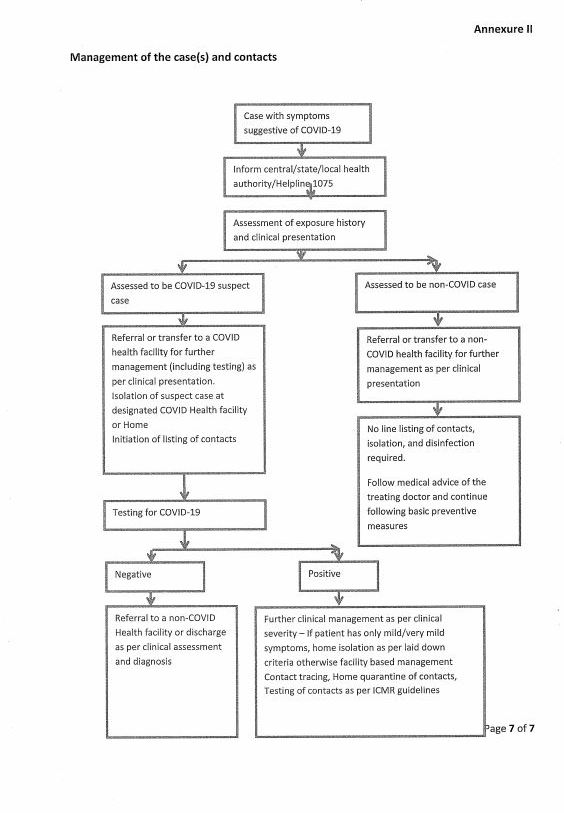
The flowchart for management of contact/ cases is placed at Annexure – II.
6. Closure of workplace
If there a re one or two cases reported, the disinfection procedure will be limited to places/areas visited by the patient in past 48 hrs. There is no need to close the entire office building/halt work in other areas of the office and work can be resumed after disinfection as per laid down protocol.
However, if there is a larger outbreak, the building/block will have to be closed for 48 hours after thorough disinfection. All the staff will work from home, till the building/block is adequately disinfected and is declared fit for re-occupation.
7. Disinfection Procedures in Offices
Detailed guidelines on the disinfection as already issued by Ministry of Health & Family Welfare as available on their website shall be followed.
Annexure I
Risk profiling of contacts
Contacts are persons who have been exposed to a confirmed case anytime between 2 days prior to onset of symptoms (in the positive case) a nd the date of isolation (or maximum 14 days after the symptom onset in the case).
High-risk contact
Touched body fluids of the patient (respiratory tract secretions, blood, vomit, saliva, urine, faeces; e.g. being coughed on, touching used paper tissues with a bare hand)
Had direct physical contact with the body of the patient including physical examination without PPE
Touched or cleaned the linens, clothes, or dishes of the patient.
Lives in the same household as the patient.
Anyone in close proximity (within 1 meter) of the confirmed case without precautions.
Passengers in close proximity (within 1 meter) in a conveyance with a symptomatic person who later tested positive for COVID-19 for more than 6 hours.
Low-risk contact
Shared the sa me space (worked in same room/similar) but not having a high-risk exposure to confirmed case of COVID-19.
Travelled in same environment (bus/train/flight/any mode of transit) but not having a high-risk exposure.
PENSION FUND REGULATORY AND DEVELOPMENT AUTHORITY
8-14/A, Chhatrapati Shivaji Bhawan,
Qutub Institutional Area,
Katwaria Sarai, New Delhi-110016
Ph : 011-26517501, 26517503, 26133730
Fax : 011-26517507
Website ·. www.pfrda.org.in
CIRCULAR
PFRDA/17/08/11/0031/2017-SUP-SG
01st June 2020
Subject : Choice of Pension Funds and Investment Pattern in Tier I of NPS for the Government subscribers employed with State Governments (SG), State Autonomous Bodies (SABs) & Central Autonomous Bodies (CABs)
A. This has reference to the Gazette Notification F. No. 1/3/2016-PR. dated 31-01- 2019 issued by Dept. of Financial Service (DFS), Ministry of Finance (MoF), pursuant to which the Authority vide its circular no PFRDA/2019/12/REG-PF/1 dated 08th May 2019, introduced the choice of the pension fund and investment pattern in the Tier I of the NPS for the employees of the Central Government.
B. The following were introduced by Central Government through the DFS Gazette Notification ( Annexure 1) mentioned supra
I. Enhancement in Government Co- Contribution – The monthly contribution of 10 percent of the Basic Pay plus Dearness Allowance (DA) to be paid by the employee and 14 percent of the Basic Pay plus DA by the Central Government.
IL Compensation For Non-Deposit Or Delayed Deposit Of Contributions in the following cases:
1. where the NPS contributions were deducted from the salary of the Government employee but the amount was not remitted to CRA system or was remitted late;
2. where the NPS contributions were not deducted from the salary of the Government employee;
3. where the Government contributions were not remitted to CRA system or were remitted late (irrespective whether the employee contributions were deducted or not),
III. Choice of Pension Fund And Investment Pattern In Tier-I Of NPS as under:
1. Choice of Pension Fund: The Government subscriber shall be allowed to choose any one of the pension funds including Private sector pension funds. They can change their option once in a year. However, the current provision of combination of Public Sector Pension Funds will be available as default option for existing as well as new Government subscriber.
2. Choice of Investment Pattern: The following options for investment choices shall be offered to Government subscribers
(i) Default Scheme: The existing scheme in which funds are allocated among three Public Sector undertaking fund managers shall continue as default scheme for both existing and new subscribers.
(ii) Scheme G: Employees who prefer returns with comparatively less amount of risk shall be given an option to invest 100% of the funds in Govt. securities. (Scheme G)
(iii) Auto Choice Life Cycle Funds: Employees preferring better returns with comparatively higher risk shall be given the options of the following Life Cycle based schemes-
a) Conservative Life Cycle Fund with maximum exposure to equity capped at 25%- LC-25 Scheme.
b) Moderate Life Cycle Fund with maximum exposure to equity capped a 50 LC- 50 Scheme
The Government subscribers may exercise one of the above choices of Investment pattern twice in a financial year.
IV. Implementation of choices to the legacy corpus : Transfer of huge legacy corpus in respect of the Government subscribers from the existing Pension Funds is likely to impact the market. It may be practically difficult for the PFRDA to allow Government subscribers to change the Pension Funds or investment pattern in respect of the accumulated corpus, in one go. Therefore, for the present, change in the Pension Funds or investment pattern is allowed in respect of the incremental flows only.
v. Transfer of Legacy corpus in reasonable time frame : PFRDA shall draw up a scheme in due course for transfer of accumulated corpus as per new choices of Government subscribers in a reasonable time frame of say five years. Once PFRDA draws up this scheme, change in Pension Funds or investment pattern shall be allowed in respect of the accumulated corpus in accordance with that scheme.
VI. For investment option of Default scheme as per para B.III 2 (i) above, all other terms and conditions as contained in the investment guidelines issued by the Authority dated 03.06.2015 for NPS Schemes (Applicable to Scheme CG, Scheme SG, Corporate CG and NPS Lite Schemes and APY) and subsequent amendments made thereto shall be applicable.
VII. Further, for investment options as per para B.III 2 (ii) or B.III 2.(iii) (a) and (b) above, all other terms and conditions as contained in the investment guidelines issued by the Authority dated 04.05.2017 in respect of NPS Schemes {Other than Govt. Sector (CG & SG), Corporate CG, NPS Lite and APY} and subsequent amendments made thereto shall apply.
C. It has been brought to the notice of the Authority that while some of the State Governments (SGs) I SABs/ CABs have either partially or wholly adopted the provisions of Gazette Notification F. No.1/3/2016-PR. dated 31-01-2019 issued by Dept. of Financial Service (DFS), Ministry of Finance (MoF), the others have been seeking clarifications on the same. It is, therefore, clarified that the State Governments ( SGs) I SABs/ CABs are free to adopt the provisions of the said Gazette notifications on their own volition , based on their own internal approvals and notifications , without seeking the Authority’s approval.
D. This circular is issued in exercise of powers of the Authority under sub-clause (b) of sub-section (2) of Section 14 read with Section 23 of the PFRDA Act, 2013 and sub regulation (1) of Regulation 14 of the PFRDA (Pension Fund) Regulations, 2015.
Union Minister Dr. Jitendra Singh launches e-Booklet on one year achievements of DoPPW under Modi Government 2.0
Pension reforms hugely benefitted the lives of the Pensioners: Dr Jitendra Singh
Union Minister of State (Independent Charge) Development of North Eastern Region (DoNER), MoS PMO, Personnel, Public Grievances & Pensions, Atomic Energy and Space, Dr Jitendra Singh today launched an e-Booklet on one year achievements of the Department of Pension and Pensioners’ Welfare (DoPPW)” through Video Conferencing (VC).
Dr. Jitendra Singh, while addressing all the officers of the Department congratulated the team for carrying out a series of reforms which not only high-lighted the sensitivity of the Modi Government but also the dedication of the team during the trying times of the Pandemic. He stated that the department went outside its call of duty to organize a webinar on Covid by bringing in leading doctors to address the anxiety and fears of the Pensioners. He stated that the Department is blessed with the unique opportunity of being able to serve the elderly and retired which no other department has.
Among a series of reforms in Pension policy, the most notable was the Amendment of Rule 54 of CCS Pension Rules, 1972 to provide enhanced Family Pension in the event of unfortunate death of Government servant even before completion of 7 years of service.
Earlier only those families were eligible for enhanced family Pension (@50% of last pay drawn) wherein the deceased government servant had completed 7 years of service.
Another landmark OM in the recent year was extending the Old Pension scheme to those employees who joined on or after 01.01.2004 but whose result for recruitment had been declared before 01.01.2004. This was a long standing demand of employees covered under the National Pension System (NPS) and was the cause of several court cases and anxiety among such employees.
Soon after the formation of the new government a series of welfare measures for the Pensioners were also carried out such as opening of an “Integrated Grievance Cell & Call Centre with Toll free number 1800-11-1960 ” to facilitate elderly pensioners in registering their grievances and get information of pending grievances, holding of “All India Pension Adalat” wherein more than 50 locations were connected through live interactive video conferencing which resulted in resolution of more than 4000 grievances by a single event.
The other welfare activities carried out in the last one year include facilitating doorstep service for submission of life certificate with the help of Pension Disbursing Banks, DLC from home campaign by involving Pensioners’ Associations in 24 cities, organizing the First Regional Adalat at Jammu, and issuance of consolidated instructions to banks in order to ensure ease of living for pensioners.
The Department also organized a tele-consultation for pensioners on Covid 19 with renowned Pulmonologist & Director AIIMS, Dr Randeep Guleria & Dr Prasun Chatterjee, Associate Professor AIIMS.
Dr Kshatrapati Shivaji, Secretary (P&PW), thanked the Union Minister for consistently guiding DoPPW to make Pension reforms which hugely affected the lives of the Pensioners. He stated that this is one of the few Departments which even prior to Covid pandemic was 100% on e-office and therefore the transition to work from home at the height of the pandemic was easy to implement. All officials have been provided with a VPN which enables them to work from wherever they are and therefore the working of this Department remained unaffected during the pandemic.
Joint Secretary, Shri Sanjiv Narain Mathur conducted the proceedings which were completely online with all senior officers of the Department present through VC. Shri Ruchir Mittal, DS gave the vote of thanks.
File No.X-12/1/2019-SPB-II
Government of India
Ministry of Communications
Department of Posts
(Personnel Division)
Dak Bhawan, Sansad Marg
New Delhi – 110 001
Dated: June 3, 2020
To
All Chief Postmasters General / Postmasters General
Chief General Manager, BD Directorate / Parcel Directorate / PLI Directorate
Director, RAKNPA / GM, CEPT / Directors of all PTCs
Addl. Director General, Army Postal Service, New Delhi
All General Managers (Finance) / Directors Postal Accounts / DDAP
Subject : – Transfer policy guidelines – clarifications.
Sir/Madam,
I am directed to refer to Directorate’s communication number 141-141/2013-SPN-II dated 17.01.2019 vide which revised ‘Guidelines for transfer’ was circulated to all Postal Circles. Subsequently, clarification has been issued vide communication of even number dated 07.05.2019, 24/27.06.2019, 24.10.2019 and 30.04.2020. Now, references were received from various Postal Circles pointing out some difficulties and seeking clarifications. The references have been examined and clarified as under: –
Sl No
Clarification sought
Comments / Remarks
1
Whether 3 years of service condition holds for transfer underdated Rule-38 for surplus qualifying officials or not as mentioned in earlier transfer policy guidelines.
Para 3 (A) (x) of transfer policy guidelines 17.01.2019 provides that only such official who have completed probation or put in minimum service of 2 years in the grade where there is no probation period shall be eligible for transfer under Rule-38. Further, it is clearly mentioned that transfer policy guidelines is applicable on Group ‘C’, Group ‘B’ (non-gazetted) officials and Assistant Superintendent of Posts. Therefore, the question of DR or surplus qualified may not be arise as it is equally applicable for both.
Therefore, service condition mentioned in Para 3 (A) (x) is applicable on both DR and surplus qualified as well.
2
Competent authority for deciding Postman inter sub divisional Rule-38 transfer of Postman and MTS staff.
Postman and MTS are Divisional cadres. As such, request transfer of Postman and MTS has not come under Rule-38 transfer. Therefore, Divisional Head is competent enough to approve such transfer of MTS
& Postman within the Division.
3
Application received after 30th June 2019 may be rejected or taken up in the year 2020 without requesting the applicants to submit fresh application.
Para 3 (C)(ii) of transfer policy guidelines provides that the application for transfer under Rule 38 shall be received in the office of Chief Postmaster General (CPMG) between 1st April to 30th June of the year. Applications, received after closing of normal office hour of 30th June shall not be entertained in any circumstances.Therefore, the transfer requests received after 30th June, 2019 shall be rejected and shall not be entertained. However, such applicants may be requested to apply afresh before 30th June, 2020 for consideration.
4
Disease covered under ‘Terminal illness’.
Competent authority has decided that a medical certificate specifying such disease as ‘terminal llness’ shall be obtained from Government hospital certified by Chief Medical Officer of the headquarter of the applicant.
5
Clarification issued vide letter dated 24.10.2019 (Point No. 5) i.e. Regional Head shall be the competent authority to approve rotational transfer of SBCO officials within a Region is contradictory with Sl. No. (vi) of Directorate’s instructions issued vide communication number 4-9/2011-SPG-(Pt) dated 30.03.2015 regarding composition of Transfer and Placement Committees for recommending transfer of SBCO staff.
In order to remove any discrepancy, Competent authority has decided that DPS (Region) or Regional Head (where there is no DPS) shall be the competent authority to approve rotational transfer of SBCO officials within a Region.
6
Immunity from transfer to office bearers of recognized Service Associations on completion of station tenure.
Office bearer of recognized Service Associations who are elected to the office of Chief Executive or General Secretary, Assistant Secretary and Financial Secretary or Treasurer of Group ‘C’ and Group ‘D’ Associations whether they are All India, Circle or Division units, if the constitution and bye laws of the Central Service Association permit opening of such branches shall be allowed for their posting at headquarter station of recognized service association for a period of two years even after completion of station tenure, if holding the post in Service Association.
F.No.09-01/2018-SR
Government of India
Ministry of Communications
Department of Posts
(SR Section)
Dak Bhawan, New Delhi – 110001
Dated: 01 Jun 2020
OFFICE MEMORANDUM
Subject : Recommendations of the Committee for suggesting modification and better system in verification process for recognition of Associations – reg.
With reference to this Department’s OM of even number dated 20.10.2019 where suggestions were asked, it is informed the Committee has submitted its report (Copy enclosed). The revised SOPs are also enclosed for reference.
2. It is requested to provide your comments/suggestions if any Latest by 05th June, 2020.
This issues with the approval of DG (Postal Services).
(Harpreet Kaur Manchanda)
Assistant Director General (SR & Legal)
No. 1-1/2020/D (Pay/Services)
Government of India
Ministry of Defence
New Delhi, the 24th April 2020
To
The Chief of the Army Staff
The Chief of the Air Staff The Chief of the Naval Staff
Subject : Freezing of Dearness Allowance to Armed Forces Officers and Personnel Below Officer Rank including NCs (E).
Sir,
I am directed to refer to the Ministry of Finance, Department of Expenditure OM No. 1/1/2020-E-II (B) dated 23-4-2020 on the subject noted above and to say that in view of the crisis arising out of COVID-19, it has been decided that the additional installment of Dearness Allowance payable to the Defence Service Personnel due from 1st January 2020 shall not be paid. The additional installments of Dearness Allowance due from 15th July 2020 and 1st January 2021 shall also not be paid. However, Dearness Allowance at current rates will continue to be paid.
2. As and when the decision to release the future installment of Dearness Allowance due from 1st July 2021 is taken by the Government, the rates of Dearness Allowance as effective from 1st January 2020, 1st July 2020 and 1st January 2021 will be restored prospectively and will be subsumed in the cumulative revised rate effective from 1st July 2021. No arrears for the period from 1st January 2020 till 30th June 2021 shall be paid.
3. These orders are issued in line with Ministry of Finance OM No. 1/1/2020-E-II(B) dated 23.4.2020.
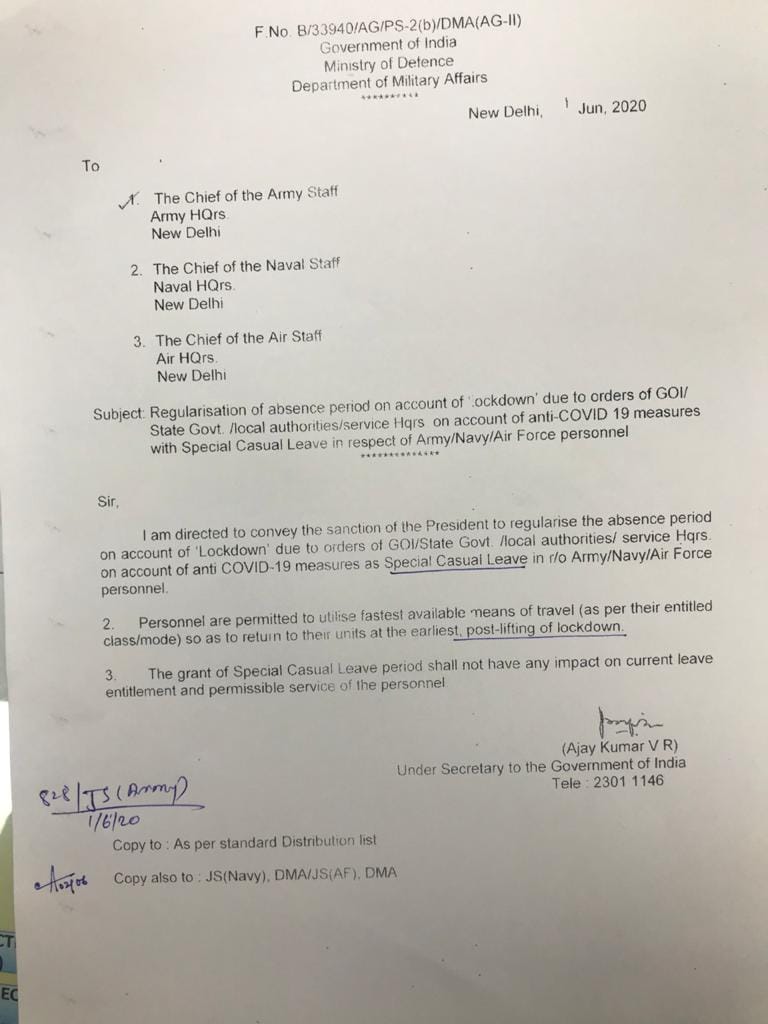
F.No.B/33940/AG/PS-2(b)/DMA(AG-II)
Government of India
Ministry of Defence
Department of Military Affairs
New Delhi, 1st Jun,2020
To
1. The Chief of the Army Staff
Army HQrs
New Delhi
2. The Chief of the Naval Staff
Naval HQrs
New Delhi
3. The Chief of the Air Staff
Air HQrs
New Delhi
Subject : Regularisation of absence period on account of lockdown due to orders of GOI/State Govt./Local authorities/service Hqrs on account of anti-COVID 19 measures with Special Casual Leave in respect of Army/Navy/Air Force Personnel.
Sir,
I am directed to convey the sanction of the President to regularise the absence period on account of ‘Lockdown‘ due to orders of GOI/State Govt./Local authorities/service Hqrs. on account of anti COVID-19 measures as Special Casual Leave in r/o Army/Navy/Air Force personnel.
2. Personnel are permitted to utilise fastest available means of travel (as per their entitled class/mode so as to return to their units at the earliest, post-lifting of lockdown.
3. The grant of Special Casual Leave period shall not have any impact on current leave entitlement and permissible service of the personnel.
(Ajay Kumar V R)
Under Secretary to the Government of India