IDA from October 2019 in CPSE on 1987 and 1992 Pay Scales – DPE OM
F.No.W-02/0003/2014-DPE (WC)-GL- XXIII/19
Government of India
Ministry of Heavy Industries & Public Enterprises
Department of Public Enterprises
Public Enterprises Bhawan
Block 14, CGO Complex,
Lodi Road, New Delhi-110003
Dated: 7th October, 2019
OFFICE MEMORANDUM
Subject :- Payment of DA to Board level/below Board level executives and non-unionized supervisors following IDA scales of pay in Central Public Sector Enterprises (CPSEs) on 1987 and 1992 basis.
The undersigned is directed to refer to para No. 4 of this Department’s O.M. No. 2(50)/86-DPE (WC) dated 19.07.1995 wherein the rates of DA payable to the executives holding Board level post have been indicated. In accordance with the DA scheme spelt out in Annexure-III of the said O.M. the instalments of DA become payable from 1st January, lst July and 1st October, every year based on the price increase above quarterly Index average of 1099 (1960=100).
2. In continuation of this Department’s O.M. of even No. dated 04.07.2019, the rates of DA payable to the executives of CPSEs holding Board level post, below Board level post and Non-Unionized Supervisors following IDA pattern of 1992 pay scales may be modified as follows:-
(a) Date from which payable: 01.10.2019
(b) AICPI (Linked to 1960=100) for the quarter June 2019 — Aug.2019
June, 2019 7213
July, 2019 7282
Aug., 2019 7306
Average of the quarter 7267
(c) Increase over link point : 6168 (7267-1099)
(d) % increase over link point: 561.2% (6168/1099* 100)
DA Rates for various Pay Ranges
Basic Pay per Month
DA Rates
Upto Rs. 3500
561.2% of pay subject to minimum of Rs. 12336/-
Above Rs 3500 and Upto Rs. 6500
420.9% of pay subject to minimum of Rs. 19642/-
Above Rs 6500 and Upto Rs. 9500
336.7% of pay subject to minimum of Rs. 27359/-
Above Rs 9500
280.6% of pay subject to minimum of Rs. 31987/-
3. The payment on account of dearness allowance involving fractions of 50 paise and above may be rounded off to the next higher rupee and the fractions of less than 50 paise may be ignored.
4. The quantum of IDA payable from 01.10.2019 at the old system of neutralization @ Rs. 2.00 per point shift for increase of 151 points, may be Rs. 302/- and at AICPI 7267, DA payable may be Rs. 13123.75 to the executives holding Board level post, below Board level post and non-unionised supervisors following IDA pattern in the CPSEs of 1987 pay scales.
5. All administrative Ministries/Department of Government of India are requested to bring the foregoing to the notice of the CPSEs under their administrative control for necessary action at their end.
IDA from October 2019 for 1997 Pay Scales CPSE Employees – DPE OM
F.No.W-02/0004/2014-DPE(WC)-GL-XXII/19
Government of India
Ministry of Heavy Industries & Public Enterprises
Department of Public Enterprises
Public Enterprises Bhawan
Block 14, CGO Complex,
Lodi Road, New Delhi–110003
Dated: 7th October, 2019
OFFICE MEMORANDUM
Subject :- Board level posts and below Board level posts including Non-unionised supervisors in Central Public Sector Enterprises (CPSEs) – Revision of scales of pay w.e.f. 01.01.1997 Payment of IDA at revised rates regarding.
*****
In modification of this Department’s O.M. iof even No. dated 04.07.2019, the rate of DA payable to the executives of CPSEs (1997 pay revision) is as follows:
a) Date from which payable: 01.10.2019
b) Average AICPI (1960-400) for the quarter June 2019 – Aug 2019
June, 2019 7213
July, 2019 7282
Aug., 2019 7306
Average of the quarter 7267
c) Link Point :1708 (as on 01.01.1997)
d) Increase over link point: 5559 (72674708)
e) Revised DA Rate w.e.f. 01.10.2019: 325.5% [(5559 : 1708) x 100]
2. These rates are applicable in the case of IDA employees, whose pay have been revised with effect from 01.01.1997 as per DPE O.M. dated 25.06.1999.
3. All Administrative Ministries/Departments of the Government of India are requested to bring the foregoings to the notice of the CPSEs under their administrative control for necessary action at their end.
DPE ORDER : IDA from October 2019 for CPSE Employees – 2007 Revised Pay Scales
No. W-02/0002/2014-DPE (WC)-GL-XXI/19
Government of India
Ministry of Heavy Industries & Public Enterprises
Department of Public Enterprises
Public Enterprises Bhawan
Block 14, CGO Complex,
Lodi Road, New Delhi-110003
Dated: 7th October, 2019
OFFICE MEMORANDUM
Subject :- Board level and below Board level posts including non-unionised supervisors in Central Public Sector Enterprises (CPSEs)- Revision of scales of pay w.e.f. 01.01.2007 Payment of IDA at revised rates-regarding.
In modification of this Department’s O.M. of even No. dated 04.07.2019, the rate of DA payable to the executives and non-unionized supervisors of CPSEs (2007 pay revision) is as follows:
a) Date from which payable: 01.10.2019
b) Average AICPI (2001-100) for the quarter June, 2019 — Aug., 2019
June, 2019 316
July, 2019 319
Aug, 2019 320
Average of the quarter 318.33
c) Link Point: 126.33 (as on 01.01.2007)
d) Increase over link point: 192 (318.33 minus 126.33)
e) DA Rate w.e.f. 01.10.2019: 152% [(192 / 126.33) x 100]
2. The above rate of DA i.e. 1 52% would be applicable in the case of IDA employees who have been allowed revised pay scales (2007) as per DPE O.Ms. dated 26.11.2008, 09.02.2009 & 02.04.2009.
3. All administrative Ministries/ Departments of the Government of India are requested to bring the foregoings to the notice of the CPSEs under their administrative control for necessary action at their end.
Engagement of Retired Government Officers as Consultant on contract basis in the Directorate General of Health Services as Under Secretary level
F.No.21/07/2019-CS-I(P)
Ministry of Personnel, Public Grievances Pension
Department of Personnel & Training
(C.S.I Division)
2nd Floor, ‘A’wing,
Lok Nayak Bhawan,
Khan Market, New Delhi
Dated 4th October 2019
OFFICE MEMORANDUM
Subject : Engagement of Retired Government Officers as Consultant on contract basis in the Directorate General of Health Services as Under Secretary level
he undersigned is directed to circulate the vacancy Circular No. A-22017/2/2013-Admin-I dated 26th September 2019 (along-with enclosures) received from Ministry of Health and Family Welfare inviting application from retired Under Secretary or equivalent or and above. well versed with Establishment/Administration Rules and procedure and who have served in Central Secretariat, for engagement as Consultant on contract basis for a period of one year or till the vacancy is filled up on regular basis whichever is earlier.
2. It may be noted that cadre clearance from C.S.I Division will be required in case of Under Secretary and above level officers of CSS applying for deputation
3 In case of any further clarification, applicants are requested to contact the concerned Ministries/Departments.
(Sanjay Kumar Das Gupta)
Under Secretary to the Government of India
GOVERNMENT OF INDIA
MINISTRY OF RAILWAY
RAILWAY BOARD
No. E(W)2016/PS5-8/1
New Delhi, dated 20.09.2019
The General. Managers (P)
All Zonal Railways & Production Units
Sub : Revised format for issue of Pensioners’ Identity Card.
Ref:(i)Board’s letter of even number dated 29.09.2016.
(ii) OM No. 41/21/2000-P&PW(D) dated 19.02.2019 of Department of Pension & Pensioners’ Welfare.
The Department of Pension & Pensioners’ Welfare, vide their OM cited under Ref.(ii) above have circulated a revised format for issue of Pensioners’ Identity Card deleting the requirement for indicating Aadhaar No. in the earlier format.
2. Accordingly the earlier format circulared vide Board’s letter under Ref (i) has been revised and enclosed as Annexure I & II. Henceforth Pensioners Identity Cards may be issued to the Railway servants retiring under Railway Services (Pension) Rules,1993 as per format at Annexure-I and to the Railway servants retiring under ‘National Pension System'(NPS) as per format at Annexure-II.
3. Other conditions stipulated in Board’s letter cited under Ref.(i) shall continue.
IDA from October 2019 for CPSE Employees – 2017 Revised Pay Scales
No. W-02/0039/2017-DPE (WC)-GL-XX/19
Government of India
Ministry of Heavy Industries & Public Enterprises
Department of Public Enterprises
Public Enterprises Bhawan
Block 14, CGO Complex,
Lodi Road, New Delhi-110003
Dated: 7th October, 2019
OFFICE MEMORANDUM
Subject :- Board level and below Board level posts including non-unionised supervisors in Central Public Sector Enterprises (CPSEs)- Revision of scales of pay w.e.f. 01.01.2017 – Payment of IDA at revised rates-regarding.
*****
The undersigned is directed to refer to the Para 7 and Annexure-III (B) of DPE’s OM dated 03.08.2017 wherein the rates of DA payable to the Board level and below Board level executives and non-unionized supervisors of CPSEs have been indicated. The next instalment for revision of rates of DA is due from 01.10.2019. Accordingly, the rate of DA payable to the executives and non-unionized supervisors of CPSEs is as follows:
(a) Date from which payable: 01.10.2019
(b) Average AICPI (2001-400) for the quarter June, 2019 Aug, 2019
June, 2019 316
July, 2019 319
Aug, 2019 320 Average of the quarter 318.33
(c) Link Point: 277.33 (as on 01.01.2017)
(d) Increase over link point: 41 (318.33 minus 277.33)
(e) DA Rate w.e.f. 01.10.2019: 14.8% [(41 4-277.33) x 100]
2. The above rate of DA i.e. 14.8% would be applicable in the case of IDA employees who have been allowed revised pay scales (2017) as per DPE O.Ms. dated 03.08.2017, 04.08.2017 & 07.09.2017.
3. All administrative Ministries/ Departments of the Government of India are requested to bring the foregoings to the notice of the CPSEs under their administrative control for necessary action at their end.
ALL INDIA BANK EMPLOYEES ASSOCIATION – AIBEA
Singapore Plaza, 164, Linghi Chetty Street, Chennai-600 001
e mail : [email protected] – 98400 89920
BANK EMPLOYEES FEDERATION OF INDIA – BEFI
53, Radha Bazar Lane, (1st Floor), Kolkata – 700 001
e-mail: [email protected] – 70595 91066
To All units of AIBEA and BEFI
3-10-2019
Dear Comrades,
Our Joint Call for Strike on 22nd Oct. 2019 Against merger and closure of Banks
We are sure that all our unions and members are preparing well for the successful implementation of our strike on 22-10-2019 against the unwarranted merger of 10 Banks and resultant closure of 6 Banks. Reports reaching us from different centres indicate that our members have well understood the seriousness of the attacks and the negative implications of such mergers.
All our unions should concentrate on the campaign meetings so that the issues involved are properly explained to our members everywhere.
Hold Campaign meetings: For this purpose, it is suggested that in as many places, towns, cities, District centres, etc. joint campaign meetings are to be held. We should move in this regard immediately, as the time before us is short.
Calendar for Cadre Review of Central Group ‘A’ Services
F.No.I.11019/9/2018-CRD
Government of India
Ministry of Personnel, Public Grievances & Pensions
Department of Personnel & Training
3rd Floor, Lok Nayak Shawan, Khan Market,
New Delhi, Dated 1/10/2019
OFFICE MEMORANDUM
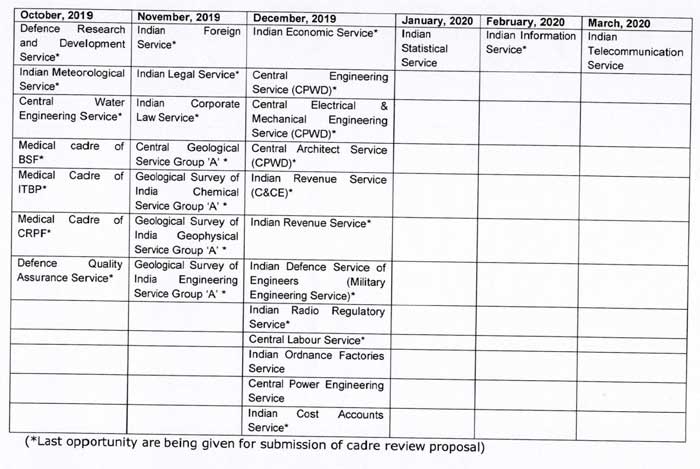
Sub: Calendar for Cadre Review of Central Group ‘A’ Services
The undersigned is directed to say that in terms of this Department’s OM No. I. 11011/1/2019-CRD dated 14/12/2010, the ideal periodicity of cadre review is 5 years. Despite the said instructions and repeated reminders, it has been observed that the said periodicity is not followed.
With the objective to get the cadre review completed for all the services, this Department had issued a calendar for cadre review for year 2018 vide OM of even No. dated 25/5/2018 with the direction that the same may be followed strictly within the time frame given in the said OM. However, cadre review proposals of many of the services listed therein have yet to be received .
In view of the above, the Department has prepared a calendar (Annexure) for 2019-20 for cadre review of all the Central Group ‘A’ Services, where the cadre review is due, for strict compliance. The months and year mentioned in the calendar is the time frame within which the cadre review proposal should be submitted by the Cadre Controlling Authorities to DoPT positively. The services required to submit their proposal as per calendar of 2018 are hereby given a last opportunity to submit the proposal failing which necessary action, as deemed fit, would be taken.
Other services which have not been mentioned in the calendar and the cadre review is not due, the Cadre Controlling Authority may submit their proposal in accordance with Cadre Review Guidelines, as and when they feel that the cadre review is required but not later than the ideal periodicity.
It is reiterated that any proposal for addition in cadre strength of Central Group ‘A’ Services (creation, encadrement, upgradation, merger etc.) must be routed through DoPT as reiterated in this Department’s OM No. I. 11019/17/2016-CRD dated 15/2/2017.
(Randhir Kumar)
Under Secretary to the Govt. of India
Non-Productivity Linked Bonus (ad-hoc bonus) to Central Government Employees for the year 2018-19.
No.7/24/2007/E III (A) Government of India Ministry of Finance Department of Expenditure ( E III-A Branch )
North Block,New Delhi 04th October, 2019
OFFICE MEMORANDUM
Sub: Grant of Non-Productivity Linked Bonus (ad-hoc bonus) to Central Government Employees for the year 2018-19.
The undersigned is directed to convey the sanction of the President to the grant of Non-Productivity Linked Bonus (Ad-hoc Bonus) equivalent to 30 days emoluments for the accounting year 2018-19 to the Central Government employees in Group ‘C’ and all non-gazetted employees in Group ‘B’, who are not covered by any Productivity Linked Bonus Scheme. The calculation ceiling for payment of ad-hoc Bonus under these orders shall be monthly emoluments of Rs.7000/-, as revised w.e.f 01/04/2014 vide OM No.7/4/2014- E.III(A), dated 29th August, 2016.
The payment of ad-hoc Bonus under these orders will also be admissible to the eligible employees of Central Para Military Forces and Armed Forces. The orders will be deemed to be extended to the employees of Union Territory Administration which follow the Central Government pattern of emoluments and are not covered by any other bonus or ex-gratia scheme.
2. The benefit will be admissible subject to the following terms and conditions:-
(i) Only those employees who were in service as on 31.3.2019 and have rendered at least six months of continuous service during the year 2018-19 will be eligible for payment under these orders. Pro-rata payment will be admissible to the eligible employees for period of continuous service during the year from six months to a full year, the eligibility period being taken in terms of number of months of service (rounded off to the nearest number of months);
(ii) The quantum of Non-PLB (ad-hoc bonus) will be worked out on the basis of average emoluments/calculation ceiling whichever is lower. To calculate Non-PLB (Ad-hoc bonus) for one day, the average emoluments in a month will be divided by 30.4 (average number of days in a month). This will, thereafter, be multiplied by the number of days of bonus granted. To illustrate, taking the calculation ceiling of monthly emoluments of Rs. 7000 (where actual average emoluments exceed Rs. 7000), Non-PLB (Ad-hoc Bonus) for thirty days would work out to Rs. 7000×30/30.4=Rs.6907.89 (rounded off to Rs.6908/-).
(iii) The casual labour who have worked in offices following a 6 day week for at least 240 days for each year for 3 years or more (206 days in each year for 3 years or more in the case of offices observing 5 day week), will be eligible for this Non-PLB (Ad-hoc Bonus) Payment. The amount of Non-PLB (ad-hoc bonus) payable will be (Rs.1200×30/30.4 i.e.Rs.1184.21 (rounded off to Rs.1184/-). In cases where the actual emoluments fall below Rs.1200/- p.m., the amount will be calculated on actual monthly emoluments.
(iv) All payments under these orders will be rounded off to the nearest rupee.
(v) Various points regarding regulation of Ad-hoc / Non- PLB Bonus are given in the Annexure.
3. The expenditure on this account will be debitable to the respective Heads to which the pay and allowances of these employees are debited.
4. The expenditure to be incurred on account of Non-PLB (Ad-hoc Bonus) is to be met from within the sanctioned budget provision of concerned Ministries/Departments for the current year.
5. In so far as the persons serving in the Indian Audit and Accounts Department are concerned, these orders are issued in consultation with the Comptroller and Auditor General of India.
Annexure to OM No. 7/24/2007-E.III(A), dated 04.10.2019
POINT
CLARIFICATION
1. Whether the employees in the following categories are eligible for the benefit of ad-hoc bonus for an accounting year
Subject to completion of minimum six months continuous service and being in service as on 31st March, 2019.
(a) Employees appointed on purely temporary ad-hoc basis.
(a) Yes, if there is no break in service.
(b) Employees who resigned, retired from service or expired before 31st March, 2019.
(b) As a special case only those persons who superannuated or retired on invalidation on medical grounds or died before 31st March, 2019 but after completing at least six months regular service during the year will be eligible for the ad-hoc bonus on pro rata basis in terms of nearest number of months of service.
(c) Employees on deputation/foreign service terms to state governments, U.T. Governments, Public Sector Undertakings, etc., on 31st March, 2019.
(c) Such employees are not eligible for the ad-hoc bonus to be paid by the lending departments . In such cases the liability to pay ad-hoc bonus lies with the borrowing organization depending upon the ad-hoc bonus/PLB/ex-gratia/incentive payment scheme, if any, in force in the borrowing organization.
(d) Employees who reverted during accounting year from deputation on foreign service with the organizations indicated in ‘C’ above.
(d) The total amount of bonus/ex-gratia received for the accounting year from foreign employer and the ad-hoc bonus, if any, due from a central government office for the p.eriod after reversion will be restricted to the amount due under ad-hoc bonus as per these orders.
(e) Employees from state Government/ U.T. Admn./Public Sector Undertakings on reverse deputation with the Central Government.
(e) Yes, they are eligible for ad-hoc bonus to be paid by the borrowing departments in terms. of these orders provided no additional incentive as part of terms of deputation, other than Deputation Allowance , is paid and the lending authorities have no objection.
(f) Superannuated employees who were re-employed.
(f) Re-employment being fresh employment, eligibility period is to be worked out separately for re-employment period; the total amount admissible, if any, for prior to superannuation and that for re employment period being restricted to the maximum admissible under ad-hoc bonus under these orders.
(g) Employees on half-Pay leave/ E.O.L./ Leave not due/study leave at any time during the accounting year.
(g) Except in the case of leave without pay the period of leave of other kinds will be included for the purpose of working out eligibility period. The period of E.O.L./dies non will be excluded from eligibility period but will not count as break in service for the purpose of ad-hoc bonus.
(h) Contract employees .
(h) Yes, if the employees are eligible for benefits like dearness allowance and interim relief. Categories not eligible for these benefits would be considered at par with casual labor in terms of ad-hoc bonus orders.
(i) Employees under suspension at any time during the accounting year.
(i) Subsistence allowance given to an employee under suspension for a period in the accounting year cannot be treated as emoluments. Such an employee becomes eligible for the benefit of ad-hoc bonus if and when reinstated with benefit of emoluments for the period of suspension , and in other cases such period will be excluded for the purpose of eligibility as in the case of employees on leave without pay.
(j) Employees transferred from one Ministry./Department/Office covered by ad- hoc bonus orders to another within the Government of India or a Union Territory Government covered by ad-hoc bonus orders and vice versa.
(j) Employees who are transferred from any of the Ministry/Department/Office covered by ad-hoc bonus orders to another such office without break in service will be eligible on the basis of combined period of service in the different organizations. Those who are nominated on the basis of a limited departmental or open competitive exam from one organization to a different organization will also be eligible for the ad-hoc bonus. The payment will be made only by the organization where he was employed as on 31st March, 2019 and no adjustments with the previous employer will be necessary.
(k) Employees who are transferred from a Government Department/Organization covered by ad-hoc bonus orders to a Government Department/Organi sation covered by productivity – Linked Bonus scheme or vice versa.
(k) They may be paid what would have been paid on the basis of emoluments in ad-hoc bonus covered department for the entire year less the amount due as productivity-linked bonus. The amount so calculated may be paid by Department where he was working on 31st March, 2019 and/or at the time of payment.
(l) Part-time employees engaged on nominal fixed payment
(l) Not eligible.
2. Whether ad-hoc bonus is payable to casual labour for an accounting year in the following cases:-
(a) Those who have put in specified number of days of work in different offices during each of the three years ending with the said accounting year.
a) The eligibility is to be worked out for three years from the said accounting year backwards . The period of 240 days of work in each of these years may be arrived at by combining the number of days worked in more than one offices of the government of India, for which bonus, ex-gratia or incentive payment has not been earned and received.
(b) Casual labour who were not in work on 31st March, 2019.
b) The condition of being in employment on 31st March, 2019 as laid down in these orders is. applicable to regular Government Employees and not to casual labour.
(c) Those who have put in at least specified number of days of work in each of two years preceding the accounting year but are short of this limit due to regularization in employment in the said accounting year.
(c) If a casual labour , who has been regularized in the accounting year does not fulfill the minimum continuous service of six months as on 31st March, 2019 and therefore, cannot be granted benefit as a regular employee, he may be allowed the benefit as for a casual labour provided the period of regular service in the said year if added to the period of work as casual labour works out to at least specified number of days in that accounting year.