Extension of validity period of empanelment of already empanelled HCO under CGHS
F.No: S-11045/36/2016-CGHS (HEC)
Government of India
Directorate General of Central Govt. Health Scheme
Ministry of Health & Family Welfare
************
Nirman Bhawan, New Delhi
Dated: 26.06.2019
OFFICE ORDER
Sub : Extension of validity period of empanelment of already empanelled Health Care Organizations under CGHS.
With reference to above mentioned subject attention is drawn to office order dated 27.03.2019 whereby empanelment of all existing empanelled health care organizations under CGHS was extended till 30.06.2019.
In this regards it has been now decided to extend empanelment of all Health Care Organizations already empanelled under CGHS for a further period of three months w.e.f. 01.07.2019 till 30.09.2019 or till next empanelment whichever is earlier on same terms conditions and rates on which they are presently empanelled. However, all hospitals and diagnostic centres shall charge NABL rates only for those investigations conducted by them which are NABL accredited. For all other investigations they shall claim Non-NABL rates.
Central Government Employees Monthly News Letter – June 2019
DOPT ORDERS
ORDER NO
SUBJECT
ORDER LINK
No.21011/02/2015-Estt(A-II)-Part II
dated 28th June 2019
Online generation and recording of Annual Performance Assessment Report (APAR) on SPARROW (Smart Performance Appraisal Report Recording Online Window) of Group ‘A’, ‘B’ and ‘C’ officers — Extension of timelines for completion of APAR online for the year 2018-19 where the reporting/reviewing/accepting authority demits office or retires from service before the prescribed dates
Inter-Ministry Swimming Championship-2019-2020 to be held on 29th and 30th July, 2019 at Shyama Prasad Mukherjee Swimming Pool Complex (Talkatora Swimming Pool), New Delhi- reg
Central Civil Services (Leave Travel Concession) Rules, 1988 – Relaxation to travel by air to visit North East Region, Jammu & Kashmir and Andaman & Nicobar – clarification reg
Strengthening of administration — Periodic review of Central Government Employees under Fundamental Rule (FR) 56(j)/(I) and Rule 48 of CCS (Pension) Rules, 1972
Implementation of approved recommendations of Kamlesh Chandra Committee on ‘Schedule of Engaging Authority’, Disciplinary Authority and Appellate Authority for BPMs and ABPMs/ Dak Sevaks under Rule 31 of GDS (Conduct and Engagement) Rules for all categories of Gramin Dak Sevaks (GDS)
Small Savings Schemes Interest Rates from July 1st to September 30, 2019
F.No.01/04/2016-NS
Government of India
Ministry of Finance
Department of Economic Affairs
(Budget Division)
North Block, New Delhi
Dated: 28.06.2019
Subject: Revision of interest rates for Small Savings Schemes.
The undersigned is directed to refer to this Department’s OM of even number dated 16th February, 2016, vide which the various decisions taken by the Government regarding interest fixation for small savings schemes were communicated to all concerned.
2. On the basis of the decision of the Government, interest rates for small savings schemes are to be notified on quarterly basis. Accordingly, the rates of interest on various small savings schemes for the second quarter of financial year 2019-20 starting 1st July, 2019, and ending on 30th September, 2019, on the basis of the interest compounding / payment built-in in the schemes, shall be as under:
Post-operative Follow-up treatment from Hospitals empanelled under CGHS in respect of critically ill CGHS beneficiaries
Z 15025/35/2019/DIR/CGHS/ CGHS(P)
Government of India
Ministry of Health & Family Welfare
Department of Health & Family Welfare
Nirman Bhawan, New Delhi
Dated the 29th May, 2019.
OFFICE MEMORANDUM
Sub: Post-operative Follow-up treatment from Hospitals empanelled under CGHS in respect of critically ill CGHS beneficiaries – regarding
***
With reference to the above mentioned subject the undersigned is directed to state that in view of the difficulties being faced by critically ill CGHS beneficiaries in getting post-operative follow-up treatment at CGHS empanelled hospitals, the matter was reviewed and it has now been decided that critically ill CGHS beneficiaries shall be permitted for follow up treatment in CGHS empanelled hospitals as per the details given under:
i. Permission for post-operative follow-up treatment in respect of the following post —operative conditions requiring frequent Consultations from Specialists at private hospitals empanelled under CGHS, need not be re validated from time to time and follow-up treatment may be under taken at CGHS rates without time limit.
ii. The consultation /investigations are permitted under these follow-up cases. The conditions covered are:
a. Post Cardiac Surgery Cases including Coronary Angioplasty
b. Post Organ Transplant Cases (Liver, Kidney, Heart, etc.,)
c. Post Neuro Surgery Cases/Post Brain Stroke cases requiring regular follow-up treatment
d. End Stage Renal Disease/follow up cases of Liver Failure
e. Cancer treatment
f. Auto-immune disorders like Rheumatoid Arthritis requiring regular follow-up
g. Neurological disorders like Dementia, Alzheimer’s disease, Parkinsonism , etc.,
Medicines prescribed are to be procured from CGHS Wellness Centre.
iii. The beneficiaries shall have to submit a self-attested photo copy of the permission letter to the hospital to enable the hospitals to provide credit facility in respect of pensioners and other categories of CGHS beneficiaries entitled for credit facility. Serving employees (and their dependents) who may not be entitled for cashless facilities shall enclose a self-attested photo copy of permission letter to claim reimbursement from the concerned Ministry /Department.
iv. Permission in respect of Pensioner CGHS beneficiaries, Ex-MPs (and other categories of CGHS beneficiaries, whose medical expenditure is borne by CGHS) etc., shall be granted by CGHS. Permission in respect of Hon’ble Members of Parliament shall be granted by Rajya Sabha Secretariat/Lok Sabha Secretariat as the case may and by concerned Ministry /Department in respect of serving beneficiaries and by concerned Autonomous Body / Statutory Body in respect of serving /pensioner beneficiaries.
v. However, if any non-listed investigations / procedures are advised permission from competent Authority shall be required, except in emergency.
2. These orders are in supersession of the earlier guidelines on the subject.
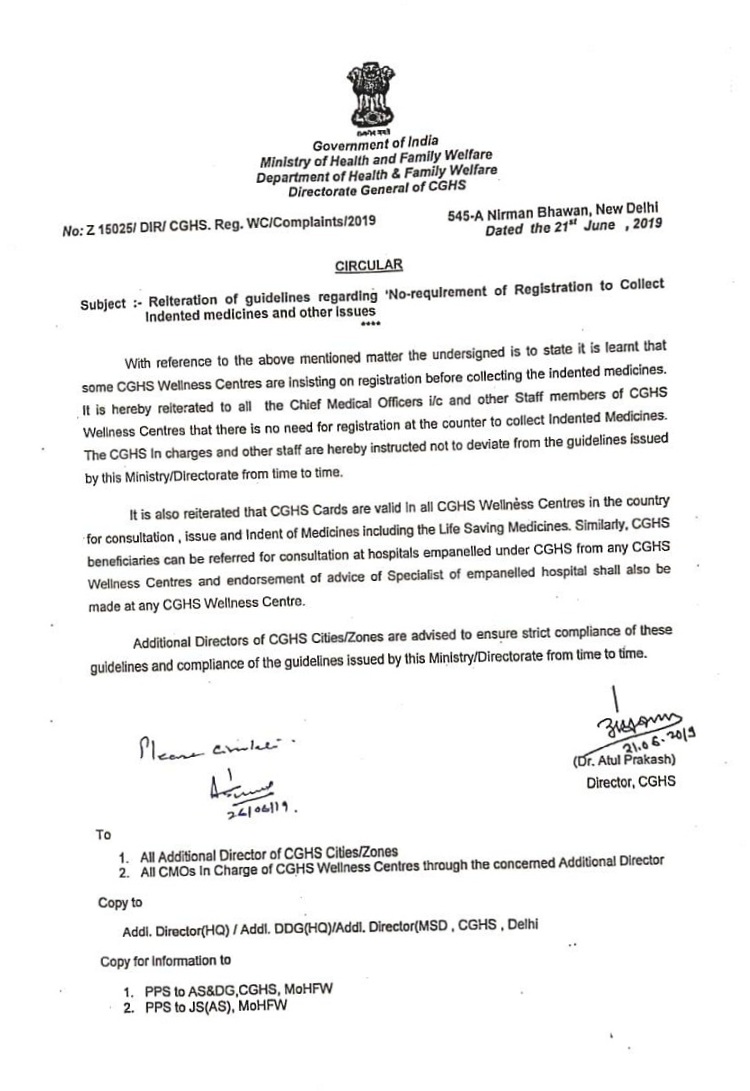
No-requirement of Registration to Collect Indented medicines – CGHS
Government of India
Ministry of Health and Family Welfare
Department of Health & Family Welfare
Directorate General of CGHS
No: Z 15025 / DIR / CGHS. Reg. WC/Complaints/2019
545-A NIrman Bhawan, New Delhi
Dated the 21st June , 2019
CIRCULAR
Subject :- Reiteration of guidelines regarding ‘No-requirement of Registration to Collect Indented medicines and other issues
With reference to the above mentioned matter the undersigned is to state it is learnt that some CGHS Wellness Centres are insisting on registration before collecting the indented medicines. It is hereby reiterated to all the Chief Medical Officers i/c and other Staff members of CGHS Wellness Centres that there is no need for registration at the counter to collect Indented Medicines. The CGHS In charges and other staff are hereby instructed not to deviate from the guidelines issued by this Ministry/Directorate from time to time.
It is also reiterated that CGHS Cards are valid In all CGHS Wellness Centres in the country for consultation , issue and Indent of Medicines including the Life Saving Medicines. Simlarty, CGHS beneficiaries can be referred for consultation at hospitals empanelled under CGHS from any CGHS Wellness Centres and endorsement of advice of Specialist of empanelled hospital shall also be made at any CGHS Wellness Centre.
Additional Directors of CGHS Cities/Zones are advised to ensure strict compliance of these guidelines and compliance of the guidelines issued by this Ministry/Directorate from time to time.
Around 3,650 women candidates have been given employment in the Indian Railways in technical categories in the last three years.
In the past few years, against notifications issued for various technical posts, a total of 2,79,60,224 applications were received and out of these, 46,76,928 (16.73%) were from women. Wide publicity is given to Railway recruitment notifications and every candidate, irrespective of gender, etc. fulfilling eligibility criteria is free to apply.
Application fee collected from women candidates are refunded to those who appear in the examination. Also, upper age limit in case of widows, divorced women and women judicially separated from their husbands, who are not remarried, is relaxed up to the age of 35 years. In addition, for Level-1 categories, relaxed qualifying standards for the Physical Efficiency Test (PET) for women candidates are applied.
Provisions of separate rest rooms, cloak rooms, changing rooms and crèches have been made to ensure safe working conditions for women employees.
Wide publicity is given to Railway recruitment notifications to encourage women candidates to apply for Railway jobs. Facility of online application form ensures that women are able to apply even from their home for Railway recruitment notifications.
This information was given by the Minister of Railways and Commerce & Industry, Shri Piyush Goyal in a written reply to a question in Lok Sabha today.
Retention of Government Accommodation – Lok Sabha QA
GOVERNMENT OF INDIA
MINISTRY OF HOUSING AND URBAN AFFAIRS
LOK SABHA
UNSTARRED QUESTION NO. 902
TO BE ANSWERED ON JUNE 27, 2019
RETENTION OF GOVERNMENT ACCOMMODATION
No. 902. SHRI UPENDRA SINGH RAWAT:
SHRI KAUSHAL KISHORE :
Will the Minister of HOUSING AND URBAN AFFAIRS be pleased to state:
(a) Whether the Government has any proposal for retention of the Government accommodation by the Central Government servants after retirement, on payment of suitable rent, at least till the lifetime of the Central Government servant, especially in cases related to medical and education of children;
(b) If so, the details thereof; and
(c) If not, the reasons therefor?
ANSWER
THE MINISTER OF STATE (INDEPENDENT CHANRGE) OF THE MINISTRY OF HOUSING AND URBAN AFFAIRS (SHRI HARDEEP SINGH PURI)
(a) No, Sir.
(b) Does not arise in view of reply to (a) above.
(c) As per Rule 40(1)(ii) of Central Government General Pool Residential Accommodation (CGGPRA) Rules, 2017, on retirement, a central Government employee who is an allottee of General Pool Residential Accommodation (GPRA), can retain Government Accommodation for six months on payment of normal licence fee.
Bio-metric Attendance System (BAS) for punctuality in Defence Accounts Department
Office of the CGDA Ulan Batar Road, Palam, Delhi Cantt.-10
No.AN/III/3012/Misc/BAS dated 17.06.2019
To
ALL PCsDA/CsDA/CsFA/PIFAs/IFAs/RTCs
Admin-IV (Local)
(Through CGDA’s website)
Subject: Bio-metric Attendance System (BAS) for punctuality in Defence Accounts Department-reg.
As per the directions of Government of India, Aadhar Enabled Biometric Attendance System (AEBAS) was to be implement in the Defence Accounts Department for making attendance by all the officers and staff. Accordingly, guidelines/instructions were issued to all the field offices vide HQrs letter dated 20.02.2015 and 16.07.2015 for implementation of AEBAS and enrolment of officers/staff.
It has come to the notice of the Competent Authority that directions/instructions issued by the HQrs office on the are not being followed properly by the officers. Regular complaints are being received regarding non-punctuality and non-making of attendance on AEBAS by the officials of the department. AFBAS has also not been implemented in some of the sub-offices. The same has been viewed seriously by the Competent Authority.
In View of the above, all the Principal Controllers/Controllers are requested of look in to the mtter and ensure that:
1) Registration of all the sub-offices under your organization on AEBAS.
2) Enrolment of all Officers/Staff on AEBAS.
3) Marking of attendance the present status may please be furnished urgently through E-Mail ([email protected]) for perusal of the Competent Authority.
No.3/1/2019-JCA
Government of India
Ministry of Personnel, Public Grievances and Pensions
Department of Personnel & Training
Establishment (JCA) Section
North Block, New Delhi – 110 001
Dated: 13th June, 2019
OFFICE MEMORANDUM
Subject: Minutes of the 47th Meeting of National Council (JCM) held on 13th April, 2019.
The undersigned is directed to forward a copy of the minutes of the 47th Meeting of the National Council (JCM) held on 13th April, 2019 in Conference Hall, Rail Bhavan, New Delhi under the Chairmanship of Cabinet Secretary for information and necessary action.
Encl.: As above
(Juglal Singh)
Deputy Secretary to the Govt. of India
Tel: 2309 2338
MINUTES OF THE 47th MEETING OF THE NATIONAL COUNCIL OF THE JOINT CONSULTATIVE MACHINERY(JCM) HELD ON 13th APRIL, 2019
The 47th Meeting of the National Council (JCM) was held on 13th April, 2019 under the Chairmanship of Shri P. K. Sinha, Cabinet Secretary, at Rail Bhawan, New Delhi. A list of the representatives of Staff Side and Official Side who participated in the meeting is annexed.
2. At the outset, Secretary (Personnel) welcomed Cabinet Secretary and Chairman, National Council (JCM), the Leader of the Staff Side, the Secretary of the Staff Side, the Senior Officers from-different Ministries/Departments-and Members of-the Staff Side.
3. Thereafter, Cabinet Secretary and Chairman, National Council (JCM) extended a hearty welcome to the representatives of the Staff Side as well as the Official Side. He stated that there has been a long gap between the 46th and 47th meeting of the National Council. However, four meetings of the Standing Committee were held during the last four years. He thanked the Staff side for their cooperation for successful and smooth implementation of recommendations of the 7th CPC and further stated that Government of India have taken several new initiatives, such as maintaining 10% employees’ contribution and increasing Government contribution from 10% to 14% in the New Pension Scheme(NPS), promotion of more than 4000 Central Secretariat Officers viz. Deputy Secretaries, Under Secretaries and Section Officers, increasing the duration of admissible maternity leave upto 6 months, employee friendly modifications to the CGHS and abolition of the interview for recruitment to Group ‘B’ and Group ‘C’ posts. He further observed that some of the agenda items of the 47th meeting are too old and may have thus lost relevance. He also stated that Staff Side should come up with new ideas for the welfare of the employees, and that National Council and the Standing Committee meetings must be held regularly in future. Chairman also emphasized on the need for all Departmental Council meetings to be held on a regular basis to remove the gap between the two sides as also to identify the issues which require further consideration, and desired that all Secretaries of the concerned Ministries/ Departments should ensure regular meetings of the Departmental Councils.
4. Leader of the Staff Side thanked the Chairman for highlighting important initiatives of the Government and for the assurance to continue sustained dialogue through JCM. He highlighted following issues for consideration:-
4.1. Importance of the forum of Joint Consultative Machinery(JCM) and holding regular meetings of NC(JCM) so that accumulation of Staff issues/grievance is avoided.
4.2 Non-fulfillment of the commitment given by the Government relating to revision of minimum wage and the 7th CPC fitment formula.
4.3 Withdrawal of NPS and re-introduction of Defined Pension under CCS (Pension) Rules 1972. He emphasized the Government to recommend at least 50% of the last pay drawn as minimum pension to the retired/retiring Central Government employees.
4.4 Discouraging privatization and outsourcing of various activities of the Government. He reminded that in the past, a D.O. letter was sent by the Cabinet Secretary to various Departments to hold meetings I consultations with the Staff Side before taking any decision on privatization/outsourcing/closure of establishments. He urged to issue similar instructions again to all Departments to ensure prior consultations with the Staff Side.
4.5 To consider modification to the MoF’s O.M. dated 12th December, 2018 relating to reoption opportunity to those staff who intend to switch over to the 7th CPC from the date of their promotion/MACPS/Cadre restructuring beyond 25th July, 2016 instead of restricting the same upto 25th July, 2016 and also to those employees who have opted for promotional/MACP/Pay fixation from the date of increment i.e. on 1st July 2016 in 6th CPC pay scale prior to the notification of 7th CPC.
He further stated that when Vth & VIth CPC Pay Scale/Structures were implemented in the past, opportunity for revising the option was granted.
4.6 7th CPC recommendation relating to placement of OT Assistants/Dressers in GP 2000 and placement of SSO (Accounts) in GP 5400/Level-9 in Railways has been pending with the Ministry of Finance, which may be cleared at the earliest.
4.7 Non-implementation of the 7th CPC recommendation for allotment of GP – Rs.4600/- (Level 7) to CMA category in Railways was also raised. He requested to take action to implement the specific recommendation relating to CMA category given by 7th CPC particularly when similar other recommendations have been/are being implemented.
4.8 Upgradation of 75% of SSEs/ Supervisory officials etc., in Railways to GP 4800/-Level-8. He urged that this needs to be expedited and approval given soon as Engineers/Supervisors in Railways are greatly disappointed over the delay.
4.9 Resolving issue of Night Duty Allowance and National Holiday allowance to Railway employees. The aberrations brought out by the Ministry of Railways in its communication to the DoP&T may be rectified without any further delay.
4.10 Implementation of awards of Board of Arbitration:- Concern was expressed over the abnormal delay in finalizing the Awards given by Board of Arbitration, pending for 15 years. The case of CA ref 3/2001 relating to Pay Scales of Senior Accountants, Accounts Assistants/ Senior Auditors to be brought on par with Assistants of the Central Secretariat, which has been pending since 24th August, 2004. He specially requested the Cabinet Secretary to issue a directive that all such Awards be settled through dialogue/discussion with the Staff Side.
4.11 Crediting earned leave to the employees’ account beyond 300 days including Industrial employees. He further said that while there is no financial implication as also the Rule position is unaltered there should not be any problem in accepting the demand.
4.12 Re-fixation of pay on last pay drawn at the time of retirement of Defence Forces Personnel re-employed in Central Government Departments. He urged to issue orders at the earliest duly granting pay re-fixation to the retired Defence Forces Personnel re-employed in Railways etc., on the basis of their last pay drawn at the time of retirement.
4.13 Removal of ceiling for Compassionate appointments. He requested that the issue needs to be considered with the objective of mitigating the hardships faced by the bereaved families.
4.14 Revision of Kilometrage Allowance rates of Running Staff. He urged that concurrence is communicated to the Ministry of Railways soon by Ministry of Finance.
4.15 MACP issues:-
The Leader of the Staff Side said that “Very Good” benchmarking should be cancelled and the MACPS should be given effect from 01/01/2006 with appropriate option. He explained that while the teaching staff under HRD Ministry and Delhi Government have been brought under MACPS, the Principals and Teachers of Indian Railways, Defence etc. are not covered. He requested for quick action for rendering justice to Teaching staff of Railways and Defence etc.
4.16 Exemption of TA Element from Kilometrage from the purview of Income Tax. It was explained that 70% of Kilometrage Allowance (KMA) paid to Running Staff is the Travelling Allowance (TA) component. Therefore this should be exempted from Income Tax as TA is not taxable.
5. The Secretary of the Staff Side, while making his opening remarks thanked the Chairman for holding the 47th meeting of the National Council after 9 years.
5.1 He made the following observations with regard to the functioning of the JCM Scheme:-
Regular meetings of the Departmental councils were held only in a very few Ministries/Departments. To make effective use of the JCM, it must be ensured that meetings of the Departmental Council are held more frequently as provided in the JCM Scheme. He stated that necessary instruction should be issued to all Ministries / Departments to make effective use of the JCM and also to ensure that meetings of the Departmental Councils are held more frequently.
5.2 Promotion of the officials in their career is a vital issue, and if not given to them in time, it jeopardizes their career. He requested the Cabinet Secretary to implement the scheme of time bound promotions; based on benchmark. He further mentioned that, at present, the staff working in GP Rs. 1800 and 4600 is suffering a lot because of non-availability of their promotion prospects, which needs to be redressed to remove their frustration.
5.3 Normally the Court decisions on common service matters of all Central Govt. employees are implemented only to those employees who moves the petition, whereas once the judgment is implemented to the petitioners, the benefits may equally be extended to all the similarly placed employees to avoid multiplicity of litigations and as per the National Litigation Policy published by the Govt. of India.
5.4 CGHS Scheme does not contain clear instructions and there is ambiguity in many cases. Medical reimbursement cases of retired personnel are not processed in time and ought to be made hassle free. Entitlement of beds in private hospitals should be decided by the Ministry/ Departments concerned.
5.5 The issues relating to retired personnel’s are to be taken on priority basis. Pension revision cases are much delayed all over, and wherever revised PPO ‘s have been issued, banks are not giving revised pension. Pensioners Portal and other portals are not proving worthy of redressing the grievances of the pensioners. This needs regular monitoring.
5.6 Recognition of Unions under CCS(RSA) Rules, 1993, especially in the Department of Posts is going against the idea of recognition and pending_since 2005. Instead of recognizing the union, Regional Channel under JCM has also been stopped. The Department should advise the concerned authorities to ensure streamlining of the procedure of receiving the applications for recognition and disposal in a time bound manner. In fact, it has been decided in the recently held meeting of the Standing Committee on 7.3.2019, that all Ministries/ Departments should take timely action on recognition of associations.
5.7 Regarding LTC-80 cases, there are instances where huge amount is deducted from employees, especially in various Defence establishments under MoD from the funds released to them on retirement as terminal benefits on the ground that these employees have travelled in private airlines and also the employees who have travelled in Air India Flight have purchased Flight Tickets from other than authorized agents. The demand of the Staff Side for granting One Time exemption to such cases is still pending with DOP&T. This is a serious matter since as per Supreme Court directions, no recovery should be made from the employees at the time of retirement. It is requested that the DOP&T may grant One Time Exemption to all such cases, especially in the case of those employees who are otherwise not entitled for flight for settlement of all such LTC-80 cases as a One Time measure.
5.8 In case of Loco Pilots in Ministry of Railways, necessary instructions be issued to extend the benefit of Promotional Pay Fixation on promotion to a post carrying higher duties and responsibilities.
5.9 The Unions are required to file the statement of account before the Registrar of Trade Unions and before the Income Tax Authorities. For Registrar of Trade Unions, the statement is to be prepared for year ending on 31st December and for the LT. Authorities it is to be’ prepared for the year ending on 31st March. This creates insurmountable problems. He requested to either make it 31st March or 31st December by amending the provisions of the respective enactments.
5.10 On the issue of creation of posts “matching savings” are being insisted in all the Ministries including Railways. In the Ministry of Railways “matching Saving policy” for creation of posts is not workable as it is day to day productive Organization. New trains, new Railway Lines and many new assets of State of Art technology are augmented frequently, whereas the number of employees is getting decreased. Therefore, there is a need to reconsider the policy of matching savings for creation of new posts so as to maintain safe train operations by Indian Railways.
5.11 The Secretary Staff Side raised the issue of “Very Good” benchmark, made effective from retrospective date, which needs to be changed. He said that, in the Railways, CRB had raised the issue with the Cabinet Secretary to bring benchmark at par with selectional promotions. The Chairman asked Member (Staff), Railway Board to review the issue and take appropriate action.
5.12 Secretary Staff Side raised the issue of Kilometerage Allowance pending with the Department of Expenditure even after approval of the Railway Board and Hon’ble Minister of Railways. Chairman advised that the matter may be considered early.
5.13 The Secretary Staff Side also raised the issue of exemption of Income Tax on 70% TA element on Running Allowance. Cabinet Secretary directed the CBDT and Revenue Department to resolve the issue at earliest.
5.14 Secretary, Staff Side stated that they were opposed to NPS and demanded that the Old Pension Scheme be restored. He further stated that the Government should guarantee pension of 50% of last pay drawn to all employees recruited on or after 01.01.2004. He further demanded facility of GPF and Family Pension to all employees.
5.15 He further demanded for improvement in appointments on compassionate ground. It was mentioned that totally incapacitated staff of Defence (Civil) and Ordinance Factories are not given out of tum appointment on compassionate ground. This needs to be considered sympathetically, as is being done in case of Paramilitary Staff.
5.16 Many Central Government Departments have no channel of Departmental Council under JCM. The same needs to be constituted. Chairman asked Secretary, DoPT to look into the matter in a time bound manner.
5.17 Like Citizen’s Charter, “Employee’s Charter” be published on service matters of the employees, for timely redressal of their grievances, which will improve productivity of employees.
5.18 Technical employees of the Railways and Defence Ordinance Factories etc. are subjected to unwarranted tests at every stage of promotion. This should be reviewed for hassle free timely promotions.
5.19 Contract labourers are badly exploited by the contractors. Principal employers are not able to safeguard them. Their Wages, Weekly Rest, Medical Facilities, Social Securities and other benefits have to be streamlined.
5.20 After detailed deliberations, a D.O. letter was issued to all Departments in 2009 regarding discussion of issue like restructuring, outsourcing, offloading, handling over of perennial jobs to other agencies/private parties etc. with Organised Labour. However, respective Departments are ignoring Contract Labour (Regulation & Abolition) Act, 1970 in a big way without any consultation with Organised Labour. This needs to be checked immediately.
5.21 Long pending demand of computation of entire service rendered by Casual Labourers attaining Temporary Status for the purpose of pensionary benefits has been accepted by Hon’ble Courts in many cases. Chairman advised Secretaries to examine the issue comprehensively.
6. Thereafter, the 36 agenda items for meeting of the 47th National Council and Action Taken Statement on 9 agenda items of the 46th meeting of the National Council, JCM held in 2010, were taken up for discussion department-wise, which are summarized below:-
6.1 M/o Health and Family Welfare
6.1.1 Item No.04/10/NC-46 – Grant of Fixed Medical Allowance (FMA) in lieu of outdoor treatment facilities
Secretary, M/o H&FW stated that the matter for grant of Fixed Medical Allowance (FMA) in lieu of outdoor treatment facilities has been examined, and it has been found that acceding to this demand will put more financial burden on the elderly and retired, and that further, they will have to forego their entitlement to draw CGHS medicines, for which the FMA may not be sufficient. She requested that Staff Side should look at the demand from this perspective. Upon discussion, the Staff Side agreed that they would reconsider the demand in light of these observations, and to drop the demand.
6.1.2 Item no.13/19/NC-47 – Reimbursement of expenses on indoor treatment to pensioners living in non-CGHS towns
Staff Side stated that there are many Central Government Pensioners who are living in towns/villages etc. not covered by CGHS. who have been granted Rs. 1000/- p.m. by way of FMA in lieu of outdoor treatment. There is no scheme for reimbursement of expenses on account of indoor treatment for critical diseases like heart ailments, etc. The demand for extending the CS(MA) Rules to pensioners has not been accepted. As such, many pensioners who got their indoor treatment in private Hospitals had to go to High Court/CAT and get the expenses incurred by them reimbursed under Court orders. Some arrangement may be made to reimburse the expenditure on indoor treatment of pensioners residing in Non-CGHS Towns.
Reply of the Official Side:
Pensioners residing in non-CGHS areas have been provided the following options to avail medical facilities:-
i) FMA @ Rs. 1,000/- per month.
ii) Benefits of CGHS (OPD & IPD) by registering themselves in the nearest CGHS city after making the required subscription.
iii) Option to avail FMA for OPD treatment, and CGHS for IPD treatments after making the required subscription as per CGHS guidelines.
6.1.3 Item No. 16/19/NC-47 – Grant of Medical Advance to the Central Govt. employees.
Staff Side stated that M io H&FW vide OM No.S.11016/1192-CGHS(P), dated 29.10.1992 have issued instructions for grant of Medical Advances, and vide OM No. 812015/3/93- CGHS_(P) dated 30.12.1993, a clarification was issued thereafter on limit of advance. Even though 90% of the estimate can be given as advance, the amount is restricted to Rs.10,000/- only for those diseases which are not covered under packages (conservative treatments) and this ceiling limit fixed during 1992 with no revision thereafter may be revised to 90% of the estimated amount.
Reply of the Official Side:
The guidelines regarding grant of medical advance for Central Government Employees have been revised vide OM No. S.14025/18/2015-MS/EHSS, dated 17.10.2016. As per the said OM, serving CGHS and CS(MA) beneficiaries may be granted 90% medical advance of the approved CGHS package rates for all indoor treatment, irrespective of major or minor diseases. Chairman advised that a copy of relevant OM may be shared with Staff Side.
6.1.4 Item No. 17/19/NC-47 – Reimbursement of additional charges paid on account of overstay in the hospitals.
Staff Side stated that as per CGHS rules, no additional charge on account of extended period of stay shall be allowed, if that extension is due to infection consequent to surgical procedure or due to any improper procedure and is not justified. This decision of the Govt. is putting the employees to undue financial hardship, since the hospital authorities never take the responsibility for infection and consequences of the surgery etc. In case of extended period of stay in the hospital, the additional charges incurred may be reimbursed.
Staff side pointed that no hospital provides a certificate for overstay. The Hospital authorities state that the discharge of a patient is on the advice of the doctor who treats the patient. No hospital, the staff side added, to the best of their information, has been blacklisted for this undesirable practice. It is ultimately the beneficiary who suffers, they added.
Reply of the Official Side:
Additional charge on account of overstay is reimbursable, if the extended period of stay is justified and the hospital issues a certificate to this effect. Further, in case of overcharging by hospital which is not justified, there is provision for recovery from pending hospital bills and payment to the beneficiary. After discussions, the Chairman felt that in cases of deliberate overstay on account of hospitals, the patient ought to be fully reimbursed and appropriate action may be taken against the erring hospitals including blacklisting them. Accordingly, it was recommended that the matter may be reviewed by MoH&FW.
6.1.5 Item No. 18/19/NC-47 – Reimbursement of Oxygen charges.
Staff Side stated that as per the approved charges under CGHS Rules, oxygen charges in causality, ICU are mentioned as Rs. 30/-. While the hospital authorities are charging Rs.30/- per hour as oxygen charges, the accounts authorities under the Defence Ministry are restricting the charges to Rs.30/- per day, which is causing hardship to the employees and a clarification needs to be issued.
Reply of the Official Side:
The CGHS rate list has since been revised in the year 2014. As per the revised CGHS rate list, the oxygen charges are specified as Rs. 50 per hour for non-NABH, and Rs.58 per hour for NABH Hospitals. Hence, the issue stands resolved. It was recommended that a copy of orders may be shared with Staff Side.
6.1.6 Item No. 27/19/NC-47 – Hospital Patient Care Allowance for C.G. employees working in hospitals.
Staff Side stated that at present, the Hospital Patient Care Allowance has been extended to the categories of cook, ward sahaika, safaiwala, barber and washermen. However, junior physiotherapists, junior dietician, carpenter, painter, tailor, mazdoor, mali and chowkidar (non ministerial Staff) have been left out and are not being granted this allowance on the plea that the contact of these categories of employees with patients or their exposure to infected materials is of occasional nature. However, there are other categories of ministerial employees who are exposed to infection in hospitals. All employees ministerial or non-ministerial, working in hospitals, may be granted Hospital Patient Care Allowance.
Reply of the Official Side:
The matter is under examination in consultation with the Department of Expenditure.
6.1.7 Item No. 34/19/NC-47 -FIXING OF CGHS RATES APPLICABLE TO THE TREATMENT AND DIAGNOSTIC PROCEDURE.
Staff Side stated that CGHS recognized hospitals at Chennai have given treatment/diagnostic procedure to the Central Government Employees and their dependents. However, the audit authorities are not allowance the medical claims for such treatment/diagnostic procedures on the plea that there is no CGHS rate available for the treatment and diagnostic procedures. It is therefore requested that the rates may be made available.
Reply of the Official Side:
The issue has since been resolved and the relevant orders have been placed in public domain. However, copies of the orders would be made available to the Staff Side Secretariat for their record.
6.2 M/o Defence
Chairman observed that there were many demands for rationalization of the CGHS Scheme. He stated that not only the agenda items, there may be other issues as well which may require to be looked into by the Government. He suggested that the Staff Side may send all the points that they consider necessary for resolution and a meeting can be taken by the
Secretary, M/o H&FW in a month’s time.
6.2.1 Item No. 18/10/NC-46 – CASUAL LABOURERS (GRANT OF TEMPORARY STATUS & REGULARIZATION) SCHEME – NON IMPLEMENTATION OF.
MoD stated that DOPT had approved a number of cases for regularization. A few remaining cases are being examined, for which the department is gathering the requisite information.
6.2.2 Item No. 19/10/NC-46 – RESTRICTED HOLIDAYS FOR THE EMPLOYEES WORKING IN THE INDUSTRIAL ESTABLISHMENTS.
Staff Side stated that as per the existing instructions on the subject of holidays to be observed in Govt. Offices, the employees are entitled to avail any two holidays as Restricted Holidays in addition to the 14 compulsory holidays and three holidays decided by the Central Govt. Employees Coordination Committee in the State Capitals. However, the employees working in the Industrial Establishments are eligible for 16 holidays in a year including 3 National Holidays. The employees of Industrial Establishments are thus deprived of one holiday. Apart from this, various ministries, are not allowing two days Restricted Holidays for the employees working in the Industrial Establishments, especially under the MOD. This is a clear discrimination, since the Govt. of India instructions on this subject does not prohibit RH for the employees of the Industrial Establishments. In view of the above, it is demanded that the employees working in Industrial Establishment may also be given 17 holidays and 2 RH.
Reply of the Official Side:
It has not been found feasible to grant the facility of RH for employees working in the Industrial Establishment as their entitlements are different from Central Government Offices. It was informed that this view had been conveyed to General Secretary, AIDEF vide letter No. 6/6/2007/D(Civ-II) dated 14.01.2013.
6.2.3 Item No. 20/10/NC-46 -APPLICABILITY OF CCS(RSA) RULES TO THE WORKERS EMPLOYED IN DEFENCE ESTABLISHMENTS
Staff Side demanded that they are only asking for implementing the CCS(RSA) Rules, 1993 to the workers employed in Defence Establishments.
Ministry of Defence stated that the issue is under examination. Chairman observed that some Associations had been granted recognition as a convention dating to many decades. He advised the Ministry of Defence to expedite the matter.
6.2.4 Item No. 30/19/47-NC – CONSULTATION WITH UPSC UNDER RULE 9 OF CCS (PENSION) RULES, 1972 WITH REGARD TO RETIRED DEFENCE CIVILIAN EMPLOYEES
Staff Side stated that at present the Department of Defence Production is referring disciplinary cases of retired employees of ordnance factories for the advice of UPSC for imposing penalty etc. under Rule 9 of CCS (Pension) Rules, 1972. This process indefinitely delays the completion of disciplinary proceedings against retired defence civilian employees, especially non-gazetted employees and industrial employees, subjecting them to undue hardship. The procedure may be dispense with.
Reply of the Official Side:
The provision is related to consultation with UPSC under Rule 9 of the CCS (Pension) Rules, with regard to retired defence civilian employees. Consultation with UPSC is a statutory requirement, wherever a cut in pension is proposed to be imposed on conclusion of disciplinary proceedings. It was explained to the Staff Side that this in fact provides a protection to the retired employees against the unabated use of discretionary power of the concerned authorities for cut in pension, and therefore, it cannot be accepted. Chairman stated that UPSC plays a very crucial independent role in such matters and this position should be appreciated by the Staff Side. The Staff Side agreed with his suggestion. This item was treated as closed.
6.2.5 Item No. 32/19/NC-47 – REVISION OF FIXED MEDICAL ALLOWANCE TO THE DEFENCE CIVILIAN EMPLOYEES POSTED IN REMOTE/ORDER AREAS
Staff Side stated that a large number of defence civilian employees are posted in remote/border areas where no AMA /government hospital is available for medical treatment. These employees are being paid FMA Rs. 100/- per month based on the 5th CPC. Ministry of Defence have sent a proposal to Ministry of Health to revise the FMA for Defence Civilian Employees to Rs. 300/- per month w.e.f. 01.09.2008. They requested that necessary instructions to revise the FMA to the Defence Civilian Employees to Rs. 300/- per month w.e.f. 01.09.2008 may be issued.
Reply of the Official Side:
M/O H&FW vide OM No. 14025/9/2013-MS dated 03.06.2015, has decided to stop the FMA being paid to the Central Government employees working in the interior/ remote areas. Henceforth, they shall be governed by the extant rules as laid down under CS(MA) Rules, 1944. Hence, the matter has been resolved. A copy of the said order shall be provided to the Staff Side.
6.2.6 Item No. 33/19/NC-47 -REVISION OF RISK ALLOWANCE TO THE DEFENCE CIVILIAN EMPLOYEES
Staff Side stated that Defence Civilian Employees are working in hazardous jobs since majority of them are involved in handling explosives, chemicals, acids etc. After the 5th CPC, the Risk Allowance to the Defence Civilian Employees handling risky/ hazardous operations was revised. After the 6th CPC DOP&T vide OM No. 21012/01/2010-Estt(All.) dated 18.10.2012 further revised the Risk Allowance. However, the above rates are not yet revised for the Defence Civilian employees. The proposal of MoD to double the above mentioned rates of Risk Allowance to the Defence Civilian Employees and to raise the Risk Allowance automatically by 25% every time DA on the revised pay structure goes up by 50% is still pending with DoP&T and may be expedited.
Reply of the Official Side:
The request is not justified as the Defence Civilian Employees were drawing higher rates of Risk Allowance since 22.05.2002, and the revision of the rates of Risk Allowance in respect of other Central Government Employees w.e.f. 01.09.2008 has only brought parity between Defence Civilian Employees and other Central Government Employees. Moreover, the decision to double the rates that were in existence since 22.08.1988 was taken by the Cabinet and if the rates of Risk Allowance for Defence civilian employees are increased, it would amount to going beyond the scope of the decision so taken. Hence, the demand cannot be accepted.
6.3 D/o Expenditure, M/o Finance
6.3.1 Item No. 8/10/NC-46 – Sanction of Incentive Allowance to Central Government Employees working in Extremists Infested Areas.
Reply of the Official Side:
This is a the 6th CPC demand, and after examination the 7thCPC, has not agreed to any such allowance.
This item was closed.
6.3.2 Item No.9/10/NC-46 – Declaration of Gandhinagar as Link-City_ of Ahmedabad.
Official Side stated that Gandhinagar (Notified Area/Outer Growth) is a part of the Ahmedabad Urban Agglomerate, HRA at Ahmedabad rates are admissible to Gandhinagar (NA/OG) w.e.f. 01.04.2015. Transport Allowance is also admissible to these employees at higher rate w.e.f. 1.4.2015, in terms of DOE OM dated 21(2)/2015-EII(B) dated 6.8.2015.
This item was closed.
6.3.3 Item No. 10/10/NC-46 – Upgradation of Jamnagar as B-2 Town with effect from 14.2.2006.
Reply of the Official Side:
Certain other cities have also been upgraded prospectively, on the lines similar to Jamnagar. Therefore, the demand of the Staff Side for upgradation from a retrospective date cannot be acceded to. It was also stated that upgradation is a continuous process and retrospective benefits in all such cases cannot be given. This item was closed.
6.3.4 Item No. 11/10/NC-46 – A-1 Status to Bangalore City
Reply of the Official Side:
Certain other cities have also been upgraded prospectively similar to Bangalore. Therefore, the demand of the Staff Side for upgradation of Bangalore backdated w.e.f 16.1.2007 cannot be acceded to. This item was closed.
6.3.5 Item No.3/19/NC-47 – BENEFIT OF PROVISO TO RULE 10 CCS(RP) RULES, 2008
Staff Side stated that benefit of Proviso to Rule 10 CCS (RP) Rules, 2008, to those who complete 1 year service at maximum has been sought. It has been stated that there are cases when employees drawing maximum of their Pay Scale complete one year after 01.01.2006 are denied the benefit of next increment in the revised pay structure. The pay may be fixed in the revised pay scale with effect from 01.01.2006 and one increment may be granted on 01.01.2006, and the next increment on 01.07.2006.
Reply of the Official Side:
As per Rule 10 of CCS(RP) Rules, 2008, in the 6th CPC regime, a uniform date of annual increment, viz 1st July of every year has been introduced, under which employees completing six months and above in the
revised pay structure as on 1st July would be eligible for increment on 01.07.2006. OM dated 4.7.2014 has also stipulated that the increment on 01.01.2006 shall also be allowed to those who had reached the maximum of the applicable pre-revised pay scale more than one year before 01.01.2006, and were in receipt of stagnation increment(s), provided the revised pay was fixed on 01.01.2006.
Therefore, the proposal/demand is not in consonance with the 1st Proviso to Rule 10 and the benefit of increment on 01.01.2006 cannot be given in these cases.
This item was closed.
6.3.6 Item No. 11/19/NC-47 – insisting on non availability certificate from the Estate officer.
The Staff Side stated that the order insisting on non-availability certificate for grant of HRA should be withdrawn, as it is causing hardship to house owning employees.
Reply of the Official Side:
The condition for furnishing of “No Accommodation Certificate” by the Central Government employees to become eligible for HRA has been dispensed with for all places in respect of the GPRA controlled by Directorate of Estates, vide O.M. No. 2/5/2017-E-II(B) dated 05.03.2019. Other organizations which have their own pool of accommodation can issue similar orders.
Staff Side stated that the condition may be dispensed with and if there is any office where is felt that the condition cannot be waived then that can be continued.
6.3.7 Item No. 28/19/NC-47 –
Staff Side stated that as per extant orders an advance of Rs. 20,000/ or anticipated price, whichever is less, is granted for the purchase of moped to Government servants having pay below Rs. 8560. If an employee purchases a motorcycle or any other two wheelers, the above advance is not available to him. This retraction that an employee should purchase only the moped is unreasonable and it may belifted.
Reply of the Official Side:
All the interest bearing advances, except HBA have been withdrawn as per the recommendations of the 7th CPC.
6.3.8 Item No.35/19/NC-47
Today’s Discussion – Click to Read Hot Questions & Answers
Expected DA from July 2019: DA 4% Confirm…5% Possible! – Click for more details
Staff Side stated that the demand is for revision in the amount of advance given to the family of a government servant who dies while in service. After the amount of this advance was revised to Rs. 8000/- or three months salary, whichever is less. In the present circumstances, there is a need for revision in the amount of this advance to Rs. 25000/-.
Reply of the Official Side:
DoE, vide OM No. 12(1)/2016-EII(A) dated 20.6.2018, has amended the Compendium of Rules on Advances to the Government Servants, 2005. As per the amendment in Rule 80, the amount of advances to the family of Government Servant who dies while in service has been revised to Rs. 25,000
The item may be treated as closed.
6.4 DoPT
6.4.1 Item No.16/10/NC-46 – Relaxation of Upper Age Limit for Departmental Candidates for Appointment to Group C Posts
It has been stated that earlier, the age relaxation for departmental candidates for appearing in the examination for direct recruitment for Group “C” posts was 35 years. This was subsequently liberalized vide this Department’s OM dated 20th May, 1988 after an agreement in the National Council (JCM). It was decided that the departmental candidates could be allowed to compete along with candidates from open market up to the age of 40 years of Group C posts in the case of general candidates and 45 years in the case of Scheduled Castes and Scheduled Tribes. The relaxation was allowed in view of limited promotional avenues for Group D and Group C employees. This was also done with the intention that persons already in Government service should get some chance to improve their lot by appearing in competitive examinations.
In view of the above, since the upper age limit is already on higher side, therefore, allowing further concession in upper age limit is not advisable.
6.4.2. Item No. 1/19/NC-47
The Staff Side stated that the 6th CPC“s recommended stoppage of direct recruitment in Group-D posts. Duties of Group-D staff (Peons, Daftries etc.) mainly constitute storing and retrieving of files / records / documents, etc. Stoppage of direct recruitment in Group-D posts will shut the door to Govt. employment for lakhs of unemployed youth including those from families of SC/ST/OBC, who are less privileged and live Below Poverty Line and could not continue their studies beyond class- VIII standard due to poverty and other socio economic circumstances. The 6th CPC has argued for outsourcing of work and for contract labour which will lead to exploitation.
Reply of the Official Side:
Since all erstwhile Group D posts have been converted into Group C and as such, Group D posts do not exist anymore in Central Govt. This item may be treated as closed.
6.4.3 Item No.2/19/NC-47
The Staff Side stated that 16 awards from the Board of Arbitration, pending for number of years, were discussed conclusively in the past. These awards may be discussed afresh and methods may be devised to implement them.
Reply of the Official Side:
The concerned departments, including DoPT, are of the view that the Awards are fairly old and the issues covered have lost relevance after the successive Pay Commissions. The Awards are at various stages of rejection and as such, the demand cannot be accepted. The Chairman advised that Additional Secretary, Department of Personnel & Training, may review the issue in a meeting with the Staff Side.
6.4.5 Item No. 4/19/NC-47
Reply of the Official Side:
JCM Scheme has been introduced on the pattern of Whitley Council but covers only C and erstwhile D Groups. Central Secretariat Group B Gazetted/ Non-gazetted are also covered. After the 6th CPC, many posts earlier classified as Group C have now been classified as Group B Gazetted, and have been taken out from JCM. If this continues, a time would come when none of the employees shall be in Group C, and therefore they too would be out of coverage of JCM.
All the posts which were Group C or Group D at the inception of JCM Scheme should be continued to be covered under JCM. The demand is that all posts covered by PB-1 and PB-2 may be deemed to be Group C posts for the purposes of JCM coverage.
Reply of the Official Side:
This item was discussed in the JCM Standing Committee under Secretary(P). The stakeholder departments with large number of employees, such as Railways, Defence, Posts, etc. are being consulted in this regard and a suitable decision shall be taken soon.
6.4.6 Item No.6/19/NC-47
The Staff Side stated that Board of Arbitration in CA reference No. 1 of 2004 had given the Award “The Government is directed to pay Washing Allowance to Central Government employees who are given uniforms at the rate of Rs. 30/- pm. with effect from 15.11.1995, and @ Rs.60/- pm with effect from 1.8.1997”. Though the award was given on 28.04.2005 and its implementation with modifications was discussed, no decision to implement it even prospectively from 2006 has not been taken so far.
Reply of the Official Side:
The demand of the Staff Side has been met to a considerable extent. The said Award is under submission to the Competent Authority for consideration.
6.4.7 Item No. 12/19/NC-47
The Staff Side stated that the modified Assured (MACP) has come into force on 01.09.2008. The earlier financial upgradation scheme (ACP or otherwise) were applied up to 31.08.2008. Seniors who got financial upgradation before 01.09.2008 are drawing lesser salary than their juniors who got financial upgradation under MACP. A provision may be made as a special case that seniors under old scheme(s) are granted stepping up of pay to the level of their juniors.
Reply of the Official Side:
In terms of decision taken in the meeting held on 27.07.2012 with the Staff Side relating to instances of senior employees who got benefit under ACP Scheme prior to 1.1.2006, and were drawing less pay than their juniors who got benefits under ACP Scheme after 01.01.2006 (i.e. between 01.01.2006 to 31.08.2008) it was decided in consultation with the DoE to allow stepping up of pay in cases where the senior, but for the pay revision on account of the 6th CPC would have continued to draw higher pay subject to certain conditions [Departments OM No. 35034/1/97-Estt(D) dated 04.10.2012].Barring this situation, no stepping up of pay was allowed in the ACP/MACP Schemes.
Secretary (Personnel) agreed that the issue raised by the Staff Side should be re-examined.
6.4.8 Item No. 14/19/NC-47
The Staff Side stated that the residency period has been increased for future promotions in certain categories like Admin Cadre, Storekeepers which has adversely affected the staff. For example, in the pre-revised pay scale, before the 6th CPC, 16 years was the time to reach gazetted posts now it has been increased to 23 years. The residency period for future promotion may be reduced to as it was before the 6th CPC implementation.
Reply of the Official Side:
The issue has been examined. However, no example could be found in which the residency period has been increased from 16 to 23 years in case the Staff Side finds any such example they should come up with that so the issue can further be examined.
Staff Side agreed to bring specific instance, if any, to the notice of the Official Side.
6.4.9 Item No. 15/19/NC-47
Staff Side stated that DOPT, vide F No.16/6/2001-Estt.Pay-1 dated, 14.02.2006, have issued instructions about the protection of pay to those employees who have been appointed/ transferred to the lower posts at their own request under FR-15(a). However, DoPT in supersession of this clarification, have issued a revised OM F No. 13/9/2009-Estt. (Pay-1) dated 21/10/2009, which has taken away the benefit of pay protection up to the maximum of the pay scale of the lower post. This has put the employees to undue hardship. It is demanded that the pay of an employee (pay in the pay band + GP) may be protected on reversion to a lower post so as to avoid undue financial hardship.
Reply of the Official Side:
The proposal may not be accepted as the post is identified on the basis of Grade Pay attached to it and the Government Servant himself opts for appointment on such a post, of his own volition.
6.4.10 Item No. 19/19/NC-47
Staff Side stated that Government employee and his family are allowed LTC to go to their native place and go back to duty station 2 times in a block of 3 years. The parents of most of the govt. servants prefer to live at their native place, though dependent on the govt. servant. It is suggested that in the first year/next year, the serving employee and his family may be permitted to go on LTC to their native place to meet their parents. In the next or the first year, the parents, if dependant on the Government servant, may be permitted to go from native station to duty station of their son/ daughter on LTC and to return to their native place.
Reply of the Official Side:
DOPT has already issued an OM on 31.10.2017. Hence, the demand of the Staff Side has been accepted.
The item may be treated as closed.
6.4.11 Item No. 20/19/NC-47
The Staff Side stated that DoPT in their O.M. F. No. 14014/2/2009 Estt.(D) dated 11.12.2009, have decided that persons applying for appointment on compassionate grounds, but not immediately meeting the educational qualification standards, may, in exceptional circumstances, be engaged as trainees who would be given regular pay bands and grade pay only on acquiring the minimum qualification prescribed under the Recruitment Rules. Emoluments of these trainees, during the period of their training, and before they are absorbed in the Government as employees, will be governed by the minimum of the -1S Pay Band Rs. 4400-7440 without any grade pay.
Persons appointed on compassionate ground not meeting the educational standard of matriculation and during the period of training which should not be more than six months may be granted IS Pay Band Rs. 4400 7700 plus grade pay of Rs.1300/- After completion of training of six months they may be placed in Pay Band I Rs.5200-20200 with Grade Pay of Rs. 1800 with effect from the date of their initial appointment.
The 7th CPC has not provided any replacement scale for the 15 pay band of the 6th CPC, which is granted to trainees under compassionate appointment. After consultation with DoE, it has been decided vide OM No. 14014/2/2009-Estt. (D) dated 09.10.2017 that Level-1 of Pay Matrix introduced on after the 7th CPC shall be the replacement for the pre revised 15 scale. The instructions on compassionate appointment, inter alia, provide for appointment of the candidates, not immediately meeting the educational standards, as trainees. The period of service spent as a trainee is not counted as service for any purpose. The regular service commences only on acquiring the minimum educational qualification provided in the applicable Recruitment Rules. Hence, the demand of the Staff Side has been partially accepted.
Chairman suggested that the issue may be re-examined and if there is any possibility to further liberalise the extant provisions then that should be considered.
6.4.12 Item No.22/19/NC-47
Staff Side stated that DOPT vide O.M.No.20/49/2009-CSII(B) dated 22.06.2011 have created a grade called the Non Functional Selection Grade (NFSG) for UDCs in the CSCS cadre and stenographers Gr. D (NFSG) in the CSSS. As UDCs and Stenographers Grade D are cadres common to all departments and the 6th CPC has recommended parity in pay structure up to the post of assistants, similar NFSG grades of UDCs and Stenographers Grade II may be created in all offices outside Central Secretariat, subject to same conditions as above.
Reply of the Official Side :
The aforesaid proposal is being examined in DoPT with respect to the earlier Pay Commission recommendations and conditions of service in all offices outside the Central Secretariat.
6.4.13. Item No.23/19/NC-47
The Staff Side stated that DOPT OM No. 12011/03/2008-Estt (Allowances) dated 02.09.2008, provides that the hostel subsidy will be reimbursed up to a maximum limit of Rs. 3000/- per month per child subject to a maximum of two children and that both hostel subsidy and Children Education Allowance cannot be availed concurrently. However, in O.M dated 11.11.2008 it has been clarified that hostel subsidy means expenses incurred by the government servant if he has to keep his children in the hostel of a residential school away from the station at which he is posted/ or is residing. This restriction has neither been recommended nor was laid down by the government while accepting the relevant recommendation. Hostel subsidy should be granted to government servant who has kept his children in any hostel away from the station at which he is posted / or is residing. By way of another clarification in DoPT O.M. No. 12011/08/2011-Estt (AL) dated 30.12.2010 it has been clarified that for the purpose of hostel subsidy, station would be demarcated by the first three digit of the PIN Code of the area where the government servant is posted / residing which means the entire revenue district. This restriction may also be done away with so that government servant is allowed to reimburse hostel expenses on children living in hostel located away from the place where he is living / posted, may be in the same revenue district.
Reply of the Official Side :
Based on the recommendations of the 7th CPC, the amount of ceiling of hostel subsidy has been revised upwards to Rs.6750/- p.m. Further, the CEA and hostel subsidy can now be claimed concurrently. Further, vide DOPT OM dated 31/5/2012 the term “Hostel Subsidy” would mean expenses incurred by the Government servant if he/she keeps his/her children in a hostel of a residential school/institution located beyond a distance of 50 kilometres from his/her residence. The PIN Code based reimbursement no longer exists. Hence, the demand of the Staff Side has been accepted.
This item may be treated as closed.
6.4.14 Item No.26/19/NC-47
The Staff Side stated that the sewing charges of uniform were revised vide DoPT order No.14/3/2006-JCA dated 28.9.2006. There has been steep rise in the sewing charges during last 5 years. At present these rates have practically trebled. It is, therefore, proposed that sewing charges for uniforms may be at least be doubled.
Reply of the Official Side :
It was decided to enhance the rates of sewing charges, with effect from 01.04.2011, thereby modifying the earlier instructions issued vide O.M. No. 14/3/2006-JCA dated 28.09.2006. Now, after the 7th CPC, the common categories of Group C and erstwhile Group D employees of various Ministries/departments, including attached/subordinate offices, who are supplied uniform earlier are now paid a Dress Allowance.
This item may be treated as closed.
6.4.15 Item No.29/19/NC-47
The Staff Sided stated that in order to encourage sports activities, every department has been permitted to recruit sports personnel and maintain teams at the Government cost. However, presently practice of providing incentive to sports personnel varies from department to department as there are no uniform guidelines. It is necessary that some general guidelines must be issued in this regard.
Reply of the Official Side :
DOPT has issued guidelines from time to time on the issue of special increment in the form of personal pay to Central Government Servants for participation in sporting events and tournaments of national or international importance. Vide OM dated 11.06.2018, DOPT has revised the rates of these increments in the context of the 7th CPC applicable to all the Central Government Civilian Employees and posts. This item may be treated as closed.
6.4.16 Item No.31/19/NC-47
The Staff Side stated that Secretary (Personnel) vide DO Letter No. 43019/11/2014-Estt.(D) dated 17.06.2014 has advised all the administrative departments to address service matter grievances raised by the employees as indicated in the representations, the number of avoidable litigations would not only get reduced but also resulting considerable savings of governments resources, both manpower as well as financial.
Some issues represented by the Staff Side have not been settled due to which the employees are forced to approach CAT for redressal of their genuine grievances. Some of the judgments given in favour of the employees on policy matters and either implemented to the petitioner only or government has filed appeal etc.
Reply of the Official Side :
The demand from the Staff Side is to extend the benefits of court judgments to all similarly placed employees. Court judgments which are contrary to Govt. policy can be implemented only in consultation with DOPT or DoE as case may be. As such, the demand for extension of all court judgments to all the employees cannot be accepted.
The Staff Side stated that employees who have been appointed on or after 01.01.2004 are covered by NPS, and while doing so, G.P.F. deductions in respect of these employees have been abolished.
The contribution made under NPS is fully locked for the entire tenure of the service. During the service, employees may require advances or final payments to meet social obligations like marriages etc. It is, therefore, necessary that employees may be allowed to contribute to GPF.
Reply of the Official Side :
All new recruits, after 01.01.2004, have been given the option of opening Tier II account under NPS in lieu of GPF and there is no restriction on the withdrawals from Tier-II. NPS provides complete flexibility with respect to contributions and withdrawal. PFRDA Regulations allow a partial withdrawal from NPS Tier-I upto 25% of the contributions made by the subscriber, at any time before exit from NPS. Such partial withdrawal from NPS is allowed if the subscriber has been in the NPS for at least three years and is allowed for maximum three times for certain specified purposes such
as marriage of children, purchase of house, medical treatment etc. Pursuant to the recommendations of Committee to suggest measures for streamlining the implementation of the NPS, a number of steps have been taken.
6.5.2 Item No. 21/19/NC-47
The Staff Side stated that government have already included widowed/ divorced/ unmarried and dependent daughters, who have attained 25 years of age, in the definition of family for family pension. Dependent disabled siblings (i.e. real brothers/ sisters) are also now eligible for family pension. Unmarried/ divorced/ widowed dependent real sister of a Government servant/ pensioner may also be made eligible for family pension.
Reply of the Official Side :
It was a considered decision of the government to grant family pension to dependent disabled brothers and sisters of central government employees/ pensioners. There are no fresh grounds to reconsider this decision and to extend family pension to all dependent siblings.
6.5.3 Item No. 24/19/NC-47-EXTENSION OF CONSTANT ATTENDANT ALLOWANCE TO TOTALLY VISUALLY HANDICAPPED PENSIONERS WHO RETIRED UNDER CCS(PENSION RULES, 1972.
The Staff Side stated that government have extended Constant Attendant Allowance at the rate of Rs.3000 pm. to disabled pensioners in addition to disability pension, thus recognizing that such pensioners in their old age will have to engage someone as their constant attendant. Such pensioners (i.e. those who are visually impaired or with impaired legs or with children with special needs, of a pensioner entitled for family pension) may also be extended Constant Attendant Allowance with increase of 25% every time the DA goes up by 50%.
Reply of the Official Side :
The benefits of Constant Attendant Allowance to handicapped pensioners (i.e. those who were visually handicapped or with impaired legs) and mentally handicapped children of a pensioner entitled for a family pension is not agreed to. Therefore, the demand of the Staff Side has been turned down.
This item may be treated as closed.
6.5.4 Item No.25/19/NC-47 -ARBITRARY ORDERS DENYING REVISION OF PENSION AND FAMILY PENSION IN FAVOUR OF THE PENSIONERS WHO WERE RECEIPT OF COMPULSORY RETIREMENT PENSION AND COMPASSIONATE ALLOWANCE UNDER RULE 40 AND 41 OF THE CENTRAL CIVIL SERVICES (PENSION) RULES, 1972.
The Staff Side stated that in terms of rule 40 & 41 of Central Civil Services (Pension) Rules, 1972, compulsory retirement pension and compassionate allowance are sanctioned and are revised at par with other pension. DoP&PW O.M. No. 38/37/08 – P&PW(A) dated 03.10.2008 has stated that there should not be any revision on the Compulsory Retirement Pension and Compassionate Allowance. This order will adversely affect the living standard of such retired employee.
Reply of the Official Side :
As per the orders issued after 5th and the 6th CPC, the pension of past pensioners was revised by consolidating the pre-revised pension, dearness pension, dearness relief, interim relief and fitment benefit. These orders further provided an alternate method according to which the revised pension will not be less than 50% of the minimum pay in the revised pay scale.
Sanctity of the penalty of reduced pension in such cases would be lost
if the benefit of modified parity was also extended to the pensioners drawing compulsory retirement pension/ compassionate allowance.
Hon’ble Kerala High Court, in its order dated 31.07.2015 in OP(CAT) No. 108/2016, directed to grant pension based on the minimum pay in the revised pay- scale (modified parity). However, on the advice of the Department of Pensions and the Department of Posts filed SLP No. 6726/2017.
6.6 CBDT/Department of Revenue
6.6.1 Item No. 7/19/NC-47 – EXEMPT TRANSPORT/RUNNING ALLOWANCE FROM INCOME-TAX.
Staff Side stated that transport allowance upto Rs. 800/- pm has been exempted from taxable income. The revised TA ranges to Rs. 3200/- plus DA thereon. As such, TA upto Rs. 3200/-pm + DA thereon may not be treated income and be exempted from Income Tax.
Reply of the Official Side :
In Union Budget 2018, a standard deduction of Rs. 40,000/- in lieu of the present exemption in respect of transport allowance and reimbursement of miscellaneous medical expenses was introduced. So the present exemption in respect of TA (except in case of differently abled persons) has already been withdrawn vide notification dated 06.04.2018.
This item may be treated as closed.
6.6.2 Item No. 10/19/NC-47 – EXEMPT THE ISLAND SPECIAL DUTY ALLOWANCE, SPECIAL DUTY ALLOWANCE GRANTED TO EMPLOYEES IN THE NORTH EASTERN REGION FROM THE PURVIEW OF INCOME TAX.
The Staff Side stated that the Island Special duty allowance and Special
duty allowance granted to employees in the North Eastern Region may be exempted from the purview of Income Tax.
Reply of the Official Side :
With a view to improving the equity of the tax system, it has been the policy of the government to provide tax benefit for personal expenses only. by periodically reviewing exemption available to the entire community of individual taxpayers. The current policy is to withdraw the individual allowance and allow a general deduction which would be available to all taxpayers. A standard deduction upto Rs, 40,000/- or the amount of salary received, whichever is less, is allowed. In view of this, the demand of the Staff Side is not feasible.
This item may be treated as closed.
6.6.3 Item No. 36/19/NC-47 – Exemption from payment of income tax to Pensioners who have attained age of 80 years or more.
Staff Side stated that at present very old pensioners are exempted, if their income is up to Rs 5 lakh per annum whereas the govt. have granted additional pension @20% of their basic pensioner on attainment of 80 years of age 30%, .on 85 years 40%, on 90 years to 100% on attaining 100 years of age, the fixation of ceiling of Rs. 5 lakh for exemption from income tax would act to reduce their pension income which will affect them adversely. Staff Side therefore suggested that exemption from income tax to very senior pensioners aged 80 years or above be considered and granted by way of gift to these elders on the next Elders’ day.
Reply of the Official Side:
Considering the specific needs of the senior citizens, the basic exemption limit for a senior citizen i.e. above 80 years, is fixed at Rs. 5 Lakh. Hence, the demand of the Staff Side is not feasible.
However, the Chairman stated that the demand of the Staff Side should be re-examined by the Department of Revenue. He observed that there was a case that the requirement of mandatory filing of income tax returns by persons beyond a certain age may be dispensed with. He advised the Department of Revenue to send him a report on this issue.
6.6.4 item no. 9/19/nc-47 – denial of parity in scales of pay to the workshop staff of railway/defence and postal department.
Staff Side stated that parity in scales of pay to the workshop staff of Department of Posts in the Artisan cadre, as is being done in Railways and Defence has been desired. Further, the benefit of fast Track Committee report may also be extended to Artisans of Department of Posts.
Reply of the Official Side:
The proposal relating to cadre restructuring of Mail Motor Service (MMS) cadre is under consideration of the Department of Posts in Consultation with DoE.
7. After the above detailed discussion on the agenda, the following important points were noted and summarized:
i) Regular meeting of the NC, the Standing Committee as well as the Departmental Councils of the JCM shall be held in order to have speedy resolution of issues concerning the employees.
ii) The precedent problem raised by the Staff Side concerns unavailability of latest instructions/circulars issued by various Departments to the Staff Side, it was directed by the Chairman that steps possible should be taken with alacrity by the Department to ensure that copies of the latest OMs/Circulars are made available to the Staff Side on e-mail as well as by other means.
iii) The Chairman also directed the Official Side to ensure that all matters which require further examination as discussed in today’s meeting should be taken up for resolution.
8. After all the above detailed deliberations and discussions, Shri Ajay Kumar, Secretary, Department of Defence Production briefed the National Council about the work being done including the important initiatives being taken by the Ordnance Factory Board. He mentioned the efforts being undertaken to modernize the Board. It was also informed that a meeting of the Departmental Council would be held to discuss the issues of the Ordnance Factory Board with the Staff Side.
9. The meeting was concluded with a vote of thanks given by Smt. Sujata Chaturvedi, Additional Secretary (Estt.), DOPT with special thanks to the Chair.
Extension of timelines for completion of APAR online for the year 2018-19
No.21011/02/2015-Estt(A-II)-Part II
Government of India
Ministry of Personnel, Public Grievances and Pension
Department of Personnel & Training
North Block. New Delhi — 110001
Dated the 28th June 2019
OFFICE MEMORANDUM
Subject : Online generation and recording of Annual Performance Assessment Report (APAR) on SPARROW (Smart Performance Appraisal Report Recording Online Window) of Group ‘A’, ‘B’ and ‘C’ officers — Extension of timelines for completion of APAR online for the year 2018-19 where the reporting/reviewing/accepting authority demits office or retires from service before the prescribed dates.
The undersigned is directed to say that vide this Department’s 0.M of even number dated 18.04.2019 (copy enclosed), the timelines for online generation. filling up of self-appraisal, reporting. reviewing and acceptance of APAR for the year 2018-19, through SPARROW portal, for all Group ‘A’, ‘B’ and ‘C’ officers, were extended as a one-time measure.
2. It has further been decided, with the approval of competent authority, that for APAR for the year 2018-19, the extended timelines specified in the Annexure to the O.M. dated 18.04.2019 shall apply to the reporting / reviewing / accepting authorities, who demit office or retire from service prior to the respective cut off dates, and they shall be allowed to record their remarks till the respective cut off dates.
(Jayashree Chellamani)
Under Secretary to the Government of India