Citizens Forum in Defence of Indian Financial Sector
NATIONAL CONVENTION
27th October 2018, Constitutional Club, Speaker Hall Annexe, New Delhi
PRESS STATEMENT
Citizen Forum in Defense of Indian Financial Sector is organising a National Convention at Speaker Hall Annexe, Constitutional Club, V.P. House, Rail Marg, New Delhi – 110 001. Prominent speakers in this convention are – Economists – Prof. Prabhat Patnaik & Prof. Jayati Ghosh; prominent political leaders – Prof. Manoj Jha (RID) & Sh. Harish Rawat (Congress) and other prominent trade union leaders from financial sector -Insurance, Banking and representatives from Central Govt. Employees.
The network of Public Sector Financial Institutions which have played a highly laudable role in financial and economic development of modern India is an uncontested fact It is also a fact that Public Sector Financial Institutions in India provided shield to financial system in India during international financial crisis in 2008. Unfortunately, Moth Govt at Centre is hell-bent to destroy Public Sector Financial Institutions in the name of ‘ease of doing business’, also as a political class of a particular political leaning keeping in view the interest of Indian and foreign corporate houses and thus jeopardising the national interest.
This convention will discuss the whole gamut of neoliberal global agenda which Indian government is implementing with full zeal ignoring the ground realities in Indian context. The campaign in defence of Indian Financial sector will not be limited to this convention. Campaign will continue and will cover whole country in times to come in order to mobilise the people of this country to force the Indian Govt. to abandon neo-liberal agenda on financial sector in the best interest of this country.
We invite your representatives to cover this event which will start at 10.30 am on 27.10.2018 at Speakers Hall Annexe, Constitutional Club, V P Haase, New Delhi and will continue till 1 pm.
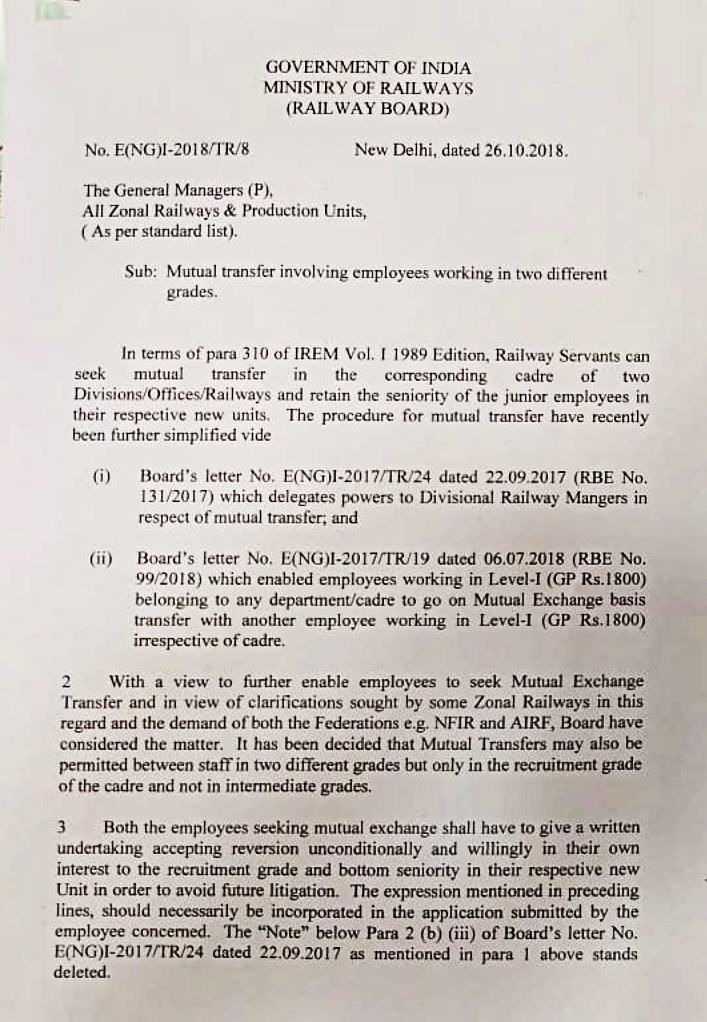
Mutual Transfer involving employees working in two different grades
GOVERNMENT OF INDIA
MINISTRY OF RAILWAYS
(RAILWAY BOARD)
No. E(NG)I-2018/TR/8
New Delhi, Dated: 26.10.2018
The General Manager (P),
All Zonal Railways & Production Units
(As per standard list)
Sub:- Mutual Transfer involving employees working in two different grades.
In terms of para 310 of IREM Vol. I 1989 Edition, Railway Servants can seek mutual transfer in the corresponding cadre of two Divisions/Offices/Railways and retain the seniority of the junior employees in their respective new units. The procedure for mutual transfer have recently been further simplified vide:-
(ii) Board’s letter No. E(NG)I-2017/TR/19 dated 06.07.2018 (RBE No. 99/2018) which enabled employees working in Level-I (GP Rs. 1800) belonging to any department/cadre to go on Mutual Exchange basis transfer with another employee working in Level-I (GP Rs. 1800) irrespective of cadre.
2. With a view to further enable employees to seek Mutual Exchange Transfer and in view of clarifications sought by some Zonal Railways in this regard and the demand of both and Federation e.g. NFIR and AIRF, Board have considered the matter. It has been decided that Mutual Transfers may also be permitted between staff in two different grades but only in the recruitment grade of the cadre and not in intermediate grades.
3. Both the employees seeking mutual exchange shall have to give a written undertaking accepting reversion unconditionally and willingly in their own interest to the recruitment grade and bottom seniority in their respective new Unit in order to avoid future litigation. The expression mentioned in preceding lines, should necessarily be incporated in the application submitted by the employee concerned. The “Note” below para 2(b)(iii) of Board’s letter No. E(NG)I-2017/TR/24 dated 22.09.2017 as mentioned in para 1 above stands deleted.
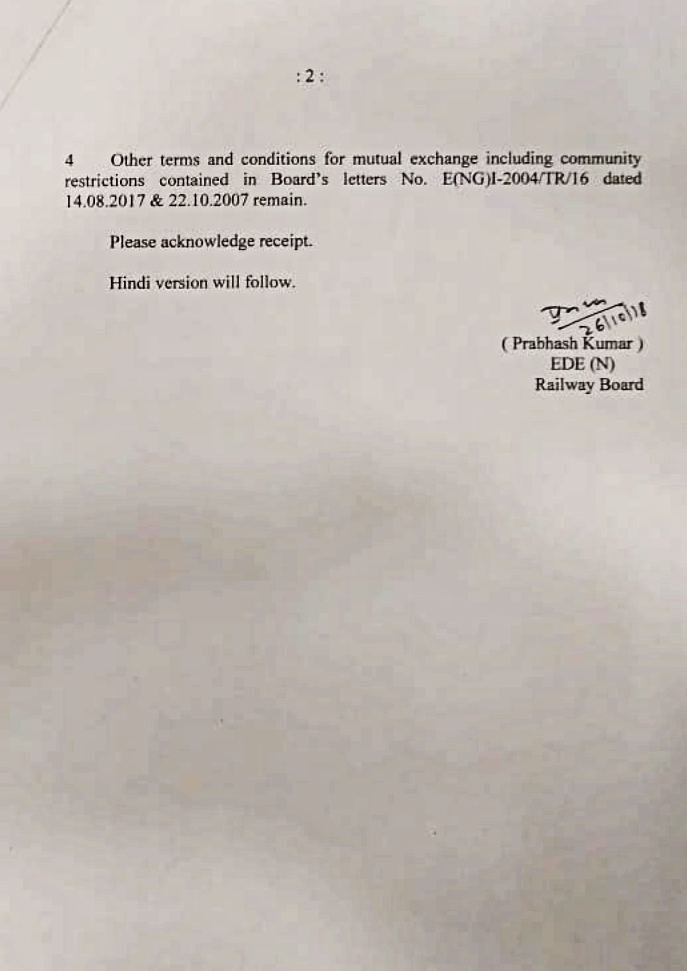
4. Other terms and conditions for mutual exchange including community restrictions contained in Board’s letter No. E(NG)I-2004/TR/16 dated 14.08.2017 and 22.10.2007 remain.
GOVERNMENT OF INDIA
MINISTRY OF FINANCE
DEPARTMENT OF EXPENDITURE
CENTRAL PENSION ACCOUNTING OFFICE
TRIKOOT-II, BHIKAJI CAMA PLACE,
NEW DELHI-110066
CPAO/IT&Tech/Life Certificate/2 Vol-V/2018-19/147
23.10.2018
OFFICE MEMORANDUM
Subject :- Submission of ‘Life Certificate’.
It has been observed that the Authorized Banks are not adhering to extant rule regarding submission of life certificate issued vide OM No. CPAO/Tech/Life Certificate/ 2014-15/31-72 dated-30.01.2015 and subsequent OM No. CPAO/Tech/Life Certificate/ 2 Vol-V/2017-18/178 dated-08.01.2018 (Copies Enclosed). At present following three options are available with pensioner/family pensioner to authenticate his/her life:
I. By presenting himself/herself to the authorised bank officer to record the life certificate,
II. According to Para 15.2 of the “Scheme for Payment of pension to Central Civil Pensioner” which states that “In case a pensioner is unable to obtain a life certificate from an authorised Bank officer on account of serious illness/ incapacitation etc., an intimation to this effect supported by a medical certificate from a registered medical practitioner about his inability to appear in person may be sent to officer-in-charge of the paying branch so that the latter may nominate an officer to visit the pensioner at his/her residence/hospital for the purpose of recording the life certificate”. Further, vide Correction Slip No. 14 of “Scheme for payment of pension to Central Government Civil Pensioners by Authorized Banks” (Copy Enclosed), a pensioner who produces a life certificate in the prescribed form in Annexure-VII signed by any person specified in the said Correction Slip, is exempted from personal appearance.
III. Moreover, as a part of Prime Minister’s Mission “Digital India” and with the development of software application by Deptt. of Information Technology circulated as per Correction Slip No. 22 to the “Scheme for payment of pension to Central Government Civil Pensioners by Authorized Banks” (Copy Enclosed] the pensioner can prove their existence though Aadhaar based authentication of Life Certificate.
In spite of above provisions some banks are insisting on appearing physically in the banks causing inconvenience to the pensioners. All Heads of CPPCs/Government Business Departments are advised to ensure that all the above options are honoured by the respective branches of Authorized Banks.
Encl :- As above
(Md. Shahid Kamal Ansari)
(Asstt. Controller of Accounts)
Applicability of Dearness Relief to the pensioner / Family Pensioner – CPAO ORDER
GOVERNMENT OF INDIA
MINISTRY OF FINANCE
DEPARTMENT OF EXPENDITURE
CENTRAL PENSION ACCOUNTING OFFICE
TRIKOOT-II, BHIKAJI CAMA PLACE,
NEW DELHI-110066
CPA0/1T&Tech/Salaries & Allowances of MPs /70/2018-19/146
23.10.2018
OFFICE MEMORANDUM
Subject :- Applicability of Dearness Relief to the pensioner/Family Pensioner.
It has come to notice that the dearness relief is being paid on the pension to the pensioners who are not entitled to dearness relief on their pension. In this regard attention is invited to the Para 19.4 of the Scheme for Payment of Pension to Central Government Civil Pensioners by Authorized Banks (copy enclosed) wherein it is stated that the dearness relief on the pension is not payable to pensioners mentioned below:-
1) President/Vice-President
2) Ex-MP Lok Sabha
3) Ex-MP Rajya Sabha
CPPCs of the banks are requested to ensure that the dearness relief on the pension should not be paid to the pensioners mentioned above.
This issues with the approval of Chief Controller (Pension).
End:- As above
(Md. Shahid Kamal Ansari)
(Asstt. Controller of Accounts)
DA to Himachal Pradesh Government Employees from Jan 2018
Fin(C)-B(7)-2/2006
Government of Himachal Pradesh
Finance (Regulations) Department
Dated Shimla – 171002, the 27th October, 2018.
OFFICE MEMORANDUM
Subject : Grant of Dearness Allowance to the employees of the State Government w.e.f. 01.01.2018.
In continuation of this Department’s OM of even number dated the 12th January, 2018, the Governor, Himachal Pradesh, is pleased to enhance Dearness Allowance @3% from the existing rate of 137% to 140% with effect from 01.01.2018 in respect of the employees of the State Government and @2% from existing 5% to 7% in respect of the officers of All India Services who are drawing pay in the revised pay scales.
2. This additional rate of Dearness Allowance of 3% (Three percent) and 2% (two percent) shall be paid in cash with the salary of October, 2018 payable in November, 2018 and the arrears accrued from 01.01.2018 to 30-06-2018 shall be credited in the GPF Accounts of the employees with the salary of October, 2018. The interest on this account shall accrue w.e.f. 1st November, 2018. The arrears from 1st July, 2018 will be paid in cash with the salary of October, 2018.
3. In the case of Government employees who have retired in between or who have closed GPF Accounts and employees who are governed under Contributory Pension Scheme, the arrears on account of release of additional installment of DA w.e.f. 01.01.2018 will be paid in cash with salary of October, 2018 payable in November, 2018.
4. Other terms and conditions as contained in OM of even number dated 26th August, 2009 shall continue to be applicable.
5. These orders will be applicable only to the regular employees covered by HP Civil Services (Revised Pay) Rules, 2009, HP Civil Services (Category/Post-wise Revised Pay) Rules,2012 and Work charged employees drawing pay under Pre-revised Scale. These orders will also apply to HP Judicial Services Officers and State Government employees covered by UGC Pay Scales.
6. The payment on account of Dearness Allowance involving fraction of 50 paise and above may be rounded off to the next higher rupee and the fraction of less than 50 paise may be ignored.
7. As far as the PSUs/ Universities/ Autonomous Bodies/ Boards etc. are concerned, the managements of these PSUs/ Universities /Autonomous Bodies/ Boards etc. would take an appropriate decision in this regard, considering the availability of resources in their organizations.
8. Please see these orders on vvww.himachal.gov.in/finance
Anil Kumar Khachi
Addl. Chief Secretary (Finance) to the
Government of Himachal Pradesh
Fixation of pay of Inspector Posts on promotion to the cadre of Asstt. Superintendent Posts
No. 2-12/2013-PCC (Pt.)
Government of India
Ministry of Communications
Department of Posts
Dak Bhawan, Sansad Marg
New Delhi 110001
Date: 23-10-2018
To
All the Heads of Circles.
Sub : Clarification on fixation of pay of Inspector Posts on promotion to the cadre of Asstt. Superintendent Posts cadre.
The Grade Pay of Inspector Posts was upgraded to Rs. 4600 (pre-revised) in PB – 2 vide this Directorate OM No.2-12/2013-PCC dated 24.10.2017, whereas the higher post of ASPOs continued to fall in the GP Rs. 4600 w.e.f. 01.01.2006. After issue of OM dated 24.10.2017, various authorities have sought for clarification that since both the cadres were placed in identical GP between 01.01.2006 to 31.12.2015 and as such whether 3% fixation benefit as per CCS (RP) Rules, 2008 would be available on promotion from IP to ASP cadre or not.
2. The issue has been examined in this Directorate in light of DoP ID Note No. 2-5/2010-PCC dated 26.04.2012 and MoF OM No. 10/02/2011-E.III/A dated 07.01.2013 and it is clarified that the Asstt. Superintendent Posts cadre carries higher duties and responsibilities than that of Inspector Posts, as such fixation benefit will be available on promotion from Inspector Posts to Assistant Superintendent Posts cadre.
Concordance Table For Defence Pensioners – Table-1A for ACI/X-Pay Scales
Revision of pension of pre-2016 pensioners/ family pensioners in implementation of Government’s decision on the recommendations of the 7th Central Pay Commission Concordance tables – DESW ORDER
CONCORDANCE TABLE FOR PENSIONERS WHO RETIRED IN AC I/X PAY SCALES
Stepping up of pay Consolidated guidelines – DOPT ORDER
No.4/3/2017-Estt (Pay-I)
Government of India
Ministry of Personnel, Public Grievances and Pensions
Department of Personnel and Training
North Block, New Delhi,
Dated the 26th October, 2018
OFFICE MEMORANDUM
Subject :- Stepping up of pay-Consolidated guidelines-reg.
The undersigned is directed to say that the issue of anomaly relating to senior Government employees drawing less pay than their juniors due to application of provisions of FR 22(I)(a)(1) is considered on merits for allowing stepping up pay of the seniors so as to bring it at par with that of the junior in accordance with the guidelines scattered in various OMs noted in the margin. A need has been felt to consolidate guidelines on stepping up of pay at one place keeping in view the provisions of the Central Civil Services (Revised Pay) Rules, 2016, [in short CCS(RP)Rules, 2016] as the frequent references on such issues continue to be received in this Department.
2. Consequent upon implementation of CCS (RP)Rules, 2016, the President is pleased to decide the following:
(i) In order to remove the anomaly of a Government servant promoted or appointed to a higher post on or after 1-1-2016 drawing lower pay in that post than another Government servant junior to him in the lower grade and promoted or appointed subsequently to another identical post, the pay of the senior Government servant in the higher post should be stepped up to a figure equal to the pay as fixed for the junior Government servant in that higher post. The stepping up should be done with effect from the date of promotion or appointment of the junior Government servant and will be subject to the following conditions, namely:
(a) both the junior and the senior Government servants should belong to the same cadre and the posts in which they have been promoted are identical in the same cadre;
(b) the Level in the Pay Matrix of the lower and higher posts in which they are entitled to draw pay should be identical;
(c) the anomaly is directly as a result of the application of the provisions of Fundamental Rule 22(I)(a)(1) read with Rule 13 of CCS(RP)Rules, 2016. For example, if the junior officer was drawing more pay in the existing pay structure than the senior by virtue of any advance increments granted to him, the provisions of this subrule should not be invoked to step up the pay of the senior officer.
(ii) The order relating to re-fixation of the pay of the senior officer in accordance with clause (i) shall be issued under Fundamental Rule 27 and the senior officer shall be entitled to the next increment on completion of his required qualifying service with effect from the date of re-fixation of pay.
3. The following instances/events wherein juniors draw more pay than seniors, do not constitute anomaly and, therefore, stepping up of pay will not be admissible in such events:
(a) Where a senior proceeds on Extra Ordinary Leave which results in postponement of his Date of Next Increment in the lower post and consequently he starts drawing less pay than his junior in the lower grade itself. He, therefore, cannot claim pay parity on promotion even though he may be promoted earlier to the higher grade than his junior(s);
(b) If a senior forgoes/refuses promotion leading to his junior being promoted/appointed to the higher post earlier and the junior draws higher pay than the senior.
(c) If the senior is on deputation while junior avails of the ad-hoc promotion in the cadre, the increased pay drawn by the junior due to ad-hoc/officiating and/or regular promotion following such adhoc promotion in the higher posts vis-à-vis senior, is not an anomaly in strict sense of the term;
(d) If a senior joins the higher post later than the junior, for whatsoever reasons, whereby he starts drawing less pay than the junior. In such cases, senior cannot claim stepping up of pay at par with that of his junior.
(e) If a senior is appointed later than the junior in the lower post itself whereby he is in receipt of lesser pay than the junior, in such cases also the senior cannot claim pay parity in the higher post if he draws less pay than his junior though he may have been promoted earlier to the higher post.
(f) Where an employee is promoted from lower post to a higher post, his pay is fixed with reference to the pay drawn by him in the lower post under FR22 (I)(a)(1) read with Rule 13 of CCS(RP)Rules, 2016 and due to his longer length of service in the lower grade, his pay may get fixed at a higher stage than that of a senior direct recruit appointed to the same higher grade and whose pay is fixed under different set of rules. For example a Senior Secretariat Assistant (SSA) on promotion to the post of Assistant Section Officer (ASO) gets his pay fixed under FR 22(I)(a)(1) with reference to the pay drawn in the post of SSA, whereas the pay of ASO(DR) is fixed under Rule 8 of CCS(RP)Rules, 2016 at the minimum pay or the first Cell in the Level, applicable to ASO to which he is appointed. In such a case, the senior ASO (DR) cannot claim pay parity with that of the promotee junior ASO.
(g) Where a senior is appointed in higher post on ad-hoc basis and is drawing less pay than his junior who is appointed in the same cadre and in same post on ad-hoc basis subsequently, the senior cannot claim pay parity with reference to the pay of that junior since the ad-hoc officiating service in higher post is reversible and also since full benefits of FR22(I)(a)(I) are not available on ad-hoc promotion but only on regular promotion following such ad-hoc promotion without break.
(h) Where a junior gets more pay due to additional increments earned on acquiring higher qualifications.
Note: The above instances/events are only illustrative and not exhaustive.
4. These orders shall be in supersession of D/o Expenditure’s OM No.F.2(78)-E.III(A)63 dated 2nd February, 1966 and DOP&T’s OM No.4/7/92-Estt(Pay-I) dated 4th November, 1993.
5. This OM is effective from 01.01.2016.
6. In so far as persons serving in the Indian Audit and Accounts Department are concerned, these orders have been issued after consultation with the Comptroller and Auditor General of India.
7. Hindi version will follow.
(Rajeev Bahree)
Under Secretary to the Government of India
Dearness Allowance to Navodaya Vidyalaya Samiti Employees from July 2018
NAVODAYA VIDYALAYA SAMITI
(An Autonomous Organisation)
Under Ministry of HRD)
Dept. of School Education & Literacy
Govt. of India
B-15, Institutional Area
Sector-62 Noida Distt. Gamin Budb Nagar
Uttar Pradesh -201307.
F.No.6-1/98-99/NVS(F&A)/106
Dated :- 14/09/2018
Sub: Payment of Dearness Allowance to the Employees of NVS – Revised Rates effective from 01.7 2018.
Consequent upon the orders issued by the Govt. of India, Ministry of Finance, Deptt. of Expenditure vide its O.M. number F.1/2/2018-E-II(B) dated 07/09/2018. approval of the competent authority is hereby conveyed for enhancement of Dearness Allowance to NVS employees with effect from 01/07/2018, from the existing rate of 7% to 9%
2. The additional installment of Dearness Allowance payable under these orders shall be paid in cash to all employees of NVS.
3. The Dearness Allowance, will be computed on the Basic Pay. The basic pay means the pay drawn in the prescribed level in the pay Matrix as per 7th CPC, which does not include any other type of pay like special pay etc.
4. The Dearness Allowance will continue to be a distinct element of remuneration and will not be treated as pay within the ambit of FR.9 (21).
5. The payment on account of Dearness Allowance involving fractions of 50 paise and above may be rounded off to the next higher rupee and the fractions of less than 50 paise may be ignored.
6. The expenditure on account of the above payment shall be met from the budgetary provisions under the head Staff Payments-Salary as per the budget allocation for the financial year 2018-19.
Vigilance Awareness Week 2018 to be observed from 29th Oct-3rd Nov
Theme for this year is ‘Eradicate Corruption-Build a New India’
The Central Vigilance Commission (CVC) observes the Vigilance Awareness Week every year during the week in which the birthday of Sardar Vallabhbhai Patel (31st October) falls.
This week, through its various outreach activities, it seeks to motivate stakeholders to collectively participate in the fight against corruption and also aims at raising public awareness regarding the detrimental consequences of corruption. This year, the Vigilance Awareness Week is being observed from 29th October to 3rd November, 2018 on the theme “Eradicate Corruption-Build a New India (भ्रष्टाचार मिटाओ- नया भारत बनाओ)”.
The Commission has requested all Central Government Ministries/Organisations to conduct activities relevant to the theme both within their organization, and outreach activities for public/citizens inter alia detailed as follows :
Activities to be conducted within the organization may include taking of the Integrity Pledge by all employees, distribution of pamphlets/handouts on preventive vigilance activities, whistle blower mechanism and other anti-corruption measures, conducting workshops and sensitization programmes for employees and other stake holders on policies/procedures of the organization and preventive vigilance measures. Other activities may include publication of journals/newsletters on vigilance issues, systemic improvements and good practices adopted for wider dissemination and awareness, conducting various competitions such as debates, quiz etc. for the employees and their families on issues relating to anti-corruption and the use of organizational websites for dissemination of employees/customer oriented information.
Outreach activities for public/citizens may include the display of hoardings, banners, posters and distribution of handouts etc. at prominent locations/places in offices/field units and also at places with public interface , organization of grievance redressal camps for citizens/customers by organizations having customer oriented services/activities and the taking of the online “Integrity Pledge” developed by the Commission.
Laying stress for creation of awareness on the ill-effects of corruption amongst school and college students, special efforts may be being made by each field unit/branch of every CPSE/ to reach out to students in schools and colleges. In this regard, various activities such as lectures, panel discussions, debates, quiz, essay writing, slogans/elocution/cartoon/poster competitions on moral values, ethics, good governance practices etc. are to be organized across the country. In 2017, such activities were organized in over 15,000 schools and over 3200 colleges with the participation of more than 14.70 lakh children across the country.
A new feature is the establishment of ‘Integrity Clubs’ in schools and colleges to cultivate ethical values in the leaders of tomorrow.
“Awareness Gram Sabhas” are also organized for dissemination of awareness in Gram Panchayats (in rural and semi-urban areas) to sensitize the rural citizens about the ill-effects of corruption. In 2017, 67,131 such Gram Sabhas were organized during the Vigilance Awareness Week.
Seminars, discussions and other outreach events are also organized involving the private sector, professional associations, trade unions and associations for wide participation of all sections of civil society.
Organizations also conduct activities with high visibility and public appeal such as walkathons, marathons, cycle rallies, human chains, street plays and other public functions in various cities and towns across the country.
Many organizations would be extensively using social media platforms , bulk SMS/E-mail, Whatsapp, electronic and print media etc. for spreading awareness.