Home Blog Page 551

Option for fixation of pay on promotion from the Date of Next Increment – Ministry of Defence Order

Option for fixation of pay on promotion from the Date of Next Increment – Ministry of Defence Order

No.1(20)/2017/D(Pay/Services)
Ministry of Defence
D (Pay/Services)

Sena Bhawan, New Delhi
Dated 22nd, March 2018

OFFICE MEMORANDUM

Subject: Availability of option for fixation of pay on promotion from the Date of Next Increment (DNI) in the lower post and method of fixation of pay from DNI, if opted for, in respect of Army Pay Rules 2017, Air Force Pay Rules 2017 and Navy Pay Regulations 2017 in respect of Officers and JCOs/OR equivalent.

Reference is invited to Special Army Instructions (SAI-2008), Special Air Force Instructions (SAFI-2008), Special Navy Instructions (SNI-2008) dated 11.10.2008 and Army Pay Rules 2017, Air Force Pay Rules 2017 and Navy Pay Regulations 2017 dated 3.5.2017 in respect of Officers and JCOs/OR equivalent.

2. In 6th CPC regime pay fixation on promotion in respect of Defence Services Personnel was governed by provisions contained in SAI-2008, SAFI-2008 and SNI-2008. These provisions regulates pay fixation on promotion, wherein an Officer has an option to get his pay fixed in the higher post either from the date of his promotion or from the date of next increment. Similarly, consequent upon implementation of ih CPC, the pay fixation on promotion from the date of promotion is regulated by Rule 12 of the Army Pay Rules 2017, Air Force Pay Rules 2017 and Navy Pay Regulations 2017 dated 3.5.2017 in respect of Officers and JCOs/OR equivalent. This methodology of fixation of pay on promotion to a post carrying duties and responsibilities of greater importance, of a Defence Services Personnel in case he opts for pay fixation from the Date of Next Increment (DNI) has been considered in this Department.

3. After due consideration in this matter, the following is decided as follows:

(i) A Defence Personnel, who is promoted or upgraded from one rank to another, subject to the fulfilment of the eligibility conditions as prescribed in the relevant Recruitment Rules, to another post carrying duties or responsibilities of greater importance than those attaching to the post held by him/her. Such, Defence Personnel may opt to have his/her pay fixed from the Date of his/her Next Increment (either 1st July or 1st January, as the case may be) accruing in the Level of the post from which he/she is promoted, except in cases of appointment on deputation basis to an ex-cadre post or on direct recruitment basis or appointment/promotion on ad-hoc basis, as applicable in the Defence Services.

(ii) In case, consequent upon his/her promotion, the Defence Personnel opts to have his/her pay fixed from the date of his/her next increment (either 1st July or 1st January, as the case may be) in the Level of the post from which Defence Personnel is promoted, then, from the date of promotion till his/her DNI, the Defence Personnel shall be placed at the next higher cell in the level of the post to which he/she is promoted.
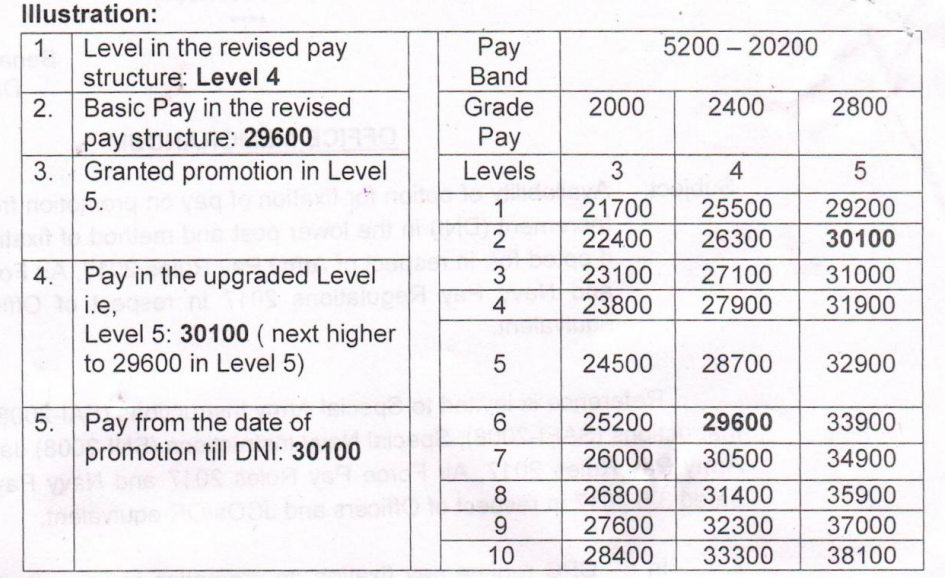
illustration_defence_1

(iii) Subsequently, on DNI in the level of the post to which Defence Personnel is promoted, his/her Pay will be re-fixed and two increments (one accrued on account of annual increment and the second accrued on account of promotion) may be granted in the Level from which the Defence Personnel is promoted and he/she shall be placed, at a Cell equal to the figure so arrived, in the Level of the post to which he/she is promoted; and if no such Cell is available in the Level to which he/she is promoted, he/she shall be placed at the next higher Cell in that Level.illus_defence_2
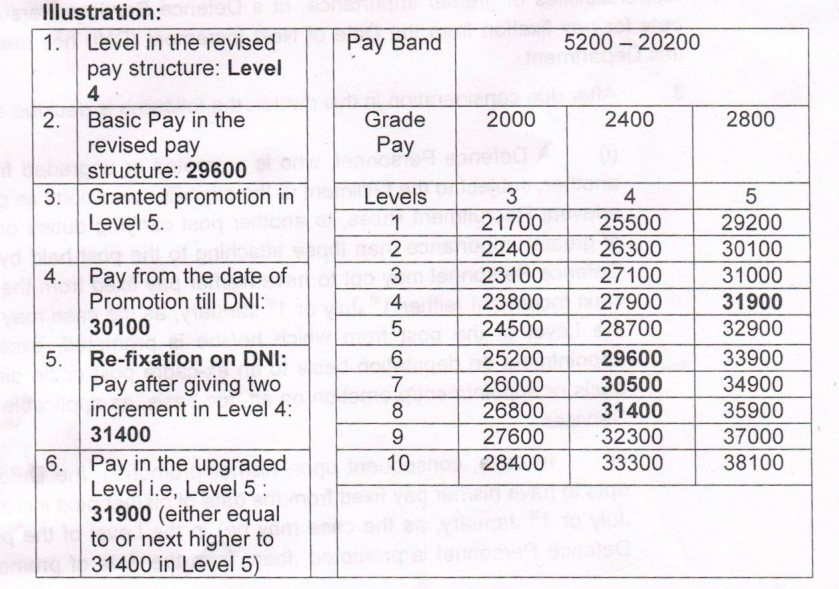
(iv) In such cases where Defence Personnel opts to have his/her pay fixed from the date of his/her next increment in the Level of the post from which he/she is promoted, the next increment as well as Date of Next Increment (DNI) will be regulated accordingly.

4. It is further reiterated that in order to enable the officials to exercise the option within the time limit prescribed, the option clause for pay fixation on promotion with effect from date of promotion/DNI shall invariably be incorporated in the promotion/appointment order, as per applicability, so that there are no cases of delay in exercising the options due to administrative lapse.

5. This issues with the concurrence of Ministry of Finance vide their ID No. 4-23/2017-IC/E.III (A) dated 22.3.2018.

sd/-
(Prashant Rastogi)
Under Secretary to the Government of India

Signed Copy

Appointment on compassionate grounds – Railway Order

Appointment on compassionate grounds : Second Marriage Policy Order

GOVERNMENT OF INDIA
MINISTRY OF RAILWAYS
RAILWAY BOARD

*****

RBE No. 42/2018

No. E(NG)II/2018/RC-1/5

New Delhi, dated 21.03.2018

The General Manager(P)
All Indian Railways & PUs.

Sub: Appointment on compassionate grounds.

The issue of considering appointment on compassionate grounds(CG) to sons/daughters, born through other than first legally married wife has been engaging the attention of this Ministry for quite some time, in the backdrop of partial quashing of CG related instructions contained in this Ministry’s letter dated 02.01.1992 regarding such appointments, by the Hon’ble High Court/Calcutta in the case(WPCT 20 of 2009) Namita Goldar & Ors. Vs UOI & Others.

2. In this regard, Railway Board has taken into account following observations of the Hon’ble Supreme Court, on the subject of CG appointment, in the case of State Bank of India & another Vs Rajkumar, (Civil appeal No. 1641 of 2010):

“it is now well settled that appointment on compassionate grounds is not a source of recruitment. On the other hand it is an exception to the general rule that recruitment to public services should be on the basis of merit, by an open invitation providing equal opportunity to all eligible persons to participate in the selection process. The dependants of employees, who die in harness, do not have any special claim or right to employment, except by way of the concession that may be extended by the employer under the Rules or by a separate scheme, to enable the family of the deceased to get over the sudden financial crisis. The claim for compassionate appointment is, therefore, traceable only to the scheme framed by the employer for such employment and there is no right whatsoever out side such scheme…..”

3. Railway Board has also taken into account following observation of Hon’ble High Court of Jharkhand (Ranchi) in writ petition No. WP(S) 16 of 2014 (pronounced on 24.07.2014) “Compassionate appointment is a matter of policy of the employer and the employer cannot be compelled to provide compassionate appointment contrary to its policy/scheme. When there is specific circular which clearly provides that the children of second marriage of the employee shall not be eligible for compassionate appointment, no direction can be issued to the respondents to consider the case of the petitioner.”


Also Read : Consolidated Instructions on compassionate appointment


4. The matter has been examined and in supersession of this Ministry’s letter dated 02.01.1992 issued under RBE No. 01/1992 and No. E(NG)II/2012/RC-1/21 dated 03.04.2013, it has been decided that the first right of being considered for compassionate grounds appointment is vested, in cases of death of Railway servants while in service, with the legally wedded surviving widow provided she has not remarried at the time of making request for appointments on compassionate grounds. It is clarified that in cases of those Railway Servants who are governed by the Hindu Marriage Act, 1955, there can only be one legally wedded wife/widow, as second marriage, while spouse is living, is void/voidable in view of the Section 5(1) read with Section 11 of the Act. In this respect, Railway Board’s letter No. E(D&A)92 GS 1-1 dated 10.04.1992 connects.

5. If aforementioned legally wedded surviving widow does not want herself to be considered for compassionate grounds appointment, she can nominate, for CG appointment, a “bread winner” for the family from amongst the following:

(a) In cases of those Railway Servants who are governed by the Hindu Marriage Act, 1955 : Son(including adopted son); or daughter(including widowed/ adopted/married/divorced daughter). However, if such Railway Servant has left sons/daughters, who have been treated as legitimate or deemed to be legitimate, under Section 16 of Hindu Marriage Act, 1955, neither widow can nominate them as bread winner for CG appointment nor such sons/daughters can claim CG appointment.

(b) In cases of those Railway Servants who are governed by their respective Personal Laws: Son(including adopted son); or daughter(including widowed/ adopted/married/divorced daughter). However, if such Railway Servant has left sons/daughters through second/subsequent legally valid marriages, i.e. other than through first wife and deceased Railway Servant have failed to obtain requisite permission for such second/subsequent marriage as required under section 21 (relating to restrictions regarding marriage) of the Railway Services (Conduct) Rules, 1966, neither first widow/second/subsequent widow can nominate such sons/daughters as bread winner for CG appointment nor such sons/daughters can claim CG appointment. Moreover, such second/subsequent widow also would not have any right to seek compassionate grounds appointment.

6. All Zonal Railway/PUs/Units are directed to decide cases accordingly.

Please acknowledge receipt.

(Neeral Kumar)
Director Estt. (N)II,
Railway Board.

Signed Copy

Aadhaar is not mandatory to get pension: Dr Jitendra Singh

Dr. Jitendra Singh chairs 30th meeting of Standing Committee of Voluntary Agencies

Aadhaar is not mandatory to get pension: Dr Jitendra Singh

The Union Minister of State (Independent Charge) for Development of North Eastern Region (DoNER), MoS PMO, Personnel, Public Grievances, Pensions, Atomic Energy and Space, Dr. Jitendra Singh chaired the 30th meeting of the Standing Committee of Voluntary Agencies (SCOVA) here today. The SCOVA meeting is organised by the Department of Pensions & Pensioners’ Welfare (DoP&PW), Ministry of Personnel, Public Grievances & Pensions and the last such meeting was held on January 12, 2017.

During the meeting, Dr. Jitendra Singh said that the SCOVA which was first constituted in July, 1986 would be completing 32 years this year. He said this platform has gone a long way in addressing in a focused manner issues related to Pensioners. He said that today’s interaction was very meaningful and stimulating, thus reflecting on the working of DoP&PW. The Minister while assuring the representatives of pensioners’ Associations said that it was no more mandatory to have one’s Aadhaar Card to get his/her pension.

The Minister said that the Department of Pensions has brought out a series of OMs to benefit the Pensioners/Family Pensioners in the last 12 months including enhancing of minimum pension from Rs.3500/- to Rs.9000/- per month; the ceiling of gratuity has been increased from the existing Rs.10 lakhs to Rs.20 lakhs; the rates of ex-gratia lump sum compensation being paid to the families of employees who die in performance of duty has been increased from existing Rs. 10-15 lakhs to Rs.25-45 lakhs. He also said that divorced daughter will be eligible for family pension if divorce case has been filed before the death of pensioner/family pensioner, even though the judgment has been passed after the death of the pensioner /family pensioner.

Dr. Jitendra Singh said that this Government has given relief to the senior citizens and Pensioners in the Budget 2018-19 by allowing Standard Deduction of Rs. 40,000/- per year to the Pensioners and given exemption on tax on account of interest income from bank savings accounts has been increased to Rs. 50,000/ from Rs. 10,000/- per year. Deduction on account of health insurance premium which was earlier allowed at maximum of Rs.30,000/- has now been increased to Rs. 50,000/- in the case of Senior Citizens/Pensioners.

While addressing the meeting he said that we need to put in place an institutionalized mechanism to make good use of the knowledge, experience and efforts of the retired employees which can help in the value addition to the current scenario. Dr. Jitendra Singh said the retired employees are a healthy and productive workforce for India and we need to streamline and channelize their energies in a productive direction. We should learn from the pensioners’ experience, he added. The Minister also said that the DoP&PW should be reoriented in such a way that pensioners become a part of nation building process.

In the meeting, discussions were held on the action taken report of the 29th SCOVA meeting. Further many issues related to pensioners were discussed threadbare, such as revision of PPOs of pre-2006 pensioners, Health Insurance Scheme for pensioners including those residing in non-CGHS area, Special “Higher” Family Pension for widows of the war disabled invalidated out of service, Extension of CGHS facilities to P&T pensioners, issue relating to CGHS Wellness Centre, Dehradun etc. The Minister directed for the prompt and time bound redressal of the grievances of the pensioners and said that we should have sympathetic attitude towards them.

The Secretary, DoP&PW, Shri K.V. Eapen and other senior officers of the department were also present on the occasion. The meeting was also attended by the member Pensioners Associations and senior officers of the important Ministries/Departments of Government of India.

Relaxation of Norms for National Pension Scheme (NPS)

Relaxation of Norms for NPS

The Government of India has recently made three changes in the National Pension Scheme (NPS) including withdrawal norms. The details are as under:

Partial withdrawal during the service: The Pension Fund Regulatory and Development Authority (PFRDA), with an objective to meet the subscriber’s sudden financial requirement enrolled under NPS, has liberalized norms for partial withdrawals which also include reduction of requirement of minimum years of being enrolled under NPS from 10 years to 3 years from the date of joining. Suitable amendments were made through “Pension Fund Regulatory and Development Authority (Exits and Withdrawals under the National Pension System) (First Amendment) Regulations, 2017 and the same has been notified on 10.08.2017.

Increase in the joining age under NPS: With an objective to allow individuals (under NPS-All Citizen Model and Corporate Sector Model) who are in the age bracket between 60 years and 65 years to join NPS system. Suitable amendments were made through “Pension Fund Regulatory and Development Authority (Exits and Withdrawals under the National Pension System) (Second Amendment) Regulations, 2017 and the same has been notified on 06.10.2017.

Exit in case of disability and incapacitation of the subscriber: With an objective of facilitating easy exit & withdrawal in case of disability and incapacitation of the subscriber covered under NPS, PFRDA has made suitable amendments through “Pension Fund Regulatory and Development Authority (Exits and Withdrawals under the National Pension System) (Third Amendment) Regulations, 2018 and the same has been notified on 02.02.2018.

This was stated by Shri Ship Pratap Shukla, Minister of State for Finance in a written reply to a question in Lok Sabha today.

Dearness Relief from Jan 2018 – DOPPW Order

Grant of Dearness Relief to Central Government pensioners / family pensioners – Revised rate effective from 01.01.2018

No.42/06/2018-P&PW(G)
Government of India
Ministry of Personnel, Public Grievances & Pensions
Department of Pension & Pensioners’ Welfare

3rd Floor, Lok Nayak Bhavan,
Khan Market, New Delhi – 110003
Dated the 22nd March,2018

Sub: Grant of Dearness Relief to Central Government pensioners/family pensioners – Revised rate effective from 01.01.2018.

The undersigned is directed to refer to this Department’s OM No. 42/15/2016-P&PW(G) dated 28.09.2017 on the subject mentioned above and to state that the President is pleased to decide that the Dearness Relief admissible to Central Government pensioners/family pensioners shall be enhanced from the existing rate of 5% to 7% w.e.f 01.01.2018.

2. These rates of DR will be applicable to (i) Civilian Central Government Pensioners/Family Pensioners including Central Govt. absorbee pensioners in PSU/Autonomous Bodies in respect of whom orders have been issued vide this Department’s OM No.4/34/2002-P&PW(D) Vol.II dated 23.06.2017 for restoration of full pension after expiry of commutation period of 15 years (ii) The Armed Forces Pensioners, Civilian Pensioners paid out of the Defence Service Estimates, (iii) All India Service Pensioners (iv) Railway Pensioners/family pensioners (v) Pensioners who are in receipt of provisional pension (vi) The Burma Civilian pensioners/family pensioners and pensioners/families of displaced Government Pensioners from Burma/ Pakistan, in respect of whom orders have been issued vide this Department’s OM No.23/3/2008-P&PW(B) dated 11.09.2017.

3. These orders shall not be applicable on CPF beneficiaries, their widows and eligible children who are in receipt of ex-gratia payment in terms of this Department’s OM No.45/52/97-P&PW(E) dated 16.12.1997 and revised vide this Department’s OM 1/10/2012-P&PW(E) dtd 27.06.2013.


Also Read : DA from January 2018 – FINMIN ORDER


Separate orders will be issued in respect of above category.

4. The payment of Dearness Relief involving a fraction of a rupee shall be rounded off to the next higher rupee.

5. The payment of arrears of Dearness Relief shall not be made before the date of disbursement of pension/family pension of March, 2018.

6. Other provisions governing grant of DR in respect of employed family pensioners and re-employed Central Government Pensioners will be regulated in accordance with the provisions contained in this Department’s OM No. 45173/97-P&PW (G) dated 2.7.1999 as amended vide this Department’s OM No. F.No. 38/88/2008-P&PW(G) dated 9th July, 2009. The provisions relating to regulation of DR where a pensioner is in receipt of more than one pension will remain unchanged.

7. In the case of retired Judges of the Supreme Court and High Courts, necessary orders will be issued by the Department of Justice separately.

8. It will be the responsibility of the pension disbursing authorities, including the nationalized banks, etc. to calculate the quantum of DR payable in each individual case.

9. The offices of Accountant General and authorised Pension Disbursing Banks are requested to arrange payment of relief to pensioners etc. on the basis of these instructions without waiting for any further instructions from the Comptroller and Auditor General of India and the Reserve Bank of India in view of letter No. 528-TA, II/34-80-U dated 23/0411981 of the Comptroller and Auditor General of India addressed to all Accountant Generals and Reserve Bank of India Circular No. GANB No. 2958/GA-64 (ii) (CGL)/81 dated the 21st May, 1981 addressed to State Bank of India and its subsidiaries and all Nationalised Banks.

10. In their application to the pensioners/family pensioners belonging to Indian Audit and Accounts Department, these orders issue after consultation with thc C&AG.

11. This issues in accordance with Ministry of Finance, Department of Expenditure’s OM No. 11/2018-E.U(B) dated 15th March,2018.

12. Hindi version will follow.

(Charanjit Taneja)
Under Secretary to the Government of India

Signed Copy

Educational concessions to the children of Armed Forces Officers / PBORs

Cap Oneducational Concession to Children of Missing/Disabled/Killed Soldiers Removed

Government has decided to continue educational concessions to the children of Armed Forces Officers/Personnel Below Officer Ranks (PBORs)/Missing/Disabled/ Killed in Action without the cap of Rs. 10,000 per month.

Ministry of Defence had persuaded the Finance Ministry twice in this regard, which is agreed upon by the latter.

The above educational concession will be admissible only for undertaking studies in a government/government aided schools/educational institutes, Military/Sainik Schools and other schools or colleges recognised by the Central or State Governments including the autonomous organisations financed entirely by the Central/State Governments.

PIB

Grant of 10 days Casual Leave to those Civilian employees under Defence Establishments

Grant of 10 days Casual Leave to those Civilian employees under Defence Establishments who are not entitled to 17 holidays per calendar year

Government of India
(Department of Defence)
Ministry of Defence
D(Civ-ll)

Subject: Grant of 10 days Casual Leave to those Civilian employees under Defence Establishments who are not entitled to 17 holidays per calendar year

The undersigned is directed to say that this division has been receiving proposals from Line Dtes and Defence Federations to grant 10 days Casual Leave to the Defence Civilian employees in such Defence units wherever the entitlement is less than 17 days Gazetted holidays.

2. In this connection, para 9 of the Appendix-III of the CCS(Leave) Rules, 1972 is reiterated as under: –

“Entitlement (per calendar year) –

8 days – For those entitled to 17 holidays

10 days – For those not entitled to 17 holidays.”

3. All concerned are therefore requested to ensure that the entitlement of Casual Leave to the Civilian employees in the Defence Establishments under MoD who are covered under CCS(Leave) Rules, 1972, is adhered strictly as per Para 9 of the Appendix-III of these Rules.

(Dalpat Singh)
Under Secretary to the Govt of India

Signed Copy

Payment of Gratuity (Amendment) Bill, 2018 passed by Parliament

Payment of Gratuity (Amendment) Bill, 2018 passed by Parliament

The Payment of Gratuity (Amendment) Bill, 2018 has been passed by parliament today.The bill ensures harmony amongst employees in the private sector and Public Sector Undertakings/Autonomous Organizations under Government who are not covered under CCS (Pension) Rules. These employees will be entitled to receive higher amount of gratuity at par with their counterparts in Government sector. The bill was passed by the Rajya Sabha today and the Lok Sabha on 15th March, 2018.

The Payment of Gratuity Act, 1972 applies to establishments employing 10 or more persons. The main purpose for enacting this Act is to provide social security to workman after retirement, whether retirement is a result of superannuation, or physical disablement or impairment of vital part of the body. Therefore, the Payment of Gratuity Act, 1972 is an important social security legislation to wage earning population in industries, factories and establishments.

The present upper ceiling on gratuity amount under the Act is Rs. 10 Lakh.

The provisions for Central Government employees under Central Civil Services (Pension) Rules, 1972 with regard to gratuity are also similar. Before implementation of 7th Central Pay Commission, the ceiling under CCS (Pension) Rules, 1972 was Rs. 10 Lakh. However, with implementation of 7th Central Pay Commission, in case of Government servants, the ceiling has been raised to Rs. 20 Lakhs.

Therefore, considering the inflation and wage increase even in case of employees engaged in private sector, this Government decided that the entitlement of gratuity should also be revised in respect of employees who are covered under the Payment of Gratuity Act, 1972. Accordingly, the Government initiated the process for amendment to Payment of Gratuity Act, 1972 to increase the maximum limit of gratuity to such amount as may be notified by the Central Government from time to time.

In addition, the Bill also envisages to amend the provisions relating to calculation of continuous service for the purpose of gratuity in case of female employees who are on maternity leave from ‘twelve weeks’ to such period as may be notified by the Central Government from time to time.

After enactment of the Act, the power to notify the ceiling of the amount of gratuity under the Payment of Gratuity Act, 1972 shall stand delegated to the Central Government so that the limit can be revised from time to time keeping in view the increase in wage and inflation and future pay commissions.

Rates of Small Savings Schemes from Jan 2018 to Mar 2018

Rates of small savings schemes 

The revised Rates of Interest on various Small Savings Schemes Including Saving Deposits, Public Provident Fund, Kisan Vikas Patra and Sukanya Samriddhi Accounts Scheme for the 4th Quarter of financial year 2017-18 is as below:

Instrument Rate of interest w.e.f. 01.01.2018 to 31.03.2018
Savings Deposit 4.0
1 Year Time Deposit 6.6
2 Year Time Deposit 6.7
3 Year Time Deposit 6.9
5 Year Time Deposit 7.4
5 Year Recurring Deposit 6.9
5 Year Senior Citizen Savings Scheme 8.3
5 Year Monthly Income Account 7.3
5 Year National Savings Certificate 7.6
Public Provident Fund Scheme 7.6
Kisan Vikas Patra 7.3 (will mature in 118 months)
Sukanya Samriddhi Account Scheme 8.1

This was stated by Shri Shiv Pratap Shukla, Minister of State for Finance in written reply to a question in Rajya Sabha.

PIB

LTC Facility to Visit SAARC Countries

LTC Facility to Visit SAARC Countries

A proposal of Leave Travel Concession (LTC) facility to Central Government employees to visit SAARC countries was found not feasible and decided not to take it forward, Dr. Jitendra Singh informed in the Loksabha Q&A Session

GOVERNMENT OF INDIA
MINISTRY OF PERSONNEL, PUBLIC GRIEVANCES AND PENSIONS
LOK SABHA
UNSTARRED QUESTION NO: 4333
ANSWERED ON: 21.03.2018

LTC Facility to Visit SAARC Countries

RAMESH POKHRIYAL NISHANK

Will the Minister of
PERSONNEL, PUBLIC GRIEVANCES AND PENSIONS be pleased to state:-

(a) whether the Government had announced in the year 2015 to allow the Central Government employees to visit SAARC countries on Leave Travel Concession (LTC) in order to promote mutual tourism among the SAARC countries;

(b) if so, the details and the present status thereof;

(c) the reasons for not providing such LTC facility even after the lapse of three years; and

(d) the time by which the orders are likely to be issued in this regard?

ANSWER

MINISTER OF STATE IN THE MINISTRY OF PERSONNEL, PUBLIC GRIEVANCES AND PENSIONS AND MINISTER OF STATE IN THE PRIME MINISTER’S OFFICE

(DR. JITENDRA SINGH)

(a) to (d): A proposal of Leave Travel Concession (LTC) facility to Government employees to SAARC countries with a purpose to enhance people to people contact and boost relations in the SAARC region was examined by the Government and after thorough examination of all aspects involved, the proposal was found not feasible and decided not to take it forward.

Source : Loksabha

Just In