Home Blog Page 558

Finance Minister inaugurates the Centralized GPF Module of PFMS for all the Central Government Employees

The Union Finance Minister, Shri Arun Jaitley to inaugurate the Centralized GP Fund Module of PFMS for all the Central Government Employees and ePPO Module of PFMS for complete end –to –end electronic processing of Pension cases, on the occasion of the 42nd Civil Accounts Day tomorrow in National Capital.

The Union Finance Minister, Shri Arun Jaitley has kindly consented to be the Chief Guest at the Inaugural Session of a function organised tomorrow, 1st March, 2018 in national capital to mark the 42nd Civil Accounts Day .On the occasion , the Finance Minister, Shri Jaitley will inaugurate the Centralized GP Fund Module of PFMS for all the Central Government Employees. The centralized GPF module meets a long standing demand of the Central Government Employees for a mapping of GPF Accounts with the unique Employee ID thereby facilitating online application for GPF advances and withdrawals with online access to the employee’s current GPF balances. The module will streamline GPF accounting and transfer of balances.

During the Inaugural Session, the Finance Minister, Shri Jaitley will also inaugurate the ePPO module of PFMS for complete end –to –end electronic processing of Pension cases. The ePPO includes the integration of the BHAVISHYA application of the Department of Pension & Pensioners’ Welfare and the PARAS application of CPAO with PFMS for seamless processing of Pension cases thereby eliminating delays and errors involved in manual processing.

A function is being organized on March 1, 2018 at D.S. Kothari Auditorium, DRDO Bhawan Complex, New Delhi to mark the 42nd Civil Accounts Day.

The Union Finance Minister, Shri Arun Jaitley has kindly consented to be the Chief Guest at the Inaugural Session from 10:30 AM -11:30 AM. The Union Minister of State for Finance, Shri Pon. Radhakrishnan will preside over this Session. The Secretary (Expenditure), Shri A. N. Jha and the Controller General of Accounts(CGA), Shri Anthony Lianzuala will be the other dignitaries at the Inaugural Session.

It may be mentioned here that the Union Finance Minister, Shri Arun Jaitley had earlier graced the 40th Civil Accounts Day function on March 1, 2016 in which the Hon’ble President of India was the Chief Guest. The Union Finance Minister, Shri Jaitley had also very graciously inaugurated the ‘Mahalekha Niyantrak Bhawan’, the new building of this office on September 14, 2016.

Earlier, the Finance Minister had been kind enough to launch the mandatory use of PFMS for Central –Sector schemes monitoring (Oct 2015), the Non –Tax Receipts Portal (NTRP) (Feb 2016) and the Web Responsive Pensioners’ Service of the Central Pension Accounting Office (CPAO) (September 2016).

The Union Government initiated a major reform in Public Financial Management in 1976. The Audit and Accounts functions were separated by relieving the Comptroller and Auditor General of his responsibility of preparation of Union Government accounts. The accounting function was brought directly under the control of the Executive. Consequently, the Indian Civil Accounts Service (ICAS) was established. The ICAS was carved out from the Indian Audit & Accounts Service (IA & AS), initially through the promulgation of an Ordinance amending the C & AG’s (Duties, Powers and Conditions of Service) Amendment Act, 1976. Later on, the Departmentalization of Union Accounts (Transfer of Personnel) Act, 1976 was enacted by Parliament and assented to by Hon’ble President of India on 8th April, 1976. The Act was deemed to have come into force with effect from 1st March, 1976. Accordingly, the ICAS is celebrating March 1 every year as the “Civil Accounts Day”.

Since its inception the ICAS has steadily grown in stature and now plays an important role in the management of public finances of the Union Government

Other highlights of the 42nd Civil Accounts Day function are

* Inauguration of the Centralised GPF and ePPO modules of PFMS

Reforms in public financial management are a continuous process. Structural changes take place in the economy and in the functioning of government which demand accounting data on public finances to be available to decision makers, often on real time basis. This demand for faster information can only be met through adoption of technology. Recognizing this need, the Service has since its inception, been a pioneer in the use of Information Technology in Payments, Accounting and Financial Reporting.

* Keynote address by Shri N. K. Singh, Chairman, Fifteenth Finance Commission (FFC)

Shri N. K. Singh, Chairman, FFC will deliver the keynote address at the Plenary Session from 12.00 PM to 12.50 PM on the topic “Managing Public Finances for a resurgent India”. The Address will be of tremendous significance in the context of fiscal discipline efforts of the Union and the States that would be required to achieve fiscal consolidation.

* Address by Shri Rajnish Kumar, Chairman, State Bank of India

The post-lunch session (2:00 PM -2:50 PM) will feature a talk by Shri Rajnish Kumar, Chairman, State Bank of India on the topics “Leveraging Information Technology for an efficient receipt and payment system of the Government of India”. As the head of the premier accredited and aggregator bank for Government business, the views of Chairman, SBI on the subject would be of immense significance especially in the context of implementation of the Public Financial Management System (PFMS) with a seamless integration with the banking systems.

Concluding session

This Session will be an Open House Session where Service Officers will interact for a way forward on issues relating to Accounts, IT and Internal Audit.
AICPIN for the month of January 2018

AICPIN for January 2018

No.5/1/2018-CPI
GOVERNMENT OF INDIA
MINISTRY OF LABOUR & EMPLOYMENT
LABOUR BUREAU

`CLEREMONT’, SHIMLA-171004
DATED: 28th February, 2018

Press Release

Consumer Price Index for Industrial Workers (CPI-IW) — January, 2018

The All-India CPI-IW for January, 2018 increased by 2 points and pegged at 288 (two hundred and eighty eight). On 1-month percentage change, it increased by (+) 0.70 per cent between December, 2017 and January, 2018 when compared with the decrease of (-) 0.36 per cent for the corresponding months of last year.

The maximum upward pressure to the change in current index came from Housing group contributing (+) 3.99 percentage points to the total change. At item level, Goat Meat, Poultry (Chicken), Tea (Readymade), Pan Leaf, Doctor’s Fee, Medicine (Allopathic), Cinema Charges, Bus Fare, Petrol, Flowers/Flower Garlands, etc. are responsible for the increase in index. However, this increase was checked by Rice, Wheat & Wheat Atta, Gram Dal, Eggs (Hen), Fish Fresh, Onion, Brinjal Cabbage, Carrot, Cauliflower, French Bean, Gourd, Palak, Peas, Potato, Radish, Tomato, Sugar, etc., putting downward pressure on the index.

The year-on-year inflation measured by monthly CPI-IW stood at 5.11 per cent for January, 2018 as compared to 4.00 per cent for the previous month and 1.86 per cent during the corresponding month of the previous year. Similarly, the Food inflation stood at 3.36 per cent against 4.32 per cent of the previous month and 0.34 per cent during the corresponding month of the previous year.

At centre level, Nasik reported the maximum increase of (16 points) followed by Nagpur (11 points), Pune, Lucknow and Goa (10 points each), Kodarma and Amritsar (9 points each), and Coonoor, Agra and Chandigarh (8 points each). Among others, 7 points increase was observed in 3 centres, 6 points in 1 centre, 5 points in 5 centres, 4 points in 1 centre, 3 points in 6 centres, 2 points in 7 centres and 1 point in 8 centres. On the contrary, Quilon recorded a maximum decrease of 6 points followed by Siliguri and Madurai (5 points each). Among others, 4 points decrease was observed in 3 centres, 3 points in 7 centres, 2 points in 8 centres and 1 point in 10 centres. Rest of the 6 centres’ indices remained stationary.

The indices of 36 centres are above All-India Index and 40 centres’ indices are below national average. The index of Varanasi and Jabalpur centres remained at par with All-India Index. The next issue of CPI-IW for the month of February, 2018 will be released on Wednesday, 28th March, 2018. The same will also be available on the office website www.labourbureaunew.gov.in

(ANIL KUMAR NEGI)
DEPUTY DIRECTOR

DA Calculation Sheet

6th CPC DA Calculation Sheet

Expected DA Calculator from July 2018

KV Admission 2018-19 : Admission of wards of Armed / Para Military Forces

KV Admission 2018-19 : Admission of wards of Armed / Para Military Forces

Automatic admission of children in the Kendriya Vidyalayas on the basis of transfer certificate issued by the CBSE affiliated schools run by Armed Forces (Army, Air Force, Navy) and Para Military Forces i.e. CRPF/BSF/ITBP/SSB (Sashastra Seema Bal) and CISF will be entertained only if the parent has been transferred to that place or has desired to settle at the place after his retirement,or transferred to some non-family station or posted in Naxal affected areas and choose to keep the family elsewhere.

This provision shall be applicable to schools run by Indian Coast Guard also. This provision may also be extended to the children of government employees studying in schools run by ISRO/AEES (Atomic Energy Education Society).

It is clarified that above provisions are only for the wards of Defence personnel / Para Military Forces i.e.CRPF/BSF/ITBP/SSB (Sashastra Seema Bal) and CISF viz. sons & daughters only. This will not include the grand children of Defence personnel. Provisions of KVS admission guidelines including the eligibility criteria for age and marks/Grades will be followed in letter and spirit. Also, the fee including VVN is to be paid from the month of admission of the child in the Kendriya Vidyalaya regardless of the fact that the fee for succeeding months have already been paid in the school from which TC has been issued for admission to KV. TCs issued by the CASE schools of Defence Ministry/Deptts/Authority will be endorsed by the concerned Deputy Commissioner of the region where admission is sought.

Kendriya Vidyalaya Admission 2018-19 : Eligible Age for Admission

Kendriya Vidyalaya Admission 2018-19 : Eligible Age for Admission

A Child must be 5 years old as on 31st March in the academic year in which admission is sought for Class I. (Child born on 1st April should also be considered)

A. The minimum and maximum age limit for admission in Kendriya Vidyalayas in various classes is given below:(Child born on 1st April should also be considered.)

Class Minimum Age as on 31st March Maximum Age as on 31st March
I 5 Years 7 Years
II 6 Years 8 Years
III 7 Years 9 Years
IV 8 Years 10 Years
V 9 Years 11 Years
VI 10 Years 12 Years
VII 11 Years 13 Years
VIII 12 Years 14 Years
IX 13 Years 15 Years
X 14 Years 16 Years

Note: The maximum age limit can be relaxed by two years in case of Differently abled children by the Principal.

B. There is no age restriction for admission to Class XI provided the student is seeking admission in the year of passing Class X examination. Similarly, there will be no upper & lower age limit for admission to class Xll provided there has been no break in the continuous study of the student after passing class XI.

Kendriya Vidyalaya Admission 2018-19 : Method of Admission for Class II to IX

Kendriya Vidyalaya Admission 2018-19 : Method of Admission for Class II to IX

METHOD OF ADMISSION IN CLASS II TO VIII

Admission test shall not be conducted for admission to Class II to VIII and the admission may be granted based on Priority category system (1 to 5 or 6 as the case may be). If applications are more than the number of seats, lottery system will be followed in each category including single girl child quota (Class VI Onwards).


Also Read : Method of Admission for Class I


METHOD OF ADMISSION IN CLASS IX

For admission to Class IX, an admission test shall be conducted and a merit list will be prepared for each category of priority separately. Admission shall be granted in the sequence of priority categories, in the order of merit.

(i) Admission test shall be conducted in the subjects: Hindi, English, Maths, Social Science and Science.

(ii) There will be only one paper of Admission test of 3 Hours duration & 100 marks comprising Hindi, English, Maths, Social Science & Science each of 20 marks.

(iii) Candidates must secure 33% marks in aggregate to qualify. Students belonging to SC/ST/Divyang category(PH) will be eligible for admission on securing 25% in aggregate

Kendriya Vidyalaya Admission 2018-19 – Method for Class I

Kendriya Vidyalaya Admission 2018-19 –  Method of Admission for Class I

Kendriya Vidyalaya Sangathan released the guidelines for admission process in KV for the year 2018-19. Check the Method of Admission for Class I

Out of the available seats of fresh admission 15% will be reserved for SC and 7.5% will be reserved for ST. The short fall in the number of seats reserved for SC and ST, will be worked out after considering number of SC/ST children admitted under RTE quota.

(1) In first phase, 10 seats (out of 40 seats) in Class I per section are to be filled as per RTE Provisions (25% of seats) and these 10 seats will be filled by draw of lots from all applications of SC/ST/EWS/BPL/OBC (Non-Creamy Layer)who are the resident of Neighborhood/Differently abled taken together.

(2) In second phase; remaining seats are to be filled as per existing Priority category system. The short fall in the seats reserved for SC/ST, if any shall be made good by admitting SC/ST applicants.

For example : In a single Section School 6 seats are reserved for SC and 3 Seats for ST (15% for SC and 7.5% for ST). Assuming that, 2 SC candidates, 1 ST candidate and 1 Differently Abled candidate are admitted under RTE in the lottery system in first phase, then available SC seats will be considered as 6-2 = 4 and ST seats will be 3-1 = 2. The left out registered candidates from SC and ST category will be considered as per order of Priority categories for admission. In this case the remaining 24 seats will be available for admission under order of Priority of Category.

Note-I:

a) In no case the seats reserved as per RTE will be de-reserved.

b) The seats reserved for SC/ST may be interchanged, by interchanging SC seats to ST and vice- versa after 201″ April.

c) If required numbers of candidates covered under RTE do not register in 1st spell of registration then a second notification may be given in the month of April.

d) The definition/eligibility criteria of Disadvantaged Group/Weaker Section/BPUOBC (Non-creamy layer) will be as per the notification of the concerned State Governments.(The DC KVS RO Concerned may issue guidelines regarding BPL/EWS as per the latest notification of the concerned State Governments).

e) Admission test will not be conducted for Class 1.

Note-2:

A DEFINITION OF DISADVANTAGED GROUP

1. Child belonging to disadvantaged group means a child belonging to the Scheduled Caste, Scheduled Tribe, the socially and educationally backward class or such other group having disadvantage owing to social, cultural, economic, geographical, linguistic, gender or such other factor as may be specified by the appropriate government, by notification (Section 2(d) of RTE Act).

2. Child with special needs and suffering from disability will be determined as per the provision mentioned in RTE Act 2009 or as defined by the concerned State Govt.

B DEFINITION OF WEAKER SECTION

Child belonging to weaker section means a child belonging to such a parent or guardian (declared by a Court or a Statute) whose annual income is lower than the minimum limit specified by the appropriate government, by notification (Section 2(e)).

The income limit regarding economically weaker sections will be applicable as notified by the State Govt. concerned.

C. DEFINITION OF NEIGHBOURHOOD & PROOF OF RESIDENCE (APPLICABLE FOR ADMISSION UNDER RTE ONLY)

Since Kendriya Vidyalayas are located at places with varied density of population, they have been categorized as follows for determining the limits of neighbourhood:

Major cities and Urban area 5 kms. Radius
(All District Hors. & Metros)

2 Places and areas other than 8 kms Radius included in I above.

Note:

1. Proof of residence shall have to be produced by all applicants. However, admission cannot be denied due to non-submission of Proof of residence.

2. A self-declaration in writing from the parent about distance may also be accepted to this effect.

Interaction with the Joint Secretary (BC), Commission for Sub- Categorization of OBCs

Interaction with the Joint Secretary (BC), Commission for Sub- Categorization of OBCs

Reminder

No.21/1/2016-CS.I(PR/CMS)
Government of India
Ministry of Personnel, PG and Pensions
Department of Personnel & Training

2nd Floor, Khan Market,
New Delhi-110003
Date: 27th Feb., 2018.

OFFICE MEMORANDUM

SUBJECT:- Interaction with the Joint Secretary (BC), Commission for Sub- Categorization of OBCs — regarding.

The undersigned is directed to refer to this Department’s O.M. of even number 20th February, 2018 on the subject mentioned above and to state that on scrutiny of the data available on CSCMS portal, it is observed that many Ministries/Departments have not yet updated the information with reference to Categorization/Sub-Categorization of OBC officers along with the data relating to the “State” from which the OBC candidates appeared/selected in respect of CSS Cadre (ASO to JS-in-situ) in the CSCMS portal . In view of the above, it is once again requested that the same may kindly be updated positively by 27th February, 2018 (Tuesday).

(Anil Tripathi)
Under Secretary to Government of India

DOPT Order


Also Read : DOPT Orders 2018


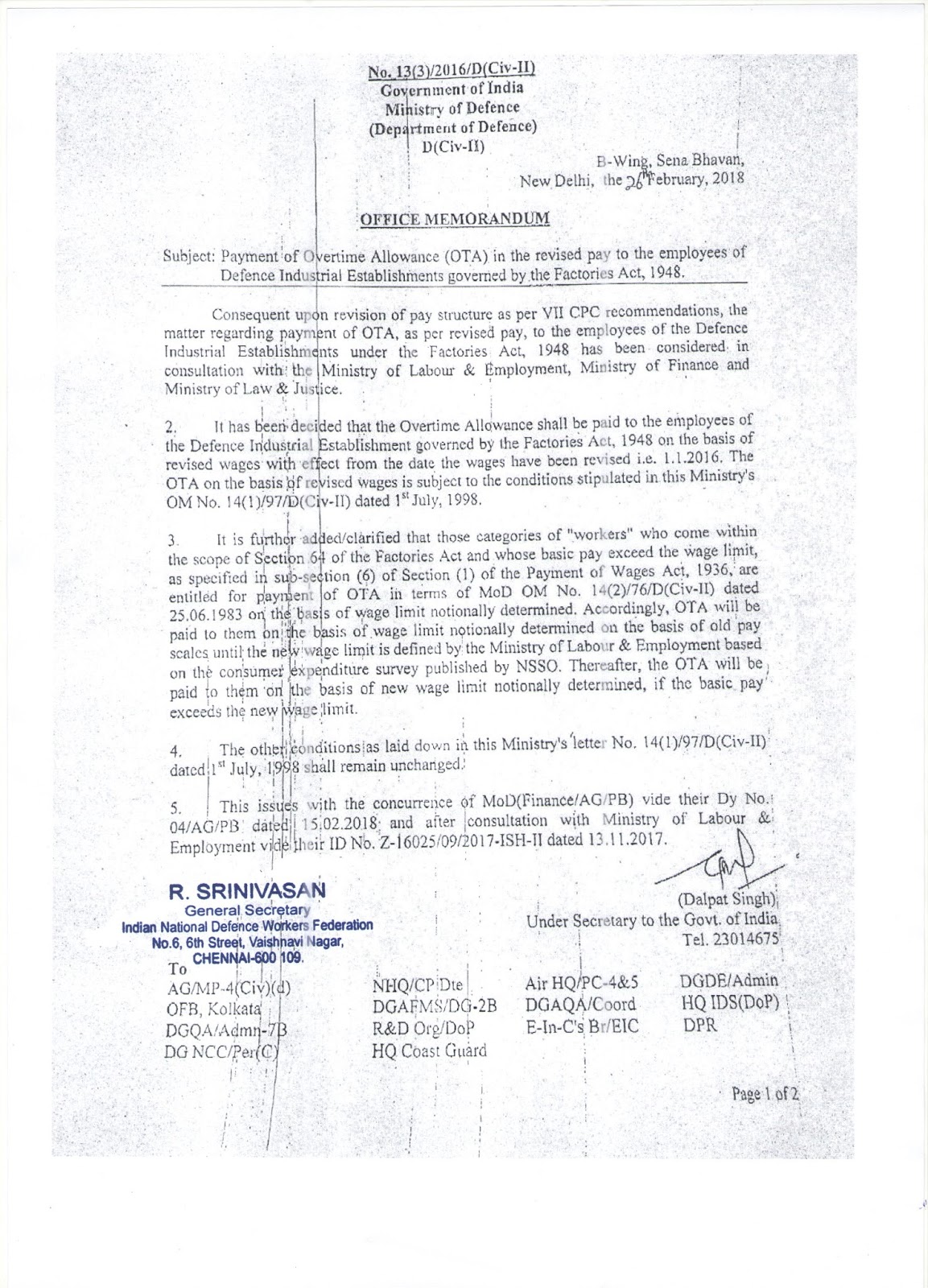
Payment of Overtime Allowance in the revised pay to the employees of Defence Industrial Establishments governed by the Factories Act, 1948

Payment of Overtime Allowance in the revised pay to the employees of Defence Industrial Establishments governed by the Factories Act, 1948.

No.13(3)/2016/D(Civ-II)
Government of India
Ministry of Defence
(Department of Defence)
D(Civ-II)

B-wing, Sena Bhavan
New Delhi, the 26th February,2018

OFFICE MEMORANDUM

Subject: Payment of Overtime Allowance (OTA) in the revised pay to the employees of Defence Industrial Establishments governed by the Factories Act, 1948.

Consequent upon revision of pay structure as per VII CPC recommendations, the matter regarding payment of OTA, as per revised pay, to the employees of the Defence Industrial Establishments under the Factories Act, 1948 has been considered in consultation with the Ministry of Labour & Employment, Ministry of Finance and Ministry of Law & Justice.

2. It has been decided that the Overtime Allowance shall be paid so the employees of the Defence Industrial Establishment governed by the Factories Act, 1948 on the basis of revised wages with effect from the date the wages have been revised i.e 1.1.2016. The OTA on the basis of revised wages is subject to the conditions stipulated in this Ministry’s OM No.14(1)/97/D(Civ-II) dated 1st July,1998

3. It is further added/clarified that those categories of workers who come within the scope of section 64 of the Factiories Act and whose basic pay exceed the wage limit, as specified in sub section (6) of Section (1) of the payment of wages Act 1936, are entitled for payment of OTA in terms of MoD OM No.14(2)/27/D(civ-II) dated 25.06.1983 on the basis of wage limit notionally determined. Accordingly, OTA will be paid to them on the basis of wage limit notionaly determined on the Ministry of Laboury & Employment based on the consumed expenditure survey published by NSSO. Thereafter, the OTA will be paid to them on the basis of new wage limit notionally determined, if the basis pay exceeds the new wage limit.

4. The other conditions as laid domw in this Ministry’s letter No.14(1)/97/D(Civ-II) dated 1st July, 1998 shall remain unchanged.

5. This issues with the concurrence of MoD (finance/AG/PB) vide their Dy No.01/AG/PB dated 15.02.2018 and after consultation with Ministry of Labour & Employment vide their ID No. Z-16025/09/2017-ISH-II dated 13.11.2017

(Dalpat Singh)
Under Secretary to the Govt. of India
Tel. 23014675

Source : http://indwf.blogspot.in/

OTA_Defence

Finmin Order : Guidelines on Air Travel on Official Tours – Purchase of air ticket from authorized agent

Finmin Order : Guidelines on Air Travel on Official Tours – Purchase of air ticket from authorized agent

No. 19024/22/2017-E.IV
Government of India
Ministry of Finance
Department of Expenditure

North Block, New Delhi
Dated the 27th February, 2018

Office Memorandum

Subject: – Guidelines on Air Travel on Official Tours — Purchase of air ticket from authorized agent.

***

The undersigned is directed to refer to this Departments’ O.M. No. 19024/22/2017-E.IV dated 19.07.2017 regarding guidelines on Air travel where the Govt. of India bears the cost of passage. As per this O.M., Ministries/Departments were asked to ensure that these instructions are given adequate coverage and were to be circulated to all so that ‘lack of knowledge’ of the rules is not cited as an excuse. In spite of these instructions, a large number of cases for relaxation of air travel guidelines due to purchase of air ticket from unauthorized travel agents, are still being received in this Department.

2. The matter has been re-considered and it has been decided that all such cases of air travel where tickets have been purchased after issue of this Department’s O.M. dated 19.07.2017, seeking relaxation of air travel guidelines pertaining to purchase of air ticket from authorized agent, should have the approval of Secretary of the Administrative Ministry before referring the same to Department of Expenditure.

This is issued with the approval of Secretary Expenditure.

(Nirmala Dev)
Deputy Secretary to the Government of India

Signed Copy

Purchase of Laptops and similar devices for eligible officers – FINMIN Instructions

Purchase of Laptops and similar devices for eligible officers – FINMIN Instructions

F.No.08(34)/2017-E II(A)
Ministry of Finance
Department of Expenditure
E.ll(A).B.ranch

New Delhi, the 20th February, 2018

OFFICE MEMORANDUM

Subject: Instructions for the purchase of laptops/notebooks and similar devices for eligible officers – revised guidelines.

ln supersession to this Ministry’s Office Memorandum bearing No. 08(64)/2017-E..II(A) dated 27th September 2016, regarding purchase of Note Book/Lap-Top computers by Ministries/ Departments & delegation of powers thereof, it has been decided that lap{op; tablet; notepad; ultrabook; notebook, net-book or devices of similar categories may be issued to officers of the rank of Deputy Secretary and above for discharge of official work. These powers shall continue to be exercised in consultation with the Financial Adviser by the Secretary of the Ministry/ Department or any other authority who are specifically delegated these powers by this Ministry from time to time, duly taking into consideration the functional requirements and budgetary provisions.

2. This would, however, be subject to the following conditions:

(i) Cost of device: The Cost of device including Standard software* shall not exceed Rs. 80,000/-

Standard Software: Any software (Operating System, Antivirus software or MS-Office etc.) that is essential for the running of device towards discharge of official functions/duties.

(ii) Purchase Procedures: As prescribed under GFRS/CVC guidelines may be followed.

(iii) Safety, Security & Maintenance of Device: The officer, who is given the device, shall be personally responsible for its safety and security as well as security of data/information, though the device shall continue to remain Government property. The officer concerned will be at liberty to get the device insured at his personal cost.

(iv) Retention/Replacement of device:

a) No new device may be sanctioned to an officer, who has already been allotted a device, in a Ministry /Department, up to five years. Any further issue of laptop in case of loss/damage beyond repairs within the prescribed period, should be considered only after the cost is recovered from the officer based on the book value after deducting the depreciation.

b) For the purpose of calculation of the book value, a depreciation of 25% per year, on straight line method, be adopted.

c) Post the completion of five years of usage, the officer shall retain the issued device.

(v) Conditions at the time of transfer, Superannuation etc.:

a) ln case where, at the time of purchase of device if the residual service of the officer is less than 5 years or in case the officer is transferred/deputed to State Govt. but with residual service of less than 5 years or the officer leaves the Government Service within 5 years of purchase of such device, the officer concerned will have the option of retaining the device by paying the annunl after deducting the depreciation.

b) Upon transfer/deputation of the officer to other Ministry/ Departments Attached/Subordinate offices of the Government of India or to the State Government in case of Officers of the All India Services, the officer will have the option of retaining the existing device and in case of such retention, this fact should be specifically mentioned in the Last Pay Certificate (LPC).

3. Instructions for Ministries/Departments:

(i) For the officials who are currently holding laptops, notebooks or similar devices in accordance with the provisions of O.M. dt. 2710912016, the terms & conditions for retention/disposal of the device shall continue to be governed under the existing instructions of the said O.M.

(ii) The applicability of the provisions of this order to the officers of Armed Forcesi Para-Military Forces, officers of MoD & other similar establishments would be subject to restrictions imposed by the concerned departments/organizations duly taking into consideration the security of information. ln all such cases the security of the information shall be the responsibility of the concerned department.

4. This is issued with the approval of Secretary (Expenditure).

sd/-
(Dr. Bhartendu Kumar Singh)
Directo(E.IIA)

Signed copy

Just In