Link Aadhar Number with beneficiary number before 31st March 2018
File No.44-42/2016/MCTC/CGHS
Government of India
Ministry of Health and Family Welfare
Department of Health & Family Welfare
Nirman Bhawan, New Delhi 110 11
No : No 44-26/2016/MCTC/CGHS/EHS
Dated the January, 2018
OFFICE MEMORANDUM
Subject :- Integration of AADHAR Number with CCHS beneficiary number
****
With reference to the above subject the undersigned is directed to state that CGHS is capturing the AADHAR number of new CGHS beneficiaries. while issuing the CGHS Cards. Serving employees are already using the Aadhar based Bio-metric attendance system and a large number of primary card holders have linked their Aadhar number to CGHS Ben ID Number. However, some of the existing CGHS beneficiaries particularly the pensioner beneficiaries are yet to link their Aadhar Number. The matter has been reviewed and it is now decided that linking of Aadhar Number to Ben ID No has been made compulsory and all the CGHS beneficiaries are advised to link their Aadhar Number before 31st March 2018.
2. The procedure for doing so is as follows:
(I) Through CMO-In charge’s Module – Beneficiary can visit CMO-Incharge of his/her CGHS Wellness Centre with AADHAR Card to get his her and family members’ AADHAR Number linked to CGHS Beneficiary Number.
(II) Registration of AADHAR Number by beneficiary himself/herself – the following steps are to be followed:
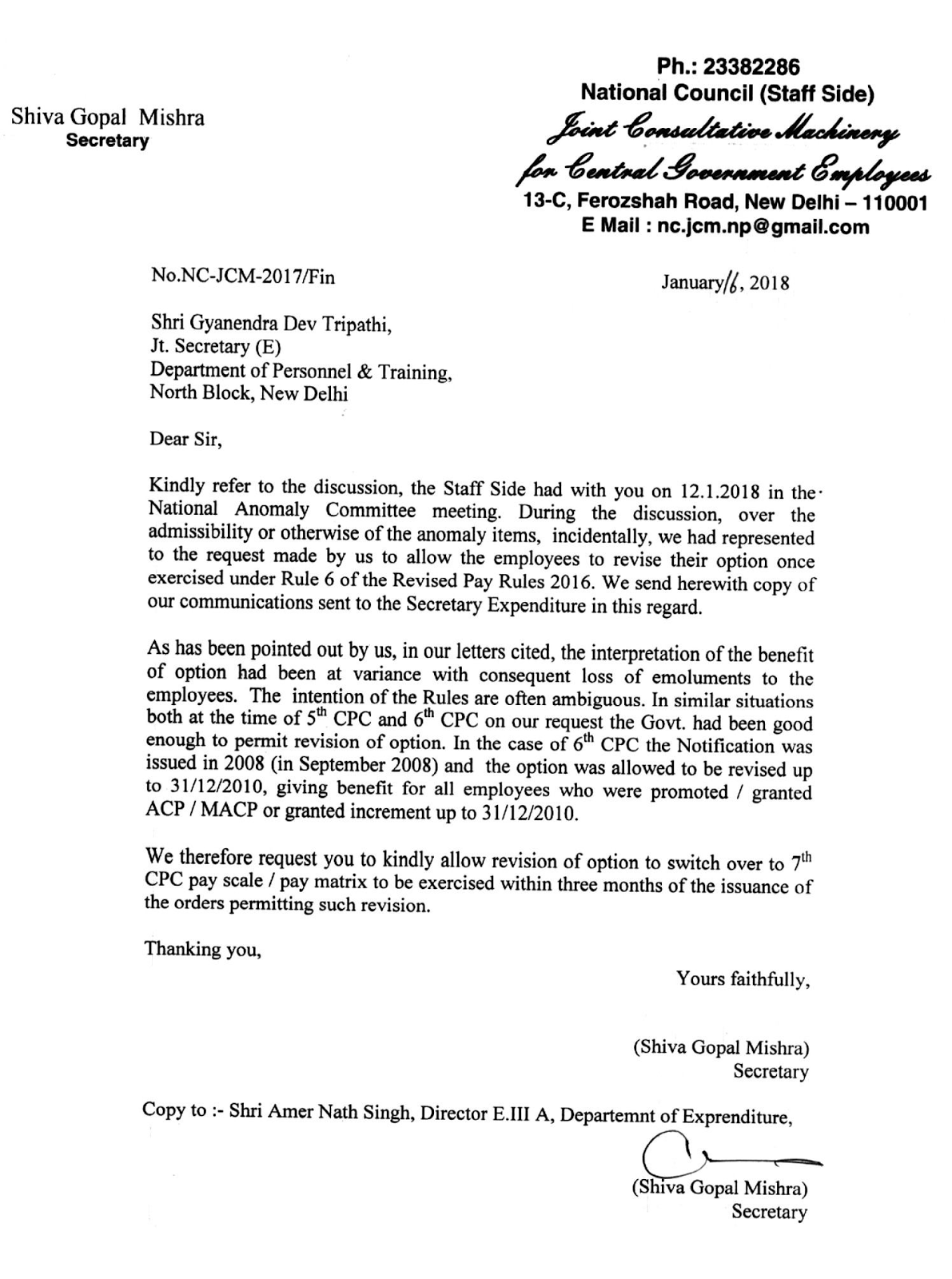
Shri Gyanendra Dev Tripathi,
Jt. Secretary (E)
Department of Personnel & Training,
North Block, New Delhi
Dear Sir,
Kindly refer to the discussion, the Staff Side had with you on 12.1.2018 in the National Anomaly Committee meeting. During the discussion, over the admissibility or otherwise of the anomaly items, incidentally, we had represented to the request made by us to allow the employees to revise their option once exercised under Rule 6 of the Revised Pay Rules 2016. We send herewith copy of our communications sent to the Secretary Expenditure in this regard.
As has been pointed out by us, in our letters cited, the interpretation of the benefit of option had been at variance with consequent loss of emoluments to the employees. The intention of the Rules are often ambiguous. In similar situations both at the time of 5th CPC and 6th CPC on our request the Govt. had been good enough to permit revision of option. In the case of 6th CPC the Notification was issued in 2008 (in September 2008) and the option was allowed to be revised up to 31/12/2010, giving benefit for all employees who were promoted / granted ACP / MACP or granted increment up to 31/12/2010.
We therefore request you to kindly allow revision of option to switch over to 7th CPC pay scale / pay matrix to be exercised within three months of the issuance of the orders permitting such revision.
Online transfer of CGHS Cards of serving employees on transfer from one CGHS Covered City to another CGHS Covered City
Z 15025/108/2017/DIR/CGHS/EHS
Government of India
Ministry of Health & Family Welfare
Department of Health & Family Welfare
EHS Section
Nirman Bhawan, New Delhi
Dated the January, 2018
OFFICE MEMORANDUM
Sub: Online transfer of CGHS Cards of serving employees on transfer from one CGHS Covered City to another CGHS Covered City — Reg.
With reference to the above mentioned subject the undersigned is directed to state that this Ministry has been receiving representations for allowing online transfer of same CGHS cards of serving employees of Central Government on transfer from one CGHS City to another CGHS City. The matter has been reviewed and it has now been decided, in supersession of the earlier orders in this regard, to allow online transfer of same CGHS cards of serving employees of Central Government on transfer from one CGHS City to another CGHS City as per the details given under:
i) Serving employees on transfer from one CGHS City to another CGHS City shall submit an application to the Additional Director of CGHS City (forwarded by the Ministry /Department from where he /she is being transferred) along with copy of the transfer / relieving order for transfer of CGHS Cards to another CGHS City with an undertaking that he shall be residing in the new City in a CGHS covered area.
ii) Addl. Director, CGHS of City shall transfer the card online and shall issue an acknowledgement slip to the serving employee. CGHS Plastic cards shall be retained by the serving employee.
iii) Serving employee in the new CGHS City submits an application duly forwarded by his /her Ministry /Department/ Office, certifying that CONS contribution is being deducted, to the Additional Director of new CGHS City for acceptance of the transit CGHS Cards to the data base of new City and allocation of a CGHS Wellness Centre in new CGHS City along with proof of residence for residing in a CGHS covered area. Additional Director, CGHS in the new City shall accept the cards in new City after verification of the residential address. If the area is coverd under CGHS, the card shall remain inoperable until it is accepted by the Addl. Director,CGHS.
iv) It is also brought to the attention of all Ministries and Departments that they are responsible for surrender of CGHS cards issued to Serving Employees, when they are transferred to a non-CGHS covered City.
2. These order shall supersede all the earlier instructions issued on the subject and will be in effect from the date of its issue.
(Dharminder Singh)
Under Secretary to Government of India
CPAO listed common mistakes by PAOs in processing of Revision of Pension under 7th Central Pay Commission, Check the details
1) DATE OF DEATH OF PENSIONER NOT MENTIONED IN COLUMN 3 [b]. (FAMILY PENSION CASE)
2) APPLICABILITY OF COMMUTED PENSION MAY BE CHECKED WHETHER IT IS APPLICABLE OR NOT.
3) CLASS/CATEGORY OF PENSION UNDER COLUMN 1 (g) MAY BE CHECKED.
4) NOTIONAL PAY SHOWN UNDER COLUMN 3 (e) MAY BE CHECKED.
5) PAY/NOTIONAL PAY SHOWN IN COLUMN 3 (e), DOES NOT MATCH WITH PAY FIXED UNDER 7TH CPC AS SHOWN IN COLUMN 4 (a).
6) LEVEL AND INDEX UNDER COLUMN 4 (a) MAY BE CHECKED.
7) BASIC PENSION IS NOT MATCHING WITH THE LAST PAY DRAWN AS PER 7TH CPC.
8) PAY MATRIX FOR LEVEL? 13 MAY BE CHECKED WITH REFERENCE TO REVISED PAY MATRIX IN TERMS OF MINISTRY OF FINANCE (DEPTT.OF EXPENDITURE) RESOLUTION DATED-16.05.2017.
9) PAY MATRIX FOR LEVEL-14 MAY BE CHECKED WITH REFERENCE TO REVISED PAY MATRIX IN TERMS OF DEPTT. OF PENSION & PENSIONERS WELFARE OM DATED – 13.09.2017.
Subject: Meeting with all Heads of CPPCs/Government Business Divisions to review the implementation of 7th CPC pension revision.
In continuation of this office Meeting Notice No. CPAO/IT&Tech/Master data/14(Vol-III)/2017-18/183 dated-17.01.2018, it has been decided to hold a meeting with all Heads of CPPCs/Heads of Govt. Business Divisions of the Authorised Banks for pensions under the chairmanship of chief controller (Pension) on 31st January, 2018 instead of 30th January, 2018 at 3.00 PM in Conference Hall of Central Pension Accounting Office, Trikoot-II, Bhikaji Cama Place, New Delhi – 110 066.
S/d,
(Md. Shahid Kamal Ansari)
(Assistant Controller of Accounts)
CPAO : Meeting with all Heads of CPPCs/Government Business Divisions to review the implementation of 7th CPC pension revision
GOVERNMENT OF INDIA
MINISTRY OF FINANCE
DEPARTMENT OF EXPENDITURE
CENTRAL PENS10N ACCOUNTING OFFICE
TRIKOOT-II BHIKAJI CAMA PLACE,
NEW DELH – 110066
CPAO/IT &Tech/Master data/14 (Vol-III)2017-18/183
17.01.2018
MEETING NOTICE
Subject : Meeting with all Heads of CPPCs/Government Business Divisions to review the implementation of 7th CPC pension revision.
It has been decided to hold a meeting with art Heads of CPPCs/Heads of Govt. Business Divisions of the Authorised Banks for pensions under the Chairmanship of Chief controller (Pension) on 30th January, 2018 at 3.00 PM at Conference Hall of central Pension Accounting Office, Trikoot-II, Bhikaji cama place, New Delhi – 110 066 to review the status of implementation of 7th cpc pension revision in the light of DP&PW OM No. 38/37/2016-P&PW [A) dated 12th May, 2017.
Agenda items of the meeting are as follows:
1. Monitoring of implementation of 7th CPC by Banks.
2. Reporting of revised cases to CPAO by Banks.
3. Master Data Reconciliation.
4. IT related issues w.r.t. e-Revision of pension and fresh pension.
5. Compliance of Internal Audit observations on 7th CPC revisions.
6. Timely commencement of family Pension.
7. Timely commencement of Additional Pension.
8. Timely restoration of commuted portion of pension.
9. Timely submission of life certificates.
10. Any other point with the permission of the chair.
All the Authorised Banks are requested to make it convenient to depute their sufficiently senior representatives (A.G.M. and above) to attend the meeting. A line in confirmation may be intimated on e-mail [email protected] or through Fax No. 26715108/ 26162326 (Kind Attn: Shri Vijay Singh,Consultant).
S/d,
(Md.Shahid Kamal Ansari)
(Assistant Controller of Accounts)
1184. Clarifications regarding use of Form No. 16 for pensioners where pensioners are drawing their pensions through banks
1. The attention of the Board has been drawn to certain difficulties being faced by pensioners drawing their pensions through banks where the tax deduction at source certificate in the prescribed Form No. 16 is some-time denied to them on the ground that no employee-employer relationship exists between the banks and the pensioner. At times, objections have also been raised by the banks on the premise that Form No. 16 relates to deductions from salaries and not from pensions. In other cases, the certificates have been denied on the ground that the bank was not aware of any other income which the pensioner may have had.
2. The matter has been considered by the Board. It is hereby clarified that :—
(a) as per section 17(1)(ii) of the Income-tax Act, 1961, the term ‘salary’ includes pension;
(b) once tax has been deducted under section 192 of the Income-tax Act, 1961, the tax-deductor is bound by section 203 to issue the certificate of tax deducted in Form 16. No employee-employer relationship is necessary for this purpose;
(c) the certificate in Form No.16 cannot be denied on the ground that the tax deductor is unaware of the payees’ other income.
3. These clarifications may be brought to the notice of all concerned, especially the banks in your region.
Cases of promotion taking place in the pre-revised pay structure between 1.1.2006 and the date of notification of RS(RP)Rules, 2008 and the subsequent merger of the pre-revised pay scales of the promotional and feeder posts in a common grade – Fixation of Pay – Reg
No.NC/JCM/2018
Dated: January 18, 2018
The Secretary(Exp.),
Ministry of Finance,
Department of Expenditure,
New Delhi
Dear Sir,
Sub: Cases of promotion taking place in the pre-revised pay structure between 1.1.2006 and the date of notification of RS(RP)Rules, 2008 and the subsequent merger of the pre-revised pay scales of the promotional and feeder posts in a common grade – Fixation of Pay – Reg.
Ref.: (i) Deptt. of Expenditure, MoF’s OM No.7/14/2010-E.III(A) dated 05.07.2010 and OM No.F-2-1/2015-E.III(A) dated 16.10.2015
Through this missive, your kind attention is drawn towards Department of Expenditure’s OM No.-F-2-1/2015-E.III(A) dated 16.10.2015, whereby it was decided that, in cases where promotion took place in the pre-revised pay structure during the period between 01.01.2006 and the date of notification of CCS(RP) Rule, 2008 and subsequently promotional grade merged with the feeder grade consequent upon promulgation of the CCS(RP) Rules, 2008, the benefit of pay fixation shall be allowed under Rule 13 of CCS(RP) Rules, 2008.
In this connection, it is stated that, some of the government employees, who have got promotion/financial upgradation between 01.01.2006 and date of notification of the CCS(RP) Rules, 2008, exercised their option to switch over to 6th CPC from the date of such promotion/financial upgradation instead of 01.01.2006 as per option provided vide Deptt. of Expenditure’s OM dated 05.07.2010, as the same was more beneficial to them at that time. In this connection, it is pertinent to mention here that, initially they opted to switch over to revised pay structure w.e.f 01.01.2006 prior to issuance of OM dated 05.07.2010.
Now, as per instruction of the Deptt. of Expenditure’s OM dated 16.10.2015, the benefit of pay fixation is being allowed under Rule-13 of CCS(RP) Rules, 2008, in those cases where promotional/financial upgradation took place in the pre-revised pay structure between 01.01.2006 and the date of notification of CCS(RP) Rule, 2008 and who opted 6th CPC w.e.f. 01.01.2006.
However, it has to come to our knowledge that, the benefit of pay fixation allowed under Rule-13 of CCS(RP) Rules, 2008, as per the provision of Deptt. of Expenditure’s OM dated 16.10.2015, is not being extended to those employee who have opted to switched over to the Railway Servant (RP) Rules, 2008 with effect from the date of promotional/financial upgradation instead of 01.01.2006 by exercising the option made available vide Deptt. of Expenditure’s OM dated 05.07.2010(as mentioned in para 2 above), although fulfilling other conditions for getting the benefit of fixation as per the instructions in Deptt. of Expenditure’s OM dated 16.10.2015.
It has also come to our knowledge that, some of the Railways have made a reference on this issue seeking clarification regarding extending the benefit of the above mentioned fixation to these employees after providing opportunity for re-option to switched over to the RS(RP) 2008 (or CCS(RP) Rule, 2008) w.e.f. 01.01.2006 instead of any subsequent date opted earlier. It is also understood that, Railway Board (Ministry of Railways) has referred this issue of revision of option to switch over to the 6th CPC in view of unforeseen events etc. to the Deptt. of Expenditure(Ministry of finance). Despite elapse of more than 12 months, no response has been received in this regard from Deptt. of Expenditure(Ministry of Finance) to resolve the genuine demands of these employees.
In this connection, it is stated that as these are the unforeseen developments or change of rule, the opportunity to revise option for fixation under the Rule of the CCS(RP) Rules, 2008 may be given to these employees in these conditions, as it is more beneficial for them as now. Had they were aware with the fact that any such benefit of pay fixation would be extended in future (as has been provided vide Deptt of Expenditure’s OM dated 16.10.2015), they would not have exercised their option to switch over to CCS(RP) Rules, 2008 w.e.f. from their respective dates of promotion/financial upgradation as per the option provided vide Deptt. of Expenditure’s OM dated 05.07.2010.
In view of the above, you are requested to issue necessary clarifications in this regard to all the Ministries/Departments of the Government of India, so that, the aggrieved staff should get the opportunity to re-exercise their option under rule-6 of CCS(RP) Rule, 2008 to switch over to CCS(RP) Rules, 2008 w.e.f. 01.01.2006 and get the benefit of pay fixation provided vide Deptt. of Expenditure’s OM dated 16.10.2015, so as to avoid financial loss to the affected staff.
With Regards
Sincerely yours
(Shiva Gopal Mishra)
Secretary (Staff Side)
National Council (JCM)
GDS Committee report Cabinet note circulated among PM0 office and Finance Ministry and is under consideration from last 10-15 days. Reliable source informed PMO office and Postal offices are now under consultation regard cabinet note.
Cabinet decision may take one or two weeks. All are requested to keep patience and not to give any attention to false rumours regarding this. Through some Social Media like WhatsApp and Youtube are Misleading since last few days and spreading false rumours/news. Don’t believe such rumours.
Digitalization of Service Records of all the Railway Employees
RBE NO. 04 / 2018
Government of India
Ministry of Railways
(Railway Board)
No.E(G)2018/FR 1-1
New Delhi, dated January 12, 2018
The General Managers,
All Zonal Railways and
Production Units, CORE,
METRO & RDSO.
Sub: Digitalization of Service Records of employees.
As you are aware, the Government is encouraging to undertake digitalization of more and more activities. As a step in this direction, it has been decided by the Ministry of Railways that Service Records of all the Railway employees working in the Zonal Railways and Production Units etc. should be digitalized.
It may please be ensured that this process may be completed by the target date of 31.03.2018. Meanwhile, a status report as on December 31, 2017 may be sent to this office by email (ID of Dy.Dir./Estte(Genl.) III / Rly.Board) at [email protected].