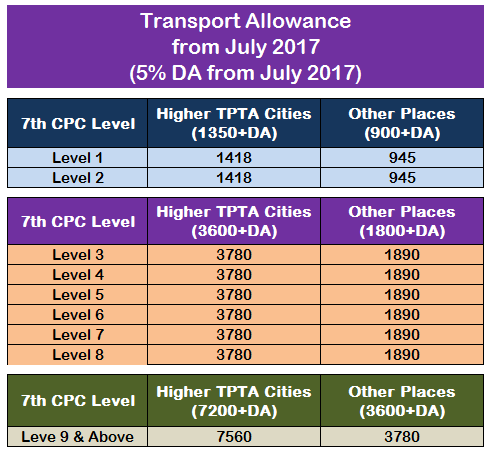
7th Pay Commission Transport Allowance from July 2017
Cabinet approved the release of additional 1% Dearness Allowance to Central Government employees and Dearness Relief to pensioners from July 1 2017. Revised DA will be applicable from July 1, 2017. After the announcement now DA percentage will be 5% for CG employees.
Now Transport allowance also increase based on the 5% Dearness Allowance.
7th Pay Commission Recommendation for Transport Allowance
The 7th Pay Commission recommendations on Transport Allowance was implemented by the Union Cabinet with no changes.
S. No. 1— Item no. 5(i) of the Standing Committee meeting of 25.10.2016.
JS(Admn and JCA) mentioned that as desired by the Staff Side, the minutes of the earlier meetings held on 07.05.2014, 25.02.2015 and 09.10.2015 had been circulated to the Secretary and members of the Staff-Side. It was decided that the item may be closed.
S. No. 2 – Include Grameen Dak Sewaks within the ambit of 7th CPC.
Department of Posts had informed through their letter dated 07.02.2017 that a one-man Committee constituted to look into the service conditions, emoluments and other facilities of Gramin Dak Sevaks has submitted its report and the same has been hosted on the website of the Department of Posts. Further, due to the then prevailing Model Code of Conduct, no further action could be taken till it was lifted in March, 2017. The representative of the Department of Posts informed that the report had been examined and the financial implications were being worked out. The proposal will then be forwarded to Ministry of Finance before taking a final view. The Staff-Side expressed satisfaction on the development. It was decided that the item may be closed.
S. No. 3 — Settle all anomalies of the Sixth Central Pay Commission.
Additional Secretary, Department of Pensions & Pensioners’ Welfare informed that in respect of one of the pending items viz. anomaly related to modified parity in pension had been settled and orders had been issued to this effect. It was decided that the updated statement may be re-circulated to all and this item taken up in the next meeting. The Staff-Side pointed out that there had been several items in the Anomaly Committee. ATS has not been circulated. The Official side assured to circulate the ATS on all anomaly committee items. It was then decided that the Staff- Side will present its views after it is circulated.
S. No. 4 — No privatisation, PPP or FDI in Railways and Defence Establishments.
Ministry of Railways had vide their O.M. dated 14.02.2017 intimated that following a meeting between Railway Minister and the highest office-bearers of AIRF and NFIR on 18.12.2014 on FDI and other issues, a Standing Committee has been set up to discuss and suggest ways of generating resources towards improving the financial health of Indian Railways. Following two more meetings on 20.07.2015 and 29.07.2015, the terms of reference have been expanded by adding the words “and productivity of Indian Railways”.
Members of Staff-Side rebutted that the reply of Ministry of Railways was not correct as the committee is not looking into the point raised in this agenda item. At this point, Chairman asked the representative of Ministry of Railways to share the terms of reference of the said Committee with the members of Staff Side.
On the point related to Ministry of Defence (MoD), the representative of the Ministry shared a Note on the ‘Status of FDI in Defence Sector’. As per the Note, defence manufacturing sector was opened for the first time in 2001 for 100% private sector participation including FDI. In 2001, the FDI upto 26% was allowed under the Government route (FIPB approval). Since then, the policy has been revised several times. The FDI Policy for defence sector was last revised in June 2016. As per the revised policy, FDI upto 49% is allowed under automatic route and beyond 49%, under Government route, wherever it is likely to result in access to modern technology or for other reasons to be recorded. FDI policy for defence is applicable to defence industry subject to Industrial Licence under the Industries(Development & Regulation) Act, 1951. The Policy is also applicable for manufacturing of small arms and ammunition under the Arms Act, 1959.
He clarified further that this sector badly needs capital investment and infusion of technology for which foreign investment can play a significant role. Investment promotion and technology transfer being of prime concern, Government believes that the amendments made in the policy could be the most trusted route to technology transfer which would help in increasing the defence production base and providing the much-needed impetus to self-reliance and indigenisation in defence sector.
Members of the Staff-Side stated that the present Policy is likely to impact the existing Defence Establishments like DRDO and Ordnance Factories. The recent decision of DDP to outsource 143 products produced by ordnance factories would affect the existence of the organization and its employees. This is against the assurance given by the Ministry of Defence that the products already being produced by ordnance factories would not be outsourced and, for any new products, ordnance factories would be given first preference. However all these major policy decisions were taken without any discussion with the Staff Side and without hearing their view points.
It was decided that the Ministry of Defence would be requested to hold discussion with the Staff side on the subject matter and accordingly the issue would be referred to Ministry of Defence.
It was decided that the item may be treated as closed.
Department of Posts has informed through their letter dated 07.02.2017 that there is no proposal of corporatization /privatization at this juncture. The said Department has further stated to be making efforts to give better and competitive services to the customers specifically in the areas of insurance, banking and parcels.
The Staff-Side representative confirmed that D/o Posts has communicated to them that there is no proposal to corporatize the postal services at this juncture. It was decided that the item may be treated as closed.
S. No. 6 — No ban on recruitment/creation of posts
Department of Expenditure had vide letter dated 05.01.2017 informed that they had already delegated power to Ministry of Railways to create work-charged posts vide I.D. dated 17.07.2015.However,for creation of work-charged posts at the level of SAG and above, Ministry of Railways is to approach the Cabinet for approval. JS(Personnel), Department of Expenditure reiterated that there was no ban on creation of posts. Further, at present there is no ban on recruitment of posts already in existence.
The Staff-Side contended that the reality is otherwise. Because whenever a new service or train is introduced, it is not followed up with creation of posts. As a result, the operations are suffering and the employees are working beyond duty hours. It was stated that often a proposal for creation of posts is returned with the rider of matching savings. They requested that a direction should go from the Chairman of the Standing Committee that no new service should be introduced till new posts are created.
Staff-Side also stated that in the last National Council meeting, the Cabinet Secretary had stated that that there cannot be ban on creation of posts for meeting operational needs. Hence, after informing that no recruitment has taken place to meet the increased operational requirement of Ministry of Railways, they argued that if the power to introduce new trains is delegated to the Railway Board, the power to create posts and make recruitment should also be delegated to the Board.
After hearing them, Chairman observed that in so far as the item is concerned, Department of Expenditure have clarified that there is no ban on recruitment on posts. In so far as creation of posts in M/o Railways is concerned, the following delegation has been made:
i) For ‘Revenue’ Non-Gazetted posts, Railway is allowed to continue with the existing system being followed by them for creation of posts. For creation of ‘Revenue’ Gazetted posts, for the posts below SAG level, approval of Finance Minister will be required and for posts at the level of SAG and above, approval of Cabinet will be required.’
ii) For Work-charged’ posts, Ministry of Railways is allowed to continue with the existing procedure for creation of posts below SAG level. For creation of Work-charged’ posts at the level of SAG and above, Ministry of Railways is advised to approach the Cabinet for approval.
iii) For the purpose of final Cadre strength of the Railway Services, as was done in the last Cadre Review, 75% of the Work-charged’ posts may be added to arrive at the final strength.
The moot point is which type of case should come to Department of Expenditure for approval. As such the Ministry of Railways have been delegated the power to make recruitments or create posts. The item can therefore be closed as settled.
It was admitted that the recruitment processes is slow. However, Government has been making efforts to make it faster by introducing modern technology. On the concerns expressed by the Staff-Side on security related aspects, the representative of Ministry of Railways was asked to take note of them.
It was also directed that the Ministry of Railways be informed of the new points raised by the Staff Side in this matter.
S. No. 7 — Scrap PFRDA Act and reintroduce the defined benefit statutory pension scheme.
The representative of Department of Financial Services informed that a committee has been constituted to look into the issue and suggest measures to streamline the NPS and make it more effective. It was informed that the Committee had also held discussion with the representatives of the Staff Side.
The Staff-Side stated that while discussions have been held, it has also been made clear by the said Committee that they cannot commit on a minimum pension. It was stated that although the defined benefit pension scheme has been re-introduced in many places and the experience of those organisations should be taken into account, the fact remains that employees are not getting any benefit of the New Pension Scheme though they are the people who have put in their money. It was informed that these concerns were expressed before the said Committee but there has been no response. Even a minimum assured pension as provided in CCS(Pension) Rules-1972, Family Pension, Disability Pension are not guaranteed and there is no provision for GPF.
Hearing the Staff-Side, Chairman remarked that the mandate of the Committee seems to be about the NPS and making it more effective. Noting that the Staff-Side are in favour of scrapping of the PFRDA Act and reverting to the old pension scheme, it was directed to the representatives of Department of Financial Services and Department of Pensions & Pensioners’ Welfare to bring the concerns expressed by the Staff-Side to the notice of the Committee set up to streamline the NPS.
It was also decided that in the light of discussions, the Staff- Side may await the report since the entire matter is with the NPS committee.
S. No. 8 – No outsourcing, contractorisation, privatisation of governmental function; withdraw the proposed move to close down the printing press, publication, form store and stationery departments and medical stores depots.
Ministry of Health & Family Welfare had vide O.M. No. B-12014/01 /2016- JCM dated 05.04.2017 informed that there was no proposal to close down the medical stores depots immediately. However, the house believes that MoHFW should hold discussion with the Staff-Side and recommends accordingly.
About printing presses, the representative of Ministry of Urban Development informed that a proposal is afoot to rationalize the Government of India Presses and modernize them. It was stated that there would be no retrenchment of the existing employees of the Presses and there may be redeployment of some staff. Regarding publication and stationery department, no decision has been taken so far. On this the Staff Side desired that whenever a decision is taken to re-deploy the staff, the stakeholders should be consulted.
It was decided that in view of the clarification provided by the Ministry of Urban Development that there would be no retrenchment, the part of the item concerning them may be closed. Further, Ministry of Urban Development may hold discussions with the Staff Side on deployment, as and when the stage comes.
S. No. 9 – Regularise the existing daily rated/casual and contract workers, and absorb trained apprentices. No labour reforms should be carried out which are not in the interest of workers.
Joint Secretary (Establishment), DoPT clarified that no proposal from Ministry of Railways had been received relating to grant of temporary status. He informed that the Ministry of Railways have their own scheme for regularisation of casual labourers with temporary status similar to the DoPT scheme. Staff site stated that the issue is about the causal labourers whose services were regularised after 01.01.2004 and why the entire temporary service period prior to regularisation should not be counted for reckoning the qualifying service for pensionary and other benefits. This is similar to item no.29 discussed later on.
Staff-Side stated that Ministry of Railways had sent a proposal that those who had temporary status as on 1st January 2004 before the introduction of new pension scheme in 2004 should be covered under the old pension scheme. DoPT, in its response to Ministry of Railways, had proposed for a methodology of screening. To an observation that DoPT is not giving replies, JS(E), informed that the instructions issued by DoPT on 26.02.2016 on contribution to GPF and Pension under the old pension scheme have already addressed this situation and such employees would be covered under that. Further discussion on this point followed later.