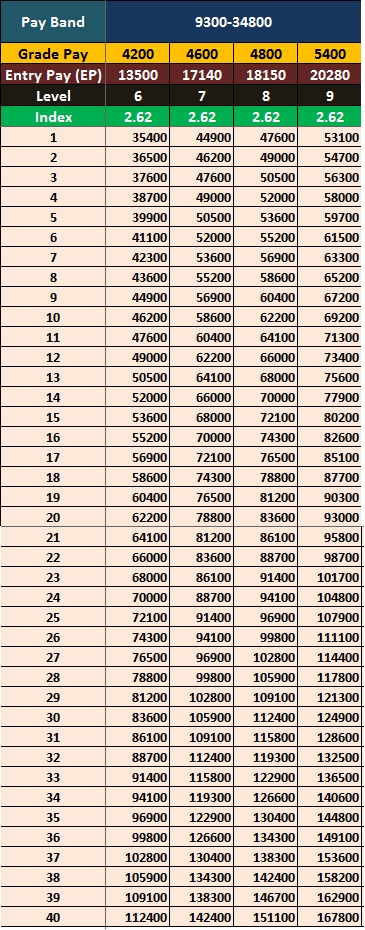
A 23.55% pay hike has been recommended for central government employees by Justice A K Mathur in his Seventh Pay Commission report that was submitted to Finance Minister Arun Jaitley today.
Within this the increase in pay will be 16% ,63% in allowances & 24% in pension
A minimum salary of Rs 18,000 and a minimum increment of 3% has also been recommended. Maximum salary will be Rs 2,25,000.
The recommendations will directly impact 50 lakh central government employees and 54 lakh pensioners.
One Rank One Pension has been recommended for central govt staffers as well as armed forces
52 allowances will be abolished and for defence personnel 36 allowances will be merged.
“In the 900-page report of Seventh Pay Commission, we’ve heard all parties, seen hardships of people,” said Justice Mathur
Total financial impact in FY 2016-17 is likely to be Rs 1,02,100 crore, which is 0.65% of GDP.
The Pay Commission report has to be implemented from January 1, 2016.
7th pay commission likely to propose 23% salary hike for govt staff
In a bonanza for central government employees, the Seventh Pay Commission is likely to recommend on Thursday, a 22-23% jump in their salary and allowances, people familiar with the matter said.
The Pay Commission headed by Justice A.K. Mathur has suggested a 15% increase over the basic salary plus dearness allowance (DA) for the central government staff, they said, adding that an increase in allowances like house rent allowance (HRA) has also been recommended.
The total increase will be 22-23% of the gross salary (basic plus DA plus allowances), the sources said. The recommendations of the Seventh Pay Commission are scheduled to take effect from 1 January 2016.
Besides chairman, other members of the commission are Vivek Rae, a retired IAS officer of 1978 batch, and Rathin Roy, an economist. Meena Agarwal is secretary of the commission.
The central government constitutes the pay commission every 10 years to revise the pay scale of its employees and often these are adopted by states after some modifications.
The commission was set up by the UPA government in February 2014 to revise remuneration of about 48 lakh central government employees and 55 lakh pensioners.
The Union cabinet had extended the term of the panel in August by four months, till December. The 6th Pay Commission was implemented with effect from 1 January 2006.
DOPT prohibit the Government servants from participating the NJCA dharna on 19.11.2015
DEVESH CHATURVEDI,
JOINT SECRETARY
GOVERNMENT OF INDIA
DEPARTMENT OF PERSONNEL & TRAINING
MINISTRY OF PERSONNEL, PUBLIC GRIEVANCES AND PENSIONS
NORTH BLOCK, NEW DELHI-110001
Dated the 17th November, 2015
D.O. No.33012/3(s)/2015-Estt-B
Dear sir / Madam
National Joint Council of Action (NJCA) has proposed a dharna on 19th November, 2015 in pursuance of their charter of demands.
2. The instructions issued by the Department of Personnel & Training prohibit the Government servants from participating in any form of strike including mass casual leave, go-slow etc. or any action that abet any form of strike in violation of Rule 7 of the CCS (Conduct) Rules, 1964. Besides, in accordance with the proviso to Rule 17 (1) of the Fundamental Rules, pay and allowances is not admissible to an employee for his absence from duty without any authority. As to the concomitant rights of an Association after it is formed, they cannot be different from the rights which can be claimed by the individual members of which the Association is composed. It follows that the right to form an Association does not include any guaranteed right to strike. There is no statutory provision empowering the employees to go on strike. The Supreme Court has also agreed in several judgments that going on a strike is a grave misconduct under the Conduct Rules and that misconduct by the Government employees is required to be dealt with in accordance with the law. Any employee going on strike in any form would face the consequences which, besides deduction of wages, may also include appropriate disciplinary action. In this connection, your kind attention is also drawn to this Department’s OM No. 33012/1(s)/2008-Estt (B) (pt) dated 12 th September, 2008 (copy enclosed)
3. A Joint Consultative Machinery for Central Government employees is already functioning. This scheme has been introduced with the object of promoting harmonious relations and of securing the greatest measure of cooperation
between the Government, in its capacity as employer, and the general body of its employees in matters of common concern, and with the object, further of increasing the efficiency of the public service. The JCM at the different levels have been discussing issues brought before it for consideration and either reaching amicable settlement or referring the matter to the Board of Arbitration in relation to pay and allowances, weekly hours of work and leave, whenever no amicable settlement could be reached in relation to these items.
4. The Central Government Employees under your Ministry/Departments may, therefore, be suitably informed of the aforesaid instructions under the Conduct Rules issued by this Department and other regulations upheld by the
Hon’ble Supreme Court and dissuaded from resorting to strike in any form.You may also issue instructions not to sanction Casual Leave or other kind of leave to employees if applied for, during the period of the proposed strike and ensure that the willing employees are allowed hindrance free entry into the office premises. For this purpose, Joint secretary (Admn) may be entrusted with the task of coordinating with security personnel. Suitable contingency plan may also be worked out to carry out the various functions of the Ministry/Department.
5. In case the employees go on strike, a report indicating the number of employees who took part in the proposed strike may be conveyed to this Department on the evening of the day.