Consumer Price Index for Industrial Workers (2016=100) – February, 2026
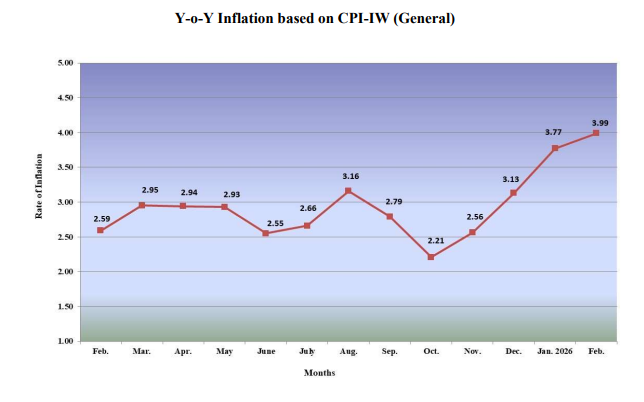
1. Labour Bureau, an attached office of the M/o Labour & Employment, has been compiling Consumer Price Index for Industrial Workers every month on the basis of retail prices collected from 317 markets spread over 88 industrially important centres in the country. The index for the month of February, 2026 is being released in this press release.
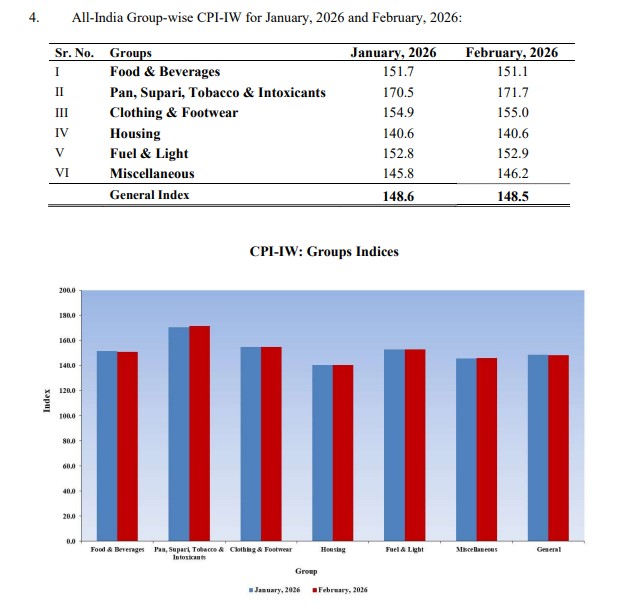
2. The All-India CPI-IW for February, 2026 decreased by 0.1 points and stood at 148.5 points (one hundred forty-eight point five).
8th CPC’s Visit to Dehradun: Stakeholder Meetings Set for 24 April 2026; Applications Open Until 10 April
No.25/1/2026-App/8CPC Government of India Eighth Central Pay Commission
30th March, 2026
NOTICE
A team of the Eighth Central Pay Commission shall be visiting Dehradun, Uttarakhand on 24th April, 2026. Interested stakeholders including Central Government Organizations/Institutions and Unions/Associations desirous of interacting with the Commission at Dehradun may kindly submit their request seeking an appointment at [email protected] on or before 10th April, 2026. Venue details and meeting schedule shall be intimated subsequently.
Sd/- Manish Kumar Director Eighth Central Pay Commission
8th CPC Update: Govt Confirms 18-Month Timeline for Pay, Allowance, and Pension Recommendations
GOVERNMENT OF INDIA MINISTRY OF FINANCE DEPARTMENT OF EXPENDITURE
LOK SABHA UNSTARRED QUESTION No. 4851
TO BE ANSWERED ON MONDAY, MARCH 23, 2026 CHAITRA 02, 1948 (SAKA)
“8th Central Pay Commission (CPC)”
Shri Raja A:
Will the Minister of FINANCE be pleased to state:
(a) whether Chairperson and members have been appointed for the 8th Central Pay Commission (CPC) and if so, the current status thereof;
(b) the key areas under review by the said CPC, including proposed changes in the pay scales, salaries/allowances and pension structures;
(c) the timeline proposed for submission of the CPC report along with the Government’s roadmap for implementation of its recommendations; and
(d) whether the Government has made any assessment of the fiscal impact of implementing the CPC recommendations on the Union Budget, if so, the details thereof?
ANSWER MINISTER OF STATE IN THE MINISTRY OF FINANCE (SHRI PANKAJ CHAUDHARY)
(a) to (c): The Government has notified Resolution dated 03.11.2025 for constitution of 8th Central Pay Commission (CPC), along with appointment of the Chairperson and Members, that will make its recommendations on various issues viz. Pay, Allowances, Pension, etc. of the Central Government employees within 18 months of its constitution.
(d): The fiscal impact of the recommendations of 8th CPC will be known, once the recommendations are made by the 8th CPC and are accepted by the Government
भारत सरकार वित्त मंत्रालय व्यय विभाग
लोक सभा
लिखित प्रश्न संखया – 4851
सोमवार, 23 मार्च; 2026/02 चेंत्र 7948 (शक)
8वां केन्द्रीय वेतन आयोग
श्री ए. राजा:
क्या वित्त मंत्री यह बताने की कृपा करेंगे किः
(क) कया 8वें केन्द्रीय वेतन आयोग (सीपीसी) के लिए अध्यक्ष और सदस्यों की नियुक्ति की गई है और यदि हां, तो तत्संबंधी वर्तमान स्थिति क्या है;
(ख) वेतनमान, वेतन/भत्ते और पेंशन ढांचों में प्रस्तावित बदलावों सहित उक्त वेतन आयोग दवारा किन-किन प्रमुख क्षेत्रों की समीक्षा की जा रही है;
(ग) सीपीसी संबंधी रिपोर्ट प्रस्तुत करने के लिए प्रस्तावित समय-सीमा क्या है और इसकी सिफारिशों के कार्यान्वयन के लिए सरकार की रूपरेखा क्या है; और
(घ) क्या सरकार ने सीपीसी की सिफारिशों को लागू करने के केन्द्रीय बजट के संबंध में राजकोषीय प्रभाव का कोई आकलन किया है, यदि हां, तो तत्संबंधी ब्यौरा क्या है?
उत्तर वित्त राज्य मंत्री (श्री पंकज चौधरी)
(क) से (ग): सरकार ने अध्यक्ष और सदस्यों की नियुक्ति के साथ 8वें केंद्रीय वेतन आयोग (सीपीसी) के गठन के लिए दिनांक 03.11.2025 के संकल्प को अधिसूचित किया है, जो अपने गठन के 18 महीने के भीतर केंद्र सरकार के कर्मचारियों के वेतन, भत्ते, पेंशन आदि जैसे विभिन्न मुद्दों पर अपनी सिफारिशें प्रस्तुत करेगा।
(घ): 8वें केन्द्रीय वेतन आयोग की सिफारिशों के राजकोषीय प्रभाव के संबंध में तब ही ज्ञात हो पाएगा, जब 8वें केन्द्रीय वेतन आयोग द्वारा सिफारिशें की जाएंगी और सरकार दवारा इन्हें स्वीकार कर लिया जाएगा।
In a significant move for millions of central government employees and pensioners, the 8th Central Pay Commission (CPC) has officially extended the deadline for submitting responses to its comprehensive questionnaire. Originally set for March 16, 2026, the new submission cutoff is now March 31, 2026.
This extension provides a crucial window for stakeholders to voice their opinions on the future of government pay structures, allowances, and service conditions.
Key Highlights of the Extension
The Commission, headed by Justice Ranjana Prakash Desai, decided on the extension following multiple requests from employee unions and associations who sought more time to formulate detailed, evidence-based responses.
Feature
Details
New Deadline
March 31, 2026 (11:45 PM IST)
Submission Mode
Exclusively via the MyGov portal
Language
Available in both English and Hindi
Anonymity
Responses are analyzed on an aggregate, non-attributable basis
What the Questionnaire Covers
The 18-point questionnaire is designed to gather feedback on critical structural changes. It serves as the foundation for the Commission’s eventual recommendations to the Union Cabinet. Key focus areas include:
Pay Structure & Fitment Factor: Feedback on the multiplier used to jump from 7th CPC to 8th CPC salaries. Unions are currently advocating for a fitment factor between 2.86 and 3.25.
Uniformity vs. Benchmarking: Whether compensation should be uniform across departments or benchmarked against private sector peers (e.g., comparing government engineers to private firm standards).
Pension Provisions: Revisions to the pension system and the potential inclusion of new price indices for Dearness Relief (DR) calculations.
Allowances: The rationalization of House Rent Allowance (HRA), Travel Allowance (TA), and specialized perks for sectors like Defence, Railways, and Atomic Energy.
Who Should Participate?
The Commission has emphasized that this is a broad consultation process. The following stakeholders are encouraged to submit their views:
Current Central Government and Union Territory employees.
Pensioners and retired personnel.
Employee Unions and Associations (e.g., NC-JCM, AITUC, FNPO).
Judicial Officers and Court employees.
Academicians and Researchers specializing in public finance.
How to Submit Your Response
Stakeholders must log in to the MyGov portal using a registered mobile number or email ID verified via OTP.
Important Note: The Commission has explicitly stated that physical paper copies, emails, or PDF submissions will not be considered. All feedback must be digital to ensure proper data analysis.
Looking Ahead
The 8th CPC was formally notified in late 2025 and has been given 18 months to submit its final report. While the standard 10-year cycle suggests an implementation date of January 1, 2026, the actual rollout often occurs later with retrospective arrears. This consultation phase is the most critical opportunity for employees to ensure their economic concerns—especially regarding inflation and the cost of living—are formally documented.
🚨 Update on 8th Pay Commission Last date for submission of responses to the 8thCPC Questionnaire has been extended till 31.03.2026. All stakeholders are requested to utilize the extended timeline and submit their inputs.#8thpaycommission 🔗 link https://t.co/PlgdDzQcDOpic.twitter.com/lzZXJjWDLo
Format for submission of memorandum to the 8th CPC online: IRTSA
INDIAN RAILWAYS TECHNICAL SUPERVISORS’ ASSOCIATION
No:IRTSA/Memo/7/8th CPC Memorandum
Date: 16.03.2026
CHAIR PERSON, 8th Central Pay Commission, 3rd Floor, Chanderlok Building, Janpath, New Delhi — 110001
Respected Justice,
Sub: Format for submission of memorandum to the 8th CPC online.
All Central Government Employees and Pensioners wholeheartedly welcome 8th CPC and are happy to witness its functioning utilizing on-line services. We would like to bring to your kind notice the following concerns and request for their redressal;
1) The nine online themes presently proposed do not cover all the areas addressed by the previous Pay Commissions. Therefore, it is requested that the number of themes may kindly be increased, taking into consideration the experience and scope of earlier Pay Commissions, so that all relevant aspects are adequately covered.
2) Restriction of 3500 characters each for concerns/views and response to challenges/problems for nine themes are grossly insufficient and size for supporting document as one attachment is very minimum. Number of characters for each theme may please be increased substantially and supporting documents for every theme without restriction in size may please be allowed.
3) No specific provision available for expression of concerns/views and response to challenges/problems attached to specific multiple categories. For example, IRTSA wishes to represent for categories Junior Engineer, Senior Section Engineer, (working in four technical departments with different suffix in designation) Chemical & Metallurgical Assistant, Chemical & Metallurgical Superintendent, Depot Material Superintendent, Chief Depot Material Superintendent, Junior Engineer (IT) and Senior Engineer (IT) working in Indian Railways. There should be provision for expression of concerns/views and response to challenges/problems attached to each category/designation.
4) 7th CPC has dealt with 196 allowances. In 8th CPC theme, only 12 groups of allowances are mentioned. Since each allowance is given for specific purpose, to different group of staff, provision given in 8th CPC theme format is insufficient. Theme for allowances may please be expanded to cover all allowances.
5) There is no specific mention about pension & family pension. Even though major retirement benefits are mentioned some other retirement benefits are missing. This theme may please be expanded accordingly
6) In career progression theme only MACPS is mentioned. Career progression should primarily be focused on functional promotions hence this theme may please be modified accordingly.
7) The Central Government staff structure is presently based on the classification of posts into Group A, Group B, and Group C. Over the time, significant changes have occurred in the nature of duties, responsibilities, technological advancements, and organizational requirements across various departments. In view of these developments, any modification or improvement in the existing classification structure warrants a comprehensive and detailed examination by the 8th Central Pay Commission. It is therefore requested that the issue of classification of posts may kindly be included as one of the themes for detailed study and consideration by the 8th Central Pay Commission, so that an appropriate and updated framework may be evolved keeping in view the present administrative and functional requirements.
8) Specific provisions should be made for posting Judgements of Hon’ble Central administrative Tribunals, Hon’ble High Courts and Hon’ble Supreme Court of India arising out of legal cases filed by respective Unions/Associations/Individuals.
9) 8th CPC is requested to receive physical copies of memorandum by Unions and Associations over and above submission of memorandum Online.
Next Increment after Stepping up of Pay: Lok Sabha QA
GOVERNMENT OF INDIA MINISTRY OF PERSONNEL, PUBLIC GRIEVANCES AND PENSIONS (DEPARTMENT OF PERSONNEL & TRAINING)
LOK SABHA UNSTARRED QUESTION NO.3210 (ANSWERED ON 11.03.2026)
NEXT INCREMENT AFTER STEPPING UP OF PAY
SHRI ANAND BHADAURIA:
Will the PRIME MINISTER be pleased to state:
(a) whether as per the OM of Department of Personnel and Training dated 13.09.2022 regarding next increment after stepping up of pay, the senior officer shall be entitled to the next increment on completion of the required qualifying service w.e.f. the date of re-fixation of the pay;
(b) if so, the details of required qualifying period for next increment from the date of stepping up under 7th Central Pay Commission in cases where stepping up has been allowed under Rule 7, Note 10 of CCS (RP) Rules, 2016;
(c) whether Hon’ble Delhi High Court in W.P(C) 12452/2023 has ruled that stepping of pay is personal to senior employee only to remove the anomaly due to junior drawing higher pay than the senior and stepping up of pay does not affect the date of next increment of senior employee; and
(d) if so, the details of orders issued in response to said order?
ANSWER MINISTER OF STATE IN THE MINISTRY OF PERSONNEL, PUBLIC GRIEVANCES AND PENSIONS AND MINISTER OF STATE IN THE PRIME MINISTER’S OFFICE (DR. JITENDRA SINGH)
(a): Department of Personnel and Training (DoP&T) has issued information document on pay fixation of Government Servant on 13.09.2022 for the facility of reference and guidance. As per para 2(ii) of DoP&T OM No. 4/3/2017-Estt.(Pay-I) dated 26.10.2018 as also contained in abovesaid document dated 13.09.2022, the senior officer shall be entitled to the next increment after stepping up of pay on completion of the required qualifying service w.e.f. the date of re-fixation of the pay.
(b): The date of next increment in 7th Central Pay Commission pay structure is governed under Rule 10 of Central Civil Services (Revised Pay) Rules, 2016, the extract of which has been annexed herewith.
(c): The Judgement of the Hon’ble High Court of Delhi dated 05.10.2023 in W.P.(C) No.12452/2023 is a matter of public record and is available on the official website of Hon’ble Delhi High Court (https://www.delhihighcourt.nic.in/web/>Case Status).
(d): The Judgement of the Hon’ble High Court of Delhi dated 05.10.2023 in W.P.(C) No. 12452/2023 has been implemented in respect of applicant of the case.
Annexure
Rule 10 of the Central Civil Services (Revised Pay) Rules, 2016 referred to in inputs of Lok Sabha Un-starred Question No. 3210 for 11.03.2026
Date of next increment in revised pay structure:-
“(1) There shall be two dates for grant of increment namely, 1st January and 1st July of every year, instead of existing date of 1st July:
Provided that an employee shall be entitled to only one annual increment either on 1st January or 1st July depending on the date of his appointment, promotion or grant of financial upgradation.
(2) The increment in respect of an employee appointed or promoted or granted financial upgradation including upgradation under Modified Assured Career Progression Scheme (MACPS) during the period between the 2nd day of January and 1st day of July (both inclusive) shall be granted on 1st day of January and the increment in respect of an employee appointed or promoted or granted financial upgradation including upgradation under MACPS during the period between the 2nd day of July and 1st day of January (both inclusive) shall be granted on 1st day of July.
Illustration:
(a) In case of an employee appointed or promoted in the normal hierarchy or under MACPS during the period between the 2nd day of July, 2016 and the 1st day of January, 2017, the first increment shall accrue on the 1st day of July, 2017 and thereafter it shall accrue after one year on annual basis.
(b) In case of an employee appointed or promoted in the normal hierarchy or under MACPS during the period between 2nd day of January, 2016 and 1st day of July, 2016, who did not draw any increment on 1st day of July, 2016, the next increment shall accrue on 1st day of January, 2017 and thereafter it shall accrue after one year on annual basis:
Provided that in the case of employees whose pay in the revised pay structure has been fixed as on 1st day of January, the next increment in the Level in which the pay was so fixed as on 1st day of January, 2016 shall accrue on 1st day of July, 2016:
Provided further that the next increment after drawal of increment on 1st day of July, 2016 shall accrue on 1st day of July, 2017.
(3) Where two existing Grades in hierarchy are merged and the junior Government servant in the lower Grade happens to draw more pay in the corresponding Level in the revised pay structure than the pay of the senior Government servant, the pay of the senior government servant shall be stepped up to that of his junior from the same date and he shall draw next increment in accordance with this rule.”
Revision of Basic Pension for Public Sector Bank Retirees: Lok Sabha QA
GOVERNMENT OF INDIA MINISTRY OF FINANCE DEPARTMENT OF FINANCIAL SERVICES
LOK SABHA UNSTARRED QUESTION NO. 2709
ANSWERED ON MONDAY, MARCH 9, 2026 / PHALGUNA 18, 1947 (SAKA)
Revision of Basic Pension for Public Sector Bank Retirees
SHRI KONDA VISHWESHWAR REDDY:
Will the Minister of FINANCE be pleased to state:
(a) whether the Government is aware that the Ministry of Finance has approved a 10% increase on basic pension plus Dearness Allowance (DA) with effect from 1st November, 2022 for pensioners of Reserve Bank of India and National Bank for Agriculture and Rural Development, if so, the details thereof;
(b) whether there is any proposal under consideration to revise or increase the basic pension of retirees of Public Sector Banks, whose basic pension has reportedly not been revised for nearly three decades;
(c) if so, the details thereof, bank-wise, if not, the reasons therefor; and
(d) whether the Government proposes to initiate discussions with the Indian Banks’ Association and employee unions to address the long-pending demand for revision of basic pension of Public Sector Bank retirees and if so, the details thereof?
ANSWER MINISTER OF STATE IN THE MINISTRY OF FINANCE (SHRI PANKAJ CHAUDHARY)
(a): Ministry of Finance vide letter dated 22.01.2026 has accorded approval to Reserve Bank of India regarding its proposal for an increase of 10% in basic pension plus dearness relief with effect from 01.11.2022, for all pre-01.11.2022 retirees.
As regards National Bank for Agriculture and Rural Development (NABARD), the Ministry has revised the pensions of all pre-01.11.2017 retirees. The said revision is effective from 01.03.2019 for pre-01.11.2012 retirees and from 12.06.2023 for pre-01.11.2017 retirees. Further, no proposal for revision of pension of pre-1.11.2022 retirees of NABARD has been received.
(b) to (d): Public Sector Banks (PSBs) comprises of the State Bank of India (SBI) and eleven Nationalised Banks. Pension in SBI is governed by State Bank of India Employees’ Pension Fund Regulations, 2014, framed with the approval of their Central Board and in Nationalised banks, the same is governed by their Bank (Employees’) Pension Regulations, 1995, framed with the approval of respective banks’ board. These regulations do not have provision for revision of pension. However, pensioners of PSBs are being granted dearness relief on pension and the same is being increased from time to time i.e. on half yearly basis. Also, as per the agreed terms of 12th Bi-partite Settlement / 9th Joint Note, monthly Ex-gratia is being paid by PSBs in addition to the pension / family pension to the pensioners / family pensioners, who became eligible to draw pension on or before 31.10.2022.
No proposal to revise the basic pension of retirees of PSBs beyond the existing provisions of the relevant Pension Regulations, is presently under consideration.
Will the Government Set Up a Separate Pay Revision Committee for CPSU Employees on the Lines of the 8th Central Pay Commission?
GOVERNMENT OF INDIA MINISTRY OF FINANCE DEPARTMENT OF PUBLIC ENTERPRISES
LOK SABHA UNSTARRED QUESTION NO. 253
TO BE ANSWERED ON THE 09th MARCH, 2026
SEPARATE PAY REVISION COMMITTEE FOR CPSUS
SHRI LAXMIKANT PAPPU NISHAD:
Will the Minister of FINANCE be pleased to state:
(a) whether the Government is considering setting up a separate and institutional Pay Revision Committee (PRC) on the lines of the 8th Central Pay Commission for about 8 lakh non-executive employees and officers below the board level working in Central Public Sector Undertakings (CPSUs) to revise their salaries with effect from 2027, similar to that of PSU officers, if so, the details thereof;
(b) whether the Government acknowledge that the pay/wage revision process, formula for bonus/PRP, percentage of allowances and perks, and the pattern of profit sharing for officers and staff in CPSUs to revise their salaries with vary significantly and are inconsistent from CPSU to CPSU, thereby violating the principle of equal pay for equal work; and
(c) if so, the steps are being taken by the Government to standardise the said process and make the same more equitable?
ANSWER THE MINISTER OF STATE OF FINANCE (SHRI PANKAJ CHAUDHARY)
(a) There is no proposal under consideration for setting up a separate and institutional Pay Revision Committee (PRC) for non-executive employees and officers below Board level working in Central Public Sector Enterprises (CPSEs).
(b) & (c): Variations in pay, allowances and incentives across CPSEs reflect differences in financial capacity, performance. The Government issues periodic uniform guidelines to ensure transparency, affordability and broad parity, while preserving the functional autonomy of CPSEs
Option for Pay Fixation under Statutory Rules: Lok Sabha QA
GOVERNMENT OF INDIA MINISTRY OF FINANCE DEPARTMENT OF EXPENDITURE
LOK SABHA UNSTARRED QUESTION No. 2590
TO BE ANSWERED ON MONDAY, MARCH 9, 2026/PHALGUNA 18, 1947 (SAKA)
OPTION FOR PAY FIXATION UNDER STATUTORY RULES
SHRI SRIBHARAT MATHUKUMILLI:
Will the Minister of Finance be pleased to state:
a) whether pay fixation on promotion/financial upgradation of Central Government employees is governed by Statutory Rules namely the Central Civil Services (Revised Pay) Rules, 2016 and Fundamental Rule FR 22(i)(a)(1);
b) if so, whether employees who were promoted or granted financial upgradation under the Modified Assured Career Progression (MACP) Scheme between 01.01.2016 and 01.07.2016, who opted under Rule 5 of the CCS (RP) Rules, 2016, are eligible to exercise the option under the statutory proviso to FR 22(i)(a)(1) for regulation of their pay and to switch over to the 7th CPC Pay Matrix from the date of their next increment, i.e., 01.07.2016; and;
c) if not, the reasons therefor?
ANSWER MINISTER OF STATE IN THE MINISTRY OF FINANCE (SHRI PANKAJ CHAUDHARY)
(a): Pay fixation on promotion/financial upgradation of Central Government employees on or after 1st day of January, 2016 is governed by Central Civil Servies (Revised Pay) Rules, 2016 and Fundamental Rules (FRs).
(b) & (c): Such cases are examined under the provisions of Rule 5 of the CCS(RP) Rules, 2016 and Department of Personnel & Training’s O.M. dated 27.07.2017.
Regulation of Increment in cases of Stepping Up of Pay Under CCS (RP) Rules, 2016: Lok Sabha QA
GOVERNMENT OF INDIA MINISTRY OF FINANCE DEPARTMENT OF EXPENDITURE
LOK SABHA UNSTARRED QUESTION No. 2611
TO BE ANSWERED ON MONDAY, MARCH 9, 2026/PHALGUNA 18, 1947 (SAKA)
REGULATION OF INCREMENT IN CASES OF STEPPING UP OF PAY UNDER CCS (RP) RULES, 2016
SHRI ANAND BHADAURIA:
Will the Minister of Finance be pleased to state:
(a) whether the next annual increment in cases of stepping up of pay of senior employees at par with that of their junior employees under Rule 7(10) of the Central Civil Services (Revised Pay) Rules, 2016 is governed by Rule 10 of the said Rules;
(b) if so, whether the Hon’ble Delhi High Court in W.P. (C) No. 12452/2023 has ruled that stepping up of pay is personal to the senior employee and only to remove the anomaly arising from a junior drawing higher pay than the senior, and that such stepping up of pay does not affect the date of next increment of the senior employee;
(c) if so, the details thereof;
(d) whether, in terms of Rule 15 of the Central Civil Services (Revised Pay) Rules, 2016, Rule 10 has an overriding effect over any other Rules and provisions, including the Fundamental Rules; and
(e) if so, whether the Government proposes to issue general instructions/orders in compliance with the aforesaid judgment of the Hon’ble Delhi High Court, if not, the reasons therefor?
ANSWER MINISTER OF STATE IN THE MINISTRY OF FINANCE (SHRI PANKAJ CHAUDHARY)
(a): The date of next increment in 7th Central Pay Commission pay structure is governed under Rule 10 of Central Civil Services (Revised Pay) Rules, 2016.
(b) & (c): The Judgement of the Hon’ble High Court of Delhi dated 05.10.2023 in W.P. (C) No. 12452/2023 is a matter of public record and is available on the official website of Hon’ble Delhi High Court (https://www.delhihighcourt.nic.in/web/ > Case Status)
(d): The Rule 15 of the CCS(RP) Rules, 2016 provides that “Overriding effect of rules – The provisions of the Fundamental Rules, the Central Civil Services (Revision of Pay) Rules, 1947, the Central Civil Services (Revised Pay) Rules, 1960, the Central Civil Services (Revised Pay) Rules, 1973, the Central Civil Services (Revised Pay) Rules, 1986, the Central Civil Services (Revised Pay) Rules, 1997 and the Central Civil Services (Revised Pay) Rules, 2008 shall not saveas otherwise provided in these rules, apply to cases where pay is regulated under these rules, to the extent they are inconsistent with these rules”.
(e): The Judgement of the Hon’ble High Court of Delhi dated 05.10.2023 in W.P. (C) No. 12452/2023 has been implemented in respect of applicant of the case.