Home Blog Page 10

Small Savings Schemes interest rate from Jan 2026 to March 2026

Small Savings Schemes interest rate from Jan 2026 to March 2026

SB Order No. 17/2025

F. No 113-03/2024
Government of India
Ministry of Communications
Department of Posts
(Financial Services Division)

Dak Bhawan, New Delhi — 110001
Dated: 31.12.2025

To

All Head of Circles/Regions

Subject: Revision of interest rates for Small Savings Schemes w.e.f. 01.01.2026

Madam / Sir,

The undersigned is directed to intimate that. vide memorandum No. 1/4/2019-NS dated 31.12.2025 (copy enclosed), Government of India, Ministry of Finance, Department of Economic Affairs (Budget Division) has informed that the rates of interest on various Small Savings Schemes (National Savings Schemes) for the fourth quarter of financial year 2025-26 (starting from 1st January, 2026 and ending on 31st March, 2026) shall remain unchanged from those notified for the third quarter (1st October, 2025 to 31st December, 2025) of FY 2025-26.

2. It is requested to circulate it to all concerned for information and necessary guidance. This may also be placed on the notice board of all Post Offices in public area.

3. This issues with the approval of the Competent Authority.

(Devender Kumar Sharma)
Assistant Director (SB-II)

Copy to: –

  1. Sr. PPS to Secretary (Posts)
  2. Sr. PPS/PPS to Director General Postal Services
  3. PPS/ PS to Member (Financial Services)/Member (O)/Member (P)/ Member (HRD)/ Member (Tech)/ Member (Service Quality and Marketing), Member (Infrastructure), AS & FA
  4. Addl. Director General, APS, New Delhi
  5. Chief General Manager, BD Directorate / Parcel Directorate / PLI Directorate.
  6. CGM. CEPT for kind information and necessary action
  7. Sr. Deputy Director General (Vig) & CVO) /Sr. Deputy Director General (PAF)
  8. Director, RAKNPA / Directors of all PT’Cs
  9. Director General P & T (Audit), Civil Lines, New Delhi
  10. Secretary, Postal Services Board / All Deputy Directors General
  11. All General Managers (Finance) / Directors Postal Accounts / DDAP
  12. The Joint Director & HOD. National Savings Institute, ICCW Building, 4 Deendayal Upadhyay Marg, New Delhi-110002
  13. The Under Secretary, MOF (DEA), NS-II Section, North Block, New Delhi.
  14. All recognized Federations / Unions / Associations
  15. Guard File/e-File

(Devender Sharma)
Assistant Director (SB-II)

InstrumentRates of interest
Savings Deposit4
1 Year Time Deposit6.9
2 Year Time Deposit7
3 Year Time Deposit7.1
4 Year Time Deposit7.5
5 Year Recurring Deposit6.7
Senior Citizen Savings Scheme8.2
Monthly Income Account Scheme7.4
National Savings Certificate7.7
Public Provident Fund Scheme7.1
Kisan Vikas Patra7.5 (will mature in 115 months)
Sukanya Samriddhi Account Scheme8.2

Follow us on WhatsApp, Telegram, Twitter and Facebook for all latest updates
Accumulation of paid leave without encashment facilities for Gramin Dak Sevaks

Accumulation of paid leave without encashment facilities for Gramin Dak Sevaks

सं/No. 17-12/2025-GDS
भारत सरकार/Government of India
संचार मंंत्रालय /Ministry of Communications
डाक विभाग/Department of Posts
(जीडीएस अनुभाग/GDS Section)

डाक भवन, संसद मार्ग,
Dak Bhawan, Sansad Marg,
नई दिल्‍ली/New Delhi – 110 001
दिनांक/Date : 30-12-2025

OFFICE MEMORANDUM

Subject : Accumulation of paid leave without encashment facilities for Gramin Dak Sevaks (GDS) – reg.

A proposal for allowing accumulation of paid leave without encashment facilities was under consideration of the Department for quite some time. The Department had also sought suggestions/feed back of the Circles/stakeholders on the proposal.

2. After examination of the proposal and feed back of all the stakeholders, Rule-7, regarding paid Leave of the GDS, ofGDS (Conduct and Engagement) Rules, 2020, has been amended as under:

7. Leave

The Gramin Dak Sevaks may be granted paid leave at the rate of 20 days in a year (10 days for every half year). Paid leave for 10 days will be credited to his account at the beginning of half year, starting 1st January or 1st July;

A GDS will be allowed to carry forward unavailed paid leave to the maximum extent of 45 days at any given time;

Paid leave shall be credited to the leave account of GDS at the rate of 1.67 days for each completed calendar month of engagement which a GDS is likely to render in a half-year of the calendar year of engagement/discharge/cessation of engagement;

While affording credit of paid leave, fractions of a day shall be rounded off to the nearest day. A fraction of 0.5 or above will be taken as one day of leave, while fraction of less than 0.5 will be ignored and

Provided that –

a. Where a Sevak fails to resume duty on the expiry of the maximum period leave admissible and granted to him/her, or

b. Where such a Sevak who is granted leave for a period less than the maximum period admissible to a Sevak under these rules, remains absent from duty for any period which together with the leave granted exceeds the limit upto which a GDS shall, unless the Government, in view of the exception circumstances of the case, otherwise decides, be removed from engagement after following the procedure laid down in Rule 10.

3. The above change in the said Rule-7 of GDS (Conduct and Engagement) Rules, 2020, will effective from 01.01.2026.

4. Based on the feed back sought of the stakeholders, an FAQs is also provided in Annexure-I to this OM for the guidance of all concerned.

5. Hindi Version of this O.M will follow.

(Ravi Pahwa)
Director (GDS)

Follow us on WhatsApp, Telegram, Twitter and Facebook for all latest updates
NPS Vatsalya Scheme Guidelines 2025: PFRDA Circular

NPS Vatsalya Scheme Guidelines 2025: PFRDA Circular

PENSION FUND REGULATORY AND DEVELOPMENT AUTHORITY

Circular

Circular No. PFRDA/2026/02/NPS-Vatsalya/01

07th January, 2026

To,
All Stakeholders under NPS

Subject: NPS Vatsalya Scheme Guidelines 2025

“NPS Vatsalya” Scheme was launched by the Hon’ble Finance Minister in the Union Budget of FY 2024-25 as a plan for contribution by parents and guardians for minors, marking a significant advancement in financial planning and setting a new standard for prudent financial management from a young age. Aligned with the goal of ‘Vikasit Bharat 2047’, NPS Vatsalya aims not only to secure the future of its young subscribers but also to underscore the importance of nurturing a culture of savings from an early age.

2. In pursuance of the announcement, PFRDA issued NPS Vatsalya Scheme Details vide circular no. PFRDA/2024/16/PDES/01 dated 18th September, 2024

3. NPS Vatsalya Scheme is defined as a Specific Purpose Scheme as per Regulation 4A of PFRDA (Exit and Withdrawals under NPS) Regulations, 2015, which shall be governed by the guidelines issued by the Authority in respect of such scheme.

Also read NPS Vatsalya: A Groundbreaking Pension Scheme for Minors

4. Therefore, PFRDA, in supersession of circular no. PFRDA/2024/16/PDES/01 dated 18th September, 2024, hereby issues “NPS Vatsalya Scheme Guidelines 2025”. The Guidelines shall come into effect from the date notified by the Authority after building the necessary system capabilities.

5. This circular is being issued in exercise of the powers conferred under Section 14 of the Pension Fund Regulatory and Development Authority Act, 2013.

Yours sincerely,
Kavita Singam Xavier
General Manager

Objectives of NPS Vatsalya Scheme

NPS Vatsalya scheme is designed specifically for minors to nurture the culture of saving from an early age, introduce minors to financial literacy and financial planning, strengthen the concept of long-term financial security and prudent financial management.

NPS Vatsalya objective is to secure the future of its young subscribers by creating wealth from an early age so as to empower the young subscribers, to create a pensioned society, emanating from the vision of “Viksit Bharat@2047” while at the same time providing for partial withdrawals to meet contingency requirements till the attainment of age of 18 years.

Follow us on WhatsApp, Telegram, Twitter and Facebook for all latest updates

OTP based authentication for paperless opening of National Pension System accounts: PFRDA

OTP based authentication for paperless opening of National Pension System accounts: PFRDA

PENSION FUND REGULATORY AND DEVELOPMENT AUTHORITY

Circular

Circular No: PFRDA/2026/01/SUP-CRA/01

Date: 2nd Jan 2026

To

All Central Recordkeeping Agencies, Points of Presence and Other NPS Stakeholders

Subject: OTP based authentication for paperless on-boarding-reg

In order to facilitate paperless opening of National Pension System (NPS) accounts, the Authority had issued Circular No. PFRDA/2020/23/SUP-CRA/10 dated 15th June 2020, permitting submission of NPS account opening applications through e-Signature or One Time Password (OTP).

2. In partial modification of Circular No PFRDA/2020/23/SUP-CRA/10 dated 15th June 2020, it has been decided that

Applicants shall authenticate the submission of online NPS registration form through e-sign or through an OTP received on their mobile number. The consent and mandatory declarations applicable for opening of NPS account shall be specifically obtained from the applicant at the end of such online journey through the said e-Sign or mobile OTP authentication.

3. Central Recordkeeping Agencies (CRAs) and Points of Presence (POPs) are advised to align their systems and subscriber onboarding journeys in accordance with the above.

4. This Circular is issued in exercise of powers conferred under sub-section (1) of Section 14 read with clause (e) of sub-section (2) of Section 14 of the Pension Fund Regulatory and Development Authority Act, 2013.

Yours sincerely,

Ashish Kumar Bharati
Chief General Manage

Follow us on WhatsApp, Telegram, Twitter and Facebook for all latest updates

Return of PPOs and Pension Papers Post-Demise of Pensioner: CPAO Guidelines

Return of PPOs and Pension Papers Post-Demise of Pensioner: CPAO Guidelines

GOVERNMENT OF INDIA
MINISTRY OF FINANCE
DEPARTMENT OF EXPENDITURE
CENTRAL PENSION ACCOUNTING OFFICE
TRIKOOT-II, BHIKAJI CAMA PLACE
NEW DELHI-110066

CPAO/IT&Tech/BankPerformance/37Vol-IV/2025-26/e-6476/93

Dated: 24.12.2025

Office Memorandum

Subject: Guidelines regarding return of Pension Payment Order (PPOs) along with all the relevant pension papers by CPPCs to CPAO after the demise of Pensioner /Family Pensioner — regarding

Attention is invited to the para 23 of guidelines/instructions of the Scheme Booklet under the Heading “Scheme for Payment of Pension to Central Government Civil Pensioners by the Authorized Banks” issued by CPAO to be followed by the Centralized Pension Processing Centre (CPPC) of authorized banks regarding return of PPOs of the Central Civil Pensioners/Family Pensioners, whereinit has clearly been mentioned that the CPPC of authorized banks will return the disburser’s portion of PPOs of the Central Civil Pensioners/Family Pensioners along with the death certificate and other relevant documents (SSA issued by the CPAO time to time) to CPAO. All PPOs requiring return to PAOs along with death certificate and other relevant documents after the demise of pensioners/family pensioners, must be routed through CPAO only.Central Government Jobs

2. However, it has been observed that some CPPCs/ Banks are returning the Pension Payment Orders (PPOs) directly to the concerned PAOs/ Departments after the demise of pensioners/family pensioners, which is in contravention to the prescribed procedure laid down for dealing with PPOs in such cases.

3. Hence, all authorized CPPCs and Bank branches handling Central (Civil) Pension disbursement are directed to comply with the above instructions without fail; and any deviation from the above instructions shall be viewed seriously and suitable action shall be initiated.

This issues with the approval of the Chief Controller (Pensions).

Sd/-
(Ajay Chaudhary)
Sr. Accounts Officer (IT & Tech)

Follow us on WhatsApp, Telegram, Twitter and Facebook for all latest updates

OPS vs NPS vs TAPS: Comparison of Pension Schemes: Key Highlights of TAPS (Tamil Nadu)

OPS vs NPS vs TAPS: Comparison of Pension Schemes: Key Highlights of TAPS (Tamil Nadu)

On January 3, 2026, the Tamil Nadu government officially announced the Tamil Nadu Assured Pension Scheme (TAPS). This scheme is a hybrid model designed to satisfy the long-standing demand for the restoration of the Old Pension Scheme (OPS) while maintaining the contributory framework of the National Pension System (NPS).

Below is the comparison between the newly launched TAPS, the NPS, and the OPS

FeatureOld Pension Scheme (OPS)National Pension Scheme (NPS)TN Assured Pension Scheme (TAPS)
Basic NatureDefined Benefit (Guaranteed)Defined Contribution (Market-linked)Assured Benefit (Hybrid)
Employee ContributionNil10% of Basic + DA10% of Basic + DA
Govt ContributionFully funded by State14% of Basic + DAFull additional funding required to meet the 50% assurance
Pension Amount50% of last drawn payDepends on market returns50% of last drawn basic pay
Inflation ProtectionDA hikes twice a yearNone (depends on annuity)DA hikes twice a year (matching active employees)
Family Pension60% of pension to spouseBased on corpus/annuity60% of pension to spouse
GratuityUp to ₹20 LakhNo fixed gratuityUp to ₹25 Lakh
Minimum PensionFixed by Pay CommissionNo guaranteed minimumGuaranteed minimum pension (even for short service)
Risk LevelRisk-freeMarket-linked riskRisk-free for employee

Also read: தமிழ்நாடு உறுதியளிக்கப்பட்ட ஓய்வூதியத் திட்டம் (TAPS): திட்டத்தின் சிறப்பம்சங்கள்

Key Highlights of TAPS (Tamil Nadu)

The TAPS is specifically tailored for State Government employees and teachers who joined after April 1, 2003.

  • Last Drawn Pay Advantage: Unlike the Central Government’s Unified Pension Scheme (UPS)—which calculates pension based on the average of the last 12 months—the Tamil Nadu TAPS calculates it based on the last month’s basic pay, mirroring the original OPS benefit.
  • Special Compassionate Pension: Employees who joined under the Contributory Pension Scheme (CPS) but retired before the implementation of TAPS will be eligible for a “special compassionate pension.”
  • Lump Sum Gratuity: The retirement and death gratuity has been enhanced to a maximum of ₹25 Lakh.
  • Fiscal Commitment: The Tamil Nadu government has committed an initial ₹13,000 crore to the fund, with an annual recurring contribution of approximately ₹11,000 crore to bridge the gap between employee contributions and the 50% guarantee.

Summary: Which is better?

  • TAPS effectively acts as “OPS via the back door.” It provides the same security as the Old Pension Scheme (50% guarantee + DA) but requires the employee to continue the 10% contribution they were already making under the CPS/NPS.
  • For Employees: It removes the market uncertainty of NPS while ensuring their pension grows with inflation (DA), which was the biggest drawback of the new system.

Follow us on WhatsApp, Telegram, Twitter and Facebook for all latest updates

Central Govt Employees Likely To Get 2% DA Hike from Jan 2026 ahead of 8th CPC

Central Govt Employees Likely To Get 2% DA Hike from Jan 2026 ahead of 8th CPC

The latest data from the Labour Bureau regarding the All-India Consumer Price Index for Industrial Workers (AICPI-IW) for November 2025 has cleared the path for the upcoming Dearness Allowance (DA) revision. As of January 2026, central government employees and pensioners are looking at a confirmed increase, with the 12-month average pointing toward a 2% hike

1. AICPIN Data for November 2025: The Numbers

On December 31, 2025, the Ministry of Labour & Employment released the AICPI-IW for November 2025. The index saw a steady climb, which is the primary driver for the DA calculation.

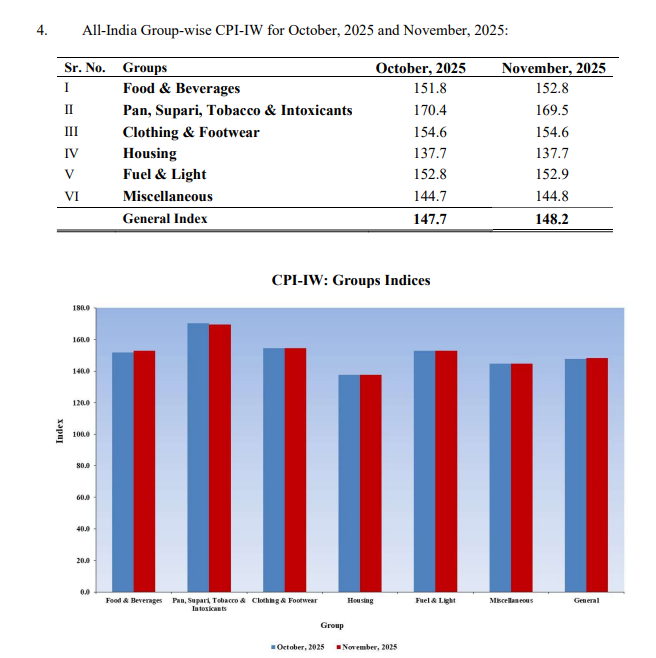
  • October 2025 Index: 147.7
  • November 2025 Index: 148.2 (+0.5 points)
  • Current DA Rate: 58% (Effective since July 2025)

This 0.5-point jump in November is significant. It brings the 12-month average of the consumer price index to a level that mathematically secures a minimum of 60% total DA.


Also Check

DA from January 2026 Calculator

DA Calculation Sheet


2. Why is a 2% Hike “Almost Confirmed”?

The formula for DA is based on a 12-month average of the AICPI-IW. A crucial aspect of this government policy is that fractions of a percent are ignored. Unlike standard mathematics where 0.5 and above is rounded up, the DA calculation only recognizes the whole number.

  • Scenario A: If the average results in 60.12%, the DA is 60%.
  • Scenario B: Even if the average reaches 60.94%, the DA is still 60%.

Why a 3% Hike is Mathematically Unlikely

To achieve a 3% hike (reaching 61%), the 12-month average would need to cross the 61.00 threshold exactly. Based on the November 2025 index of 148.2:

  1. The cumulative index points for the last 11 months are already locked in.
  2. If the December 2025 index stays at 148.2, the final calculation sits at approximately 59.94%.
  3. Because the government ignores everything after the decimal, this 59.94% is treated as 59% in the interim, but since we are currently at 58%, it confirms a 2% increase to reach the 60% mark.
  4. To hit 61%, the December index would need to jump by more than 10 points in a single month—a move that has never occurred in the history of the index.

Confirmed Status for Jan 2026

With the November 2025 figures now public, the 2% hike is essentially “locked.” Even a minor dip in the December inflation data would not be enough to drag the average below the 60.00% threshold, nor is any realistic jump enough to push it to 61%.

3. Impact on Salaries and Pensions

This revision will benefit over 1 crore central government employees and pensioners.14 Here is a quick look at how a 2% hike (moving from 58% to 60%) affects monthly payouts:

ComponentCurrent (58% DA)New (60% DA)Monthly Increase
Basic Pay: ₹18,000₹10,440₹10,800+₹360
Basic Pay: ₹30,000₹17,400₹18,000+₹600
Basic Pay: ₹50,000₹29,000₹30,000+₹1,000

4. The 8th Pay Commission Connection

The January 2026 DA revision is uniquely important because January 1, 2026, marks the theoretical start date for the 8th Central Pay Commission (CPC) cycle.

Traditionally, when a new Pay Commission is implemented:

  • The existing DA (which will be 60%) is merged into the Basic Pay.
  • The DA is reset to 0% for the new pay scale.
  • While the 8th CPC implementation is still in its early stages, this 60% figure serves as the final “inflation buffer” that will determine the Fitment Factor (the multiplier used to jump from 7th CPC to 8th CPC salaries).

Conclusion & Timeline

While the data confirms a 2% hike is the most realistic outcome, the official announcement from the Union Cabinet is expected in March 2026. Once announced, the hike will be applied retrospectively from January 1, 2026, and employees will receive arrears for the preceding months.

Follow us on WhatsApp, Telegram, Twitter and Facebook for all latest updates

தமிழ்நாடு உறுதியளிக்கப்பட்ட ஓய்வூதியத் திட்டம் (TAPS): திட்டத்தின் சிறப்பம்சங்கள்

தமிழ்நாடு உறுதியளிக்கப்பட்ட ஓய்வூதியத் திட்டம் (TAPS)

அரசு அலுவலர்கள் மற்றும் ஆசிரியர்களின் இருபதாண்டுகாலக் கோரிக்கையினை நிறைவேற்றும் வகையில், பழைய ஓய்வூதியத் திட்டத்தின் பலன்களை வழங்கக்கூடிய “தமிழ்நாடு உறுதியளிக்கப்பட்ட ஓய்வூதியத் திட்டம் (Tamil Nadu Assured Pension Scheme – TAPS)” செயல்படுத்தப்படும் என்று மாண்புமிகு முதலமைச்சர் திரு. மு.க.ஸ்டாலின் அவர்கள் ஆணையிட்டுள்ளார்.

அரசு அலுவலர்களின் நலன் காப்பதில் இந்த அரசு எடுத்துள்ள முக்கிய நடவடிக்கைகள்:

  • அகவிலைப்படி உயர்வு: 2022-ஆம் ஆண்டு முதல் ஒன்றிய அரசிற்கு இணையாக அகவிலைப்படி உயர்வு தொடர்ந்து வழங்கப்பட்டு வருகிறது.
  • ஈட்டிய விடுப்பு: 01.10.2025 முதல் அரசுப் பணியாளர்கள் தங்களது ஈட்டிய விடுப்பினை ஒப்படைப்பு செய்து பணமாகப் பெற்றுக்கொள்ளும் நடைமுறை மீண்டும் செயல்படுத்தப்பட்டுள்ளது.
  • காப்பீட்டுத் தொகை: அரசுப் பணியாளர்கள் விபத்தில் உயிரிழக்க நேர்ந்தால் 1 கோடி ரூபாயும், இயற்கை மரணமடைந்தால் 10 இலட்சம் ரூபாயும் ஆயுள் காப்பீட்டுத் தொகையாக வழங்கப்படுகிறது.
  • கல்வி முன்பணம்: தொழிற்கல்விக்கு 1 இலட்சம் ரூபாயாகவும், கலை மற்றும் அறிவியல் கல்விக்கு 50 ஆயிரம் ரூபாயாகவும் கல்வி முன்பணம் உயர்த்தி வழங்கப்படுகிறது.
  • திருமண முன்பணம்: அரசுப் பணியாளர்களுக்கு வழங்கப்பட்டு வந்த திருமண முன்பணம் 10 ஆயிரம் ரூபாயிலிருந்து 5 இலட்சம் ரூபாயாக உயர்த்தப்பட்டுள்ளது.
  • வீடு கட்டும் முன்பணம்: வீடு கட்டுவதற்கான முன்பணம் 40 இலட்சம் ரூபாயிலிருந்து 50 இலட்சம் ரூபாயாக உயர்த்தி வழங்கப்படுகிறது.
  • மகப்பேறு விடுப்பு: பெண் அரசு அலுவலர்களின் மகப்பேறு விடுப்பு 9 மாதங்களிலிருந்து 12 மாதங்களாக உயர்த்தப்பட்டுள்ளது.
  • ஓய்வூதியப் பணிக்கொடை: ஓய்வூதியப் பணிக்கொடை 20 இலட்சத்திலிருந்து 25 இலட்சம் ரூபாயாக உயர்த்தி வழங்கப்படுகிறது.

Also Read in English : Tamil Nadu Assured Pension Scheme (TAPS): TN Govt

புதிய TAPS திட்டத்தின் சிறப்பம்சங்கள்:

அரசு கூடுதல் தலைமைச் செயலாளர் திரு. ககன்தீப்சிங் பேடி, இ.ஆ.ப. தலைமையிலான குழுவின் அறிக்கையைப் பரிசீலித்து இத்திட்டம் அறிவிக்கப்பட்டுள்ளது.

  1. 50% ஓய்வூதியம்: மாநில அரசு அலுவலர்கள் பெற்ற கடைசி மாத ஊதியத்தில் 50 சதவீதம் உறுதியளிக்கப்பட்ட ஓய்வூதியமாக வழங்கப்படும்.
  2. அரசின் பங்களிப்பு: பணியாளர்களின் 10 சதவீத பங்களிப்போடு, ஓய்வூதிய நிதியத்திற்குத் தேவைப்படும் கூடுதல் நிதி முழுவதையும் தமிழ்நாடு அரசே ஏற்கும்.
  3. அகவிலைப்படி உயர்வு: ஓய்வூதியதாரர்களுக்கு ஆண்டுதோறும் ஆறு மாதத்திற்கு ஒருமுறை அரசு அலுவலர்களுக்கு இணையான அகவிலைப்படி உயர்வு அளிக்கப்படும்.
  4. குடும்ப ஓய்வூதியம்: ஓய்வூதியதாரர் இறந்துவிட்டால், அவர் பரிந்துரைத்த குடும்ப உறுப்பினர்களுக்கு 60 சதவீதம் குடும்ப ஓய்வூதியமாக வழங்கப்படும்.
  5. பணிக்கொடை: ஓய்வு பெறும் போதும், பணிக்காலத்தில் இறக்க நேரிடும் போதும் 25 இலட்சம் ரூபாய்க்கு மிகாமல் பணிக்கொடை வழங்கப்படும்.
  6. குறைந்தபட்ச ஓய்வூதியம்: தகுதிப் பணிக்காலத்தை நிறைவு செய்யாமல் ஓய்வு பெறும் அலுவலர்களுக்கும் குறைந்தபட்ச ஓய்வூதியம் வழங்கப்படும்.
  7. சிறப்பு கருணை ஓய்வூதியம்: பங்களிப்பு ஓய்வூதியத் திட்டத்தின் (CPS) கீழ் பணியில் சேர்ந்து, இத்திட்டம் வருவதற்கு முன்னர் ஓய்வு பெற்றவர்களுக்கு சிறப்பு கருணை ஓய்வூதியம் வழங்கப்படும்.

இத்திட்டத்தை அறிமுகப்படுத்துவதால் தமிழ்நாடு அரசு கூடுதலாக 13 ஆயிரம் கோடி ரூபாயும், ஆண்டுதோறும் அரசின் பங்களிப்பாக சுமார் 11 ஆயிரம் கோடி ரூபாயும் வழங்கும். பழைய ஓய்வூதியத் திட்டத்திற்கு இணையான பலன்களைத் தரும் இத்திட்டத்திற்கு முழு ஒத்துழைப்பு நல்குமாறு மாண்புமிகு முதலமைச்சர் அவர்கள் கேட்டுக்கொண்டுள்ளார்.

Follow us on WhatsApp, Telegram, Twitter and Facebook for all latest updates

Tamil Nadu Assured Pension Scheme (TAPS): TN Govt

Tamil Nadu Assured Pension Scheme (TAPS): TN Govt

To fulfill the twenty-year demand of Tamil Nadu government employees and teachers, the Honorable Chief Minister of Tamil Nadu, Thiru. M.K. Stalin, has ordered the implementation of a new scheme titled “Tamil Nadu Assured Pension Scheme (TAPS),” which provides the benefits of the old pension scheme.

Government employees are the wheels of the vehicle of governance. These wheels travel to ensure that the government’s welfare schemes reach the very last person in society. Recognizing this, the Dravidian Model government, following the path of Muthamizh Arignar Kalaignar, has always functioned with concern for the welfare of government employees and teachers.

Since assuming office in 2021, this government has been implementing various schemes to protect the interests of all sections of the people. To safeguard the welfare of government employees and teachers, who act as the hands of the government, several necessary measures have been taken.

Despite the financial burden caused by the continuous reduction in tax sharing and funding from the Union Government, and the decrease in state tax revenue due to GST changes, the Honorable Chief Minister continues to protect the welfare of employees. Notable measures include:

Also Read: தமிழ்நாடு உறுதியளிக்கப்பட்ட ஓய்வூதியத் திட்டம் (TAPS): திட்டத்தின் சிறப்பம்சங்கள்

  • Dearness Allowance (DA): DA increases, which were suspended during the COVID pandemic, have been provided on par with the Union Government since 2022 without delay.
  • Earned Leave: The procedure for employees to surrender earned leave for cash was reinstated effective 01.10.2025.
  • Insurance: A unique insurance scheme provides ₹1 crore for accidental death and ₹10 lakh for natural death.
  • Family Support: Financial assistance for the marriage of deceased employees’ children (₹5 lakh to ₹10 lakh) and higher education assistance (up to ₹10 lakh) is provided through banks.
  • Education Advance: Advances for technical education were increased from ₹50,000 to ₹1 lakh, and for Arts and Science education from ₹25,000 to ₹50,000.
  • Marriage & Housing: Marriage advances were raised from ₹10,000 to ₹5 lakh. House building advances were increased from ₹40 lakh to ₹50 lakh, the highest among all states.
  • Maternity Leave: Female employees’ maternity leave was extended from 9 months to 12 months.
  • Retirement Benefits: Pensioners’ medical insurance was raised to ₹10 lakh, and the retirement gratuity was increased from ₹20 lakh to ₹25 lakh.

Key Features of the TAPS Scheme:

Following the recommendations of a committee led by Additional Chief Secretary Thiru. Gagandeep Singh Bedi, IAS, the government has introduced TAPS with the following benefits:

  1. 50% Assured Pension: Employees will be guaranteed a pension of 50% of their last drawn monthly salary. The state government will bear all additional costs for the pension fund beyond the employees’ 10% contribution.
  2. Dearness Allowance: Pensioners will receive DA increases every six months, equivalent to those provided to active government employees.
  3. Family Pension: In the event of a pensioner’s death, 60% of their pension will be provided to their nominated family members.
  4. Death/Retirement Gratuity: A gratuity not exceeding ₹25 lakh will be provided based on the service period.
  5. Minimum Pension: A minimum pension will be provided to all employees who retire after the implementation of TAPS, even if they have not completed the full qualifying service period.
  6. Special Compassionate Pension: Those who retired under the Contributory Pension Scheme (CPS) before the implementation of TAPS will receive a special compassionate pension.

To introduce this scheme, the Tamil Nadu government will provide an additional ₹13,000 crore to the pension fund, along with an annual contribution of approximately ₹11,000 crore.

Honorable Chief Minister Thiru. M.K. Stalin has requested government employees and teachers to unanimously welcome and provide full cooperation for this TAPS scheme, which fulfills a 20-year demand and ensures pension benefits equivalent to the old scheme.

Follow us on WhatsApp, Telegram, Twitter and Facebook for all latest updates

AICPIN for Nov 2025: November Data Signals a 2% DA Hike from January 2026

AICPIN for Nov 2025: November Data Signals a 2% DA Hike from January 2026

GOVERNMENT OF INDIA
MINISTRY OF LABOUR & EMPLOYMENT
LABOUR BUREAU

Shram Bureau Bhawan, Block No. 2,
Institutional Area, Sector 38 (West),
Chandigarh – 160036

F.No. 5/1/2021-CPI Dated: 31.12.2025

Press Release

Consumer Price Index for Industrial Workers (2016=100) – November, 2025

1.Labour Bureau, an attached office of the M/o Labour & Employment, has been compiling Consumer Price Index for Industrial Workers every month on the basis of retail prices collected from 317 markets spread over 88 industrially important centres in the country. The index for the month of November, 2025 is being released in this press release.

2. The All-India CPI-IW for November, 2025 increased by 0.5 point and stood at 148.2 (one hundred forty-eight point two).


Also Check

DA from January 2026 Calculator

DA Calculation Sheet


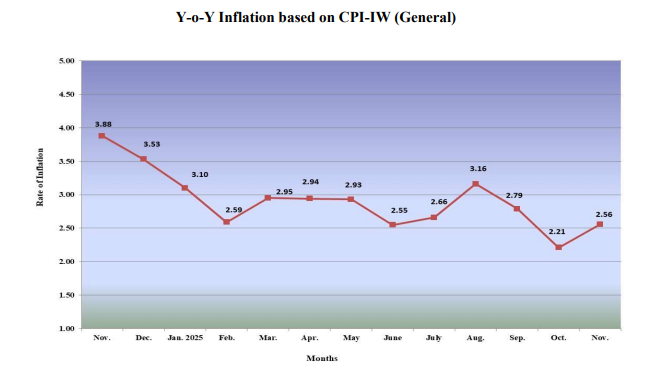
3. Year-on-year inflation for the month of November, 2025 stood at 2.56% as compared to 3.88% in November, 2024.

Follow us on WhatsApp, Telegram, Twitter and Facebook for all latest updates

Just In