Home Blog Page 122

Tax deduction limit increased to 14% on employers contribution to NPS account of State Govt Employees

Tax deduction limit increased to 14% on employers contribution to NPS account of State Govt Employees

Taxpayers can file updated Income Tax return within two years

TAX RELIEF TO PERSONS WITH DISABILITY

TAX DEDUCTION LIMIT ON EMPLOYER’S CONTRIBUTION TO NPS ACCOUNT OF STATE GOVERNMENT EMPLOYEES INCREASED TO 14% FROM 10%

INCOME FROM VIRTUAL DIGITAL ASSETS TRANSACTIONS TO BE TAXED AT 30%

NEW STEPS TO AVOID REPEAT LITIGATIONS WITH TAXPAYERS

The Government proposes to permit taxpayers to file an updated return on payment of additional tax within two years from the end of the relevant assessment year announced the Union Finance & Corporate Affairs Minister Smt. Nirmala Sitharaman while presenting the Union Budget 2022-23 in the Parliament today. She said this would give taxpayers an opportunity to correct any omissions or mistakes in correctly estimating their income for tax payment. She pointed out that currently, if the department finds out that some income has been missed out by the assessee, it goes through a lengthy process of adjudication, the new proposal would repose trust in the taxpayer. She said “It is an affirmative step in the direction of voluntary tax compliance”.

Tax Relief to Persons with Disability

The law currently provides for deduction to the parent or guardian when they take an insurance scheme for the differently abled person only if the lump sum payment or annuity is available to the differently abled person on the death of the subscriber. Pointing out that there could be situations where differently abled dependants may need payment of annuity or lump sum amount even during the lifetime of their parents/guardians, Smt. Sitharaman announced that the Government proposes to allow the payment of annuity and lump sum amount to the differently abled dependent during the lifetime of parents/guardians, on subscribers attaining the age of sixty years.
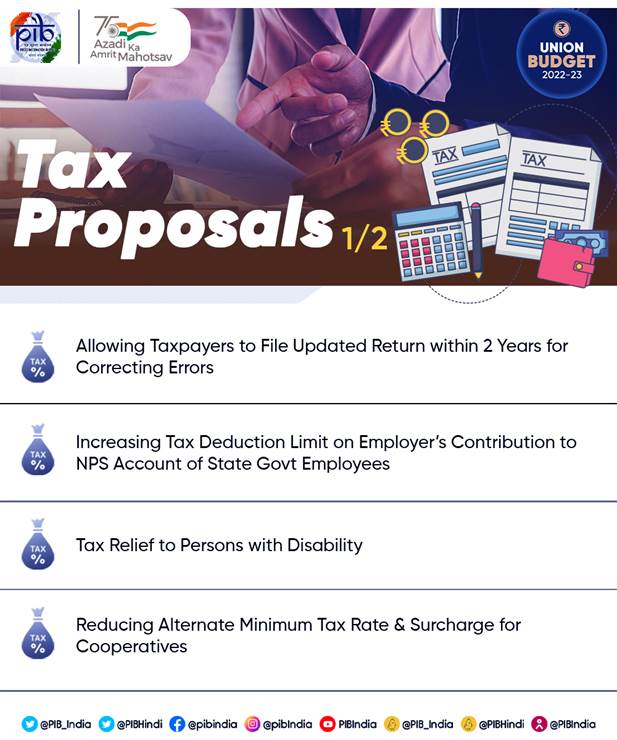
Tax Proposals.jpg

Parity between Employees of State and Central Government

The minister said that to enhance the social security benefits of the State government employees and bring them at par with the central government employees, the Government proposes to increase the tax deduction limit to 14 per cent from 10 per cent on employer’s contribution to the NPS account of State Government employees.

Also Read: Highlights of the Union Budget 2022-23

Scheme for Taxation of Virtual Digital Assets

Stating that the magnitude and frequency of transactions in virtual digital assets have increased phenomenally, Smt. Sitharaman announced that “any income from transfer of any virtual digital asset shall be taxed at the rate of 30 per cent”. She said that the scheme would not allow any deduction in respect of any expenditure or allowance while computing such income except cost of acquisition. Further she said, loss from transfer of virtual digital asset cannot be set off against any other income. The minister also added that in order to capture the transaction details, the Government would also make a provision to provide for TDS on payment made in relation to transfer of virtual digital asset at the rate of 1 per cent of such consideration above a monetary threshold. Gift of virtual digital asset is also proposed to be taxed in the hands of the recipient, she said.

Litigation Management

Smt. Sitharaman stated that “a lot of time and resources are consumed in filing of appeals which involve identical issues”. In order to take forward the Government’s policy of sound litigation management and reduce repeated litigation between taxpayers and the department, the Government would make a provision that if a question of law in the case of an assessee is identical to a question of law which is pending in appeal before the jurisdictional High Court or the Supreme Court in any case, the filing of further appeal in the case of this assessee by the department shall be deferred till such question of law is decided by the jurisdictional High Court or the Supreme Court.
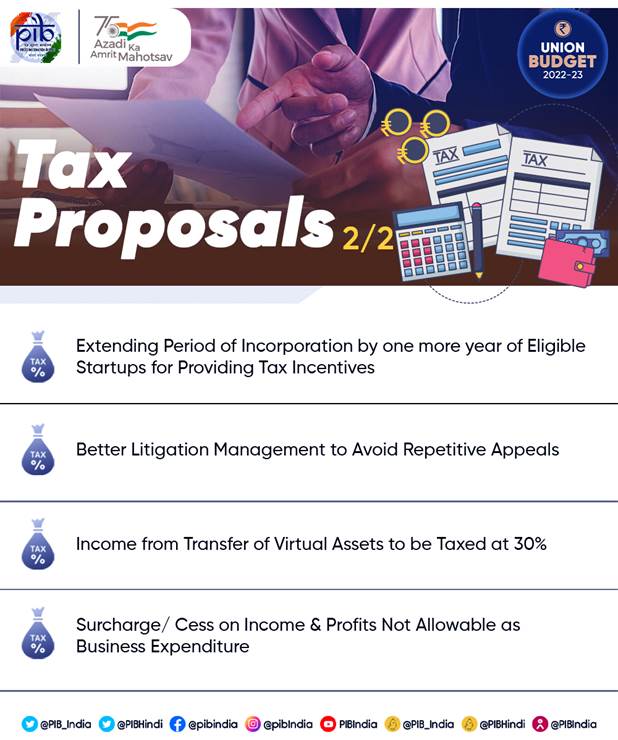
Taxpayers can file updated Income Tax return within two years

The minister also thanked the taxpayers of the country who have contributed immensely and strengthened the hands of the Government in helping their fellow citizens in the hour of need.

***

Follow us on Telegram Channel, Twitter and Facebook for all the latest updates

Highlights of the Union Budget 2022-23

Highlights of the Union Budget 2022-23

The Union Budget seeks to complement macro-economic level growth with a focus on micro-economic level all inclusive welfare. The Union Minister for Finance & Corporate Affairs, Smt Nirmala Sitharaman tabled the Union Budget 2022-23 in Parliament today.

The key highlights of the budget are as follows:

PART A

  • India’s economic growth estimated at 9.2% to be the highest among all large economies.
  • 60 lakh new jobs to be created under the productivity linked incentive scheme in 14 sectors.
  • PLI Schemes have the potential to create an additional production of Rs 30 lakh crore.
  • Entering Amrit Kaal, the 25 year long lead up to India @100, the budget provides impetus for growth along four priorities:
  • PM GatiShakti
  • Inclusive Development
  • Productivity Enhancement & Investment, Sunrise opportunities, Energy Transition, and Climate Action.
  • Financing of investments

PM GatiShakti

  • The seven engines that drive PM GatiShakti are Roads, Railways, Airports, Ports, Mass Transport, Waterways and Logistics Infrastructure.

PM GatiShkati National Master Plan

  • The scope of PM GatiShakti National Master Plan will encompass the seven engines for economic transformation, seamless multimodal connectivity and logistics efficiency.
  • The projects pertaining to these 7 engines in the National Infrastructure Pipeline will be aligned with PM GatiShakti framework.

Road Transport

  • National Highways Network to be expanded by 25000 Km in 2022-23.
  • Rs 20000 Crore to be mobilized for National Highways Network expansion.

Multimodal Logistics Parks

  • Contracts to be awarded through PPP mode in 2022-23 for implementation of Multimodal Logistics Parks at four locations.

Railways

  • One Station One Product concept to help local businesses & supply chains.
  • 2000 Km of railway network to be brought under Kavach, the indigenous world class technology and capacity augmentation in 2022-23.
  • 400 new generation Vande Bharat Trains to be manufactured during the next three years.
  • 100 PM GatiShakti Cargo terminals for multimodal logistics to be developed during the next three years.

Parvatmala

  • National Ropeways Development Program, Parvatmala to be taken up on PPP mode.
  • Contracts to be awarded in 2022-23 for 8 ropeway projects of 60 Km length.

Inclusive Development

Agriculture

  • Rs. 2.37 lakh crore direct payment to 1.63 crore farmers for procurement of wheat and paddy.
  • Chemical free Natural farming to be promoted throughout the county. Initial focus is on farmer’s lands in 5 Km wide corridors along river Ganga.
  • NABARD to facilitate fund with blended capital to finance startups for agriculture & rural enterprise.
  • ‘Kisan Drones’ for crop assessment, digitization of land records, spraying of insecticides and nutrients.

Ken Betwa project

  • 1400 crore outlay for implementation of the Ken – Betwa link project.
  • 9.08 lakh hectares of farmers’ lands to receive irrigation benefits by Ken-Betwa link project.

MSME

  • Udyam, e-shram, NCS and ASEEM portals to be interlinked.
  • 130 lakh MSMEs provided additional credit under Emergency Credit Linked Guarantee Scheme (ECLGS)
  • ECLGS to be extended up to March 2023.
  • Guarantee cover under ECLGS to be expanded by Rs 50000 Crore to total cover of Rs 5 Lakh Crore.
  • Rs 2 lakh Crore additional credit for Micro and Small Enterprises to be facilitated under the Credit Guarantee Trust for Micro and Small Enterprises (CGTMSE).
  • Raising and Accelerating MSME performance (RAMP) programme with outlay of Rs 6000 Crore to be rolled out.

Also Read: Key Highlights of the Economic Survey 2021-2022: GDP projected to grow 8.0-8.5 Percent in 2022-23

Skill Development

  • Digital Ecosystem for Skilling and Livelihood (DESH-Stack e-portal) will be launched to empower citizens to skill, reskill or upskill through on-line training.

· Startups will be promoted to facilitate ‘Drone Shakti’ and for Drone-As-A-Service (DrAAS).

Education

  • One class-One TV channel’ programme of PM eVIDYA to be expanded to 200 TV channels.

· Virtual labs and skilling e-labs to be set up to promote critical thinking skills and simulated learning environment.

· High-quality e-content will be developed for delivery through Digital Teachers.

· Digital University for world-class quality universal education with personalised learning experience to be established.

Health

  • An open platform for National Digital Health Ecosystem to be rolled out.

· ‘National Tele Mental Health Programme’ for quality mental health counselling and care services to be launched.

  • A network of 23 tele-mental health centres of excellence will be set up, with NIMHANS being the nodal centre and International Institute of Information Technology-Bangalore (IIITB) providing technology support.

Saksham Anganwadi

  • Integrated benefits to women and children through Mission Shakti, Mission Vatsalya, Saksham Anganwadi and Poshan 2.0.
  • Two lakh anganwadis to be upgraded to Saksham Anganwadis.

Har Ghar, Nal Se Jal

  • Rs. 60,000 crore allocated to cover 3.8 crore households in 2022-23 under Har Ghar, Nal se Jal.

Housing for All

  • Rs. 48,000 crore allocated for completion of 80 lakh houses in 2022-23 under PM Awas Yojana.

Prime Minister’s Development Initiative for North-East Region (PM-DevINE)

  •  New scheme PM-DevINE launched to fund infrastructure and social development projects in the North-East.
  • An initial allocation of Rs. 1,500 crore made to enable livelihood activities for youth and women under the scheme.

Vibrant Villages Programme

  • Vibrant Villages Programme for development of Border villages with sparse population, limited connectivity and infrastructure on the northern border.

Banking

  • 100 per cent of 1.5 lakh post offices to come on the core banking system.
  • Scheduled Commercial Banks to set up 75 Digital Banking Units (DBUs) in 75 districts.

e-Passport

  • e-Passports with embedded chip and futuristic technology to be rolled out.

Urban Planning

  • Modernization of building byelaws, Town Planning Schemes (TPS), and Transit Oriented Development (TOD) will be implemented.
  • Battery swapping policy to be brought out for setting up charging stations at scale in urban areas.

Land Records Management

  • Unique Land Parcel Identification Number for IT-based management of land records.

Accelerated Corporate Exit

  • Centre for Processing Accelerated Corporate Exit (C-PACE) to be established for speedy winding-up of companies.

AVGC Promotion Task Force

  • An animation, visual effects, gaming, and comic (AVGC) promotion task force to be set-up to realize the potential of this sector.

Telecom Sector

  • Scheme for design-led manufacturing to be launched to build a strong ecosystem for 5G as part of the Production Linked Incentive Scheme.

Export Promotion

  • Special Economic Zones Act to be replaced with a new legislation to enable States to become partners in ‘Development of Enterprise and Service Hubs’.

AtmaNirbharta in Defence:

  • 68% of capital procurement budget earmarked for domestic industry in 2022-23, up from 58% in 2021-22.

· Defence R&D to be opened up for industry, startups and academia with 25% of defence R&D budget earmarked.

· Independent nodal umbrella body to be set up for meeting testing and certification requirements.

Sunrise Opportunities

  • Government contribution to be provided for R&D in Sunrise Opportunities like Artificial Intelligence, Geospatial Systems and Drones, Semiconductor and its eco-system, Space Economy, Genomics and Pharmaceuticals, Green Energy, and Clean Mobility Systems.

Energy Transition and Climate Action:

  • Additional allocation of Rs. 19,500 crore for Production Linked Incentive for manufacture of high efficiency solar modules to meet the goal of 280 GW of installed solar power by 2030.

· Five to seven per cent biomass pellets to be co-fired in thermal power plants:

  • CO2 savings of 38 MMT annually,
  • Extra income to farmers and job opportunities to locals,
  • Help avoid stubble burning in agriculture fields.

· Four pilot projects to be set up for coal gasification and conversion of coal into chemicals for the industry

· Financial support to farmers belonging to Scheduled Castes and Scheduled Tribes, who want to take up agro-forestry.

Public Capital Investment:

  • Public investment to continue to pump-prime private investment and demand in 2022-23.

· Outlay for capital expenditure stepped up sharply by 35.4% to Rs. 7.50 lakh crore in 2022-23 from Rs. 5.54 lakh crore in the current year.

· Outlay in 2022-23 to be 2.9% of GDP.

  • ‘Effective Capital Expenditure’ of Central Government estimated at Rs. 10.68 lakh crore in 2022-23, which is about 4.1% of GDP.

GIFT-IFSC

  • World-class foreign universities and institutions to be allowed in the GIFT City.
  • An International Arbitration Centre to be set up for timely settlement of disputes under international jurisprudence.

Mobilising Resources

  • Data Centres and Energy Storage Systems to be given infrastructure status.

· Venture Capital and Private Equity invested more than Rs. 5.5 lakh crore last year facilitating one of the largest start-up and growth ecosystem. Measures to be taken to help scale up this investment.

· Blended funds to be promoted for sunrise sectors.

· Sovereign Green Bonds to be issued for mobilizing resources for green infrastructure.

Digital Rupee

  • Introduction of Digital Rupee by the Reserve Bank of India starting 2022-23.

Providing Greater Fiscal Space to States

  • Enhanced outlay for ‘Scheme for Financial Assistance to States for Capital Investment’:
    • From Rs. 10,000 crore in Budget Estimates to Rs. 15,000 crore in Revised Estimates for current year

· Allocation of  Rs. 1 lakh crore in 2022-23 to assist the states in catalysing overall investments in the economy: fifty-year interest free loans, over and above normal borrowings

  • In 2022-23, States will be allowed a fiscal deficit of 4% of GSDP, of which 0.5% will be tied to power sector reforms

Fiscal Management

  • Budget Estimates 2021-22: Rs. 34.83 lakh crore

· Revised Estimates 2021-22: Rs. 37.70 lakh crore

· Total expenditure in 2022-23 estimated at Rs. 39.45 lakh crore

· Total receipts other than borrowings in 2022-23 estimated at Rs. 22.84 lakh crore

· Fiscal deficit in current year: 6.9% of GDP (against 6.8% in Budget Estimates)

  • Fiscal deficit in 2022-23 estimated at 6.4% of GDP

PART B

DIRECT TAXES

To take forward the policy of stable and predictable tax regime:

  • Vision to establish a trustworthy tax regime.
  • To further simplify tax system and reduce litigation.

Introducing new ‘Updated return’

  • Provision to file an Updated Return on payment of additional tax.
  • Will enable the assessee to declare income missed out earlier.
  • Can be filed within two years from the end of the relevant assessment year.

Cooperative societies

  • Alternate Minimum Tax paid by cooperatives brought down from 18.5 per cent to 15 per cent.
  • To provide a level playing field between cooperative societies and companies.
  • Surcharge on cooperative societies reduced from 12 per cent to 7 per cent for those having total income of more than Rs 1 crore and up to Rs 10 crores.

Tax relief to persons with disability

  • Payment of annuity and lump sum amount from insurance scheme to be allowed to differently abled dependent during the lifetime of parents/guardians, i.e., on parents/ guardian attaining the age of 60 years.

Parity in National Pension Scheme Contribution

  • Tax deduction limit increased from 10 per cent to 14 per cent on employer’s contribution to the NPS account of State Government employees.
  • Brings them at par with central government employees.
  • Would help in enhancing social security benefits.

Incentives for Start-ups

  • Period of incorporation extended by one year, up to 31.03.2023 for eligible start-ups to avail tax benefit.
  • Previously the period of incorporation valid up to 31.03.2022.

Incentives under concessional tax regime

  • Last date for commencement of manufacturing or production under section 115BAB extended by one year i.e. from 31st March, 2023 to 31st March, 2024.

Scheme for taxation of virtual digital assets

  • Specific tax regime for virtual digital assets introduced.
  • Any income from transfer of any virtual digital asset to be taxed at the rate of 30 per cent.
  • No deduction in respect of any expenditure or allowance to be allowed while computing such income except cost of acquisition.
  • Loss from transfer of virtual digital asset cannot be set off against any other income.
  • To capture the transaction details, TDS to be provided on payment made in relation to transfer of virtual digital asset at the rate of 1 per cent of such consideration above a monetary threshold.
  • Gift of virtual digital asset also to be taxed in the hands of the recipient.

Litigation Management

  • In cases where question of law is identical to the one pending in High Court or Supreme Court, the filing of appeal by the department shall be deferred till such question of law is decided by the court.
  • To greatly help in reducing repeated litigation between taxpayers and the department.

Tax incentives to IFSC

  • Subject to specified conditions, the following to be exempt from tax
    • Income of a non-resident from offshore derivative instruments.
    • Income from over the counter derivatives issued by an offshore banking unit.
    • Income from royalty and interest on account of lease of ship.
    • Income received from portfolio management services in IFSC.

Rationalization of Surcharge

  • Surcharge on AOPs (consortium formed to execute a contract) capped at 15 per cent.
  • Done to reduce the disparity in surcharge between individual companies and AOPs.
  • Surcharge on long term capital gains arising on transfer of any type of assets capped at 15 per cent.
  • To give a boost to the start up community.

Health and Education Cess

  • Any surcharge or cess on income and profits not allowable as business expenditure.

Deterrence against tax-evasion

  • No set off, of any loss to be allowed against undisclosed income detected during search and survey operations.

Rationalizing TDS Provisions

  • Benefits passed on to agents as business promotion strategy taxable in hands of agents.
  • Tax deduction provided to person giving benefits, if the aggregate value of such benefits exceeds Rs 20,000 during the financial year.

INDIRECT TAXES

Remarkable progress in GST 

  • GST revenues are buoyant despite the pandemic – Taxpayers deserve applause for this growth.

Special Economic Zones

  • Customs Administration of SEZs to be fully IT driven and function on the Customs National Portal – shall be implemented by 30th September 2022.

Customs Reforms and duty rate changes

  • Faceless Customs has been fully established. During Covid-19 pandemic, Customs formations have done exceptional frontline work against all odds displaying agility and purpose.

Project imports and capital goods

  • Gradually phasing out of the concessional rates in capital goods and project imports; and applying a moderate tariff of 7.5 percent   – conducive to the growth of domestic sector and ‘Make in India’.
  • Certain exemptions for advanced machineries that are not manufactured within the country shall continue.
  • A few exemptions introduced on inputs, like specialised castings, ball screw and linear motion guide – to encourage domestic manufacturing of capital goods.

Review of customs exemptions and tariff simplification

  • More than 350 exemption entries proposed to be gradually phased out, like exemption on certain agricultural produce, chemicals, fabrics, medical devices, & drugs and medicines for which sufficient domestic capacity exists.
  • Simplifying the Customs rate and tariff structure particularly for sectors like chemicals, textiles and metals and minimise disputes; Removal of exemption on items which are or can be manufactured in India and providing concessional duties on raw material that go into manufacturing of intermediate products – in line with the objective of ‘Make in India’ and ‘Atmanirbhar Bharat’.

Sector specific proposals

Electronics

  • Customs duty rates to be calibrated to provide a graded rate structure – to facilitate domestic manufacturing of wearable devices, hearable devices and electronic smart meters.
  •  Duty concessions to parts of transformer of mobile phone chargers and camera lens of mobile camera module and certain other items – To enable domestic manufacturing of high growth electronic items.

Gems and Jewellery

  • Customs duty on cut and polished diamonds and gemstones being reduced to 5 per cent; Nil customs duty to simply sawn diamond – To give a boost to the Gems and Jewellery sector

.

  • A simplified regulatory framework to be implemented by June this year – To facilitate export of jewellery through e-commerce.
  • Customs duty of at least Rs 400 per Kg to be paid on imitation jewellery import – To disincentivise import of undervalued imitation jewellery.

Chemicals

  • Customs duty on certain critical chemicals namely methanol, acetic acid and heavy feed stocks for petroleum refining being reduced; Duty is being raised on sodium cyanide for which adequate domestic capacity exists – This will help in enhancing domestic value addition.

MSME

  • Customs duty on umbrellas being raised to 20 per cent. Exemption to parts of umbrellas being withdrawn.
  • Exemption being rationalised on implements and tools for agri-sector which are manufactured in India
  • Customs duty exemption given to steel scrap last year extended for another year to provide relief to MSME secondary steel producers
  • Certain Anti- dumping and CVD on stainless steel and coated steel flat products, bars of alloy steel and high-speed steel are being revoked – to tackle prevailing high prices of metal in larger public interest.

Exports

  • To incentivise exports, exemptions being provided on items such as embellishment, trimming, fasteners, buttons, zipper, lining material, specified leather, furniture fittings and packaging boxes.
  • Duty being reduced on certain inputs required for shrimp aquaculture – to promote its exports.

Tariff measure to encourage blending of fuel

  • Unblended fuel to attract an additional differential excise duty of Rs 2/ litre from the 1st of October 2022 – to encourage blending of fuel.

*****

Follow us on Telegram Channel, Twitter and Facebook for all the latest updates

Grant of paid holiday to the employees on the day of poll: General Election to the Legislative Assemblies of states of Goa, Punjab, Manipur, Uttarakhand & Uttar Pradesh, 2022

Grant of paid holiday to the employees on the day of poll: General Election to the Legislative Assemblies of states of Goa, Punjab, Manipur, Uttarakhand & Uttar Pradesh, 2022

F. No.12/1/2022-JCA
Government of India
Ministry of Personnel, Public Grievances and Pensions
(Department of Personnel & Training) Establishment (JCA) Section

North Block, New Delhi
Dated: 31st January, 2022

OFFICE MEMORANDUM

Subject: General Election to the Legislative Assemblies of states of Goa, Punjab, Manipur, Uttarakhand & Uttar Pradesh, 2022 – Grant of paid holiday to the employees on the day of poll – regarding

The undersigned is directed to state that, as informed by the Election Commission of India, vide their Letter No. 78/ EPS/ 2022, dated 19/01/ 2022, General Election to the Legislative Assemblies of the states of Goa, Punjab, Manipur, Uttarakhand & Uttar Pradesh, 2022, are scheduled to be held as under:

Schedule for General Election to the Legislative Assemblies as follows

S.No. Name of State Phase Date of Poll Day
1. Goa, Uttarakhand Single Phase 14.02.2022 Monday
2. Manipur Two Phases 27.02.2022  Sunday
03.03.2022 Thursday
3. Uttar Pradesh, Seven Phases 10.02.2022 Thursday
14.02.2022 Monday
20.02.2022 Sunday
23.02.2022 Wednesday
27.02.2022 Sunday
03.03.2022 Thursday
07.03.2022 Monday
4. Punjab Single Phase 20.02.2022 Sunday

2. In this regard, it is stated that guidelines have been Issued by this Department, vide OM No. 12/14/99-JCA, dated 10.10.2001, regarding closure of Central Government Offices and grant of paid holiday to all concerned, including the daily wage/ casual workers, on the date of election. It is reiterated that all the Central government Offices and the Central Industrial Establishments, shall remain closed in the notified areas, where general election to the State Legislative Assemblies are to be conducted, on the date of Poll. The employees concern shall be granted paid holiday on the date of Poll to enable them to exercise their right to Vote

Also Read: Physical Attendance of CG Employees for 50% has been extended till 15th Feb 2022

3. The above instructions may please be brought to the notice of all concerned.

4. Hindi version will follow.

(S.P. Pant)
Deputy Secretary to the Government of India

Follow us on Telegram Channel, Twitter and Facebook for all the latest updates

DA for Bank Employees from Feb 2022 to Apr 2022, IBA Order

DA for Bank Employees from Feb 2022 to Apr 2022, IBA Order

HR & Industrial Relations

HR&IR/MBR/76/D/2021-22/10866
February 1, 2022

All Members of the Association
(Designated Officers)

Dear Sir/ Madam,

Dearness Allowance for Workmen and Officer Employees in banks for the months of February, March and April 2022 under XI BPS/ Joint Note dated 11.11.2020

The confirmed All India Average Consumer Price Index Numbers for Industrial Workers (Base 1960=100) for the quarter ended December 2021 are as follows:-

October 20218210.75
November 20218263.34
December 20218243.62

The average CPI of the above is 8239.24 and accordingly the number of DA slabs are 471 (8239 – 6352= 1887/4= 471 Slabs). The last quarterly Payment of DA was at 434 Slabs. Hence, there is an increase in DA slabs of 37 i.e. 471 Slabs for payment of DA for the quarter February, March and April 2022.

Also Check: Expected DA Calculator for Bank Employees from Feb 2022

In terms of clause 7 of the 11th Bipartite Settlement dated 11.11.2020 and clause 3 of the Joint Note dated 11.11.2020, the rate of Dearness Allowance payable to Workmen and Officer employees for the months of February, March and April 2022 shall be 32.97 % of `pay’. While arriving at dearness allowance payable, decimals from third place may please be ignored.

Yours faithfully,

Brajeshwar Sharma Senior Advisor (HR&IR)

Follow us on Telegram Channel, Twitter and Facebook for all the latest updates

Physical Attendance of CG Employees for 50% has been extended till 15th Feb 2022

Physical Attendance of CG Employees for 50% has been extended till 15th Feb 2022

F.No.11013/9/2014-Estt.A-III
Government of India
Ministry of Personnel, Public Grievances and Pensions
Department of Personnel & Training

North Block, New Delhi
Dated the 31st January, 2022

OFFICE MEMORANDUM

Subject: Preventive measures to contain the spread of Novel Coronavirus (COVID-19) —Attendance of Central Government officials regarding.


The undersigned is directed to refer to this Department’s OM of even number dated the 3.1.2022 (copy enclosed) on the above-mentioned subject and to state that the instructions issued vide the said OM will remain in force upto 15th February, 2022 or till further orders, whichever is earlier.

Also Read: Biometric attendance remain suspended till 15th Feb 2022 – DOPT

(Umesh Kumar Bhatia)
Deputy Secretary to the Govt. of India

Biometric attendance remain suspended till 15th Feb 2022 – DOPT

Biometric attendance remain suspended till 15th Feb 2022 – DOPT

F.No.11013/9/2014-Estt,A-III
Government of India
Ministry of Personnel, Public Grievances and Pensions
Department of Personnel & Training

North Block, New Delhi
Dated the 31st January, 2022

OFFICE MEMORANDUM

Subject: Preventive measures to contain the spread of Novel Coronavirus (COVID-19) –Biometric attendance regarding.

The undersigned is directed to refer to this Department’s OM of even number dated the 3.1.2022 on the above-mentioned subject and to state that the biometric attendance shall remain suspended till 15th February. 2022 or till further orders. whichever is earlier. It is reiterated that the employees shall mark their attendance in the Attendance Registers to be maintained manually. All the Heads of Departments shall also ensure that all employees wear masks, at all times, and continue to follow COVID-appropriate behavior strictly.

Also Read: Exemption of marking of attendance through Biometric System for Railway Employees

(Umesh Kumar Bhatia)
Deputy Secretary to the Govt. of India

Follow us on Telegram Channel, Twitter and Facebook for all the latest updates

PCDA Circular 658: Allowing family pension to other eligible family members in the event of family pensioner is charged with the offence

PCDA Circular 658: Allowing family pension to other eligible family member in the event of family pensioner is charged with the offence of murdering the Government servant or for abetting in the commission of such an offence

O/O THE PRINCIPAL CONTROLLER OF DEFENCE ACCOUNTS(PENSION)
DRAUPADI GHAT, ALLAHABAD – 211014

Circular No. 658

Dated:-24.01.2022

To,
The OI/C
Records/PAOs (ORs)

Sub : Allowing family pension to other eligible family member in the event of family pensioner is charged with the offence of murdering the Government servant or for abetting in the commission of such an offence.

*******

A copy of Govt. of India. Ministry of Defence, Department of Ex-Servicemen Welfare letter No. F.No. 2(3)/2021/D(Pen/Pol) dated 5th January, 2022 on the above subject is forwarded herewith for information, guidance and necessary action.

2) The provisions contained in regulation No. 75 of Pension Regulations for the Army. Part-1. 2008 on the above subject matter have been reviewed by competent authority and now it has been decided that the provisions contained in GoI, DoP&PW O.M. No.1/24/2019-P&PW(E) dated 16th June, 2021 shall mutatis-mutandis apply to Armed Forces Pensioners also. These provisions shall he applicable with effect from 16 June 2021.

3) A copy of this circular along with Government of India. Ministry of Defence letter F.No. 2{3)/2021/D(Pen/Pol) dated 5th January. 2022 as well as Gol, DoP&PW OM No. 1/24/2019-P&PW(E) dated 16th June. 2021 is also available on the website of this office

No. Grants/Tech/0113/LXXX11 ACDA(P)
Dated: 24 Jan, 2022

(Rajendra Kumar Gupta)
ACDA(P)


F.No. 2(3)/2021/D(Pen/Poli
Government of India .
Ministry of Defence
Department of Ex-Servicemen Welfare
D(Pension/Policy)

Room No. 222, ‘B’ Wing,
Sena Bhawan, New Delhi-110011.
Dated: 05th January, 2022

To
The Chief of the DefenceStaff
The Chief of the Army Staff
The Chief of the Naval Staff
The Chief of the Air Staff

Subject: Allowing family pension to other eligible family member in the event of family pensioner is charged with the offence of murdering the Government servant or for abetting in the commission of such an offence.

Sir,

The undersigned is directed to refer to the provisions contained in DoP&PW D.M. No. 1/24/2019-P&PW(E) dated 16.06.2021 allowing family pension to other eligible family member in the event of family pensioner is charged with the offence of murdering the Government servant or for abetting in the commission of such an offence,

2. In terms of Regulation No. 75 of Pension Regulations for the Army, Part- 1, 2008 in the event of an eligible member to receive ordinary family pension under these Regulations is charged with the offence of murdering the service personnel or for abetting in the commission of such an offence, the claim of such a person including other eligible member or members of the family to receive ordinary family pension, shall remain .suspended till the conclusidn of the criminal proceedings instituted against him.

3. The above provisions have been reviewed and it has been decided that the provisions contained in above mentioned DoP&PW D.M. dated 16th June, 2021 shall mutatis-mutandis apply to Armed Forces Pensioners also. These Provisions shall be applicable with effect from 16 June 2021.

4. The relevant provisions of Pension Regulations of the three Services shall stand modified to the extent mentioned in DoP&PW OM dated 16th June, 2021.

5. This issues with the concurrence of the Finance Division of this Ministry vide their U0 Note No. 10 (06)/2021/Fin/Pen dated 08.12.2021.

6. Hindi version will follow. Yours faithfully,

(Ashok Kumar)
Under Secretary to the Government of India


F. No. 1/24/2019-P&PW (E)
Government of India
Ministry of Personnel, Public Grievances & Pensions
Department of Pension & Pensioners’ Welfare
(Desk-E)

3rd Floor, Lok Nayak Bhawan,
Khan Market, New Delhi
Dated 16th June, 2021

OFFICE MEMORANDUM

Subject: Suspension of family pension to a person charged with the offence of murdering or abetting in the murder of the Government servant— Allowing family pension to other eligible family member.

In accordance with sub-rule (11-C) of rule 54 of the Central Civil Services (Pension) Rules, 1972, if a person, who is eligible to receive family pension on death of a Government servant or a pensioner, is charged with the offence of murdering the Government servant/pensioner or for abetting in the commission of such an offence, the payment of family pension remains suspended till the conclusion of the criminal proceedings instituted in this regard. In that case, family pension is neither paid to the person who is charged with the offence nor to any other eligible member of the family till the conclusion of the said criminal proceedings. If on conclusion of the criminal proceedings, the person concerned is convicted for the murder or abetting in the murder of the Government servant, he/she is debarred from receiving the family pension. In that case, the family pension becomes payable to other eligible member of the family, from the date of death of the Government servant. If, however, the person concerned is subsequently acquitted of the charge, the family pension becomes payable to that person from the date of death of the Government servant.

2. The above provisions have. been reviewed in consultation with Department of Legal Affairs, Denying the payment of family pension to any other member of the family (e,g. dependent children, parents, etc,), who is not charged with the offence, till the conclusion of criminal proceedings is not considered justified, as finalisation of the criminal, proceeding may take a long time and the eligible children/parents of the deceased may suffer for want of financial support by way of family pension.

3. It has, accordingly, been decided that in cases where a person eligible to receive family pension is charged with the offence of murdering the Government servant or for abetting in the commission of such an offence and the payment of family pension to him/her remains suspended under Rule 54(11-C) of CCS (Pension) Rules, 1972, family pension may be allowed to other eligible member of the family till the conclusion of the criminal proceedings in this. regard. If the spouse of the Government servant is charged with the offence of murdering the Government servant or for abetting in the commission of such an offence and the other eligible family member is a minor child of the deceased Government servant, the family pension to such minor child .shall be payable through a duly appointed guardian, and the mother or father of the minor child (who is charged with the offence) shall not act as guardian for the purpose of drawal of family pension.

4. if the concerned person is subsequently acquitted of the charge, the family pension shall become payable to that person from the date of such acquittal and the family pension to other member of the family shall be discontinued from that date.

5. This will take effect from the date of issue of this Office Memorandum. In the cases where the payment of family pension has been suspended as per the provisions of Rule 54 (11-C) of CCS (Pension) Rules, 1972, before the issue of this Office Memorandum, the arrears of family pension accruing from the date following the date of death Govt. Servant/Pensioner, shall also be paid to the other eligible family member of the Govt. Servant/Pensioner.

6. The provisions of Rule 54(11-C) of CCS (Pension) Rules, 1972, shall stand amended to the extent mentioned above. Formal amendment to the Central Civil Services (Pension) Rules, 1972 shall-be notified separately.

(Sanjay Shankar)
Deputy Secretary to the Government of India
Ph. 24644632


Follow us on Telegram Channel, Twitter and Facebook for all the latest updates

AICPIN for December 2021: Expected DA Calculator from Jan 2022

AICPIN for December 2021: Expected DA Calculator from Jan 2022

GOVERNMENT OF INDIA
MINISTRY OF LABOUR & EMPLOYMENT
LABOUR BUREAU

F.No. 5/1/2021-CPI

Press Release

`CLEREMONT, SHIMLA-171004
DATED: 31st January, 2022

Consumer Price Index for Industrial Workers (2016=100) — December, 2021

The Labour Bureau, an attached office of the M/o Labour & Employment, has been compiling Consumer Price Index for Industrial Workers every month on the basis of retail prices collected from 317 markets spread over 88 industrially important centres in the country. The index is compiled for 88 centres and All-India and is released on the last working day of succeeding month. The index for the month of December, 2021 is being released in this press release.

The All-India CPI-IW for December, 2021 decreased by 0.3 points and stood at 125.4 (one hundred twenty five and point four). On 1-month percentage change, it decreased by 0.24 per cent with respect to previous month compared to decrease of 0.92 per cent recorded between corresponding months a year ago.


Also Check

DA Calculation Sheet

DA Calculator from Jan 2022


The maximum downward pressure in current index came from Food & Beverages group contributing 0.39 percentage points to the total change. At item level, Fish fresh, Poultry chicken, Sunflower oil, Banana, Cauliflower, Onion, Peas, Potato, Tomato, ESI contribution, Petrol etc. are responsible for the fall in index. However, this decrease was largely checked by Buffalo-Milk, Grapes, Pomegranate, Lady Finger, Fire wood, Medicine Allopathic, Auto rickshaw fare, Telephone Charges etc. putting upward pressure on the index.

At centre level, Udham Singh Nagar recorded a maximum decrease of 4.2 points. Among others, 5 centres observed a decrease between 3 to 3.9 points, 6 centres between 2 to 2.9 points, 19 centres between 1 to 1.9 points and 27 centres between 0.1 to 0.9 points. On the contrary, Virudhu Nagar recorded a maximum increase of 3.6 points. Among others, 5 centres observed an increase between 2 to 2.9 points, 9 centres between 1 to 1.9 points and 12 centres between 0.1 to 0.9 points. Rest of 3 centres’ indices remained stationary.

Year-on-year inflation for the month stood at 5.56 per cent compared to 4.84 per cent for the previous month and 3.67 per cent during the corresponding month a year before. Similarly, Food inflation stood at 5.93 per cent against 3.40 per cent of the previous month and 2.89 per cent during the corresponding month a year ago.

The next issue of CPI-IW for the month of January, 2022 will be released on Monday, 28th February, 2022. The same will also be available on the office website www.labourbureaunew.gov.in.

Follow us on Telegram Channel, Twitter and Facebook for all the latest updates

Mentally retarded child entitled to Family Pension: Dr Jitendra Singh

Mentally retarded child entitled to Family Pension: Dr Jitendra Singh

Union Minister of State (Independent Charge) Science & Technology; Minister of State (Independent Charge) Earth Sciences; MoS PMO, Personnel, Public Grievances, Pensions, Atomic Energy and Space, Dr Jitendra Singh today said that mentally retarded child of a deceased Government employee/Pensioner is entitled to Family Pension and the spirit of this provision needs to be understood and respected.

Giving details, the Minister said, this reiteration in public was necessitated by the fact that it has come to the notice of the Department of Pension & Pensioners’ Welfare that in some cases the Banks are not allowing Family Pension in respect of a mentally retarded child through the person nominated by the Pensioner or his/her spouse and they insist for a Guardianship Certificate issued by a Court of Law.

Dr Jitendra Singh emphasised that under the leadership of Prime Minister Narendra Modi, the Government follows the Mantra of Good Governance for bringing “Ease of Living” to the common man. In that spirit, the provision for nomination for Family Pension is intended to avoid any hassle to the child suffering from a mental disability in obtaining Guardianship Certificate from the Court or in claiming Family Pension after the death of his/her parents. Therefore, he said, insisting for a Guardianship Certificate by a Bank in such cases defeats the very purpose of such nomination and also amounts to violation of the statutory provisions of Central Civil Service (Pension) Rules, 2021.

Also Read: Payment of family pension in respect of a child suffering from a disorder or disability of mind: DOPPW

The Department has, therefore, reiterated the provisions of the above rules. CMDs of all Pension Disbursing Banks have been advised to issue suitable instructions to their CPPCs/Pension Paying Branches for payment of Family Pension in respect of a mentally retarded child through the person nominated by the Government servant/Pensioner/ Family Pensioner in accordance with the statutory provisions of the Rules and not to insist for a Guardianship Certificate issued by Court of Law in such cases.

Pertinent to mention that in recent months, the Department of Pensions has introduced a number of path breaking reforms including relaxation in the provision of Family Pension for divorced daughters, introduction of Face Recognition Technology through mobile app for ease in submitting Life Certificate by elderly pensioners, Electronic Pension Pay Order, assistance from Postal Department to facilitate pension process etc.

Follow us on Telegram Channel, Twitter and Facebook for all the latest updates

Key Highlights of the Economic Survey 2021-2022: GDP projected to grow 8.0-8.5 Percent in 2022-23

Key Highlights of the Economic Survey 2021-2022: GDP projected to grow 8.0-8.5 Percent in 2022-23

  • 9.2 PERCENT GROWTH EXPECTED IN REAL TERMS IN 2021-22
  • GDP PROJECTED TO GROW 8.0-8.5 PERCENT IN 2022-23
  • PANDEMIC: GOVERNMENT’s SUPPLY SIDE REFORMS PREPARING ECONOMY FOR SUSTAINED LONGTERM EXPANSION 
  • CAPEX GROWS BY 13.5 PERCENT (YoY) DURING APRIL-NOVEMBER, 2021
  • FOREIGN EXCHANGE RESERVES TOUCH  US$ 633.6 BILLION ON 31st DECEMBER, 2021 
  • MACROECONOMIC STABILITY INDICATORS SUGGEST ECONOMY WELL PLACED TO TAKE ON CHALLENGES OF 2022-23
    MASSIVE GROWTH IN REVENUE RECEIPTS
  • SOCIAL SECTOR: EXPENDITURE ON SOCIAL SERVICES AS PROPORTION OF GDP INCREASES TO 8.6 PERCENT IN 2021-22 (BE) AS COMPARED TO 6.2 PERCENT IN 2014-15 
  • WITH REVIVAL OF ECONOMY, EMPLOYMENT INDICATORS BOUNCED BACK TO PRE-PANDEMIC LEVELS DURING LAST QUARTER OF 2020-21
  • MERCHANDISE EXPORTS AND IMPORTS REBOUND STRONGLY AND SURPASS PRECOVID LEVELS 
  • BANK CREDIT ACCELERATES TO 9.2 PERCENT AS ON 31st DECEMBER, 2021
  • Rs 89,066 CRORE RAISED VIA 75 IPOs; SIGNIFICANTLY HIGHER THAN IN ANY YEAR IN LAST DECADE
  • CPI-C INFLATION MODERATES TO 5.2 PERCENT IN 2021-22 (APRIL-DECEMBER)
  • FOOD INFLATION AVERAGES AT A LOW OF 2.9 PERCENT IN 2021-22 (APRIL-DECEMBER)
  • EFFECTIVE SUPPLY SIDE MANAGEMENT KEEPS PRICES OF MOST ESSENTIAL COMMODITIES UNDER CONTROL
  • AGRICULTURE: GVA REGISTERS BUOYANT GROWTH OF 3.9% IN 2021-22
  • RAILWAYS: CAPITAL EXPENDITURE SEES SUBSTANTIAL INCREASE TO Rs. 155,181 CRORE IN 2020-21; BUDGETED TO FURTHER INCREASE TO Rs. 215,058 CRORE IN 2021-22, A FIVE TIMES INCREASE COMPARED TO 2014 LEVEL 
  • PER DAY ROAD CONSTRUCTION INCREASES TO 36.5 KMS IN 2020-21 – RISE OF 30.4 PERCENT COMPARED TO THE PREVIOUS YEAR
  • SDGs: OVERALL SCRORE ON NITI AAYOG DASHBOARD IMPROVES TO 66 IN  2020-21

The Union Minister for Finance & Corporate Affairs, Smt. Nirmala Sitharaman presented the Economic Survey 2021-22 in Parliament today. The highlights of the Economic Survey are as follows:

State of the Economy:

  • Indian economy estimated to grow by 9.2 percent in real terms in 2021-22 (as per first advanced estimates) subsequent to a contraction of 7.3 percent in 2020-21. 
  • GDP projected to grow by 8- 8.5 percent in real terms in 2022-23.  
  • The year ahead poised for a pickup in private sector investment with the financial system in good position to provide support for economy’s revival. 
  • Projection comparable with World Bank and Asian Development Bank’s latest forecasts of real GDP growth of 8.7 percent and 7.5 percent respectively for 2022-23.
  • As per IMF’s latest World Economic Outlook projections, India’s real GDP projected to grow at 9 percent in 2021-22 and 2022-23 and at 7.1 percent in 2023-2024, which would make India the fastest growing major economy in the world for all 3years.
  • Agriculture and allied sectors expected to grow by 3.9 percent; industry by 11.8 percent and services sector by 8.2 percent in 2021-22.
  • On demand side, consumption estimated to grow by 7.0 percent, Gross Fixed Capital Formation (GFCF) by 15 percent, exports by 16.5 percent and imports by 29.4 percent in 2021-22.
  • Macroeconomic stability indicators suggest that the Indian Economy is well placed to take on the challenges of 2022-23.
  • Combination of high foreign exchange reserves, sustained foreign direct investment, and rising export earnings will provide adequate buffer against possible global liquidity tapering in 2022-23.
  • Economic impact of “second wave” was much smaller than that during the full lockdown phase in 2020-21, though health impact was more severe.
  • Government of India’s unique response comprised of safety-nets to cushion the impact on vulnerable sections of society and the business sector, significant increase in capital expenditure to spur growth and supply side reforms for a sustained long-term expansion.
  • Government’s flexible and multi-layered response is partly based on an “Agile” framework that uses feedback-loops, and the use of eighty High Frequency Indicators (HFIs) in an environment of extreme uncertainty.

Fiscal Developments:

  • The revenue receipts from the Central Government (April to November, 2021) have gone up by 67.2 percent (YoY) as against an expected growth of 9.6 percent in the 2021-22 Budget Estimates (over 2020-21 Provisional Actuals).
  • Gross Tax Revenue registers a growth of over 50 percent during April to November, 2021 in YoY terms.  This performance is strong compared to pre-pandemic levels of 2019-2020 also. 
  • During April-November 2021, Capex has grown by 13.5 percent (YoY) with focus on infrastructure-intensive sectors.
  • Sustained revenue collection and a targeted expenditure policy has contained the fiscal deficit for April to November, 2021 at 46.2 percent of BE.
  • With the enhanced borrowings on account of COVID-19, the Central Government debt has gone up from 49.1 percent of GDP in 2019-20 to 59.3 percent of GDP in 2020-21, but is expected to follow a declining trajectory with the recovery of the economy. 

External Sectors:

  • India’s merchandise exports and imports rebounded strongly and surpassed pre-COVID levels during the current financial year.
  • There was significant pickup in net services with both receipts and payments crossing the pre-pandemic levels, despite weak tourism revenues.
  • Net capital flows were higher at US$ 65.6 billion in the first half of 2021-22, on account of continued inflow of foreign investment, revival in net external commercial borrowings, higher banking capital and additional special drawing rights (SDR) allocation.
  • India’s external debt rose to US $ 593.1 billion at end-September 2021, from US $ 556.8 billion a year earlier, reflecting additional SDR allocation by IMF, coupled with higher commercial borrowings.
  • Foreign Exchange Reserves crossed US$ 600 billion in the first half of 2021-22 and touched US $ 633.6 billion as of December 31, 2021.
  • As of end-November 2021, India was the fourth largest forex reserves holder in the world after China, Japan and Switzerland.

Monetary Management and Financial Intermediation:

  • The liquidity in the system remained in surplus.
    • Repo rate was maintained at 4 per cent in 2021-22.
    • RBI undertook various measures such as G-Sec Acquisition Programme and Special Long-Term Repo Operations to provide further liquidity.
  • The economic shock of the pandemic has been weathered well by the commercial banking system:
    • YoY Bank credit growth accelerated gradually in 2021-22 from 5.3 per cent in April 2021 to 9.2 per cent as on 31st December 2021.
    • The Gross Non-Performing Advances ratio of Scheduled Commercial Banks (SCBs) declined from 11.2 per cent at the end of 2017-18 to 6.9 per cent at the end of September, 2021.
    • Net Non-Performing Advances ratio declined from 6 percent to 2.2 per cent during the same period.
    • Capital to risk-weighted asset ratio of SCBs continued to increase from 13 per cent in 2013-14 to 16.54 per cent at the end of September 2021.
    • The Return on Assets and Return on Equity for Public Sector Banks continued to be positive for the period ending September 2021.
  • Exceptional year for the capital markets:
    • Rs. 89,066 crore was raised via 75 Initial Public Offering (IPO) issues in April-November 2021, which is much higher than in any year in the last decade.
    • Sensex and Nifty scaled up to touch peak at 61,766 and 18,477 on October 18, 2021.
    • Among major emerging market economies, Indian markets outperformed peers in April-December 2021.

Prices and Inflation:

  • The average headline CPI-Combined inflation moderated to 5.2 per cent in 2021-22 (April-December) from 6.6 per cent in the corresponding period of 2020-21.
    • The decline in retail inflation was led by easing of food inflation.
    • Food inflation averaged at a low of 2.9 per cent in 2021-22 (April to December) as against 9.1 per cent in the corresponding period last year.
    • Effective supply-side management kept prices of most essential commodities under control during the year.
    • Proactive measures were taken to contain the price rise in pulses and edible oils.
    • Reduction in central excise and subsequent cuts in Value Added Tax by most States helped ease petrol and diesel prices.
  • Wholesale inflation based on Wholesale Price Index (WPI) rose to 12.5 per cent during 2021-22 (April to December).
    •  This has been attributed to:
      • Low base in the previous year,
      • Pick-up in economic activity,
      • Sharp increase in international prices of crude oil and other imported inputs, and
      • High freight costs.
  • Divergence between CPI-C and WPI Inflation:
    • The divergence peaked to 9.6 percentage points in May 2020.
    • However, this year there was a reversal in divergence with retail inflation falling below wholesale inflation by 8.0 percentage points in December 2021.
    • This divergence can be explained by factors such as:
      • Variations due to base effect,
      • Difference in scope and coverage of the two indices,
      • Price collections,
      • Items covered,
      • Difference in commodity weights, and
      • WPI being more sensitive to cost-push inflation led by imported inputs.
    • With the gradual waning of base effect in WPI, the divergence in CPI-C and WPI is also expected to narrow down.

Sustainable Development and Climate Change:

  • India’s overall score on the NITI Aayog SDG India Index and Dashboard improved to 66 in 2020-21 from 60 in 2019-20 and 57 in 2018-19.
  • Number of Front Runners (scoring 65-99) increased to 22 States and UTs in 2020-21 from 10 in 2019-20.
  • In North East India, 64 districts were Front Runners and 39 districts were Performers in the NITI Aayog North-Eastern Region District SDG Index 2021-22.
  • India has the tenth largest forest area in the world.
  • In 2020, India ranked third globally in increasing its forest area during 2010 to 2020.
  • In 2020, the forests covered 24% of India’s total geographical, accounting for 2% of the world’s total forest area.
  • In August 2021, the Plastic Waste Management Amendment Rules, 2021, was notified which is aimed at phasing out single use plastic by 2022.
  • Draft regulation on Extended Producer Responsibility for plastic packaging was notified.
  • The Compliance status of Grossly Polluting Industries (GPIs) located in the Ganga main stem and its tributaries improved from 39% in 2017 to 81% in 2020.
  • The consequent reduction in effluent discharge has been from 349.13 millions of litres per day (MLD) in 2017 to 280.20 MLD in 2020.
  • The Prime Minister, as a part of the national statement delivered at the 26th Conference of Parties (COP 26) in Glasgow in November 2021, announced ambitious targets to be achieved by 2030 to enable further reduction in emissions.
  • The need to start the one-word movement ‘LIFE’ (Lifestyle for Environment) urging mindful and deliberate utilization instead of mindless and destructive consumption was underlined.

Agriculture and Food Management:

  • The Agriculture sector experienced buoyant growth in past two years, accounting for a sizeable 18.8% (2021-22) in Gross Value Added (GVA) of the country registering a growth of 3.6% in 2020-21 and 3.9% in 2021-22.
  • Minimum Support Price (MSP) policy is being used to promote crop diversification.
  • Net receipts from crop production have increased by 22.6% in the latest Situation Assessment Survey (SAS) compared to SAS Report of 2014.
  • Allied sectors including animal husbandry, dairying and fisheries are steadily emerging to be high growth sectors and major drivers of overall growth in agriculture sector.
  • The Livestock sector has grown at a CAGR of 8.15% over the last five years ending 2019-20. It has been a stable source of income across groups of agricultural households accounting for about 15% of their average monthly income.
  • Government facilitates food processing through various measures of infrastructure development, subsidized transportation and support for formalization of micro food enterprises.
  • India runs one of the largest food management programmes in the world.
  • Government has further extended the coverage of food security network through schemes like PM Gareeb Kalyan Yojana (PMGKY).

Industry and Infrastructure:

  • Index of Industrial Production (IIP) grew at 17.4 percent (YoY) during April-November 2021 as compared to (-)15.3 percent in April-November 2020.

· Capital expenditure for the Indian railways has increased to Rs. 155,181 crores in 2020-21 from an average annual of Rs. 45,980 crores during 2009-14 and it has been budgeted to further increase to Rs. 215,058 crores in 2021-22 – a five times increase in comparison to the 2014 level.

· Extent of road construction per day increased substantially in 2020-21 to 36.5 Kms per day from 28 Kms per day in 2019-20 – a rise of 30.4 percent.

· Net profit to sales ratio of large corporates reached an all-time high of 10.6 percent in in July-September quarter of 2021-22 despite the pandemic (RBI Study).

  • Introduction of Production Linked Incentive (PLI) scheme, major boost provided to infrastructure-both physical as well as digital, along with measures to reduce transaction costs and improve ease of doing business, would support the pace of recovery.

Services:

  • GVA of services crossed pre-pandemic level in July-September quarter of 2021-22; however, GVA of contact intensive sectors like trade, transport, etc. still remain below pre-pandemic level.
  • Overall service Sector GVA is expected to grow by 8.2 percent in 2021-22.
  • During April-December 2021, rail freight crossed its pre-pandemic level while air freight and port traffic almost reached their pre-pandemic levels, domestic air and rail passenger traffic are increasing gradually – shows impact of second wave was much more muted as compared to during first wave.
  • During the first half of 2021-22, service sector received over US$ 16.7 billion FDI – accounting for almost 54 percent of total FDI inflows into India.
  • IT-BPM services revenue reached US$ 194 billion in 2020-21, adding 1.38 lakh employees during the same period.
  • Major government reforms include, removing telecom regulations in IT-BPO sector and opening up of space sector to private players.
  • Services exports surpassed pre-pandemic level in January-March quarter of 2020-21 and grew by 21.6 percent in the first half of 2021-22 – strengthened by global demand for software and IT services exports.
  • India has become 3rd largest start-up ecosystem in the world after US and China. Number of new recognized start-ups increased to over 14000 in 2021-22 from 733 in 2016-17.
  • 44 Indian start-ups have achieved unicorn status in 2021 taking overall tally of unicorns to 83, most of which are in services sector.

Social Infrastructure and Employment:

  • 157.94 crore doses of COVID-19 vaccines administered as on 16th January 2022; 91.39 crore first dose and  66.05 crore second dose.
  • With revival of economy, employment indicators bounced back to pre-pandemic levels during last quarter of 2020-21.
  •  As per the quarterly Periodic Labour Force Survey (PFLS) data up to March 2021, employment in urban sector affected by pandemic has recovered almost to the pre-pandemic level.
  • According to Employees Provident Fund Organisation (EPFO) data, formalization of jobs continued during second COVID wave; adverse impact of COVID on formalization of jobs much lower than during the first COVID wave.
  • Expenditure on social services (health, education and others) by Centre and States as a proportion of GDP increased from 6.2 % in 2014-15 to 8.6% in 2021-22 (BE)
  • As per the National Family Health Survey-5:
  • Total Fertility Rate (TFR) came down to 2 in 2019-21 from 2.2 in 2015-16
  • Infant Mortality Rate (IMR), under-five mortality rate and institutional births have improved in 2019-21 over year 2015-16
  •  Under Jal Jeevan Mission (JJM), 83 districts have become ‘Har Ghar Jal’ districts.
  • Increased allotment of funds to Mahatma Gandhi National Rural Employment Guarantee Scheme (MNREGS) to provide buffer for unorganized labour in rural areas during the pandemic.

Follow us on Telegram Channel, Twitter and Facebook for all the latest updates

Just In