Tax benefits available under NPS shall apply mutatis mutandis to UPS
The Department of Financial Services, Ministry of Finance vide its Notification No. FS-1/3/2023-PR dated 24.01.2025 had notified introduction of the Unified Pension Scheme (UPS) as an option under NPS for the recruits to the Central Government civil service w.e.f. 01.04.2025 giving one-time option to the Central Government employees covered under the National Pension System (NPS) for inclusion under the UPS.
To operationalise this framework, the Pension Fund Regulatory and Development Authority (PFRDA) notified the PFRDA (Operationalisation of the Unified Pension Scheme under NPS) Regulations, 2025 on 19th March 2025.
In a bid to provide further impetus to the UPS, the Government has decided that tax benefits as available under NPS shall apply mutatis mutandis to UPS as it is an option under NPS.
These provisions ensure parity with the existing NPS structure and provide substantial tax relief and incentives to employees opting for the Unified Pension Scheme.
Government’s Commitment to Pension Reform
The inclusion of UPS under the tax framework marks another step forward in the Government’s effort to strengthen retirement security for Central Government employees through transparent, flexible and tax-efficient options.
Sub.: Enhancement of Allowances – Tough Location I, II, III due to increased DA rates i.e. 50% w.e.f. 01.01.2024.
The undersigned is directed to draw the attention towards Department o f Expenditure ID No.2/5/2017-E.II(B) dated 20.03.2024 addressed to the Controller General of Accounts, New Delhi with copy to this Department and others vide which DoE has reiterated their position that no separate order with regard to increase of allowances consequent upon increase in DA rates to 50% is required.
2. Para-2 of DoEOM No.3/1/2017-E.II (B), dated 19.07.2017 states that the rates shall increase by 25% whenever the Dearness Allowance payable on the revised pay structure goes up by 50%. Therefore, consequent upon increase of Dearness Allowance to 50% w.e.f. 01.01.2024, the enhanced revised rates of Tough Location Allowance I, II & III may be regulated as per the DoE OM No.3/1/2017-E.II (B) dated 19.07.2017 w.e.f. 01.01.2024 as below:
Allowance
Category
Cell Name
Rate per month (in Rs)
Revised rate (After increase of DA to 50%)
Pay Level
(i) Special Compensatory (Remote Locality) Allowance Places covered under Part-A & B
Tough Location Allowance-I
R3H1
5300
6625
9 & above
4100
5125
8 & below
(ii) Special Compensatory (Remote Locality) Allowance Places covered under Part-C
Tough Location Allowance-II
R3H2
3400
4250
9 & above
2700
3375
8 & below
(iii) Special Compensatory (Remote Locality) Allowance Places covered under Part-D
Tough Location Allowance-III
R3H3
1200
1500
9 & above
1000
1250
8 & below
Bad Climate Allowance
Tough Location Allowance-III
R3H3
1200
1500
9 & above
1000
1250
8 & below
Tribal area Allowance
Tough Location allowance-III
R3H3
1200
1000
9 & above
1500
1250
8 & below
Sunderban Allowance
Tough Location allowance-III
R3H3
1200
1500
9 & above
1000
1250
8 & below
3. All other contents inDoE OM No.3/1/2017-E.II (B) dated 19.07.2017 shall remain unchanged.
4. This issues with approval of the competent authority.
GPF interest rate from July 2025 to September 2025
(TO BE PUBLISHED IN PART I SECTION 1 OF GAZETTE OF INDIA) F. NO. 5(3)-B(PD)/2023 Government of India Ministry of Finance Department of Economic Affairs (Budget Division)
New Delhi, the 02 July, 2025
RESOLUTION
It is announced for general information that during the year 2025-26. accumulations at the credit of subscribers to the General Provident Fund and other similar funds shall carry interest at the rate of 7.1% (Seven point one percent) w.e.f. 1st July, 2025 to 30th September, 2025. This rate will be in force w.e.f. 1 July, 2025. The funds concerned are:
Scheme to Enhance Job Creation, Employability and Social Security in all Sectors
Focus on Manufacturing Sector and Incentives for First Timers
First Timers to get one month’s wage up to Rs 15,000/- in two installments
Scheme to Support Employment Generation of more than 3.5 Crore Jobs in two Years with an Outlay of Rs one lakh Crore
The Union Cabinet chaired by the Prime Minister, Shri Narendra Modi, has approved the Employment Linked Incentive (ELI) Scheme to support employment generation, enhance employability and social security across all sectors, with special focus on the manufacturing sector. Under the Scheme, while the first-time employees will get one month’s wage (up to Rs 15,000/-), the employers will be given incentives for a period to two years for generating additional employment, with extended benefits for another two years for the manufacturing sector. The ELI Scheme was announced in the Union Budget 2024-25 as part of PM’s package of five schemes to facilitate employment, skilling and other opportunities for 4.1 Crore youth with a total budget outlay of Rs 2 Lakh Crore.
With an outlay of Rs 99,446 Crore, the ELI Scheme aims to incentivize the creation of more than 3.5 Crore jobs in the country, over a period of 2 years. Out of these, 1.92 Crore beneficiaries will be first timers, entering the workforce. The benefits of the Scheme would be applicable to jobs created between 01st August 2025 and 31st July, 2027.
The Scheme consists of two parts with Par A focused on first timers and Part B focused on employers:
Part A: Incentive to First Time Employees:
Targeting first-time employees registered with EPFO, this Part will offer one-month EPF wage up to Rs 15,000 in two installments. Employees with salaries up to Rs 1 lakh will be eligible. The 1st installment will be payable after 6 months of service and the 2nd installment will be payable after 12 months of service and completion of a financial literacy programme by the employee. To encourage the habit of saving, a portion of the incentive will be kept in a savings instrument of deposit account for a fixed period and can be withdrawn by the employee at a later date.
The Part A will benefit around 1.92 crore first time employees.
Part B: Support to Employers:
This part will cover generation of additional employment in all sectors, with a special focus on the manufacturing sector. The employers will get incentives in respect of employees with salaries up to Rs 1 lakh. The Government will incentivize employers, up to Rs 3000 per month, for two years, for each additional employee with sustained employment for at least six months. For the manufacturing sector, incentives will be extended to the 3rd and 4th years as well.
Establishments, which are registered with EPFO, will be required to hire at least two additional employees (for employers with less than 50 employees) or five additional employees (for employers with 50 or more employees), on a sustained basis for at least six months.
The incentive structure will be as under:
EPF Wage Slabs of Additional Employee (in
Benefit to the Employer (per additional employment per month)
Up to Rs 10,000*
Upto Rs 1,000
More than Rs 10,000 and up to Rs 20,000
Rs 2,000
More than Rs 20,000 (upto salary of Rs 1 Lakh/month)
Rs 3,000
*Employees with EPF wages up to Rs. 10,000 will get a proportional incentive.
This part is expected to incentivize employers for the creation of additional employment of nearly 2.60 crore persons.
Incentive Payment Mechanism:
All payments to the First Time Employees under Part A of the Scheme will be made through DBT (Direct Benefit Transfer) mode using Aadhar Bridge Payment System (ABPS). Payments to the Employers under Part B will be made directly into their PAN-linked Accounts.
With ELI Scheme, the government intends to catalyse job creation in all sectors, particularly in manufacturing sector, besides incentivizing youth joining the workforce for the first time. An important outcome of the Scheme will also be formalization of the country’s workforce by extending social security coverage for crores of young men and women.
A Vision to Harness the Power of Sports for the Nation’s Holistic Development
The Union Cabinet chaired by the Prime Minister Shri Narendra Modi today approved the the National Sports Policy (NSP) 2025, a landmark initiative aimed at reshaping the country’s sporting landscape and empowering citizens through sports.
The new policy supersedes the existing National Sports Policy, 2001, and lays out a visionary and strategic roadmap to establish India as a global sporting powerhouse and a strong contender for excellence at international sporting events, including the 2036 Olympic Games.
The NSP 2025 is the outcome of extensive consultations involving Central Ministries, NITI Aayog, State Governments, National Sports Federations (NSFs), athletes, domain experts, and public stakeholders. The policy is anchored on five key pillars.
1. Excellence on the Global Stage
This pillar aims to:
Strengthen sports programs from the grassroots to elite levels, including mechanisms for early identification and nurturing of talent.
Promote the establishment of competitive leagues and competitions, and develop sports infrastructure in both rural and urban areas.
Build world-class systems for training, coaching, and holistic athlete support.
Enhance the capacity and governance of National Sports Federations.
Encourage the adoption of sports science, sports science, medicine, and technology to boost athletic performance.
Train and develop sports personnel, including coaches, technical officials, and support staff.
2. Sports for Economic Development
NSP 2025 recognizes the economic potential of sports and seeks to:
Promote sports tourism and attract major international events to India.
Strengthen the sports manufacturing ecosystem, and promote startups and entrepreneurship in the sector.
Encourage private sector participation through Public-Private Partnerships (PPPs), Corporate Social Responsibility (CSR) and innovative funding initiatives.
3. Sports for Social Development
The policy emphasizes the role of sports in driving social inclusion by:
Promoting participation among women, economically weaker sections, tribal communities, and persons with disabilities through focused programs.
Revitalizing and promoting indigenous and traditional games.
Positioning sports as a viable career option by integrating it into education, encouraging volunteering, and facilitating dual-career pathways.
Engaging the Indian diaspora through sports.
4. Sports as a People’s Movement
To make sports a national movement, the policy aims to:
Drive mass participation and a culture of fitness through nationwide campaigns and community-based events.
Launch fitness indices for schools, colleges, and workplaces etc.
Enhance universal access to sports facilities.
5. Integration with Education (NEP 2020)
In alignment with the National Education Policy 2020, the NSP 2025 proposes to:
Integrate sports into school curricula.
Equip educators and physical education teachers with specialized training to promote sports education and awareness.
6. Strategic Framework
To realise its objectives, the NSP 2025 lays down a comprehensive implementation strategy encompassing:
Governance: Establish a robust regulatory framework for sports governance, including legal framework.
Private Sector Funding & support: Develop innovative financing mechanisms and engage private sector participation through PPPs and CSR.
Technology & Innovation: Leverage emerging technologies, including AI and data analytics, for performance tracking, research, and program implementation.
National Monitoring Framework: Create a national framework with well-defined benchmarks, Key Performance Indicators (KPIs), and time-bound targets.
Model Policy for States: The NSP 2025 will serve as a model for States and Union Territories, encouraging them to revise or formulate their own policies in alignment with national objectives.
Whole-of-Government Approach: The policy calls for integration of sports promotion into the activities, schemes, and programs of all Ministries and Departments to achieve a holistic impact.
With its structured vision and forward-looking strategy, National Sports Policy 2025 sets India on a transformative path toward becoming a leading sporting nation globally, while creating healthier, more engaged, and empowered citizens.
To, The PrAOs, PAOs, DDOs of Central Government, Existing Employees, Eligible Past Retirees and the Legally Wedded Spouses of Deceased Past Retirees of Central Government covered under National Pension System (NPS), The DTAs, DTOs, DDOs of State Governments with respect to AIS Officials, The Central Recordkeeping Agencies (CRAs), National Pension System Trust.
Subject: Extension of cut-off date for exercising Option of Unified Pension Scheme (UPS) under NPS by three months i.e upto 30 September 2025
Please refer to the Regulation 3 (2) (i) of the Pension Fund Regulatory and Development Authority (Operationalisation of the Unified Pension Scheme under National Pension System) Regulations, 2025 dated 19th March 2025, wherein, it is provided that the exercise of option in respect of an eligible employee to covered under UPS shall be undertaken: – (i) within three months from 1st April 2025, or within such extended timelines if any, allowed by the Central Government, in respect of a person mentioned under clause (i) and clause (iii) of sub-regulation (1) of regulation 3 of the above regulations.
2. The Central Government of India has extended the cut-off date for exercising the option for UPS by three months i.e., upto 30th September 2025 in respect of the following
(i) migration to UPS from NPS by an existing Central Government employee in service as on 1st April 2025, who is covered under NPS,
(ii) claim by (a)A Central Government employee who was covered under NPS and who has superannuated or voluntarily retired or has retired under Fundamental Rules 56(j) (which is not treated as penalty under Central Civil Services (Classification, Control and Appeal) Rules, 1965), on or before 31st March 2025 or (b) the legally wedded spouse in case of a subscriber who has superannuated or retired and has demised prior to exercising the option for UPS.
सादर/Yours Sincerely, (विकास कुमार सिंह) (Vikas Kumar Singh) मुख्य महाप्रबंधक /Chief General Manager
Small Savings Schemes interest rates from July 2025 to September 2025
F.No.1/4/2019-NS Government of India Ministry of Finance Department of Economic Affairs (Budget Division)
North Block, New Delhi Dated: 30.06.2025
OFFICE MEMORANDUM
Subject: Revision of interest rates for Small Savings Schemes – reg.
The rates of interest on various Small Savings Schemes for the second quarter of FY 2025-26 starting from 1st July, 2025 and ending on 30th September, 2025 shall remain unchanged from those notified for the first quarter (1st April, 2025 to 30th June, 2025) of FY 2025-26.
2. This has approval of the competent authority.
(Masroor Ahmad) Deputy Secretary (Budget)
To,
The Finance Secretary & Secretary (EA), Department of Economic Affairs, North Block, New Delhi.
The Secretary, Department of Posts, Dak Bhawan, New Delhi.
The Secretary, Department of Expenditure, North Block, New Delhi.
The Secretary, Department of Investment and Public Asset Management, CGO complex, New Delhi.
The Secretary, Department of Financial Services, Jeevan Deep Building, New Delhi.
The Secretary, Department of Revenue, North Block, New Delhi.
The Chief General Manager (DGBA) Reserve Bank of India, Central Office, Mumbai.
Reserve Bank of India Central Account Section, Additional Office Building, East High Court Road, Civil Lines, P.B. No.15, Nagpur — 440 001.
Chief Secretaries of States / UT Government
The Joint Director National Savings Institute, New Delhi.
Consumer Price Index for Industrial Workers (2016=100) – May, 2025
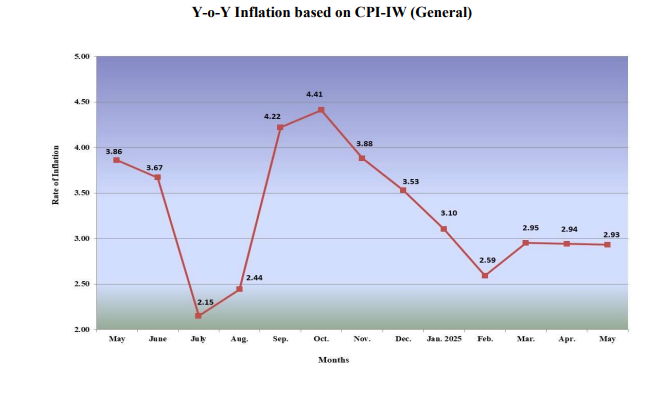
1. Labour Bureau, an attached office of the M/o Labour & Employment, has been compiling Consumer Price Index for Industrial Workers every month on the basis of retail prices collected from 317 markets spread over 88 industrially important centres in the country. The index for the month of May, 2025 is being released in this press release.
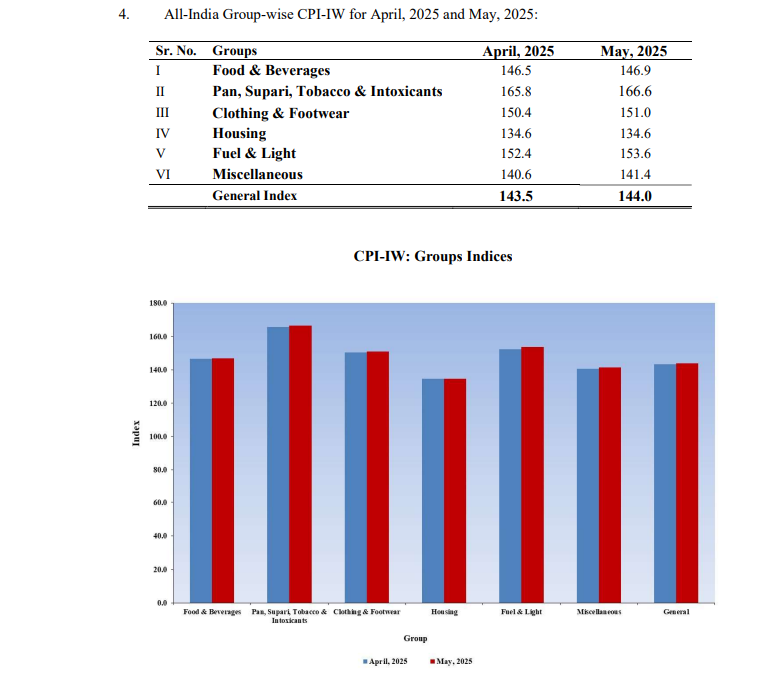
2. The All-India CPI-IW for May, 2025 increased by 0.5 point and stood at 144.0 (one hundred forty four).
EPFO Enhances Auto-Settlement Limit for Advance Claims to ₹5 Lakhs
EPFO has taken a significant step forward in its efforts to enhance member services by increasing the auto-settlement limit for advance claims from existing ₹1 lakh to ₹5 lakhs. This move will help lakhs of EPFO members receive funds faster, especially in times of urgent need.
EPFO had first introduced auto-settlement of advance claims during the COVID-19 pandemic to provide quick financial assistance to members. Since then the facility has been extended to cover advance claims for illness, education, marriage, and housing purposes. These claims are processed automatically by the system without any human involvement, ensuring quick turnaround and transparency.
In the financial year 2024–25, EPFO achieved a significant milestone by successfully processing a record 2.34 crore advance claims through auto-settlement, reflecting a sharp increase of 161% over the previous year. Notably, 59% of all advance claims in 2024–25 were settled through the auto mode.
Continuing this upward trajectory, in the first two and a half months of FY 2025–26, EPFO has already auto-settled 76.52 lakh claims, constituting around 70% of all advance claims settled so far. This growth highlights EPFO’s strong focus on automation and delivering faster, more efficient services to its members.
With the elevated limit of ₹5 lakhs, additional advance claims will now qualify for auto-settlement, leading to their processing within three days of submission. This enhanced limit and faster access to funds will help members get timely financial support when they need it the most.
This step is part of EPFO’s broader push to improve service delivery by using technology. Reaffirming the government’s commitment to enhance ease of access for EPFO members, it is underscored that the organization will continue to leverage technology and process simplification to ensure a seamless and efficient service experience. These reforms have not only accelerated the claim settlement process but have also contributed to minimizing member grievances, further enhancing ease of living for the member.
Another People-Centric Move under Modi Government!
EPFO enhances Auto-Settlement Limit for Advance Claims from ₹1 Lakh to ₹5 Lakh, with fast-track disbursal now within 72 hours. pic.twitter.com/MbBQGhWH5p
— Dr Mansukh Mandaviya (@mansukhmandviya) June 24, 2025
e-F.No. Z-20025/02/2023-Estt.(AL) Government of India Ministry of Personnel, Public Grievances & Pension Department of Personnel & Training
Block IV, Old JNU Campus, New Delhi, dated 17.06.2025
OFFICE MEMORANDUM
Subject: Implementation of e-Service Book in all Ministries! Departments- Reg.
The Service Book of a Government Servant is a document to record all the events in his/her entire service period and career recording each and every administrative action of the Government Servant right from the stage of his recruitment till his retirement to reflect the history of service of a Government employee. As per SR 198 & 199 such a Service Book is to be maintained for a Government servant from the date of his! her first appointment and is required to be kept in the custody of the Head of Office in which he is serving and needs to be transferred along with the employee, upon transfer.
2. It has now been decided to maintain the c-Service Book on e-HRMS 2.0 portal.
3. Hence all the Ministries/ Departments, further to their onboarding on e-HRMS 2.0, are requested to maintain e-Service Books on e-HRMS 2.0 only and phase out physical service books, after ensuring the completeness & accuracy of data in the e-Service books on eHRMS 2.0, as the same will be treated legally tenable for all purposes.