The Union Cabinet chaired by the Prime Minister Shri Narendra Modi today has given its approval for extending the contribution both 12% employees’ share and 12% employers’ share under Employees Provident Fund, totaling 24% for another 3 months from June to August, 2020, as part of the package announced by the Government under Pradhan Mantri Garib Kalyan Yojana (PMGKY)/ Aatmanirbhar Bharat in the light of COVID-19, a Pandemic.
This approval is in addition to the existing scheme for the wage months of March to May, 2020 approved on 15.04.2020. The total estimated expenditure is of Rs.4,860 crore. Over 72 lakh employees in 3.67 lakh establishments will be benefitted.
Salient Features:
The salient features of the proposal are as under:
For the wage months of June, July and August, 2020, the scheme will cover all the establishments having upto 100 employees and 90% of such employees earning less than Rs. 15,000 monthly wage.
About 72.22 lakh workers working in 3.67 lakh establishments will be benefited and would likely to continue on their payrolls despite disruptions.
Government will provide Budgetary Support of Rs.4800 crore for the year 2020-21 for this purpose.
The beneficiaries entitled for 12% employers’ contribution for the months of June to August, 2020 under Pradhan Mantri Rozgar Protsahan Yojana (PMRPY) will be excluded to prevent overlapping benefit.
Due to prolonged lockdown, it was felt that businesses continue to face financial crisis as they get back to work. Therefore, the Hon’ble FM, as part of Aatmanirbhar Bharat, announced on 13.5.2020 that the EPF support for business and workers will be extended by another 3 months viz. for the wage months of June, July, and August, 2020.
The steps taken by the Government from time to time to ameliorate the hardships faced by the low paid workers are well accepted by the stakeholders
Till now unmarried permanently disabled and financially dependent sons of ECHS beneficiaries after attaining the age of 25 years are not considered dependant and hence are not eligible for availing medical facilities under Ex-servicemen Contributory Health Scheme (ECHS). This is as per the Central Government Health Scheme (CGHS) Rules which are followed by ECHS. However, vide their OM No 4-24/96-C&P/CGHS(P)/EHS dated January 1, 2020, the CGHS has declared such sons of CGHS beneficiaries who have become disabled after attaining the age of 25 years, dependant and hence eligible for availing CGHS benefits subject to fulfilment of conditions laid down in the Ministry of Health and Family Welfare (MoHFW) Office Memorandum (OM) No 4-24/96-C&P/CGHS(P)/EHS dated May 5, 2018.
It has now been decided by the Ministry of Defence (MoD), Department of Ex-Servicemen Welfare (DESW) to similarly treat unmarried permanently disabled and financially dependent sons of ECHS beneficiaries who have become disabled after attaining the age of 25 years as dependant and hence eligible for availing benefits under ECHS subject to fulfilment of conditions laid down in the MoHFW OM of May 7, 2018.
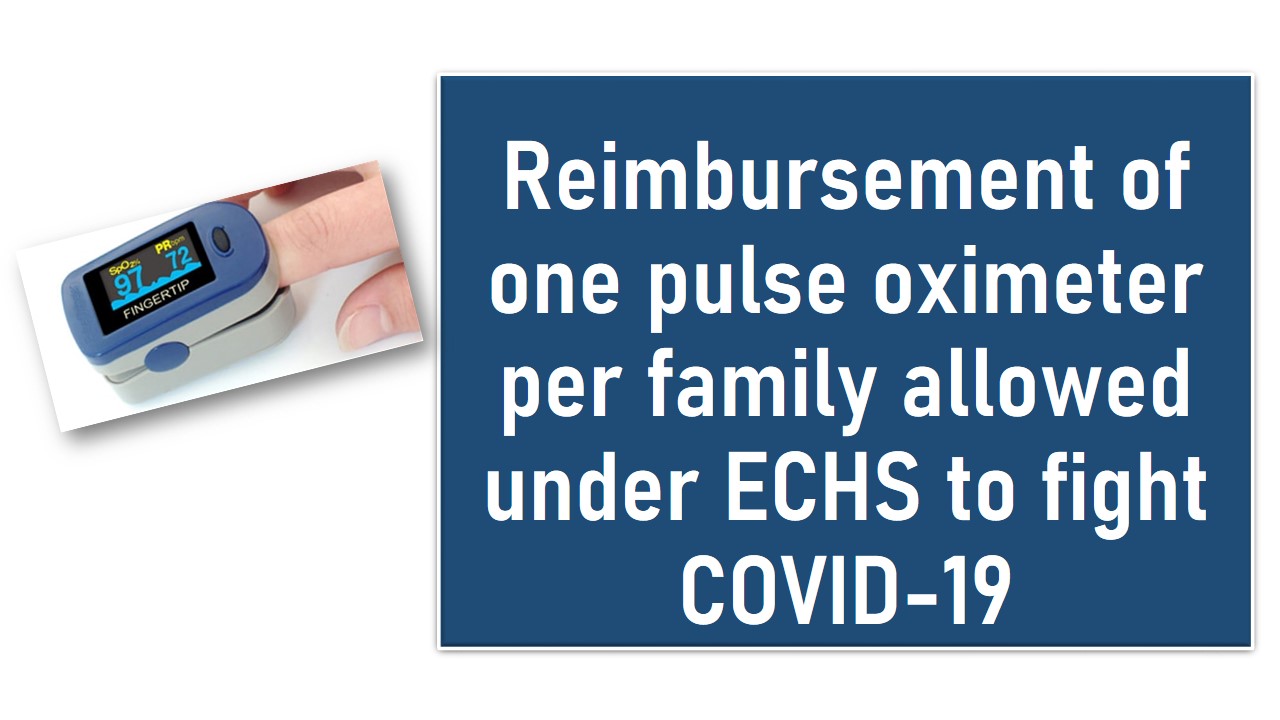
As measuring of oxygen saturation level is one of the most important parameters for monitoring the health of COVID-19 patients, Ministry of Defence (MoD), Department of Ex-Servicemen Welfare (DESW) has decided to reimburse the cost of pulse oximeter purchased by the Ex-Servicemen Contributory Health Scheme (ECHS) beneficiaries subject to the following conditions:
(a) The ECHS beneficiaries who have been tested positive for COVID-19 infection are permitted to purchase one pulse oximeter per family. In other words, in case there are more than one COVID positive cases in a family of ECHS beneficiary, they can claim reimbursement only for one pulse oximeter.
(b) The reimbursement shall be claimed as per actual cost of pulse oximeter, subject to a ceiling of Rs 1,200.
Union HRD Minister releases UGC Revised Guidelines on Examinations and Academic Calendar for the Universities in view of COVID-19 Pandemic
Union Human Resource Development Minister Shri Ramesh Pokhriyal ‘Nishank’ virtually released UGC Revised Guidelines on Examinations and Academic Calendar for the Universities in view of COVID-19 Pandemic in New Delhi on 6th July, 2020. Shri Pokhriyal said that the decision was taken to safeguard the principles of health, safety, fair and equal opportunity for students. At the same time, it is very crucial to ensure academic credibility, career opportunities and future progress of students globally. He applauded the initiatives of UGC for constantly making efforts to address various issues related to teaching, learning, examinations, academic calendar etc. in the difficult times of COVID-I9 pandemic.
The UGC has revisited its earlier guidelines related to university examinations. In view of the safety, career progression and placements of the students and their larger interests, after consulting @HMOIndia and @MoHFW_INDIA, it has been decided that pic.twitter.com/evKTYPwnIa
— Dr. Ramesh Pokhriyal Nishank (@DrRPNishank) July 6, 2020
In April 2020, the University Grants Commission constituted an Expert Committee to deliberate and make recommendations regarding the issues related to Examinations and Academic Calendar. Based on the Report of the Committee, the UGC had issued Guidelines on Examinations and Academic Calendar on 29.04.2020. The Expert Committee was requested by the UGC to revisit the Guidelines and suggest options for examinations, admissions in the Universities/ Colleges and also for beginning of new academic session as the number of COVID cases is still increasing.
The Commission in its emergent meeting held on 06.07.2020 accepted the Report of the Committee and approved the ‘UGC Revised Guidelines on Examinations and Academic Calendar for the Universities in view of COVID-19 Pandemic’.
The highlights of the Guidelines are as under:
In view of the emerging situation related to COVID-19 pandemic in India, it is important to safeguard the principles of health, safety, fair and equal opportunity for students. At the same time, it is very crucial to ensure academic credibility, career opportunities and future progress of students globally. Academic evaluation of students is very important milestone in any education system. The performance in examinations gives confidence and satisfaction to the students and is a reflection of competence, performance and credibility that is necessary for global acceptability.
The terminal semester(s)/ final year(s) examinations be conducted by the universities/ institutions by the end of September, 2020 in offline (pen & paper)/ online/ blended (online + offline) mode.
The students of terminal semester/ final year students having backlog should compulsorily be evaluated by conducting examinations in offline (pen & paper)/ online/ blended (online + offline) mode as per feasibility and suitability.
In case a student of terminal semester/ final year is unable to appear in the examination conducted by the University for whatsoever the reason(s) may be, he/she may be given opportunity to appear in special examinations for such course(s)/ paper(s), which may be conducted by the university as and when feasible, so that the student is not put to any inconvenience/ disadvantage. The above provision shall be applicable only for the current academic session 2019-20 as a one-time measure.
The guidelines regarding intermediate semester/ year examination, as notified on 29.04.2020 will remain unchanged.
If need be, the relevant details pertaining to the Admissions and Academic Calendar in the universities and colleges shall be issued separately in place of those mentioned in the earlier guidelines issued on 29th April, 2020.
Union HRD Minister announces revision of syllabi by CBSE for classes IX-XII for the academic session 2020-21
Considering the importance of learning achievement, it has been decided to rationalize syllabus up to 30% by retaining the core concepts – HRD Minister
Union Minister for HRD Shri Ramesh Pokhriyal ‘Nishank’ has said that looking at the extraordinary situation prevailing in the country and the world, CBSE was advised to revise the curriculum and reduce course load for the students of Class 9th to 12th.Accordingly, CBSE has revised the syllabi for classes IX-XII for the academic session 2020-21
He also informed that a few weeks ago, he invited suggestions from all educationists on the reduction of syllabus on social media by using #SyllabusForStudents2020. ShriNishank informed that we received more than 1.5K suggestions and expressed his gratitude to everyone for the overwhelming response.
— Dr. Ramesh Pokhriyal Nishank (@DrRPNishank) July 7, 2020
The union Minister said that the changes made in the syllabi have been finalised by the respective Course Committees with the approval of the Curriculum Committee and Governing Body of the Board.
The revision of syllabi is a measure taken due to the extraordinary situation prevailing in the country and at different parts of the world. Considering the importance of achieving the level of learning, the syllabus has been rationalised to the extent possible up to 30% by retaining the core concepts.
The Heads of Schools and Teachers have been advised by the Board to ensure that the topics that have been reduced are also explained to the students to the extent required to connect different topics. However the reduced syllabus will not be part of the topics for Internal Assessment and year-end Board Examination. Alternative Academic Calendar and inputs from the NCERT on transacting the curriculum using different strategies shall also be part of the teaching pedagogy in the affiliated schools.
For Elementary Classes (I-VIII) schools shall follow the Alternative Academic Calendar and Learning Outcomes specified by NCERT. The revised syllabus is available on CBSE Academic Website www.cbseacademic.nic.in
A copy of Department of Pension and Pensioners’ Welfare (DOP&PW)’s O.M. no. 12/4/2020-P&PW(C)-6300 dated January,17, 2020 (17.1.2020) on the above subject is enclosed for information, guidance and compliance.
DA: 1 letter as cited as above.
(V. Prakash)
Joint Director Accounts
Railway Board
The AUAB meeting held yesterday the 06.07.2020 has decided to call on the BSNL employees to organise lunch hour black flag demonstrations on 16.07.2020. It is also decided that the employees should wear black badge on that day. The following are the agitational programme and charter of demands, as decided in yesterday’s meeting.
Agitational programme.
All the employees are called upon to wear black badge on 16.07.2020. Black flag demonstrations are to be organised by the employees during lunch hour on 16.07.2020, against the cancellation of BSNL’s 4G tender and against the road blocks being created in the rolling out of BSNL’s 4G services.
A memorandum is to be submitted to all the MPs during the period from 13.07.2020 to 31.07.2020, urging upon them to intervene in favour of BSNL’s expeditious rolling out of 4G network, as well as the early revival of BSNL.
Twitter campaign is to be organised on 05.08.2020, demanding immediate rolling out of 4G network by BSNL and implementation of the assurances given in the Revival Package.
Demands:
BSNL should immediately be allowed to roll out it’s 4G Services.
BSNL should take immediate actions to upgrade the 4G compatible BTSs.
Add on order for 4G equipments as per Phase VIII.4 tender should be issued immediately.
In the matter of procuring new equipments and upgrdation, there should not be any discrimination, between BSNL and other private telecom service providers.
The Government should immediately implement the decisions contained in BSNL’s Revival Package, like extension of Sovereign Guarantee for the issuing of Bonds.
Urgent measures should be undertaken by the BSNL Management for immediately improving the quality of service.
The Management should ensure that the salary payment of the employees is made on the last working of every month.
The Management should immediately take steps to ensure that the employees get cashless treatment from empanelled hospitals during Covid 19 pandemic. The Management should pay Rs.10 lakh to the family of the employees who die due to COVID-19. Based on the instructions issued by the DoT, the Postal Department has already introduced such a scheme to it’s employees.
All the circle and district unions are requested to coordinate with the other constituents of the AUAB and to make the agitational programme a total success. Circle and district secretaries are requested to go through the AUAB circular for full details.
From
Addl. Chief Secretary to Government Haryana
Finance Department.
To
1. All Heads of Departments, Commissioners of Division.
2. All Deputy Commissioners & Sub Divisional Officers (Civil) in Haryana.
3. The Registrar General, Punjab & Haryana High Court, Chandigarh.
Memo No. 2/47/2007-1Pension (FD)
Dated Chandigarh, the 22nd June, 2020
Subject :- Adoption of Online PRAN Generation on Module (OPGM) in the State of Haryana.
Sir/ Madam,
Kindly refer to this Department’s guidelines issued vide letter No. 1/1/2014-1Pension dated 04.12.2008 in relation to the NPS and other instructions from time to time on the subject cited above.
It has been observed by the State Government that there is a huge gap between date of joining the Service and the date of generation of PRAN, which adversely compromises the NPS corpus of the subscribers and thus is a matter of serious concern and needs to be addressed on priority. Delay in generation of Permanent Retirement Account Number (PRAN) further leads to delay in uploading of NPS contributions. Such delays in uploading NPS contributions adversely impact the total corpus available in the NPS account leading to lesser monthly pension being received by the subscriber and defeating the very purpose of providing NPS to an employee subscriber.
Accordingly, NSDL-CRA. has developed ‘Online PRAN Generation Module’ (OPGM) for the Government employees. Online PRAN Generation has greater advantages over the manual PRAN generation process as listed below:-
Manual PRAN Generation process
Automated File Based process
Consideration time & effort spent to check every PRAN application
Accuracy cannot be ensured in case of all the applicable fields.
Time lag movement of physical from DDO to CRA – FCs
Higher probability of application
Above might lead to delay in contribution credit
Once Data, Photo & Signature are collated centrally, text file can be Generated from Back Office System
Inbuilt validations
Expedites PRAN Generation
Error free operations as details present in back office are part of rejections the text file
Faster contribution credit
After due consideration, it has been decided by the State Government to adopt/ implement ‘Online PRAN Generation Module’ (OPGM) w.e.f. 01.06.2020 only.
The above instructions may be brought to the notice of all concerned for strict compliance
Deputy Secretary Finance (Pension)
for Addl. Chief Secretary to Government Haryana
Finance Department
Simplification of pension process for permanently disabled children / siblings and dependent parents – Haryana Govt Order
From
Additional Chief Secretary to Government Haryana,
Finance Department.
To
1. All Heads of Departments
2. Commissioners of Divisions
3. All the Deputy Commissioners 85 Sub Divisional Officers (Civil) in Haryana.
4. The Registrar, Punjab & Haryana High Court, Chandigarh.
Memo No. 2/2/2019-1Pension (FD)
Dated, Chandigarh, the 22.06.2020
Subject : Simplification of pension process for permanently disabled children/siblings and dependent parents – instructions thereof.
Sir/ Madam,
Kindly refer to the notification No. 2/22/2016-1Pension Dated 19.07.2016 wherein Haryana Civil Services (Pension) Rules, 2016, were notified.
Whereas, Government of India had issued OM No. 1/27/2011-P85PW (E) dated 01.07.2013, wherein they have prescribed pension process for permanently disabled child/children/ siblings and/or dependent parents,
A number of references were received from the quarter concerned for adopting the above said pension process of Central Government also in respect of State Government employees.
After due consideration and to avoid difficulty faced in getting the revised Pension Payment Orders (PPOs) issued for old parents and disabled children/ siblings after the death of the pensioner/ family pensioner, it has now been decided by State Government to adopt the pension process, for permanently disabled children/siblings and/or dependent parents, prescribed in the OM No. 1/27/2011-P&PW (E) dated 01.07.2013 in the following manner:-
The name(s) of permanently disabled child/children/ siblings and/or dependent parents may be added to the PPO issued to the retiring Government servant if there is no other eligible prior claimant for family pension other than the spouse. No fresh PPO needs to be issued in such case and the family pension will be payable by the pension disbursing authority in the following order and the following manner: –
(i) To the Spouse :- on the death of the pensioner – on production of death certificate of pensioner. This Family Pension will continue till death or remarriage of spouse. In the case of a childless widow, the family pension may continue even after her re-marriage as per provisions contained under Haryana Civil Services (Pension) Rules, 2016.
(ii) To the permanently disabled child/children:- on the death/ remarriage of spouse – on production of such death certificate/ remarriage-intimation, Family pension to the spouse will be discontinued and family pension would be allowed by the Pension Disbursing Authority (PDA) for life for permanent disabled children in the order, prescribed in Haryana Civil Services (Pension) Rules, 2016.
(iii) To the dependent parents:- To be taken up sequentially first mother, then father-when claimants in (i) and (ii) die or become ineligible- on production of death certificate/remarriage-intimation of Spouse and/or death certificate of all permanently disabled children, family pension would be allowed by the PDA to dependent parents. This family pension would continue till death of the dependent parents. The relevant detailed provisions contained under Haryana Civil Services (Pension) Rules, 2016.
(iv) To the permanently disabled siblingsjs:- when family pension to all above ceases to be payable on account of death/remarriage on production of death certificates/remarriage-intimation as applicable, the family pension will be allowed by PDA to the permanently disabled siblings. The relevant detailed provisions are as contained under Haryana Civil Services (Pension) Rules, 2016.”
It is requested to bring the above instructions to the concerned for strict compliance.
The above order can be downloaded from the website of Finance Department i.e. www.finhry.gov.in.
Deputy Secretary Finance (Pension)
for Addl. Chief Secretary to Government Haryana
Finance Department
From
The Additional Chief Secretary to Govt. Haryana
Finance Department
To
1. The Chief Secretary to Govt. Haryana (Establishment-I/II).
2. All the Administrative Secretaries to Govt. Haryana.
3. All Head of Departments in Haryana.
4. Commissioners of Divisions-Hisar, Ambala, Karnal, Faridabad, Rohtak, Gurugram.
5. All Deputy Commissioners in Haryana.
6. The Registrar (General), Punjab and Haryana High Court, Chandigarh.
7. All Sub Divisional Officers (Civil) in Haryana.
Dated : 25.06.2020
Subject : Instructions regarding preparing reply to the legal notices & court cases related to grant of House Rent Allowance w.e.f. 1.1.2016 instead of 1.8.2019.
****
Reference on the subject noted above.
As aware, instructions have been issued by the Finance Department vide No.4/2/2017-5FR(FD) dated 30.7.2019 for grant of House Rent Allowance (HRA) under 7th Pay Structure w.e.f. 01.08.2019, as amended vide even number dated 14.08.2019 and 22.08.2019.
Many employees/retirees are filing legal notices and Civil Writ Petitions for grant of HRA w.e.f. 01.01.2016 instead of 01.08.2019. Cases are received in the Finance Department for vetting of draft reply to be filed in the Hon’ble High Court in different CWPs. Therefore to maintain uniformity in such cases, please find enclosed herewith a draft copy of “Preliminary Submissions” on the matter in question.
It is advised to prepare detailed reply/written statement to the legal notices/CWPs as per facts of each case individually and file the same in the Hon’ble High Court after getting it vetted from 0/o Ld. Advocate General, Haryana under intimation to the Finance Department.
Copy of this communication may be downloaded from the official website of the Finance Department i.e. www.finhry.gov.in also.
DA: As above.
Under Secretary Finance (FR)
for Additional Chief Secretary to Government,
Haryana Finance Department