(a) whether the 8th Central Pay Commission (CPC) has been approved;
(b) if so, the details thereof; and
(c) the estimated number of Central Government employees and pensioners that would benefit from this at the level of the 8th CPC which would boost consumption in the economy?
MINISTER OF STATE IN THE MINISTRY OF FINANCE (SHRI PANKAJ CHAUDHARY)
(a) & (b): It has been decided by the Government to constitute the 8th Central Pay Commission (CPC).
(c): The approximate number of Central Government civilian employees and pensioners/family pensioners is 36.57 lakh (as on 01.03.2025) and 33.91 lakh (as on 31.12.2024) respectively. Defence Personnel and Pensioners will also be benefitted.
Unified Pension Scheme vs New Pension Scheme : Implementation Timeline, Impact, and Financial Viability: Lok Sabha QA
GOVERNMENT OF INDIA MINISTRY OF FINANCE DEPARTMENT OF FINANCIAL SERVICES
LOK SABHA UNSTARRED QUESTION NO. 3681
ANSWERED ON MONDAY, 24 MARCH, 2025/ CHAITRA 3, 1947 (SAKA)
IMPLEMENATION OF UNIFIED PENSION SCHEME
†3681. Shri Dharmendra Yadav Will the Minister of Finance be pleased to state:
(a) the timeline for full implementation of Unified Pension Scheme (UPS) and the manner in which it is likely to impact the existing New Pension Scheme (NPS) Subscribers;
(b) the likely long-term financial viability for UPS in comparison to NPS for the Government;
(c) the difference between investment flexibility in NPS and UPS;
(d) whether the Government has identified the problems of NPS and if so, the details thereof;
and
(e) whether the UPS will resolve the above problems, if so, the details thereof?
ANSWER MINISTER OF STATE FOR FINANCE (SHRI PANKAJ CHAUDHARY)
(a) Unified Pension Scheme (UPS) has been notified by the Government on 24.01.2025, as an option under National Pension System (NPS) with the objective of providing assured monthly payout after retirement to the Central Government employees covered under the NPS. The UPS has been envisaged to address the demand of the employees covered under National Pension System (NPS) regarding assured pension after retirement while ensuring fiscally responsible funded and contributory pension scheme.
(b) UPS is defined contribution scheme with elements of defined benefit. It relies on the regular and timely accumulation and investment of applicable contributions (from both the employee and the employer) for assured payout to the employees. The monthly contribution of the UPS subscriber shall be ten percent of the basic pay and dearness allowance matched by the Central Government by crediting an equal amount, to the individual PRAN of the UPS subscriber. The Central Government shall also make additional contribution at an estimated eight and half percent of basic pay plus dearness allowance of all employees who opt the UPS, to the pool corpus on aggregate basis. The additional contribution is for supporting assured payouts under the Unified Pension Scheme to ensure long-term financial viability of UPS.
(c) Presently, Central Government subscribers are allowed to choose any of the pension funds registered with PFRDA and exercise investment options from (a) 100% investments in Government securities; (b) Conservative Life Cycle fund with maximum equity exposure capped to 25%; (c) Moderate Life Cycle fund with maximum equity exposure capped to 50%; and (d) Default scheme. Under UPS, the employee can exercise investment choices for the individual corpus alone. uch investment choices shall be regulated by the Pension Fund Regulatory and Development Authority. If an employee does not exercise an investment choice on individual corpus, the ‘default pattern’ of investment will apply. The investment decisions for the pool corpus built through the additional Central Government contribution solely rests with Central Government.
(d) & (e) NPS is a defined contribution-based scheme with market linked returns for postretirement benefits. An NPS review committee was constituted to suggest measures as are appropriate to modify the NPS with a view of improving upon the pensionary benefits of Government employees covered under NPS, keeping in view the fiscal implications and impact on overall budgetary space, so that fiscal prudence is maintained to protect the common citizens. UPS is a defined contribution-based schemes with elements of defined benefit which addresses the concerns regarding assured payout after retirement.
Mandatory use of Bhavishya Portal for processing of Pension Cases w.e.f. 01.01.2017 : DOPPW O.M
File No. 55/4/2014-PPW(C)(Vol.II)-part-I भारत सरकार /Government of India कार्मिक, लोक शिकायत और पेंशन मंत्रालय/Ministry of Personnel Public Grievances and Pensions पेंशन और पेंशनभोगी कल्याण विभाग/Department of Pension and Pensioners’ Welfare
Subject: Mandatory use of Bhavishya Portal for processing of Pension Cases w.e.f. 01.01.2017.
The undersigned is directed to refer to this department’s OM No.55/14/2014-PPW(C)-Part.I dated 21.1.2021 and to say that Department of Pension & Pensioners’ Welfare had developed ‘Bhavishya’, a common software module for Ministries, which has now been functioning as a mandatory platform for processing Pension & related benefits of Central Civil Pensioners w.e.f. 01.01.2017 (O.M. of even number dated 29.11.2016-enclosed).
2. DoPPW has been taking all possible steps to ensure that all types of pension cases are processed through ‘Bhavishya’. However, in case any difficulty arises in settling a case under exceptional circumstances, the concerned HOO (Head of Office) shall contact this Department, at the earliest, with the issue arising, if any. DoPPW shall either ensure processing such an exceptional case through ‘Bhavishya’ software or grant exemption so that the concerned HOO can process the same manually.
3. Further, the new Single Pension Application Form 6-A is accessible to retiring Central Government employees w.e.f. 06.11.2024. The retiring Central Government employees are required to fill the Form 6-A exclusively through online mode on Bhavishya or e-HRMS 2.0.
4. As already mentioned under Para 5 of the O.M dated 29.11.2016 and Para 4 of OM dated 21.01.2021, it is reiterated that, under all circumstances, the authorities shall Strictly follow the timelines prescribed under CCS (Pension) Rules, 2021 and in no case will any pension settlement be delayed beyond prescribed timelines.
5. This issues with the approval of competent authority.
Revised salary, daily allowance, pension and additional pension for Members and Ex-Members of Parliament from April 2023
MINISTRY OF PARLIAMENTARY AFFAIRS NOTIFICATION New Delhi, the 21st March, 2025
G.S.R. 188(E).— In exercise of the powers conferred by sub-section (2) of section 3 and sub-section (1A) of section 8A of the Salary, Allowances and Pension of Members of Parliament Act, 1954 (30 of 1954), the Central Government hereby notifies the increase in the salary, daily allowance, pension and additional pension of Members and Ex-Members of Parliament on the basis of Cost Inflation Index specified under clause (v) of the Explanation to section 48 of the Income-tax Act, 1961(43 of 1961), with effect from the 1st April, 2023, as under :
S. No.
Head
Existing Rate (₹) w.e.f. 1.4.2018
Revised Rate (₹) w.e.f. 1.4.2023
1.
Salary
1,00,000/- per mensem
1,24,000/- per mensem
2.
Daily Allowance
2,000/-
2,500/-
3.
Pension
25,000/- per mensem
31,000/-per mensem
4.
Additional Pension for every year service in excess of five years
Rate of interest for purchase of Computer during 2025-26 – Advances to Government Servants – FinMin O.M
F.No. 5(2)-B(PD)/2025 Government of India Ministry of Finance Department of Economic Affairs (Budget Division)
Room No. 237, North block, New-Delhi, the 24th March, 2025
OFFICE MEMORANDUM
Subject: Advances to Government Servants — Rate of interest for purchase of Computer during 2025-26.
The undersigned is directed to state that the rate of interest for advance sanctioned to the Government servants for purchase of computer during 2025-26 i.e. from 1st April, 2025 to 31st March, 2026 is as under:
Rate of interest per annum
Advance for purchase of Computer
9.1%
(Lekha Nair) Deputy Director (Budget)
To 1) All Ministries/Departments of the Government of India with spare copies for Integrated Finance Division (IFD), Controller of Accounts and Pay and Accounts Offices.
2) Finance Secretaries of UTs without legislature.
Copy forwarded to:-
1) Comptroller and Auditor General of India, New Delhi. 2) Controller General of Accounts, New Delhi. 3) Controller General of Defence Accounts, New Delhi. 4) All Auditor Generals and Director of Accounts. 5) Supreme Court of India. 6) Union Public Service commission, New Delhi.
Eligibility age for additional pension benefits : Lok Sabha QA 19.03.2025
GOVERNMENT OF INDIA MINISTRY OF PERSONNEL, PUBLIC GRIEVANCES AND PENSIONS (DEPARTMENT OF PENSION & PENSIONERS’ WELFARE) LOK SABHA
UNSTARRED QUESTION NO. 2991 (ANSWERED ON 19.03.2025)
ELIGIBILITY AGE FOR ADDITIONAL PENSION BENEFITS
2991. SHRI MANICKAM TAGORE B: SHRI VIJAYAKUMAR ALIAS VIJAY VASANTH:
Will the PRIME MINISTER be pleased to state:
(a) the rationale behind setting the eligibility age for additional pension benefits at 80;
(b) whether the Government is considering to reduce this age threshold to 65 years as recommended by the Parliamentary Standing Committee on Pensioner’s grievances and if so, the details thereof;
(c) the number of Central Government pensioners expected to benefit from the additional pension scheme and the estimated annual expenditure likely to be incurred under this scheme;
(d) the measures taken/being taken by the Government to ensure that pensioners receive their additional pension benefits in a timely and transparent manner and there are no delays or discrepancies in the payment process;
(e) whether the Government is considering to extend the additional pension benefits to State Government pensioners and other categories of retirees and if so, the timeline for implementing this extension; and
(f) the steps taken/being taken by the Government to address the concerns that the additional pension benefits may not keep pace with inflation and the mechanisms put in place to ensure that the benefits are indexed to rising living costs?
ANSWER
MINISTER OF STATE IN THE MINISTRY OF PERSONNEL, PUBLIC GRIEVANCES AND PENSIONS AND MINISTER OF STATE IN THE PRIME MINISTER’S OFFICE (DR. JITENDRA SINGH)
(a) to (f): Government has on the recommendation of the 6th CPC approved the quantum of additional pension of 20% on attaining the age of 80 years, 30% on attaining the age of 85 years, 40% on attaining the age of 90 years, 50% on attaining the age of 95 years and 100% on attaining the age of 100 years, on the rationale that the older pensioners require a better deal because their needs, especially those relating to health, increase with age. The recommendation of the Parliamentary Standing Committee for amendments in additional pension in its 110th report dated 10.12.2021 have been duly examined in the Government and an action taken report was submitted on 06.06.2022.The Parliamentary Standing Committee in its 120th report dated 08.12.2022 noted the action taken report and observed that the Committee do not wish to pursue this matter for now. The additional pension is automatically paid to the pensioner/family pensioner by the Pension Disbursing Authorities/Banks as soon as it becomes due. The instructions/guidelines, as issued by the Government from time to time, are there in place ensuring scrupulous and timely payment of additional pension. The grant of additional pension is age based only. To address the concern regarding inflation and rising living costs, Dearness Relief equivalent to Dearness Allowance is payable to the pensioners/family pensioners at such rate as Central Government may specify from time to time. The dearness relief is applicable on additional pension also.
Government of India Ministry of Finance Department of Expenditure
Rajya Sabha
Un-Starred Question No. 2009 To be answered on Tuesday, the 18th March, 2025 . Phalguna 27, 1946 (Saka)
Merger of DA/DR with basic pay/pension
2009 Shri Javed Ali Khan:
Will the Minister of Finance be pleased to state:
a) whether Government proposes to merge 50 per cent DA/DR with basic pay/pension of central Government employees/pensioners as interim relief before report of the 8th Central Pay Commission is prepared and adopted in view of the unprecedented inflation during the last 32 years as per the data given by the Minister to this August House and reduced DA/DR calculation during recent years;
Minister of State in the Ministry of Finance (Shri Pankaj Chaudhary)
a) No.
b) Does not arise.
c) The Dearness Allowance (DA)/ Dearness Relief (DR) is paid to Central Government employees/pensioners to adjust the cost of living and to protect their Basic Pay/Pension from erosion in the real value on account of inflation. The rate of DA/DR is revised periodically every 6 months on the basis of All India Consumer Price Index for Industrial Workers (AICPI-IW) released by Labour Bureau under Ministry of Labour and Employment. Since the implementation of the recommendations of the Seventh Central Pay Commission from 01.01.2016, 15 instalments of DA/DR have been granted to the Central Government employees/pensioners so far
8th Pay Commission Status, ToR & Impact:Lok Sabha QA 17.03.2025
GOVERNMENT OF INDIA MINISTRY OF FINANCE DEPARTMENT OF EXPENDITURE
LOK SABHA STARRED QUESTION No. *235
TO BE ANSWERED ON MONDAY, MARCH 17, 2025/PHALGUNA 26, 1946 (SAKA)
CONSTITUTION OF 8TH CENTRAL PAY COMMISSION
*235. MS KANGNA RANAUT: SMT. SAJDA AHMED:
Will the Minister of Finance be pleased to state:
(a) whether the 8th Central Pay Commission (CPC) has been constituted by the Government for revision of salaries and pensions of Central Government employees;
(b) if so, the details thereof along with the terms of reference of the Commission and the time fixed for submission of its report to the Government;
(c) the approximate number of Central Government employees and pensioners at the 7th CPC level likely to be benefitted by the 8th CPC leading to consumption boost and the economic growth across the country including Odisha;
(d) whether implementation of the recommendations of the 8th CPC is likely to increase the financial burden on Government;
(e) if so, the details thereof, and
(f) whether the Government has conducted any studies or held any consultation with employee unions, pensioners and other stakeholders to assess the impact of 8th CPC on fiscal policies and Government expenditure?
ANSWER FINANCE MINISTER (SMT. NIRMALA SITHARAMAN)
(a): It has been decided by the Government to constitute the 8th Central Pay Commission (CPC).
(b): Will be decided in due course of time.
(c): The approximate number of Central Government civilian employees and pensioners/family pensioners is 36.57 lakh (as on 01.03.2025) and 33.91 lakh (as on 31.12.2024) respectively. Defence Personnel and Pensioners will also be benefitted.
(d) & (e): The financial implication of the recommendations of the 8th Central Pay Commission will be known, once the recommendations are made by the 8th Central Pay Commission and accepted by the Government.
(f): Inputs on Terms of Reference (ToR) have been sought from major stakeholders including Ministry of Defence, Ministry of Home Affairs, Department of Personnel & Training and from States. Impact of 8th CPC can be assessed only once the recommendations are made by 8th CPC and are accepted by the Government.
Consumer Price Index for Industrial Workers (2016=100) – January, 2025
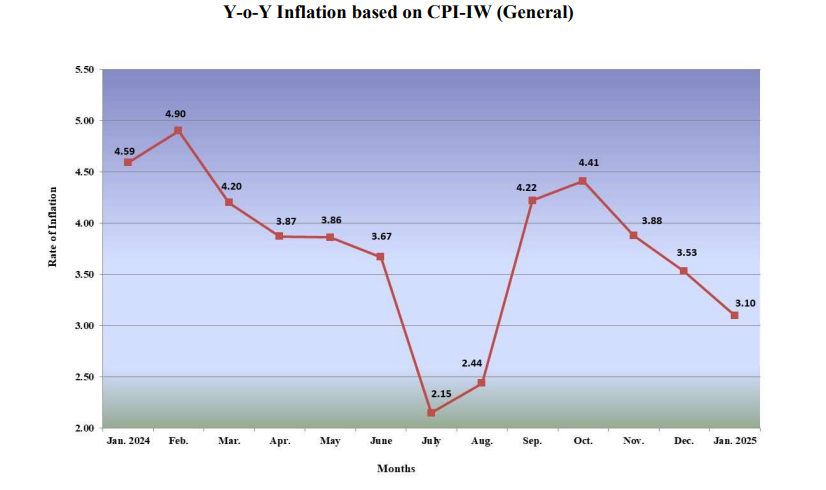
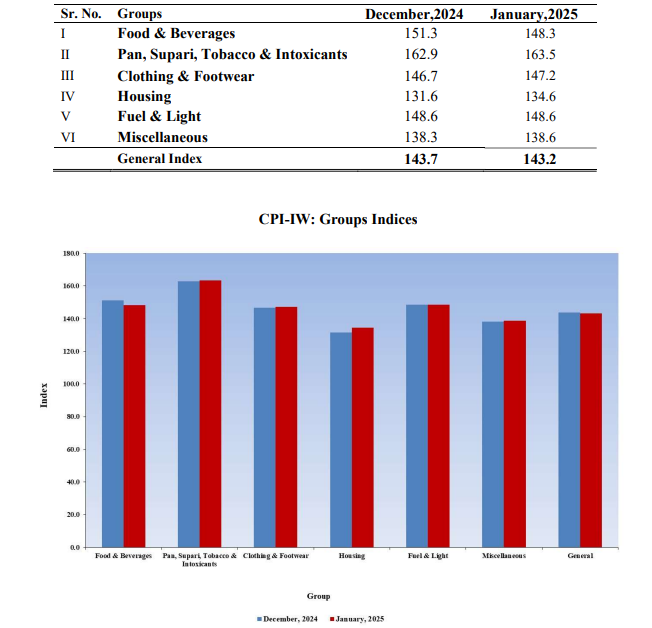
1. Labour Bureau, an attached office of the M/o Labour & Employment, has been compiling Consumer Price Index for Industrial Workers every month on the basis of retail prices collected from 317 markets spread over 88 industrially important centres in the country. The index for the month of January, 2025 is being released in this press release.
2. The All-India CPI-IW for January, 2025 decreased by 0.5 point and stood at 143.2 (one hundred forty three point two).
Meeting Minutes with Staff Side of NCJCM held on 25.02.2025 on the pension related matters: DOPPW O.M
F. No. 28/03/2025-P&PW(B)/JCM भारत सरकार कार्मिक, लोक शिकायत और पेंशन मंत्रालय पेंशन और पेंशनभोगी कल्याण विभाग
लोकनायक भवन खान मार्केट, नई दिल्ली दिनांक 04.03.2025
OFFICE MEMORANDUM
Subject:- Minutes of the meeting with Staff Side of N.C. (JCM) held on 25.02.2025 under the chairmanship of Secretary (Pension) on the pension related matters-reg.
The undersigned is directed to forward herewith the minutes of the meeting with Staff Side of N.C. (JCM) held on 25.02.2025 at Lok Nayak Bhawan under the chairmanship of Secretary (Pension) on the pension related matters for information and further necessary action.
(S. Chakrabarti) Under Secretary to Govt of India
To All Participants (As Per list Attached)
Copy to 1.PSO to Secretary (Pension) 2.PPS to JS(Pensions)
Minutes of the meeting with the staff side of the National Council (JCM) held on 25.02.2025 under the Chairmanship of Secretary (Pension) in Lok Nayak Bhawan, Khan Market, New Delhi.
A meeting with the staff side of National Council (JCM) was held on 25.02.2025 at 4:30 PM under the chairmanship of Sh. V. Srinivas, Secretary (Pension) to discuss the applicability of DoPPW OM dated 03.03.2023 to the employees appointed on compassionate grounds.
2.The meeting was attended by the Officers of DOPPW, Ministry of Railways led by Smt. Roopa Srinivasan, Member (Finance), Railway Board and delegation of staff side of National Council (JCM) led by Shri Shiva Gopal Mishra, Secretary. The list of participants is at Annexure I.
3.Secretary (Pension) welcomed the participants and invited the member from the staff Side as well as the official side to participate in the meeting with a free and frank approach, so that issues are appreciated and arrived at a solution.
4.Following issues were discussed during the meeting:-
(i) Applicability of DoPPW OM dated 03.03.2023 to the employees appointed on compassionate grounds – It was requested by the staff side that the facility of coverage under OPS be extended to compassionate ground appointees who had submitted their application before 01.01.2004 but were appointed after 01.01.2004. Further, it was highlighted that there is no Notification/Advertisement in the case of appointments on compassionate grounds.
Therefore, in order to extend the benefit of DoPPW OM dated 03.03.2023 to them, the date of their application for compassionate appointment may be treated as date of notification/advertisement. Accordingly, para 4 of the DoPPW’s OM dated 03.03.2023 may be revised. The proposal found favour from Ministry of Railways. Accordingly it was decided that inter-ministerial consultations with DOPT, DOLA, DFS and DOE, may be initiated on the subject.
(ii) The issue related to merger of the Railway (Pension) Rules, 1993 with the CCS(Pension) Rules, 2021 was discussed and it was requested that the same may be expedited. It was informed that the matter of merger of these rules continues to be under examination. The Ministry of Railways can separately initiate necessary amendments in the Railway (Pension) Rules 1993 as per felt-need on the subject.
The meeting ended with a vote of thanks to the Chair.
ANNEXURE -I
List of participants attended the meeting held on 25.02.2025 under the Chairmanship of Secretary (Pension) with the National Council (staff side) of JCM:-
National Council (staff side) of JCM
Official Side
Shri Shiva Gopal Mishra,Secretary,
Smt. Roopa Srinivasan, Member (Finance), Railway Board