Dearness Relief to pre 1986 Bank Pensioners from Feb 2020
Indian Banks’ Association
HR & Industrial Relations
No.CIR/HR&IR/D/G2/2019-20/8620
February 1, 2020
Designated Officers of all Nationalised Banks
and State Bank of India
Dear Sir/Madam,
Dearness Relief payable for the period February to July 2020 to surviving pre 1.1.1986 retirees of banks (b) surviving spouses of pre 1.1.86 Retirees who are in receipt of Ex-gratia
As per the directive contained in the Government of India, Ministry of Finance Department of Economic Affairs (Banking Division) letter F.No.11/2/2012-IR dated 17.12.2013, the Dearness Relief payable to surviving pre 1.1.1986 retirees of banks for the period February 2020 to July 2020 on Ex-gratia will be as under :
Applicable CPI Average
Amount of Ex-gratia per month
Rate of Dearness Relief
Amount of Dearness Relief per month
Total Ex-gratia amount including Dearness Relief per month
Indian Banks’ Association
HR & Industrial Relations
No.CIR/HR&IR/76/D/2019-20/8619
February 1, 2020
All Members of the Association
(Designated Officers)
Dear Sirs,
Dearness Allowance for Workmen and Officer Employees in banks for the months of February, March & April 2020 under X BPS / Joint Note dated 25.5.2015.
The confirmed All India Average Consumer Price Index Numbers for Industrial Workers (Base 1960= 100) for the quarter ended December 2019 are as follows:-
October 2019 – 7418.42
November 2019 – 7486.90
December 2019 – 7532.55
The average CPI of the above is 7479.29 and accordingly the number of DA slabs are 759 (7479 – 4440 = 3039 / 4 = 759 Slabs) The last quarterly Payment of DA was at 717 Slabs. Hence there is an increase in DA slabs of 42 i.e 759 Slabs for payment of DA for the quarter February, March and April 2020.
In terms of clause 7 of the 10th Bipartite Settlement dated 25.05.2015 and clause 3 of the Joint Note dated 25.05.2015, the rate of Dearness Allowance payable to workmen and officer employees for the months of February, March & April 2020 shall be 75.90% of pay. While arriving at dearness allowance payable, decimals from third place may please be ignored.
Yours Faithfully,
sd/-
S K Kakkar
Senior Advisor (HR&IR)
Presenting the first Union Budget of the third decade of the 21st century, Finance Minister Smt. Nirmala Sitharaman, today unveiled a series of far-reaching reforms, aimed at energizing the Indian economy through a combination of short-term, medium-term, and long term measures.
The Union Budget has been structured on the overall theme of “Ease of Living.” This has been achieved by farmer friendly initiatives such as Agriculture credit target of Rs 15 lakh crore for 2020-21; schemes of “Kisan Rail” and “Krishi Udaan” for a seamless national cold supply chain for perishables; and expansion of PM-KUSUM to provide 20 lakh farmers for setting up stand-alone solar pumps.
In the health sector, the Budget proposes more than 20,000 empanelled hospitals under PM Jan Arogya Yojana for poor people; and expansion of Jan Aushadhi Kendra Scheme to all districts offering 2000 medicines and 300 surgicals by 2024.
Infrastructure receives a boost, with 100 more airports by 2024 to support Udaan scheme; and operation of 150 passenger trains to be done through PPP mode.
Starting apprenticeship embedded courses through 150 higher educational institutions by March 2021 and a proposal to establish Indian Institute of Heritage and Conservation are some of the other major highlights.
The Finance Minister said that the Union Budget Aims:
To achieve seamless delivery of services through Digital governance
To improve physical quality of life through National Infrastructure Pipeline
Risk mitigation through Disaster Resilience
Social security through Pension and Insurance penetration.
The budget is woven around three prominent themes:
Aspirational India in which all sections of the society seek better standards of living, with access to health, education and better jobs.
Economic development for all, indicated in the Prime Minister’s exhortation of “SabkaSaath, SabkaVikas, SabkaVishwas”.
Caring Society that is both humane and compassionate, where Antyodaya is an article of faith.
The three broad themes are held together by
Corruption free – policy-driven good governance
Clean and sound financial sector.
The three components of Aspirational India are- a) Agriculture, Irrigation and Rural Development , b) Wellness, Water and Sanitation and c) Education and Skills
Agriculture, Irrigation and Rural Development
The Finance Minister said that more than Rs 2.83 lakh crore would be spent on Agriculture, Rural Development, Irrigation and allied activities as farmers and rural poor continue to remain the key focus of the Government. Reiterating the commitment of doubling farmers’ income by 2022, She said, Government has already provided resilience for 6.11 crore farmers insured under PM Fasal Bima Yojana. Agriculture credit target for the year 2020-21 has be set at Rs 15 lakh crore. All eligible beneficiaries of PM-KISAN will be covered under the KCC scheme. Moreover, comprehensive measures for one hundred water stressed districts, proposal to expand PM-KUSUM to provide 20 lakh farmers for setting up stand-alone solar pumps and for another 15 lakh farmers to solarise their grid-connected pump sets, setting up of efficient warehouses at the block/taluk level and in Horticulture sector with focus on “one product one district” for better marketing and export are some of the steps in that direction. Foot and Mouth disease, brucellosis in cattle and also peste des petits ruminants(PPR) in sheep and goat to be eliminatated by 2025, Coverage of artificial insemination to be increased from the present 30% to 70%, MNREGS to be dovetailed to develop fodder farms, doubling of milk processing capacity from 53.5 million MT to 108 million MT by 2025 to be facilitated. Similarly on the Blue Economy, raising of fish production to 200 lakh tonnes is proposed by 2022-23. Youth to be involved in fishery extension through 3477 Sagar Mitras and 500 Fish Farmer Producer Organisations. Fishery exports hoped to be raised to Rs 1 lakh crore by 2024-25. DeenDayalAntyodayaYojana- for alleviation of poverty, half a crore households are mobilized with 58 lakh SHGs and it will be further expanded.
Wellness, Water and Sanitation
Dwelling on the Wellness, Water and Sanitation theme, Smt Sitharaman said Rs 69,000 crore is being provided for Health care including Rs 6400 crores for Prime Minister Jan ArogyaYojana (PMJAY). She said, under PM Jan ArogyaYojana (PMJAY), there are more than 20,000 empanelled hospitals more in Tier-2 and Tier-3 cities for poorer people. Setting up hospitals in the PPP mode mainly in Aspirational Districts, using machine learning and AI, in the Ayushman Bharat scheme, “TB Harega Desh Jeetega” campaign to end Tuberculosis by 2025, expansion of Jan Aushadhi Kendra Scheme to all districts offering 2000 medicines and 300 surgicals by 2024 are some of the other wellness measures in the Budget.
On sanitation front, Government is committed to ODF Plus in order to sustain ODF behaviour and the total allocation for Swachh Bharat Mission is Rs.12,300 crore in 2020-21. Similarly, Rs 3.60 lakh crore approved for Jal Jeevan Mission and Rs 11,500 crore in 2020-21.
Education and Skills
On Education and Skill front, the Finance Minister said Rs 99,300 crore is being allocated in 2020-21 and Rs 3000 crores for skill development. New Education Policy will be announced soon. About 150 higher educational institutions will start apprenticeship embedded degree/diploma courses by March 2021. Degree level full-fledged online education programme to be started. Under its “Study in India” programme, an Ind-SAT is proposed to be held in Asian and African countries. A National Police University and a National Forensic Science University are being proposed in the domain of policing science, forensic science, cyber-forensics etc. It is proposed that special bridge courses be designed by the Ministries of Health, Skill Development.
Economic Development
Industry, Commerce and Investment
Referring to the theme of Economic Development, the Finance Minister said that Rs 27300 crore would be allocated for development and promotion of Industry and Commerce for the year 2020-21. An Investment Clearance Cell will be set up to provide “end to end” facilitation. It is proposed to develop five new smart cities in collaboration with States in PPP mode. A scheme to encourage manufacture of mobile phones, electronic equipment and semi-conductor packaging is also proposed. A National Technical Textiles Mission would be set up with a four-year implementation period from 2020-21 to 2023-24 at an estimated outlay of Rs 1480 crore to position India as a global leader in Technical Textiles. To achieve higher export credit disbursement, a new scheme, NIRVIK is being launched to support mainly small exporters. Government e-Marketplace (GeM) is moving ahead for creating a Unified Procurement System in the country for providing a single platform for procurement of goods, services and works. It is proposed to take the turnover of GeM to Rs 3 lakh crores. 3.24 lakh vendors are already on this platform.
Infrastructure
On Infrastructure sector as highlighted by the Prime Minister that Rs 100 lakh crore would be invested over the next 5 years, National Infrastructure Pipeline was launched on 31st December 2019 of Rs 103 lakh crore. It consists of more than 6500 projects across sectors and are classified as per their size and stage of development. She said that about Rs 22,000 crore has already been provided as support to Infrastructure Pipeline. Accelerated development of highways will be undertaken. This will include development of 2500 Km access control highways, 9000 Km of economic corridors, 2000 Km of coastal and land port roads and 2000 Km of strategic highways. Delhi-Mumbai Expressway and two other packages to be completed by 2023. Chennai-Bengaluru Expressway also be started. It is proposed to monetise at least 12 lots of highway bundles of over 6000 Km before 2024. Indian Railways aims to achieve electrification of 27000 Km of tracks. She said that within 100 days of assumption of this government, it has commissioned 550 wi-fi facilities in as many stations. Four station re-development projects and operation of 150 passenger trains would be done through PPP mode. The process of inviting private participation is underway. More Tejas type trains will connect iconic tourist destinations. High speed train between Mumbai to Ahmedabad would be actively pursued. Similarly, 100 more airports would be developed by 2024 to support Udaan scheme. Air fleet number expected to go up from the present 600 to 1200 during this time. Allocation of Rs 1.70 lakh crore proposed for transport Infrastructure in 2020-21. Similarly, allocation of Rs 22,000 crore proposed for power and renewable energy sector in 2020-21. Expansion of the national gas grid from the present 16,200 km to 27,000 km proposed.
New Economy
On New Economy, Smt Sitharaman said that a policy to enable private sector to build Data Centre parks throughout the country will be brought out soon. Fibre to the Home (FTTH) connections through Bharatnet will link 100,000 gram panchayats this year. It is proposed to provide Rs 6000 crore to Bharatnet programme in 2020-21. Measures proposed to benefit the Start-ups include a digital platform for seamless application and capture of IPRs, Knowledge Translation Clusters to be set up across different technology sectors including new and emerging areas. For designing, fabrication and validation of proof of concept, and further scaling up Technology Clusters, harbouring test beds and small scale manufacturing facilities to be established. It is proposed to provide an outlay of Rs 8000 crore over a period five years for the National Mission on Quantum Technologies and Applications.
Caring society
Women and Child, Social Welfare
Harping on the theme of Caring Society, the Finance Minister said that Rs 35,600 crore proposed for nutrition-related programmes for the financial year 2020-21. Rs 28,600 crore proposed for programs that are specific to women. Moreover, Rs 85000 crore would be allocated towards the welfare of Scheduled Castes and Other Backward classes for 2020-21. Similarly, for furthering development and welfare of Scheduled tribes, Rs 53,700 crore is proposed for 2020-21. She said, the government is mindful of the concerns of senior citizens and Divyang. Accordingly, an enhanced allocation of Rs 9,500 crore is being provided for 2020-21.
Culture and Tourism
On Culture and Tourism, establishment of an Indian Institute of Heritage and Conservation under Ministry of Culture proposed with the status of a deemed University. 5 archaeological sites to be developed as iconic sites with on-site Museums – Rakhigarhi (Haryana), Hastinapur (Uttar Pradesh) Shivsagar (Assam), Dholavira (Gujarat) and Adichanallur (Tamil Nadu). Re-curation of the Indian Museum in Kolkata, announced by Prime Minister in January 2020. Museum on Numismatics and Trade to be located in the historic Old Mint building Kolkata. 4 more museums from across the country to be taken up for renovation and re-curation. Support for setting up of a Tribal Museum in Ranchi (Jharkhand). Maritime museum to be set up at Lothal- the Harrapan age maritime site near Ahmedabad, by Ministry of Shipping.
Environment and Climate Change
On Environment, States that are formulating and implementing plans for ensuring cleaner air in cities above one million to be encouraged. Parameters for the incentives to be notified by the Ministry of Environment, Forests and Climate change and the allocation for this purpose is Rs 4,400 crore for 2020-21.
Governance
Dwelling on the issue of Governance as clean, corruption-free, policy driven and good in intent and most importantly trusting in faith, the Finance Minister announced setting up of a National Recruitment Agency (NRA) as an independent, professional, specialist organisation for conduct of a computer-based online Common Eligibility Test for recruitment to Non-Gazetted posts. A test-centre in every district, particularly in the Aspirational Districts would also be set up. It is also proposed to evolve a robust mechanism for appointment including direct recruitment to various Tribunals and specialised bodies to attract best talents and professional experts. Deliberation to strengthen the Contract Act is also on.
Financial Sector
The Finance Minister said that In the last few years, Government of India has infused about Rs 3,50,000 crore by way of capital into Public Sector Banks for regulatory and growth purposes. Governance reforms would be carried out in these banks, so that they become more competitive. Government has already approved consolidation of 10 banks into four. Further, the Deposit Insurance and Credit Guarantee Corporation (DICGC) has been permitted to increase Deposit Insurance Coverage for a depositor, which is now Rs one lakh to Rs five lakh per depositor. The limit for NBFCs to be eligible for debt recovery under the Securitization and Reconstruction of Financial Assets and Enforcement of Security Interest (SARFAESI) Act 2002 is proposed to be reduced from Rs. 500 crore to asset size of Rs 100 crore or loan size from existing Rs 1 crore to Rs 50 lakh. To meet the need for greater private capital, it is proposed to sell the balance holding of Government of India IDBI Bank to private, retail and institutional investors through the stock exchange. To help easy mobility while in jobs, we wish to infuse into the Universal Pension coverage with auto enrolment. More than five lakh MSMEs have benefitted from restructuring of debt permitted by RBI in the last year. The restructuring window was to end on March 31, 2020. Government has asked RBI to consider extending this window till March 31, 2021. For selected sectors such as pharmaceuticals, auto components and others, it is proposed to extend handholding support – for technology upgradations, R&D, business strategy etc. A scheme of Rs 1000 crore will be anchored by EXIM Bank together with SIDBI.
Financial Markets
On Financial Markets, about deepening of the bond market, certain specified categories of Government securities would be opened fully for non-resident investors, apart from being available to domestic investors as well. Government also proposes to expand by floating a new Debt-ETF consisting primarily of government securities. This will give retail investors access to government securities as much as giving an attractive investment for pension funds and long-term investors. To address the liquidity constraints of the NBFCs/HFCs, post the Union budget 2019-20, the government formulated a Partial Credit Guarantee scheme for the NBFCs. The Government and RBI has taken various measures to permit Rupee derivatives to be traded in the International Financial Services Centre at GIFT city, Gujarat.
Disinvestment
On Disinvestment, the Finance Minister said that listing of companies on stock exchanges discipline a company and provides access to financial markets and unlocks its value. It also gives opportunity for retail investors to participate in the wealth so created. The government now proposes to sell a part of its holding in LIC by way of Initial Public Offer (IPO).
Fiscal Management
On Fiscal Management, the Finance Minister said that XV Finance Commission has given its first report pertaining to Financial Year 2020-21. In the spirit of co-operative federalism, Government in substantial measure, accepted the recommendations of the Commission. The commission would submit its final report to the President during the latter part of the year, for five years beginning 2021-22. She also announced to transfer to the GST Compensation Fund balances due out of collection of the years 2016-17 and 2017-18, in two instalments. Hereinafter, transfers to the fund would be limited only to collection by way of GST compensation cess. The Revised Estimates of Expenditure for the Financial Year 2019-20 are at a level of Rs 26.99 lakh Crore and the receipts are estimated at Rs.19.32 lakh crore.
She said, Government has estimated nominal growth of GDP for year 2020-21, on the basis of trends available, at 10%. Accordingly, receipts for the year 2020-21 are estimated at Rs. 22.46 lakh cr and, keeping in mind commitment of the Government towards various schemes and need for improvement in quality of life, level of expenditure has been kept at Rs 30.42 lakh cr. A good part of the borrowings for the financial year 2020-21 would go towards Capital expenditure of the Government that has been scaled up by more than 21%. She said that the measures would spur growth impulses in the economy.
PART-B
Finance Minister Smt Nirmala Sitharaman said that the Union Government has spearheaded radical fiscal measures to ensure that India’s economy continues to tread the path of high growth. She said that to make sure India stays globally competitive and a favoured destination for investment, a bold historic decision was taken to reduce the corporate tax rate for new companies in the manufacturing sector to an unprecedented level of 15%. For existing companies, the rate has been brought down to 22%. As a result, our corporate tax rates are now amongst the lowest in the world.
The Finance Minister said that in continuation of the reform measures already taken so far, the tax proposals in this budget introduce further reforms to stimulate growth, simplify tax structure, bring ease of compliance, and reduce litigations.
Personal Income Tax and Simplification of Taxation
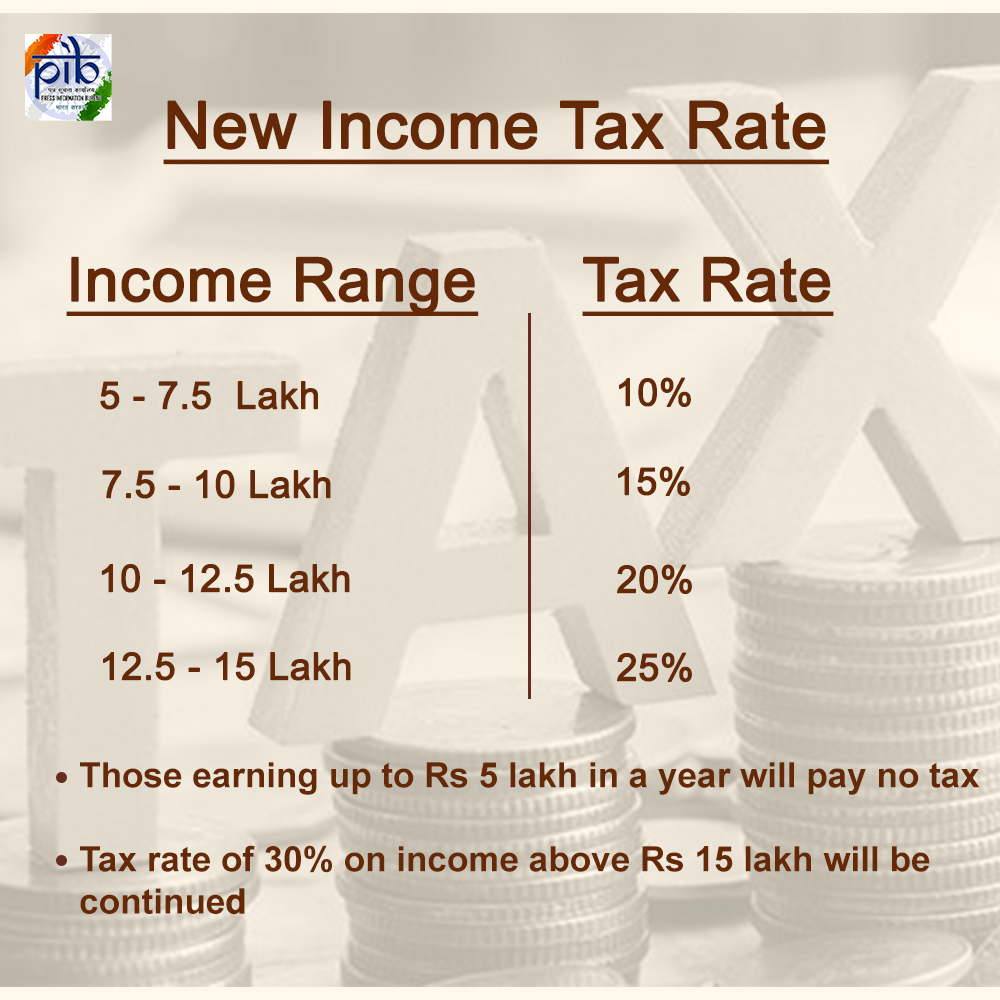
In order to provide significant relief to the individual taxpayers and to simplify the Income-Tax law, the Finance Minister has proposed to bring a new and simplified personal income tax regime, wherein income tax rates will be significantly reduced for the individual taxpayers who forego certain deductions and exemptions.
The proposed changes in tax slabs are listed in the following table:
Taxable Income Slab (Rs.)
Existing Tax Rates
New Tax Rates
0-2.5 Lakh
Exempt
Exempt
2.5-5 Lakh
5%
5%
5-7.5 Lakh
20%
10%
7.5-10 Lakh
20%
15%
10-12.5 Lakh
30%
20%
12.5-15 Lakh
30%
25%
Above 15 Lakh
30%
30%
Surcharge and cess shall be continued to be levied at the existing rates.
In the new tax regime, substantial tax benefit will accrue to a taxpayer depending upon exemptions and deductions claimed by him. For example, a person earning Rs. 15 lakh in a year and not availing any deductions etc., will pay only Rs. 1,95,000 as compared to Rs. 2,73,000 in the old regime. Thus, his tax burden shall be reduced by Rs. 78,000 in the new regime. He would still be the gainer in the new regime, even if he was taking deduction of Rs. 1.5 Lakh under various sections of Chapter VI-A of the Income Tax Act under the old regime.
The new tax regime shall be optional for taxpayers. An individual who is currently availing more deductions and exemption under the Income Tax Act may choose to avail them and continue to pay tax in the old regime.
The new personal income tax rates will entail estimated revenue foregone of Rs. 40,000 crore per year. Measures have been initiated to pre-fill the income tax return so that an individual who opts for the new regime would need no assistance from an expert to file his return and pay income tax.
The Finance Minister said she had reviewed all exemptions and deductions which got incorporated in the income tax legislation over the past several decades. Currently more than one hundred exemptions and deductions of different nature are provided in the Income Tax Act. She said that she has removed around 70 of them in the new simplified regime. She said that the remaining exemptions and deductions would also be reviewed and rationalized in the coming years, with a view to further simplifying the tax system and lowering the tax rate.
Dividend Distribution Tax
Currently, companies are required to pay Dividend Distribution Tax (DDT) on the dividend paid to its shareholders at the rate of 15% plus applicable surcharge and cess, in addition to the tax payable by the company on its profits. In order to increase the attractiveness of the Indian Equity Market and to provide relief to a large class of investors, the Finance Minister has proposed to remove DDT, and adopt the classical system of dividend taxation, under which the companies would not be required to pay DDT. The dividend shall be taxed only in the hands of the recipients at their applicable rate.
In order to remove the cascading effect, the Finance Minister has proposed to allow deduction for the dividend received by holding company from its subsidiary. The removal of DDT will lead to estimated annual revenue foregone of Rs. 25,000 crore. This will further make India an attractive destination for investment.
Concessional Tax Rate for Electricity Generation Companies
New provisions were introduced in September 2019, offering a concessional corporate tax rate of 15% to the newly incorporated domestic companies in the manufacturing sector which start manufacturing by 31st March, 2023.
In order to attract investment in the power sector, it has been proposed to extend the concessional corporate tax rate of 15% to new domestic companies engaged in the generation of electricity.
Tax Concession for Foreign Investments
To incentivize investment by Sovereign Wealth Fund of foreign governments, the Finance Minister has proposed to grant 100% tax exemption to their interest, dividend and capital gains income in respect of the investment made in infrastructure and other notified sectors before 31st March, 2024 and with a minimum lock-in period of 3 years.
Start-ups
The Finance Minister noted that during their formative years, Start-ups generally use Employee Stock Option Plan (ESOP) to attract and retain highly talented employees. Currently, ESOPs are taxable as perquisites at the time of exercise. In order to give a boost to the start-up ecosystem, the Finance Minister has proposed to ease the burden of taxation on the employees by deferring the tax payment for five years or till they leave the company or when they sell their shares, whichever is earliest.
An eligible Start-up having turnover upto 25 crore is allowed deduction of 100% on its profits for three consecutive assessment years out of seven years if the total turnover does not exceed 25 crore rupees. The Finance Minister has proposed to increase this limit to Rs. 100 crore. She has also proposed to extend the period of eligibility for claim of deduction from the existing 7 years to 10 years.
Concessional Tax Rate for Cooperatives
Cooperative societies are currently taxed at a rate of 30% with surcharge and cess. As a major concession, and in order to bring parity between the cooperative societies and corporates, the Finance Minister has proposed to provide an option to cooperative societies to be taxed at 22% plus 10% surcharge and 4% cess with no exemptions/deductions. She has also proposed to exempt these societies from Alternative Minimum Tax (AMT), just like companies under the new tax regime are exempted from the Minimum Alternate Tax (MAT).
Medium, Small and Micro Enterprises
In order to reduce the compliance burden on small retailers, traders, shopkeepers who comprise the MSME sector, the Finance Minister has proposed to raise by five times, the turnover threshold for audit from the existing Rs. 1 crore to Rs. 5 crore. In order to boost less-cash economy, she has proposed that the increased limit shall apply only to those businesses which carry out less than 5% of their business transactions in cash.
Affordable Housing
In the last budget, the Finance Minister had announced an additional deduction of upto one lakh, fifty thousand rupees for interest paid on loans taken for purchase of an affordable house. The date of loan sanction for availing this additional deduction is proposed to be extended by one year, beyond 31st March, 2020.
Charity Institutions
Income of Charity Institutions is fully exempt from taxation. Donation made to these institutions is also allowed as deduction in computing the taxable income of the donor. It is proposed to pre-fill the donee’s information in taxpayer’s return on the basis of information of donations furnished by the donee.
In order to claim the tax exemption, charity institutions have to be registered with the Income Tax Department. It is proposed to make the registration completely electronic under a unique registration number (URN) to be issued to all new and existing charity institutions.
Faceless Appeals
In order to impart greater efficiency, transparency and accountability to the assessment process, a new faceless assessment scheme has already been introduced. It is proposed to amend the Income Tax Act so as to enable Faceless appeal on the lines of Faceless assessment.
‘Vivad se Vishwas’ scheme
Under the proposed ‘Vivad se Vishwas’ scheme, a taxpayer would be required to pay only the amount of the disputed taxes and will get complete waiver of interest and penalty, provided he pays by 31st March, 2020. Those who will avail the scheme after 31st March, 2020 will have to pay some additional amount. The scheme will remain open till 30th June 2020.
Instant PAN through Aadhaar
In order to further ease the process of allotment of PAN, a system will be launched under which PAN shall be instantly allotted online on the basis of Aadhaar, without any requirement for filling up of detailed application form.
Indirect Tax
GST
A simplified GST return shall be implemented from the 1st April, 2020. It will make return filing simple with features like SMS based filing for nil return, return pre-filling, improved input tax credit flow and overall simplification. Dynamic QR-code is proposed for consumer invoices. GST parameters will be captured when payment for purchases is made through the QR-code.
Customs
On the Customs side, India has taken a quantum leap in the “Trading Across Border” parameter of Ease of Doing Business rankings by the World Bank. India’s rank has improved from 146 to 68.
Imports under Free Trade Agreements are on the rise. Undue claims of FTA benefits have posed threat to domestic industry. In the coming months, Rules of Origin requirements shall be reviewed, particularly for certain sensitive items, so as to ensure that FTAs are aligned to the conscious direction of our policy.
Labour intensive sectors in MSME are critical for employment generation. Cheap and low-quality imports are an impediment to their growth. Keeping in view the need of this sector, customs duty is being raised on items like footwear and furniture. Rate of Duty for footwear is being raised from 25% to 35%; and for “parts of footwear” from 15% to 20%. Rate of Duty for specified Furniture goods is being raised from 20% to 25%.
To give impetus to domestic industry, and to generate resource for health services, it is proposed to impose a nominal health cess of 5% on imports of specified medical equipment. Basic customs duty on imports of newsprint and light-weight coated paper is being reduced from 10% to 5%.
An increase is proposed in National Calamity Contingent Duty (NCCD) on Cigarettes and Tobacco products. NCCD on Bidis remains unchanged.
नई आयकर व्यवस्था में विशेष रूप से मध्यम वर्ग के करदाताओं को बड़ी राहत
नई कर व्यवस्था करदाताओं के लिए वैकल्पिक होगी
नई आयकर दरों के लिए प्रति वर्ष 40,000 करोड़ रुपये का अनुमानित राजस्व छोड़ना आवश्यक होगा
केन्द्रीय बजट में करदाताओँ को बड़ी राहत प्रदान करते हुए और आयकर कानून को सरल बनाने के लिए एक नई और सरल व्यक्तिगत आयकर व्यवस्था का प्रस्ताव दिया गया है। इसमें उन व्यक्तिगत करदाताओं के लिए आयकर दरों को पर्याप्त रूप से कम किया जाएगा जो कटौतियों और छूटों को छोड़ने के लिए तैयार होंगे। वर्ष 2020-21 के लिए संसद में आज केन्द्रीय बजट पेश करते हुए वित्त एवं कॉरपोरेट कार्य मंत्री श्रीमती निर्मला सीतारमण ने कहा, “नई कर व्यवस्था करदाताओं के लिए वैकल्पिक होगी।” उन्होंने कहा कि कोई भी व्यक्ति जिसे आयकर कानून के अंतर्गत इस समय अधिक कटौतियां और छूट मिल रही हैं वह इनका लाभ उठा सकता है और पुरानी व्यवस्था के अनुसार कर का भुगतान जारी रख सकता है।
नई व्यक्तिगत आय कर व्यवस्था में निम्नलिखित कर ढांचे का प्रस्ताव रखा गया है :
कर योग्य आय का स्लैब (रुपये में)
आय कर की वर्तमान दरें
नई कर दरें
0-2.5 लाख
छूट
छूट
2.5-5 लाख
5 प्रतिशत
5 प्रतिशत
5-7.5 लाख
20 प्रतिशत
10 प्रतिशत
7.5-10 लाख
20 प्रतिशत
15 प्रतिशत
10-12.5 लाख
30 प्रतिशत
20 प्रतिशत
12.5-15 लाख
30 प्रतिशत
25 प्रतिशत
15 लाख से ऊपर
30 प्रतिशत
30 प्रतिशत
नई कर व्यवस्था में किसी करदाता द्वारा दायर छूटों और कटौतियों के आधार पर उसे पर्याप्त कर लाभ मिलेगा। उदाहरण के लिए यदि कोई व्यक्ति एक वर्ष में 15 लाख रुपये अर्जित करता है और वह किसी कटौती का लाभ नहीं उठा रहा है तो उसे पुरानी व्यवस्था में 2,73,000 रुपये का भुगतान करना होता जबकि नई कर दर के अनुसार अब उसे 1,95,000 रुपये का भुगतान करना होगा। अतः नई कर व्यवस्था में उसका कर भार 78,000 रुपये कम हुआ है। वह नई व्यवस्था में तब भी लाभ में रहेगा भले ही वह पुरानी व्यवस्था के तहत आयकर कानून के अध्याय VI-क की विभिन्न धाराओं के अंतर्गत 1.5 लाख रुपये की कटौती ले रहा हो।
नई कर व्यवस्था करदाताओं के लिए वैकल्पिक होगी। यदि कोई व्यक्ति अथवा हिन्दू अविभाजित परिवार जो वर्तमान में कानून के तहत और अधिक कटौतियां और छूटे ले रहा है, उनका लाभ उठाने का विकल्प दे सकता है और पुरानी व्यवस्था में कर का भुगतान करना जारी रख सकता है। वित्त विधेयक में किए गए प्रावधानों के अनुसार, विकल्प का इस्तेमाल प्रत्येक पिछले वर्ष के लिए किया जा सकता है, जहां किसी व्यक्ति अथवा हिन्दू अविभाजित परिवार (एचयूएफ) की व्यवसाय से कोई आमदनी नहीं है और अन्य मामलों में यदि विकल्प का एक बार पिछले वर्ष के लिए इस्तेमाल किया जा चुका है, तो वह पिछले वर्ष और उसके बाद के सभी वर्षों के लिए मान्य होगा। पिछले वर्ष अथवा पिछले वर्षों के लिए यह विकल्प अमान्य हो सकता है यदि व्यक्ति अथवा एचयूएफ लागू होने वाले कानून की शर्तों और अन्य प्रावधानों को पूरा करने में विफल रहता है।
नई आयकर दरों के लिए प्रतिवर्ष 40,000 करोड़ रुपये का अनुमानित राजस्व छोड़ना अवश्य होगा। श्रीमती सीतारमण ने कहा, “हमने ऐसे उपाय शुरु किए हैं जिससे आयकर रिटर्न को समयपूर्व भरा जा सके ताकि कोई भी व्यक्ति जो नई व्यवस्था को अपनाता है उसे अपना रिटर्न दायर करने और आयकर का भुगतान करने में किसी विशेषज्ञ की सहायता लेने की जरूरत नहीं होगी।” वित्त मंत्री ने कहा कि आयकर व्यवस्था को सरल बनाने के लिए, उन्होंने पिछले अनेक दशकों में आयकर कानूनों में शामिल की गई सभी छूटों और कटौतियों की समीक्षा की है।
बजट में, विभिन्न प्रकृति (100 से अधिक) की 100 से अधिक छूटें और कटौतियों प्रदान की गई है। सरलीकृत व्यवस्था में इनमें से लगभग 70 छूटों और कटौतियों को समाप्त करने का प्रस्ताव किया गया है। शेष छूटों और कटौतियों की समीक्षा की जाएगी और आने वाले वर्षों में उन्हें युक्तिसंगत बनाया जाएगा ताकि कर व्यवस्था को और सरल बनाया जा सके तथा करों की दरें कम की जा सके।
Union Budget 2020-21 allocates Rs.99,300 crore for Education, Rs. 3,000 crore for Skill Development
150 Higher Educational Institutions to start apprenticeship embedded degree/diploma courses by March, 2021
Degree level online education programmes for students of deprived sections of the society
External Commercial Borrowings and FDI to be encouraged for financing education infrastructure
Ind-SAT to be conducted in Asia and Africa under Study in India programme
Special bridge courses for nurses, para medical staff and care givers to enhance their employability abroad
National Police University and National Forensic Science University to be set up
Meeting the needs of Aspirational India in which all the sections of the society seek better standards of living with access to education, health and better jobs is one of the key themes of the Union Budget 2020-21. The Budget lays special emphasis on the employability and quality aspects of education.
Presenting the Budget for the financial year 2020-21 in the Parliament today, the Union Finance and Corporate Affairs Minister, Smt Nirmala Sitharaman said that a total outlay of Rs.99,300 crore has been earmarked for the education sector in 2020-21 and Rs.3000 crore for Skill Development. “By 2030, India is set to have the largest working age population in the world. Not only do they need literacy but they need both job and life skills”, the Finance Minister explained.
Smt Nirmala Sitharaman announced that about 150 Higher Educational Institutions will start apprenticeship embedded degree/diploma courses by March 2020-21. This will help to improve the employability of students in the general stream (vis-a-vis services or technology stream). The government will also start a program whereby urban local bodies across the country would provide internship opportunities to fresh engineers for a period of up to one year. National Skill Development Agency will give special thrust to infrastructure-focused skill development opportunities, the Minister explained.
The Finance Minister, in her speech also said that the New Education Policy will be announced soon. Smt Nirmala Sitharaman stated that steps will be taken to enable sourcing External Commercial Borrowings and FDI to ensure greater inflow of finance to attract talented teachers, innovate and build better labs.
Degree level full-fledged online education programme will be started to provide quality education to students of deprived sections of the society as well as those who do not have access to higher education. However, these shall be offered only by institutions who are ranked within top 100 in the National Institutional Ranking Framework.
The Finance Minister observed that India should be a preferred destination for higher education. Therefore, under its “Study in India” programme, an Ind-SAT is proposed to be held in Asian and African countries for benchmarking foreign candidates who receive scholarships for studying in Indian higher education centres.
In order to meet the requirement of qualified medical doctors, it is proposed to attach a medical college to an existing district hospital in PPP mode. Viability gap funding will be made available to the States that fully allow the facilities of the hospital to the medical college and provide land at a concession.
The Government will also encourage large hospitals with sufficient capacity to offer resident doctors DNB/FNB courses under the National Board of Examinations. Smt Nirmala Sitharaman stated that a huge demand exists for teachers/nurses/para medical staff and care givers abroad. Therefore special bridge courses may be designed jointly by the Ministries of Health and Skill Development along with professional bodies to match the employer’s standards as well as meet the language requirements of various countries.
A National Police University and a National Forensic Science University have also been proposed in the domain of policing science, forensic science, cyber-forensics etc. in the Budget.
Rs 69,000 crore provided for Health Care in Union Budget 2020-21
Viability Gap Funding Window proposed for Setting Up Hospitals under Prime Minister Jan Arogya Yojana in PPP Mode
Jan Aushadhi Kendra Scheme to be Expanded to all Districts by 2024
In order to achieve the holistic vision of health care that translate wellness of the citizen, about Rs. 69,000 crore have been provided for health care in Union Budget 2020-21. It includes Rs. 6400 crores for Prime Minister Jan Arogya Yojana (PMJAY).
While presenting the Union Budget 2020-21 in Parliament today, the Union Minister for Finance and Corporate Affairs, Smt Nirmala Sitharaman said, “presently, under PM Jan Arogya Yojana (PMJAY) there are more than 20,000 empanelled hospitals. We need more in Tier-2 and Tier-3 cities for poorer people under this scheme. It is proposed to set up Viability Gap funding window for setting up hospitals in the PPP mode. In the first phase, those Aspirational Districts will be covered, where presently there are no Ayushman empanelled hospitals. This would also provide large scale employment opportunities to youth. Proceeds from taxes on medical devices would be used to support this vital health infrastructure”.
Smt Sitharaman further said that health authorities and the medical fraternity can target disease with an appropriately designed preventive regime using machine learning and AI, in the Ayushman Bharat scheme. She said, “TB Harega Desh Jeetega campaign has been launched. I propose to strengthen these efforts towards our commitment to end Tuberculosis by 2025”.
The Minister for Finance and Corporate Affairs also announced to expand Jan Aushadhi Kendra Scheme to all districts offering 2000 medicines and 300 surgicals by 2024.
Deposit Insurance coverage to be increased to Rs. Five lakh per depositor
PFRDAI Amendments: separate NPS trust for Govt Employees
Proposal to sell a part of government holding in LIC by way of IPO: opportunity for retail investors
Focus on MSMEs: Invoice Financing, Subordinate Debt, Export support Schemes announced
Govt asks RBI to consider extension of debt restructuring window for MSMEs till March 31, 2021
103 lakh crores for national infrastructure pipeline: 22,000 crores via equity support to infrastructure finance companies
International bullion exchange proposed in gift-ISC for better gold price discovery and creation of jobs
Limits for FPI in corporate bonds increased from 9% to 15% of outstanding stock
New debt-ETF consisting primarily of government securities proposed
With a view towards unlocking flow of capital to the financial sector, the Union Minister for Finance and Corporate Affairs unveiled several reforms across the banking sector, financial markets and infrastructure financing.
While presenting the Union Budget 2020-21 in Parliament today, the Union Minister for Finance and Corporate Affairs, Smt. Nirmala Sitharaman said, “A clean, reliable and robust financial sector is critical to the economy. In our efforts to achieve the USD 5 trillion economy, the financial architecture should keep evolving and move from strength to strength.”
In order to unlock private capital, Smt. Sitharaman proposed the sale of the balance holding of Government of India in IDBI Bank to private, retail and institutional investors through stock exchange. On the back of bank consolidation and capital infusion of Rs. 3,50,000 crore into Public Sector Banks (PSBs), the Finance Minister asserted that governance reforms would be carried out to make them more competitive, transparent and professional and thereby ensure a robust banking system. A few PSBs would also be encouraged to approach capital market to raise additional capital.
Further, the Minister announced that Deposit Insurance and Credit Guarantee Corporation (DICGC) has been permitted to increase Deposit Insurance coverage to Rs. 5 lakh per depositor from Rs. 1 lakh previously. She emphasized that a robust mechanism is in place to monitor the health of all Scheduled and Commercial Banks, and thereby ensure safety of depositor money.
Cooperative banks and NBFCs are also important constituents of the financial sector to be strengthened through improved governance. With respect to the Cooperative Banks, amendments to the Banking Regulation Act have been proposed to increase professionalism, facilitate access to capital and improve oversight through RBI. Further, limit for NBFCs to be eligible for Debt Recovery Mechanism via SARFAESI Act, 2002, is proposed to be reduced from existing asset size limits of Rs. 500 crore to Rs. 100 crores or loan size from existing Rs. 1 crore to Rs. 50 lakh.
Stressing on the need to strengthen the regulatory role of PFRDAI, the Finance Minister proposed necessary amendments in PFRDAI Act that will also facilitate separation of NPS trust for Government employees from PFRDAI. This would also enable establishment of a Pension Trust by the employees other than Government. Further, the Government proposes to infuse auto-enrolment into Universal Pension Coverage, apart from mechanisms for inter-operability and safe-guarding of accumulated corpus. “I am confident that this will motivate citizens to plan for their old age”, she added.
Micro, Small and Medium Sector Enterprises (MSMEs)
The Finance Minister noted that MSMEs are vital to the economy as they are the innovators, job creators and risk-takers. Several initiatives have been announced to enhance economic and financial sustainability of MSMEs.
To enable NBFCs to extend invoice financing to MSMEs through TReDS, amendments have been proposed to Factor Regulation Act, 2011. Further, the Minister announced the launch of an app-based invoice financing loans product to obviate the problem of delayed payments and consequential cash-flow mismatch.
· A new scheme to provide subordinate debt to MSME entrepreneurs has been proposed to mitigate the issues of working capital credit. This subordinate debt, to be provided by banks, would count as quasi-equity, and be fully guaranteed through Credit Guarantee Trust for Medium and Small Entrepreneurs (CGTMSE), whose corpus shall be accordingly augmented by the Government.
· The Government has asked RBI to consider extension of debt restructuring window for MSMEs till March 31, 2021. More than five lakh MSMEs have benefitted from restructuring of debt permitted by RBI in the last year and the same is due to end on March 31, 2020.
In order to offer handholding support for mid-size companies in export markets, the Government has proposed a scheme of Rs. 1000 crore, to be anchored by EXIM Bank and SIDBI, each of which shall contribute Rs. 50 crore each. This Rs. 100 crore would be achieved towards equity and technical assistance, while the remaining Rs 900 crore would be via debt funding from banks. The scheme shall focus on selected sectors like pharmaceuticals, auto components and others, and would extend support for technology upgradations, R&D, business strategy etc
Disinvestment
In order to provide greater access to financial markets, unlock true value and induce market discipline, the Government has proposed sale of a part of its holding in LIC by way of Initial Public Offer (IPO). This shall also be an opportunity for retail investors to participate in the wealth so created.
Infrastructure Financing
The Finance Minister highlighted the Government’s commitment to infrastructure investment with its announcement of Rs 103 lakh crore National Infrastructure Pipeline projects. She informed the House that Rs 22,000 crore has already been provided for the same. This shall serve as equity support to Infrastructure Finance Companies such as IIFCL and a subsidiary of NIIF, who shall then leverage it, as permissible, to create a financing pipeline of more than Rs. 1,00,000 crore.
Underscoring the potential of IFSC, GIFT city to become a centre for international finance and high-end data processing, Smt Sitharaman proposed the setting up of an International Bullion Exchange at GIFT-IFSC as an additional option for trade by global market participants. It is further expected to enable better gold price discovery, create jobs and enhance India’s position worldwide. The Minister outlined that GIFT-IFSC already has an approved Free Trade Zone for housing vaults, 19 insurance entitites, 40 banking entities, along with precious metals testing laboratories and refining facilities being set up.
Financial Markets
To achieve the aspirational growth rate, the Finance Minister underscored the need to boost the flow of capital in the financial system, through the following measures, taken in consultation with RBI:
FPI limits in corporate bonds are proposed to be increased to 15 per cent of outstanding stocks from the current 9 per cent
· Specified categories of Government securities would be opened fully for non-resident investors, along with domestic investors as well
· New Debt-based Exchange Traded Fund (ETF) consisting primarily of Government Securities to be floated. This is on the back of the massive success of the previous version. Further, it is expected to give retail investors access to Government securities, attractive investment option to Pension Funds and long-term investors
· A new legislation is proposed for laying down mechanisms for netting of financial contracts; this is to improve investor confidence and further expand the scope of Credit Default Swaps.
A new mechanism would be devised to further support the Partial Credit Guarantee Scheme floated by the Government, post the Union Budget 2019-20, to address the liquidity crisis of NBFCs. The Government will offer support by guaranteeing securities so floated.
Tourism sector proposed to get Rs 2,500 Crore in union budget 2020-21
Rs 3,150 Crore proposed for Ministry of Culture
Indian Institute of Heritage and Conservation to be established
8 New Museums proposed, 5 Museums set for major overhaul
5 Iconic sites to see Infrastructure development
To make India an attractive destination for both international and domestic tourists, the Finance Minister proposed to allocate Rs 2,500 crores in 2020-21 for the tourism sector. Besides tourism, Union Minister for Finance & Corporate Affairs Smt. Nirmala Sitharaman also proposed to allocate Rs 3,150 crore for Ministry of Culture while presenting the Union Budget 2020-21 in Parliament today.
In order to have well-trained resources in the disciplines of museology and archeology, the Finance Minister proposed to establish first Indian Institute of Heritage and Conservation with the status of a deemed university to operate under the Ministry of Culture. She said, “Acquisition of knowledge in disciplines such as museology and archeology are essential for collecting and analysing scientific evidence of such findings and for dissemination through high quality museums.”
Highlighting improved tourism revenues due to better rank, the Finance Minister said, “India had moved up from rank 65 in 2014 to 34 in 2019 in the Travel & Tourism Competitive Index (World Economic Forum).” Due to this, she continued, “Foreign Exchange earnings grew 7.4% to Rs 1.88 lakh crores for the period January 2019 from Rs 1.75 lakh crores.”
In a major bid to revitalise tourism, Smt. Sitharaman proposed 8 new museums, which includes building infrastructure around 5 Iconic Sites, besides proposing renovation of 5 major museums across the length and breadth of India.
The Union Finance Minister proposed the following:
5 Archeological sites to be set-up/developed as Iconic Sites with on-site Museums at the following locations:
Rakhigarhi (Haryana)
Hastinapur (Uttar Pradesh)
Shivsagar (Assam)
Dholavira (Gujarat)
Adichanallur (Tamil Nadu)
Maritime Museum to highlight Harappan Age at Lothal, Ahmedabad, by Ministry of Shipping
KOLKATA:
Indian Museum: Re-curation of the oldest museum in India as announced by Prime Minister Narendra Modi in January 2020.
Numismatics and Trade Museum to be located in the historic Old Mint Building
Support for setting up Tribal Museum in Ranchi (Jharkhand)
Renovation and re-curation of 4 more museums across India
Recognising the role of States in the proposed scheme for growth and employment generation, Smt. Sitharaman said, “Growth of tourism directly relates to growth and employment. States have a critical role to play. I expect State Governments expected to develop a roadmap for certain identified destinations and formulate financial plans during 2021 against which specified grants will be made available to the States in 2020-21”.
Entrepreneurship has always been the strength of India: Smt. Nirmala Sitharaman
Announces setting up of investment clearance cell to provide “End-to-End” facilitation and support to entrepreneurial youth
Proposes developing five new smart cities in collaboration with states in PPP mode
Encourages manufacture of mobile phones, electronic equipment and semi-conductor packaging
Proposes launching a national technical textiles mission to position India as a global leader in technical textiles
Announces a new scheme NIRVIK to achieve higher export credit disbursement
Government e-marketplace (GeM) to create a unified procurement system to procure goods, services and works
The Union Minister for Finance & Corporate Affairs, Smt. Nirmala Sitharaman has said that Entrepreneurship has always been the strength of India and our young men and women have been contributing to India’s growth with their entrepreneurial skills. She was presenting the Union Budget 2020-21, in Parliament, here today. We recognise the knowledge, skills and risk-taking capabilities of our youth and they are no longer job seekers but they are job creators, she added.
The Finance Minister proposed setting up of an Investment Clearance Cell that will provide “end to end” facilitation and support to create more opportunities to youth and remove road-blocks. She also proposed to develop five new smart cities in collaboration with States in PPP mode and such sites would be chosen that offer the best choices in terms of aforementioned principles.
Smt. Nirmala Sitharaman said that electronics manufacturing industry is very competitive and the potential in job creation is immense. She further said that India needs to boost domestic manufacturing and attract large investments in the electronics value chain. She proposed a scheme to encourage manufacture of mobile phones, electronic equipment and semi-conductor packaging. She also proposed a National Technical Textiles Mission with a four-year implementation period from 2020-21 to 2023-24 at an estimated outlay of Rs. 1480 crore to position India as a global leader in Technical Textiles.
She referred the Prime Minister’s call from Red Fort about quality and standards when he spoke of “Zero Defect-Zero Effect” manufacturing. All Ministries, during the course of this year, would be issuing quality standard orders, she added.
The Finance Minister announced a new scheme NIRVIK to achieve higher export credit disbursement, which provides for higher insurance coverage, reduction in premium for small exporters and simplified procedure for claim settlements. She further said that by the end of 5th year, this Scheme is expected to support export of around Rs 30 lakh crore. She proposed to digitally refund to exporters, duties and taxes levied at the Central, State and local levels, such as electricity duties and VAT on fuel used for transportation, which are not getting exempted or refunded under any other existing mechanism.
Smt. Sitharaman said that Government e-Marketplace (GeM) is moving ahead for creating a Unified Procurement System in the country for providing a single platform for procurement of goods, services and works. She proposed to take the turnover of GeM to Rs. 3lakh crores. She also proposed to provide Rs. 27300 crore for development and promotion of Industry and Commerce for the year 2020-21.