Rate of interest for purchase of Computer during 2025-26 – Advances to Government Servants – FinMin O.M
F.No. 5(2)-B(PD)/2025 Government of India Ministry of Finance Department of Economic Affairs (Budget Division)
Room No. 237, North block, New-Delhi, the 24th March, 2025
OFFICE MEMORANDUM
Subject: Advances to Government Servants — Rate of interest for purchase of Computer during 2025-26.
The undersigned is directed to state that the rate of interest for advance sanctioned to the Government servants for purchase of computer during 2025-26 i.e. from 1st April, 2025 to 31st March, 2026 is as under:
Rate of interest per annum
Advance for purchase of Computer
9.1%
(Lekha Nair) Deputy Director (Budget)
To 1) All Ministries/Departments of the Government of India with spare copies for Integrated Finance Division (IFD), Controller of Accounts and Pay and Accounts Offices.
2) Finance Secretaries of UTs without legislature.
Copy forwarded to:-
1) Comptroller and Auditor General of India, New Delhi. 2) Controller General of Accounts, New Delhi. 3) Controller General of Defence Accounts, New Delhi. 4) All Auditor Generals and Director of Accounts. 5) Supreme Court of India. 6) Union Public Service commission, New Delhi.
Eligibility age for additional pension benefits : Lok Sabha QA 19.03.2025
GOVERNMENT OF INDIA MINISTRY OF PERSONNEL, PUBLIC GRIEVANCES AND PENSIONS (DEPARTMENT OF PENSION & PENSIONERS’ WELFARE) LOK SABHA
UNSTARRED QUESTION NO. 2991 (ANSWERED ON 19.03.2025)
ELIGIBILITY AGE FOR ADDITIONAL PENSION BENEFITS
2991. SHRI MANICKAM TAGORE B: SHRI VIJAYAKUMAR ALIAS VIJAY VASANTH:
Will the PRIME MINISTER be pleased to state:
(a) the rationale behind setting the eligibility age for additional pension benefits at 80;
(b) whether the Government is considering to reduce this age threshold to 65 years as recommended by the Parliamentary Standing Committee on Pensioner’s grievances and if so, the details thereof;
(c) the number of Central Government pensioners expected to benefit from the additional pension scheme and the estimated annual expenditure likely to be incurred under this scheme;
(d) the measures taken/being taken by the Government to ensure that pensioners receive their additional pension benefits in a timely and transparent manner and there are no delays or discrepancies in the payment process;
(e) whether the Government is considering to extend the additional pension benefits to State Government pensioners and other categories of retirees and if so, the timeline for implementing this extension; and
(f) the steps taken/being taken by the Government to address the concerns that the additional pension benefits may not keep pace with inflation and the mechanisms put in place to ensure that the benefits are indexed to rising living costs?
ANSWER
MINISTER OF STATE IN THE MINISTRY OF PERSONNEL, PUBLIC GRIEVANCES AND PENSIONS AND MINISTER OF STATE IN THE PRIME MINISTER’S OFFICE (DR. JITENDRA SINGH)
(a) to (f): Government has on the recommendation of the 6th CPC approved the quantum of additional pension of 20% on attaining the age of 80 years, 30% on attaining the age of 85 years, 40% on attaining the age of 90 years, 50% on attaining the age of 95 years and 100% on attaining the age of 100 years, on the rationale that the older pensioners require a better deal because their needs, especially those relating to health, increase with age. The recommendation of the Parliamentary Standing Committee for amendments in additional pension in its 110th report dated 10.12.2021 have been duly examined in the Government and an action taken report was submitted on 06.06.2022.The Parliamentary Standing Committee in its 120th report dated 08.12.2022 noted the action taken report and observed that the Committee do not wish to pursue this matter for now. The additional pension is automatically paid to the pensioner/family pensioner by the Pension Disbursing Authorities/Banks as soon as it becomes due. The instructions/guidelines, as issued by the Government from time to time, are there in place ensuring scrupulous and timely payment of additional pension. The grant of additional pension is age based only. To address the concern regarding inflation and rising living costs, Dearness Relief equivalent to Dearness Allowance is payable to the pensioners/family pensioners at such rate as Central Government may specify from time to time. The dearness relief is applicable on additional pension also.
Government of India Ministry of Finance Department of Expenditure
Rajya Sabha
Un-Starred Question No. 2009 To be answered on Tuesday, the 18th March, 2025 . Phalguna 27, 1946 (Saka)
Merger of DA/DR with basic pay/pension
2009 Shri Javed Ali Khan:
Will the Minister of Finance be pleased to state:
a) whether Government proposes to merge 50 per cent DA/DR with basic pay/pension of central Government employees/pensioners as interim relief before report of the 8th Central Pay Commission is prepared and adopted in view of the unprecedented inflation during the last 32 years as per the data given by the Minister to this August House and reduced DA/DR calculation during recent years;
Minister of State in the Ministry of Finance (Shri Pankaj Chaudhary)
a) No.
b) Does not arise.
c) The Dearness Allowance (DA)/ Dearness Relief (DR) is paid to Central Government employees/pensioners to adjust the cost of living and to protect their Basic Pay/Pension from erosion in the real value on account of inflation. The rate of DA/DR is revised periodically every 6 months on the basis of All India Consumer Price Index for Industrial Workers (AICPI-IW) released by Labour Bureau under Ministry of Labour and Employment. Since the implementation of the recommendations of the Seventh Central Pay Commission from 01.01.2016, 15 instalments of DA/DR have been granted to the Central Government employees/pensioners so far
8th Pay Commission Status, ToR & Impact:Lok Sabha QA 17.03.2025
GOVERNMENT OF INDIA MINISTRY OF FINANCE DEPARTMENT OF EXPENDITURE
LOK SABHA STARRED QUESTION No. *235
TO BE ANSWERED ON MONDAY, MARCH 17, 2025/PHALGUNA 26, 1946 (SAKA)
CONSTITUTION OF 8TH CENTRAL PAY COMMISSION
*235. MS KANGNA RANAUT: SMT. SAJDA AHMED:
Will the Minister of Finance be pleased to state:
(a) whether the 8th Central Pay Commission (CPC) has been constituted by the Government for revision of salaries and pensions of Central Government employees;
(b) if so, the details thereof along with the terms of reference of the Commission and the time fixed for submission of its report to the Government;
(c) the approximate number of Central Government employees and pensioners at the 7th CPC level likely to be benefitted by the 8th CPC leading to consumption boost and the economic growth across the country including Odisha;
(d) whether implementation of the recommendations of the 8th CPC is likely to increase the financial burden on Government;
(e) if so, the details thereof, and
(f) whether the Government has conducted any studies or held any consultation with employee unions, pensioners and other stakeholders to assess the impact of 8th CPC on fiscal policies and Government expenditure?
ANSWER FINANCE MINISTER (SMT. NIRMALA SITHARAMAN)
(a): It has been decided by the Government to constitute the 8th Central Pay Commission (CPC).
(b): Will be decided in due course of time.
(c): The approximate number of Central Government civilian employees and pensioners/family pensioners is 36.57 lakh (as on 01.03.2025) and 33.91 lakh (as on 31.12.2024) respectively. Defence Personnel and Pensioners will also be benefitted.
(d) & (e): The financial implication of the recommendations of the 8th Central Pay Commission will be known, once the recommendations are made by the 8th Central Pay Commission and accepted by the Government.
(f): Inputs on Terms of Reference (ToR) have been sought from major stakeholders including Ministry of Defence, Ministry of Home Affairs, Department of Personnel & Training and from States. Impact of 8th CPC can be assessed only once the recommendations are made by 8th CPC and are accepted by the Government.
Consumer Price Index for Industrial Workers (2016=100) – January, 2025
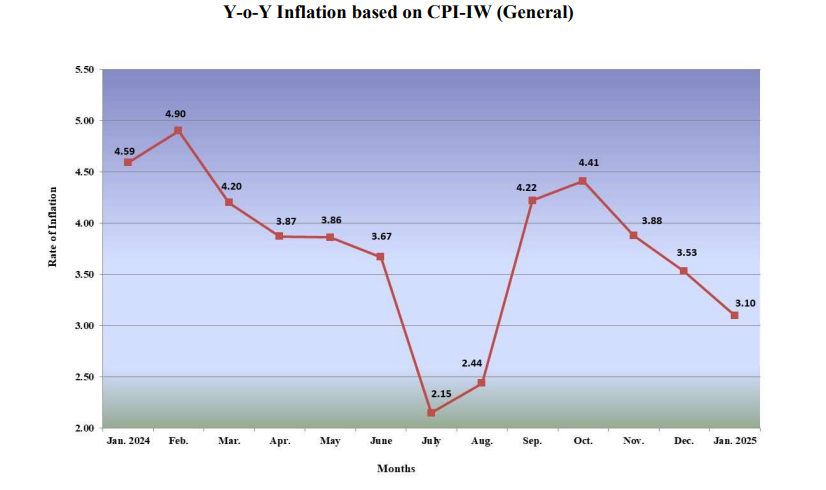
1. Labour Bureau, an attached office of the M/o Labour & Employment, has been compiling Consumer Price Index for Industrial Workers every month on the basis of retail prices collected from 317 markets spread over 88 industrially important centres in the country. The index for the month of January, 2025 is being released in this press release.
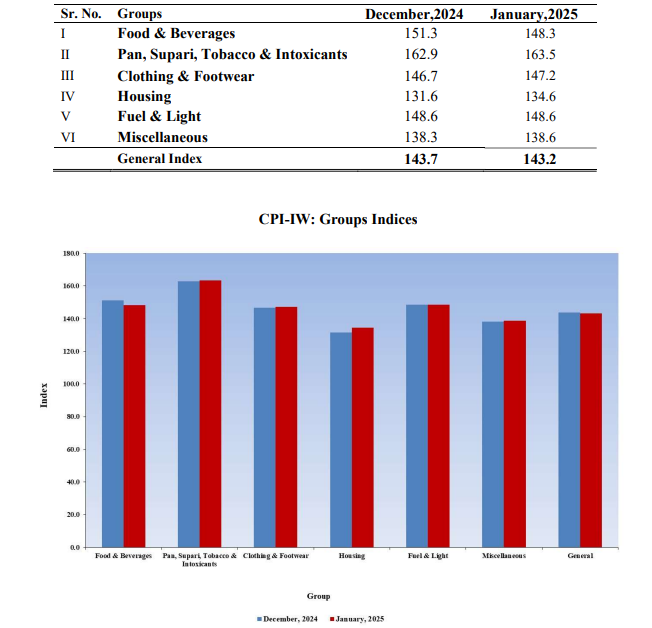
2. The All-India CPI-IW for January, 2025 decreased by 0.5 point and stood at 143.2 (one hundred forty three point two).
Meeting Minutes with Staff Side of NCJCM held on 25.02.2025 on the pension related matters: DOPPW O.M
F. No. 28/03/2025-P&PW(B)/JCM भारत सरकार कार्मिक, लोक शिकायत और पेंशन मंत्रालय पेंशन और पेंशनभोगी कल्याण विभाग
लोकनायक भवन खान मार्केट, नई दिल्ली दिनांक 04.03.2025
OFFICE MEMORANDUM
Subject:- Minutes of the meeting with Staff Side of N.C. (JCM) held on 25.02.2025 under the chairmanship of Secretary (Pension) on the pension related matters-reg.
The undersigned is directed to forward herewith the minutes of the meeting with Staff Side of N.C. (JCM) held on 25.02.2025 at Lok Nayak Bhawan under the chairmanship of Secretary (Pension) on the pension related matters for information and further necessary action.
(S. Chakrabarti) Under Secretary to Govt of India
To All Participants (As Per list Attached)
Copy to 1.PSO to Secretary (Pension) 2.PPS to JS(Pensions)
Minutes of the meeting with the staff side of the National Council (JCM) held on 25.02.2025 under the Chairmanship of Secretary (Pension) in Lok Nayak Bhawan, Khan Market, New Delhi.
A meeting with the staff side of National Council (JCM) was held on 25.02.2025 at 4:30 PM under the chairmanship of Sh. V. Srinivas, Secretary (Pension) to discuss the applicability of DoPPW OM dated 03.03.2023 to the employees appointed on compassionate grounds.
2.The meeting was attended by the Officers of DOPPW, Ministry of Railways led by Smt. Roopa Srinivasan, Member (Finance), Railway Board and delegation of staff side of National Council (JCM) led by Shri Shiva Gopal Mishra, Secretary. The list of participants is at Annexure I.
3.Secretary (Pension) welcomed the participants and invited the member from the staff Side as well as the official side to participate in the meeting with a free and frank approach, so that issues are appreciated and arrived at a solution.
4.Following issues were discussed during the meeting:-
(i) Applicability of DoPPW OM dated 03.03.2023 to the employees appointed on compassionate grounds – It was requested by the staff side that the facility of coverage under OPS be extended to compassionate ground appointees who had submitted their application before 01.01.2004 but were appointed after 01.01.2004. Further, it was highlighted that there is no Notification/Advertisement in the case of appointments on compassionate grounds.
Therefore, in order to extend the benefit of DoPPW OM dated 03.03.2023 to them, the date of their application for compassionate appointment may be treated as date of notification/advertisement. Accordingly, para 4 of the DoPPW’s OM dated 03.03.2023 may be revised. The proposal found favour from Ministry of Railways. Accordingly it was decided that inter-ministerial consultations with DOPT, DOLA, DFS and DOE, may be initiated on the subject.
(ii) The issue related to merger of the Railway (Pension) Rules, 1993 with the CCS(Pension) Rules, 2021 was discussed and it was requested that the same may be expedited. It was informed that the matter of merger of these rules continues to be under examination. The Ministry of Railways can separately initiate necessary amendments in the Railway (Pension) Rules 1993 as per felt-need on the subject.
The meeting ended with a vote of thanks to the Chair.
ANNEXURE -I
List of participants attended the meeting held on 25.02.2025 under the Chairmanship of Secretary (Pension) with the National Council (staff side) of JCM:-
National Council (staff side) of JCM
Official Side
Shri Shiva Gopal Mishra,Secretary,
Smt. Roopa Srinivasan, Member (Finance), Railway Board
Immediately set up Committee for 8th CPC finalize Terms of Reference: Confederation Charter of Demands
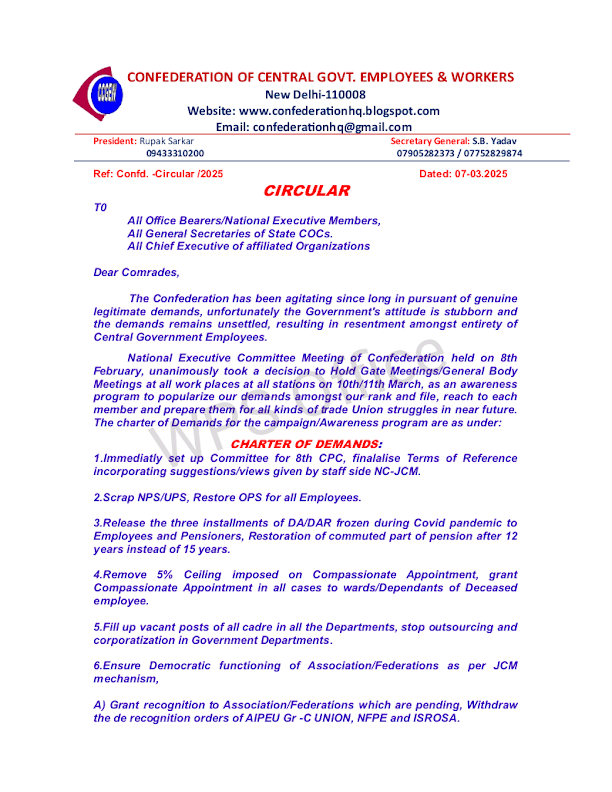
Ref: Confd. Circular /2025
Dated: 07.03.2025
CIRCULAR
TO
All Office Bearers/National Executive Members, All General Secretaries of State COCs. All Chief Executive of affiliated Organizations
Dear Comrades,
The Confederation has been agitating since long in pursuant of genuine legitimate demands, unfortunately the Government’s attitude is stubborn and the demands remains unsettled, resulting in resentment amongst entirety of Central Government Employees.
National Executive Committee Meeting of Confederation held on 8th February, unanimously took a decision to Hold Gate Meetings/General Body Meetings at all work places at all stations on 10th/11th March, as an awareness program to popularize our demands amongst our rank and file, reach to each member and prepare them for all kinds of trade Union struggles in near future. The charter of Demands for the campaign/Awareness program are as under:
CHARTER OF DEMANDS:
1.lmmediatly set up Committee for 8th CPC, finalalise Terms of Reference Incorporating suggestions/views given by staff side NC-JCM.
2.Scrap NPS/UPS, Restore OPS for all Employees.
3.Release the three installments of DA/DAR frozen during Covid pandemic to Employees and Pensioners. Restoration of commuted part of pension after 12 years Instead of 15 years.
4.Remove 5% Ceiling imposed on Compassionate Appointment, grant Compassionate Appointment in all cases to wards/Dependants of Deceased employee.
5.Fill up vacant posts of all cadre in all the Departments, stop outsourcing and corporatization in Government Departments.
6.Ensure Democratic functioning of Association/Federations as per JCM mechanism
A) Grant recognition to Association/Federations which are pending, Withdraw the de recognition orders of AIPEU Gr •C UNION, NFPE and ISROSA.
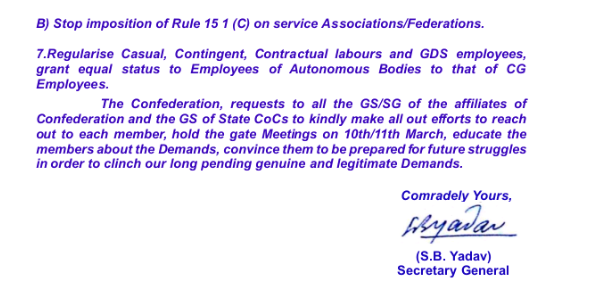
B) Stop imposition of Rule 15 1 (C) on service Associations/Federations.
7.Regularise Casual, Contingent, Contractual labours and GDS employees, grant equal status to Employees of Autonomous Bodies to that of CG Employees.
The Confederation, requests to all the GS/SG of the affiliates of Confederation and the GS of State CoCs to kindly make all out efforts to reach out to each member, hold the gate Meetings on 10th/11th March, educate the members about the Demands, convince them to be prepared for future struggles in order to clinch our long pending genuine and legitimate Demands.
Kendriya Vidyalaya Admission Notice: 2025-26 | केन्द्रीय विद्यालय प्रवेश सूचना 2025-26
केन्द्रीय विद्यालय संगठन (मु.), नई दिल्ली
प्रवेश सूचना 2025-26
शैक्षणिक सत्र 2025-26 के लिए केन्द्रीय विद्यालयों में कक्षा 1 एवं बालवाटिका (चयनित विद्यालयों) में प्रवेश हेतु ऑनलाइन पंजीकरण दिनांक 07.03.2025 प्रातः 10:00 बजे से दिनांक 21.03.2025 रात्रि 10:00 बजे तक होगा । प्रवेश संबंधित वरण वेबसाइट https://kvsangathan.nic.in/en/admission/ के माध्यम से प्राप्त किया जा सकता है।
कक्षा 1 के लिए ऑनलाइन आवेदन करने का लिंक: https://kvsonlineadmission.kvs.gov.in/
बालवाटिका 1 और 3 (जहाँ लागू हो) के लिए ऑनलाइन आवेदन करने का लिंक: https://balvatika.kvs.gov.in/
कक्षा-I में प्रवेश के लिए न्यूनतम आयु 06 वर्ष होनी अनिवार्य है। सभी कक्षाओं के लिए आयु की गणना 31.03.2025 के अनुसार होगी। कक्षाओं में सीटों का आरक्षण के.वि.सं. के प्रवेश दिशा-निर्देशों 2025-26 के अनुसार किया जाएगा।
बालवाटिका-1, 2 एवं 3 में प्रवेश हेतु आयु क्रमशः 3 से 4 वर्ष, 4 से 5 वर्ष और 5 से 6 वर्ष होगी, जो 31.03.2025 के अनुसार होगी।
बालवाटिका-2 व 3 (जहाँ ऑनलाइन माध्यम से आवेदन नहीं होना है), कक्षा [1 एवं उससे ऊपर (कक्षा जा को छोड़कर) की कक्षाओं में, स्थान रिक्त होने पर ही, प्रवेश के लिए पंजीकरण दिनांक 02.04.2025 प्रात: 10:00 बजे से दिनांक 11.04.2025 सायं 4:00 बजे तक ऑफलाइन मोड (offline mode) द्वारा किया जा सकेगा। विधिवत भरे हुए फॉर्म को संबंधित के०वि० में प्राचार्य के कार्यालय में जमा करवाना होगा।
बालवाटिका-2 व 3(जहाँ ऑनलाइन माध्यम से आवेदन नहीं होना है), कक्षा-1 और उससे ऊपर के लिए प्रवेश और पंजीकरण प्रपत्रों के बारे में सभी जानकारी विद्यालयों की वेबसाइट पर उपलब्ध की जाएगी तथा प्रवेश हेतु पंजीकरण प्रवेश- 2025-26 की अनुसूची के अनुसार किया जाएगा।
यदि आवेदन पत्र में कोई गलत/ भ्रामक जानकारी दी गई है तो केवि में प्रवेश प्रक्रिया के दौरान प्रवेश निरस्त कर दिया जाएगा।
प्राचार्य/प्रवेश प्रभारी द्वारा विद्यालय में बुलाए जाने पर, निर्धारित समय अंतराल में ही संपर्क करें।
Kendriya Vidyalaya Sangathan (HQs), New Delhi Admission Notice: 2025-26
1. Online Registration for Admission in Class-I and Balvatika (in selected KVs) in Kendriya Vidyalayas for the Academic Year 2025-26 will commence at 10:00 am on 07.03.2025 and will close at 10:00 pm on 21.03.2025. The details of admission are available on website https://kvsangathan.nic.in/en/admission/
Link to apply online for Class 1: https://kvsonlineadmission.kvs.gov.in
Link to apply online for Balvatika 1 and 3 (wherever applicable): https://balvatika.kvs.gov.in
Minimum age for admission in Class-I will be 6 years. Reckoning of age for all Classes shall be as on 31.03.2025. Reservation of seats will be as per KVS Admission Guidelines 2025-26.
Age for Balvatika-1, 2 & 3 will be 3 to 4 years, 4 to 5 years and 5 to 6 years respectively as on 31.03.2025.
Registration for fresh admissions, in Balvatika-2 & 3 (where online admissions are not taking place), Class II and above (except class XI), will start from 02.04.2025 at 10:00 am to 11.04.2025 up to 04:00 pm, if vacancies exist, in offline mode only. The duly filled up form needs to be submitted to the office of the Principal in the respective KV.
All information regarding Admission & Registration forms for Balvatika-2 & 3 (where online admissions are not taking place), Class-II and above, if vacancies exist, will be available on the Vidyalaya Websites and registrations can be done as per the Schedule for Admission 2025-26.
Admission will not be granted, if wrong and misleading information in the application form is found at the time of scrutiny by the KV.
Contact Principal/Admission In-charge, only when called, in the given time slot.
Kendriya Vidyalaya Admission Schedule for the 2025-26 | केन्द्रीय विद्यालय सत्र 2025-26 में प्रवेश के लिए समय-सारणी
SCHEDULE FOR ADMISSION
सत्र 2025-26 में प्रवेश के लिए समय-सारणी निम्नलिखित होगी :
The Admission Schedule for the Session 2025-26 will be as under:
क्र.सं S.N.
विषय-वस्तु CONTENTS
निर्धारित तिथियॉं SCHEDULED DATES
1.
प्रवेश के लिए विज्ञापन Advertisement for admission
1st week of March 2025(Latest by 06.03.2025)
2.
बालवाटिका-1 व 3 एवं कक्षा-1 के लिए पंजीकरण -ऑनलाइन माध्यम से Last date of Online Registration for Balvatika-1 & 3 and Class-I(बालवाटिका-1 व 3 केवल चयनित विद्यालयों में/ Balvatika-1 & 3 in selected KVs only)
07.03.2025 10:00 AM onwards
3.
बालवाटिका-1 व 3 एवं कक्षा-1 के लिए ऑनलाइन पंजीकरण की अंतिम तिथि Last date of Online Registration for Balvatika-1 & 3 and Class-I
21.03.2025 Up to 10:00 PM
4.
(a) सभी पंजीकृत विद्यार्थियों की चयनित एवं प्रतीक्षित अनंतिम सूची का प्रदर्शन Declaration of provisional lists of selected and waitlisted registered candidates(b) उपरोक्त जारी सूची के अनुसार चयनित विद्यार्थियों के प्रवेश का आरंभ निम्न क्रम में:शिक्षा के अधिकार के अंतर्गत चयनितसेवा श्रेणी वरीयता क्रम श्रेणी I एवं II में से चयनितउपरोक्त में शामिल आरक्षित कोटे में भरी सींटों के बाद रिक्त सीट पर प्रवेशAdmission of eligible & selected candidates as per the above list in following order:(i) RTE(ii) From Service Priority Category (I and II) only(iii) Shortfall of Reservation Quota after admission in (i) and (ii) above
1st Provisional List on 25.03.2025 (for Class 1) & 26.03.2025 (for Balvatika)
2nd Provisional List on 02.04.2025 (if seats remain vacant)
3rd Provisional List on 07.04.2025 (if seats remain vacant)
5.
शिक्षा के अधिकार के अंतर्गत एवं अनुसूचित जाति/ जनजाति, अन्य पिछड़ा वर्ग (NCL)) प्रवेश हेतु दूसरी अधिसूचना (बालवाटिका-1 व 3 एवं कक्षा-1) यदि पर्याप्त आवेदन पत्र प्राप्त ना हुए हों तो (Offline)Extended date for the Second Notification for offline registrations for admission to be made under RTE Provisions, SC, ST and OBC (NCL), if sufficient applications were not received in online mode for Balvatika-1 & 3 and Class-I
Notification on 07.04.2025Registration from 08.04.2025 to 14.04.2025Display of list and Admissions23.04.2025 to 28.04.2025
6.
बालवाटिका-2, कक्षा-ा तथा अन्य कक्षाओं का पंजीकरण ((in offline mode) (कक्षा-XI को छोडकर), कक्षा- विशेष में रिक्तियाँ होने की स्थिति में।Registration (in offline mode) for Balvatika-2 and Class-II onwards (except Class XI) – Subject to the availability of vacancies in a particular class.(बालवाटिका-2 केवल चयनित विद्यालयों में/ Balvatika-2 & 3 in selected KVs only)
02.04.2025 to 11.04.2025
7.
बालवाटिका-2, कक्षा-ा तथा आगे की कक्षाओं अनंतिम सूची जारी करनाDeclaration of the first provisional list for admission in Balvatika-2 and Class-II onwards.
17.04.2025
8.
बालवाटिका-2, कक्षा-II तथा आगे की कक्षाओं के लिए प्रवेश।Admission for Balvatika-2 and Class-II onwards
18.04.2025 to 21.04.2025
9.
कक्षा-XI को छोडकर अन्य सभी कक्षाओं के प्रवेश की अंतिम तिथि। Last date of admission for all classes except class XI
30.06.2025
10.
30 जून के बाद भी सीटें रिक्त रहने पर, निर्धारित सीमा अर्थात 40 तक, स्वीकृत प्राथमिकता क्रम में, उपायुक्त के विशेषाधिकार द्वारा सभी कक्षाओं में प्रवेश की अंतिम तिथि Last date of admission for all classes, if seats remain vacant, after 30th June, with special power of Deputy Commissioner to allow admissions up to the prescribed strength i.e. 40 as per priorities in admissions
31.07.2025
11.
के० वि० के छात्र/ छात्रा: कक्षा XI में प्रवेश के लिए पंजीकरण For KV students: Registration for admission in class XI
Within 10 days after the declaration of class X result
12.
के० वि० के छात्र/ छात्रा: कक्षा XI की प्रवेश सूची जारी करना एवं प्रवेश KV students: Display of admission list & admissions for Class-XI.
Within 20 days after declaration of class X results
13.
गैर के० वि० के छात्र/छात्रा: कक्षा-XI में प्रवेश के लिए पंजीकरण प्रवेश सूची जारी करना उतर प्रवेश (रिक्तियाँ होने की स्थिति में) Non-KV students: Registration, display of admission list & admissions in class XI (Subject to availability of vacancies)
After the admissions of KV students in class XI
कक्षा-XI के प्रवेश की अंतिम तिथि। Last date of admission for class – XI
30 days from the date of declaration of class-X results by CBSE
समस्त पंजीकृत बच्चों की सूची, प्रवेश-योग्य बच्चों की सूची, प्रवेश के लिए अंतिम चयनित बच्चों की श्रेणी- वार सूची, प्रतीक्षा-सूची व उत्तरवर्ती सूचियों को संबन्धित केन्द्रीय विद्यालय के सूचनापट्ट पर प्रदर्शित करने के साथ- साथ विद्यालय की बैबसाइट एवं सोशल मीडिया हैंडल्स-फेसबुक व एक्स (पूर्व-ट्विटर) पर देना अनिवार्य है। List of children registered, list of eligible children, category-wise list of provisionally selected children, waiting list and subsequent lists to be compulsorily displayed on the website/social media handles like Facebook, X (formerly Twitter) of the Vidyalayas concerned, in addition to display on School’s Notice Board
यदि पंजीकरण हेतु निर्धारित प्रारम्भिक/ अंतिम तिथि को कोई सार्वजनिक अवकाश का दिन है, तो अगला कार्य दिवस स्वीकार्य होगा। If any of the dates happens to be a public holiday the next working day shall be treated as opening/closing dates
Voluntary Discharge Scheme for all categories of Gramin Dak Sevaks (GDS) on Medical Grounds: Dept of Posts O.M 25.02.2025
No. 19-19/2024-GDS Government of India Ministry of Communications Department of Posts (GDS Section)
Dak Bhawan, Sansad Marg, New Delhi – 110 001 Dated : 25-02-2025
OFFICE MEMORANDUM
Subject : Voluntary Discharge Scheme for all categories of Gramin Dak Sevaks (GDS) on Medical Grounds – reg.
In compliance with the provisions of Section 20 of Rights of People with Disabilities Act, 2016 and the order dated 11.04.2024 of the Hon’ble High Court of Kerala in OP (CAT) No. 85/2021, the Para 2.2 (Scheme-2 : On Medical Ground) of the OM No. 17-31/2016-GDS dated 14.12.2018 is hereby modified as under:
2. SCHEME : VOLUNTARY DISCHARGE SCHEME ON MEDICAL GROUNDS :
I. Scope : Intended for those who suffer on account of any contagious disease or bodily or mental infirmity which permanently incapacitates him/her for engagement as GDS.
II. Scheme Options for GDS :
(Option : A) In case a GDS suffers on account of any contagious disease or bodily or mental infirmity which permanently incapacitates him/her for engagement and the GDS does not wish to quit, following provisions shall be applicable :
No authority shall dispense with or reduce TRCA of a GDS who suffers on account of any contagious disease or bodily or mental infirmity, which permanently incapacitates him/her for engagement :
Provided that, if a GDS after acquiring disability is not suitable for the post he/she was holding, shall be shifted to some other post, irrespective of its TRCA level, which is suitable for discharge of his or her duties as GDS.
Provided further that if it is not possible to adjust the GDS against any post keeping in view the nature of disability, he/she may be kept on a supernumerary post until a suitable post is available or he/she attains the age of 65 years, whichever is earlier.
(Option : B) In case, the GDS suffers on account of any contagious disease or bodily or mental infirmity which permanently incapacitates him/her for engagement and neither willing to be shifted on any other post nor to be retained on the supernumerary post, he/she may quit Gramin Dak Seva (in short Seva) permanently.
III. Term and Conditions : The exercise of any of the above option by the GDS will be subject to following conditions:
i) An application for quitting the Seva in prescribed proforma (as per Annexure-I) will be submitted by the GDS.
ii) In case GDS is not in a position to sign the application, it can be submitted on his behalf by his/her spouse or any other family member, above 18 years of age.
iii) On submission of application, the GDS is to be directed by the Divisional Head to appear before the appropriate Medical Authority (i.e., Civil Surgeon or a District Medical Officer or Medical Officer of Govt. Hospital) immediately but not later than 15 days from receipt of his/her application for quitting the seva.
iv) Upon being referred by the Divisional Head, the appropriate Medical Authority, who will examine the fitness of the GDS and in case he is found to be fit he will certify accordingly. In case the GDS is not found fit, the Medical Authority would certify that:
a) the GDS suffer on account of any contagious disease (name of disease) o r bodily or mental infirmity (name of infirmity) which permanently incapacitates him/her for engagement as GDS.
or
b) the GDS is fit for further service of less laborious character than he is presently doing.
v) A certificate so obtained from the Medical Authority without the prior approval of the Department will not be valid.
vi) Where the medical authority has found the GDS fit for further service or fit for the work of less laborious character, the GDS will not be allowed to quit and he/she will be offered alternative post. In case the Medical Authority certify him to be unfit, the competent authority will accept the request forthwith.
vii) The Divisional Head will be the competent authority to accept and approve the voluntary discharge for all categories of GDS. Date of effect will be the date of acceptance of the request.
viii) The scheme is purely voluntary and there will be no compulsion on any GDS to quit under this scheme.
ix) The scheme will not be available for GDS under put off duty, or against whom any disciplinary action/criminal action is pending or contemplated.
x) The scheme will be effective from the date of issue of this O.M. and applicable to all the GDS who are engaged on regular basis in accordance with the GDS (Conduct & Engagement) Rules, as amended time to time, subject to fulfillment of all other conditions of this scheme.
IV. Entitlements: Normal discharge benefits proportionate to the period of engagement rendered. In case the GDS quits engagement before completion of 10 years of engagement period, she/he will not be entitled to get any monetary benefits.
V. Note: The powers of Divisional Head will be discharged by the Head of Unit of not below the rank of the PS Group ‘B’ in case of independent units (e.g., GPOs, Foreign Post office etc.).
3. This issues with the approval of the competent authority.
4. Hindi version will follow.
(Ravi Pahwa) Director (GDS/PCC)
To All the Chief Postmasters General / Post Masters General
Copy to (for information) :
Sr. PPS to Secretary (Posts)/Sr. PPS to Director General Postal Services
PPS/PS to Member (Service Quality & Marketing)/Member (Infrastructure)/ Member (Operations)/ Member (Personnel)/ Member (HRD)/ Member (Financial Services)/ Member (Technology)