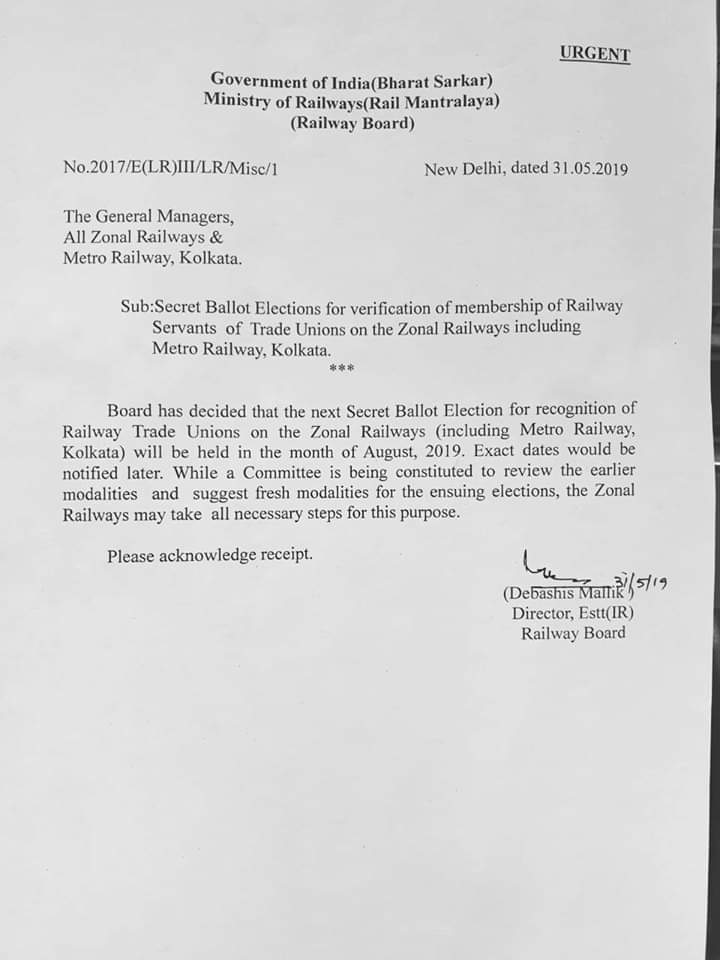
Government of India (Bharat Sarkar}
Ministry of Railways(Rail Mantralaya)
(Railway Board)
URGENT
No.2017/E(LR)III/LR/Misc/1
New Delhi, dated 31.05.2019
The General Managers,
All Zonal Railways &
Metro Railway. Kolkata.
Sub : Secret Ballot Elections for verification of membership of Railway Servants of Trade Unions on the Zonal Railways including Metro Railway, Kolkata .
************
Board has decided that the next Secret Ballot Election for recognition of Railway Trade Unions on the Zonal Railways (including Metro Railway, Kolkata) will be held in the month of August, 2019. Exact dates would be notified later. While a Committee is being constituted to review the earlier modalities and suggest fresh modalities for the ensuing elections, the Zonal Railways may take all necessary steps for this purpose.
Introduction of ‘SPARROW’ for all the cadre of CSS, CSSS & CSCS- extension of timelines for completion of APAR online on ‘SPARROW’ portal for the year 2018-19
Implementation of recommendations of VI Central Pay Commission – Revision of rates of Uniform Allowance, Kit Maintenance Allowance and Washing Allowance in respect of RPF/RPSF personnel.
No.2019/Trans Cell/Civil/Contractual Staffing dated 24th May 2019
Engagement of Ex-Servicemen against vacancies in Safety Categories of Bridge Organization, Track Machine Organization and other similar technical safety Categories on Contract Basis
Modifications in the instructions issued w.r.t. implementation of recommendations of Seventh Central Pay Commission accepted by the Government — Qualification Pay renamed as Railway Accounts Examination Allowance
Amendments to Rule 60(4)(B) and Rule 165(4)(ii) of POSB(CBS) Manual, Rule 87(4) (ii)POSB Manual Volume I and Rule 50(4)(ii) of POSB Manual Volume II regarding change in powers of various authorities to sanction deceased claim cases and their time line in respect of Post Office Savings Schemes, including Certificates, where no nomination is registered and there is no legal evidence available/produced
Revised Inspection Questionnaire for Training Institues viz. Rafi Ahmed Kidwai National Postal Academy (RAKNPI) Ghaziabad, Postal Training Centres (PTCs) and Regional Training Centres (RTCs)
Implementation of approved recommendations of Kamlesh Chandra Committee on Limited Transfer Facility for all categories of Gramin Dak Sevaks (GDS)-reg.
Cabinet clears pension scheme for traders 3 crore retail traders and shop keepers to benefit from this move PM Modi fulfils yet another promise on the first day in Government
India has a rich tradition of trade and commerce. Our traders continue to make a strong contribution to India’s economic growth.
In a decision that will benefit the trading community, the Union Cabinet, chaired by Prime Minister Shri Narendra Modi has approved a new scheme that offers pension coverage to the trading community. This is a part of the Prime Minister’s vision to provide a robust architecture of universal social security.
How the scheme works:
Under this scheme all shopkeepers, retail traders and self-employed persons are assured a minimum monthly pension of Rs. 3,000/- month after attaining the age of 60 years.
All small shopkeepers and self-employed persons as well as the retail traders with GST turnover below Rs. 1.5 crore and age between 18-40 years, can enrol for this scheme. The scheme would benefit more than 3 crore small shopkeepers and traders.
The scheme is based on self-declaration as no documents are required except Aadhaar and bank account. Interested persons can enrol themselves through more than 3,25,000 Common Service Centres spread across the country.
The Government of India will make matching contribution in the subscribers’ account. For example if a person with age of 29 years contributes Rs. 100/- month, then the Central Government also contributes the equal amount as subsidy into subscriber’s pension account every month.
Delivering a major promise on Day 1:
By imitating a pension architecture for the trading community, the Prime Minister and his team have fulfilled a major promise made to the people of India. Shri Modi had spoken about the need of proving pension for traders, that would assure them a life of dignity and financial security especially when during their old age.
This decision can also be seen in the light of several other steps taken for the welfare of traders, small and medium business. The GST underwent significant simplification after taking feedback of the trading community. In the same way, Mudra loans gave wings to the entrepreneurial zeal of young India. Loans upto Rs. 1 crore are now easily available.
These, and many more efforts would help the trading community.
Landmark decision taken in the first Cabinet meeting of the NDA Government offers pension coverage to crores of farmers
Pension scheme to secure lives of 5 crore farmers in three years This scheme, in addition to PM-KISAN monetary support will ease economic burden and lead to greater efficiency
The Union Cabinet, chaired by the Prime Minister Narendra Modi has approved a new Central Sector Scheme, a historic decision that will empower farmers across India. This is a path breaking scheme that will provide pension cover to our industrious farmers who toil day and night to keep our nation fed. It is also for the first time since independence that such a pension coverage has been envisioned for farmers.
It is estimated that 5 crore small and marginal farmers will benefit in the first three years itself. The Central Government would spend Rs. 10774.50 crore for a period of 3 years towards its contribution (matching share) for providing social security cover as envisaged under the scheme.
The salient features of this scheme are:
A voluntary and contributory pension scheme for all Small and Marginal Farmers (SMF) across the country.
Entry age of 18 to 40 years with a provision of minimum fixed pension of Rs.3,000/- on attaining the age of 60 years.
For example, a beneficiary farmer is required to contribute Rs 100/ – per month at median entry age of 29 years. The Central Government shall also contribute to the Pension Fund an equal amount as contributed by the eligible farmer.
After the subscriber’s death, while receiving pension, the spouse of the SMF beneficiary shall be entitled to receive 50% of the pension received by the beneficiary as family pension, provided he/she is not already an SMF beneficiary of the Scheme. If, the death of the subscriber happens during the period of contribution, the spouse shall have the option of continuing the Scheme by paying regular contribution.
Synergy between schemes, prosperity for farmers:
An interesting feature of the Scheme is that the farmers can opt to allow his/her monthly contribution to the Scheme to be made from the benefits drawn from the Pradhan Mantri Kisan SAmman Nidhi (PM-KISAN) Scheme directly. Alternatively, a farmer can pay his monthly contribution by registering through Common Service Centres (CSCs) under MeitY.
Fulfilling core promises, empowering the agriculture sector:
For seventy years after Independence, such a coverage for farmers was never thought. It was in the run up to the 2019 Parliamentary elections that PM Narendra Modi first mooted such an idea, which gradually found resonance across the length and breadth of India. Such a plan was mentioned in the BJP manifesto and in the first Cabinet meeting after the formation of a new Government, it has become a reality.
Dr Jitendra Singh took charge as Minister of State, Ministry of Personnel, Public Grievances and Pensions, here today.
The Secretary, Department of Administrative Reforms & Public Grievances (DARPG) and Pensions, Shri K. V. Eapen and senior officers of the Ministry were present on the occasion. The Minister was later briefed by the senior officers of the Ministry.
Smt. Nirmala Sitharaman takes charge as the Union Minister of Finance & Corporate Affairs
Smt. Nirmala Sitharaman assumed charge as the Union Minister of Finance & Corporate Affairs here today. She was greeted at the office in North Block by Minister of State for Finance & Corporate Affairs designate, Shri Anurag Singh Thakur, Finance Secretary Shri Subhash Chandra Garg and other Secretaries of the Ministry. Smt. Sitharaman is the first woman appointed as the full-time Union Minister of Finance & Corporate Affairs.
After assuming the charge, the Union Minister for Finance & Corporate Affairs was briefed on the key initiatives and policy issues by the Secretaries of the different departments of the Ministry of Finance & Corporate Affairs and was apprised of the ongoing issues and the forthcoming challenges facing the Indian economy among others.
BRIEF PROFILE:
Smt. Nirmala Sitharaman has served as the Union Defence Minister since 2017. She is currently a Rajya Sabha Member of Parliament (MP) from Karnataka. In 2014, she was elected as Rajya Sabha MP from Andhra Pradesh. She has also served as the Minister of State for Finance and Corporate Affairs and later the Minister for Commerce and Industry with Independent Charge.
As the Defence Minister, Smt. Sitharaman is credited with expediting the decision-making process relating to procurement in defence sector. She constituted a Defence Planning Committee to formulate an “action plan” to effectively overcome with various security challenges facing the nation.
Smt. Sitharaman joined the Bhartiya Janta Party (BJP) in 2008 and has served as a national spokesperson for the party since 2010.
Smt. Sitharaman was born in Madurai, Tamil Nadu, on August 18, 1959. She completed her graduation from Seethalakshmi Ramasamy College, Tiruchirappalli and obtained her M.A. (Economics) from Jawaharlal Nehru University, New Delhi.
The President of India, as advised by the Prime Minister, has directed the allocation of portfolios among the following members of the Union Council of Ministers:-
Shri Narendra Modi
Prime Minister and also in-charge of:
Ministry of Personnel, Public Grievances and Pensions;
Department of Atomic Energy;
Department of Space; and
All important policy issues; and
All other portfolios not allocated to any Minister.
Cabinet Ministers
1
Shri Raj Nath Singh
Minister of Defence.
2
Shri Amit Shah
Minister of Home Affairs.
3
Shri Nitin Jairam Gadkari
Minister of Road Transport and Highways; and
Minister of Micro, Small and Medium Enterprises.
4
Shri D.V. Sadananda Gowda
Minister of Chemicals and Fertilizers.
5
Smt. Nirmala Sitharaman
Minister of Finance; and
Minister of Corporate Affairs.
6
Shri Ramvilas Paswan
Minister of Consumer Affairs, Food and Public Distribution.
7
Shri Narendra Singh Tomar
Minister of Agriculture and Farmers Welfare;
Minister of Rural Development; and
Minister of Panchayati Raj.
8
Shri Ravi Shankar Prasad
Minister of Law and Justice;
Minister of Communications; and
Minister of Electronics and Information Technology.
9
Smt. Harsimrat Kaur Badal
Minister of Food Processing Industries.
10
Shri Thaawar Chand Gehlot
Minister of Social Justice and Empowerment.
11
Dr. Subrahmanyam Jaishankar
Minister of External Affairs.
12
Shri Ramesh Pokhriyal ‘Nishank’
Minister of Human Resource Development.
13
Shri Arjun Munda
Minister of Tribal Affairs.
14
Smt. Smriti Zubin Irani
Minister of Women and Child Development; and Minister of Textiles.
15
Dr. Harsh Vardhan
Minister of Health and Family Welfare;
Minister of Science and Technology; and
Minister of Earth Sciences.
16
Shri Prakash Javadekar
Minister of Environment, Forest and Climate Change; and
Minister of Information and Broadcasting.
17
Shri Piyush Goyal
Minister of Railways; and
Minister of Commerce and Industry.
18
Shri Dharmendra Pradhan
Minister of Petroleum and Natural Gas; and
Minister of Steel.
19
Shri Mukhtar Abbas Naqvi
Minister of Minority Affairs.
20
Shri Pralhad Joshi
Minister of
Parliamentary Affairs;
Minister of Coal; and
Minister of Mines.
21
Dr. Mahendra Nath Pandey
Minister of Skill Development and Entrepreneurship.
22
Shri Arvind Ganpat Sawant
Minister of Heavy Industries and Public Enterprise.
23
Shri Giriraj Singh
Minister of Animal Husbandry, Dairying and Fisheries.
24
Shri Gajendra Singh Shekhawat
Minister of Jal Shakti.
Ministers of State (Independent Charge)
1
Shri Santosh Kumar Gangwar
Minister of State (Independent Charge) of the Ministry of Labour and Employment.
2
Rao Inderjit Singh
Minister of State (Independent Charge) of the Ministry of Statistics and Programme Implementation; and
Minister of State (Independent Charge) of the Ministry of Planning.
3
Shri Shripad Yesso Naik
Minister of State (Independent Charge) of the Ministry of Ayurveda, Yoga and Naturopathy, Unani, Siddha and Homoeopathy (AYUSH); and
Minister of State in the Ministry of Defence.
4
Dr. Jitendra Singh
Minister of State (Independent Charge) of the Ministry of Development of North Eastern Region;
Minister of State in the Prime Minister’s Office;
Minister of State in the Ministry of Personnel, Public Grievances and Pensions;
Minister of State in the Department of Atomic Energy; and
Minister of State in the Department of Space.
5
Shri Kiren Rijiju
Minister of State (Independent Charge) of the Ministry of Youth Affairs and Sports; and
Minister of State in the Ministry of Minority Affairs.
6
Shri Prahalad Singh Patel
Minister of State (Independent Charge) of the Ministry of Culture; and
Minister of State (Independent Charge) of the Ministry of Tourism.
7
Shri Raj Kumar Singh
Minister of State (Independent Charge) of the Ministry of Power;
Minister of State (Independent Charge) of the Ministry of New and Renewable Energy; and
Minister of State in the Ministry of Skill Development and Entrepreneurship.
8
Shri Hardeep Singh Puri
Minister of State (Independent Charge) of the Ministry of Housing and Urban Affairs;
Minister of State (Independent Charge) of the Ministry of Civil Aviation; and
Minister of State in the Ministry of Commerce and Industry.
9
Shri Mansukh L. Mandaviya
Minister of State (Independent Charge) of the Ministry of Shipping; and
Minister of State in the Ministry of Chemicals and Fertilizers.
Ministers of State
1
Shri Faggansingh Kulaste
Minister of State in the Ministry of Steel.
2
Shri Ashwini Kumar Choubey
Minister of State in the Ministry of Health and Family Welfare.
3
Shri Arjun Ram Meghwal
Minister of State in the Ministry of Parliamentary Affairs; and
Minister of State in the Ministry of Heavy Industries and Public Enterprises.
4
General (Retd.) V. K. Singh
Minister of State in the Ministry of Road Transport and Highways.
5
Shri Krishan Pal
Minister of State in the Ministry of Social Justice and Empowerment.
6
Shri Danve Raosaheb Dadarao
Minister of State in the Ministry of Consumer Affairs, Food and Public Distribution.
7
Shri G. Kishan Reddy
Minister of State in the Ministry of Home Affairs.
8
Shri Parshottam Rupala
Minister of State in the Ministry of Agriculture and Farmers Welfare.
9
Shri Ramdas Athawale
Minister of State in the Ministry of Social Justice and Empowerment.
10
Sadhvi Niranjan Jyoti
Minister of State in the Ministry of Rural Development.
11
Shri Babul Supriyo
Minister of State in the Ministry of Environment, Forest and Climate Change.
12
Shri Sanjeev Kumar Balyan
Minister of State in the Ministry of Animal Husbandry, Dairying and Fisheries.
13
Shri Dhotre Sanjay Shamrao
Minister of State in the Ministry of Human Resource Development;Minister of State in the Ministry of Communications; and
Minister of State in the Ministry of Electronics and Information Technology..
14
Shri Anurag Singh Thakur
Minister of State in the Ministry of Finance; andMinister of State in the Ministry of Corporate Affairs.
15
Shri Angadi Suresh Channabasappa
Minister of State in the Ministry of Railways.
16
Shri Nityanand Rai
Minister of State in the Ministry of Home Affairs.
17
Shri Rattan Lal Kataria
Minister of State in the Ministry of Jal Shakti; and Minister of State in the Ministry of Social Justice and Empowerment.
18
Shri V. Muraleedharan
Minister of State in the Ministry of External Affairs; and Minister of State in the Ministry of Parliamentary Affairs.
19
Smt. Renuka Singh Saruta
Minister of State in the Ministry of Tribal Affairs.
20
Shri Som Parkash
Minister of State in the Ministry of Commerce and Industry.
21
Shri Rameswar Teli
Minister of State in the Ministry of Food Processing Industries.
22
Shri Pratap Chandra Sarangi
Minister of State in the Ministry of Micro, Small and Medium Enterprises; and Minister of State in the Ministry of Animal Husbandry, Dairying and Fisheries.
23
Shri Kailash Choudhary
Minister of State in the Ministry of Agriculture and Farmers Welfare.
24
Sushri Debasree Chaudhuri
Minister of State in the Ministry of Women and Child Development.
No. 5/1/2019-CPI
GOVERNMENT OF INDIA
MINISTRY OF LABOUR & EMPLOYMENT
LABOUR BUREAU
`CLEREMONT’, SHIMLA-171004
DATED: 31st May, 2019
Press Release Consumer Price Index for Industrial Workers (CPI-IW) — April, 2019
The All-India CPI-IW for April, 2019 increased by 3 points and pegged at 312 (three hundred and twelve). On 1-month percentage change, it increased by (+) 0.97 per cent between March, 2019 and April, 2019 when compared with the increase of (+) 0.35 per cent between the corresponding months of previous year.
The maximum upward pressure in current index came from Food group contributing (+) 2.26 percentage points to the total change. At item level, Arhar Dal, Fish Fresh, Goat Meat, Poultry (Chicken), Fresh Milk, Chillies Green, Garlic, Ginger, Onion, Apple, Banana, Lemon, Brinjal, Cabbage, Carrot, Cauliflower, French Bean, Green Coriander Leaves, Lady’s Finger, Methi, Palak, Peas, Potato, Radish, Tomato, Torai, Electricity Charges, Ornament Glass, etc. are responsible for the increase in index. However, this increase was checked by Eggs (Hen), Tamarind, Bitter Gourd, Parval, Cucumber, Kharbooza, Mango (Ripe), Flowers/ Flower Garlands, etc., putting downward pressure on the index.
The year-on-year inflation based on CPI-IW stood at 8.33 per cent for April, 2019 as compared to 7.67 per cent for the previous month and 3.97 per cent during the corresponding month of the previous year. Similarly, the Food inflation stood at (+) 4.92 per cent against (+) 3.96 per cent of the previous month and (+) 1.33 per cent during the corresponding month of the previous year.
At centre level Rourkela, Howrah and Siliguri reported the maximum increase of 7 points each followed by Mysore, Munger-Jamalpur and Varanasi (6 points each). Among others, 5 points increase was observed in 8 centres, 4 points in 8 centres, 3 points in 15 centres, 2 points in 23 centres and 1 point in 10 centres. Rest of the 8 centres’ indices remained stationary.
The indices of 35 centres are above All-India Index and 43 centres’ indices are below national average.
The next issue of CPI-IW for the month of May, 2019 will be released on Friday, 28th June, 2019. The same will also be available on the office website www.labourbureaunew.gov.in.
No. 7(2)/EV/2016
Government of India
Ministry of Finance
Department of Expenditure
New Delhi, the 29th May, 2019
OFFICE MEMORANDUM
Sub : Central Government Employees Group Insurance Scheme-1980 – Tables of Benefits for the savings fund for the period from 01.04.2019 to 30.06.2019.
The Tables of Benefits for Savings Fund to the beneficiaries under the Central Government Employees Group Insurance Scheme-1980, which are being issued on a quarterly basis from 01.01.2017 onwards, as brought out in this Ministry’s OM of even number dated 17.03.2017, for the quarter from 01.04.2019 to 30.06.2019, as worked out by IRDA based on the interest rate of 8% per annum (compounded quarterly) as notified by the Department of Economic Affairs as per their Resolution No. 5(2)-B(PD)/2019 dated 03.04.2019, are enclosed.
2. The Tables enclosed are of two categories as per the existing practice. As hitherto, the first Table of Benefits for the savings fund of the scheme is based on the subscription of Rs.10 p.m. from 1.1.1982 to 31.12.1989 and Rs.15 p.m. w.e.f. 1.1.1990 onwards. The second Table of Benefits for savings fund is based on a subscription of Rs.10 p.m. for those employees who had opted out of the revised rate of subscription w.e.f. 1.1.1990.
3. While these orders are in respect of Table of Benefits for the period from 01.04.2019 to 30.06.2019, the Tables already issued for the first quarter i.e. for the period 01.01.2019 to 31.03.2019 are also reproduced for the sake of convenience and consolidation.
4. In their application to the employees of Indian Audit and Accounts Department, these orders are issued after consultation with the Comptroller & Auditor General of India.
Early Closure of Offices in connection with the Swearing of Ceremony of the newly elected Prime Minister of India on 30.05.2019
No.12/10/2016- JCA
Government of India
Ministry of Personnel, Public Grievances and Pensions
Department of Personnel & Training Establishment (JCA) Section
North Block, New Delhi – 110 001
Dated : 28 May, 2019
OFFICE MEMORANDUM
Subject: Early Closure of Offices in connection with the Swearing of Ceremony of the newly elected Prime Minister of India on 30.05.2019.
In connection with arrangements for the Swearing in Ceremony of the newly elected Prime Minister of India on 30.05.2019, it has been decided that the Government offices located in the North Block, South Block, Rail Bawan, Vayu Bhawan, Sena Bhawan, DRDO and Hutments would be closed early at 14:00 hours. on 30th May, 2019 (Thursday).