IDA rates from April 2019 for 1997 Pay Scales in CPSE
F. No. W-02/0004/2014-DPE (WC)-GL-X/19
Government of India
Ministry of Heavy industries & Public Enterprises
Department of Public Enterprises
Public Enterprises Bhawan
Block 14, CGO Complex,
Lodi Road, New Delhi-110003
Dated: 2nd April, 2019
OFFICE MEMORANDUM
Subject :- Board level posts and below Board level posts including Non-unionised supervisors in Central Public Sector Enterprises (CPSEs) – Revision of scales of pay w.e.f. 01.01.1997 — Payment of IDA at revised rates regarding.
*****
In modification of this Department’s O.M of even No. dated 03.01.2019, the rate of DA payable to the executives of CPSEs (1997 pay revision) is as follows:
a) Date from which payable: 01.04.2019
b) Average AICPI (1960=100) for the quarter Dec 2018 – Feb 2019
Dec 2018 6872
Jan 2019 7006
Feb 2019 7006 Average of the quarter 6961
c) Link Point : 1708 (as on 01.01.1997)
d) Increase over link point: 5253 (6961 – 1708)
e) Revised DA Rate w.e.f. 01.04.2019: 307.5% [ (5253 : 1708) x 100 ]
2. These rates are applicable in the case of IDA employees, whose pay have been revised with effect from 01.01.1997 as per DPE O.M. dated 25.06.1999.
3. All Administrative Ministries/Departments of the Government of India are requested to bring the foregoings to the notice of the CPSEs under their administrative control for necessary action at their end.
GFR 2017 Amendment : Replacement of name of erstwhile DGS&D Government e-Marketplace
No.F.1/26/2018-PPD
Government of India
Ministry of Finance
Department of Expenditure
Procurement Policy Division
Room.No.512, Lok Nayak Bhawan,
New Delhi dated the 2nd April, 2019.
OFFICE MEMORANDUM
Subject : Replacement of name of erstwhile DGS&D (Directorate General of Supplies & Disposals) by GeM (Government e-Marketplace) in General Financial Rules (GFRs) 2017 – reg.
The undersigned is directed to refer Supply Division, Department of Commerce (DoC) OM No, 1(1)/2018-Pol. Dated 20.08.2018 proposing changes in GFRs, 2017 and to say that the proposal of Doe has been examined and it has been decided with the approval of Finance Minister to make changes to the GFRs, 2017 as tabulated below:
S.NO.
EXISTING PROVISIONS OF FRS, 2017
AMENDED RULE
1
Rule 147: Powers for procurement of goods:
The Ministr[es or Departments have been delegated full powers to make their own arrangements for procurement of goods. In case, however, a Ministry or Department does not have the required expertise, it may project its indent to the Central Purchase Organisation (e.g. DGS&D) with the approval of competent authority. The intent form to be utilized for this purpose will be as per the standard form evolved by the Central Purchase Organisation,
Rule 147: Powers for procurement of goods:
The Ministries or Departments have been delegated full powers to make their own arrangements for procurement of goods and services, that are not available on GeM. Common use Goods and Services available on GeM are required to be procured mandatorily through GeM as per Rule 149.
2
Rule 149 Government e-Marketplace (GeM):
DGS&D or any other agency authorized by the Government will host an online Government e-Marketplace (GOA) for common use Goods and Services. OGS&D will ensure adequate publicity including periodic
advertisement of the items to be procured through GeM for the prospective suppliers_ The Procurement of Goods and Services by Ministries or Departments will be mandatory for Goods or Services available on Ge The credentials of suppliers on GeM shall be certified by DGS&D. The procuring authorities will certify the reasonability of rates. The GeM portal shall be utilized by the Government buyers for direct on-line purchases as under:
(i) Up to Rs.50.000i- through any of the available suppliers on the GeM meeting the requisite quality, specification and delivery period.(ii) Above Rs.50,000/- and up to R5.30,00,0001- through the Gelvt Seller having lowest price amongst the available sellers, of at least three different manufacturers, on GeM, meeting the requisite quality, specification and delivery period. The tools for online bidding and online reverse auction available on GeM can be used by the Buyer decided by the competent authority.
(iii) Above Rs_ 0,001000/- through the supplier having lowest price meeting the requisite quality, specification and delivery period after mandatorily obtaining bids, using online bidding or reverse auction tool provided on GeM.
Rule 149 Government e-Marketplace (GeM):
1Government of India has established the Government e-Marketplace (Gelv1) for common use Goods and Services_ GeM SPV will ensure adequate publicity including periodic advertisement of the items to be procured through GeM for the prospective suppliers. The Procurement of Goods and Services by Ministries or Departments will be mandatory for Goods or Services available on GeM. The credentials of suppliers on GeM shall be certified by GeM SPY The procuring authorities will certify the reasonability of rates. The GeM portal shall be utilized by the Government buyers for direct on-line purchases as under:
(i) Up to Rs.25,000 through any of the available suppliers on the GeM, meeting the requisite quality, specification and delivery period. (ii) Above Rs_ 5, 000 and up to Rs.5,00,000 through the Gehl Seller having lowest price amongst the available sellers (excluding automobiles where current limit of 30 lakh will continue), of at least three different manufacturers, on GeM, meeting the requisite quality, specification and delivery period. The tools for online bidding and online reverse auction available on GeM can be used by the Buyers even for procurements less than Rs 5,00,000.
(iii) Above Rs.5,00,000 through the supplier having lowest price meeting the requisite quality, specification and delivery period after mandatorily obtaining bids, using online bidding or reverse auction tool provided on GeM (excluding Automobiles where current limit of 30 lakh will continue).Note: There is no change in clauses(iv) to (viii).
3
Rule 150: Registration of Suppliers;
(i) With a view to establishing reliable sources for procurement of goods commonly required for Government use, the Central PurchaseOrganisation (e.g. DGS&D) will prepare and maintain item-wise lists of eligible and capable suppliers_ Such approved suppliers will be known as “Registered Suppliers””,”
All Ministries or Departments may utilise these lists as and when necessary. Such registered suppliers are prima facie eligible for consideration for procurement of goods through Limited Tender Enquiry, They are also ordinarily exempted from furnishing bid security along with theft bids. A Head of Department may also register suppliers of goods which are specifically required by that Department or Office, periodically. Registration of the supplier should be done following a fair, transparent and reasonable procedure and after giving due publicity
(v) The list of registered suppliers for the subject matter of procurement be exhibited on the Central Public Procurement Portal and websites of the Procuring Entity/ e-Procurement portals.
(i) For goods and services not available or eM, Head of Ministry/ Department may also register suppliers of goods and services which are specifically required by that Department or Office, periodically. Registration of the supplier should be done following a fair, transparent and reasonable procedure and after giving due publicity. Such registered suppliers should be boarded on GeM as and when the item or service gets listed on Gehl.
(v) The list of registered suppliers for the subject matter of procurement be exhibited on websites of the Procuring Entity) e-Procurement portals. Note; There is no change in clauses(i) to (iv).
4
Rule 155: Purchase of goods by Purchase Committee:
Purchase of goods costing above Rs. 25,000 (Rupees twenty five thousand only) and upto Rs.2,50,0001- (Rupees two lakh and fifty thousand only) on each occasion may be made on the recommendations of a duly constituted Local Purchase Committee consistingRule 1551 Purchase of goods by
Purchase Committee: in case a certain item is not available on the GeM portal, Purchase of goods costing above Rs. 25,000 (Rupees twenty five thousand only) and upto Rs_2,50,000 (Rupees two lakh and fifty thousand only) on each occasion may be made on the recommendations of a
Existing Provisions of GFRs, 2017 of three members of an appropriate level as decided by the Head of the Department. The committee will survey the market to ascertain the reasonableness of rate, quality and specifications and identify the appropriate supplier. Before recommending placement of the purchase order, the members of the committee will jointly record a certificate as under:
certified that we, members of the purchase committee are jointly and individually satisfied that the goods recommended for purchase are of the requisite specification and quality, priced at the prevailing market rate and the supplier recommended is reliable and competent to supply the goods in question, and it is not debarred by Department of Commerce or Ministry/ Department concerned.
Amended Rule duly constituted Local Purchase Committee consisting of three members of an appropriate level as decided by the Head of the Department, The committee will survey the market to ascertain the reasonableness of rate, quality and specifications and identify the appropriate supplier. Before recommending placement of the purchase order, the members of the committee will jointly record a certificate as under:
Certified that we. members of the purchase committee are jointly and individually satisfied that the goods recommended for purchase are of the requisite specification and quality, priced at the prevailing market rate and the supplier recommended is !reliable and competent to supply the goods in question, and it is not debarred by Department of Commerce or Ministry/ Department concerned,’
5
Rule 225 (xiii): Copies of all contracts and agreements for purchases of the value of Rupees Twenty-five Lakhs and above, and of all rate and running contracts entered into by civil departments of the Government other than the departments like the Directorate General of Supplies and Disposals for which a special audit procedure exists, should be sent to the Audit Officer and for the Accounts officer as the case may be.
Rule 225 (xiii) Copies of all contracts and agreements for purchases of the value of Rupees Twenty-five Lakhs and above entered into by civil departments of the Government, should be sent to the Audit Officer and or the Accounts officer as the case may be.
2. It has been also decided to delete Rules 148,156,159(iv),160(iii),173(xv) and 174(iv) of GFRs, 2017 related to rate contracts.
3. This OM is also available on our website www.doe.gov.in -> Notification -> Circular -> Procurement Policy OM.
4. Hindi version of this OM will follow.
(K Narayana Reddy)
Under Secretary to the Govt. of India
Reckoning of pay element for revision of pension of pre–2016 retired Loco Inspectors
GOVERNMENT OF INDIA
MINISTRY OF RAILWAYS
(RAILWAY BOARD)
PC-VII No. 128
RBE No. 41/2019
No. E(P&A)II/2018/RS/12
New Delhi, dated : 06.03.2019
The General Managers,
All Indian Railways &PUs.
Sub : Reckoning of pay element for revision of pension of pre–2016 retired Loco Inspectors.
*****
Please refer to Board’s letter number D-43/34/2017-F(E)III, dt. 24.01.2018 (RBE No.13/2018) regarding revision of pension of pre-2016 retired running staff. After issue of this letter dt. 24.01.2018 references have been received from the recognized Federations and some of the Zonal Railways for issuing of instructions for revision of pension of pre-2016 retired Loco Inspectors and Chief Loco Inspectors.
2. Loco Inspectors and Chief Loco Inspectors are eligible for reckoning of 30% pay element for calculation of emoluments for pensionary benefits w.e.f. 01.01.1993 in terms of paragraph No. 5.5 of Board’s letter No.E(P&A)II/83/RS-10(iv) dated 25.11.1992. When a Loco Inspector has rendered less than 10 months service as Loco Inspector as per revised scheme effective from 01.01.1993, reckoning of pay element is admissible on pro-rata basis e.g. if a Loco Inspector has rendered only 5 months service he will be entitled to only 15% pay element.
3. The reckoning of pay element for revision of pension of Loco Inspectors and Chief Loco Inspectors who have retired/died between/on 01.01.1993 and 31.12.2015 have been shown in the Annexure attached herewith.
4. Other conditions stipulated in DoP&PW’s OM dated 12.05.2017 & 06.07.2017 will apply in the case of Loco Inspectors also. It is also clarified that higher of the two formulations i.e. the pension/family pension already revised in accordance of Board’s letter No. 2016/F(E)III/1(1)/7 dated. 10.08.2016 or the revised pension/family pension as worked out in accordance with para 3 above, shall be granted to pre-2016 retired Loco Inspectors as revised pension/family pension w.e.f 01.01.2016.
5. Loco Inspectors and Chief Loco Inspectors who have retired/died before 01.0.1.1993 are not eligible for reckoning of 30% pay element for calculation of emoluments for pensionary benefits, therefore, their notional fixation of pay for revision of pension would be done in the same way as being done in the case of non-running staff in general.
6. For those Loco Inspectors who have retired after 01.01.2016, the reckoning of pay element for calculation of emoluments for pensionary benefits would be administered in terms of Board’s letter No. E(P&A)II-2015/RS-25 dated 13.11.2017 till further orders.
7. This issues with the concurrence of the Finance Directorate of the Ministry of Railways.
PCDA Circular C-182 : Submission of superannuation / retiring pension claim in respect of civilian paid from defence service estimate
O/o The Principal Controller of Defence Accounts (Pension) Draupadi Ghat, Allahabad – 211014
Circular No. C-182
No. G1/C/MISC/Vol-X/Tech
O/o the PCDA (P), Allahabad
Dated: 19/02/2018
To,
…………………..
………………….
(All Head of Department under Min.of Defence)
Sub : Submission of superannuation/retiring pension claim in respect of civilian paid from defence service estimate.
Ref:- This office circular No.C-181 dated 22.01.2018.
Office of the PCDA (P) Allahabad has implemented e-PPO in r/o Defence Civilian w.e.f. January, 2018 which contains unique 12 digit PPO No. with 4 digit PPO suffix. These e-PPO are being electronically generated and digitally signed (no physical PPO is printed and sent to any agency). On implementation of ibid process, processing time of pension claims has been reduced to 45 days from the date of receipt of claim (if all required certificate/document submitted with claim and found correct).
2. During the processing, it has been noticed that in some superannuation/retiring cases, pension claims are being received in this office before 6 to 9 months from the date of retirement. Accordingly PPOs are being issued in these cases before 5 to 8 months from the date of retirement. However, most of ibid cases required cancellation or corrigendum due to contingencies arising between date of issue of PPO and Date of Retirement. These cancellation and corrigendum are causing in avoidable delay in issuance of others PPOs. Therefore, it has been decided that pension claim in r/o Defence Civilian should be submitted in this office not more than 3 months prior to date of retirement. Pension claim will not be accepted/entertained more than 3 month before from the date of retirement.
3. In view of the above, you are requested to issue suitable instructions (along with copy of this circular) to all the Head of the Offices under your administrative control to ensure the submission superannuation/retiring pension claim so that the same may be reached to this office not before 3 month from the date of retirement.
Re-Structuring of IT Cadre in Zonal Railways/Production Units
GOVERNMENT OF INDIA
MINISTRY OF RAILWAYS
RAILWAY BOARD
RBA No. 22/2019
No. 2016/AC-II(CC)/37/9
28-3-2019
General Managers,
All Zonal Railways and Production Units (including RDSO)
Sub :– Re-Structuring of IT Cadre in Zonal Railways/Production Units.
Ref:- Board’s letter of even No. dated 18.04.2017 (RBA 45/2017).
Further to the instructions issued vide Board’s letter ibid, the matter regarding restructuring of Senior Engineer (IT) and Junior Engineer (IT)’s post of IT Cadre in Zonal Railways/Production Units has again been reviewed in the Ministry of Railways and it has now been decided with the approval of competent authority, that the cadre restructuring of the post of Senior Engineer (IT) and Junior Engineer (IT) of IT Cadre, earlier approved on the basis of operated strength as on 1.4.2017 in the ratio of 67:33 respectively, shall now be done on the basis of Sanctioned Strength of Senior Engineer (IT) and Junior Engineer (IT) w.e.f. 1.4.2017. The entire up-gradation has to be revenue neutral. Accordingly, the revised sanctioned strength of Senior Engineer (IT) and Junior Engineer (IT) of IT Cadre in Zonal Railways/Production Units as on 1.4.2017 after restructuring duly taking into account the surrender of JE/IT posts shall be as under:-
S.NO
ZONAL RAILWAY/PRODUCTION UNIT
REVISED SANCTIONED STRENGTH AFTER RESTRUCTURING W.E.F 1.4.2017
HAT
SE/IT
Total
1
Central Railway
23
50
73
2
Eastern Railway
49
51
100
3
Northern Railway
44
50
94
4
North Eastern Railway
20
37
57
5
North East Frontier Railway
8
90
98
6
Southern Railway
20
37
57
7
South Central Railway
13
51
64
8
South Eastern Railway
27
65
92
9
Western Railway
10
33
43
10
North Western Railway
10
18
28
11
West Central Railway
0
22
22
12
East Coast Railway
3
10
14
13
East Central Railway
1
16
17
14
South Western Railway
8
4
12
15
North Central Railway
16
31
47
16
South East Central Railway
5
37
42
17
Diesel Modernisation Works, Patiala
1
8
9
18
Rail Wheel Factory, Bengaluru
0
14
14
19
Chittaranjan Locomotive Works
12
31
43
20
Diesel Locomotive, Varanasi
1
31
32
21
Integral Coach Factory
7
40
47
22
Central Organisation for Railway Electrification
0
1
1
23
Metro Railway, Kolkata
0
8
8
24
RDSO, LKO
0
9
9
25
Rail Coach Factory (KXH)
0
45
45
Total
278
789
1067
3. Surrender of Post in JE/IT will be effected before implementing above mentioned cadre restructure orders and the resultant imbalance/variation in the cadre due to surrender of posts of JE/IT shall be reviewed at the time of next annual review of the cadre after implementation of cadre restructuring.
4. Zonal Railways/Production Units may update the book of sanction as per the above sanctioned post w.e.f 1.4.2017..
5. All the other terms and condition mentioned in Board’s letter ibid remain unchanged.
(Gaisingam Kabui)
Director Finance/CCA,
Railway Board
Simplification of pension procedure – submission of undertaking by retiring Government servant along with pension papers & Handing over of PPO booklet to Pensioners by Head of Office
GOVERNMENT OF INDIA
DEPARTMENT OF EXPENDITURE
MINISTRY OF FINANCE
CENTRAL PENSION ACCOUNTING OFFICE
TRIKOOT-II, BHIKAJI CAMA PLACE,
NEW Delhi-110066
PHONES :26174596, 26174456, 26174438
CPAO/IT&Tech/11(Vol-VI)/Simplification/2018-19/01
01.04.2019
OFFICE MEMORANDUM
Subject : Simplification of pension procedure – submission of undertaking by retiring Government servant along with pension papers & Handing over of PPO booklet to Pensioners by Head of Office – reg.
The Scheme for Payment of pensions to Central Government Civil Pensioners through Authorized Banks’, issued by the Central Pension Accounting Office provides for an undertaking to be submitted by the retiring Government servant/pensioner to the pension disbursing bank before commencement of pension. The pensioner undertakes to refund or make good any amount to which he is not entitled.
2. In view of the above Department of Pension & Pensioners’ Welfare issued instructions vide its O.M. No. 1/27/2011-P&PW(E) dated 07.05.2014 which were also communicated through this office O.M. No. CPAO/Tech/Simplification/2014-15/53 dated 28.05.2014. These provisions are reiterated below:
(a) It has been established that the first payment of pension after retirement gets delayed mainly due to two reasons. One, the delay in receipt of intimation by the pensioner that pension papers have reached the bank and two, delay on part of the pensioner in approaching the bank for submission of the undertaking.
(b) The required undertaking may be obtained by the Head of Office from the retiring Government servant along with Form 5 and other documents before his retirement. This undertaking shall be forwarded to the pension disbursing bank along with the Pension Payment Order by the Accounts Officer/CPAO following the usual procedure.
(c) The pensioner would no longer be required to visit the bank to activate the first payment of pension. Therefore, after ascertaining that the Bank’s copy has been dispatched by the Central Pension Accounting Office, the pensioner’s copy of the Pension Payment Order (PPO) may be handed over to him at the time of retirement along with other retirement dues. This should be feasible in all cases where the Government servant had submitted pension papers within the time-limits prescribed in the Central Civil Services (Pension) Rules, 1972.
(d) However, if any employee posted at a location away from the office of the Head of Office or who for any other reasons feels that it would be more convenient to him to obtain his copy of PPO from the bank, may inform the Head of Office of his option in writing while submitting his pension papers.
3. Pay & Account Office/Head of Office should not wait for the copy of PPO (SSA) for confirmation of the dispatch of the same by CPAO to bank for handing over of the pensioner’s copy to the retiring government servant along with other retirement dues. PAO/Ho0 may confirm the dispatch of Banks Copy of PPO by visiting CPAO’s website i.e www.cpao.nic.in -> See your PPO Status.
4. It has been observed that pensioner’s portion of the PPO is not being handed over to the pensioner, but being sent to the bank through CPAO. It seems that the timeline for submission of finalizing the pension cases as mentioned in the CCS (Pension) Rules, 1972 are not being adhered to by HoO/PAO.
5. All Pr. CCAs/CCA/CAs/AGs (with independent charge)/JS(Admin) are requested to issue instructions to all Pay and Accounts Offices/ Head of Offices under their jurisdiction to ensure timely submission of pension papers so that the correct procedure is followed strictly. Timeline for finalization of pension cases as prescribed in CCS (Pension) Rules, 1972 is annexed herewith.
This issues with the approval of Chief Controller (Pension).
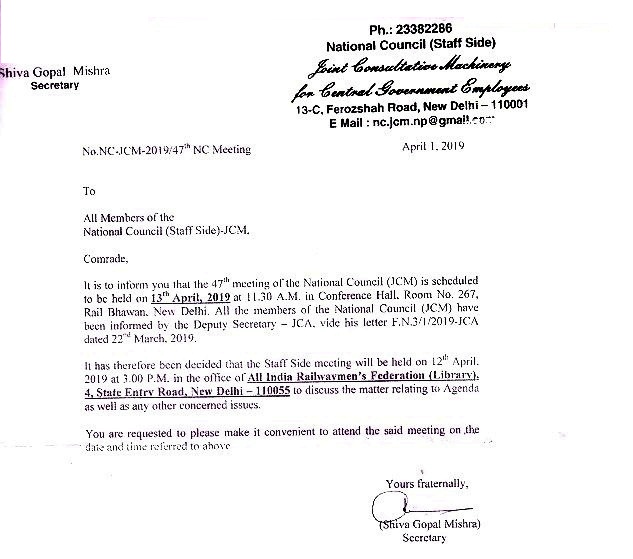
All Members of the
National Council (Staff Side)-JCM.
Comrade,
It is to inform you that the 47th meeting of the National Council (JCM) is scheduled to be held on 13th April, 2019 at 11.30 A.M. in Conference Hall, Room No. 267. Rail Bhawan, New Delhi. All the members of the National Council (JCM) have been informed by the Deputy Secretary – JCA, vide his letter F.N.3/1/2019-JCA dated 22rd March, 2019.
It has therefore been decided that the Staff Side meeting will be held on 12th April, 2019 at 3.00 P.M. in the office of All India Railwaymen’s Federation (Library). 4, State Entry Road, New Delhi– 110055 to discuss the matter relating to Agenda as well as any other concerned issues.
You are requested to please make it convenient to attend the said meeting on the date and time referred to above
TN G.O.Ms.No.98 : Re-employment Fixation of pay of re-employed pensioners
Government of Tamil Nadu
2019
FINANCE [PENSION] DEPARTMENT
G.O.Ms.No.98, Dated 7th March 2019.
(Vilambi, Maasi-23,,Thiruvalluvar Aandu 2050)
ABSTRACT
PENSION – Re-employment – Fixation of pay of re-employed pensioners – Enhancement of ignorable part of pension from Rs.4,000/- to Rs.15,000/- in the case of Commissioned Service Officers and Civil Officers holding Group-A posts who retire before attaining the age of 55 years – Orders – Issued.
Read the following:-
1. G.O.Ms.No.304, Finance (Pension) Department, Dated: 30-12-2014.
2. From the Government of India, Ministry of Personnel, Public Grievances and Pension, Department of Personnel
and Training O.M.No.3/3/2016-Estt.(Pay II), dated 01-05-2017.
ORDER:
In the Government Order first read above, orders have been issued for enhancement of ignorable part of pension from Rs.1,500/- to Rs.4,000/- in the case of Commissioned Service Officers and Civil Officers holding Group-A posts who retire before attaining the age of 55 years on their re-employment with effect from the date of issue of order.
2. In the Office Memorandum second read above, the Government of India inter-alia has enhanced the ignorable part of pension from Rs.4,000/- to Rs.15,000/- with effect from 1-1-2016 in the case of Commissioned Service Officers and Civil Officers holding Group-A posts who retire before attaining the age of 55 years on their re-employment in Central Civil Service.
3. The Government, after careful consideration, on the analogy of the orders issued by the Government of India, have decided to extend the orders of the Government of India in the reference second read above to such officers in the State Government. Accordingly, the Government hereby enhance the ignorable part of pension from Rs.4,000/- to Rs.15,000/- (Rupees fifteen thousand only) in the case of Commissioned Service Officers and Civil Officers holding Group A posts who retire before attaining the age of 55 years on their re-employment in the State Service.
4. These orders shall take effect from the date of issue of this order.
(BY ORDER OF THE GOVERNOR)
K.SHANMUGAM
ADDITIONAL CHIEF SECRETARY TO GOVERNMENT
Abolition of National Pension System and for restoration of Old Pension Scheme
Annexure-I
F.No-20/07/2017-PR
भारत सरकार
वित्त मंत्रालय
वित्तीय सेवाएं विभाग
****
द्वितीय तल, जीवन द्वीप भवन,
संसद मार्ग, नई दिल्ली,
18.03.2019
To
Shri C. Srikumar, General Secretary,
All India Defence Employees’ Federation,
S.M. Joshi BhavanI, Survey No. 81 ,
Dr. Babasaheb Ambedkar Road,
Khadki, Pune – 411 003.
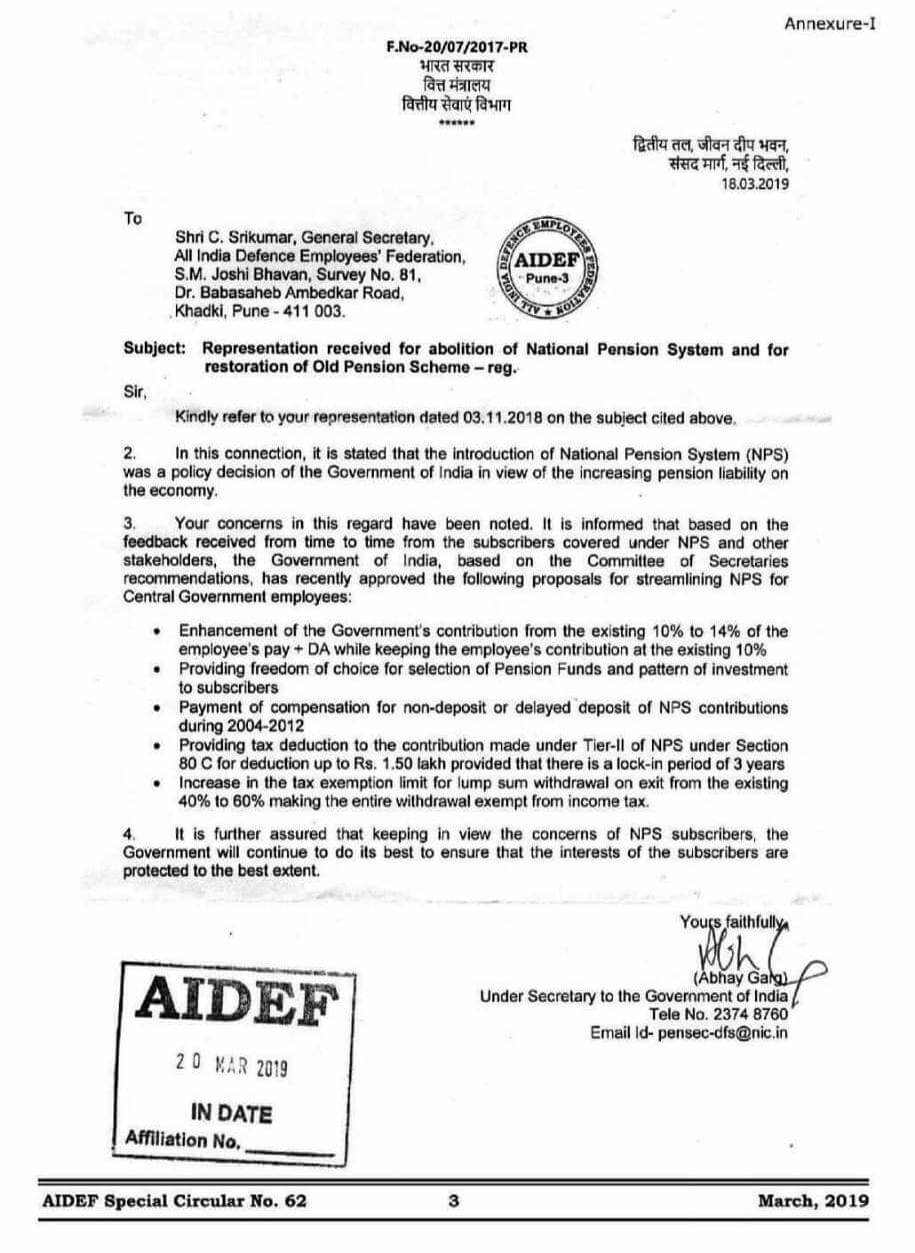
Subject: Representation received for abolition of National Pension System and for restoration of Old Pension Scheme – reg.
Sir,
Kindly refer, to your representation dated 03.11.2018 on the subject cited above.
2. In this connection, it is started that the introduction of National Pension System (NPS) was a policy decision of the Government of India in view of the Increasing pension liability on the economy.
3. Your concerns In this regard have been noted. It Is informed that based on the feedback received from time to time from the subscribers covered under NPS and other stakeholders, the Government of India, based on the Committee of Secretaries recommendations, has recently approved the following proposals for streamlining NPS for Central Government employees.
Enhancement of the Government’s contribution from the existing 10% to 14% of the employee’s pay + DA While keeping the employee’s contribution at the existing 10%.
Providing freedom of choice for selection of Pension Funds and pattern of investment to subscribers
Payment of compensation for non-deposit or delayed deposit of NPS contributions during 2004-2012
Providing tax deduction to the contribution made under Tier-II of NPS under Section 80 C for deduction up to Rs. 1.50 Iakh provided that there is a lock in period of 3 years
Increase In the tax exemption limit for lump sum withdrawal on exit from the existing 40% to 60% making the entire withdrawal exempt from Income tax.
4. It is further assured that keeping in view the concerns of NPS subscribers, the Government will continue to do its best to ensure that the Interests of the subscribers are protected to the best extent.
Yours faithfully,
(Abhay Garg)
Under Secretary to the Government of India