8th Pay Commission Update: Multi-Day Meetings Scheduled for April 28-30 in Delhi
No. 25/2/2026-App/8CPC Government of India Eighth Central Pay Commission
Dated: 24th April, 2026
NOTICE
The Eighth Central Pay Commission has received large number of requests for interaction with the Commission for 28th-30th April, 2026 meetings at Delhi. The Commission is scheduling meeting with maximum number of Unions/Associations during these dates. However, due to compressed schedule, all requests for interaction during these dates may not be accepted.
Please note that the Commission shall be holding more meetings at Delhi and at various other States/UT in due course in coming months, which shall be updated on the website of the Commission. Interested stakeholders outside Delhi NCR may seek appointment for interaction with the Commission in their State/UT or nearby State/UT at that stage.
(Abhay N Sahay) Deputy Secretary Eighth Central Pay Commission
CPAO Order: Disbursement of Fixed Medical Allowance for NPS Retirees through CPPCs
Government of India Ministry of Finance Department of Expenditure Central Pension Accounting Office Trikoot-II, Bhikaji Cama Place New Delhi-110066.
No. CPAO/IT&Tech/FMA to NPS/101/5894/2026-27/65
Dated: 16.04.2026
Office Memorandum
Subject: Grant of Fixed Medical Allowance (FMA) to Pensioners/Family Pensioners covered under National Pension System– reg
The undersigned is directed to refer to the DoP&PW OMs dated 06.12.2023 and 07.02.2025 regarding grant of Fixed Medical Allowance (FMA) to pensioners/family pensioners covered under National Pension System (NPS), wherein the procedure for payment of FMA to these retirees has been prescribed (copies enclosed).
In this regard, it is informed that the payment of FMA to eligible NPS pensioners/family pensioners shall be disbursed by the Pension Disbursing Banks through their Central Pension Processing Centres (CPPCs). The modalities for sanctioning and procedure for payment of FMA to NPS retirees has been finalized as per details given below:
i) After carrying out necessary checks, CPAO will prepare Special Seal Authority (SSA) and send the same along with all the Forms received from Pay & Accounts Officer to the concerned CPPC of the Authorized Bank for payment of FMA to the beneficiary.
ii) The CPPC of the authorized bank, after receiving the Special Seal Authority for payment of FMA from CPAO, will credit the amount of FMA at the rate notified from time to time by the DoP&PW in respect of these beneficiaries in their bank account on quarterly basis as per schedule given in the aforementioned O.Μ.
iii) The payment of FMA will be automatic and no bill is required to be submitted by the beneficiary. The CPPC will strictly follow the instructions mentioned in the Special Seal Authority issued by the CPAO for payment of FMA and any other orders issued by the Government on the subject.
iv) In the case of change in option by the beneficiary from FMA to CGHS (OPD) facility, the instructions contained in the DoP&PW O.M. dated 23rd March 2022 will be followed.
v) For transfer of account from one branch/bank to another for payment of FMA, the procedure laid down in Scheme booklet issued by CPAO for payment of pensions to Central Government Civil Pensioners by Authorized banks shall be followed.
vi) The person drawing FMA shall submit the life certificate (Digital or Physical) every year in November in the concerned bank for continuing the payment of FMA. The payment of FMA for the period September to November shall be in the first week of December and the release of FMA from the month of December onwards shall be subject to the submission of the life certificate by the beneficiary due in preceding November.
vii) On the death of FMA beneficiary, if the name of the spouse/family member eligible for FMA is mentioned in the FMA payment authority, the spouse/family member will apply to the bank along with the death certificate for disbursement of FMA to him/her. The bank will accordingly start disbursement of FMA to him/her. If the name of family member eligible for FMA is not mentioned in the FMA authority, then on death of an FMA beneficiary, the eligible member of the family shall apply to the Head of the Office for issue of fresh FMA authority.
viii) After making payment of FMA, the CPPC shall follow the procedure / instructions contained in the scheme booklet issued by CPAO for reimbursement, accounting and submission of reports to the extent feasible and required. The amount of FMA disbursed to the retired NPS employees and their families will be reimbursed by the Government to the banks as per the existing system.
CPPCs are requested to take necessary action for compliance of the aforesaid instruction. Detailed instructions for integration with CPAO for making payment of FMA to NPS retirees will be issued in due course.
This issues with the approval of the competent authority.
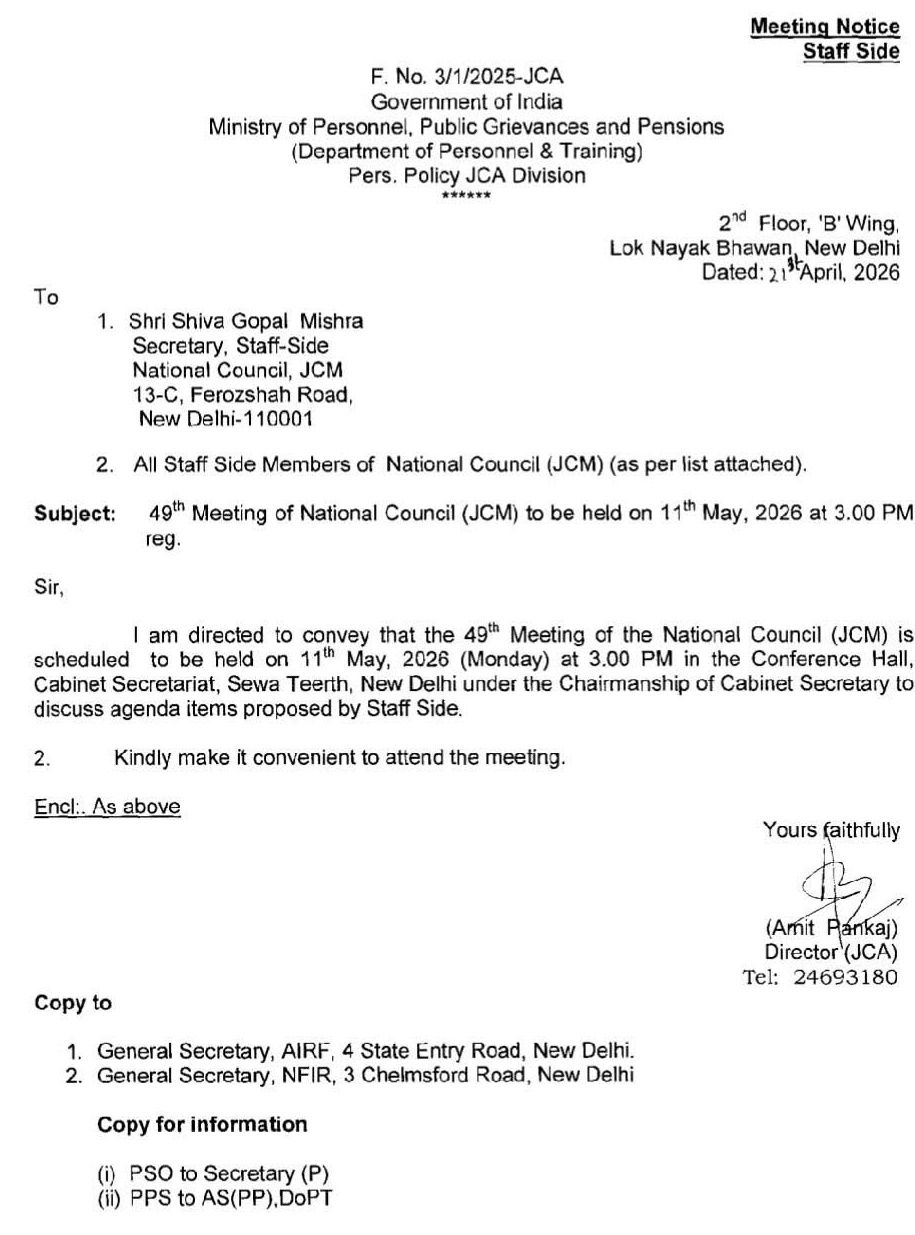
49th Meeting of National Council (JCM) Scheduled for May 11, 2026
Meeting Notice Staff Side
F. No. 3/1/2025-JCA Government of India Ministry of Personnel, Public Grievances and Pensions (Department of Personnel & Training) Pers. Policy JCA Division
2nd Floor, ‘B’ Wing. Lok Nayak Bhawan, New Delhi Dated: 21st April, 2026
To
Shri Shiva Gopal Mishra Secretary, Staff-Side National Council, JOM 13-C, Ferozshah Road, New Dalhi-110001
All Staff Side Members of National Council (JCM) (as per list attached).
Subject: 49th Meating of National Council (JCM) to be held on 11th May, 2026 at 3.00 PM reg.
Sir,
I am directed to convey that the 49th Meeting of the National Council (JCM) is scheduled to be held on 11th May, 2026 (Monday) at 3.00 PM in the Conference Hall, Cabinet Secretariat, Sewa Teerth, New Delhi under the Chairmanship of Cabinet Secretary to discuss agenda items proposed by Staff Side.
2. Kindly make it convenient to attend the meeting.
Encl:. As above
Yours faithfully
Sd/- (Amit Pankaj) Director (JCA) Tel: 24693180
Copy to
General Secretary, AIRF, 4 State Entry Road, New Delhi.
General Secretary, NFIR, 3 Chelmsford Road, New Delhi
Copy for information (i) PSO to Secretary (P) (ii) PPS to AS(PP),DoPT
FinMin Order Released: 7th CPC DA Increased to 60% from January 2026
No. 1/1(0/2026-E.II(B) Government of India Ministry of Finance Department of Expenditure
Kartavya Bhavan-1, New Delhi. Dated the 22nd April, 2026
OFFICE MEMORANDUM
Subject: Revision of rates of Dearness Allowance to Central Government employees – effective from 01.01.2026
The undersigned is directed to refer to this Department’s Office Memorandum No. 1/4(i)/2025-E.II(B) dated 6th October, 2025 on the subject mentioned above and to say that the President is pleased to decide that the rates of Dearness Allowance payable to Central Government employees, shall be enhanced from 58% to 60% of the Basic Pay with effect from 1st January, 2026.
2. The term ‘Basic Pay’ in the revised pay structure means the pay drawn in the prescribed Level in the Pay Matrix as per 7th CPC recommendations accepted by the Government, but does not include any other type of pay like special pay etc.
3. The Dearness Allowance will continue to be a distinct element of remuneration and will not be treated as pay within the ambit of FR 9(21).
4. The payment on account of Dearness Allowance involving fractions of 50 paise and above may be rounded off to the next higher rupee and the fractions of less than 50 paise may be ignored.
5. These orders shall also apply to the civilian employees paid from the Defence Services Estimates and the expenditure will be chargeable to the relevant head of the Defence Services Estimates. In respect of Armed Forces personnel and Railway employees, separate orders will be issued by the Ministry of Defence and Ministry of Railways, respectively.
6. In so far as the persons serving in the Indian Audit and Accounts Department are concerned, these orders are issued in consultation with the Comptroller and Auditor General of India, as mandated under clause (5) of Article 148 of the Constitution of India.
Hindi version is attached.
(Samir Kumar Das) Deputy Secretary to the Government of India
To All Ministries/Departments of the Government of India (as per standard distribution list)
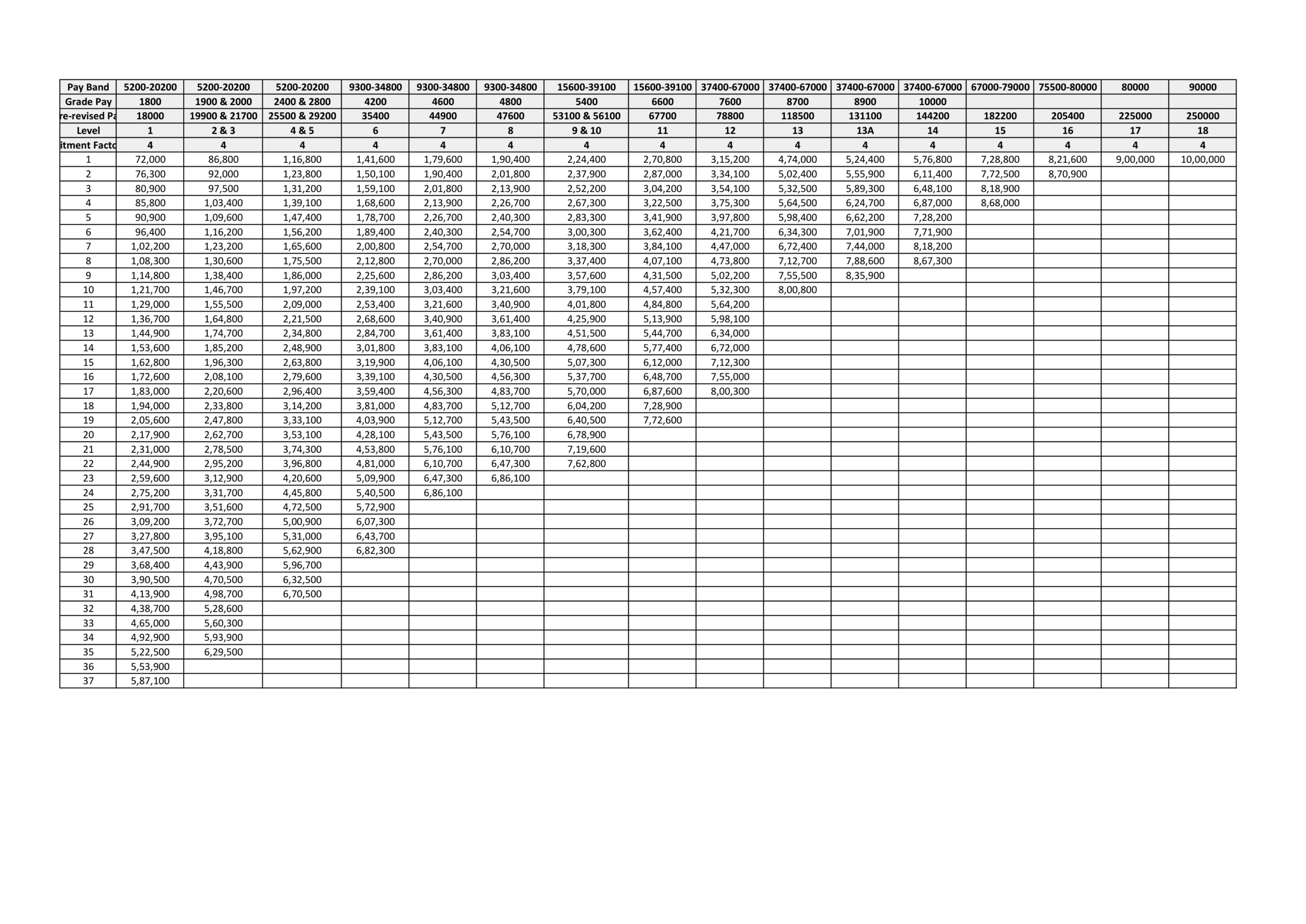
BPMS Draft Proposal on 8th CPC: ₹72,000 Minimum Pay and a 4.00 Fitment Factor
भारतीय प्रतिरक्षा मजदूर संघ Bharatiya Pratiraksha Mazdoor Sangh (AN ALL INDIA FEDERATION OF DEFENCE WORKERS) (AN INDUSTRIAL UNIT OF B.M.S.) (RECOGNISED BY MINISTRY OF DEFENCE, GOVT. OF INDIA) CENTRAL OFFICE: 2-A, NAVIN MARKET, KANPUR-1 PH.: (0512) 2332222 FAX: (0512) 2296229 Mob.: 09335621629, 09415726924, 09415733686 E-mail: gensecbpms[at]yahoo.co.in, cecbpms[at]yahoo.in
Dated: 16.04.2026
Dear Members,
Kindly go through the draft on 8th CPC on the topics of Minimum Pay, Multiplication Factor, Merger of Pay Levels, Annual Increment, Pay Matrix. Kindly offer your valuable suggestions.
Regards,
Sd/- (Rabindra Kr Mishra) General Secretary
8th Pay Commission Draft for Suggestions
Minimum Pay-
Principle adopted for minimum pay determination
The determination of minimum pay for Government employees has historically been guided by a careful balance between economic realities, social justice, and administrative sustainability. It is not merely a matter of wage fixation, but a broader exercise aimed at ensuring that the lowest-paid employee is able to maintain a dignified standard of living in line with the prevailing socio-economic.
Over successive Pay Commissions, various methodologies have been examined, including needs-based approaches, consumption standards, and income-based benchmarks. Among these, the concept of linking minimum pay with growth in national income has emerged as a rational and equitable framework, as it aligns the earnings of Government employees with the overall progress of the economy.
In this context, the approach adopted by the Fifth Central Pay Commission marked a significant evolution in pay determination philosophy by introducing a modified version of the Constant Relative Income Criterion, thereby ensuring that wage growth reflects changes in per capita income levels. The relevant extract of the recommendation is reproduced below:
“We would like to adopt a modified version of the Constant Relative Income Criterion as possibly the most equitable norm, both from the point of view of the employee as well as the Government. Taking Rs.750 as the basic pay fixed in 1986, and dearness allowance of Rs. 1110 as on 1.1.96 we may adopt a compensation factor of 30.9% (See Annexe-41.5) as being the increase in the per capita net national product during When it is added to the existing basic pay (Rs.750) the period 1986-1995. This comes to Rs.574.74. and dearness allowance as on 1.1.96 (Rs.1110), the total works out as Rs.2434.75. This figure could be rounded off to Rs.2440, mean more than which would also incidentally a threefold jump in the basic pay from Rs. 750 to Rs.2440. The interim reliefs of Rs.200 paid so far to the lowest functionary would naturally subsumed be within the above mentioned figure.“
Annexe 41.5
Percentage increase in Per Capita Net National Product at factor cost
Year
Per Capita Net National Product (at factor cost) at constant prices
1986-87
1,871
1987-88
1,901
1988-89
2,059
1989-90
2,157
1990-91
2,222
1991-92
2,175
1992-93
2,239
1993-94
2,292
1994-95
2,449
Percentage increase in 1994-95 over 1986-87: 30.9
Determination of minimum pay under the 8th Central Pay Commission
In the same analogy, the revision of pay scales should be guided by objective economic indicators and prevailing socio-economic conditions. In this regard, the growth in Per Capita Net National Product (NNP) at factor cost provides a reasonable and scientific benchmark for assessing the increase in income levels over time.
As per data published by the Ministry of Statistics and Programme Implementation (MoSPI), the Per Capita Net National Income at current prices has increased from ₹1,03,219 in 2016-17 to ₹1,92,774 in 2024-25. This reflects an increase of approximately 86.76% over the period.
Percentage Increase: (₹89,555 ÷ ₹1,03,219) x 100 = 86.76% (approx.)
It is pertinent to mention that this increase represents nominal growth at current prices and reflects the overall rise in income levels, including inflationary effects.
Applying the above growth factor to the existing minimum pay determined by the 7th Central Pay Commission yields the following:
Minimum Pay (7th CPC): ₹18,000
Dearness Allowance @ 58%: ₹10,440
Sub-total: ₹ 28,440
Increase @ 86.76%: ₹24,674.54
Revised Minimum Pay: ₹53,114.54
However, the minimum pay determined by the 7th Central Pay Commission was based on a 3-unit family structure, which does not adequately reflect the prevailing Indian socio-cultural framework. In Indian conditions, a government employee is generally responsible not only for the spouse and children but also for dependent parents.
Accordingly, a more realistic family composition may be considered as under:
Government Servant: 1 Unit
Spouse (gender-neutral): 1 Unit
Two Minor Children: 1.5 Units (0.75×2)
Parents: 1.5 Units (0.75×2)
Total Family Size: 5 Units
On this basis, the revised minimum pay works out to:
(₹53,114.54 ÷ 3) x 5 = ₹88,524.24
While the above calculation yields a minimum pay of ₹88,524.24 based on objective economic growth and a realistic family unit structure, it is equally important to recognise the broader fiscal implications for the Government. Pay revision impacts not only Central Government employees but also has cascading effects on pensions, allowances, and State Government pay structures. Therefore, any recommendation must balance adequacy of wages with fiscal sustainability, keeping in view factors such as revenue growth, fiscal deficit targets, and competing demands on public expenditure including infrastructure, social welfare, and defence.
At the same time, it is submitted that the minimum pay should not fall below a level that ensures a dignified standard of living, as envisaged in the principles of fair wages and earlier Pay Commission recommendations. The erosion of real income due to inflation, rising costs of essential services such as housing, education, and healthcare, and the increasing financial responsibilities of employees necessitate a reasonable upward revision.
In this context, a moderated and pragmatic approach is proposed. Instead of adopting the full computed figure of ₹88,524.24, a calibrated level of ₹72,000 per month may be considered appropriate. This figure represents a balanced midpoint between the existing pay structure and the fully justified requirement, thereby ensuring:
Partial but meaningful neutralization of inflationary pressures;
Improvement in living standards without imposing excessive fiscal strain;
Administrative feasibility and smoother implementation; and
Alignment with long-term fiscal consolidation goals of the Government.
Thus, the suggested minimum pay of ₹72,000 per month emerges as a prudent, sustainable, and socially just benchmark, reconciling economic justification with fiscal responsibility.
It is, therefore, requested that the Hon’ble Commission may kindly consider:
Adoption of growth in Per Capita NNP as a benchmark for pay revision.
Revision of the family unit structure from 3 units to 5 units.
Fixation of minimum pay at an appropriate and just level, preferably around ₹72,000 per month.
Fitment Factor
The minimum pay has been proposed at ₹72,000 per month, corresponding to the starting pay of ₹18,000 as determined by the 7th Central Pay Commission and implemented with effect from 01.01.2016. The proposed figure thus represents a fourfold increase over the base pay prevailing at the time of implementation of the VII CPC recommendations.
This enhancement is grounded in objective economic analysis. As established earlier, the Per Capita Net National Product (NNP) at current prices has increased by approximately 86.76% during the period from 2016-17 to 2024-25. When this growth is applied to the existing pay structure along with Dearness Allowance neutralisation, the revised minimum pay works out to ₹53,114.54 for a 3-unit family. Further, when adjusted to a more realistic 5-unit family structure, the minimum pay requirement rises to ₹88,524.24.
In this context, the proposed minimum pay of ₹72,000 represents a balanced and moderated outcome, positioned between the computed requirement and fiscal considerations. The implied fitment factor of 4.00 (72,000 ÷ 18,000) is therefore justified not only as a simple multiplier but as a reflection of cumulative economic growth, inflationary trends, and evolving household responsibilities.
It is also pertinent to note that this fitment factor includes a component of 1.58 on account of Dearness Allowance (DA) neutralisation, which compensates for the erosion in real wages due to inflation since 01.01.2016. The remaining portion of the fitment factor represents the real increase necessary to ensure a dignified standard of living, consistent with the principles adopted by previous Pay Commissions.
Accordingly, the proposed fitment factor of 4.00, to be applied uniformly across all employees, ensures equity, transparency, and administrative simplicity, while adequately balancing economic justification, social realities, and fiscal prudence.
Annual Increment
Justification for Enhancing Annual Increment to 6% for Central Government Employees under the 8th CPC
The structure of pay revision in Government service rests on three foundational elements—basic pay, Dearness Allowance (DA), and annual increment. While periodic Pay Commissions address structural revisions and DA neutralises inflation, the annual increment represents the only assured mechanism for real wage growth within a pay cycle. In this context, a strong case emerges for revising the rate of annual increment from the existing 3% to 6% under the forthcoming 8th Central Pay Commission.
1. Historical Context and Need for Revision
The rate of annual increment at 3% of basic pay was standardised by the Sixth Central Pay Commission and retained by the Seventh Central Pay Commission. At the time of its introduction, this rate was considered adequate in a relatively moderate inflation environment and in conjunction with other structural changes in pay.
However, over the past decade, economic conditions have undergone significant transformation:
Sustained inflationary pressures have eroded real income levels.
Consumption patterns and cost of living have increased substantially.
Household financial responsibilities have expanded, particularly in urban and semi-urban contexts.
In such a scenario, the continuation of a 3% increment rate appears inadequate to ensure meaningful real wage progression.
2. Distinction Between DA and Annual Increment
A critical conceptual distinction must be maintained:
Dearness Allowance (DA) compensates for inflation and protects purchasing power.
Annual Increment provides real income growth and rewards experience and service continuity.
Thus, while DA ensures survival, the annual increment ensures improvement in standard of living. A low increment rate effectively leads to wage stagnation in real terms, particularly between Pay Commission.
3. Comparison with Broader Economic Trends
Recent data indicates that Per Capita Net National Product (NNP) at current prices has increased by approximately 86.76% between 2016-17 and 2024-25. This reflects a substantial rise in across the economy.
At the same time:
The private sector in India provides average annual increments of 8%-10%, combining both inflation and performance-linked growth.
Even in organised sectors, annual increases commonly exceed 6%.
In contrast, Central Government employees receive:
3% annual increment (real growth)
DA adjustments separately
This creates a widening gap between government compensation growth and overall economic income trends, potentially affecting talent attraction and retention.
4. Inadequacy of 3% Increment Over a Pay Cycle
Over a typical 10-year Pay Commission cycle, a 3% annual increment results in limited real growth:
The cumulative increase remains modest when compared with rising living costs.
Employees at lower pay levels experience greater financial stress, as increments are calculated on a smaller base.
The gap between entry-level and mid-career compensation remains compressed, affecting motivation.
A 6% increment, on the other hand:
Provides a more meaningful progression over time.
Reduces dependence on periodic pay revisions for income correction.
Ensures a smoother and more continuous growth trajectory.
5. Alignment with Family-Based Needs and Social Realities
As highlighted in pay determination principles, the wage structure must support a family-based consumption model. In Indian conditions, an employee typically supports:
Spouse
Children
Dependent parents
Given rising costs in education, healthcare, housing, and elderly care, the current increment rate does not adequately support evolving family needs. Enhancing the increment rate to 6% would help partially bridge this gap in a sustained manner.
6. Administrative Simplicity and Equity
One of the strengths of the current system is its uniformity and transparency. Increasing the increment rate to 6%:
maintains structure (percentage of basic pay)
applies across all levels
aligns with performance-linked pay systems
Thus, the proposal enhances adequacy without compromising administrative efficiency.
7. Fiscal Sustainability
While any increase in increment rate has fiscal implications, the proposal remains moderate and sustainable:
It does not involve immediate large-scale pay restructuring.
The impact is gradual and spread over time.
It reduces the need for sharp corrections in future Pay Commissions.
A calibrated increase to 6% represents a balanced approach, reconciling employee welfare with fiscal prudence.
Conclusion
The existing 3% annual increment, though historically justified, no longer aligns with present economic realities and societal needs. A revision to 6% annual increment is justified on the grounds of:
Sustained increase in national income levels
Rising cost of living and changing consumption patterns
Need for meaningful real wage growth
Alignment with broader market trends
Support for family-based financial responsibilities
Accordingly, it is recommended that the 8th Central Pay Commission may consider enhancing the rate of annual increment to 6% of basic pay, thereby ensuring a more realistic, equitable, and forward-looking compensation framework for Central Government employees.
8th CPC clarification for submission of Memorandum
No.25/2/2026-App/8CPC Government of India Eighth Central Pay Commission
20th April, 2026
CLARIFICATION
The last date for submitting memorandum at Commission’s website(8cpc.gov.in) is 30th April, 2026. However, Unions/Associations seeking appointment for interacting with the Commission at Pune or during first round of meetings at Delhi may kindly submit the memorandum by today i.e. 20th April, 2026.
2. Please note that the Commission shall be holding more meetings at Delhi, Maharashtra and at various other States.
(Manish Kumar) Director Eighth Central Pay Commission
Cabinet Approves 2% DA Hike from Jan 2026 for Central Government Employees and Pensioners
New Delhi | April 18, 2026 — In a move providing modest financial relief to millions, the Union Cabinet has officially approved a 2% increase in Dearness Allowance (DA) and Dearness Relief (DR). This decision, announced today, is aimed at compensating for the impact of inflation and will benefit over 11 million central government employees and pensioners.
The hike brings the total DA from 58% to 60% of basic pay, effective retrospectively from January 1, 2026.
Key Highlights of the Announcement
The adjustment follows the standard formula based on the All India Consumer Price Index for Industrial Workers (AICPI-IW). While the hike is a routine semi-annual revision, it comes at a critical juncture as the nation transitions toward a new pay structure.
Total DA/DR: Increased from 58% to 60%.
Effective Date: January 1, 2026 (Arrears for Jan–March will be paid).
Beneficiaries: Approximately 4.8 million employees and 6.8 million pensioners.
Fiscal Impact: The move is expected to cost the exchequer several thousand crores annually.
The announcement follows a period of heightened anticipation and recent protests by employee unions over the delay in the DA notification, which is usually cleared before the Holi festival.
Fitment Factor: Unions are pushing for a fitment factor of 3.83, which would theoretically raise the minimum basic pay from the current ₹18,000 to roughly ₹69,000.
Annual Increments: A proposal to increase annual increments to 6%.
HRA Revision: Higher House Rent Allowance slabs, reaching up to 40% for metro cities.
Pension Reform: Ongoing discussions regarding the restoration of the Old Pension Scheme (OPS) or a modified 50% guaranteed pension under the Unified Pension Scheme (UPS).
What it Means for Employees
While the 2% hike is seen as “modest” by many union leaders, it provides immediate liquidity while the broader 8th Pay Commission recommendations are finalized. For an employee with a basic pay of ₹30,000, this 2% hike results in a monthly increase of ₹600.
Basic Pay Level
DA at 58%
DA at 60%
Monthly Increase
₹18,000 (Min)
₹10,440
₹10,800
₹360
₹50,000
₹29,000
₹30,000
₹1,000
₹1,00,000
₹58,000
₹60,000
₹2,000
Note: The government has clarified that there is currently no proposal to merge DA with basic pay, even though the total has reached the 60% threshold. Revisions will continue under the existing system until the 8th Pay Commission’s recommendations are officially implemented, likely between late 2026 and 2027.
NC JCM Proposes 6% Annual Increment and ₹69,000 Minimum Basic Pay for 8th CPC
The National Council – Joint Consultative Machinery (NC JCM), representing central government employees, has officially submitted its memorandum to the 8th Central Pay Commission (CPC). This comprehensive proposal outlines a significant overhaul of the current salary structure, seeking to align wages with the rising cost of living and inflation.
Below is a detailed report on the key demands submitted by the Staff Side.
1. Minimum Pay & Fitment Factor
The NC JCM has proposed a dramatic increase in the entry-level salary to ensure a living wage that accounts for health, productivity, and dignity.
Proposed Minimum Pay:₹69,000 (Up from the current ₹18,000 under the 7th CPC).
Proposed Fitment Factor:3.833.The fitment factor is the multiplier used to arrive at the new basic pay from the old one. A factor of 3.833 would ensure a uniform salary jump across all pay levels.
2. Annual Increment Revision
One of the standout proposals in the memorandum—as seen in the provided document—is the doubling of the annual increment rate.
Existing Rate: 3%
Proposed Rate:6%The Staff Side argues that the current 3% increment is insufficient to keep pace with real-world inflation and the increasing financial requirements of employees as they progress in their careers.
3. Proposed Merger of Pay Scales
To streamline the pay matrix and improve career progression, the NC JCM has recommended merging several existing pay levels. This move aims to reduce disparity and consolidate the grade structure.
No.
Proposed Merger Action
Resulting Level
1
Level 2 & Level 3
Level 3
2
Level 4 & Level 5
Level 5
3
Level 7 & Level 8
Level 8
4
Level 9 & Level 10
Level 10
5
One-time Measure: Level 5 employees
Upgrade to Level 6
4. Additional Key Highlights
The 51-page memorandum also touches upon several other critical areas:
HRA Indexing: House Rent Allowance (HRA) to be indexed to Dearness Allowance (DA) for automatic adjustments.
Family Unit Revision: Proposing that the minimum wage calculation be based on 5 units (instead of 3), acknowledging the legal and social responsibility of employees to support dependent parents.
Old Pension Scheme (OPS): A renewed demand for the restoration of the Old Pension Scheme for all employees.
Leave Benefits: Proposals to increase Maternity Leave to 240 days and introduce 45 days of Paternity Leave.
Gratuity: Recommendation for one month’s wages as gratuity without the 33-year service ceiling.
What Happens Next?
The 8th Pay Commission, chaired by Justice Ranjana Prakash Desai, will now review these proposals. Consultations with various stakeholders are scheduled throughout April and May 2026. While the NC JCM has proposed an implementation date of January 1, 2026, the final decision rests with the Union Cabinet after the Commission submits its official report.
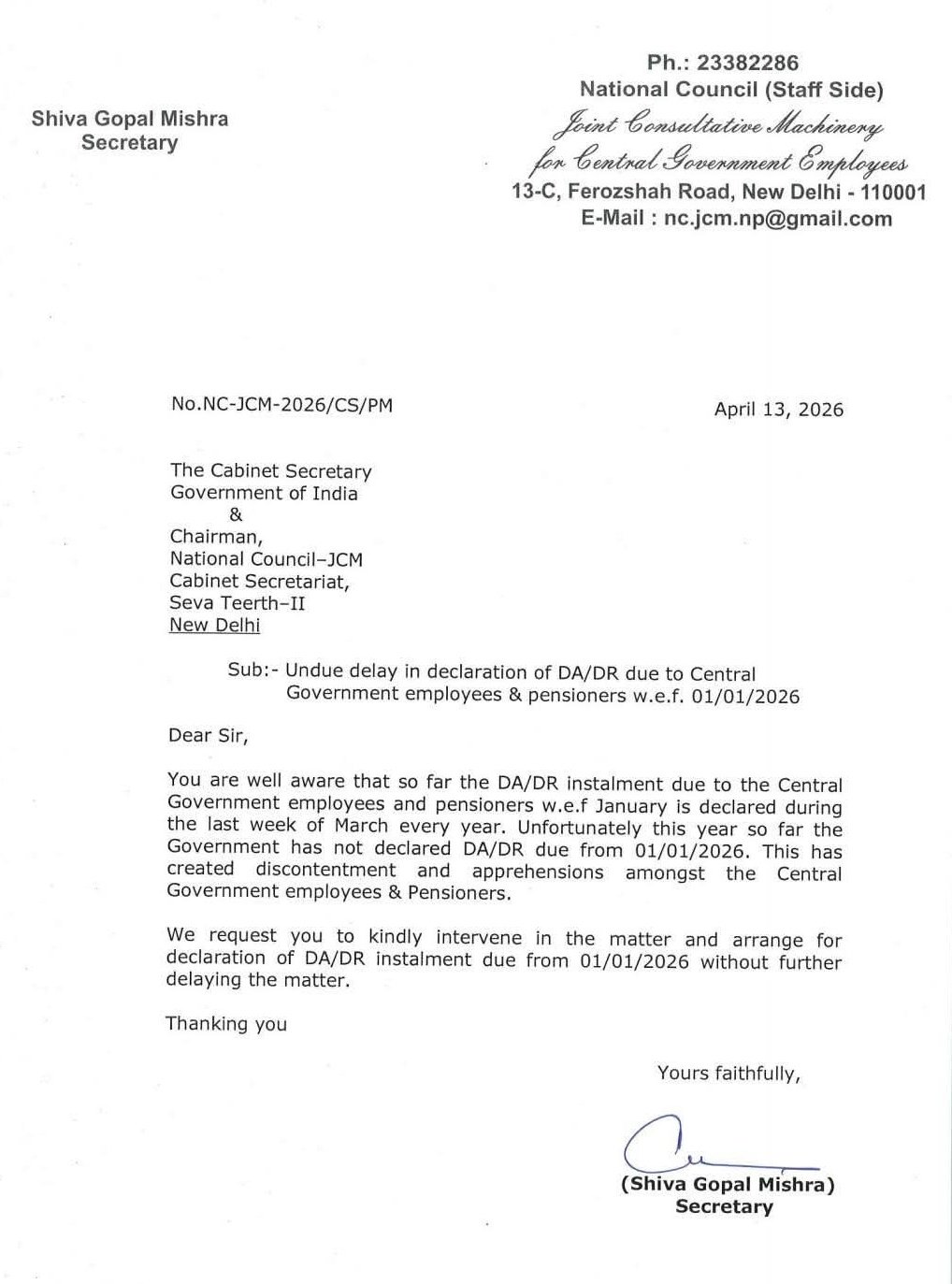
Delay in declaration of DA/DR due to Central Government employees: NCJCM writes to CS
No.NC-JCM-2026/CS/PM
April 13, 2026
The Cabinet Secretary Government of India Chairman, National Council-JCM Cabinet Secretariat, Seva Teerth-II New Delhi
Sub:- Undue delay in declaration of DA/DR due to Central Government employees & pensioners w.e.f. 01/01/2026
Dear Sir,
You are well aware that so far the DA/DR instalment due to the Central Government employees and pensioners w.e.f January is declared during the last week of March every year. Unfortunately this year so far the Government has not declared DA/DR due from 01/01/2026. This has created discontentment and apprehensions amongst the Central Government employees & Pensioners.
We request you to kindly intervene in the matter and arrange for declaration of DA/DR instalment due from 01/01/2026 without further delaying the matter.