Discontinuation of Aadhaar based authentication for opening of NPS accounts by the POPs through online module
PENSION FUND REGULATORY AND DEVELOPMENT AUTHORITY
B-14/A, Chhatrapati Shivaji Bhawan,
Qutab Institutional Area,
Katwaria Sarai, New Delhi-110016.
Website : www.pfrda.org.in
Circular
Circular No. PFRDA/2018165/POP/3
Date: 07th December, 2018
To,
All POPs
Subject: Discontinuation of Aadhaar based authentication for opening of NPS accounts by the POPs through online module
The Hon’ble Supreme Court vide its order dated 26th September, 2018 has struck down Section 57 of the Aadhaar Act, which allowed private companies to use the 12 digit biometric ID based e KYC. Earlier, Section 57 of the Aadhaar Act, 2016 allowed the use of 12 digit unique ID (Aadhaar Number) for establishing the identity of an individual for any purpose, whether by the State, Corporate or a person.
2. Further, vide PFRDA’s letter No. PFRDN17/01/02/0001/2017-SUP-CRA-Part(1) dated 28.11.2018, both Central Recordkeeping Agencies (CRAs) were instructed to stop the usage of Aadhar for authentication service from 01.12.2018 and examine legally valid alternatives to various affected functionalities.
3. In view of the above, all Points of Presence (POPs) under National Pension System are directed to immediately stop the Aadhaar-based authentication system for KYC under online module of PRAN generation in line with the Hon’ble Supreme Court’s judgement on the matter. However, Aadhaar may be accepted from the subscriber in the physical form by branches of the POPs under NPS as one of the identity proof.
4. This circular is being issued in exercise of powers conferred under Section 11 of the PFRDA Act, 2013.
Railway officers’ delegation presents memorandum to MoS DoPT Dr Jitendra Singh
A delegation of railway officers approached Union Minister of State (Independent Charge) Development of North Eastern Region (DoNER), MoS PMO, Personnel, Public Grievances & Pensions, Atomic Energy and Space, Dr Jitendra Singh for intervention by Department of Personnel and Training (DoPT) for redressal of their cadre related issues.
Led by Shri Anand Mathur, President, Indian Railway Personnel Officers Association (Regd.) (IRPOA), the members of the delegation presented a memorandum to the Minister expressing their gratitude to him because the DoPT had approved the recommendations of the Cadre Review Committee (CRC) for encadrement of the post of Member Staff (MS) in Railway Board. The members, however, stated that the Railway Board had taken a different view on this matter.
The memorandum also claimed that the officers of IRPS cadre had experience of handling matters relating to establishment, cadre management, industrial relations & labour laws and thus possess varied experience in managing cadre of all employees in all the departments. The officers therefore solicited the kind intervention.
Dr Jitendra Singh said that he would find out all the details related to the matter and take an appropriate view.
The Banking Companies(Acquisition and Transfer of Undertakings)Acts of 1970 and 1980 provide that the Central Government, in consultation with the Reserve Bank of India (RBI), may make a scheme, inter alia, for the amalgamation of any nationalised bank with any other nationalised bank or any other banking institution Various committees, including Narasimhan Committee (1998) constituted by RBI, Leeladhar Committee(2008) chaired by RBI Deputy Governor, and Nayak Committe (2014) constituted by RBI, have recommended consolidation of Public Sector Banks (PSBs) given underlying benefits/synergies. Taking note of this and potential benefits of consolidation for banks as well as public at large through enhanced access to banking services, Government, with a view to facilitate consolidation among public sector banks to create strong and competitive banks, serving as catalysts for growth, with improve risk profile of the bank, approved an approval framework for proposals to amalgamate PSBs through an Alternative Mechanism (AM). AM, after consulting RBI, in its meeting held on 17.9.2018, approved that Bank of Baroda, Vijaya Bank and Dena Bank may consider amalgamation of the three banks. Banks have since considered amalgamation and the Board of Dena Bank has recommended the same, while Boards of Bank of Baroda and Vijaya Bank have given in-principle approval therefor. RBI has furnished bank-wise total income of PSBs and private sector banks in the financial year FY 2017-18 in this regard, which is given in Annexure.
Over the last four and half years, Government has pursued a comprehensive approach for addressing non-performing assets (NPA) issues. Key elements are as under:
Recognising NPAs transparently: Forbearance has been ended and stressed assets classified as NPAs under the Asset Quality Review (AQR) in 2015 and subsequent recognition by banks. Further, restructuring schemes that permitted such forbearance have been discontinued in February 2018. As a result, as per RBI data, Standard Restructured Assets (SRAs) of Scheduled Commercial Banks (SCBs) have declined from the peak of 6.5% in March 2015 to0.49% in September 2018.
Resolving and recovering value from stressed accounts through clean and effective laws and processes: A fundamental change has been effected in the creditor-debtor relationship through the Insolvency and Bankruptcy Code, 2016 (IBC) and debarment of wilful defaulters and connected persons from the resolution process. A sizeable proportion of the gross NPAs of the banking system are at various stages of resolution in National Company Law Tribunal(NCLT). To make other recovery mechanisms as well more effective, Securitisation and Reconstruction of Financial Assets and Enforcement of Securities Interest (SARFAESI)Act has been amended to provide for three months imprisonment in case borrower does not provide asset details, and for lender getting possession of mortgaged propertywithin30 days, and six new Debts Recovery Tribunal (DRTs) have been established. As a result, NPAs of PSBs reduced by Rs. 2,61,359 crore over the last four and a half financial years. Further, PSBs reported record recovery of Rs. 60,713 crore in the first half of FY 2018-19 (H1 FY 2018-19), which is more than double the recovery made in the first half of FY 2017-18, and gross NPAs have begun declining with a reduction of Rs. 26,798 crore in H1 FY 2018-19. 30-day plus overdue account (Special Mention Accounts (SMA) 1 and 2) have also reduced steadily to around 39% over five quarters (from Rs 2.25 lakh crore in June 2017 to Rs. 0.87 lakh crore in September 2018 for PSBs), indicating significant and sustained reduction in risk of fresh NPAs. Thus, improvement in asset quality is evident with GNPAs having peaked recognition nearly over, and the amount in SMA 1 and 2 reducing by 61% over five quarters. Further, with substantial provisioning, the provisional coverage ratio(PCR)o SCBs has risen steadily to 67.17% as of September 2018, from the pre-AQR level of 49.3% in March 2015,cushioningbank balance-sheets to absorb the impact of NPAs.
Reforming banks through the PSB Reforms Agenda:
Reforms include—
number of lenders in consortium restricted by requiring minimum of 10%, for better managed consortium lending,
ring-fencing of cash flows for prudent lending,
monitoring of loans above Rs. 250 crore through specialised agencies for effective vigil,
use of technology and analytics for comprehensive due- diligence across data sources,
comprehensive checking of all accounts of Rs. 50 crore and above that turn NPA for wilful default and fraud,
strict enforcement of conditions of loan sanction,
establishment of Stressed Asset Management Verticals in banks for focussed recovery and timely and effective management of stressed accounts,
collection of passport details of borrowers for loans above Rs. 50 crore, and
enactment of the Fugitive Economic Offenders Act, 2018 in order to deter economic offenders from evading the process of Indian law by remaining outside the jurisdiction of Indian courts.
As regards employee issues, bank branches and other bank-related issues, the same fall within the purview of the bank concerned, subject to RBI’s guidelines/instructions and Board-approved policies of the bank concerned.
Retention of railway accommodation by railway officers/staff on their deputation to railway PSUs
RBE No. 193/2018
GOVERNMENT OF INDIA (BHARAT SARKAR)
MINISTRY OF RAILWAYS (RAIL MANTRALAYA)
(RAILWAY BOARD)
No. E(G) 2008 QR – 1— 15 (PSUs)
New Delhi, dated 13. 12. 2018
The General Manager/Director General
All Indian Railways/Production Units/RDSO-Lucknow
(As per Standard mailing list)
Sub: Retention of railway accommodation by railway officers/staff on their deputation to railway PSUs.
Instructions were issued vide Board’s letter of even number dated 31.05.2017 (RBE No. 53/2017) to permit Railway officers/staff in occupation of Railway accommodation in areas other than Delhi/NCR on their deputation to Railway PSUs to retain their railway accommodation at the place of previous posting for a period up to 30.06.2019.
2. Now, in exercise of the powers vested with the Board to make reasonable relaxations in public interest for a class/group of employees in all or any of the existing provisions regarding house allotment/retention, it has been decided to permit Railway officers/staff in occupation of Railway accommodation in Delhi/NCR area on their deputation to Dedicated Freight Corridor Corporation of India Ltd. (DFCCIL) to retain their railway accommodation at the place of previous posting for a period up to 30.06.2019.
3. This issues with the concurrence of the Finance Directorate of the Ministry of Railways.
4. Please acknowledge receipt.
(Anita Gautam)
Director Establishment (Gent.)
Railway Board
Grant of two additional increments at revised rates to Nursing Personnel pursuant of 7th CPC revision of pay
No. I/11/Part I
Dated : 10/12/2018
The Secretary (E),
Railway Board,
New Delhi
Dear Sir,
Sub: Grant of two additional increments at revised rates to Nursing Personnel pursuant of revision of pay (7th CPC) reg.
Ref: (i) NFIR’s PNM Item No. 11/2008.
(ii) Railway Board’s letter No. PC-VI/2010/I/7/5/1 dated 14/03/2012.
(iii) NFIR’s letter No. I.11/Part I dated 30/07/2018.
******
Federation vide its letter dated 30/07/2018 brought to the notice of Railway Board the case of non-payment of two additional increments to the Nursing Personnel at revised rates of pay as per 7th CPC, unfortunately no instructions have been issued so far.
Federation desires to clarify that with the implementation of 6th CPC recommendations the rates of two additional non-absorbable increments at the revised rates of pay of 6th CPC were last issued by the Railway Board vide letter No. PC-VI/2010/I/7/5/1 dated 14/03/2018 (RBE No. 33/2012), however similar instructions have not been issued by the Board, causing disappointment among the staff who are entitled for two additional increments on the 7th CPC Pay.
While enclosing copy of Federation’s letter dated 30/07/2018, NFIR again urges upon the Railway Board to issue instructions to all Zonal Railways to grant two additional increments (at the rate of 3% each on 7th CPC Pay) w.e.f. 01/01/2016 to the Nursing Personnel. Action taken in the matter may kindly be conveyed to the Federation.
Career progression of the staff working in GP Rs.1800
No.AIRF/24(C)
Dated: December 8, 2018
The Chairman,
Railway Board,
New Delhi
Dear Sir,
Sub: Career progression of the staff working in GP Rs.1800
As I have discussed this issue personally with your goodself and tried to get resolved the issue regarding career progression of the staff working in GP Rs.1800; because in many departments; the employees working in GP Rs.1800 are stagnating in GP Rs.1800 for 15 years and even 20 years, and these are the staff those who are working in GP Rs.1800 are virtually doing the job of skilled nature, in almost all the departments, including Technical and Non-Technical.
It would be in all fairness if 50% posts of GP Rs.1800 should be upgraded to GP Rs.1900, which will resolve the problems of the Railway Industry as well as the employees.
In this connection, it is worth-mentioning that, we have also requested your goodself for reduction in the Direct Recruitment Quota, and the employees having qualification of RRB should be given benefit for their selection against those vacancies through “LDCE open to all” policy, to facilitate the highly educated staff available over the Indian Railways.
We sincerely hope that, you will kindly consider it favourably and do the needful.
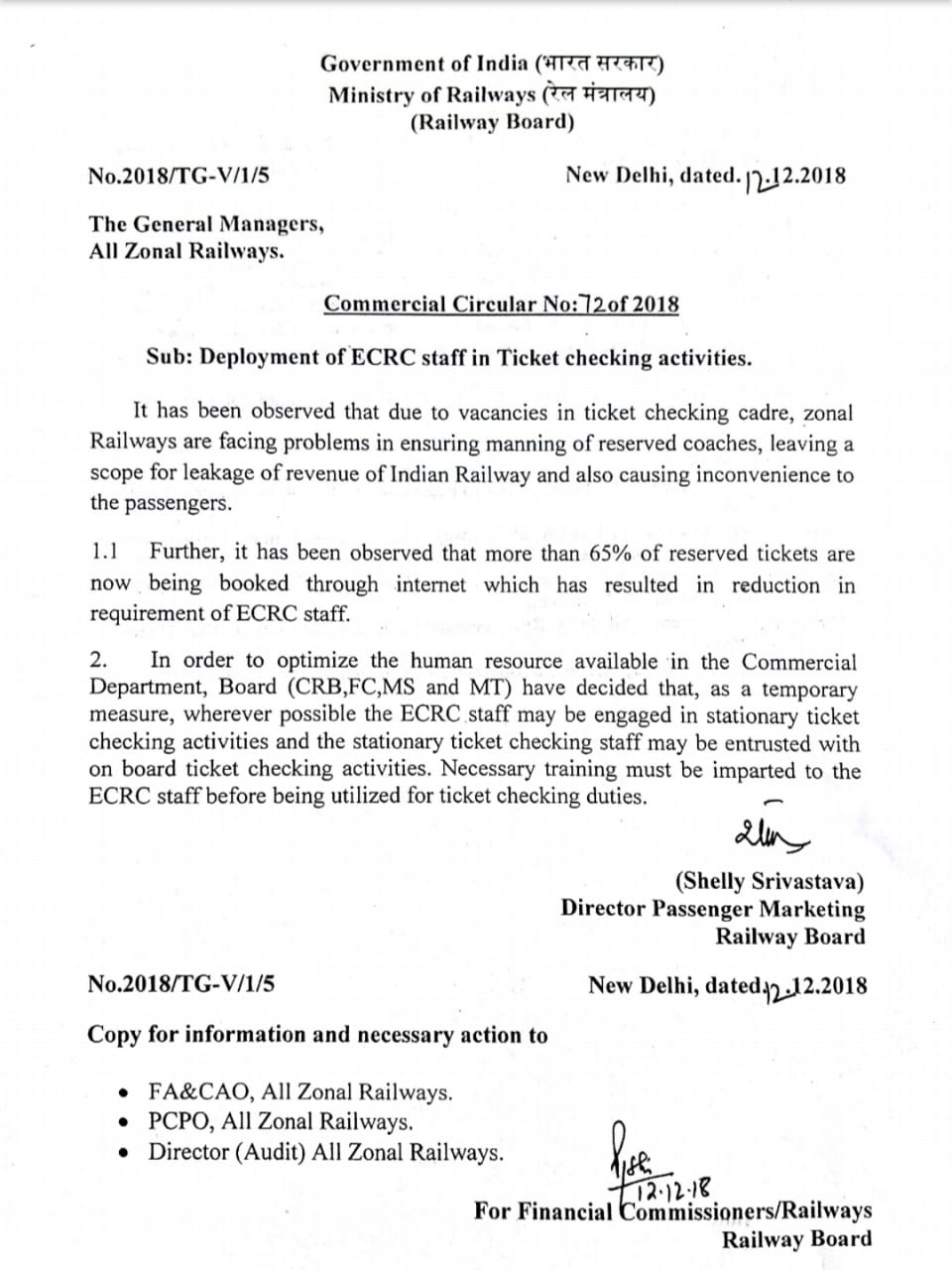
Deployment of ECRC staff in Ticket checking activities
Government of lndia
Ministry of Railways
(Railway Board)
No. 2018/TG-V/I/5
New Delhi dated:- 12.12.2018
The General Managers
All Zonal Railways.
Commercial Circular No:- 72 of 2018
Sub: Deployment of ECRC staff in Ticket checking activities.
It has been observed that due to vacancies in ticket checking cadre, zonal Railways are facing problems in ensuring manning of reserved coaches, leaving a scope for leakage of revenue of Indian Railway and also causing inconvenience to the passengers.
1.1 Further, it has been observed that more than 65% of reserved tickets are now being booked through internet which has resulted in reduction in requirement of ECRC staff.
2. In order to optimize the human resource available in the Commercial Department, Board (CRB,FC,MS and MT) have decided that, as a temporary measure, wherever possible the ECRC staff may be engaged in stationary ticket checking activities and the stationary ticket checking staff may be entn1sted with on board ticket checking activities. Necessary training must be imparted to the ECRC staff before being utilized for ticket checking duties.
(Shelly Srivastava)
Director Passenger Marketing
Railway Board
Non-functional scale to Group ‘B’ Officers of Organised Services on 100% basis after completion of 4 years of regular service
RBE No. 192/2018
GOVERNMENT OF INDIA
MINISTRY OF RAILWAYS
(RAILWAY BOARD)
No. E(GP) 2003/2/22
New Delhi, dated: 12.12.2018
The General ‘Managers,
All Indian Railways and Production Units
Sub : Grant of Non-functional scale to Group ‘B’ Officers of Organised Services on 100% basis after completion of 4 years of regular service – Procedure reg.
Ref: Board’s letter nos. E(GP)98/2/82 dated 09.12.98 and E(GP)2003/2/22 dated 16.06.2003 & 03.09.2004.
In terms of Ministry of Railways’ Notification No. PC-VII/2017/RSRP/1 dated 08.03.2018; the higher scale of Level 10 has to be operated to the extent of 100% of the Group ‘B’ officers on roll including Group ‘B’ officers officiating in Level 11 on ad hoc basis after completion of 4 years of regular service in the respective grades in Organised Departments.
2. In this regard a few references have been received from Zonal Railways wherein they have sought clarifications with regard to the procedure to be followed in the cases of pay fixation of officials working in Senior Scale adhoc, application of reservation rules, date of assessment of these vacancies etc. Accordingly, Board has decided to clarify that following procedure should be adopted for placement of these officers in the higher scale:
3. Procedure for placement of Group ‘B’ officers in the higher scale:
3.1 All Group ‘B’ officers with minimum of four years regular service in Level 9 in Accounts Department and Level 8 in other organised Departments shall be eligible for consideration for grant of higher Group ‘B’ Non-Functional Upgradation scale of Level 10.
3.2 The Group ‘B’ officers who are officiating in Senior Scale, after having been found suitable by the Committee of HODs as per extant procedure, shall be granted Non-functional upgradation in Level-10 w.e.f. 08.032018, subject to completion of four years service in Group ‘B’ in level-8 in respect of Non-accounts department and in level‑ 9 in respect of Accounts Department. On grant of Non-functional scale in Level-10, such officers would continue to officiate in Level-11.
3.3 The General Manager will constitute a Committee for this purpose, which will consist of 3 Heads of Department including the PCPO/CPO, the HOD of the concerned Department and another HOD. If none of the Committee members belongs to SC/ST, a fourth officer belonging to SC/ST, not below JAG, may be co-opted as a member of the Committee.
3.4 The same procedure for assessment of suitability, as has been prescribed for adhoc promotion of Group ‘B’ officers to Senior Scale, will be adopted by the Committee for placement of Group ‘B’ officers in the higher Group B’ Scale of Level-10, i.e. the Committee may assess the fitness of the officer based on his performance as reflected in his APARs for the preceding 5 years period. The Committee should categorize the officers as ‘Fit’ or ‘Not Yet Fit’ on the basis of overall assessment of the Reports and not merely on the basis of grading/fitness assigned in the Reports. Those categorized as `Fit’ should be placed in the higher scale of pay in the order of their Seniority.
3.5 The recommendations of the Committee will be submitted to the General Manager for approval and placement in the higher scale will be ordered accordingly.
4. As the higher scale of Level-10 has now been extended to 100% of the Group ‘B’ officers on roll, reservation rules are not attracted.
5. Seniority for purpose of absorption in Group `A’/Junior Scale and ad hoc promotion to Senior Scale:
5.1 The Officers, even after their placement in higher scale of Level-10, will be classified as Group ‘B’ only.
5.2 For the purpose of promotion to Group ‘A’/Junior Scale, the placement of officers in the higher scale of Level-10 may not be given any weightage, as is the position in the case of Group ‘B’ officers who are placed in the Senior Scale of Level-11 on ad hoc basis. All the Group ‘B’ officers, whether in Level -8 (Level-9 in Accounts Department) or in Level-10 may be arranged in the order of their original seniority in Group ‘B’ for the purpose of consideration for promotion to Group ‘A’/Junior Scale or for promotion on ad hoc basis to Senior Scale. Similarly, the residency period should remain as per extant rules regarding non-fortuitous service in Group ‘B’ irrespective of whether the officer is in Level-8 (Level-9 in Accounts Department) or in Level-10.
6. The Non-functional upgradation shall be done on the same lines as brought out above with effect from the date of notification i.e. 08.03.2018 and thereafter w.e.f. 1st January and 1st July of subsequent years.
7. Further, for consideration of officers for placement in the higher Group `B’ scale of Level-10, the senior Group ‘B’ officer should be deemed to have rendered the service put in by his immediate junior, and if that happens to be 4 years or more, he should be considered for placement in the higher Group ‘B’ scale of Level-10.
8. Pay fixation on grant of Non-functional upgradation.
8.1 On grant of Non-functional upgradation in Level-10, Pay of Group ‘B’ officers, working in Level-8 and 9, shall be fixed as per provision of RS(RP) Rules, 2016. Illustration in this regard is enclosed as Annexure-I.
8.2 On grant of Non-functional upgradation in Level-10, pay of such Group ‘B’ officers already officiating in Level-11 shall be regulated as per illustration in this regard enclosed as Annexure-II.
8.3 Benefit of Rule 1313 I(a)(i) of R-II shall be applicable on grant of Non-functional upgradation. Date of annual increment shall be regulated by provisions of Rule 10 of RS(RP)Rules, 2016.
9. Necessary action may accordingly be taken urgently. Please acknowledge receipt.
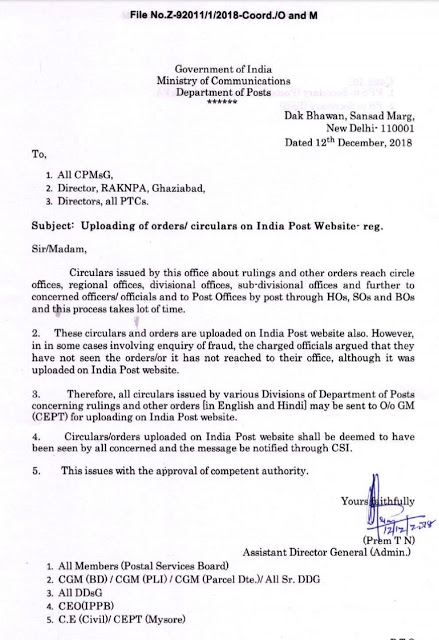
Uploading of orders/circulars on India Post Website
File No. Z-92011/1/2018-Coord./O and M
Government of India
Ministry of Communications
Department of Posts
Dak Bhawan, Sansad Marg,
New Delhi – 110001
Dated 12th December, 2018
To,
1.All CPMsG,
2. Director, RAKNPA, Ghaziabad,
3. Directors, all PTCs.
Subject : Uploading of orders/circulars on India Post Website – reg.
Sir/Madam,
Circulars issued by this office about rulings and other orders reach circle offices, regional offices, divisional offices, sub-divisional offices and further to concerned officers/officials and to Post Offices by post through HOs, SOs and BOs and this process takes lot of time.
2. These circulars and orders are uploaded on India Post website also. However, in some cases involving enquiry of fraud, the charged officials argued that they have not seen the orders/or it has not reached to their office, although it was uploaded on India Post website.
3. Therefore, all circulars issued by various Divisions of Department of Posts concerning and other orders [in English and Hindi] may be sent to O/o GM (CEPT) for uploading on India Post website.
4. Circulars/orders uploaded on India Post website shall be deemed to have been seen by all concerned and the message be notified through CSI.
5. This issues with the approval of competent authority.
Grant of increment on notional basis on 1st Jan & 1st July to those employees retiring on 30th June / 31st of December – NFIR Letter
No. I/11/Part I
Dated: 11/12/2018
The Secretary (Pers),
Ministry of Finance,
Department of Expenditure,
North Block,
New Delhi
Dear Sir,
Sub: Grant of increment on notional basis on 1st January & 1st of July to those employees retiring on 30th June / 31st of December — Apex Court order-reg.
*****
Pursuant to the implementation of the recommendations of 6th CPC, the Staff Side of National Council (JCM) had raised the demand, urging that the Central Government Employees including Railway employees who complete one year service as on 30th June and 31st December every year should be granted one increment notionally on 1st January or 1st July for calculating settlement benefit of those employees who retire on 30th, June or 31st December each year. The Government however did not agree to the demand on the plea that allowing increment is not covered under the rules.
In the above context, NFIR desires to bring to the notice of MoF that the High Court at Madras was approached by some employees through Writ Petition No. 15732/2017 praying relief in the matter. On 15/09/2017, the High Court at Madras decided on the Writ Petition and passed order as follows:-
“Para-7 The Petitioner herein had completed one full year service as on 30/06/2013, but the increment fell due on 01/07/2013, on which date he was not in service. In view of the above Judgment of this Court, naturally he has to be treated as having completed one full year of service, though the date of increment falls on the next day of his retirement. Applying the said one notional increment for the period from 01/07/2012 to 30/06/2013, as he has completed one full year of service, though his increment fell on 01/07/2013, for the purpose of pensionary benefits and not for any other purpose”.
Against the above order of the High Court an SLP was filed by the Government of India before the Hon’ble Supreme Court, which was however dismissed by the Apex Court.
The legal position as established above clearly indicates that the employee who has completed one full year service as on 30th June or 31st December, as the case may be, should be granted one notional increment despite the fact that the increment falls on 1st July or 1st January of the year. The Federation cites following illustration to prove our contention:-
“An employee who has completed one full year of service as on 30th June (date of birth being 30th June or 1st July) and 31st of December (date of birth being 31st December or 1st January) is eligible to get one notional increment for the period from 01/07/2018. Similarly an employee is eligible to get one notional increment for the period from 01/01/2018 to 31/12/2018 even though the increment falls on 01/01/2019 whose date of retirement is 31/12/2018”.
NFIR, therefore, requests the Secretary, MoF to kindly consider the above points and see that instructions are issued to all Ministries/Departments to grant increment on notional basis to the staff in the situations mentioned above to calculate the terminal/retirement benefits and also revise these benefits in favour of those who have already retired. A copy of instructions issued may kindly be endorsed to the Federation.
Yours faithfully
(Dr. M. Raghavaiah)
General Secretary