The Government has issued Notification the same day wherein gratuity limit has been increased from Rs.10 lakhs to Rs.20 lakhs under the Payment of Gratuity Act, 1972.
The Government has also issued another Notification on the same day wherein it has also increased the maximum period of maternity leave in case of female employees to be counted as continuous service from 12 weeks to 26 weeks under the Payment of Gratuity Act, 1972.
Representations from various stakeholders have been received in the Ministry. The Ministry had also organised tripartite consultations on 23.02.2017 with all stakeholders including representatives of employers and employees, who supported the proposal. The provision contained in the amended Payment of Gratuity Act, 1972 have been implemented w.e.f. from 29.03.2018.
This information was given by Shri Santosh Kumar Gangwar, Union Minister of State (I/C) for Labour and Employment in written reply to a question in Rajya Sabha today.
DAD Releases Handbook on Pay & allowances of JCOs & ORs
The Defence Accounts Department is entrusted with the responsibility of maintaining the pay accounts of million plus Jawans and JCOs of Indian Army. The Pay Accounts Offices (PAOs) of this department are at the forefront of the concerted efforts that are being put in to ensure that these men get their correct dues within reasonable time frame.
An important requirement to meet the expectations of the end user and ensuring their contentment is that the JCOs/ORs understands their dues and their entitlement. If they further appreciate the processes involved in acceptance or denial of any dues, it would equip them with enough knowledge to have better awareness to contest entitlement inconsistencies, if any.
This handbook was conceptualized with the aim to provide more grasp on the rules of entitlement as well as to have complete transparency of procedures in the PAOs. This first edition contains all the procedures right from the inception stage of publishing and processing of the daily Part II orders, till the final processing and disbursement of entitlements.
The book also details the functional boundaries and constraints of PAOs. The chapters are so ordered that they lay down entitlement parameters in a user-friendly manner. Each of the chapter seeks to enlighten the JCOs/OR on the documentary and procedural requirements for processing an entitlement.
The audit and procedural requirements behind processing of Contingent Bill items, AFPP Fund claims, MACPs, transfer/deputation, leave/TD etc., are all detailed in distinct chapters of the handbook. The deductions from pay and allowances, bank account details, etc. are also elaborated in the book.
In a unique separate chapter interpretation of the Monthly Pay Slip has been elaborated. It details item-wise description of notifications provided in the Pay Slip, which, it is expected, would not only ameliorate grievances of Jawans at the inception stage but also give him confidence regarding legitimacy of the entitlements so granted. A chapter on general FAQs is also included for assistance and ready reference.
The book has sought to cover all the parameters of pay and allowances of JCOs/ORs, incorporating the 7th CPC entitlements as well, wherever available on the date of publication. This book in pdf format is also available on the website of PAO(OR) AMC & 11 GRRC as well as of PCDA(CC), Lucknow.
Union Government sensitive to employees’ concerns: Dr Jitendra Singh
The Union Minister of State (Independent Charge) of the Ministry of Development of North-Eastern Region (DoNER), MoS PMO, Personnel, Public Grievances & Pensions, Atomic Energy & Space, Dr Jitendra Singh said here today that the Government led by Prime Minister Shri Narendra Modi is sensitive to employees’ concerns and a number of decisions taken during the last four years, are aimed in the direction of addressing employees’ issues and providing them a motivating environment.
Dr Jitendra Singh was speaking to a delegation of Bharatiya Mazdoor Sangh (BMS) led by Shri M. Sudhakar Rao, Secretary General of Geological Survey of India Employees Sangh affiliated to BMS.
The members of the delegation submitted two memoranda to the Minister. One of them related to the alleged discrepancy in Recruitment Rules (RRs) of the Non-Gazetted Group ‘B’ Assistants in the Ministry of Mines, Geological Survey of India. The other memorandum proposed the setting up of a Joint Consultative machinery for arbitration.
Dr Jitendra Singh held a detailed discussion on each of the issues raised. He said that he will get the issues examined.
Payment of Dearness Allowance to Armed Forces Officers and Personnel Below Officer Rank including NCs(E) – Revised rates effective from 1st January, 2018
F.No.1(2)/2004/D(Pay/Services)
Government of India
Ministry of Defence
New Delhi, the 28th March, 2018
To
The Chief of the Army Staff
The Chief of the Air Staff
The Chief of the Naval Staff
Subject: Payment of Dearness Allowance to Armed Forces Officers and Personnel Below Officer Rank including NCs(E) – Revised rates effective from 1st January, 2018.
Sir,
I am directed to refer to this Ministry’s letter No.1(2)/2004/D(Pay/Services) dated 3rd October 2017, on the subject cited above and to say that the President is pleased to decide that the Dearness Allowance payable to Armed Forces Officers and Personnel Below Officer Rank, including Non-Combatants (Enrolled), shall be enhanced from the existing rate of 5% to 7% of the basic pay with effect from 1st January, 2018.
2. The term ‘basic pay’ in the revised pay structure means the pay drawn in the prescribed Level in the Pay Matrix as per 7th CPC recommendations accepted by the Government, but does not include any other type of pay like special pay, etc
3. The Dearness Allowance will continue to be a distinct element of remuneration and will not be treated as pay within the ambit of Pay rules of Defence Force Personnel.
4. The payment on account of Dearness Allowance involving fractions of 50 paise and above may be rounded to the next higher rupee and the fractions of less than 50 paise may be ignored.
5. The payment of arrears of Dearness Allowance shall not be made before the date of disbursement of salary of March, 2018.
6. This letter issues with the concurrence of Finance Division of this Ministry vide their Dy. No.79-PA dated 26.03.18 based on Ministry of Finance (Department of Expenditure) O.M. No.1/1/2018-E.II(B), dated 15th March, 2018.
Yours faithfully,
sd/-
(T.D.Prashanth Rao)
Under Secretary to the Government of India
Declaration of Holiday on 14th April, 2018 – Birthday of Dr. B.R. Ambedkar
No.12/6/2016-JCA-2
Government of India
Ministry of Personnel, Public Grievances and Pensions
Department of Personnel & Training
Establishment (JCA-2) Section
North Block, New Delhi
Dated the 2nd April, 2018
OFFICE MEMORANDUM
Subject: Declaration of Holiday on 14th April, 2018 – Birthday of Dr. B.R. Ambedkar.
It has been decided to declare Saturday, the 14th April 2018, as a Closed Holiday on account of the birthday of Dr. B.R. Ambedkar, for all Central Government Offices including Industrial Establishments throughout India.
2. The above holiday is also being notified in exercise of the powers conferred by Section 25 of the Negotiable Instruments Act, 1881 (26 of 1881)
3. All Ministries/Departments of Government of India may bring the above decision to the notice of all concerned.
(D.K.Sengupta)
Deputy Secretary to the Govt. of India
Grant of vigilance clearance for obtaining passport – DoPT
F.No.11012/7/2017-Estt.A-III
Government of India
Ministry of Personnel, Public Grievances and Pension
Department of Personnel & Training
Establishment A-III Desk
North Block, New Delhi – 110001
Dated 28th March, 2018
OFFICE MEMORANDUM
Subject: Grant of vigilance clearance for obtaining passport.
The undersigned is directed to say that matter regarding guidelines for granting vigilance clearance to members of the Central Civil Service holding Central Civil Posts have been reviewed and it has been decided to lay down guidelines for grant of vigilance clearance to the Government servant for obtaining Indian Passport.
2. Ministry of External Affairs (MEA) has issued the guidelines for issuance of ordinary Passport to the Government servant vide O.M. No. VI/401/01/05/2014 dated 26.05.2015 in connection with procedures to be the followed in case of passport to be issued to Government servant.
3. In view of the above, it is mandatory for the administrative Department/Controlling Authority to check whether any provision of the Section 6(2) of the Passport Act, 1967 are attracted in the case of employee, who are working under them, while obtaining Indian Passport. As such, it is required to check the vigilance clearance of such Government servant.
4. Accordingly, it has been decided that vigilance clearance can be withheld only under the following circumstances:
(i) The officer is under suspension;
(ii) A charge sheet has been issued against the officer in a disciplinary proceeding and the proceeding is pending.
(iii) Charge sheet has been filed in a Court by the investigating Agency in a criminal case and the case is pending.
(iv) Sanction for investigation or prosecution has been granted by the Competent Authority in a case under the PC Act or any other criminal matter.
(v) An FIR has been filed or a case has been registered by any Government entity against the officer, after a preliminary fact finding inquiry.
(vi) The officer is involved in a trap/ raid case on charges of corruption and investigation is pending.
5. Vigilance clearance shall not be withheld due to an FIR filed on the basis of a private complaint unless a charge-sheet has been filed by the investigating agency provided that there are no directions to the contrary by a competent court of law. However, the information regarding FIR may be provided to the Passport Office. The final decision will be taken by the concerned Passport Issuing Authority.
6. There may be situations wherein wards and relatives of the civil servants residing abroad (for education and other purposes) could be having medical emergencies or family events. The officer himself/ herself may require to visit abroad for medical reasons. Therefore, as a policy, ordinarily, a passport will not be granted if a disciplinary proceeding is pending against the officer. However, the competent authority can take a view wherein a foreign travel is necessitated due to extreme urgent situation like medical emergencies etc. on case to case basis.
7. All Ministries/ Departments/Offices are requested to bring the above guidelines to the notice of all Disciplinary Authorities under their control.
8. Hindi version will follow.
(Sanjiv Kumar)
Deputy Secretary to the Government of India
KV Admission 2018-19, registration for admission to Class-1 (left out vacancies) and class-II to IX
Kendriya Vidyalaya Sangathan (HQ) New Delhi
Admission Notice 2018-19
In supersession of Admission Notice dated-27.02.2018 for session 2018-19, registration for admission to Class-1 (left out vacancies) and class-II to IX will commence from 02.04.2018 at 8:00 A.M. to 09.04.2018 up to 4:00 P.M. through offline mode in Kendriya Vidyalayas across the country subject to availability of vacancies.
Other contents of Admission Notice 2018- 19 dated- 27.02.2018 will remain same.
PCDA Circular 199 : Payment of enhanced Monetary Allowance attached to pre and post independence Gallantry Awards
O/o The Principal Controller of Defence Accounts (Pensions) Draupadighat, Allahabad 211014
Circular No. 199
No. AT/Tech/69-XIII
Dated: 27 /03/2018
To
01. The Chief Accountant, RBI Deptt. of Govt. Bank Accounts, Central office C-7, Second Floor, Bandre- Kurla Complex, P B No. 8143, Bandre East, Mumbai-400051
02. The Director of Treasuris of all state……………
03. The Manager CPPC of Public Sector Banks inclulding IDBI
04. The CDA (PD) Meerut
05. The CDA, Chennai
06. The Nodal Officers (ICICI/AXIS/HDFC Bank)….
07. The Pay & Accounts Officer……………
08. The Military. & Air Attache, Indian Embassy, Kathmandu, Nepal
09. The D.P.D.O…………………….
10. Post Master…………………
Sub: Payment of enhanced Monetary Allowance attached to pre and post independence Gallantry Awards.
Ref: This office Circular No. 9 dated 10/06/2011 and Circular No. 30 dated 22/12/2017.
*******
The rates of Monetary Allowance atttached to pre and post independence Gallantary Awards have been revised by the Govt w.e.f. 30/03/2011 and 01/08/2017 and the same have been issued to all the Pension Disbursing Agencies (PDAs) vide this office Circular No. 9 dated 10/06/2011 and Circular No. 30 dated 22/12/2017 respectively. These circulars are also available on this office web site www.pcdapension.nic.in.
However, complaints from various agencies as well as the pensioners/family pensioners & Pensioners’ Associations are being received at various levels including Ministry of Defence (MoD) stating that PDAs are not making payment of enhanced rate of Monetary Allowance attached to pre and post independence Gallantry Awards.
On examining the cases, it has been noticed that monetary allowance of Gallantry award has neither been revised as per this office Circular No. 9 dated 10/06/2011 nor Circular No. 30 dated 22/12/2017. Non-revision of monetary allowance of Gallantry Awards by the PDAs has resulted in huge arrears. Non-payment of dues to the pensioners/family pensioners as well as accumulation of such cases has been viewed seriously by the MoD. The MoD has further directed to ensure that such incidents do not recur.
Therfore, PDAs are requested to review all cases of monetary allowance attached to pre and post independence Gallantry Awards and ensure that revision as per circulars mentioned above has been carried out by them and payment is being made at correct rates. The Pension Disbursing Agencies are also requested to submit detailed status report on payment of correct rate of Monetary Allowance attached to pre and post independence Gallantry Awardees.
Details of Gallantry awardees extracted from pension payment scrolls for the month of January, 2018 received from the Banks in respect of whom monetary allowances are still awaiting for revision in terms of the above circulars is being forwarded separately to each CPPC for immediate revision of the same and to ensure credit the payments along with arrears in pensioners/family pensioners Bank Account. PDAs other than Banks are requested to review all cases of Gallantry awardees and confirm to this office that payment is being made as per the above quoted circulars.
Gratuity Gazette Notification : Amount, Date and Maternity Leave
MINISTRY OF LABOUR AND EMPLOYMENT
NOTIFICATION
New Delhi, the 29th March, 2018
S.O. 1419(E).—In exercise of the powers conferred by sub-section (2) of section 1 of the Payment of Gratuity (Amendment) Act, 2018 (12 of 2018), the Central Government hereby appoints the 29th day of March, 2018 as the date on which the said Act shall come into force.
[No.S-42012/02/2016-SS-II]
MANISH GUPTA, Jt. Secy.
NOTIFICATION
New Delhi, the 29th March, 2018
S.O. 1420 (E).—In exercise of the powers conferred by sub-section (3) of section 4 of the Payment of Gratuity Act, 1972 (39 of 1972), the Central Government hereby specifies that the amount of gratuity payable to an employee under the said Act shall not exceed twenty lakh rupees.
[No.S-42012/02/2016-SS-II]
MANISH GUPTA, Jt. Secy.
NOTIFICATION
New Delhi, the 29th March, 2018
S.O. 1421 (E).—In exercise of the powers conferred by clause (iv) of the Explanation to sub-section (2) of section 2A of the Payment of Gratuity Act, 1972 (39 of 1972), the Central Government hereby specifies for the purposes of the said clause that the total period of maternity leave in the case of a female employee shall not exceed twenty-six weeks.
[No.S-42012/02/2016-SS-II]
MANISH GUPTA, Jt. Secy.
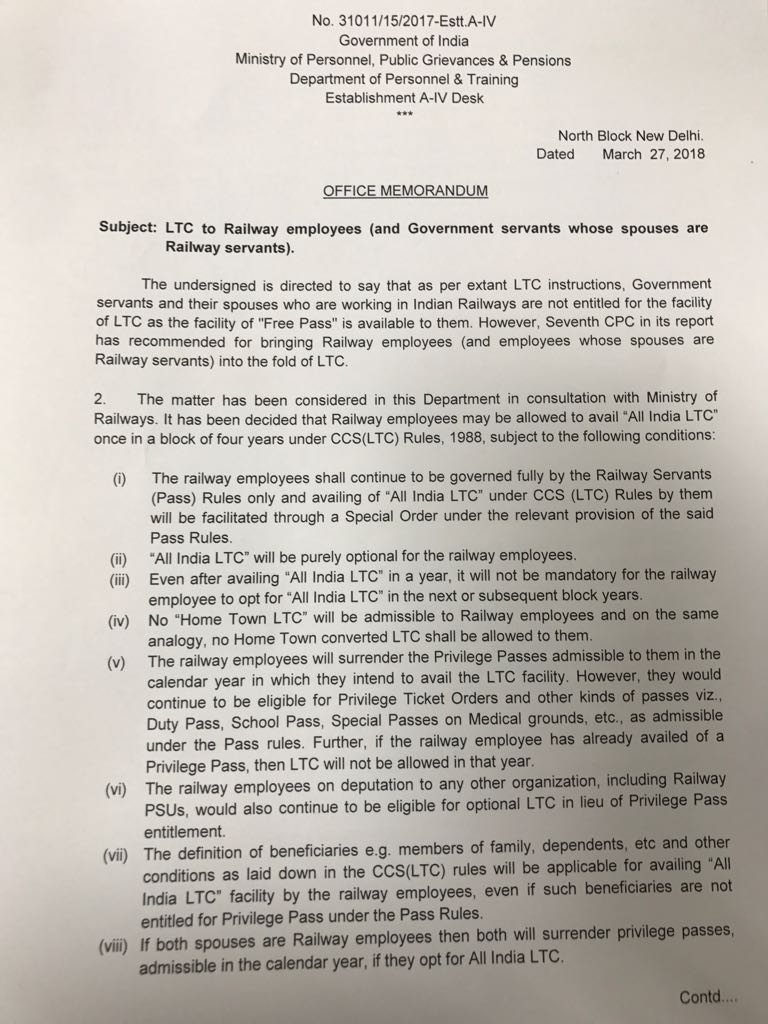
LTC to Railway employees (and Government servants whose spouses are Railway servants)
No. 31011/15/2017 – Estt A-IV
Government of India
Ministry of Personnel, Public Grievances & Pensions
Department of Personnel & Training
Establishment A-IV Desk
***
North Block New Delhi
Dated March 27, 2018
OFFICE MEMORANDUM
Subject: LTC to Railway employees (and Government servants whose spouses are Railway servants).
The undersigned is directed to say that as per extant LTC instructions, Government servants and their spouses who are working in Indian Railways are not entitled for the facility of LTC as the facility of “Free Pass” is available to them. However, Seventh CPC in its report has recommended for bringing Railway employees (and employees whose spouses are Railway servants) into the fold of LTC
2 The matter has been considered in this Department in consultation With Ministry of Railways. It has been decided that Railway employees may be allowed to avail All lndia LTC once in a block of four years under CCS(LTC) Rules, 1988, subject to the following conditions·
(i) The railway employees shall continue to be governed fully by the Railway Servants (Pass) Rules only and availing of “All India LTC” under CCS (LTC) Rules by them will be facilitated through a Special Order under the relevant provision of the said Pass Rules.
(ii) “All India LTC” will be purely optional for the railway employees.
(iii) Even after availing “All India LTC” in a year, it will not be mandatory for the railway employee to opt for “All India LTC” 1n the next or subsequent block years
(iv) No “Home Town LTC” will be admissible to Railway employees and on the same analogy, no Home Town converted LTC shall be allowed to them.
(v) The railway employees will surrender the Privilege Passes admissible to them In the calendar year in which they intend to avail the LTC facility. However they would continue to be eligible for Privilege Ticket Orders and other kinds of Passes viz., Duty Pass. School Pass, Special Passes on Medical grounds. etc., as admissible under the Pass rules. Further, if the railway employee has already availed of a Privilege Pass, then LTC will not be allowed in that year.
(vi) The railway employees on deputation to any other organization, Including Railway PSUs, would also continue to be eligible for optional LTC in lieu of Privilege Pass entitlement.
(vii) The definition of beneficiaries e g members of family, dependents etc. and other conditions as laid down in the CCS(L TC) rules will be applicable for availing ‘All India LTC” facility by the railway employees even if such beneficiaries are not entitled for Privilege Pass under the Pass Rules.
(viii) If both spouses are Railway employees then both will surrender admissible in the calendar year, if they opt for All India LTC.
(ix) In case of the Government employees whose spouse is working In Railways, want to avail All India LTC, either Independently or with family members, then he/she they may be allowed subject to the condition of surrendering privilege passes admissible in that calendar year for him/her/them and an undertaking in this regard shall be given by the Government servant to his office
3. Hindi version will follow.
(Sanjiv Kumar)
Deputy Secretary to the Government of lnd1a