Another Blow to CG Employees – NDA Govt to Reject Arbitration Awards : Confederation
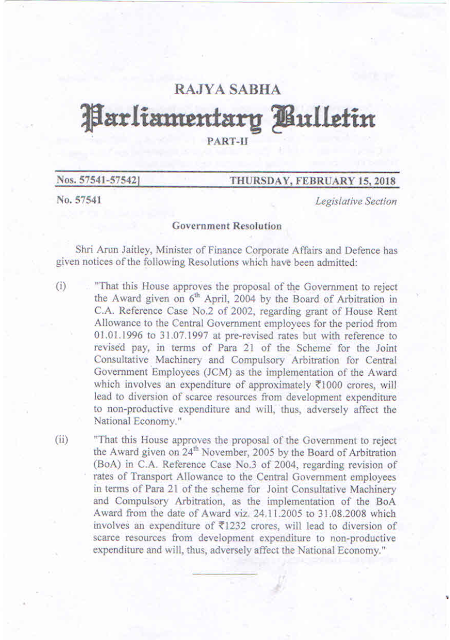
On 15.02.2018, Finance Minister, Sri Arun Jaitley has moved following resolutions in the Parliament to reject the two ARBITRATION AWARDS which are in favour of Central Govt Employees.
(1) Grant of HRA for the period from 01.01.1996 to 31.07.1997 based on revised pay.
Subject:- Timely commencement of family pension in favour of spouse by banks in the event of death of the pensioners.
Attention is invited to this office OM No. CPAO/Tech/ Bank Performance/2016-17/255 dated-27.02.2017 whereby Heads of all the CPPCs and Government Business Divisions of the Banks were advised to Commence the family pension to the spouse immediately on receipt of death certificate of the pensioner, proof of spouse age/date of birth and under taking of recovery of excess payment latest within a month.
However, analysis of reports prepared in CPAO regarding time taken in conversion of pension to family pension in favour of spouse of deceased pensioners shows inordinate delay in many cases. The details of these cases are available in CPPC logins http://eppo.nic.in.
In view of the above, Heads of CPPCs and Government Business Divisions of the banks are advised to review the latest position and ensure compliance of the above instructions and submit the status report to CPAO alongwith reasons for delay by 9th February, 2018 positively by e-mail at [email protected].
it is, further, requested to give the acknowledgement of receipt of application and death certificate to the family pensioner regarding commencement of family pension.
GOVERNMENT OF INDIA
MINISTRY OF RAILWAYS
(RAILWAY BOARD)
****
No.2007/TG – I/20/P Pt.II
New Delhi. Dated: 15.02.2018
The Principal Chief Commercial
Managers,
All Zonal Railways.
Managing Director,
CRIS, Chanakyapuri,
New Delhi.
(COMMERCIAL CIRCULAR NO 13 OF 2018)
Sub: Earmarking of reservation quota for women.
At present, following reserved accommodation is earmarked for use of female passengers:- .
(a) In Sleeper Class coach reservation quota of 6 berths in Mail/Express trains for ladies irrespective of age travelling alone or in a group of female passengers.
(b) In all trains having reserved sleeping accommodation, a combined quota of six lower berths per coach in Sleeper class and 3 lower berths per coach each in AC 3 tier and AC-2 tier classes for Senior Citizens, Female passengers of 45 years of age and above and pregnant women. In case of Rajdhani, Duronto and fully it Conditioned/Express trains, the number of berths to be earmarked under this quota in 3AC is 4 lower berths per coach as against 3 lower berths per coach in normal Mail/Express trains.
2. The issue regarding earmarking of ladies quota in 3 AC class of Garib Rath Express trains has been examined and it has been decided to earmark a reservation quota of 6 berths in 3 AC class of these trains for exclusive use of female passengers irrespective of their a while travelling alone or in group of female passengers.
3. It has also been decided to modify the- logic of utilising accommodation earmarked under ladies quota as under:-
(i) Till preparation of first reservation charts, only female passengers travelling alone or in group of female passengers will be booked against this quota,
(ii) However, at the time of preparation of first reservation charts, the unutilised quota earmarked for female passengers will b released to waiting, Its female passengers travelling alone or in group of female passengers followed by waiting list senior citizens.
If there are no such passengers and berths are left vacant, on board ticket checking staff shall be authorised to allot this accommodation to any other lady passenger/senior citizen on partially confirmed ticket, if any after making necessary entries in the reservation chart.
4. CRIS will make necessary modification in the software and advise date of effect to all Zonal Railways as well as this office.
5. Necessary instructions may be issued to all concerned accordingly.
( Shelly Srivastava)
Director Passenger Marketing
Railway Board
Cabinet approves Amendments to Housing and Telephone Facilities Rules, Constituency Allowance Rules and Office Expense Allowance Rules for MPs
The Union Cabinet chaired by Prime Minister Shri Narendra Modi has approved Amendment to
(i) The Housing and Telephone Facilities (Members of Parliament) Rules, 1956
(ii) The Members of Parliament (Constituency Allowance) Rules, 1986,
(iii) The Members of Parliament (Office Expense Allowance) Rules, 1988.
The details are:
Increase in the monetary ceiling of furniture at residence of Members of Parliament from Rs. 75,000/- (Rs. 60,000/- for durable and Rs. 15,000/- for nondurable) to Rs. 1,00,000/- (Rs. 80,000/- for durable and Rs. 20,000/- for nondurable) w.e.f. 01.04.2018 which shall be increased after every five years commencing from 01.04.2023 on the basis of Cost Inflation Index provided under clause (v) of Explanation to section 48 of the Income-tax Act, 1961.
Broadband internet facility may be provided to Members of Parliament w.e.f. August 2006 against 10,000 surrendered call units per annum on land line connection. The facility of broadband internet to Members of Parliament is already in practice since August, 2006 and it will now be incorporated in ‘the Housing and Telephone Facilities (Members of Parliament) Rules, 1956’ for its regularization through its amendment with retrospective effect by inserting a new rule.
Wi-fi zone with monthly tariff plan of Rs. 1700/- from 1.9.2015 to 31.12.2016 and Rs. 2200/- from 1.1.2017 onwards may be created in the Members’ residential areas for providing high speed internet connection (FTTH connection). This facility will be in addition to the existing broadband facility. For this purpose, three new sub-rules are to be inserted in ‘the Housing and Telephone Facilities (Members of Parliament) Rules, 1956’.
Increase in the Constituency Allowance for Members of Parliament from Rs. 45,000/- per month to Rs. 70,000/- per month w.e.f. 1.4.2018 which shall be increased after every five years commencing from 01.04.2023 on the basis of Cost Inflation Index provided under clause (v) of Explanation to section 48 of the Income-tax Act, 1961.
Increase in the Office Expense Allowance for Members of Parliament from Rs. 45,000/- per month (Rs. 15,000/- for expenses on stationary items and postage plus Rs. 30,000/- for a computer literate person engaged by Member of Parliament for obtaining secretarial assistance) to Rs. 60,000/- per month (Rs. 20,000/- for expenses on stationary items and postage plus Rs. 40,000/- for a computer literate person engaged by Member of Parliament for obtaining secretarial assistance) w.e.f. 01.04.2018 which shall be increased after every five years commencing from 01.04.2023 on the basis of Cost Inflation Index provided under clause (v) of Explanation to section 48 of the Income -tax Act, 1961.
The decision of the Cabinet shall be conveyed to the Joint Committee on Salaries and Allowances of Members of Parliament for making amendments in the relevant rules which shall be get approved and confirmed by the Chairman of the Council of States and the Speaker of House of the People and will be published in the Official Gazette.
Additional financial implication on account of the decision taken by the Cabinet would be Rupees 39,22,72,800/- (Rupees Thirty nine crores, twenty two lakhs, seventy two thousand & eight hundred) approximately of recurring expenditure and Rupees 6,64,05,400/- (Rupees Six crores, sixty four lakhs five thousand & four hundred) approximately of non-recurring expenditure.
Background:
Article 106 of the Constitution provides that the Members of either House
of Parliament shall be entitled to receive such salaries and allowances as may from time to time be determined by Parliament by law. Consequently, the Salary, Allowances and Pension of Members of Parliament Act (MSA Act) was enacted in 1954 (Act 30 of 1954). Section 9 of the MSA Act provides for constitution of a Joint Committee of both Houses of Parliament for the purpose of making rules under the Act. The Joint Committee has the powers to make rules after consultation with the Central Government to provide for all or any of the matters enumerated in the said section.
The Union Finance Minister, Shri Arun Jaitley to inaugurate the Centralized GP Fund Module of PFMS for all the Central Government Employees and ePPO Module of PFMS for complete end –to –end electronic processing of Pension cases, on the occasion of the 42nd Civil Accounts Day tomorrow in National Capital.
The Union Finance Minister, Shri Arun Jaitley has kindly consented to be the Chief Guest at the Inaugural Session of a function organised tomorrow, 1st March, 2018 in national capital to mark the 42nd Civil Accounts Day .On the occasion , the Finance Minister, Shri Jaitley will inaugurate the Centralized GP Fund Module of PFMS for all the Central Government Employees. The centralized GPF module meets a long standing demand of the Central Government Employees for a mapping of GPF Accounts with the unique Employee ID thereby facilitating online application for GPF advances and withdrawals with online access to the employee’s current GPF balances. The module will streamline GPF accounting and transfer of balances.
During the Inaugural Session, the Finance Minister, Shri Jaitley will also inaugurate the ePPO module of PFMS for complete end –to –end electronic processing of Pension cases. The ePPO includes the integration of the BHAVISHYA application of the Department of Pension & Pensioners’ Welfare and the PARAS application of CPAO with PFMS for seamless processing of Pension cases thereby eliminating delays and errors involved in manual processing.
A function is being organized on March 1, 2018 at D.S. Kothari Auditorium, DRDO Bhawan Complex, New Delhi to mark the 42nd Civil Accounts Day.
The Union Finance Minister, Shri Arun Jaitley has kindly consented to be the Chief Guest at the Inaugural Session from 10:30 AM -11:30 AM. The Union Minister of State for Finance, Shri Pon. Radhakrishnan will preside over this Session. The Secretary (Expenditure), Shri A. N. Jha and the Controller General of Accounts(CGA), Shri Anthony Lianzuala will be the other dignitaries at the Inaugural Session.
It may be mentioned here that the Union Finance Minister, Shri Arun Jaitley had earlier graced the 40th Civil Accounts Day function on March 1, 2016 in which the Hon’ble President of India was the Chief Guest. The Union Finance Minister, Shri Jaitley had also very graciously inaugurated the ‘Mahalekha Niyantrak Bhawan’, the new building of this office on September 14, 2016.
Earlier, the Finance Minister had been kind enough to launch the mandatory use of PFMS for Central –Sector schemes monitoring (Oct 2015), the Non –Tax Receipts Portal (NTRP) (Feb 2016) and the Web Responsive Pensioners’ Service of the Central Pension Accounting Office (CPAO) (September 2016).
The Union Government initiated a major reform in Public Financial Management in 1976. The Audit and Accounts functions were separated by relieving the Comptroller and Auditor General of his responsibility of preparation of Union Government accounts. The accounting function was brought directly under the control of the Executive. Consequently, the Indian Civil Accounts Service (ICAS) was established. The ICAS was carved out from the Indian Audit & Accounts Service (IA & AS), initially through the promulgation of an Ordinance amending the C & AG’s (Duties, Powers and Conditions of Service) Amendment Act, 1976. Later on, the Departmentalization of Union Accounts (Transfer of Personnel) Act, 1976 was enacted by Parliament and assented to by Hon’ble President of India on 8th April, 1976. The Act was deemed to have come into force with effect from 1st March, 1976. Accordingly, the ICAS is celebrating March 1 every year as the “Civil Accounts Day”.
Since its inception the ICAS has steadily grown in stature and now plays an important role in the management of public finances of the Union Government
Other highlights of the 42nd Civil Accounts Day function are
* Inauguration of the Centralised GPF and ePPO modules of PFMS
Reforms in public financial management are a continuous process. Structural changes take place in the economy and in the functioning of government which demand accounting data on public finances to be available to decision makers, often on real time basis. This demand for faster information can only be met through adoption of technology. Recognizing this need, the Service has since its inception, been a pioneer in the use of Information Technology in Payments, Accounting and Financial Reporting.
* Keynote address by Shri N. K. Singh, Chairman, Fifteenth Finance Commission (FFC)
Shri N. K. Singh, Chairman, FFC will deliver the keynote address at the Plenary Session from 12.00 PM to 12.50 PM on the topic “Managing Public Finances for a resurgent India”. The Address will be of tremendous significance in the context of fiscal discipline efforts of the Union and the States that would be required to achieve fiscal consolidation.
* Address by Shri Rajnish Kumar, Chairman, State Bank of India
The post-lunch session (2:00 PM -2:50 PM) will feature a talk by Shri Rajnish Kumar, Chairman, State Bank of India on the topics “Leveraging Information Technology for an efficient receipt and payment system of the Government of India”. As the head of the premier accredited and aggregator bank for Government business, the views of Chairman, SBI on the subject would be of immense significance especially in the context of implementation of the Public Financial Management System (PFMS) with a seamless integration with the banking systems.
Concluding session
This Session will be an Open House Session where Service Officers will interact for a way forward on issues relating to Accounts, IT and Internal Audit.
Consumer Price Index for Industrial Workers (CPI-IW) — January, 2018
The All-India CPI-IW for January, 2018 increased by 2 points and pegged at 288 (two hundred and eighty eight). On 1-month percentage change, it increased by (+) 0.70 per cent between December, 2017 and January, 2018 when compared with the decrease of (-) 0.36 per cent for the corresponding months of last year.
The maximum upward pressure to the change in current index came from Housing group contributing (+) 3.99 percentage points to the total change. At item level, Goat Meat, Poultry (Chicken), Tea (Readymade), Pan Leaf, Doctor’s Fee, Medicine (Allopathic), Cinema Charges, Bus Fare, Petrol, Flowers/Flower Garlands, etc. are responsible for the increase in index. However, this increase was checked by Rice, Wheat & Wheat Atta, Gram Dal, Eggs (Hen), Fish Fresh, Onion, Brinjal Cabbage, Carrot, Cauliflower, French Bean, Gourd, Palak, Peas, Potato, Radish, Tomato, Sugar, etc., putting downward pressure on the index.
The year-on-year inflation measured by monthly CPI-IW stood at 5.11 per cent for January, 2018 as compared to 4.00 per cent for the previous month and 1.86 per cent during the corresponding month of the previous year. Similarly, the Food inflation stood at 3.36 per cent against 4.32 per cent of the previous month and 0.34 per cent during the corresponding month of the previous year.
At centre level, Nasik reported the maximum increase of (16 points) followed by Nagpur (11 points), Pune, Lucknow and Goa (10 points each), Kodarma and Amritsar (9 points each), and Coonoor, Agra and Chandigarh (8 points each). Among others, 7 points increase was observed in 3 centres, 6 points in 1 centre, 5 points in 5 centres, 4 points in 1 centre, 3 points in 6 centres, 2 points in 7 centres and 1 point in 8 centres. On the contrary, Quilon recorded a maximum decrease of 6 points followed by Siliguri and Madurai (5 points each). Among others, 4 points decrease was observed in 3 centres, 3 points in 7 centres, 2 points in 8 centres and 1 point in 10 centres. Rest of the 6 centres’ indices remained stationary.
The indices of 36 centres are above All-India Index and 40 centres’ indices are below national average. The index of Varanasi and Jabalpur centres remained at par with All-India Index. The next issue of CPI-IW for the month of February, 2018 will be released on Wednesday, 28th March, 2018. The same will also be available on the office website www.labourbureaunew.gov.in
KV Admission 2018-19 : Admission of wards of Armed / Para Military Forces
Automatic admission of children in the Kendriya Vidyalayas on the basis of transfer certificate issued by the CBSE affiliated schools run by Armed Forces (Army, Air Force, Navy) and Para Military Forces i.e. CRPF/BSF/ITBP/SSB (Sashastra Seema Bal) and CISF will be entertained only if the parent has been transferred to that place or has desired to settle at the place after his retirement,or transferred to some non-family station or posted in Naxal affected areas and choose to keep the family elsewhere.
This provision shall be applicable to schools run by Indian Coast Guard also. This provision may also be extended to the children of government employees studying in schools run by ISRO/AEES (Atomic Energy Education Society).
It is clarified that above provisions are only for the wards of Defence personnel / Para Military Forces i.e.CRPF/BSF/ITBP/SSB (Sashastra Seema Bal) and CISF viz. sons & daughters only. This will not include the grand children of Defence personnel. Provisions of KVS admission guidelines including the eligibility criteria for age and marks/Grades will be followed in letter and spirit. Also, the fee including VVN is to be paid from the month of admission of the child in the Kendriya Vidyalaya regardless of the fact that the fee for succeeding months have already been paid in the school from which TC has been issued for admission to KV. TCs issued by the CASE schools of Defence Ministry/Deptts/Authority will be endorsed by the concerned Deputy Commissioner of the region where admission is sought.
Kendriya Vidyalaya Admission 2018-19 : Eligible Age for Admission
A Child must be 5 years old as on 31st March in the academic year in which admission is sought for Class I. (Child born on 1st April should also be considered)
A. The minimum and maximum age limit for admission in Kendriya Vidyalayas in various classes is given below:(Child born on 1st April should also be considered.)
Class
Minimum Age as on 31st March
Maximum Age as on 31st March
I
5 Years
7 Years
II
6 Years
8 Years
III
7 Years
9 Years
IV
8 Years
10 Years
V
9 Years
11 Years
VI
10 Years
12 Years
VII
11 Years
13 Years
VIII
12 Years
14 Years
IX
13 Years
15 Years
X
14 Years
16 Years
Note: The maximum age limit can be relaxed by two years in case of Differently abled children by the Principal.
B. There is no age restriction for admission to Class XI provided the student is seeking admission in the year of passing Class X examination. Similarly, there will be no upper & lower age limit for admission to class Xll provided there has been no break in the continuous study of the student after passing class XI.
Kendriya Vidyalaya Admission 2018-19 : Method of Admission for Class II to IX
METHOD OF ADMISSION IN CLASS II TO VIII
Admission test shall not be conducted for admission to Class II to VIII and the admission may be granted based on Priority category system (1 to 5 or 6 as the case may be). If applications are more than the number of seats, lottery system will be followed in each category including single girl child quota (Class VI Onwards).
For admission to Class IX, an admission test shall be conducted and a merit list will be prepared for each category of priority separately. Admission shall be granted in the sequence of priority categories, in the order of merit.
(i) Admission test shall be conducted in the subjects: Hindi, English, Maths, Social Science and Science.
(ii) There will be only one paper of Admission test of 3 Hours duration & 100 marks comprising Hindi, English, Maths, Social Science & Science each of 20 marks.
(iii) Candidates must secure 33% marks in aggregate to qualify. Students belonging to SC/ST/Divyang category(PH) will be eligible for admission on securing 25% in aggregate
Out of the available seats of fresh admission 15% will be reserved for SC and 7.5% will be reserved for ST. The short fall in the number of seats reserved for SC and ST, will be worked out after considering number of SC/ST children admitted under RTE quota.
(1) In first phase, 10 seats (out of 40 seats) in Class I per section are to be filled as per RTE Provisions (25% of seats) and these 10 seats will be filled by draw of lots from all applications of SC/ST/EWS/BPL/OBC (Non-Creamy Layer)who are the resident of Neighborhood/Differently abled taken together.
(2) In second phase; remaining seats are to be filled as per existing Priority category system. The short fall in the seats reserved for SC/ST, if any shall be made good by admitting SC/ST applicants.
For example : In a single Section School 6 seats are reserved for SC and 3 Seats for ST (15% for SC and 7.5% for ST). Assuming that, 2 SC candidates, 1 ST candidate and 1 Differently Abled candidate are admitted under RTE in the lottery system in first phase, then available SC seats will be considered as 6-2 = 4 and ST seats will be 3-1 = 2. The left out registered candidates from SC and ST category will be considered as per order of Priority categories for admission. In this case the remaining 24 seats will be available for admission under order of Priority of Category.
Note-I:
a) In no case the seats reserved as per RTE will be de-reserved.
b) The seats reserved for SC/ST may be interchanged, by interchanging SC seats to ST and vice- versa after 201″ April.
c) If required numbers of candidates covered under RTE do not register in 1st spell of registration then a second notification may be given in the month of April.
d) The definition/eligibility criteria of Disadvantaged Group/Weaker Section/BPUOBC (Non-creamy layer) will be as per the notification of the concerned State Governments.(The DC KVS RO Concerned may issue guidelines regarding BPL/EWS as per the latest notification of the concerned State Governments).
e) Admission test will not be conducted for Class 1.
Note-2:
A DEFINITION OF DISADVANTAGED GROUP
1. Child belonging to disadvantaged group means a child belonging to the Scheduled Caste, Scheduled Tribe, the socially and educationally backward class or such other group having disadvantage owing to social, cultural, economic, geographical, linguistic, gender or such other factor as may be specified by the appropriate government, by notification (Section 2(d) of RTE Act).
2. Child with special needs and suffering from disability will be determined as per the provision mentioned in RTE Act 2009 or as defined by the concerned State Govt.
B DEFINITION OF WEAKER SECTION
Child belonging to weaker section means a child belonging to such a parent or guardian (declared by a Court or a Statute) whose annual income is lower than the minimum limit specified by the appropriate government, by notification (Section 2(e)).
The income limit regarding economically weaker sections will be applicable as notified by the State Govt. concerned.
C. DEFINITION OF NEIGHBOURHOOD & PROOF OF RESIDENCE (APPLICABLE FOR ADMISSION UNDER RTE ONLY)
Since Kendriya Vidyalayas are located at places with varied density of population, they have been categorized as follows for determining the limits of neighbourhood:
Major cities and Urban area 5 kms. Radius
(All District Hors. & Metros)
2 Places and areas other than 8 kms Radius included in I above.
Note:
1. Proof of residence shall have to be produced by all applicants. However, admission cannot be denied due to non-submission of Proof of residence.
2. A self-declaration in writing from the parent about distance may also be accepted to this effect.