GOVERNMENT OF INDIA
MINISTRY OF RAILWAYS
(RAILWAY BOARD)
No.E(P&A)I-2017/SP-1/Genl-1
PC-VII No.57
RBE No.121/2017
New Delhi,dated 05-09-2017
The General Managers and Principal Financial Advisers,
All Indian Railways & Production Units.
Sub: Implementation of recommendations of Seventh Central Pay Commission accepted by the Government — Flag Station Allowance.
Consequent upon the decisions taken by the government on the recommendations of the Seventh Central Pay Commission relating to revision of allowances, the President is pleased to abolish Flag Station Allowance (Payable to Commercial Staff in charge of Flag Stations where Train passing duties are not involved) as a separate allowance. The eligible employees will now be governed by the newly proposed “Extra Work Allowance”, which shall be governed as under:
a. Extra Work Allowance will be paid at a uniform rate of 2%(two percent) of the basic pay per month.
b. An employee shall receive this allowance for a maximum period of one year, and there should be minimum gap of one year before the same employee is deployed for similar duties again.
c. This allowance shall not be combined i.e. if the same employee is performing two or more such duties and is eligible for 2%(two percent) allowance for each add-on, then the total Extra Work Allowance payable will remain capped at 2%(two percent) of basic pay.
2. These orders shall be effective from 1S July, 2017.
3. This issues with the concurrence of the Finance Directorate of the Ministry of Railways.
Frequently Asked Questions on timeline for completing Disciplinary proceeding in time bound manner under CCS (CCA) Rules, 1965
F.No.11012/09/2016 – Estt.A-III
Government of India
Ministry of Personnel, Public Grievances and Pensions
Department of Personnel & Training
Establishment A-III Desk
North Block, New Delhi — 110001
Dated 8th December, 2017
OFFICE MEMORANDUM
Subject: Frequently Asked Questions on timeline for completing Disciplinary proceeding in time bound manner under CCS (CCA) Rules, 1965.
Instructions have been issued in the past for expeditious disposal of disciplinary proceeding cases. Further, Central Civil Services (Classification, Control & Appeal) Rules, 1965 have also been notified vide Gazette Notification No. 548(E) dated 2.06.2017 (copy enclosed) for introducing stringent timeline for completing disciplinary proceeding in a time bound manner. Based on the same, a set of frequently asked questions is attached for necessary information.
2. Ministries/ Departments are requested to bring the contents of this O.M. to all concerned for compliance.
3. Hindi version will follow.
(Nitin Gupta)
Under Secretary to the Govt Of India
[Annexure]
FAQs on the time limit for disposal of disciplinary cases
Question: What is the time limit for charged officer to submit his written statement of defence on charge sheet?
Answer: It is 15 days, which can be further extended by a period not exceeding 15 days at a time for reasons to be recorded in writing by the Disciplinary Authority or any other authority authorized by the Disciplinary Authority on his behalf. The overall limit for filing of reply should not be extended beyond 45 days from the receipt of the articles of charge by the charged officer. [Sub Rule 4 in Rule 14 of CCS (CCA) Rules, 1965]
Question:What is the time limit for producing requisite documents claimed by charged officer during?
Answer:Sub rule (13) in Rule 14 provides for producing the documents or issue of non-availability certificate within a period of one month of the receipt of such requisition.
Question: What is the time period for the Presenting Officer to produce the evidence by which he proposes to prove the articles of charge if the Government Servant fails to appear within the specified time or refuses or omits to plead?
Answer: It is 30 days. [Sub rule (11) in Rule 14 of CCS (CCA) Rules, 1965]
Question:What is the time period for inspecting the documents produced by Presenting Officer for the purpose of preparing his defence?
Answer:Within five days of the order passed by Inquiring Authority, which can be further extended not exceeding 5 days. [Sub rule (11) (i) in Rule 14 of CCS (CCA) Rules, 1965]
Question: What is the notice period for production of any documents, which are in possession of Government but not mentioned in the list of documents served with the charge sheet but a request in this regard is made by the Charged Officer?
Answer: The Inquiring Authority can allow a time of 10 days for the purpose, which can further be extended by not exceeding 10 days. [Sub rule (11) (iii) in Rule 14 of CCS (CCA) Rules, 1965]
Question: What is the time limit provided for adjournment before close of the case for Presenting Officer to produce evidences not included in the list given to Charged officer or Inquiring Authority himself call for new evidence or recall and reexamine any witness?
Answer: Such adjournment is done for 3 clear days excluding the day of adjournment and the day to which the inquiry is adjourned. [Sub rule 15 in Rule 14 of CCS (CCA) Rules, 1965]
Question: What is the time limit for completing the inquiry and submit report by Inquiring Authority?
Answer: In terms of notification No G.S.R. 548 (E) dated 02.06.2017, the Inquiring Authority should conclude the inquiry and submit his report within 6 months from the date of receipt of order of his appointment. An additional time not exceeding six months for completing the inquiry can be allowed at a time on the basis of sufficient and good reasons, to be recorded in writing by Disciplinary Authority [Sub rule (24) in Rule 14 of CCS (CCA) Rules, 1965]
Question: Whether time limit of 6 months decided vide notification dated 02.06.2017 is also applicable to cases where Inquiring Authority was appointed prior to the 02.06.2017?
Answer: Yes. Ideally such cases should have been completed, as per the time limit prescribed in the said notification, if those cases are still pending, the period of six months for completing the inquiry can be reckoned w.e.f. 02.06.2017 and extension should be sought, if required.
Question: What is the time limit for furnishing written representation by charged officer on the advice of UPSC?
Answer: It is 15 days from the receipt of the copy of advice of UPSC by the charged officer. [Sub rule (3)(b) in Rule 15 of CCS (CCA) Rules, 1965]
Question: What is the time limit for sending proposal to CVC for first stage advice?
Answer: If vigilance angle is involved in any complaint, this case should be referred to CVC for their 1 st stage advice within one month of the receipt of investigation report. If vigilance angle is not involved, the case should be put up to disciplinary authority for taking a decision to initiate disciplinary action under CCS (CCA) Rules within one month from the date of receipt of investigation report. [DoP&T’s O.M. No. 425/04/2012-AVD-IV(A) dated 29.11.2012]
Question: What is the time limit to put up the case to Disciplinary Authority after receipt of first stage advice of CVC for taking a decision to initiate disciplinary proceeding?
Answer: Within one month of the receipt of first stage advice of CVC. [DoP&T’s O.M. No. 425/04/2012-AVD-IV(A) dated 29.11.2012]
Question: What is the time limit to issue a charge sheet to Charged Officer once a decision is taken by Disciplinary Authority to initiate disciplinary proceeding?
Answer: The charge sheet should be issued to Charged Officer within a week from the date of receipt of the decision of Disciplinary Authority. [DoP&T’s O.M.No.425/04/2012-AVD-IV(A) dated 29.11.2012]
Question: What is the time limit for seeking representation of Charged Officer on inquiry report and disagreement of Disciplinary Authority, if any on it?
Answer: The Charged Officer may be allowed 15 days to submit, if he so desires, his written representation or submission to the Disciplinary authority. [DoP&T’sO.M. No. 11012/13/85-Estt.(A) dated 29.06.1989]
Question: What is the time limit for seeking second stage advice of CVC, if required or to UPSC for their advice?
Answer: It should be sent to CVC or UPSC within one month from the date of receipt of representation of Charged Officer on Inquiry Report. (CVC’s circular No. 000NGL/18 datd 23.05.2000)
Question: What is the time limit for concluding major penalty proceeding?
Answer: It should be completed within 18 months from the date of issue of the charge sheet to Charged Officer. [DoP&T’s O.M. No. 372/3/2007-AVD-III (Vol.10) dated 14.10.2013]
Classification of Posts under the CCS (CCA) Rules, 1965
F.No.11012/10/2016 – Estt .A-III
Government of India
Ministry of Personnel, Public Grievances and Pensions
Department of Personnel & Training
Establishment A-III Desk
North Block, New Delhi — 110001
Dated: 8th December, 2017
OFFICE MEMORANDUM
Subject: Classification of Posts under the CCS (CCA) Rules, 1965.
The undersigned is directed to refer to this Department’s Order No. S.O. 3578 (E) dated 9.11.2017 regarding classification of civil posts under CCS (CCA) Rules, 1965. As per this order, all civil posts except person serving in the Indian Audit and Accounts Department under the Union are classified as follows:-
S.No.
Description of Posts
Classification of posts
(1)
(2)
(3)
1
A Central Civil Post carrying the pay in the Pay Matrix at the Level from 10 to 18.
Group A
2
A Central Civil Post carrying the pay in the Pay Matrix at the Level from 6 to 9.
Group B
3
A Central Civil Post carrying the pay in the Pay Matrix at the Level from 1 to 5.
Group C
2. In some Ministries/ Departments, posts may exist which are not classified as per the norms laid down by this Department. If, for any specific reason, a Ministry/ Department proposes to classify the posts differently, it would be necessary for that Department to send a specific proposal to Department of Personnel and Training giving full justification in support of the proposal within three months of this O.M. so that the exception to the norms of classification laid down in S.O. 3578 (E) dated 9.11.2017 (copy enclosed) can be notified.
3. Hindi version will follow.
(Nitin Gupta)
Under Secretary to the Government of India
Pre Budget Consultation – Trade unions view point on issues to be considered for framing budget for the year 2018-19
The Finance Minister held Pre Budget 2018 discussion with the representatives of central trade unions on 5th December 2018. Representatives of all the central trade unions attended the meeting. CITU was represented by its president Hemalata.
The meeting, as every year, appeared to be not more than a ritual. The ‘consultative meeting’ with the 12 trade unions that were called, lasted for around 1 hour. The trade union representatives were requested to give their opinions in 3-4 minutes. The trade unions were asked to express their concerns and suggestions related to the union budget within this time frame.
Ten central trade unions jointly presented their views in a note to the Finance Minister. In her intervention Hemalata reiterated that pre budget consultation with trade unions should not be treated as a mere ritual; the views of the trade unions representing the workers who produce the wealth should be given due place in the budget proposals. She also demanded that the Group of Ministers constituted under the chairmanship of the Finance Minister in 2015 to discuss the demands raised by the trade unions should continue discussions with them and resolve their demands. Instead of focussing on improving ‘ease of doing business’ to benefit the corporates, the government should focus on improving India’s position in ‘Global hunger index’ and closing down the ‘gender gap’ This should be done by increasing allocations for social sector including health and education, to the ICDS, National Health Mission, Midday Meal Programme etc that serve the poor, particularly women and children. ILC recommendations on recognising ‘scheme workers’ as ‘workers’, paying minimum wages to them etc should be implemented.
She also emphasised the point that the government should increase spending on social sectors like education and health and mobilise resources for this by taxing the rich who can pay. It should focus on employment generation increasing public expenditure on infrastructure. All vacant posts in various government departments including railways etc should be filled up by fresh recruitment. MGNREGA should be implemented in all rural areas and extended to urban areas.
INTUC AITUC HMS CITU AIUTUC
TUCC SEWA AICCTU UTUC LPF
Dated 05.12.2017
The Hon’ble Minister of Finance
Government of India
North Block,
New Delhi, 110 001
Sub: Trade unions view point on issues to be considered for framing budget for the year 2018-19
Sir,
To start with, we urge you to take the views presented jointly by the trade unions and incorporate them in the budget proposals so that this meeting would be meaningful. We request you not to convert this meeting into a mere a ritual.
Please recall that the Group of Ministers headed by you had an inconclusive discussion with the trade unions on the 12 point charter of demands of the working people of the country, in August 2015. The GoM did not resume the discussions despite requests from the central trade unions. The discussion the Labour Minister held with the central trade unions on 7th November 2017 did not yield any results.
Hence, we feel compelled to reiterate our demands again and present our views as follows:
Increase budgetary allocations for social sector: The government should increase allocations on social sector and basic essential services like health, education, food security etc in the Union Budget. The necessary financial resources should be raised internally by taxing the rich who have the capacity to pay.
Effective measures against deliberate tax and loan repayment defaults: Effective and firm measures should be taken against deliberate tax default by the big business and corporate lobby to curtail the huge accumulation of unpaid taxes, which have been continuously increasing. Further, wilful default should be made a criminal offence, the list of wilful defaulters should be made public and stringent measures such as fast track Debt Recovery Tribunals should be implemented.
Minimum wage: Minimum wage fixed on the basis of the recommendations of the 15th Indian Labour Conference and the Supreme Court judgment in Raptakos & Brett case and linked to Consumer Price Index, should be guaranteed to all workers. The 7th Pay Commission has worked this to be Rs 18000 per month, which the government has accepted. Hence, the minimum wage should not be less than Rs 18000 per month, which has been the common demand of all the central trade unions. Need based minimum wage should be considered as an essential part of social security.
Resolve demands of the Government employees regarding 7th Pay Commission: All the pending demands of the Government employees in centre and states in regard to 7th pay commission be resolved within time frame including arrears of allowances with effect from 01.01.2016. The autonomous bodies be included into for all the benefits of the 7th pay commission.
Price rise: The prices of essential commodities, particularly of food items have been spiralling making it impossible for the workers and other toiling people to meet their basic daily needs. Speculative forward trading and hoarding are major factors contributing to the price rise. The government should ban speculative forward trading in essential commodities, take strong measures to curtail hoarding and strengthen Public Distribution System, making it universal. Stop the system of cash transfer to beneficiaries’ accounts in lieu of PDS
Stop disinvestment and strategic sale of public sector units: The public sector has to be strengthened and expanded. Budgetary support should be provided for the revival of potentially viable sick public sector units. Strategic sale of the profit making PSUs, which is being resorted to at present should be stopped. The amendments to the Motor Vehicle Act, which pave the way for privatisation of the state – owned public transport system should be withdrawn.
Employment generation: Employment generation has nosedived in the recent period. Massive public investment in infrastructure, social sectors and agriculture would generate employment. The union budget should give priority and allocate the necessary funds for this. All vacant sanctioned posts in the different government departments, PSUs and autonomous institutions should be filled up through fresh recruitment. The ban on creation of new posts should be lifted. The practice of surrendering/ abolition of posts should be done away with.
Prevent dumping: The increasing import of industrial commodities including capital goods should be contained and regulated to prevent dumping. Protect and promote domestic industries. This will also help in preventing job losses
Extend MGNREGA: Expenditure on MGNREGA should be increased to cover all rural areas. Ensure immediate payment of wages to workers employed under MGNREGA. It should be amended to include the urban areas as well. The unanimous recommendation of 43rd ILC to extend the scheme to urban areas, guarantee employment for a minimum of 200 days with statutory minimum wage, should be implemented.
Contract and casual workers: No contract/casual workers should be deployed on jobs of perennial nature. The contract and casual workers doing the same and similar work as the permanent workers should be paid the same wages and benefits as paid to regular workers as directed by Hon’ble Supreme Court of India in 2016.
FDI: The CTUs have been repeatedly demanding that FDI should not be allowed in crucial sectors like defence production, railways, financial sector, retail trade etc. But the government has persisted with this policy. Corporates with large NPAs are allowed to invest in sensitive sectors like defence. We reiterate the demands that FDI should not be allowed in the crucial sectors.
Defence: Privatisation of the defence sector should be stopped. The order outsourcing of the 143 items of the total 273 produced by the public sector ordinance factories should be withdrawn.
Scheme workers: Regularise the workforce employed in the various schemes of government of India including the ICDS, NHM, Midday Meal Programme, National Child Labour Project, Sarva Siksha Abhiyan etc. Till this is done, at least immediately implement the recommendation of the 45th ILC that these scheme workers should be recognised as ‘workers’, they should be paid minimum wages and provided social security benefits including pension. Increase budgetary allocations to these schemes and stop privatisation of these schemes in any form.
Domestic workers: The government should ratify the ILO Convention 189 and enact a central law and create support system for domestic workers.
Unorganised workers: Create a National Fund for Unorganised Workers to provide social security for all unorganised workers including contract, casual, migrant workers etc. Direct all state governments to frame rules under the Street Vendors (Protection of Livelihood and Regulation of Street Vending) Act and allocate funds for developing street vending as livelihood model. Management of cess under the Building and Other Construction Workers’ Welfare Board, Beedi Workers Welfare Board etc. should be made the responsibility of Ministry of Finance, which should ensure its proper collection, stoppage of evasion and utilisation.
Labour law reforms: Stop labour law amendments that curtail the basic and trade union rights of workers and provide unhindered ‘hire and fire’ facilities to the employers. The Code on Wages Bill, at present before the Standing Committee on Labour and on the draft Code on Industrial Relations Bill should be finalised on the basis of the opinions of the central trade unions expressed unanimously. No labour law amendment should be undertaken without the consent of the trade unions and workers who are the main stakeholders and the most affected.
EPF: The threshold limit for EPF scheme should be brought down to 10. Government and employers’ contribution should be increased to provide a minimum pension of Rs 3000 per month and make it sustainable. Stop investing EPF funds in share market. The Supreme Court has given a judgment and order for higher payment of pension under EPS – 95. This option should be made available for all workers covered under the said scheme.
Pension for all: Pension should be construed as deferred wage and all workers who are not covered by any pension scheme should be ensured a pension not less than Rs 3,000/- per month.
New Pension scheme: NPS should be withdrawn. All central and state government employees recruited on or after 1.1.2004 should be covered under the Old Pension Scheme.
Gratuity: Gratuity under the Payment of Gratuity Act should be raised to Rs 20 lakhs and 30 days wages instead of 15 days per completed year of service.
ADHAR: Government should not rush making ADHAR linking compulsory
Closed and sick factories: Ensure that workers of closed factories get their dues within a fixed time limit. Sudden winding up of the BIFR has left many stakeholders without a remedy. Rules for carrying out the provisions of the Sick Industrial Companies (Special Provisions) Repeal Act, 2003, should be framed immediately to facilitate them.
Income tax exemption: The ceiling for income tax for salaried persons and pensioners should be raised to Rs 5 lakh per year. Income Tax ceiling for senior citizens should be raised to Rs.8 lakhs. All perks and fringe benefits like housing, medical and educations facilities and running allowances in railways should be exempted from income tax net totally.
Political funding: Recently the government removed the limit on the amount companies can donate to political parties and the need to name the political party receiving the funds. This is far from the transparency promised in public life. The earlier regime should be restored.
Railways: Adequate financial resources should be allotted to the railways to ensure more effective, accessible and affordable transport to the common people, particularly the poor. The capabilities of public sector production units should be utilised fully, further developed and strengthened. No measure should be taken to privatise the railways. The measures to hand over the railway stations across the country to private players should be immediately stopped. Any property of railways should not be handed over to private sector through lease or sale. The decision to allow 100% FDI in railways should be withdrawn. The pending expansion, track renewal, signals up gradation projects should be completed at the earliest. Adequate financial resources should be allocated to improve safety systems and ensure safe rail travel for the people. All the vacancies in the railways should be filled up. The long pending demands of the railway employees like enhancement of ceiling in respect of running allowance for tax exemption, housing scheme etc should be addressed positively.
To conclude:
We reiterate our strong opposition to the anti worker measures being undertaken by the government on the pretext of improving the ‘ease of doing business’, to benefit the employers, particularly the big corporates, domestic and foreign.
We once again urge upon the government to take concrete measures to resolve the 12 point charter of demands of the working people, being repeatedly raised by the central trade unions, as well as the pressing issues listed above.
We regret that none of the suggestions of the central trade unions, made in the earlier pre budget meetings were incorporated in the previous budgets. We hope that this would not be repeated yet again and the points raised by us will be given positive consideration while framing budget 2018-19.
GOVERNMENT OF RAJASTHAN
FINANCE DEPARTMENT
(RULES DIVISION)
ORDER
No. F. 13(1)FD(Rules)/2017
Jaipur, dated : 09.12.2017
Sub.: The Rajasthan Work-charged Employees (Revised Pay) Rules, 2017
The Governor of Rajasthan has been pleased to order to amend the Rajasthan Work-charged Employees (Revised Pay) Rules, 2017 promulgated vide Finance Department order of even number dated 30.10.2017 as under;
2. In the Rajasthan Work-charged Employees (Revised Pay) Rules, 2017:-
(a) the existing words and figures “1st October, 2017” wherever occurring in these rules shall be substituted by the words and figures “1st January, 2016”.
(b) the existing figures “01.10.2017” wherever occurring in these rules shall be substituted by figures “01.01.2016”.
(c) the existing figures “30.09.2017” shall be substituted by figures “31.12.2015”.
3. After the existing Rule 17, the following new rule 18 and 19 shall be inserted, namely;
“18. Non-accrual of Arrears.- Notwithstanding anything contained in these. Rules, no arrear of Pay and Allowances thereon, on any account shall accrue to existing Work-charged employees for the period upto 31.12.2016”.
“19. Payment of Arrear.- The arrear for the period from 01.01.2017 to 30.09.2017 shall be payable in three instalment in the ratio of 30%, 30% and 40%. The first, second and third instalment shall be payable on or after 01.04.2018, 01.07.2018 and 01.10.2018 respectively by crediting in GPF account of concerned employee. The revised pay and allowances thereon in cash shall be made with effect from 01.10.2017 payable on 01.11.2017”.
By order of the Governor
(Manju Rajpal)
Secretary to the Government
Finance (Budget)
Treating difference as Personal Pay under Rajasthan Civil Services (Revised Pay) Rules, 2008
GOVERNMENT OF RAJASTHAN
FINANCE DEPARTMENT
(RULES DIVISION)
ORDER
No. F. 14(1) FD/Rules/2013
Jaipur, dated: 09.12.2017
Subject:- Treating difference as Personal Pay under Rajasthan Civil Services (Revised Pay) Rules, 2008.
Under Finance Department Notification No. F.14(1)FD/Rules /2013-11 dated 28.06.2013, the Schedule-V appended to Rajasthan Civil Services (Revised Pay) Rules,2008 was substituted with effect from 01.07.2013. The Entry Pay in Running Pay Band and Grade Pays for direct recruits was revised w.e.f. 01.07.2013 erroneously and in certain cases undue excess payment has been authorized.
This issue of erroneous payment was referred to the Committee constituted by Administrative Reforms Department vide order No. F.6(42) AR-3/Gr.3/2014 dated 17.12.2014. The Committee has submitted its report on 21.06.2017 after considering the issue in detail and recommended to rectify the above error.
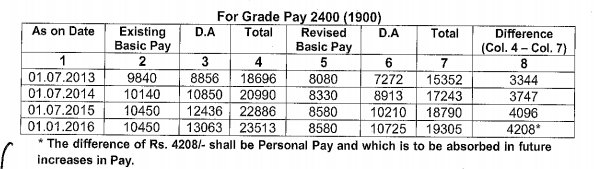
The matter has been considered and the Governor is pleased to order that in the aforementioned cases firstly pay be fixed from 01.07.2013 to 01.01.2016 as per provisions of Notification No. F.14(1)FD/Rules/2013-11 dated 28.06.2013 and again as per revised Notification No.F.14(1)FD/Rules/2013 dated 30.10.2017 from 01.07.2013 to 01.01.2016. The difference of sum of Pay plus Dearness Allowance allowed under Notifications dated 28.06.2013 and 30.10.2017 may be treated as Personal Pay which is to be absorbed in future increases in Pay.
An example of existing fixation of Pay and revised fixation of Pay from 01.07.2013 to 01.01.2016 indicating difference to be treated as Personal Pay which is to be absorbed in future increases in Pay is given below:-
Due to above re-calculation no recovery of over payment shall be made as provided in Rule 30 of the Rajasthan Civil Services (Revised Pay) Rules, 2008.
Consequent upon absorption of Personal Pay in increases in pay under Rajasthan Civil Services( Revised Pay) Rules, 2017; the increment withheld under Finance Department Order No.F.14(8)FD/Rules/2013/pt-II dated 28.07.2017 shall be released.
These provisions shall also be applicable to the Work-charged Employees drawing Pay in Rajasthan Work-charged Employees (Revised Pay) Rules, 2008.
Finance Department Order of even number dated 30th October, 2017 shall stand superceded.
By order of the Governor
(Manju Rajpal)
Secretary to the Government
Finance (Budget)
Amendment in the Rajasthan Civil Services (Contributory Pension) Rules, 2005
GOVERNMENT OF RAJASTHAN
FINANCE DEPARTMENT
(RULES DIVISION)
NOTIFICATION
No. F.12(9)FD(Rules)/2017
Jaipur, dated : 09.12.2017
Subject : Amendment in the Rajasthan Civil Services (Contributory Pension) Rules, 2005.
In exercise of the powers conferred by the proviso to Article 309 of the Constitution of India, the Governor of Rajasthan is pleased to make the amendments in the effective date of following Notification as under :-
1. The effective date of Notification No. F.12(9)FD/Rules/2017 dated 30th October, 2017 shall be as 01.01.2017 instead of 01.10.2017.
By order of the Governor,
(Manju Rajpal)
Secretary to the Government
Finance (Budget)
Dearness Allowance to Work-charged Employees – Rajasthan G.O
GOVERNMENT OF RAJASTHAN
FINANCE DEPARTMENT
(RULES DIVISION)
ORDER
No.F.13(2)FD/(Rules)/2017
Jaipur, dated : 09.12.2017
Sub:- Grant of Dearness Allowance to Work-charged Employees.
Consequent upon promulgation of the Rajasthan Work-charged Employees (Revised Pay) Rules, 2017, the Governor is pleased to order that the Work-charged Employees who are governed under the Rajasthan Public Works Department (B&R) including Gardens, Irrigation, Land Development (Programme), CAD Chambal Department, Kota, PHED, Ayurved and Forest Department Work-charged Employees Service Rules, 1964 or under corresponding provisions of standing orders and are drawing pay under the aforesaid rules may be allowed Dearness Allowance at the following rates:-
2. The payment of Dearness Allowance under this order from the dates 01.01.2017 and 01.07.2017 as indicated above shall be made after adjusting the amount of Dearness Allowance already paid from 01.01.2017 and 01.07.2017, under the existing orders,
3. The term `Pay’ for the purpose of calculation of Dearness Allowance shall be the Basic Pay i.e. pay drawn in the Pay Matrix of the prescribed Levels and shall not include any other type(s) of pay like Special Pay or Personal Pay etc.
4. The payment on account of Dearness Allowance involving fraction of 50 paisa and above may be rounded off to the next higher rupee and the fractions of less than 50 paisa may be ignored.
5. Finance Department Memorandum of even number dated 30th October, 2017 shall stand superceded.
By order of the Governor,
(Manju Rajpal)
Secretary to the Government
Finance (Budget)
Pensioners desirous of using the Jeevan Pramaan facility has to first enroll their Aadhaar number in their pension account. Once seeding has been completed, pensioner can download the software from https://jeevanpramaan.gov.in
Pensioner’s information like Pension Aadhaar number, Pensioner Name, PPO Number, Bank Account detail, Address, Mobile number etc are fed into the system through web based / client interface and finally pensioners person information are authenticated using the Aadhaar number and pensioner has to put his finger on to the finger print scanner or eye on the Iris scanner.
After successful authentication, Pramaan ID / the transaction number is displayed on the screen and same is sent to Pensioner’s mobile as SMS from the portal. The portal generates Electronic Jeevan Pramaan for the successfully authenticated pensioner and it is stored in the central Life Certificate Repository database. The disbursing Bank can access and get the Jeevan Pramaan certificate from the portal for his pensioners through the electronic data transfer mechanism created between the portal and Bank server.
Pensioner has to inform the Bank that his Jeevan Pramaan has been generated through online registration from Jeevan Pramaan portal