Home Blog Page 575

Calculation of quantum of Annual Increment in pay in case of Running Staff – Clarification

Calculation of quantum of Annual Increment in pay in case of Running Staff – Clarification

GOVERNMENT OF INDIA
MINISTRY OF RAILWAYS
(RAILWAY BOARD)

OFFICE MEMORANDUM

No. PC-VI/2016/Z/4

Dated: 04.10.2017

Sub: Clarification regarding calculation of quantum of Annual Increment in pay in case of Running Staff.

Ref.: M/o Finance’s OM No. 332469/2016-E IIIA dated 01.02.2017;

The undersigned is directed to refer to this Ministry’s OM of even no. dated 30.08.2016 wherein an issue raised by one of the Staff Federations vide PNM Agenda Item No.10/2016 was referred to M/o Finance for examination. The Federation had demanded that the basic pay for the purpose of calculation of increment in the 6th CPC should include Pay element of Running Allowance for the Running staff. This meant that increment of Running Staff should be calculated @3 % of {Basic pay + pay element (presently 30% of Basic Pay)}.

2. This issue was examined in Pay Commission Dte. of Railway Board and a copy of reply sent to one of the Zonal Railways is enclosed as Annex-I.

3. As regards the queries raised by M/o Finance vide 011/1 dated 01.02.2017, it is clarified that a portion of Basic Pay of the Running Staff is treated as a “Pay element of running allowance” which itself falls outside the definition. of Basic Pay as defined in FR(9) (21)(a)(i) but falls in the broader definition of the term “pay” as in FR(9) (21)(a)(iii). The pay element at specified rates is counted for specified purposes only. As per Rule No. 25 of “The Rules for payment of Running and other Allowances to the Running Staff on Railways, 1981” read with para 3.23 of Railway Board’s letter No.E(P&A)II-80/RS- 10 dated 17.07.1981 (Annex-11), the pay element i.e. 30% of the Basic Pay of Running Staff will be reckoned as pay for specified purposes (not for all) such as Dearness Allowances, House Rent Allowance, entitlement to Passes, PTOs etc. It is pertinent to mention here that pay element is not reckoned as pay for Transport Allowance, Night Duty Allowance etc.

3.1 In accordance with para 2 of Board’s letter No. E(P&A) II-2005/RS-34 dated 26.12.2008 (RBE No.202/2008) (Annex-III}, pay element in the Running n Allowance for running staff would be 30% of the basic pay under Railway Service (Revised Pay) Rules,2008 for computation of specified benefits excluding retirement benefits. For the purpose of computation of retirement benefits of running staff, an additional quantum of 55% of the basic pay under RS(RP) Rules,2008 would be reckoned.

(U.K. Tiwari)
Deputy Director,
Pay Commission-VI
Railway Board.

Kind Attn: Sh. Ashok Kumar
Under Secretary (DMA),
Department of Expenditure,
Ministry of Finance, North Block, New Delhi.
Signed Copy

7th CPC Classification of Posts – Gazette Notification

7th CPC Classification of Posts – Gazette Notification

Classification of Civil Posts under CCS(CCA) Rules – Gazette Notification
MINISTRY OF PERSONNEL, PUBLIC GRIEVANCES AND PENSIONS
(Department of Personnel and Training)
ORDER
New Delhi, the 9th November, 2017

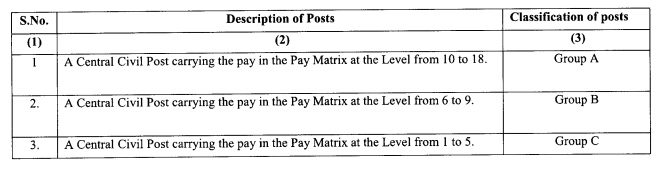
S.O. 3578 (E).— In exercise of the powers conferred by the proviso to article 309 of the Constitution read with rule 6 of the Central Civil Services (Classification, Control and Appeal) Rules, 1965 and in supersession of the notification of the Government of India in the Ministry of Personnel, Public Grievances and Pensions (Department of Personnel and Training) number S.O. 2079(E), dated the 20th August, 2014, except as respects things done or omitted to be done before such supersession, the President hereby directs that with effect from the date of publication of this Order in the Official Gazette, all civil posts except persons serving in the Indian Audit and Accounts Department under the Union, shall be classified as follows :-

dop_gazette

Explanation – For the purpose of this Order, ‘Level’ in relation to a post means, the Level specified in third row of Part A of the Schedule to the Central Civil Services (Revised Pay) Rules, 2016.

[F. No. 11012/10/2016-Estt.A-III]
GYANENDRA DEV TRIPATHI, Jt. Secy

Gazette Notification

7th Pay Commission Deputation Allowance – DOPT Order

7th Pay Commission Deputation Allowance – DOPT Order

No.2/11/2017-Estt.(Pay-II)
Government of India
Ministry of Personnel, Public Grievances & Pensions
Department of Personnel & Training

North Block, New Delhi
Dated the 24th November, 2017

OFFICE MEMORANDUM

Subject:- Grant of Deputation (Duty) Allowance – Recommendations of the Seventh Central Pay Commission – Regarding.

This Department’s OM No. 6/8/2009-Estt.(Pay-II) dated 17.6.2010 inter-alia provides for rates of Deputation (Duty) Allowance admissible to Central Government employees.

2. As provided in para 7 of Ministry of Finance, Department of Expenditure’s Resolution No.1-2/2016-IC dated 25th July, 2016, the matter regarding allowances (except Dearness Allowance) based on the recommendations of the 7th Central Pay Commission (CPC) was referred to a Committee under the Chairmanship of Finance Secretary and until a final decision thereon, all Allowances have been paid at the existing rates in the existing pay structure.

3. The decision of the Government on various allowances based on the recommendations of the 7th CPC and in the light of the recommendations of the Committee under the Chairmanship of the Finance Secretary has since been issued as per the Resolution No.11-1/2016-IC dated 6th July 2017 of Department of Expenditure.

4. As mentioned at Sl.No.46 of the Appendix-II of the said Resolution dated 6th July 2017, the recommendation of the 7th CPC for enhancement of ceiling of Deputation (Duty) Allowance for civilians by 2.25 times has been accepted and this decision is effective from 1st July, 2017. Accordingly, the President is pleased to decide that the rates of Deputation (Duty) Allowance and certain other conditions relating to grant of Deputation (Duty) Allowance shall be as under:-

The Deputation (Duty) Allowance admissible shall be at the following rates:

(a) In case of deputation within the same station the Deputation (Duty) Allowance will be payable at the rate of 5% of basic pay subject to a maximum of Rs.4500 p.m.

(b) In case of deputation involving change of station, the Deputation (Duty) Allowance will be payable at the rate of 10% of the basic pay subject to a maximum of Rs.9000 p.m.

(c) The ceilings will further rise by 25 percent each time Dearness Allowance increases by 50 percent.

(d) Basic Pay, from time to time, plus Deputation (Duty) Allowance shall not exceed the basic pay in the apex level i.e. Rs. 2,25,000/-. In the case of Government servants receiving Non Practising Allowance, their basic pay plus Non-Practising Allowance plus Deputation (Duty) Allowance shall not exceed the average of basic pay of the revised scale applicable to the Apex Level and the Level of the Cabinet Secretary i.e. Rs.2,37,500/-.

Note: 1 ‘Basic pay’ in the revised pay structure (the pay structure based on 7th Central Pay Commission recommendations) means the pay drawn by the deputationist, from time to time, in the prescribed Level, in Pay Matrix, of the post held by him substantively in the parent cadre, but does not include any other type of pay like personal pay, etc.

Note: 2 In cases where the basic pay in parent cadre has been upgraded on account of non-functional upgradation (NFU), Modified Assured Career Progression Scheme (MACP), Non Functional Selection Grade (NFSG), etc., the upgraded basic pay under such upgradations shall not be taken into account for the purpose of Deputation (Duty) Allowance.

Note 3 In the case of a Proforma Promotion under Next Below Rule (NBR): If such a Proforma Promotion is in a Level of the Pay Matrix which is higher than that of the ex-cadre post, the basic pay under such Proforma Promotion shall not be taken into account for the purpose of Deputation (Duty) Allowance. However, if such a Proforma Promotion under NBR is in a Level of the pay matrix which is equal to or below that of the ex-cadre post, Deputation (Duty) Allowance shall be admissible on the basic pay of the parent cadre post allowed under the proforma promotion, if opted by the deputationist.

Note 4 In case of Reverse Foreign Service, if the appointment is made to post whose pay structure and/ or Dearness Allowance (DA) pattern is dissimilar to that in the parent organisation, the option for electing to draw the basic pay in the parent cadre [alongwith the Deputation (Duty) Allowance thereon and the personal pay, if any] will not be available to such employee.

Note: 5 The term ‘same station’ for the purpose will be determined with reference to the station where the person was on duty before proceeding on deputation.

Note: 6 Where there is no change in the headquarters with reference to the last post held, the transfer should be treated as within the same station and when there is change in headquarters it would be treated as not in the same station. So far as places falling within the same urban agglomeration of the old headquarters are concerned, they would be treated as transfer within the same station.

5. Para 6.1 of this Department’s OM No.6/8/2009-Estt(Pay-II) dated 17.6.2010 stands amended to the above effect.

6. In so far as persons serving in the Indian Audit & Accounts Department are concerned, these orders issue after consultation with the Comptroller & Auditor General of India.

7. These orders shall take effect from 1st July, 2017

(Rajeev Bahree)
Under Secretary to the Government of India

Signed Copy

CGEGIS Table from October 2017 to December 2017

CGEGIS Table from October 2017 to December 2017

No.7(2)/EV/2016
Government of India
Ministry of Finance
Department of Expenditure

New Delhi, the 23 November, 2017

Office Memorandum

Sub: Central Government Employees Group Insurance Scheme-1980 – Tables of Benefits for the savings fund for the period from 01.10.2017 to 31.12.2017.

The Tables of Benefits for Savings Fund to the beneficiaries under the Central Government Employees Group Insurance Scheme-1980, which are being issued on a quarterly basis from 01.01.2017 onwards, as brought out in this Ministry’s OM of even number dated 17.03.2017, for the quarter from 01.10.2017 to 31.12.2017, as worked out by IRDA based on the interest rate of 7.8% per annum (compounded quarterly) as notified by the Department of Economic Affairs as per their Resolution No. 5(1)-B(PD)/2017 dated 23.10.2017, are enclosed.

2. The Tables enclosed are of two categories as per the existing practice. As hitherto, the first Table of Benefits for the savings fund of the scheme is based on the subscription of Rs.10 p.m. from 1.1.1982 to 31.12.1989 and Rs.15 p.m. w.e.f. 1.1.1990 onwards. The second Table of Benefits for savings fund is based on a subscription of Rs.10 p.m. for those employees who had opted out of the revised rate of subscription w.e.f. 1.1.1990.

3. While these orders are in respect of Table of Benefits for the period from 01.10.2017 to 31.12.2017, the Tables already issued for the quarters from 1.1.2017 to 31.3.2017, from 1.4.2017 to 30.6.2017 and from 01.07.2017 to 30.09.2017 are also reproduced for the sake of convenience and consolidation.

4. In their application to the employees of Indian Audit and Accounts Department, these orders are issued after consultation with the Comptroller & Auditor General of India.

5. Hindi version of these orders is attached.

(Amar Nath Singh)
Director

Signed Copy

Cabinet approves setting up of the 15th Finance Commission

Cabinet approves setting up of the 15th Finance Commission

The Union Cabinet chaired by the Prime Minister Narendra Modi has approved the setting up of the 15thFinance Commission. Under Article 280 (1) of the Constitution,it is a Constitutional obligation. The Terms of Reference for the 15thFinance Commission will be notified in due course of time.

Background:

Article 280(1) of the Constitution lays down that a Finance Commission (FC) should be constituted “…within two years from the commencement of this Constitution and thereafter at the expiration of every fifth year or at such earlier time as the President considers necessary…”.In keeping with this requirement, the practice has generally been to set up next Finance Commission within five years of the date of setting up of the previous Finance Commission.

Fourteen (14)Finance Commissions have been constituted in the past. The 14thFinance Commission was set up on 02.01.2013 to make recommendations covering the period of five years commencing on 1st April, 2015. The Commission submitted its Report on 15th December, 2014. The recommendations of the 14thFinance Commission are valid upto the financial year 2019-20. In terms of Constitutional provisions, setting up the 15thFinance Commission, the recommendations of which will cover the five years commencing on April 1, 2020, has now become due.

PIB

Cabinet approves Wage Policy for the 8th Round of Wage Negotiations for workmen in CPSE

Cabinet approves Wage Policy for the 8th Round of Wage Negotiations for workmen in Central Public Sector Enterprises

The Union Cabinet chaired by the Prime Minister Narendra Modi has approved the Wage Policy for the 8th Round of Wage Negotiations for workmen in Central Public Sector Enterprises (CPSEs).

Highlights:

i.Management of the CPSEs would be free to negotiate wage revision for workmen where the periodicity of wage settlement of five years or ten years has expired generally on 31.12.2016 keeping in view the affordability and financial sustainability of such wage revision for the CPSEs concerned.

ii.No budgetary support for any wage increase shall be provided by the Government. The entire financial implication would be borne by the respective CPSEs from their internal resources.

iii.In those CPSEs for which the Government has approved restructuring/ revival plan, the wage revision will be done as per the provisions of the approved restructuring / revival plan only.

iv. The management of the concerned CPSEs have to ensure that negotiated scales of pay do not exceed the existing scales of pay of executives/officers and non-unionized supervisors of respective CPSEs.

v. The Management of CPSEs where the five year periodicity is followed have to ensure that negotiated scales of pay for two successive wages negotiations do not exceed the existing scales of pay of executives/officers and non-unionized supervisors of respective CPSEs for whom ten years periodicity is being followed.

vi. To avoid conflict of pay scales of executives/non-unionised supervisors with that of their workmen, CPSEs may consider adoption of graded DA neutralization and/or graded fitment during the wage negotiations.

vii. CPSEs must ensure that any increase in wages after negotiations does not result in increase in administered prices of their goods and services.

viii. The wage revision shall be subject to the condition that there shall be no increase in labour cost per physical unit of output. In exceptional cases where CPSEs are already working at optimum capacity, the administrative Ministry / Department may consult DPE considering industry norms.

ix. The validity period of wage settlement would be for a minimum period of five years for those who opted for a five year periodicity and for a maximum period of ten years for those who have opted for a ten year periodicity of wage negotiation w.e.f. 01.01.2017.

x. The CPSEs would implement negotiated wages after confirming with their Administrative Ministry/Department that the wage settlement is in conformity with approved parameters.

Background:

There are about 12.34 lakh employees in 320 CPSEs in the country. Out of these, about 2.99 lakh employees are Board level and below Board level executives and non-unionized Supervisors. The remaining about 9.35 lakh employees belong to the unionized workmen category. Wage revision in respect of unionized workmen is decided by trade unions and managements of CPSEs in terms of guidelines issued by the Department of Public Enterprises (DPE) for wage negotiations.

PIB

Cabinet approves revised salaries, gratuity, allowances and pension for the Judges of the Supreme Court and the High Courts

Cabinet approves revised salaries, gratuity, allowances and pension for the Judges of the Supreme Court and the High Courts

The Union Cabinet chaired by the Prime Minister Narendra Modi has approved the revision in the salaries, gratuity, allowances, pension etc. of the Judges of the Supreme Court and the High Courts and retired Judges of Supreme Court and High Courts. It follows the implementation of recommendations of the 7thCentral Pay Commission in respect of Civil Servants.

The approval will pave the way for necessary amendments in the two laws viz. Supreme Court Judges (Salaries and Conditions of Service) Act, 1958 and High Court Judges (Salaries and Conditions of Service) Act, 1954, which govern the salaries of Chief Justice of India (CJI), Judges of Supreme Court of India, Chief Justices and all Judges of High Courts.

The increase in the salary and allowances etc. will benefit 31 Judges of Supreme Court of India (including the CJI) and 1079 Judges(including the Chief Justices) of High Courts. Besides, approximately 2500 retired Judges will also be benefited on account of revision of pension/gratuity etc.

Arrears on account of revised salaries, gratuity, pension and family pension w.e.f 01.01.2016 will be paid as one time lump sum payment.

Background:

Salaries, gratuity, pension, allowances etc. in respect of Judges of Supreme Court are governed by the Supreme Court Judges (Salaries and Conditions of Service) Act, 1958. Salaries etc. of Judges of High Courts are governed by High Court Judges (Salaries and Conditions of Service) Act, 1954. An amendment in the Acts is required whenever there is any proposal for revision of salaries/pension gratuity, allowances etc. in respect of Judges of Supreme Court and High Courts. Therefore, Government proposes to move a Bill in the Parliament in the ensuing Session for amendment in the relevant Acts for giving effect to the revision of salaries and allowances.

PCDA Circular 590 – Corrigendum – 7th CPC Implementation for Post-2016 retired Armed Forces Pensioners

PCDA Circular 590 – Corrigendum – 7th CPC Implementation for Post-2016 retired Armed Forces Pensioners

Office of the Principal CDA(Pensions)
Draupadi Ghat, Allahabad- 211014

Circular No: 590

Dated: 06.11.2017

To

1. The Chief Accountant, RBI, Deptt. Of Govt Bank Accounts, Central Office, C-7, Second Floor, Bandra-Kurla Complex, P B No. 8143, Bandra East, Mumbai- 400051
2. CMDs, All Public Sector Banks.
3. The Nodal Officers, ICICI/HDFC/AXIS/IDBI Banks
4. All Managers, CPPCs
5. Military and Air Attache, Indian Embassy, Kathmandu, Nepal
6. The PCDA (WC), Chandigarh
7. The CDA (PD), Meerut
8. The CDA, Chennai
9. The Director of Treasuries, All States
10. The Pay and Accounts Officer, Delhi Administration, R K Puram; and Tis Hazari, New Delhi.
11. The Pay and Accounts Office, Govt of Maharashtra, Mumbai
12. The Post Master, Kathua (J&K), and Camp Bell Bay.
13. The Principal Pay and Accounts Officer, Andaman and Nicobar Administration, Port Blair.

Subject: Corrigendum – Implementation of Govt. decision on the recommendations of the Seventh Central Pay Commission in respect of the Post-01.01.2016 retired Armed Forces Pensioners/ Family Pensioners : Reg. New PPO Series.

**************

In para 7 of this office Circular No. 588 dated 20.10.2017 at line no. 2 & 3 may be read as under:-

For : “with immediate effect”
Read : after 31.12.2017

2. All PDA’s are also requested to act upon e-PPO’s digitally signed issued by this office in terms of Circular No. 588 dated 20.10.2017. In other words, till 31.12.2017, both series of PPO (i.e. PPO series notified and also e-PPO’s) be acted upon. After 1.1.2018, all PPO series except numeric PPO’s no. affixed on e-PPO’s will no longer remain in use.

3. The same has also been uploaded on this office website www.pcdapension.nic.in.

4. All other terms and conditions shall remain unchanged.

(Nasim Ullah)
ACDA (P)

No. Gts/Tech/7th CPC/0181/Vol-IV
Dated: 06.11.2017

Signed Copy

Registering of Email IDs of CGHS beneficiaries

Registering of Email IDs of CGHS beneficiaries

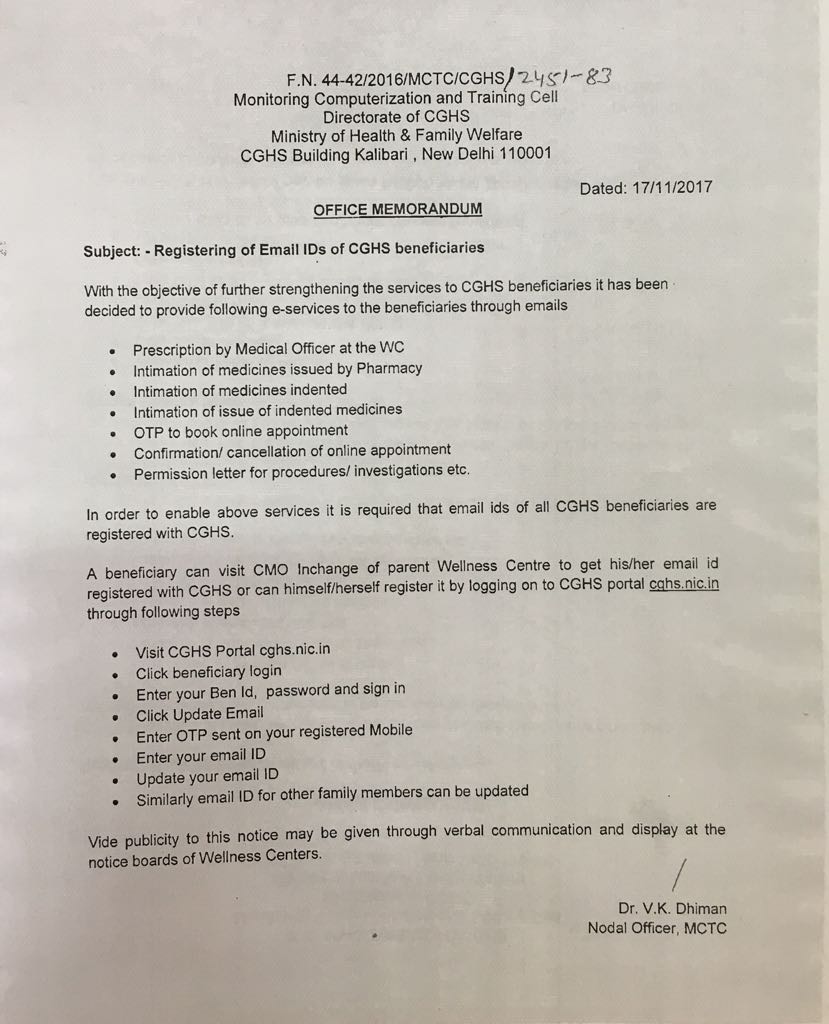
F.N.44-42/2016/MCTC/CGHS/2451-83
Monitoring Computerization and Training Cell
Directorate of CGHS
Ministry of Health & Family Welfare
CGHS Building Kalibari , New Delhi 110001

Dated: 17/11/2017

OFFICE MEMORANDUM

Subject :– Registering of Email IDs of CGHS beneficiaries

With the objective of further strengthening the services to CGHS beneficiaries it has been decided to provide following e-services to the beneficiaries through emails

• Prescription by Medical Officer at the VVC
• Intimation of medicines issued by Pharmacy
• Intimation of medicines indented
• Intimation of issue of indented medicines
• OTP to book online appointment
• Confirmation/ cancellation of online appointment
• Permission letter for procedures/ investigations etc.

In order to enable above services. it is required that email ids of all CGHS beneficiaries are registered with CGHS.

A beneficiary can visit CMO In change of parent Wellness Centre to get his/her email id registered with CGHS or can himself/herself register It by logging on to CGHS portal cghs.nic.in through following steps

• Visit CGHS Portal cghs.nic.in
• Click beneficiary login
• Enter your Ben Id, password and sign in
• Click Update Email
• Enter OTP sent on your registered Mobile
• Enter your email ID
• Update your email ID
• Similarly email ID for other family members can be updated

Vide publicity to this notice may be given through verbal communication and display at the notice boards of Wellness Centers.

Dr.V.K.Dhiman
Nodal Officer, MCTC

Monetary Allowance for Widows of Gallantry Awards Recipients

Monetary Allowance for Widows of Gallantry Awards Recipients

Recipients of the gallantry awards are entitled to the monetary allowance as per the letter of 1972 of Ministry of Defence (MoD), superseded by letter in 1995 of the MoD, which have been revised from time to time. As per the existing condition for grant of monetary allowance, the allowance shall be admissible to the recipient of the award and on his death to his widow lawfully married by a valid ceremony. The widow will continue to receive the allowance until her re-marriage or death. The payment of the allowance will, however, be continued to a widow who re-marries the late husband’s brother and lives a communal life with the living heir eligible for family pension.

Representations were received from various quarters to remove the condition of the widow’s remarriage with the late husband’s brother for continuation of the monetary allowance.

This issue was considered by the Government of India and it has now been decided to remove the condition of the widow’s remarriage with the late husband’s brother for continuation of the monetary allowance vide MoD letter dated November 16, 2017.

The revised condition for grant of monetary allowance for recipients of gallantry awards is as under:-

The allowance shall be admissible to the recipient of the award and on his death to his widow lawfully married by a valid ceremony. The widow will continue to receive the allowance until her death.

PIB

Just In