Will the Minister of Communications be pleased to state:
(a) the steps being taken to review the Time Related Continuity Allowance (TRCA) structure for Gramin Dak Sevaks;
(b) whether Government plans to prioritise local candidates who are familiar with the language and geography;
(c) if so, the details of measures implemented; and
(d) if not, the reasons for not adopting such a policy despite frequent transfer requests and challenges faced by out-of- State recruits?
ANSWER MINISTER OF STATE FOR COMMUNICATIONS AND RURAL DEVELOPMENT (DR. PEMMASANI CHANDRA SEKHAR)
(a) Sir, the Time Related Continuity Allowance (TRCA) structure for Gramin Dak Sevaks (GDS) is reviewed periodically. The Government has successively constituted committees for revision of TRCA structure and other service conditions of GDS from time to time after report of each successive Central Pay Commissions (CPCs).
(b) to (d) As per Article 16(2) of the Constitution of India, no citizen can be discriminated against in public employment on the grounds of race, caste, sex, descent, place of birth, or residence. Further, knowledge of identified local language(s), studied at least upto 10th standard is a mandatory requirement for GDS engagement under the extant rules.
Two Additional Auto Investment Choices for Central Government NPS/UPS Subscribers: PFRDA Circular Dec 2025
PENSION FUND REGULATORY AND DEVELOPMENT AUTHORITY
CIRCULAR
Circular No.: PFRDA/2025/21/Reg-PF/03
01st December 2025
To: All NPS Stakeholders
Subject: Enhancement of Investment Choice options under NPS & UPS for Central Government Subscribers
1. Pursuant to the Gazette Notification No. FX-4/2/2025-PR dated 13.11.2025 issued by the Ministry of Finance, Department of Financial Services, PFRDA hereby notifies the expansion of the existing Investment Choice Options under the NPS and UPS for Central Government (CG) employees. Two additional Auto Investment Choice options have been introduced, thereby increasing the total number of available choices to six.
2. The following investment choices are currently available to CG subscribers:
Existing Investment Choices under NPS and UPS
Description
Default Scheme
Contributions are invested as per the predefined asset allocation pattern managed by three Pension Funds. The asset allocation pattern under default schem is attached at Annexure 1 for ready reference
Active Choice (100% G-Sec)
Investment solely in Government Securities.
Auto Choice – Life Cycle 25 – Low (5E/55Y)
The Subscriber’s contribution is invested with the equity exposure of 25% until they reach 35 years and the equity allocation tapers subsequently till it reaches 5% at the age of 55 years which continues till exit.
Auto Choice – Life Cycle 50 – Moderate (10E/55Y)
The Subscriber’s contribution is invested with the equity exposure of 50% until they reach 35 years and the equity allocation tapers subsequently till it reaches 10% at the age of 55 years which continues till exit.
3. At present, approximately 4% of CG subscribers have opted for an investment choice other than the Default Scheme.
4. In accordance with the above gazette notification, the following two additional Auto Choice options are introduced:
Additional Investment Choice Option under NPS and UPS
Description
Auto Choice – Life Cycle 75 – High (15E/55Y)
The Subscriber’s contribution is invested with the equity exposure of 75% until they reach 35 years and the equity allocation tapers subsequently till it reaches 15% at the age of 55 years which continues till exit.
Auto choice – Life Cycle – Aggressive (35E/55Y)
The Subscriber’s contribution is invested with the equity exposure of 50% until they reach 45 years and the equity allocation tapers subsequently till it reaches 35% at the age of 55 years which continues till exit.
5. Subscribers opting for any alternative investment choices other than the Default Scheme shall be required to:
Exercise one of the five non-default investment options as mentioned above, and
Select one Pension Fund from among the ten Pension Funds currently registered with PFRDA.
6. Subscribers are advised to exercise their investment choice judiciously, based on a review of the performance of schemes and Pension Funds. Updated scheme-wise and PF-wise performance information is available on the NPS Trust website (www.npstrust.org.in), and subscribers are encouraged to make informed decisions.
7. PFRDA has undertaken a comprehensive review of the existing nomenclature of Auto Choice Life Cycle (LC) Funds to ensure consistency with asset allocation patterns and age-based tapering structures. The circular issued on rRationalifration of Nomenclature ofeluto Choice / Life Cycle Funds under the NPS” dated 17th October 2025 vide reference PFRDA/2025/16/Reg-PF/02 post such comprehensive review is attached at Annexure II for ready reference.
8. The enhanced investment choice options are already made available to CG subscribers by the Central Record keeping Agencies (CRAs).
9. This circular is issued in exercise of the powers conferred upon the Authority under Section 14(2)(b) read with Section 23 of the PFRDA Act, 2013, and Regulation 14(1) of the PFRDA (Pension Fund) Regulations, 2015.
Yours faithfully,
Chief General Manager
Annexure I:
Asset Allocation under Default Scheme
Category
Investment Pattern
NPS/UPS Schemes
I
Government Securities and Related Investments
Up to 65%
II
Debt Instruments and Related Investments
Up to 45%
III
Equities and Related Investments (From 1st April 2025 limit increase to 25%)
Up to 25%
IV
Short Term Debt Instruments (Money Market)
Up to 10%
V
Asset Backed, Trust Structured and Misc. Investments Asset class A
8वें वेतन आयोग को 01-01-2026 से लागू करने पर लोकसभा में सवाल-जवाब
भारत सरकार वित्त मंत्रालय व्यय विभाग
लोक सभा लिखित प्रश्न संख्या -1347
सोमवार, 8 दिसंबर, 2025 अग्रहायण, 7947 (शक)
8वें वेतन आयोग का कार्यान्वयन
1347. श्री एन. के. प्रेमचन्द्रन: श्री तमिलसेल्वन थंगाः डॉ. गणपथी राजकुमार पी.: श्री धर्मेन्द्र यादवः
क्या वित्त मंत्री यह बताने की कृपा करेंगे कि:
(क) क्या सरकार का विचार 01-01-2026 से 8वें वेतन आयोग को लागू करने का है और यदि हां, तो तत्संबंधी ब्यौरा क्या है और इस संबंध में क्या कारेवाई की गई है;
(ख) क्या 8वें वेतन आयोग के विचारार्थ विषयों (टीओआर) को अंतिम रूप दे दिया है, जिससे केन्द्र सरकार के कर्मचारियों के वेतन और पेंशनभोगियों के भत्ते में संशोधन होगा और यदि हां, तो तत्संबंधी ब्यौरा क्या है और यदि नहीं, तो इसके क्या कारण हैं;
(ग) क्या सरकार का विचार 2026-27 के बजट में 8वें वेतन आयोग को लागू करने के लिए धनराशि आवंटित करने का है और यदि हां, तो तत्संबंधी ब्यौरा क्या है और इस संबंध में की गई कार्रवाई क्या है तथा सरकारी खजाने पर कुल कितना व्यय होने की संभावना है;
(घ) क्या 8वें वेतन आयोग ने अंतिम सिफारिशें करने से पहले केन्द्रीय सरकार के कर्मचारी और पेंशनभोगी संघों तथा राज्य सरकारों सहित सभी प्रमुख हितधारकों से परामर्श किया है/कर रहा है, यदि हां, तो तत्संबंधी ब्यौरा क्या है;
(ङ) 8वें वेतन आयोग के गठन और अन्य कार्यवाही की वर्तमान स्थिति क्या है और इससे लाभान्वित होने वाले केंद्र सरकार के कुल कर्मचारियों और पेंशनभोगियों की संख्या कितनी है;
(च) क्या सरकार 8वें वेतन आयोग के कामकाज शुरु होने में देरी के कारण कर्मचारियों और पेंशनभोगियों की शिकायतों पर विचार करेगी और यदि हां, तो तत्संबंधी ब्यौरा क्या है; और
(छ) आयोग द्वारा अपनी सिफारिशें कब तक प्रस्तुत किए जाने की संभावना है और सरकार उन्हें कब तक लागू करेगी?
(क) से (ग), (ङ) और (च): आठवें केंद्रीय वेतन आयोग (सीपीसी) का गठन पहले ही कर दिया गया है। आठवें केंद्रीय वेतन आयोग के विचारार्थ विषयों (टीओआर) को दिनांक 03.11.2025 के वित्त मंत्रालय के संकल्प के माध्यम से अधिसूचित कर दिया गया है। केंद्र सरकार के कर्मचारियों की संख्या लगभग 50.14 लाख और पेंशनभोगियों की संख्या लगभग 69 लाख है। आठवें केंद्रीय वेतन आयोग के लागू होने की तारीख का निर्णय सरकार द्वारा लिया जाएगा। सरकार आठवें केंद्रीय वेतन आयोग की स्वीकृत सिफारिशों को लागू करने के लिए निधियों का समुचित प्रावधान करेगी।
(घ): आठवां केंद्रीय वेतन आयोग अपनी सिफारिशों को तैयार करने के लिए कार्य-प्रणाली और क्रिया-विधि को अपनाएगा।
(छ): दिनांक 03.11.2025 को अधिसूचित संकल्प में यथानिर्दिष्ट, आठवां केंद्रीय वेतन आयोग इसके गठन की तारीख से 18 माह के भीतर अपनी सिफारिश प्रस्तुत करेगा।
a) whether the Government proposes to implement the 8th Pay Commission with effect from 01-01-2026, if so, the details thereof and the action taken thereon;
b) whether the Government has finalised the Term of Reference (ToR) of 8th Pay Commission which will lead to revision of salaries of Central Government employees and allowance of pensioners, if so, the details thereof and if not, the reasons therefor;
c) whether the Government proposes to allocate fund for implementing the 8th Commission in 2026-2027 budget, if so details thereof and action taken thereon and the total expenditure likely to be incurred from the Government exchequer;
d) whether the 8th Pay Commission has consulted/is consulting all major stakeholders including Central Government Employee and pensioners associations, as well as State Governments before taking final recommendations, if so, the details thereof;
e) the present status of Constitution and other proceedings regarding the setting up of 8th Pay Commission along with the total number of Central Government employees and pensioners benefited;
f) whether the Government proposes to consider the grievances of employees and pensioners due to delay in starting the functioning of 8th Pay Commission, if so, the details thereof; and
g) the time by which the Commission is likely to submit its recommendations and the time by which the Government implement them?
ANSWER MINISTER OF STATE IN THE MINISTRY OF FINANCE (SHRI PANKAJ CHAUDHARY)
(a) to (c), (e) and (f): The 8th Central Pay Commission (CPC) has already been constituted. The Terms of Reference (ToR) of the 8th Central Pay Commission have been notified vide Ministry of Finance’ Resolution dated 03.11.2025. The number of Central Government employees is 50.14 lakh and the number of pensioners is 69 lakh approximately. The date of implementation of the 8th Central Pay Commission shall be decided by the Government. Government will make appropriate provision of funds for implementing the accepted recommendations of 8th CPC.
(d): The 8th Central Pay Commission will devise methodology and procedure for formulating its recommendations.
(g): As specified in the Resolution notified on 03.11.2025, the 8th Central Pay Commission will make its recommendations within 18 months from the date of its constitution.
Revised CGHS rates applicable for treatment at Healthcare Organisations of ECHS
F.No.22(16)/2025-D(WE)/Res-I Government of India Ministry of Defence Department of Ex-Servicemen Welfare
Room No 218, B-Wing Sena Bhawan, New Delhi Dated 05th December, 2025
To,
The Managing Director Central Organisation ECHS Thimayya Marg, Near Gopinath Circle, Delhi Cantt – 110010
Subject: Revised CGHS rates applicable for treatment at Healthcare Organisations of ECHS
In reference to subject above, and in supersession of all previous memoranda on the subject, the revised CGHS package rates as notified by MoH&FW vide OM No 5-16/CGHS(HQ)/HEC/2024(Part I) dated 03.10.2025 are hereby notified for ECHS.
1. Implementation of Revised CGHS rates for ECHS
These rates will be effective from 15.12.2025 and shall apply to:
a) All healthcare services availed at ECHS empaneled Healthcare Organisations (HCOs).
b) Medical Reimbursement Claims of individuals (in r/o Service pensioners and eligible ECHS beneficiaries).
c) ECHS cashless treatment shall be extended to Service Pensioners and other eligible ECHS beneficiaries as per extant rules.
The revised rates as per Annexure-I are for the semiprivate ward entitlement and are also available on the ECHS website: https: //echs.gov.in.
In exceptional circumstances, where treatment has been availed from any non-empaneled private HCOs, reimbursement may be considered as per extant instructions, but the rate would be restricted to Non-NABH (National Accreditation Board for Hospital for Healthcare Providers) rates of the concerned city.
2.Structure of Differential Rates
Revised rates have been rationalised based on accreditation status, hospital type, city classification and ward entitlement:
a) Non-NABH and Non-NABL HCOs: 15% lower than NABH/NABL accredited HCOs. (NABL – National Accreditation Board for Testing and Calibration of Laboratories)
b) Rates for super speciality hospitals shall be 15% higher than those applicable to NABH-accredited hospitals for the corresponding Super specialities within the same city category.
c) HCO located in Y (Tier II) cities and Z (Tier III) cities rates shall be 10% and 20% respectively lower than those located in X (Tier I) Cities. Y (Tier II) rates also apply to the HCO located in North-East region and Union Territories of Jammu & Kashmir and Ladakh.
d) The new package rates mentioned in are for semi-private ward. For general ward there will be a decrease of 5% in the rates, and for the private ward entitlement, there will be an increase of 5% on the applicable admissible claim amount.
e) Rates for consultations, radiotherapy, investigations, day care procedures, and minor procedures not requiring admission shall remain uniform, irrespective of the ward entitlement.
f) For cancer surgeries, existing CGHS rules and rates continue in ECHS. However, revised rates apply to chemotherapy, investigations and radiotherapy.
3. Supporting Guidelines and Definitions
Key definitions and guidelines are provided in Annexures II-VII, including:
a) CGHS Package Rate structure and inclusions. b) Description of Ward Categories. c) ICU and Nursing Care Charges. d) Equipment Charges. e) Admissible vs. Non-Admissible Items. f) Definition and Criteria for Super Speciality Hospitals. g) Relevant Office Memoranda issued by Govt of India, MoD/DoESW and Orders issued by Central Organization ECHS.
4. Renewal of MoA with Empanelled Hospitals
a) All existing Memoranda of Agreement (MoAs) executed with private empanelled hospitals shall cease to be valid with effect from 15.12.2025 12 AM.
b) All Health Care Organisations (HCOs) are required to seek renewal of empanelment through the online Hospital Empanelment Module.
c) The revised MoAs must be executed afresh within 90 days from the date of implementation of the revised rates.
d) However, in order to continue to avail the benefit of the revised rate, each HCO shall be required to submit an undertaking before 15.12.2025, confirming its acceptance of the terms and conditions of the revised MoA.
e) In case, the HCO fails to submit the undertaking shall be deemed to be de-panelled.
The above OM is issued in supersession of OM of even number dated 29th November, 2025.
This issues with the approval of the Competent Authority.
Unfilled Posts Reserved for SC/ST/OBC: Lok Sabha QA
GOVERNMENT OF INDIA MINISTRY OF PERSONNEL, PUBLIC GRIEVANCES AND PENSIONS (DEPARTMENT OF PERSONNEL & TRAINING)
LOK SABHA UNSTARRED QUESTION NO. 687 (ANSWERED ON 03.12.2025)
UNFILLED POSTS RESERVED FOR SC/ST/OBC
SHRI RAJA RAM SINGH: Will the PRIME MINISTER be pleased to state:
(a) the details of total number of unfilled posts reserved for Scheduled Castes (SC), Scheduled Tribes (ST), and Other Backward Classes (OBC) across all Central Government Ministries and Departments, as on date group-wise (A, B, C, and D) and Ministry/Department-wise;
(b) the reasons for continued backlog in filling up these posts despite constitutional provisions and repeated directions for time-bound recruitment;
(c) whether the Government has issued any directives or sought accountability from defaulting Departments and if so, the details thereof; and
(d) whether the Government intends to launch a targeted recruitment drive to clear the backlog and ensure due representation of SC/ST/OBC candidates in public services, if so, the details thereof and if not, the reasons therefor?
ANSWER MINISTER OF STATE IN THE MINISTRY OF PERSONNEL, PUBLIC GRIEVANCES AND PENSIONS AND MINISTER OF STATE IN THE PRIME MINISTER’S OFFICE (DR. JITENDRA SINGH)
(a) to (d): Occurrence and filling up of vacancies is a continuous process. Instructions have been issued to all Ministries/Departments of the Central Government to constitute an In-House Committee for identification of backlog reserved vacancies, to study the root cause of such vacancies, to initiate measures to remove the factors causing such vacancies and fill them up through Special Recruitment Drives.
Instructions have also been issued to the Ministries/Departments of the Central Government to designate an officer of the rank of Deputy Secretary and above, as Liaison Officer, to ensure due compliance of the orders and instructions pertaining to reservation and to set up a Special Reservation Cell under the direct control of Liaison Officer to assist her/him in discharge of his/her duties.
With a view to ensure effective implementation of instruction in all the concerned Ministries/Departments, the aforesaid instructions have been reiterated from time to time and capacity building programmes have been organized. As a result, over 4.80 lakh backlog vacancies have been filled up since 2016.
No.1(2)/2023/D(Pen/Pol) Government of India Ministry of Defence Department of Ex-Servicemen Welfare D(Pension/Policy)
Sena Bhawan, New Delhi Dated, the 13 October, 2025
To
The Chief of the Defence Staff The Chief of the Army Staff The Chief of the Naval Staff The Chief of the Air Staff
Subject: Revision of pension of Defence Forces Pensioners/Family Pensioners under One Rank One Pension (OROP) w.e.f. 01.07.2024-reg.
Sir,
The undersigned is directed to refer to the Ministry’s letter No 1(2)/2023/D(Pen/Pol) dated 04.09.2024 appending 121 pension tables indicating rates of pension/family pension under OROP Scheme for revision of pension of Defence Forces Pensioners/Family Pensioners w.e.f. 01.07.2024.
2. During scrutiny of tables, it has been noticed that due to some typographical mistakes and formatting issues following inadvertent errors have occurred.
(i) Table No 11: In column 4, rates of pension shown for Qualifying Service 0.5 years to 32 years are basically rates for Qualifying Service 1.5 years to 33 years. Due to this, rates at Qualifying Service 32.5 years and 33 years & above appear as “o” (zero).
(ii) Table No 26: OROP rates of pension for Qualifying Service 33 years & above for the rank of Lt. Col has not been printed.
(iii) Table No. 48 and 94: In these tables OROP rates beyond maximum terms of engagement have been mentioned for the ranks of Sepoy, Hony Naik, Naik/Naik(TS), Hony Havildar, Havildar, Hony Naib Subedar, Artificer-III-II (Navy only), Naib Subedar & Subedar and equivalent.
(iv) Table No. 59: In the table OROP rates beyond maximum terms of engagement have been mentioned for the ranks of Sepoy, Hony Naik, Naik/Naik(TS), Hony Havildar, Havildar, Hony Naib Subedar, Naib Subedar and Subedar.
3. The errors mentioned above have now been rectified and revised Table No. 11, 26, 48, 59 and 94 are enclosed herewith.
4. Any arrears/ recovery of over payment of pension would have to be adjusted by the concerned PDAs as per the extant rules/procedure.
5. All the terms and conditions which are not affected by this order shall remain unchanged.
6. This issues with the concurrence of Finance Division of this Ministry vide their MoD ID No 10(01)/2019/Fin/Pen dated 11.09.2025.
7. Hindi version will follow.
Enclosure: As above.
Yours sincerely
(Gopal Singh) Under Secretary to the Govt. of India Tele: 23012973 e-mail id – us-pen-pol[at]desw.gov.in
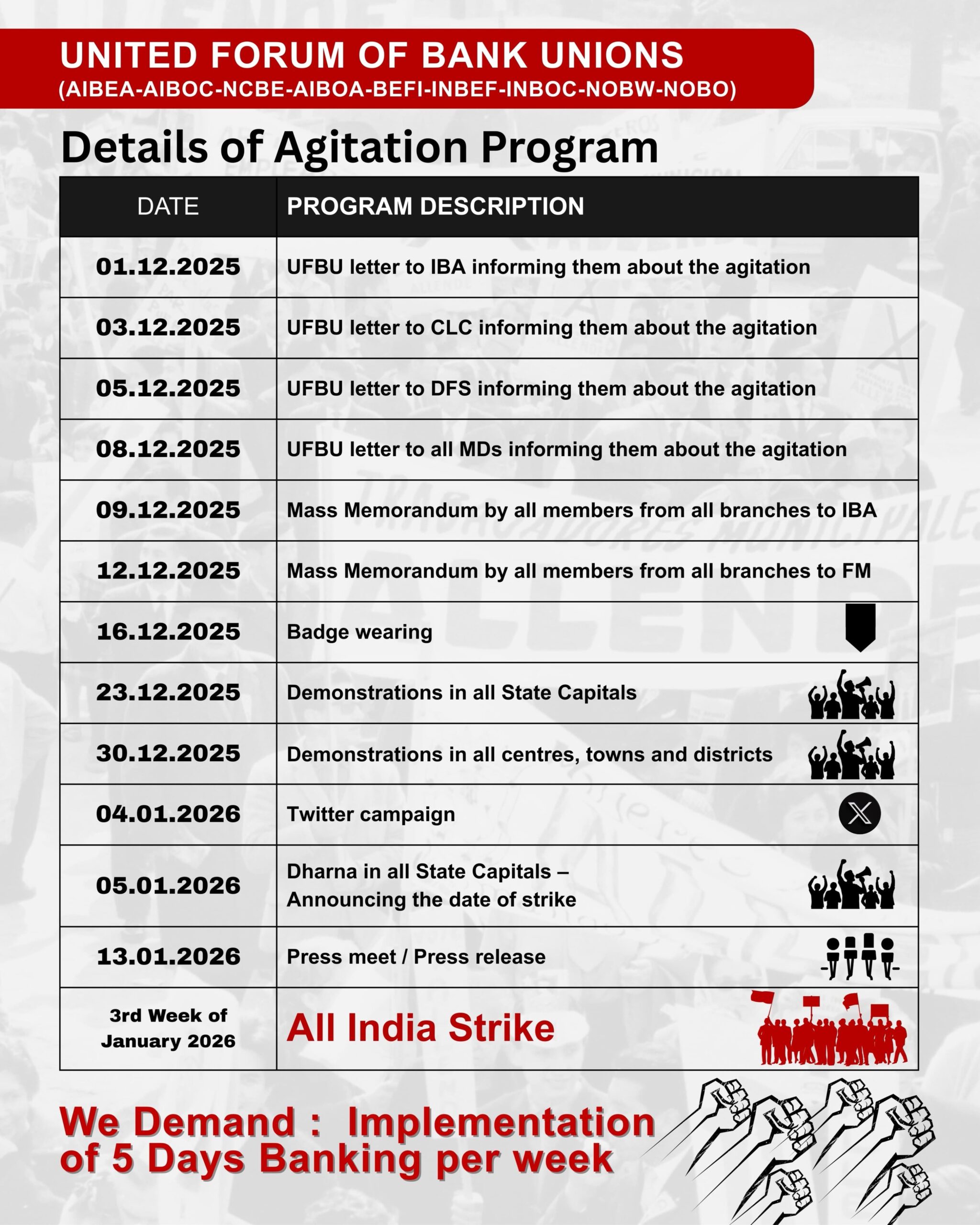
The United Forum of Bank Unions (UFBU), representing major bank unions including AIBEA, AIBOC, NCBE, AIBOA, BEFI, INBEF, INBOC, NOBW and NOBO, has unveiled a detailed nationwide agitation programme demanding the implementation of a 5-day banking week. The programme, which begins in December 2025, includes a series of coordinated actions culminating in an All-India Bank Strike in the third week of January 2026.
Timeline of Agitation Activities
1. Submission of Letters to Authorities
UFBU will initiate the campaign by formally informing key regulatory and administrative bodies:
1st December 2025: Letter to IBA (Indian Banks’ Association)
3rd December 2025: Letter to CLC (Chief Labour Commissioner)
5th December 2025: Letter to DFS (Department of Financial Services)
8th December 2025: Letter to all Managing Directors of banks
These communications highlight the unions’ concerns and officially place their demands before the authorities.
2. Mass Memorandums by Bank Employees
To demonstrate collective support from employees across the country:
9th December 2025: All members from every branch will submit a Mass Memorandum to IBA
12th December 2025: Members will submit a Mass Memorandum to the Finance Minister (FM)
3. Visible Protest Actions
UFBU has scheduled multiple on-ground and online protest activities:
16th December 2025: Badge-wearing by all employees
23rd December 2025: Demonstrations in all State Capitals
30th December 2025: Demonstrations in all centres, towns and district headquarters
These actions aim to show unity among employees while attracting public and administrative attention.
4. Digital and Public Outreach
4th January 2026: A dedicated Twitter campaign will be launched to amplify awareness among the public and stakeholders.
13th January 2026: Press Meet / Press Release to communicate the latest developments and reinforce the demand.
5. Dharna and Strike Call
5th January 2026: Dharna in all State Capitals, during which the official date of the strike will be announced.
Third Week of January 2026: All-India Strike
This strike represents the culmination of weeks of organized protests, aiming to press the government and regulatory bodies to accept the long-pending demand.
Core Demand: 5-Day Banking Week
UFBU has reiterated its primary demand—Implementation of a 5-day banking week, aligning Indian banking practices with global standards. According to the unions, reduced working days will:
Improve employee well-being
Enhance productivity
Help modernize banking operations
Ensure better work-life balance
The unions emphasize that with digitization, customer services can continue uninterrupted even with a 5-day week.
Pension Revision is included in 8th CPC recommendations, No Proposal for DA Merger – Rajya Sabha
GOVERNMENT OF INDIA MINISTRY OF FINANCE DEPARTMENT OF EXPENDITURE
RAJYA SABHA UNSTARRED QUESTION No. 252 TO BE ANSWERED ON TUESDAY, DECEMBER 2, 2025/11 AGRAHAYANA, 1947 (SAKA)
CONSTITUTION OF EIGHTH PAY COMMISSION
252 SHRI JAVED ALI KHAN: SHRI RAMJI LAL SUMAN:
Will the Minister of Finance be pleased to state;
(a) whether Government has issued notification for constitution of Eight Central Pay Commission (CPC) recently, the details thereof along with Terms of References (TOR);
(b) whether Government would merge the existing DA/DR with basic pay as an immediate relief measure for Central Government employees/pensioners, if so, the details thereof, if not, the reasons therefor; and
(c) whether revision of pension of Central Government employees is not proposed under eight CPC, the reason therefor?
Enhancement of Investment Choice Options under NPS & UPS for Central Government Subscribers: PFRDA
PENSION FUND REGULATORY AND DEVELOPMENT AUTHORITY
CIRCULAR
Circular No.: PFRDA/2025/21/Reg-PF/03
01st December 2025
To:
All NPS Stakeholders
Subject: Enhancement of Investment Choice Options under NPS & UPS for Central Government Subscribers
1. Pursuant to the Gazette Notification No. FX-4/2/2025-PR dated 13.11.2025 issued by the Ministry of Finance, Department of Financial Services, PFRDA hereby notifies the expansion of the existing Investment Choice Options under the NPS and UPS for Central Government (CG) employees. Two additional Auto Investment Choice options have been introduced, thereby increasing the total number of available choices to six.
2. The following investment choices are currently available to CG subscribers:
Existing Investment Choice under NPS and UPS
Description
Default Scheme
Contributions are invested as per the predefined asset allocation pattern managed by three Pension Funds. The asset allocation pattern under Default Scheme is attached at Annexure I for ready reference.
Active Choice (100% G- Sec)
Investment solely in Government Securities.
Auto Choice – Life Cycle 25 – Low (SE/55Y)
The Subscriber’s contribution is invested with the equity exposure of 25% until they reach 35 years and the equity allocation tapers subsequently till it reaches 5% at the age of 55 years which continues till exit
Auto Choice – Life Cycle 50- Moderate (10E/55Y)
The Subscriber’s contribution is invested with the equity exposure of 50% until they reach 35 years and the equity allocation tapers subsequently till it reaches 10% at the age of 55 years which continues till exit
3. At present, approximately 4% of CG subscribers have opted for an investment choice other than the Default Scheme.
4. In accordance with the above gazette notification, the following two additional Auto Choice options are introduced:
Additional Investment Choice Options under NPS and UPS
Description
Auto Choice – Life Cycle 75 – High (15E/55Y)
The Subscriber’s contribution is invested with the equity exposure of 75% until they reach 35 years and the equity allocation tapers subsequently till it reaches 15% at the age of 55 years which continues till exit
Auto choice – Life Cycle – Aggressive (35E/55Y)
The Subscriber’s contribution is invested with the equity exposure of 50% until they reach 45 years and the equity allocation tapers subsequently till it reaches 35% at the age of 55 years which continues till exit.
5. Subscribers opting for any alternative investment choices other than the Default Scheme shall be required to:
Exercise one of the five non-default investment options as mentioned above, and
Select one Pension Fund from among the ten Pension Funds currently registered with PFRDA.
6. Subscribers are advised to exercise their investment choice judiciously, based on a review of the performance of schemes and Pension Funds. Updated scheme-wise and PF-wise performance information is available on the NPS Trust website (www.npstrust.org.in), and subscribers are encouraged to make informed decisions.
7. PFRDA has undertaken a comprehensive review of the existing nomenclature of Auto Choice / Life Cycle (LC) Funds to ensure consistency with asset allocation patterns and age-based tapering structures. The circular issued on “Rationalization of Nomenclature of Auto Choice / Life Cycle Funds under the NPS” dated 17th October 2025 vide reference PFRDA/2025/16/Reg-PF/02 post such comprehensive review is attached at Annexure II for ready reference.
8. The enhanced investment choice options are already made available to CG subscribers by the Central Record keeping Agencies (CRAs).
9. This circular is issued in exercise of the powers conferred upon the Authority under Section 14(2)(b) read with Section 23 of the PFRDA Act, 2013, and Regulation 14(1) of the PFRDA (Pension Fund) Regulations, 2015.
Yours faithfully,
Digitally Sd/- Chief General Manager
Encl.: A/a
Annexure I
Asset Allocation under Default Scheme
Category
Investment Pattern
NPS / UPS Schemes
I
Government Securities and Related Investments
Up to 65%
II
Debt Instruments and Related Investments
Up to 45%
III
Equities and Related Investments (From 1st April 2025 limit increase to 25%)
Up to 25%
IV
Short Term Debt Instruments (Money Market)
Up to 10%
V
Asset Backed, Trust Structured and Misc. Investments – Asset class A