Heavy vacancy position on Indian Railways – NFIR writes to Railway Board
NFIR
No. II/95/Part X
Dated: 27/05/2017
The Chairman,
Railway Board,
New Delhi
Dear Sir,
Sub: Heavy vacancy position on Indian Railways leading to unbearable additional burden and serious staff discontentment – immediate action – requested
NFIR brings to your kind notice that due to accumulation of vacancies in lakhs in safety as well other than safety categories, the systems are suffering very badly and employees are heavily over burdened. Serious discontentment and unrest is prevailing among staff as they are heavily over burdened with the additional workload on account of non-filling of vacancies.
Non-creation of additional posts for maintenance of newly created assets has further aggravated the situation. New stations are opened for traffic on some Zonal Railways, but sadly new posts of Operating Staff (Station Master, Points Men etc.,) have not been created. Likewise, new Railway Lines have been opened for traffic but unfortunately safety category posts have not been sanctioned and above all, safety category vacancies continued unfilled. On some stations, no pointsmen are available while at some stations, the station masters are managing with single Points Man, facing heavy stress while performing train passing duties.
Complaints have also been received that periodic rests are denied to staff on some Zones,leave refused due to shortage of staff and at the same time shortcut methods are being resorted to for denying payment of Over
Time Allowance etc.
In C&W, S&T, TRD, TRS and Diesel Organizations, there is heavy shortage of staff as the norms/yard sticks are not being followed, consequently staff are put to sufferings. There is also heavy shortage of Supervisory Staff in the Technical and Operational categories. On some Zones, the shortage of Track Maintainers is so heavy that for patrolling duties, Tiack Maintainers are not available. It is no exaggeration to frankly state that crisis situation has developed on Railways mainly on account of heavy shortage of staff.
NFIR wants to convey to the CRB without mincing words that any delay in filling the vacancies and creating new posts in safety categories for maintaining newly created assets would cause serious setback to the Railways’ efficiency. The Federation further conveys that the Railway employees are very restive, extremely unhappy and angry over the failure of Railway Board in filling the vacancies.
Federation therefore, requests you to kindly take a realistic view and see that approval is given for filling vacancies and creating new posts immediately to save the Railways and equally preserve healthy industrial relations
Withdrawal under paragraph 68-BD of EPF Scheme, 1952 for housing needs of the PF members
Employees’ Provident Fund Organisation
(Ministry of Labour & Employment, Govt. of India)
Head Office
Bhavishya Nidhi Bhawan, 14-Bhikaiji Cama Place, New Delhi-l 10066
No: WSU/39(1)2017/Housing Scheme/4106
Date: 24.05.2017
To
All Addl. CPFC (HQ/ Zone),
Regional P.F. Commissioners-incharge of
Regional Offices.
Sub: Withdrawal under paragraph 68-BD of EPF Scheme, 1952 for housing needs of the PF members.
Ref: HO circular dated of even numbers dated 21.04.2017, 02.05.2017 & 19.05.2017
Sir,
Please refer to the above said subject.
2. There are a number of State Housing Boards or other authorities owned by the Government which construct and sell houses. In certain cases their houses remain unsold. Considering this, it is advised that RPFCs-incharge of ROs should contact all such Housing Board/authorities in their jurisdiction and persuade them for allotment of such unsold houses directly to the PF Workers’ Cooperative Societies but EPFO shall not recommend or be associated in the agreement with any particular housing agency/housing society. RPFCs should also discuss the issue with PF Workers’ Union and employers of establishments for formation of cooperative societies so that the concerned society may also negotiate with such Housing Board/ authorities.
3. Accordingly, it is advised that provisions of paragraph 68-BD of EPF Scheme, 1952 be given due focus and publicity by all such possible means in the interest of the workers.
Yours faithfully,
S/d,
(K.L. Taneja)
Addl. Central P.F. Commission (Housing)
DOPT Clarification on 7th CPC bunching of stages in the revised pay structure
No.20011/1/2016-AIS-II
Government of India
Ministry of Personnel, Public Grievances and Pension
Department of Personnel & Training
New Delhi, dated the 25th May, 2017
To,
The Chief Secretaries of all States/UTs
The Joint Secretaries (Admn.) of all Ministries/Departments.
Subject: Recommendations of the 7th Central Pay Commission – bunching of stages in the revised pay structure-reg.
Sir,
I am directed to say that after revision of pay scales w.e.f 01.01.2016, the pay of a member of Service drawing pay at two or more stages in pre-revised Pay Band and Grade Pay or scale and gets fixed at same Cell in the applicable Level in the new Pay Matrix, one additional increment shall be given for every two stages bunched and the pay of member of Service drawing higher pay in pre-revised structure shall be fixed at the next vertical Cell in the applicable Level as per the Proviso (a) to Rule 4 (A) of the IAS (Pay) Rules, 2016
2. However, this Department has been receiving queries from various Ministries/Departments/State Governments for fixation of pay in respect of members of Service whose pay gets fixed at the same Cell,in the applicable Level in the new Pay Matrix. The matter was clarified vide OM No.13021/1/2016-AIS-I (Pt.2) dated the 10th October, 2016 (copy enclosed). It is once again clarified that as per Rule 4 (A)(ii) of IAS (Pay) Rule, 2016, in cases of fixation of pay of IAS officers drawing pay at two or more stages in the pre-revised Pay Band and Grade Pay gets fixed at the same Cell in the applicable Level of the Pay Matrix, one additional increment may be given for every two stages bunched so that the pay of the member of Service drawing higher pay in the pre-revised structure is fixed at the next vertical Cell in the applicable Level.
Illustration:
If two members of Service drawing pay of Rs.53000 and Rs.54590 in the GP 10000 are to be fitted in the new pay matrix, the member of Service drawing pay of Rs.53000 on multiplication by a factor of 2.57 will expect a pay corresponding to Rs.1,36,210 and the member of Service drawing pay of Rs.54590 on multiplication by a factor of 2.57 will expect a pay corresponding to Rs. 1,40,296. Revised pay of both should ideally be fixed in the first cell of level 14 in the pay of Rs. 1,44,200 but to avoid bunching the member of Services drawing pay of Rs.54590 will get fixed second cell of level 14 in the pay of Rs.1,48,500.
2. This issues with the approval of the competent authority.
Yours faithfully,
(Rajesh Kumar Yadav)
Under Secretary to the Government of India
Atal Pension Yojana (APY) reaches 53 lakhs subscribers’ base
235 Banks and Department of Post involved with APY implementation
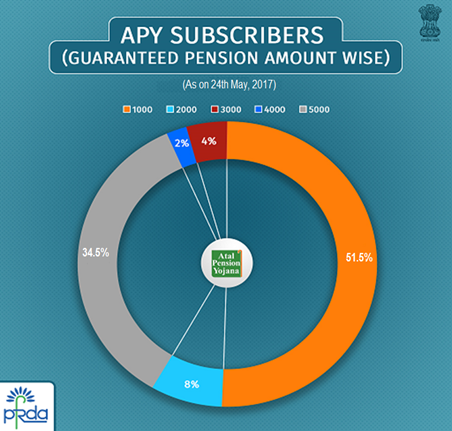
97.5% of the subscribers contributing at monthly intervals; 51.5% subscribers have opted for a monthly pension of Rs. 1000
The subscribers base under the Atal Pension Yojana (APY) has reached about 53 Lakhs. At present 235 Banks and Department of Post are involved with the implementation of the scheme. Besides the branches of the banks and CBS-enabled offices of India Post, quite a few banks are sourcing subscribers through their internet banking portals in a paperless environment.
The APY Scheme follows the same investment pattern as applicable to the NPS contribution of Central Government employees. During the year 2016-17, it has earned a return of 13.91%.
With a view to empower the APY subscribers, new functionalities have been developed where under a subscriber can view and print the ePRAN card and Statement of Transactions. Further, the subscriber can register complaints/ grievance by providing his/ her PRAN details on https://npslite-nsdl.com/CRAlite/grievanceSub.do.
Presently males account for 62% of the subscribers and female for about 38%. Most of the subscribers have opted for monthly contribution; about 97.5% of the subscribers are contributing at monthly intervals, about 0.8% at quarterly intervals and about 1.7% at half yearly intervals.
A majority of the subscribers have opted for a monthly pension of Rs. 1000/-. Presently 51.5% subscribers have opted for a monthly pension of Rs.1000/- and 34.5% of the subscribers have opted for a monthly pension of Rs.5000/-. Pension amount wise segmentation of the subscribers is shown in Figure 1.
Figure 1: Pension amount wise segmentation of the APY subscribers
The Atal Pension Yojana became operational from 1st June, 2015 and is available to all the citizens of India in the age group of 18-40 years. Under the scheme, a subscriber would receive a minimum guaranteed pension of Rs.1000 to Rs. 5000 per month, depending upon his contribution, from the age of 60 years. The same pension would be paid to the spouse of the subscriber and on the demise of both the subscriber and the spouse, the accumulated pension wealth is returned to the nominee.
Implementation of Revision of Pension of Pre 1.1.2016 Pensioners/Family Pensioners in pursuance to DP&PW OM 38/37/2016-P&PW (A) dated 12th May 2017 and Ministry Of Finance (Deptt.Of Expenditure) OM No.1(13)/EV/2017 dated 23rd May, 2017.
1. Reference is invited to DP&PW OM No.38/37/2016-P&PW(A) dated 12-05-2017 regarding revision of pension of Pre-2016 retirees under 7th CPC. As per Para 4 of this OM, it has been decided that the revised pension/family pension w.e.f. 01.01.2016 in respect of all Central Civil Pensioners/Family Pensioners, including CAPF’s who retired/died prior to 01.01.2016, may be revised by notionally fixing their pay in the pay matrix recommended by the 7th CPC in the level corresponding to the pay in the pay scale/pay band and grade pay at which they retired/died. This will be done by notional pay fixation under each intervening Pay Commission based on the Formula for revision of pay. While fixing pay on notional basis, the pay fixation formula e approved by the Government and other relevant instructions on the subject in force at the relevant time shall be strictly followed. 50% of the notional pay as on 01.01.2016 shall be the revised pension and 30% of this notional pay shall be the revised family pension w.e.f. 1.1.2016 as per the first Formulation. In the case of family pensioners who were entitled to family pension at enhanced rate, the revised family pension shall be 50% of the notional pay as on 01.01.2016 and shall be payable till the period up to which family pension at enhanced rate is admissible as per rules.
2. As per Para 18 of this OM, the Pension Sanctioning Authority would impress upon the concerned Head of Office [HOO) for fixation of pay on notional basis and issue revised authority at the earliest. The revised authority will be issued under the existing PPO number and would travel to the Pension Disbursing Authority through the same channel through which the original PPO had travelled.
3. Reference is also invited to Ministry of Finance (Deptt. of Expenditure) OM No.1(13)/EV /2017 dated 23-May,2017 mentioning procedural points of action to be taken by concerned agencies including Pension Accounting Authorities & PAOs.
4. To facilitate early revision of pension and monitoring timely progress in this regard as required by aforesaid OM, course of actions are brought out below:
i.List of all the live cases available in CPAO along with details of last pay [wherever available] due for pension revision under 7th CPC will be provided to the Pay and Account 0fficers (PAOsJ in their logins under CPAO website www.cpao.nic.in by 31st May, 2017 to provide the details to concerned Head of Offices within 3 days and coordinate with them for getting the revised pension cases at the earliest. PAOs/HOOs may also check their records to verify actual number ofcases.
ii.In the meanwhile, since all the service records/details of the pensioners are available with the respective HOOs from where they retired/died, HOOs are required to check their records and start revising the pension in terms of Para 4 of the aforementioned OM of the DP&PW forrhwith. Pr. CCAs/CCAs /CAs/AGs/Administrators of UTs may monitor number of such cases received at PAOs and submit a report to CPAO by 31st May,2017.
iii. For the expeditious revisions of these pension cases, CPAO has developed an e-revision utility which has facility of sending online revision authorities from PAOs to CPAO under the digital signatures of PAOs. PAOs are required to revise pension cases through e-revision utility. Since under this utility, revision authorities would be sent under the digital signatures, pension processing PAOs are urgently required to arrange digital signatures and their registration on PFMs, if not done so far. In unavoidable circumstances to avoid delay, PAOs may process the pension cases manually as hitherto and send the paper based revision authorities to CPAO in the format given at Annexure.
iv. The list as mentioned at (i) above will also be provided under the logins/dashboard of chief controller of accounts and joint secretary (Admn)/Adma in charge of the Ministries/Departments on CPAO website. Joint Secretary (Admn)/Admn in charge may also distribute the list of pension cases to the HOOs falling under their administrative control and monitor the progress of Pension revisions at HOOs level. similarly, Pr.CCAs/CCAs/CAs/AGs/Administrators of UTs may keep a watch on the progress of the revision of cases received from HOOs to PAOs.
v. To facilitate effective monitoring of progress of revision at each level i.e. CCA/JS(Admn)/PAO, relevant progress reports would be available on CPAO website under logins/dashboards of respective authorities. On the basis of these reports, periodical review meetings may be held at the Ministry/Deptt./Organization level.
vi. In those cases, where 2.57 multiplication method of pension fixation is beneficial under DP&PW OM No.38/37/2016-P&PW (A) (ii) dated 4/08/2016, revised pension authority under 2.57 multiplication methods will also require to be issued by HOOs/PAOs for updation of records at CPAO & Banks as well as for information of pensioners by CPAO. However, HOOs/PAOs while revising the pension may prioritize the cases which are beneficial to the pensioners under pay fixation method. To cover large number of cases, in less time Pr.CCAs/CCAs/CAs/AGs/Administrators of UTs & JS(Admn) of Ministries/Deptts./Organization may identify the cases where revisions may be effected easily without involving multiple steps e.g.revisions of pension of those pensioners who retired/died during the period from 1.1.2006 to 31.12.2015 and whose pension is already fixed under 6th CPC.
vii. Pr.CCAs/CCAs/CAs/AGs/Administrators of UTs may nominate a Nodal Person/Key Resource Person (KRP) to coordinate with CPAO regarding any issues related with pension revisions and use of e-Revision utility. In case of any difficulty in the use of e-Revision utility Sh.Davinder Kumar, Technical Director, NIC, CPAO may be contacted on Telephone No.011-26715338 and [email protected]. If required, officials of Ministries/Departments/PAOs may also visit CPAO on every Wednesday to resolve their issues related with pension revisions.
In view of the above, Pr.CCAs/CCAs/CAs/AGs/Administrators of UTs are requested to follow the above guidelines and issue necessary instructions to their PAOs for early revision of Pre-2016 pension cases under 7th CPC. They are further requested to Coordinate with their JS(Admn)/Admn in charge/HODs for timely submission of revised pension cases by the HOOs to PAOs and monitor the progress in this regard.
This issues with the approval of controller General of Accounts.
Extension of 7th CPC benefits and grant of Dearness Relief to Pensioners of Autonomous/Statutory bodies under Administrative Control of Department of Commerce
F.No. F-20016/04/2016-E-111
Ministry of Commerce and Industry
Department of Commerce
E.III Section
Udyog Bhawan, New Delhi-110107
Dated: 23rd / 25th May, 2017
OFFICE MEMORANDUM
Sub: Extension of 7th CPC benefits and grant of Dearness Relief to Pensioners of Autonomous/Statutory bodies under Administrative Control of Department of Commerce.
The undersigned is directed to refer to e-mail dated 14th May, 2017 (copy enclosed) received from Pensioners’ Associations of Statutory/Autonomous Bodies of Central Government on the above subject and to say that the 7th CPC orders issued by Department of Pension and Pensioners’ Welfare are not applicable to the pensioners of Autonomous/Statutory bodies.
2. The concerned administrative Divisions dealing with Autonomous/Statutory bodies under Department of Commerce are, therefore, requested to take necessary action accordingly.
Revision of minimum wage payable to Temporary status Casual Labourers
Ref: Confdn/Genl/2016-19
Dated – 25.05.2017
To,
The Secretary
Department of Personnel & Training
Government of India
North Block, New Delhi – 110001
Sir,
Sub:- Revision of minimum wage payable to Temporary status Casual Labourers – reg.
The minimum wage payable to Temporary Status Casual labourers is revised, every time when the minimum pay of Central Government employees is revised. Eventhough the notification revising the minimum pay of Central Government employees with effect from 01.01.2016 was issued by Government on 25.07.2016, the minimum wage of Temporary status Casual labourer is not yet revised. Pending revision, they are being now paid the minimum wage as per the 6th CPC wage revision.
It is requested that necessary action may be taken for revision of minimum wage payable to Temporary status Casual labourers working in various Central Government department.
Yours faithfully,
(M. Krishnan)
Secretary General &
Standing Committee Member
National Council JCM
Dept of Post : Revision of pension of pre- 2016 pensioners / family pensioners
No. 4-3/2017-Pension
Government of India
Ministry of Communications
Department of Posts
(Pension Section)
Dak Bhawan, Sansad Marg,
New Delhi – 110 001
23rd May, 2017
To
All Head(s) of Circles
All Directors/Dy. Directors of Accounts (P)
APS Headquarter
Head of PLI and BD Directorate
Director, Postal Staff College, Ghaziabad
All Directors of Postal Training Centres
Sub: Implementation of Government’s decision on the recommendations of the Seventh Central Pay Commission- Revision of pension of pre- 2016 pensioners/family pensioners etc-reg.
2.The pension/family pension of all pre-2016 pensioners/family pensioners shall be revised in line with instructions contained in the DoP&PW OM. dated 12.05.2017. The higher of the two formulation i.e. (i) the pension/family pension already revised in accordance with DoP&PW O.M. dated 4.8.2016 or (ii) the revised pension/family pension as worked out in accordance with para 4 of the DoP&PW OM. dated 12.5.2017, shall be treated as revised pension/family pension w.e.f 1.1.2016. It shall be the responsibilities of the Head of Department and concerned Director of Accounts (Postal) to revise the pension/family pension of pre-2016 pensioners/family pensioners w.e.f 1.1.2016 in accordance with these orders and to issue a revised pension payment authority.
3.As envisaged in the DoP&PW O.M., the Pension sanctioning Authority (PSA) would impress upon the concerned Head of Office for fixation of pay on notional basis at the earliest. The information can be obtained in Proforma A. Based on notional pay so fixed, the revision proposal will be sent by Pension Sanctioning Authority to concerned DA (P) to apply necessary checks and issue revised authority under the existing PPO number. To facilitate fixation of notional pay, DA (P) will provide copy of PPO/pension papers to concerned PSA immediately on requisition. All PSAs will maintain records of processing cases of retirees year-wise in Proforma 8. DA (P) will maintain data of proposal received and authority issued in software as has been done in case of 6th CPC revision of PPOs.
4.Since there will be large number of cases for revision, concerted efforts of all authorities will be required to accomplish the task. It is requested to take immediate action for revision of pension/family pension at the earliest.
Sub: Brief of the meeting held today with the Cabinet Secretary (Government of India)
Today I met the Cabinet Secretary(Government of India) and handed him over a copy of our letter regarding inordinate delay in implementation of the report of the Ashok Lavasa Committee on Allowances.
Also shown him our anguish regarding other demands, pending with different committees, such as Minimum Wage, Fitment Formula and NPS, etc. etc.
The Cabinet Secretary said that, he has fixed date of 1st June, 2017 for perusal of the report of the Allowances Committee by the Empowered Committee, and soon after that, he will send a memorandum to the Cabinet for their consideration.
7th CPC Allowances should be implemented without any further delay : NCJCM
No.NC/JCM/2017
Dated: May 23, 2017
The Cabinet Secretary,
(Government of India),
Cabinet Secretariat,
Rashtrapati Bhawan,
New Delhi
Dear Sir,
Sub: Inordinate delay in implementation of the report of the Committee on Allowances
It is a matter of regret that, in spite of all the persuasions made by the Staff Side(JCM) there is inordinate delay in finalization of recommendations of the Ashok Lavasa Committee on Allowances. More than one year and three months have passed after implementation of the report of the VII CPC, but the employees are still getting allowances at the old rates as had been recommended by the VI CPC.
The Committee on Allowances took longer time while finalizing its recommendations, but it is a matter of deep regret that, even after submission of the report by the said committee, the same has not been made available to the Staff Side(JCM), therefore, we do not know what recommendations have been made by the said committee.
Staff Side(JCM), therefore, requests that the recommendations of the Allowances Committee should be made available to the Staff Side(JCM).
Moreover, it would be highly appreciated that, the Allowances should be implemented without any further delay, and the date of the implementation should be w.e.f. 01.01.2016.