Consumer Price Index for Industrial Workers (CPI-IW)-December, 2016
The All-India CPI-IW for December, 2016 by 2 points and stood 275 (two hundred and seventy five). On 1-month percentage change, it decreased by (-) 0.72 per cent November and December, 2016 when compared with the decease of (-) 0.37 per cent between the same two months a year ago.
The maximum downward pressure to the change in current index came from Food group conuibuting (-) 2.74 percentage points to the total change. At item level, Arhar Dal, Gram Dal, Masur Dal, Urd Dal, Groundnut Oil, Muslard Oil, Chillies Green, Ginzer, Brinjal, Cabbage, Carrot, Cauliflower, French Beans, Gourd, Green Coriander Leaves, Methi, Palak, Peas, Potato, Radish, Tomato, Banana, Lemon, etc. are responsible for the decrease in index. However, this decrease checked by Rice, Wheal, Wheat Alta, Coconut OiL Fish Fresh, Goat Meat, Milk Snack Saltish, Cooking Gas, ESI Premium Contribution, Petrol, Flowe/Flower Garlands, Toilet Soap, etc., putting upward on the index.
The year-on-year inflation measured by monthly CPI-IW stood at 2.23 per cent for December, 2016 as compared to 2.59 per cent for the pervious month and 6.32 per cent during the corresponding month of the previous year. Similarly, the Food inflation stood at 0.67 per cent against 1.66 per cent of the previous month and 7.94 per cent during the corresponding month or the previous year.
At centre level, Rourkela reported the maximum decrease or 10 points followed by Vadodara (9 points), Nagpur and Lucknow (8 points each) and Amritsar, Varanasi and Monger Jamalpur (6 points each). Among others, 5 points decrease was observed in 7 centres, 4 points in 12 centres, 3 points in 9 centres, 2 points in 15 centres and 1 point in 10 centres. On the contrary, Quilon recorded maximum increase of 6 points followed by Ernakulam and Mundakkayam (3 points each). Among others, 2 points increase was observed in 4 centres and 1 point in 4 centres. Rest or the 7 centres indices remained stationary.
The indices or centres are above All-India Index and other 43 centres indices are below national average. The index or Vishakhapathnam centre remained at par with All-India Index. The next or CPI-IW fer the month of January, 2017 will be released on Tuesday, 28th February, 2017. The same will also be available on the office website www.labourbureaunew.gov.in
Aadhar enabled Biometric Attendance System for marking attendance
Principal Controller of Defence Account; (Central Command), Carriapa Road, Lucknow Cantt, Pin-226002
Circular
No.AN/1A/1004/Misc/2017
Dated:27/01/2017
To
The CDA, RTC Lucknow
All Sub Offices
(under the organisation including IFAs)
All sections in main office
Sub:– Aadhar enabled Biometric Attendance System for marking attendance.
The Department of Personnel & Trair ing vide letter No. 11013/9/2014-Estt(A-III) dated 21st November 2014 (circulated vide Hqrs Office letter No. AN/lll/3012/Misc/BAS dated 20.02.2015) has decided to use an AADHAR based Bio-metric Attendance System (AEBAS) in all offices of the Central Government, including attached/sub-ordinate offices in India.
Biometric Attendance System is only an enabling platform. There is no change in the instructions relating to office hours, late attendance etc. which will continue to apply. As per extant instructions, half-a-day’s Casual leave should be debited for each day of late attendance, but late attendance upto an hour, on not more than two occassions in a month, and for justiafiable reasons may be condoned by the competent authority. In addition to debiting Casual Leave(or Earned Leave, when no CL is available) disciplinary action may also be taken against government servants who are habitually late. Early leaving is also to be treatE d in the same manner as late coming.
Therefore, all the staff and officers will mark their attendance through AEBAS only. The manual attendance may be discontirwed immediately.
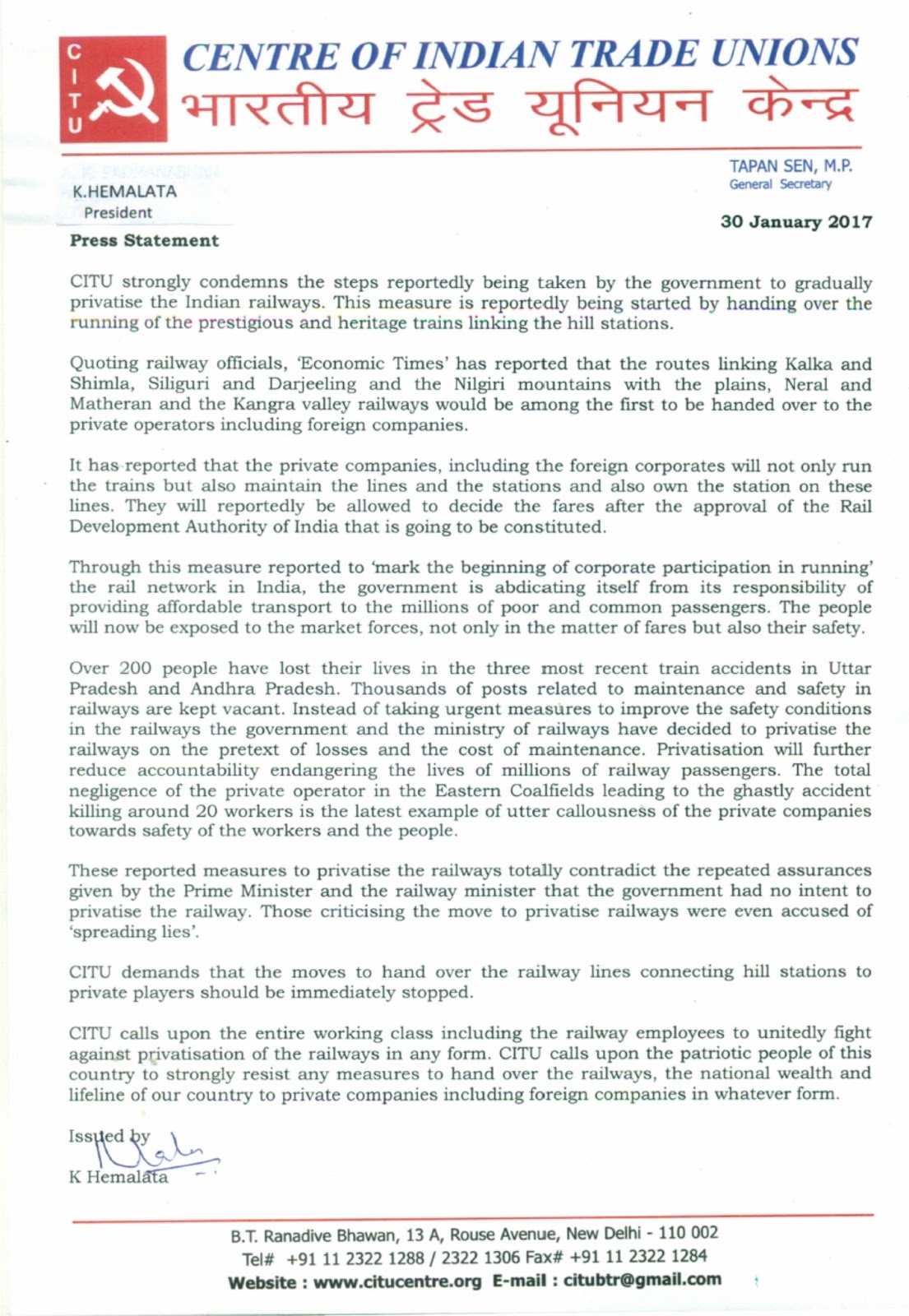
CITU strongly condemns the steps reportedly being taken by the government to gradually privatise the Indian railways.
CENTRE OF INDIAN TRADE UNIONS
K.HEMALATA
President
TAPAN SEN, M.P
General Secretary
30 January 2017
Press Statement
CITU strongly condemns the steps reportedly being taken by the government to gradually privatise the Indian railways. This measure is reportedly being started by handing over the running of the prestigious and heritage trains linking the hill stations.
Quoting railway officials, ‘Economic Times’ has reported that the routes linking Kalka and Shimla, Siliguri and Darjeeling and the Nilgiri mountains with the plains, Neral and Matheran and the Kangra valley railways would be among the first to be handed over to the private operators including foreign companies.
It has reported that the private companies, including the foreign corporates will not only run the trains but also maintain the lines and the stations and also own the station on these lines. They will reportedly be allowed to decide the fares after the approval of the Rail Development Authority of India that is going to be constituted.
Through this measure reported to `mark the beginning of corporate participation in running’ the rail network in India, the government is abdicating itself from its responsibility of providing affordable transport to the millions of poor and common passengers. The people will now be exposed to the market forces, not only in the matter of fares but also their safety.
Over 200 people have lost their lives in the three most recent train accidents in Uttar Pradesh and Andhra Pradesh. Thousands of posts related to maintenance and safety in railways are kept vacant. Instead of taking urgent measures to improve the safety conditions in the railways the government and the ministry of railways have decided to privatise the railways on the pretext of losses and the cost of maintenance. Privatisation will further reduce accountability endangering the lives of millions of railway passengers. The total negligence of the private operator in the Eastern Coalfields leading to the ghastly accident killing around 20 workers is the latest example of utter callousness of the private companies towards safety of the workers and the people.
These reported measures to privatise the railways totally contradict the repeated assurances given by the Prime Minister and the railway minister that the government had no intent to privatise the railway. Those criticising the move to privatise railways were even accused of ‘spreading lies’.
CITU demands that the moves to hand over the railway lines connecting hill stations to private players should be immediately stopped.
CITU calls upon the entire working class including the railway employees to unitedly fight against privatisation of the railways in any form. CITU calls upon the patriotic people of this country to strongly resist any measures to hand over the railways, the national wealth and lifeline of our country to private companies including foreign companies in whatever form.
Clarification on purchase of Air Tickets from unauthorized agents
GOVERNMNET OF INDIA
MINISTRY OF DEFENCE
OFFICE OF THE PRINCIPAL CONTROLLER OF ACCOUNTS (FYS)
No. T/1/72/Circular – 36
Dated : 05/01/2017
To
1. The Secretary, OFB, ID-A, S.K. Bose Rd, Kol-01
2. All Sr. General Managers/All General Managers Ordnance/ Equipments Factories.
3.All Group controllers & Branch AOs
Sub: Clarification on purchase of Air Tickets from unauthorized agents for non- entitled officials to travel by air
Kindly refer to DoP&T letter No.31011/3/2015-Estt(A.lV) dated 18/02/2016 wherein it is mentioned under points 14 & 15 that Govt employees not entitled to travel by air, may travel by any airline. However, reimbursement in such cases shall be restricted to the fare of their entitled class of train/transport or actual expense, whichever is less. In all cases whenever a Govt servant claims LTC by air, he/she is required to book the air tickets either directly through the airlines or through the approved travel agencies viz M/s Balmer Lawrie & Co. Ltd/ M/s Ashok Tours & Travels Ltd/ IRCTC. Booking of tickets through any other agency is not permissible.
This is for your information, guidance and necessary action please.
Typewriting Test Exemption – Implementation of instructions of DOP&T issued vide their letter dated 22.04.2015
GOVERNMENT OF INDIA/BHARAT SARKAR
MINISTRY OF RAILWAYS/RAIL MANTRALAYA
(RAILWAY BOARD)
No.E(NG)I-2015/CFP/7
New Delhi, dated 16.01.2017
The General Managers (P)
All Zonal Railways & Production Umts.
(As per standard list)
Sub:- Exemption from passing the Typewriting Test – Implementation of instructions of DOP&T issued vide their letter dated 22.04.2015.
Ministry of Personnel, Public Grievances and Pensions, Department of Personnel & Training , in their O.M. No.14020/2/91-Estt(D) dated 29.09.1992 had issued certain instructions/guidelines regarding exemption from passing the Typewriting Test. The same has been reiterated vide their O.M. No.14020/1/2014-Estt.(D) dated 22.04.2015.
2. Both the Federations viz. AIRF and NFIR have also raised this demand in the PNM forum. Accordingly, matter has been deliberated in consultation with concerned directorates and it has been decided by the Board to adopt the stipulations made in DOP&T’s OMs ibid (copies enclosed) mutatis mutandis to persons appointed/promoted as Junior Clerks, Accounts Clerk against promotion quota, sports persons recruited against sports quota, those appointed on compassionate grounds, under Scouts & Guide and cultural quota, re-deployed medically unfit Railway servants on alternetive posts re-deployed surplus staff and also physically handicapped railway servants, as per prevailing rules. The procedure of conducting of the typing test whether it is on manual type writer or on Personal Computer as contained in Board’s letter No.E(NG)I-2004/CFP/8 dated 04.02.2011 will remain unaltered.
3. The above instructions will take effect from the date of issue of this letter. Cases already decided in the past need not be re-opened.
Please acknowledge receipt.
(MK Meena)
Deputy Director Estt. (N)
Railway Board
NFIR’s proposals for General Budget 2017-18 – Income Tax Slab, HRA, TA
No.IV/Budget/Part III
23.01.2017
Shri Arun Jaitley,
Hon’ble Minister of Finance,
North Block, New Delhi.
Dear Sir,
Sub: General Budget 2017-18 – NFIR’s proposals for consideration
The National Federation of Indian Railwaymen (NFIR) requests the Hon’ble Finance Minister to consider its proposals listed below for inclusion in the General Budget 2017-18 to be presented in Parliament in February, 2017.
1. The Income Tax exemption limit for Central Government Employees may be raised to atleast Rupees Six Lakhs
2. The Income Tax exemption limit for senior citizens may be raised to Rs.7.5 lakhs and for those Senior Citizens above 75 years age, the exemption be allowed up to Rs.10 lakhs.
3. Transport Allowance presently paid to the Central Government Employees may be exempted from the purview of Income Tax.
4. Fixed Medical Allowance to the retired Central Government Employees may be revised to not less than Rs.2,000/- Per month.
5. Grant House Rent Allowance at the rate of 30%, 20% & 10% of 7th CPC Pay to the Central Government Employees working at Cities/Towns classified as ‘X’ ‘Y’ &’Z’ respectively with back date.
6. Contract Labour performing jobs of perennial nature be granted wages at par with the regular employees performing similar jobs.
7. Child Care Leave for women employees be revised upwardly.
8. Pension parity be granted all those pre 1.1.2016 Pensioners of Central Government.
Proposals – Railway Specific
9. Additional funds be allocated for augmenting Railway Training Institutes and Railway Community Halls, Recreation Clubs etc’.
10. More funds may be provided for construction of new quarters in the Railways and for maintenance of Railway colonies.
11. Training Allowance for Trainers in Railways Training Institules may be enhanced to 30% of pay in lieu of the existing 15%.
12. Separate Rest Rooms for Women Railway Employees at different locations be sanctioned to enable them to stay when they visit on railway duties.
13. Additional Road Mobile Medical Vans may be approved for providing medical treatment to the railway employees and their families living at remote places and jungle stations.
KAMALESH CHANDRA COMMITTEE REPORT ON GDS – ONE STEP FORWARD
Sri Kamalesh Chandra, Retired Member, Postal Services Board & Chairman Gramin Dak Sevak Committee has submitted it’s report to Government on 24th November 2016. Even though earlier GDS Committee reports were published on the same date of submission itself , this time the Postal Board kept it pending for two months and published only on 19th January 2017. Against the unjustified delay in publishing the report , NFPE & AIPEU – GDS conducted series of agitational programmes like protest demonstrations , mass dharnas and finally declared indefinite hunger fast of Secretary General and all other General Secretaries in front of Postal Directorate (Dak Bhavan) from 18th January 2017.
The main recommendations of the Committee relates to simplification and rationalisation of categories of GDS and the number of Time Related Continuity Allowance (TRCA) slabs, increasing the wages of GDS and other welfare measures of GDS. The Committee has not attempted to analyse the justification of our demand for grant of Civil Servant status to GDS and has refrained from making any recommendations on the legal status of the GDS stating that the matter is presently subjudice and hence left it to the outcome of the court case. The committee , however , observed that there is a tendency to withhold the legitimate demands of GDS which are due to them , based on the apprehension that they will get closer to regular employees , and their claim for regularisation will be strengthened in the court of law , if such demands are allowed.
The Committee has further observed that the future survival of the Postal department will largely depend on the successful management of the GDS post offices, which effectively form it’s “soul” and it would be difficult for the department to survive without the “soul”. The Committee felt that the India Post Payment Bank (IPPB) which is going to be rolled out shortly , will use the strength of the GDS network and experiences of more than 2.60 lakhs trustworthy Gramin Dak Sevaks.
Under the new wage structure recommended by the Committee, eleven (11) TRCA slabs are subsumed into three (3) wage scales with two levels each for Branch Postmasters (BPMs) and for other than BPMs. Out of three wage scales , one scale will be common to both categories of GDS. The minimum scale for GDS other than BPM is fixed as 10000 for 4 hours duty and the minimum scale for 5 hours duty is 12000. Similarly, the minimum scale for BPM with 4 hours duty is fixed as 12000 and minimum scale for 5 hours duty is 14500. There will be only three categories of GDS with nomenclature BPM, Assistant BPM and GDS. All GDS working in Branch Post offices (other than BPM) are re-designated as Assistant Branch Post Masters (ABPM). All GDS working in Departmental Post offices are designated as Gramin Dak Sevaks (GDS).
The minimum working hours of GDS is fixed as 4 hours (Level – 1) , instead of 3 hours at present and maximum working hours is 5 hours (Level – 2). Point system for assessment of workload of BPM is abolished. The new wage structure is linked to revenue generation of GDS Branch Post offices. Based on revenue generation , all GDS Post offices will be categorised as A(Green), B (Orange) , C (Pink) , D (Red) and efforts to be undertaken by the GDS BPM and the departmental officers to increase revenue of each category is explained in detail in the report. Committee has recommended that existing TRCA should not be reduced. If the BPM in the category D (which is the lowest category as per revenue earning) is not ready to improve the revenue earning , extension of working hours of Post office , stoppage of increment , withholding of promotion under financial upgradation scheme , relocation of the Post office etc are also recommended. The GDS BPM will be paid a revenue linked additional allowance @10% beyond level – 2 wage scale , if the revenue earned exceeds the limit fixed for category “A” offices. The increment rate recommended is 3%.
The other major recommendations are (a) Composite Allowance comprising of support for hiring accommodation , office maintenance , electricity charges etc (b) Children Education Allowance (c) three promotions (financial up gradations ) on completion of 12 ,24 and 36 years. (c) Enhancement of ex-gratia ceiling and Group Insurance Scheme amount (d) 26 weeks maternity leave for women GDS and one week Paternity leave (e) 30 days General leave (instead of paid leave) with provision for carry forward and leave surrender benefit upto 180 days of accumulated General leave at the time of retirement ( f ) five days Emergency leave like casual leave (g) Minimum one year service for writing promotional examination (h) liberalisation of grants and financial assistance from welfare fund and (h) Risk and hardship allowance.
Regarding Pension, no major change is recommended by the Committee, except increase in severance amount and increase in contribution to Service Discharge Benefit Scheme (SDBS). Similarly, there is no favourable recommendation regarding medical facilities. While recommending that the existing policy of relocation /redeployment should be vigorously pursued to relocate GDS post offices which are not justified as per norms, the Committee had also recommended that the department should not order closing of any GDS post office to further reduce the existing number of GDS post offices. The existing rule that the maximum hours of duty of GDS should not go beyond five hours , is retained by the Committee. There is also a recommendation that two separate unions should be formed for GDS, one exclusively for BPMs and one for all other categories of GDS.
Now comes the question of implementation. Normally Department will appoint a Postal Board Member to study and process the recommendations of the GDS committee for implementation. Then Postal Board has to approve it after seeking the comments of Joint Secretary & Financial Advisor. Then it is to be approved by other nodal Ministries like Department of Personnel & Training, Ministry of Finance, Law Ministry etc. After completing all these process, the final proposal will be submitted to Cabinet for approval.
NFPE & AIPEU – GDS will be making an in depth study of the recommendations and shall submit a detailed memorandum to the Department demanding immediate implementation of the favourable recommendations and also demanding modifications , improvement and rejection where ever required. NFPE & AIPEU -GDS will make sincere effort to get maximum benefits to the GDS. In case Government refuse to implement or dilute the favourable recommendations NFPE & AIPEU GDS will not hesitate to organise serious trade union action including indefinite strike.
All of us should keep in mind that the favourable recommendations of the GDS committee is a product of sustained struggles conducted by the entire Postal employees under the banner of NFPE , AIPEU -GDS , PJCA and Confederation of Central Government Employees and Workers. Let us be ready for the 16th March 2017, one day strike, for further improvement of our service conditions. Let us unitedly fight and shall not rest till our final goal ie; civil servant status to GDS is achieved. No doubt, Kamalesh Chandra Committee report is ONE STEP FORWARD. Let us hope for the best.
Payment of GPF final payment to the retiring Government servant
No.3/3/2016-P&PW(F)
Ministry of Personnel, PG & Pensions
Department of Pension & Pensioners’ Welfare
Desk-F
3rd Floor, Lok Nayak Bhavan,
Khan Market, New Delhi-110003
Dated 16th January 2017.
OFFICE MEMORANDUM
Subject: Clarification regarding timely payment of GPF final payment to the retiring Government servant – regarding
During review meetings held to evaluate the status of implementation of Bhavishya with Ministries/Departments, it was observed that GPF final payment in many cases is not being paid to the retiring Government servants immediately on retirement from service leading to payment of interest for the delayed period.
2. Rule 34 of General Provident Fund (Central Service) Rules clearly provides that when the amount standing at the credit of a subscriber in the General Provident Fund becomes payable, it shall be the duty of the Accounts Officer to make payment. The authority for the amount payable is to be issued at least a month before the date of superannuation, but payable on the date of superannuation. It may be noted that the requirement of submitting a written application by the retiring Govt. servant for GPF final payment has been dispensed with vide this Department’s Notification No.20(12)/94-P&PW (E) dated 15.11.1996 and notified under S.O NO.3228 dated 23.11.1996.
3. As per Rule 11(4) of GPF Rules, in case the GPF balance is not paid on retirement, interest on the GPF balance is required to be paid for the period beyond the date of retirement also. While interest for the first six months beyond retirement can be allowed by the PAO in the normal course, approval of Head of the accounts office is required for payment of interest beyond six months and that of Controller of Account/Financial Adviser beyond a period of one year.
4. To ensure timely final payment of GPF, and to avoid unnecessary financial burden on account of interest beyond retirement, it has now been decided that every case, in which payment of interest on General Provident Fund becomes necessary in terms of Rules 11(4) of GPF Rules, 1960, shall be put up for consideration to the Secretary of the Administrative Ministry/Department. In all such cases the Secretary of the Administrative Ministry/Department will fix responsibility at all levels to take appropriate action against the Government servant or servants who are found responsible for the delay in the payment of General Provident Fund.
5. This issues with the concurrence of the Ministry of Finance, Department of Expenditure, vide their 10 NO.187/EV/2016 dated 2th September 2016.
Inter cadre transfer / deputation / extension of inter cadre deputation requiring relaxation of provision(s)
Minutes of the meeting held under the chairmanship of Secretary, DOP&T on 23.01.2017 to consider the cases of inter cadre transfer / deputation / extension of inter cadre deputation requiring relaxation of provision(s) of the guidelines.
A meeting was held on 23.01.2017 under the Chairmanship of Secretary(P) to consider the cases of inter cadre deputation/ inter cadre transfer requiring relaxation of provision(s) of the guidelines. The members of the committee EO&AS & AS(S&V) were present. Further, DS(AIS) & US(S-III) were also present to assist the Committee in the meeting.
The Committee took note of the Action Taken Report on the minutes of the previous meeting held on 19.12.2016. The Committee after detailed deliberations and careful consideration in each case took following decisions in the meeting:-
Case 1: Inter cadre deputation of Shri Siva Prasad Kakumanu, IAS (PB:93) from Punjab cadre to Andhra Pradesh cadre.
The Committee was informed that the officer has requested for inter cadre deputation to Andhra Pradesh cadre on personal hardship. The Committee after detailed deliberations decided to defer the proposal for the present.
Case 2: Inter cadre deputation of Smt. Pooja Pandey, IAS (AM:08) from Assam Meghalaya cadre to Uttar Pradesh cadre for a period of three years.
The Committee was informed that the proposal was earlier placed before the Committee in its meeting held on 31.03.2016 wherein the Committee decided that the proposal for inter cadre deputation of the officer may be processed only after receipt of no objection / consent from the Government of Meghalaya. Accordingly, after receipt of the consent from the Govt. of Meghalaya, the ACC note with the
approval of MOS(PP) was forwarded to EO(SM.1) for onward submission to ACC. However, EO(SM.1) requested to clarify whether the due process of placing the subject proposal before the Committee has been followed or not after receipt of recommendation of Govt. of Meghalaya.
Having noted that all the concerned State Governments have conveyed consent for inter cadre deputation and the officer is clear from vigilance angle, the Committee after detailed deliberations recommended the proposal and directed to put up the same to EO(SM.1) for onward submission to ACC.
Case 3: Inter cadre deputation of Shri Ajay Katesaria, IAS (MP:2012) from Madhya Pradesh cadre to Jharkhand cadre for a period of three years.
The Committee was informed that the officer has requested to reconsider his proposal for inter cadre deputation on grounds of extreme hardship of medical nature of his mother. Further, both the States have conveyed their consent and the officer is presently clear from vigilance angle. The Committee after detailed deliberations recommended the proposal in relaxation of policy and directed to put up ACC note for the approval of ACC.
Case 4: Inter cadre deputation of Dr. Om Prakash, IAS (AM:2006) from AssamMeghalaya cadre to Rajasthan cadre for a period of three years.
The Committee was informed that the officer has requested for inter cadre deputation to Rajasthan cadre. The officer has completed the required period of nine years. Further, consent from Govt. of Assam and Rajasthan has been received and the office is clear from vigilance angle. The Committee after detailed deliberations recommended the proposal and directed to put up ACC note for the approval of ACC after receipt of the consent from the Govt. of Meghalaya.
Case 5: Inter cadre deputation of Shri K. Thavaseelan, IAS (NL:12) from Nagaland cadre to Telangana cadre.
The Committee was informed that the officer has requested for inter cadre deputation on grounds of ill health of his father. The Committee observed that the officer has not completed the required period of nine years in his cadre. The Committee after detailed deliberations did not recommend the proposal of the officer as the same is not covered under the policy and directed to include it
in the quarterly report to be submitted to ACC.
Case 6: Extension of inter-cadre deputation of Shri Pandurang Kondbarao Pole, IAS (JK:04) from Jammu & Kashmir cadre to Maharashtra cadre for a further period of two years beyond 02.02.2017.
The Committee was informed that officer has requested for extension of his deputation tenure. Further, both the state Governments have conveyed consent. The Committee after detailed deliberations recommended the proposal and directed to put up ACC note for the approval of ACC.
Case 7: Extension of Inter-Cadre Deputation (ICD) period of Shri Manish Kumar Verma, IAS (OR:2000) from Odisha cadre to Bihar cadre for a further period of two years beyond 22.03.2017 after completing a tenure of five years on inter cadre deputation.
The Committee was informed that the officer is working as Secretary to Hon’ble CM, Bihar and has requested for further extension of his inter cadre deputation tenure for a further period of two years beyond five years tenure. The Committee was also informed that in the past some officers have been granted extension of deputation beyond five years tenure to be posted as Secretary to the Chief Minister concerned. The Committee after detailed deliberations directed to place the proposal before the ACC for extension of deputation tenure for a further period of one year only, in relaxation of the extant policy. In case the proposal is considered favourably, it may be applicable for one year or till the officer is posted as Secretary to Hon’ble CM of Bihar, whichever is earlier. The tenure will be ended automatically if the officer is posted to any post other than Secretary to CM.
Enhancement of pension under the Swatantrata Sainik Samman Pension Scheme, 1980 in respect of freedom fighter and their eligible dependents-Clarification on Dearness Allowance-regarding
GOVERNMENT OF INDIA
MINISTRY OF FINANCE
DEPARTMENT OF EXPENDITURE
CENTRAL PENSION ACCOUNTING OFFICE
TRIKOOT-II, BHIKAJI CAMA PLACE,
NEW DELHI-110066
PHONES : 26174596, 26174456. 26174438
Subject:- Enhancement of pension under the Swatantrata Sainik Samman Pension Scheme, 1980 in respect of freedom fighter and their eligible dependents-Clarification on Dearness Allowance-regarding.
Reference is invited to OM No. CPAO/IT&Tech/Freedom Fighter/2016-17/132 dated-08.09.2016 on enhancement of pension under Swatantrata Sainik Samman Pension Scheme, 1980 in respect of freedom fighters and their eligible dependents and FFR Division, Ministry of Home Affairs letter No 45/06/2016-FRP) dated 28.10.2016 (both copies enclosed) whereby the existing Dearness Relief system based on All India Consumer Price Index for Industrial workers, which was hitherto applied to freedom fighter pensioners on annual basis, was discontinued and replaced by the Dearness Relief system applicable to Central Government employees twice a year.
2. Now, FFR Division, Ministry of Home Affairs has clarified vide its letter No. 45/06/2016-FF (P) dated-09.01.2017 (copy enclosed) that 2% Dearness Allowance w.e.f. 01.07.2016 announced recently for Central Govt. pensioners and employees will not be applicable for the Central Freedom Fighter Pensioners whose pension have been revised/enhanced w.e.f. 15.08.2016 subsequent to the effective date of the 2% Dearness Allowance which is 01.07.2016. However, next Dearness Allowance due from 01.01.2017 and subsequent Wks will be applicable for the Central Freedom Fighter Pensioners.
3. Heads of CPPCs of all the banks are advised to take necessary action as per above instructions.
4. This issues with the approval of Competent Authority.