PRE – RETIREMENT COUNSELLING WORKSHOP
Important message for employees retiring within the next six months
The Department of Pension and Pensioners Welfare is organizing a Pre-retirement counselling workshop on 25th August, 2015 from 2.00 PM to 5.00 PM in the Lecture Room-I, India International Centre (Annexe) 40, Max Muller Marg, New Delhi-110003. The employees of Government of India retiring within the next six months and who have not attended the workshop yet are hereby informed that they may attend the workshop. Confirmation with Name, Ministry & Phone No. may be sent at the email [email protected]. The persons desirous of attending the workshop are also requested to bring their PAN and Aadhar No. A write-up on the Commendable works done by the retiring employee during his entire service is also required to upload the same on ‘ANUBHAV’ on website persmin.nic.in/pension.asp
Government had constituted an Expert Committee to review Employees’ Pension Scheme (EPS), 1995 which inter alia recommended providing minimum pension of Rs. 1000/- per month to the pensioners under EPS, 1995 and enhancing wage ceiling for coverage under the Employees’ Provident Funds & Miscellaneous Provisions (EPF & MP), Act, 1952 from Rs. 6,500/- per month to Rs. 10,000/- per month. The Government has since implemented minimum pension of Rs. 1000/- per month to the member/disabled/widow/widower/ parent/nominee pensioners and Rs. 250/- per month for children pensioners and Rs. 750/- per month to orphan pensioners and increased wage ceiling for coverage under EPF&MP Act, 1952 from Rs.6,500 to Rs.15,000/.
The Employees’ Pension Scheme (EPS), 1995 has been calibrated time to time to make it robust. Moreover, Government has recently made the following amendments to the EPS, 1995:
Wage ceiling for contributions to EPS, 1995 has been enhanced from Rs.6,500 to 15,000/- per month.
Determination of pension based on average of 60 months’ salary prior to exit instead of 12 months’ salary earlier.
Option for contributing on salary exceeding the wage ceiling has been deleted.
Those members who were contributing on salary exceeding the wage ceiling are required to prefer fresh option and contribute 1.16 per cent of wages exceeding wage ceiling in lieu of the Government’s contribution.
Pension and withdrawal benefits under EPS, 1995 to be determined on pro-rata basis for service at wage ceiling of Rs. 6,500/- per month upto 31.08.2014 and Rs. 15,000/- per month thereafter.
Eligibility under EPS, 1995 is determined on the basis of contributory service instead of overall period of service.
Widow Pension Table (Table C) under EPS, 1995 has been extended upto revised wage ceiling of Rs. 15,000/- per month.
The total number of pensioners under EPS, 1995 are 51,04,397 (Provisional) as on 31.3.2015.
The list of Nationalised Banks in which provision has been made for the retired employees drawing pension under Employees’ Provident Fund Organisation (EPFO) is –
S.No.
EPFO Regional Office
Pension Disbursing Banks
1
Delhi (North)
PNB, SBI, IB, UBI, HDFC, ICICI, AXIS
2
Delhi (South)
PNB, SBI, IB, UBI, HDFC, ICICI, AXIS
3
Dehradun
PNB, SBI
4
Gurgaon
PNB, SBI, HDFC, ICICI, AXIS
5
Faridabad
PNB, SBI, HDFC, ICICI, AXIS
6
Jaipur
PNB, Thar Gramin Bank, HDFC, ICICI, AXIS, SBBJ
7
Shimla
PNB, SBI, AXIS
8
Ludhiana
PNB, SBI, HDFC, AXIS
9
Chandigarh
PNB, SBI, HDFC, AXIS, ICICI
10
Bihar
PNB, BOI, HDFC
11
Meerut
PNB, SBI
12
Kanpur
PNB, SBI, HDFC, ICICI, AXIS
13
Hyderabad
SBI, UBI, AB, HDFC, AXIS, ICICI
14
Guntur
SBI, AB, HDFC, AXIS, ICICI
15
Nizamabad
SBI, SY. BANK, Gramin BANK, UBI, AB, AXIS
16
Bhuvneshwer
SBI, BOI, UCO Bank, HDFC, AXIS, ICICI
17
Bangalore
SBI, CANARA, SY. BANK, CORP. BANK, VIJAYA BANK, HDFC, AXIS, ICICI
18
Goa
SBI, BOI, HDFC
19
Gulbarga
SBI, CANARA, SY. BANK, ICICI,CORP. BANK
20
Mangalore
SBI, CANARA, SY. BANK, CORP. BANK, VIJAYA BANK, AXIS
21
Peenya
SBI, CANARA BANK, SY. BANK, CORP. BANK, HDFC, AXIS, ICICI
22
Coimbatore
SBI, IB, IOB, HDFC, AXIS, ICICI
23
Kerala
PNB, SBI, IB, IOB, CANARA, SY. BANK, FED.BANK, HDFC, AXIS, ICICI, North Malabar Gramin Bank, SBT
24
Madurai
SBI, IB, IOB, HDFC, AXIS, ICICI
25
Tambram
SBI, IB, IOB, HDFC, AXIS, ICICI
26
Chennai
SBI, IB, IOB, HDFC, AXIS, ICICI
27
Ranchi
PNB, BOI, UBI, HDFC, AXIS, ICICI
28
Jalpaiguri
SBI, UBI, UCO, CBI, UBKG BANK
29
Kolkata
PNB, UBI, HDFC, AXIS,ICICI
30
Guwahati
SBI, HDFC, AXIS, ICICI
31
Raipur
PNB, SBI, HDFC, AXIS, ICICI, CBI,
32
Bandra
PNB, SBI, BOI, HDFC, AXIS, ICICI, BOM, IB
33
Thane
PNB, SBI, BOI, HDFC, AXIS, ICICI
34
Kandivali
PNB, SBI, BOI, HDFC, AXIS,ICICI
35
Pune
PNB, SBI, BOI, HDFC, AXIS, ICICI, BOM
36
Nagpur
PNB, SBI, BOI, HDFC, AXIS, ICICI
37
Ahemdabad
SBI, DENA, HDFC
38
Surat
SBI, DENA, HDFC, AXIS, ICICI
39
Vadodara
SBI, DENA, HDFC
40
Indore
PNB, SBI, HDFC, AXIS, ICICI
This was stated by Shri Bandaru Dattatreya, the Minister of State(IC) for Labour and Employment in response to a written question in Lok Sabha today
Government of India (BHARAT SARKAR)
Ministry of Railways (RAIL MANTRALAYA)
(RAILWAY BOARD)
No. E(G)2014-QR-1-3
New Delhi, Dated: 29.07.2015
The General Managers/Director General,
All Indian Railways/Production Units/RDSO-Lucknow.
(as per standard mailing list)
Sub: Permission to retain quarter at previous place of posting by the Railway personnel on posting to RCF/Rae Bareli.
In terms of Railway Board’s letter of even number dated 16.07.2014 (RBE No.76/2014) approval of the Railway Board was conveyed by relaxing the existing rule provisions permitting Railway officers/staff posted to RCF/Raebareli to retain Railway accommodation at their previous place of posting on payment of normal rent further upto 10.09.2015.
2. The issue of further extension of period for retention of Railway accommodation at previous ” place of posting on normal rent by Railway officials posted to RCF/Raebareli has been considered by Railway Board and in exercise of the powers to relax the existing provisions regarding allotment/retention of Railway quarters and the rent to be charged therefor for a class of people, it has been decided to extend the relaxation period for another one year Le. upto 10.09.2016.
3. This issues with the concurrence of Finance Directorate of the Ministry of Railways.
Central Government Employees excitedly waiting for 7th Pay Commission report with various expectations, here we pointed out some of the important prospect.
Employees are expected to increase in various allowances, like HRA, Children Education Allowance, Transport Allowance and other allowances
Minimum salary should start from Rs.21,000 to 32,000
MACP will be reduced to 5 years from 10 years
Permanent solution to merger of Dearness Allowance with basic pay if it crosses above 100%
Annual increment from 3% to 5%
City compensatory allowance has to be restored based on the class of cities
Raise of retirement age
Expectation for multiplication factor to calculate the dearness allowance between 2.86 to 3.7
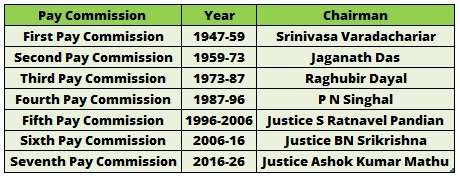
Government will implement the Seventh Pay Commission based on the final report from the commission headed by Chairman Justice, Ashok Kumar Mathu.
Pay Commission & Chairmanship from First to Seventh Pay
The government constitutes a Central Pay Commission (CPC) almost every ten years to revise the pay scales of its employees. These are often adopted by states after some modifications.
All Constituents Organizations,
National Council(JCM)(Staff Side)
Dear Comrades,
Sub: Brief of the meeting held today with the VII CPC
Today morning I met the Chairman, Seventh Central Pay Commission, Shri Ashok Kumar Mathur and Secretary, Mrs. Meena Agarwal.
It was assumed that the report of the VII CPC, as was promised for 28th August this year, may be delayed by one month.
I have impressed upon him once again for improvement in the service conditions of all the Central Government Employees working in different sectors with special emphasis in the matter of fixation of Minimum Wage and other benefits.
This is for your information.
Comradely yours,
(Shiva Gopal Mishra)
Secretary Staff Side
NC/JCM
No. 21(2)/2015-E.II (B)
Government of India
Ministry of Finance
Department of Expenditure
New Delhi, the 6th August,2015
OFFICE MEMORANDUM
Subject:- Grant of Transport Allowance to Central Government employees.
Reference is invited to Ministry of Finance, Department of Expenditure 0.M. No. 21(2)/2008-E.II(B) dated 29th August, 2008 regarding grant of Transport Allowance to Central Government employees, consequent upon implementation of the recommendations of the Sixth Central Pay Commission (6th CPC).
2. The Government has since considered the re-classification of cities/towns/localities as per Census-2011 (population criteria) for the purpose of Transport Allowance. Accordingly, the President is pleased to decide the revised classification of cities, towns and localities, for the purpose of grant of Transport Allowance at higher rates to Central Government employees, as per Annexure-1. Therefore, the table below Para ‘1’of O.M. dated 29.08.2008 stands partially modified as under:-
Employees drawing Grade Pay of
Rate of Transport Allowance admissible per month
Cities classifed as per Annexure – I
All cities towns and localities, other that those included in Annexure – I
Grade Pay of Rs. 5400/- and above
Rs.3200 plus Dearness Allowance thereon
Rs.1600 plus Dearness Allowance thereon
Grade Pay of Rs. 4200/-, Rs 4600/- and Rs.4800/-
Rs.1600 plus Dearness Allowance thereon
Rs.800 plus Dearness Allowance thereon
Those drawing Grade pay below Rs. 4200 but drawing pay in pay band eqquivalent to Rs.7440/- and above
Grade pay below Rs. 4200 and pay in pay band below Rs. 7440/-
Rs.600 plus Dearness Allowance thereon
Rs.400 plus Dearness Allowance thereon
The revised classification of ,cities/towns/localities for the purpose of grant of Transport Allowance shall take effect from 1st April, 2015.
4. The orders will apply to all civilian employees of the Central Government.
The orders will also be applicable to the civilian employees paid from the Defence Services Estimates. In respect of Armed Forces personnel and Railway
employees, separate orders will be issued by the Ministry of Defence and the Ministry of Railways, respectively.
5. All other conditions mentioned in Department of Expenditure 0.M. No. 21(2)/2008-E.II(B) dated 29.08.2008 shall remained unchanged.
6. In so far as the persons working in the Indian Audit and Accounts Department are concerned, this Order issues in consultation with the Comptroller and Auditor General of India.
No.12015/1/2015-Welfare
Government of India
Ministry of Personnel, Public Grievances and Pensions
Department of Personnel & Training
Lok Nayak Bhavan, Khan Market
New Delhi,Dated 07.08. 2015
CIRCULAR
Subject: Free Health Check-up Camp for the benefit of Central Government employees and their dependents at Samaj Sadan, Grih Kalyan Kendra, R.K. Puram, Sector-4, New Delhi on 08th August, 2015 (10.00 AM to 2.00 PM).
********
Department of Personnel and Training, Government of India is organizing Free Health Check-up, Eye Check-up and Blood Donation Camps at Samaj Sadan, Grih Kalyan Kendra, R.K. Puram, Sector-4, New Delhi on 08th August, 2015 (10.00 AM to 2.00 PM) for the benefit of Central Government employees and their dependents. Details of the Camps are as follows:-
S. No.
Types of Check-Ups
In Association with
1
Health Check up
(This includes free OPD consultation by renowned Doctors on Cardiac, Orthopedics and Gynecology/Free tests of Sugar (Randum), BP.Height, Weight, BMD, PAP Smear & ECG.
Rockland Hospital, New Delhi.
2
Eye Check-Up
Sharp Sights Centre, New Delhi.
3
Blood Donation Camp
Red Cross Society.
2. All are requested to avail the facility of free Health Check-up Camps for Free Health Check-up, Eye Check-up and Blood Donation Camps
The award money of Rs. 25,000/- being given to the Awardee Teachers has been enhanced to Rs. 50,000/- from the Award Year 2014 onwards. The last revision of the Award money took place in 1999 wherein the Award money was enhanced from Rs.10,000/- to Rs. 25,000/-.
From the Award year 2014 onwards, each of the Awardee will be provided with a Certificate, a Silver Medal of 40 grams with his/her name inscribed and a cash award of Rs. 50,000/-.
The Ministry of Human Resource Development implements a scheme of National Award to Teachers under which meritorious teachers from all over the country (Primary and Secondary and Special categories) including Sanskrit and Arabic/Persian Teachers from the institutions run on traditional lines, are awarded every year. Until now, each of the Awardee Teacher was provided with a Certificate, a Silver Medal of 40 gm with his/her name inscribed and a cash award of Rs. 25,000/-.
The National Award to Teachers are given away by the President of India on 5th September (Teacher’s Day) every year to give public recognition to meritorious teachers working in Primary, Middle and Secondary schools.
The total number of Teachers conferred with the National Award is 378, out of which 20 awards are reserved for Sanskrit, Persian and Arabic teachers. The quota for the States is fixed. Further, out of 378 awards 43 ‘Special Awards’ have been earmarked for the teachers of following categories:
Teachers with disabilities working in regular schools.
Special teacher or trained general teachers who may have done outstanding work for Inclusive Education.
Classroom teachers with at least 15 years regular teaching, experience and Headmasters with 20 years of regular teaching experience and who are actually working as teachers/headmasters in recognized primary/middle/high/higher secondary schools only are considered. Five years relaxation is given to teachers promoting Integrated Inclusive Education.
No. Z-20025/9/2014-Estt.(Allowance)
Government of India
Ministry of Personnel, Public Grievances & Pension
Department of Personnel & Training
Block IV, Old JNU Campus,
New Delhi, August 5, 2015.
Office Memorandum
Subject: Linkage of Aadhaar with various employees’ system.
The undersigned is directed to refer to this Department’s Office Memorandum of even number dated May 20, 2015 on the subject mentioned above wherein all Ministries/Departments were requested to ensure that the service books of all employees have an entry of the employees’ Aadhaar number and sought compliance report. The information from most of the Ministries/Departments has not yet been received by this Department so far.
2. All Ministries/Departments of the Government of India are once again requested to intimate the action taken in this regard and also furnish consolidated information in respect of the Ministry/Department as a whole, including attached and subordinate offices, to this Department latest by 14th August, 2015.
The 6th Pay Commission played a key role in insulating the Indian economy from the shocks of the Lehman crisis of 2008. According to Bank of America Merrill Lynch, higher salaries – resulting from the implementation of the 6th Pay Commission – drove two-wheeler and car sales, and led to a recovery in cement demand.
Salaries of government employees went up by an average of 35 per cent on the back of the 6th Pay Commission recommendations; employees also got arrears for more than 30 months because of the delayed implementation of the 6th Pay Commission in October 2008.
“The arrears resulted in robust demand for consumer discretionary products that resulted in sustained stock performance over 3-5 years,” wrote Jai Shankar, chief India economist of Religare.
It is for these economic linkages that the 7th Pay Commission report is being eyed by analysts. The 7th Pay Commission report is likely to be submitted by August-end or in October, according to media reports.
Pay Commissions are meant to review the salary structure of central government employees and are set up every 10 years. The 7th Pay Commission will revise salaries effective January 1, 2016.
According to Religare, nearly 50 lakh central government employees (including 15 lakh defence personnel) and over 1 crore state and local government employees will benefit from the 7th Pay Commission.
There’s no consensus about how much salaries will go up — Bank of America expects a modest 15 per cent increase, while Religare expects salaries to go up by 28-30 per cent. Credit Suisse says salary hikes can be as high as 40 per cent.
Economists, however, agree that the 7th Pay Commission will help kick-start the domestic economy, which continues to be plagued by weak demand and excess capacity.
How the 7th Pay Commission can fire up the Indian economy
1) A 15 per cent salary increase would push up the central government’s salary bill by Rs 25,000 crore (or $4 billion), which is 0.2 per cent of India’s GDP, says Indranil Sen Gupta of Bank of America Merrill Lynch. This will help in a consumption-driven recovery in the domestic economy, he added.
2) According to Neelkanth Mishra of Credit Suisse, nearly one-third of India’s middle class is employed by the government and as the 7th Pay Commission comes through, there will be an improvement in discretionary spending.
“In Tier 3, Tier 4 towns where government employees are 50-60 per cent of the middle class, it is very likely that real estate markets will take off again,” he said.
3) Bank of America Merrill Lynch also expects the 7th Pay Commission to double subsidized loans for cars to Rs 3.60 lakh and housing loans to Rs 15 lakh. This will push up demand for autos and housing.
4) According to Religare, “The most important factor is economic activity itself which is gaining pace and, together with greater employment generation and policy reform, the 7th Pay Commission salary hike may help India enter a larger virtuous cycle.”
Large-scale salary hikes, however, are also expected to stoke inflation and fiscal pressures.
“Clearly if you see a third or 35 per cent of your middle class getting a 40 per cent or 30 per cent jump in compensation in one shot, the fears of inflation will rise,” Mr Mishra warned. He added that expectations of rate cuts can get pushed out and some possible fiscal pressures can emerge.
According to Jai Shankar of Religare, the salary bill (centre plus state combined) will be much higher at $50 billion or Rs 3.12 lakh crore if the Pay Commission recommend a 28-30 per cent salary hike. “The total amount will be in excess of $50 billion, making deficit reduction extremely challenging in FY17,” he said.