Bank DA for Workmen and Officer Employees from May to July 2021 – IBA Circular
Indian Banks Association
HR & Industrial Relations
HR&IR/MBR/76/D/9875
May 1, 2021
All Members of the Association
(Designated Officers)
Dear Sir/ Madam,
Dearness Allowance for Workmen and Officer Employees in banks for the months of May, June & July 2021 under X BPS/ Joint Note dated 11.11.2020
We have to advise that the confirmed All India Average Consumer Price Index Numbers for Industrial Workers (Base 1960=100) for the quarter ended March 2021 as published by Govt. of India in its website Labour Bureau are as follows:-
January 2021 – 7770.30
February 2021 – 7822.89
March 2021 – 7862.33
The average of the above is 7818.51 and accordingly the number of DA slabs works out to 367 (7818.51 – 6352 = 1466.51/4= 367 Slabs) The payment of DA for the months February, March and April 2021 was at 374 Slabs. Hence, there is a decrease of 7 slabs of DA i.e. 374 -367 Slabs for payment of DA for the months May, June & July 2021 .
Accordingly, in terms of clause 7 of the 11th Bipartite Settlement dated 11.11.2020 and clause 3 of the Joint Note dated 11.11.2020, the rate of Dearness Allowance payable to Workmen and Officer employees for the months of May, June & July 2021 shall be 25.69 % of `pay’. While arriving at dearness allowance payable, decimals from third place may please be ignored.
LTC Special Cash Package Scheme : Finmin clarification on submission of bills before 31st May 2021 – No.12(2)/2020-E.II(A) – Dated 07.05.2021
No.12(2)/2020-E.II(A)
Government of India
Ministry of Finance
Department of Expenditure
North Block, New Delhi
Dated 7th May 2021
OFFICE MEMORANDUM
Subject : Clarification regarding full and final settlement of bills / claims pertaining to LTC Special Cash Package Scheme.
The undersigned is directed to refer to this department OM of even no dated. 31st March 2021 clarifying that submission of bills / claims with regard to LTC Scheme entertained and settled by Ministries / Departments not later than 30th April 2021.
2. Queries have been received in this department to extend the date for submission of bills / claims and settlement beyond 30th April. 2021. Keeping in view of the situation due to Covid-19 pandemic, it has been decided that submission of bills / claims may be entertained and settled by Ministries / Departments not later than 31st May, 2021. However it is reiterated that payment for the purchases should have been made not later than the due date, i.e. 31st March 2021.
(i) Secretaries of the Ministries/Departments and Heads of Department of Attached & Subordinate Offices are mandated to regulate the attendance of its employees, at all levels, keeping in view the COVID positive cases in the office and the functional requirement.
(ii) Persons with Disabilities and Pregnant Women employees may be exempted from attending office, but they shall continue to work from home.
(iii) The officers/staff shall follow staggered timings to avoid over-crowding in offices / workplaces as decided by the Heads of Department.
(iv) All officers/staff residing in the containment zone shall be exempted from coming to offices till the containment zone is de-notified. These officers/staff who are residing in the Containment Zone shall work from home and shall be available on telephone and electronic means of communications at all times.
(v) All officials who attend office shall strictly follow Covid-appropriate behaviour including wearing of mask, physical distancing, use of sanitizer and frequent hand-washing with soap and water.
(vi) Crowding in lifts, staircases , corridors, common areas, including refreshment kiosk and parking areas is to be strictly voided.
(vii) Meetings, as far as possible, may continue to be conducted with video-conferencing and personal meetings with visitors, unless absolutely necessary in public interest, are to be avoided.
(viii) In compliance of OM of even number dated 22.4.2021, all employees of the age of 18 years and above, are advised to get themselves vaccinated.
(ix) Proper cleaning and frequent sanitization of workplace, particularly of the frequently touched surfaces, may be ensured.
(x) Biometric attendance shall continue to be suspended until further orders.
2. The above instructions shall be in force with immediate effect till 31st May, 2021 or until further orders, whichever earlier.
(Umesh Kumar Bhatia)
Deputy Secretary to the Govt. of India
Attendance of Central Government Officials – Extended up to 31st May, 2021 – DOPT Latest Order F.No. 11013/9/2014-Estt. A-III – Dated 03.05.2021
F.No. 11013/9/2014-Estt. A-III
Government of India
Ministry of Personnel, Public Grievances and Pensions,
Department of Personnel & Training
North Block, New Delhi
Dated the 3rd May 2021
Office Memorandum
Subject : Preventive measures to contain the spread of Novel Coronavirus (COVID-19) – Attendance of Central Government officials -Extension in Date of validity of guidelines – regarding.
Reference is invited to O.M. of even number, dated 19th April, 2021, vide which instructions / guidelines were issued for regulating attendance in Central Government offices so as to prevent the spread of Covid 19- cases. Since the situation has not yet improved to a desirable level, it has been decided, with the approval of the Competent Authority, that the validity of the O.M. may be extended up to 31st May, 2021 or until further orders, whichever is earlier. The instructions/guidelines are reiterated below for strict compliance by all Ministries /Departments/ Offices of the Central Government:
a) Physical attendance of the officers of the level of Under Secretary or equivalent and below be restricted to 50% of the actual strength. Secretary/HoD may regulate the attendance of officials and may on administrative grounds, direct more officials to attend office. A roster may be prepared, accordingly.
b) All officers of the level of Deputy Secretary/equivalent and above are to attend office on regular basis.
c) The officers/staff shall follow staggered timings, to avoid over-crowding in offices, as indicated below:
9.00 A.M. to 5.30 P.M.
9.30 AM to 6.00 PM
10.00 A.M. to 6.30 P.M.
d) All officials who do not attend office on a particular day are to make themselves available on Telephone and other electronic means of communication at all times from their residence and work from home.
e) All officials residing in containment zones shall continue to be exempted from coming to office till the containment zone is de-notified.
f) Persons with Disabilities and Pregnant women employees may be exempted from attending office, but they shall continue to work from home, until further orders.
g) All officials who attend office shall strictly follow Covid-appropria behaviour including wearing of mask, physical distancing, Use of sanitizer and frequent hand washing with soap and water.
h) Crowding in lifts, staircases, corridors, common areas, including refreshment kiosk and parking areas is to strictly avoided.
i) Meetings, as far as possible, to be conducted through video-conferencing.
j) Entry of outsiders/visitors to be curtailed appropriately.
k) In compliance of Om of even number, dated 22.4.2021, all employees of the age of 18 years and above, are advised to get themselves vaccinated.
1) Proper cleaning and frequent sanitization of workplace, particularly of the frequently touched surfaces may be ensured.
2. All Ministries/Departments/Offices as well as the Central Government employees may ensure strict compliance of the instructions on Covid-appropriate behaviour issued by MHA, MoH&FW and DoP&T, from time to time. Biometric attendance shall continue to be suspended and physical attendance registers to be maintenance until further orders.
3. These guidelines shall be effective from the 1st of May, 2021
(S.P. Pant)
Deputy Secretary to Government of India
Payment of MIS/SCSS/TD accounts Monthly/Quarterly/Annual interest amount and maturity value of MIS/SCSS/TD/RD/KVP/NSC into account holder‟s Bank Account by CBS Post Offices – Department of Posts Order – SB Order No. 09/2021 – Dated 30.04.2021
SB Order No. 09/2021
F. No. FS-13/7/2020-FS
Govt. of India
Ministry of Communications
Department of Posts
(FS Division)
Dak Bhawan, New Delhi-110001
Dated: 30 .04.2021
To,
All Head of Circles/Regions
Subject:- Payment of MIS/SCSS/TD accounts Monthly/Quarterly/Annual interest amount and maturity value of MIS/SCSS/TD/RD/KVP/NSC into account holder‟s Bank Account by CBS Post Offices – Reg.
Sir/Madam,
The provision for payment of interest of MIS/SCSS/TD accounts and credit of maturity value for TDA type of accounts (MIS/SCSS/TD/RD/KVP/NSC) into account holder‟s Bank Account has been implemented in Finacle through ECS Outward Credit functionality.
2. Chennai GPO is identified as Nodal Office for ECS Outward Credit functionality. Interest and Maturity credits through ECS Outward facility
3. The summary of the ECS Outward Credit facility is detailed below:-
(a) Credit of MIS/SCSS/TD Interest into account holders Bank Account:-
(i) Account holder will submit ECS Mandate Form along with passbook and a cancelled cheque or copy of first page of Bank passbook at concerned post office.
(ii) Counter PA will modify respective account and enter ECS details on the basis of cancelled cheque/copy of first page of Bank passbook in respective account modification menu.
(iii) Supervisor will verify the account modification and file the ECS mandate form in a Guard file.
(iv) On Due date of interest payment i.e. MIS/SCSS/TD the interest will be processed and credited in ECS Outward credit Suspense account. Chennai GPO will generate ECS files for uploading to NPCI. Interest will get credited to account holder‟s other Bank Account on D+1 basis.
(b) Credit of MIS/TD/SCSS/KVP/NSC Maturity/Pre-mature closure value into account holder’s Bank Account.
(i) Account holder will submit account closure form along with passbook and a cancelled cheque or copy of first page of Bank passbook at concerned post office.
(ii) Counter PA will modify respective account and enter ECS details on the basis of cancelled cheque/copy of first page of Bank passbook in respective account modification menu.
(iii) Supervisor will verify the account modification and file ECS mandate form in a Guard file.
(iv) Counter PA will close account the account by selecting option “Customer Instruction” in respective scheme‟s closure menu.
(v) Supervisor will verify account closure.
(vi) Supervisor will run HPR menu and print account closure report and handover to account holder as acknowledgement.
(vii) Chennai GPO will generate ECS credit file on next day for all such transactions and upload outward credit files to NPCI.
(viii) The interest and maturity value will be credited in the account holder‟s Bank Account on D+1 basis i.e. Next working day.
(c) Handling of ECS returns due to incorrect account / closed account or other reasons.
(i) Chennai GPO will credit ECS return amount in respective Post Office‟s ECS Outward Suspense Account (SOL ID+0098).
(ii) Respective post office will check ECS Outward Suspense Account (SOL ID+0098) and contact concerned account holder for intimating the ECS returns.
(iii) Respective post office will pay the ECS return amount through cash (below Rs.20,000) or by Cheque/credit into PO Savings Account (Rs.20,000 or more).
(iv) In order to avoid ECS returns for subsequent months, in respect of Interest pay outs, respective Post office will immediately modify the ECS mandate details in account modification menu by collecting new ECS Mandate form.
(v) If customer is unable to provide correct Bank account details, ECS mandate can be modified to No in account modification menu and verified by Supervisor.
4. A detailed „Standard Operating Procedure for Crediting MIS/SCSS/TD Interest and TDA Closures to OTHER BANK ACCOUNTS through ECS” has been prepared and enclosed herewith for information, guidance and necessary action.
5. The non-CBS Post Offices will continue to follow existing process.i.e. this functionality is not applicable in non-CBS Post Offices.
6. It is requested to circulate this amendment to all CBS Post Offices for information, guidance and necessary action. Same may also be placed on the notice board of all Post Offices in public area. Adequate promotion of this functionality is to be done to avoid cheque issuance and speedy payment to the depositors.
7. Hindi version will be issued in due course.
8. This issues with the approval of Competent Authority.
Introduction of “Basic Savings Accounts” under Post Office Savings Account Scheme 2019 to facilitate opening of Zero Balance Accounts by beneficiaries of any Government Welfare Scheme and reduction in account maintenance fee on PO Savings Account – SB Order No. 08/2021 – Dated 30.04.2021
SB Order No. 08/2021
F.No. 113-03/2017-SB(Pt-I)
Govt. of India
Ministry of Communications
Department of Posts
(FS Division)
Dak Bhawan, New Delhi-110001
Dated: 30.04.2021
To,
All Heads of Circles / Regions
Subject: – Introduction of “Basic Savings Accounts” under Post Office Savings Account Scheme 2019 to facilitate opening of Zero Balance Accounts by beneficiaries of any Government Welfare Scheme and reduction in account maintenance fee on PO Savings Account – regarding.
*****
Madam / Sir,
The undersigned is directed to say that Ministry of Finance (DEA) vide its O.M. No. 14/10/2021-NS dated 13.04.2021 duly appended notification No. G.S.R. 257(E) dated 09.04.2021 has incorporated another category of PO Savings Account called “Basic Savings Account” under new inserted paragraph 3 of Post Office Savings Account Scheme 2019 and reduction in Account Maintenance Fee on PO Savings Account. Copy of notification is attached.
2. Account Maintenance Fee prescribed in rule 4(6) of Post Office Savings Account Scheme 2019 has been revised from Rs. 100 (One hundred rupees) to Rs. 50 (Fifty) inclusive of GST. Account Maintenance Fee will not be applicable on Basic Savings Account.
3. Basic Savings Account has been restored through aforesaid gazette notification. The procedure to be followed for opening and operating these accounts is given below :-
i) A registered adult member of any Government Welfare Scheme can open Basic Savings Account at any Post Office including GDS Branch Post Offices.
ii) A guardian of a minor whose name is registered for any Government Welfare Scheme can also open Basic Savings Account on behalf of minor.
iii) Only one Basic Savings Account can be opened by the beneficiary and guardian of beneficiary.
iv) Any Government benefit and any other deposit can be made in these accounts.
v) Basic Savings Account will be governed by Post Office Savings Account Scheme 2019 & Government Savings Promotion General Rules,2018.
vi) Only a single account can be opened under Basic Savings Account.
vii) The depositor who desires to open Basic Savings Account under this category has to provide copy of letter/card issued by a competent authority of any State or Central Government Department mentioning name of beneficiary under any welfare scheme, copy of letter/ Aadhaar card issued by UIDAI, Account Opening Form & KYC form.
viii) The postmaster concerned will compare copy of this document with the original under his/her dated signatures.
ix) While opening Basic Savings Accounts, scheme code and registration / enrolment / reference number of the beneficiary contained in letter/card issued by competent authority of any State of Central Government or letter/card number and date should be entered in the field provided for entering Job Card No. in Finacle/Sanchay Post and Aadhaar no. of the beneficiary.
x) All other formalities applicable to PO Savings Account i.e. Specimen Signature, issue of PR in GDS Branch Post Offices, issue of passbook etc. should be followed.
xi) Interest will be calculated and credited in Basic Savings Accounts by following the normal procedure laid down for PO Savings Account.
xii) All existing Basic Savings Account will also be incorporated and treated as Basic Savings Account.
xiii) Other facilities like Cheque Book, ATM Card, eBanking, mBanking may be availed by Basic Savings Account holders, subject to fulfillment of eligibility conditions for these services. For the purpose minimum balance of Rs. 500 is to be maintained by account holder and Basic Savings Accounts may be converted in to PO Savings Account.
4. Where circle received proposal from State Government for bulk account opening under any Governments Welfare Scheme, Circle may proceed for bulk account opening after taking list of beneficiaries, AOF, KYC form, Aadhaar from respective State Government/Beneficieries.
All-India Consumer Price Index for Industrial Workers (2016=100) for March, 2021 increased to 119.6 points compared to 119.0 points for February, 2021.
The increase observed in index is mainly due to items like Cooking Gas, Petrol, Poultry Chicken, Edible Oils, Apple, Tea Leaf, Served & Processed Packaged Food, etc. which experienced an increase in prices.
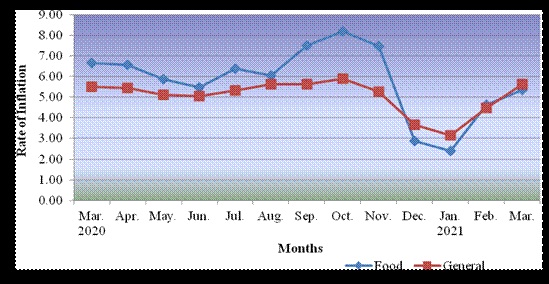
Inflation for March, 2021 went up to 5.64 per cent compared to 4.48 per cent of previous month. Similarly, Food inflation also rose to 5.36 per cent from 4.64 per cent in the previous month.
The All-India CPI-IW for March, 2021 increased by 0.6 points and stood at 119.6 (one hundred nineteen and point six). On 1-month percentage change, it increased by 0.50 per cent with respect to previous month whereas there was a decline of 0.61 per cent between corresponding months a year ago.
The maximum upward pressure in current index came from Fuel & Light group contributing 0.40 percentage points to the total change. It was further supplemented by Miscellaneous group contributing 0.15 percentage points to the total rise. At item level, Cooking Gas, Petrol, Poultry Chicken, Edible Oils, Apple, Orange, Tea Leaf, Served & Processed Packaged Food, etc. are responsible for the rise in index. However, this increase was mostly checked by vegetables putting downward pressure on the index.
At centre level, Jamshedpur and Sangrur recorded maximum increase of 3.0 points each. Among others, 4 centres observed an increase between 2 to 2.9 points, 22 centres between 1 to 1.9 points and 45 centres between 0 to 0.9 points. On the contrary, Doom-Dooma Tinsukia recorded a maximum decrease of 3.2 points. Among others, 2 centres observed a decline between 2.0 to 2.9 points, another 2 centres between 1 to 1.9 points and remaining 10 centres between 0 to 0.9 points.
Year-on-year inflation for the month stood at 5.64 per cent compared to 4.48 per cent for the previous month and 5.50 per cent during the corresponding month of the previous year. Similarly, Food inflation stood at 5.36 per cent against 4.64 per cent of the previous month and 6.67 per cent during the corresponding month a year ago.
Y-o-Y Inflation based on CPI-IW (Food and General)
All-India Group-wise CPI-IW for February and March, 2021
Sr. No.
Groups
Feb., 2021
Mar., 2021
I
Food & Beverages
117.9
118.0
II
Pan, Supari, Tobacco & Intoxicants
135.8
136.5
III
Clothing & Footwear
118.4
118.7
IV
Housing
115.2
115.2
V
Fuel & Light
142.0
149.2
VI
Miscellaneous
117.6
118.1
General Index
119.0
119.6
*Rounded upfrom second decimal place.
CPI-IW: Groups Indices
Speaking about the latest index, Minister of State (I/C) for Labour and Employment Shri Santosh Gangwar said the rise in index will result into increased wages of working class population by way of increase in dearness allowance payable to them. The rise in inflation reported during March, 2021 is mainly due to rise in prices of Petroleum products and Edible Oils.
Director General of Labour Bureau Shri DPS Negi said “The rise in inflation during March, 2021 has been observed across the board in respect of various price indices released by other Government agencies.
Shri Negi, further elaborated that rise is mainly due to, Fuel & Light, Miscellaneous and Food & Beverages items like Cooking Gas, Petrol, Poultry Chicken, Edible Oils, Apple, Tea Leaf, Served & Processed Packaged Food, etc. which experienced rise in prices.
The next issue of CPI-IW for the month of April, 2021 will be released on Monday 31st May, 2021. The same will also be available on the office website www.labourbureaunew.gov.in.
Labour Bureau, an attached office of the M/o Labour & Employment, is releasing Consumer Price Index for Industrial Workers (CPI-IW) on Base: 2016=100 for the month of March, 2021. The All-India Index for March, 2021 stood at 119.6 compared to 119.0 for February, 2021. The rate of inflation increased during the month to 5.64 per cent from 4.48 percent in the previous month.
Labour Bureau, inter-alia, compiles and releases CPI-IW every month. It is primarily used for measuring Dearness Allowance (DA) payable to government employees and pensioners and workers in the organized sector.
Formation of Panel of Supervisors in UPSC Examinations – DOPT ORDER F.No.14/1/2019-EIA-I- Dated 27.04.2021
F.No.14/1/2019-EIA-I
UNION PUBLIC SERVICE COMMISSION
DHOLPUR HOUSE, SHAHJAHAN ROAD
NEW DELHI-110069
Date: 27.04.2021
To
1. Delhi Govt.
2. DOPT with request to upload it on their website
3. UPSC Website
Sub: Formation of Panel of Supervisors in Commission’s Examinations – reg.
Sir / Madam,
The Commission conducts its Examinations throughout the year on pan India basis as per calendar of the Examinations (copy enclosed).
2. The Union Public Service Commission has now initiated the process of updating its panel of Supervisor for its examinations to be held in the Examination Hall Building of UPSC, Dholpur House, Shahjahan Road, New Delhi. The Govt. Officers retired in the grade pay of Rs. 7600 (Level-12) and above and below 65 years of age are eligible for appointment as Supervisor. It is, therefore, requested that names & bio-data with PPO, ID proof of such willing Officers who have experience of examination duties may be sent to the undersigned by 21st May, 2021. An application form in this regard is also enclosed. This may be given wide publicity.
3. The willing eligible Officers may also apply directly by sending their application to the undersigned by 21st May, 2021 at the following address:
Shri Deep Pant,
Under Secretary (EIA-I),
UPSC, Dholpur House,
Shahjahan Road,
New Delhi – 110069
Yours faithfully
(Sanjeev Thapliyal)
Under Secretary (Exam)
e-mail: [email protected]
_________________________________
UNION PUBLIC SERVICE COMMISSION
EMPANELMENT OF SUPERVISORS
PROFORMA SHOWING PARTICULARS OF PERSONS WISHING TO BE ENROLLED IN THE PANEL OF SUPERVISORS MAINTAINED BY UNION PUBLIC SERVICE COMMISSION FOR CONDUCT OF THEIR EXAMINATIONS AT DELHI CENTRE:
1. Name (in capital):
2. Address:
3. Date of Birth:
4. Educational Qualifications:
5. (a) (i) Post held at the time of retirement:
(ii) Pay Scale and Grade Pay at the time of retirement:
(iii) Pay Level as per 7th Pay Commission:
(b) Department / Office from where retired:
(c) Date of retirement (Please attach a copy of P.P.O.):
6. Previous experience of Invigilation work etc., if any
(a) Examinations conducted by the Commission
(b) Examinations conducted by other Organisations/Bodies
Payment Process of Electricity Bills through Oorja App – BSNL ORDER
BHARAT SANCHAR NICAM LIMITED
Office of Chief General Manager(EW).
Room No 8, IR Hall, Eastern Court Complex,
Janpath, New Delhi-110001.
No. BSNLCO-15(11)/2/2020-SGM-Elect.Works
Dated : 23.04.2021
To
The All CGMS/CGM ITPC
BSNL Circles/Units
Sub: Payment Process of Electricity Bills through Oorja App
Sir,
To streamline the payment of Electricity Bill (which is highest recurring expenditure of BSNL after HR cost) Director (CFA) BSNL Corporate Office, New Delhi has approved the detailed Centralised Payment Process of Electricity Bills through Oorja App which will be implemented at the earliest. A copy of the approved Centralised Payment Process is attached in ANNEXURE. The successful implementation of centralised Payment Process would require close coordination of Circles/Units, ITPC Hyderabad and ERP team.
The timely implementation of Centralised Payment Process of EB Bills through Oorja App would not only save BSNL substantial amount of time, energy and money in processing the bill, a systematic integration with ERP will result in proper monitoring of payments, avoid wrong payments minimise penalties and levies and maximise discounts by smart scheduling. Therefore, all the BSNL Circles/Units are requested to act upon it immediately in close coordination with ITPC and ERP team for onboard from this month itself.
This is issued with the approval of Director (CFA).
CDN/MF.CGA/WFH/2021/1
Ministry of Finance
Department of Expenditure
O/o Controller General of Accounts
Mahalekha Niyantrak Bhawan
E-Block, GPO Complex, INA
New Delhi-110023
Dated : 26th April, 2021
Office Order
Keeping in view the steep increase in the number of Covid-19 positive cases of official/staff in the office of the Controller General of Accounts. It has been decided that all categories of employees/outsourced personnel should Work From Home with the immediate effect and up to 30th April, 2021. However, if physical presence of an employee is required in office, the concerned officer/staff may be asked to attend office during the said period by the concerned Addl.CGA/MCGA.
All the officers and staff are accordingly advised to Work From Home till 30.04.2021. They shall remain available through electronic means for the smooth functioning of the office during this period.
It is required that all officers and staff must maintain record of their own attendance and the work done by them and also share with their Divisional head (ACGA/DCGA) who will monitor the same and ensure that the work of the division continues smoothly.
This issue with the approval of Controller General of Accounts.
(Dr.Richa Pandey)
Asstt. Controller General of Accounts (CDN)