DA for Workmen and Officer Employees in banks from Feb to April 2021 – IBA Circular
Indian Banks’ Association
HR & Industrial Relations
No.CIR/HR&IR/76/D/2020-2 1/9587
February 1, 2021
All Members of the Association
(Designated Officers)
Dear Sir/ Madam,
Dearness Allowance for Workmen and Officer Employees in banks for the months of February, March & April 2021 under X BPS/ Joint Note dated 11.11.2020
The confirmed All India Average Consumer Price Index Numbers for Industrial Workers (Base 1960=100) for the quarter ended December 2020 are as follows:-
October 2020 – 7855.76
November 2020 – 7882.06
December 2020 – 7809.74
The average CPI of the above is 7849.19 and accordingly the number of DA slabs are 374 (7849 — 6352= 1497/4= 374 Slabs) The last quarterly Payment of DA was at 341 Slabs. Hence, there is an increase in DA slabs of 33 i.e. 374 Slabs for payment of DA for the quarter February, March & April 2021.
In terms of clause 7 of the 11th Bipartite Settlement dated 11.11.2020 and clause 3 of the Joint Note dated 11.11.2020, the rate of Dearness Allowance payable to Workmen and Officer employees for the months of February, March & April 2021. shall be 26.18 % of ‘pay’. While arriving at dearness allowance payable, decimals from third place may please be ignored.
Tamil Nadu GPF Interest Rate from Jan to March 2021
Government of Tamil Nadu
2021
FINANCE [Allowances] DEPARTMENT G.O.Ms.No.30 G.O.Ms.No.30, Dated , Dated , Dated 22nd Jan 2021. (sarvari, Thai-09 , Thiruvalluvar Aandu 2052)
ABSTRACT
Provident Fund – General Provident Fund (Tamil Nadu) – Rate of interest for the financial year 2020-2021 – With effect from 01.01.2021 to 31.03.2021 – Orders – Issued.
In the Government Order first to third read above, orders were issued regarding fixation of the rate of interest on the accumulation at the credit of the subscribers of G.P.F.(TN) during the financial year 2020-2021 as detailed below:
Sl.No
Quarter
Period
Rate of Interest
1
I
01-04-2020 to 30-06-2020
7.1%
2
II
01-07-2020 to 30-09-2020
7.1%
3
III
01-10-2020 to 31-12-2020
7.1%
2. The Government of India, in its resolution fourth read above, announced that during the year 2020-2021, accumulation at the credit of subscribers to the General Provident Fund and other similar funds shall carry interest at the rate of 7.1% (Seven point one percent) with effect from 1st January, 2021 to 31st March, 2021.
3. The Government now directs that the rate of interest on the accumulation at the credit of the subscribers to General Provident Fund (Tamil Nadu) shall carry interest at the rate of 7.1% (Seven point one percent) with effect from 1st January, 2021 to 31st March, 2021.
4. The rate of interest on belated final payment of Provident Fund accumulation remaining unpaid for more than three months of its becoming payable shall be at the same rates as ordered in para-3 above.
(BY ORDER OF THE GOVERNOR)
S. KRISHANAN
ADDITIONALCHIEF SECRETARY TO GOVERNMENT
The Union Minister for Finance & Corporate Affairs, Smt Nirmala Sitharaman presented the Union Budget 2021-22 in Parliament today, which is the first budget of this new decade and also a digital one in the backdrop of unprecedented COVID-19 crisis. Laying a vision for AatmaNirbhar Bharat, she said this is an expression of 130 crore Indians who have full confidence in their capabilities and skills. She said that Budget proposals will further strengthen the Sankalp of Nation First, Doubling Farmer’s Income, Strong Infrastructure, Healthy India, Good Governance, Opportunities for youth, Education for All, Women Empowerment, and Inclusive Development among others. Additionally, also on the path to fast-implementation are the 13 promises of Budget 2015-16-which were to materialize during the AmrutMahotsav of 2022, on the 75th year of our Independence. They too resonate with this vision of AatmaNirbharta, she added.
The Budget proposals for 2021-22 rest on 6 pillars.
Health and Wellbeing
Physical & Financial Capital, and Infrastructure
Inclusive Development for Aspirational India
Reinvigorating Human Capital
Innovation and R&D
Minimum Government and Maximum Governance
Health and Wellbeing
There is substantial increase in investment in Health Infrastructure and the Budget outlay for Health and Wellbeing is Rs 2,23,846 crore in BE 2021-22 as against this year’s BE of Rs 94,452 crore, an increase of 137 percentage.
The Finance Minister announced that a new centrally sponsored scheme, PM AatmaNirbhar Swasth Bharat Yojana, will be launched with an outlay of about Rs 64, 180 crore over 6 years. This will develop capacities of primary, secondary, and tertiary care Health Systems, strengthen existing national institutions, and create new institutions, to cater to detection and cure of new and emerging diseases. This will be in addition to the National Health Mission. The main interventions under the scheme are:
Support for 17,788 rural and 11,024 urban Health and Wellness Centers
Setting up integrated public health labs in all districts and 3382 block public health units in 11 states;
Establishing critical care hospital blocks in 602 districts and 12 central institutions;
Strengthening of the National Centre for Disease Control (NCDC), its 5 regional branches and 20 metropolitan health surveillance units;
Expansion of the Integrated Health Information Portal to all States/UTs to connect all public health labs;
Operationalisation of 17 new Public Health Units and strengthening of 33 existing Public Health Units at Points of Entry, that is at 32 Airports, 11 Seaports and 7 land crossings;
Setting up of 15 Health Emergency Operation Centers and 2 mobile hospitals; and
Setting up of a national institution for One Health, a Regional Research Platform for WHO South East Asia Region, 9 Bio-Safety Level III laboratories and 4 regional National Institutes for Virology.
Vaccines
Provision of Rs 35,000 crore made for Covid-19 vaccine in BE 2021-22.
The Pneumococcal Vaccine, a Made in India product, presently limited to only 5 states, will be rolled out across the country aimed at averting 50,000 child deaths annually.
Nutrition
To strengthen nutritional content, delivery, outreach, and outcome, Government will merge the Supplementary Nutrition Programme and the PoshanAbhiyan and launch the Mission Poshan 2.0. Government will adopt an intensified strategy to improve nutritional outcomes across 112 Aspirational Districts.
Universal Coverage of Water Supply and Swachch Bharat Mission
The Finance Minister announced that the JalJeevan Mission (Urban), will be launched for universal water supply in all 4,378 Urban Local Bodies with 2.86 crore household tap connections, as well as liquid waste management in 500 AMRUT cities. It will be implemented over 5 years, with an outlay of Rs. 2,87,000 crore. Moreover, the Urban Swachh Bharat Mission will be implemented with a total financial allocation of Rs 1,41,678 crore over a period of 5 years from 2021-2026. Also to tackle the burgeoning problem of air pollution, government proposed to provide an amount of Rs. 2,217 crore for 42 urban centres with a million-plus population in this budget. A voluntary vehicle scrapping policy to phase out old and unfit vehicles was also announced. Fitness tests have been proposed in automated fitness centres after 20 years in case of personal vehicles, and after 15 years in case of commercial vehicles
Finance Minister said that for a USD 5 trillion economy, our manufacturing sector has to grow in double digits on a sustained basis. Our manufacturing companies need to become an integral part of global supply chains, possess core competence and cutting-edge technology. To achieve all of the above, PLI schemes to create manufacturing global champions for an AatmaNirbhar Bharat have been announced for 13 sectors. For this, the government has committed nearly Rs.1.97 lakh crore in the next 5 years starting FY 2021-22. This initiative will help bring scale and size in key sectors, create and nurture global champions and provide jobs to our youth.
Textiles
Similarly, to enable the textile industry to become globally competitive, attract large investments and boost employment generation, a scheme of Mega Investment Textiles Parks (MITRA) will be launched in addition to the PLI scheme. This will create world class infrastructure with plug and play facilities to enable create global champions in exports. 7 Textile Parks will be established over 3 years.
Infrastructure
The National Infrastructure Pipeline (NIP) which the Finance Minister announced in December 2019 is the first-of-its-kind, whole-of-government exercise ever undertaken. The NIP was launched with 6835 projects; the project pipeline has now expanded to 7,400 projects. Around 217 projects worth Rs 1.10 lakh crore under some key infrastructure Ministries have been completed.
Infrastructure financing – Development Financial Institution (DFI)
Dwelling on the infrastructure sector, Smt Sitharaman said that infrastructure needs long term debt financing. A professionally managed Development Financial Institution is necessary to act as a provider, enabler and catalyst for infrastructure financing. Accordingly, a Bill to set up a DFI will be introduced. Government has provided a sum of Rs 20,000 crore to capitalise this institution and the ambition is to have a lending portfolio of at least Rs 5 lakh crore for this DFI in three years time.
Asset Monetisation
Monetizing operating public infrastructure assets is a very important financing option for new infrastructure construction. A “National Monetization Pipeline” of potential Brownfield infrastructure assets will be launched. An Asset Monetization dashboard will also be created for tracking the progress and to provide visibility to investors. Some important measures in the direction of monetisation are:
National Highways Authority of India and PGCIL each have sponsored one InvIT that will attract international and domestic institutional investors. Five operational roads with an estimated enterprise value of Rs 5,000 crore are being transferred to the NHAIInvIT. Similarily, transmission assets of a value of Rs 7,000 crore will be transferred to the PGCIL InvIT.
Railways will monetize Dedicated Freight Corridor assets for operations and maintenance, after commissioning.
The next lot of Airports will be monetised for operations and management concession.
Other core infrastructure assets that will be rolled out under the Asset Monetization Programme are: (i) NHAI Operational Toll Roads (ii) Transmission Assets of PGCIL (iii) Oil and Gas Pipelines of GAIL, IOCL and HPCL (iv) AAI Airports in Tier II and III cities, (v) Other Railway Infrastructure Assets (vi) Warehousing Assets of CPSEs such as Central Warehousing Corporation and NAFED among others and (vii) Sports Stadiums.
Roads and Highways Infrastructure
Finance Minister announced that more than 13,000 km length of roads, at a cost of Rs 3.3 lakh crore, has already been awarded under the Rs. 5.35 lakh crore Bharatmala Pariyojana project of which 3,800 kms have been constructed. By March 2022, Government would be awarding another 8,500 kms and complete an additional 11,000 kms of national highway corridors. To further augment road infrastructure, more economic corridors are also being planned. She also provided an enhanced outlay of Rs. 1,18,101 lakh crore for Ministry of Road Transport and Highways, of which Rs.1,08,230 crore is for capital, the highest ever.
Railway Infrastructure
Indian Railways have prepared a National Rail Plan for India – 2030. The Plan is to create a ‘future ready’ Railway system by 2030. Bringing down the logistic costs for our industry is at the core of our strategy to enable ‘Make in India’. It is expected that Western Dedicated Freight Corridor (DFC) and Eastern DFC will be commissioned by June 2022.
For Passenger convenience and safety the following measures are proposed:
Introduction of aesthetically designed Vista Dome LHB coach on tourist routes to give a better travel experience to passengers.
The safety measures undertaken in the past few years have borne results. To further strengthen this effort, high density network and highly utilized network routes of Indian railways will be provided with an indigenously developed automatic train protection system that eliminates train collision due to human error.
Budget also provided a record sum of Rs. 1,10,055 crore, for Railways of which Rs. 1,07,100 crore is for capital expenditure.
Urban Infrastructure
Government will work towards raising the share of public transport in urban areas through expansion of metro rail network and augmentation of city bus service. A new scheme will be launched at a cost of Rs. 18,000 crore to support augmentation of public bus transport services.
A total of 702 km of conventional metro is operational and another 1,016 km of metro and RRTS is under construction in 27 cities. Two new technologies i.e., ‘MetroLite’ and ‘MetroNeo’ will be deployed to provide metro rail systems at much lesser cost with same experience, convenience and safety in Tier-2 cities and peripheral areas of Tier-1 cities.
Power Infrastructure
The past 6 years have seen a number of reforms and achievements in the power sector with the addition of 139 Giga Watts of installed capacity, connecting an additional 2.8 crore households and addition of 1.41 lakh circuit km of transmission lines.
Expressing a serious concern over the viability of Distribution Companies, the Finance Minister proposed to launch a revamped reforms-based result-linked power distribution sector scheme with an outlay of Rs. 3,05,984 crore over 5 years. The scheme will provide assistance to DISCOMS for Infrastructure creation including pre-paid smart metering and feeder separation, upgradation of systems, etc., tied to financial improvements.
Ports, Shipping, Waterways
Major Ports will be moving from managing their operational services on their own to a model where a private partner will manage it for them. For the purpose the budget proposes to offer more than Rs. 2,000 crore by Major Ports on Public Private Partnership mode in FY21-22.
A scheme to promote flagging of merchant ships in India will be launched by providing subsidy support to Indian shipping companies in global tenders floated by Ministries and CPSEs. An amount of Rs. 1624 crore will be provided over 5 years. This initiative will enable greater training and employment opportunities for Indian seafarers besides enhancing Indian companies share in global shipping.
Petroleum & Natural Gas
Smt Sitharaman said that the government has kept fuel supplies running across the country without interruption during the COVID-19 lockdown period. Taking note of the crucial nature of this sector in people’s lives, the following key initiatives are being announced:
Ujjwala Scheme which has benefited 8 crore households will be extended to cover 1 crore more beneficiaries.
Government will add 100 more districts in next 3 years to the City Gas Distribution network.
A gas pipeline project will be taken up in Union Territory of Jammu & Kashmir.
An independent Gas Transport System Operator will be set up for facilitation and coordination of booking of common carrier capacity in all-natural gas pipelines on a non-discriminatory open access basis.
Financial Capital
The Finance Minister proposed to consolidate the provisions of SEBI Act, 1992, Depositories Act, 1996, Securities Contracts (Regulation) Act, 1956 and Government Securities Act, 2007 into a rationalized single Securities Markets Code. The Government would support the development of a world class Fin-Tech hub at the GIFT-IFSC.
Increasing FDI in Insurance Sector
She also proposed to amend the Insurance Act, 1938 to increase the permissible FDI limit from 49% to 74% and allow foreign ownership and control with safeguards. Under the new structure, the majority of Directors on the Board and key management persons would be resident Indians, with at least 50% of Directors being Independent Directors, and specified percentage of profits being retained as general reserve.
Disinvestment and Strategic Sale
In spite of COVID-19, Government has kept working towards strategic disinvestment. The Finance Minister said a number of transactions namely BPCL, Air India, Shipping Corporation of India, Container Corporation of India, IDBI Bank, BEML, Pawan Hans, NeelachalIspat Nigam limited among others would be completed in 2021-22. Other than IDBI Bank, Government propose to take up the privatization of two Public Sector Banks and one General Insurance company in the year 2021-22.
In 2021-22, Government would also bring the IPO of LIC for which the requisite amendments will be made in this Session itself.
In a very important announcement, the Finance Minister said that in the AtmaNirbhar Package, she had announced to come out with a policy of strategic disinvestment of public sector enterprises and said that the Government has approved the said policy. The policy provides a clear roadmap for disinvestment in all non-strategic and strategic sectors. Government has kept four areas that are strategic where bare minimum CPSEs will be maintained and rest privatized. In the non-strategic sectors, CPSEs will be privatised, otherwise shall be closed. She said that to fast forward the disinvestment policy, NITI Aayog will work out on the next list of Central Public Sector companies that would be taken up for strategic disinvestment. Government has estimated Rs. 1,75,000 crore as receipts from disinvestment in BE 2020-21 .
Under the pillar of Inclusive Development for Aspirational India, the Finance Minister announced to cover Agriculture and Allied sectors, farmers’ welfare and rural India, migrant workers and labour, and financial inclusion.
Agriculture
Dwelling on agriculture, she said that the Government is committed to the welfare of farmers. The MSP regime has undergone a sea change to assure price that is at least 1.5 times the cost of production across all commodities. The procurement has also continued to increase at a steady pace. This has resulted in increase in payment to farmers substantially.
In case of wheat, the total amount paid to farmers in 2013-2014 was Rs. 33,874 crore. In 2019-2020 it was Rs. 62,802 crore, and even better, in 2020-2021, this amount, paid to farmers, was Rs. 75,060 crore. The number of wheat growing farmers that were benefitted increased in 2020-21 to 43.36 lakhs as compared to 35.57 lakhs in 2019-20.
For paddy, the amount paid in 2013-14 was Rs. 63,928 crore. In 2019-2020, this increased to Rs.1,41,930 crore. Even better, in 2020-2021, this is further estimated to increase to Rs. 172,752 crore. The farmers benefitted increased from 1.24 crore in 2019-20 to 1.54 crore in 2020-21.
In the same vein, in case of pulses, the amount paid in 2013-2014 was ` 236 crore. In 2019-20 it increased to Rs. 8,285 crore. Now, in 2020-2021, it is at Rs.10,530 crore, a more than 40 times increase from 2013-14.
The receipts to cotton farmers have seen a stupendous increase from Rs. 90 crore in 2013-14 to Rs. 25,974 crore (as on 27th January 2021).
Early this year, Honourable Prime Minister had launched SWAMITVA Scheme. Under this, a record of rights is being given to property owners in villages. Up till now, about 1.80 lakh property-owners in 1,241 villages have been provided cards and the Finance Minister proposed during FY21-22 to extend this to cover all states/UTs.
To provide adequate credit to our farmers, Government has enhanced the agricultural credit target to Rs. 16.5 lakh crore in FY22. Similarly, the allocation to the Rural Infrastructure Development Fund increased from Rs. 30,000 crore to Rs. 40,000 crore. The Micro Irrigation Fund, with a corpus of Rs.5,000 crore has been created under NABARD will be doubled.
In an important announcement to boost value addition in agriculture and allied products and their exports, the scope of ‘Operation Green Scheme’ that is presently applicable to tomatoes, onions, and potatoes, will be enlarged to include 22 perishable products.
Around 1.68 crore farmers are registered and Rs. 1.14 lakh crore of trade value has been carried out through e-NAMs. Keeping in view the transparency and competitiveness that e-NAM has brought into the agricultural market, 1,000 more mandis will be integrated with e-NAM. The Agriculture Infrastructure Funds would be made available to APMCs for augmenting their infrastructure facilities.
Fisheries
Finance Minister proposed substantial investments in the development of modern fishing harbours and fish landing centres. To start with, 5 major fishing harbours – Kochi, Chennai, Visakhapatnam, Paradip, and Petuaghat – will be developed as hubs of economic activity.
Migrant Workers and Labourers
Government has launched the One Nation One Ration Card scheme through which beneficiaries can claim their rations anywhere in the country. One Nation One Ration Card plan is under implementation by 32 states and UTs, reaching about 69 crore beneficiaries – that’s a total of 86% beneficiaries covered. The remaining 4 states and UTs will be integrated in the next few months.
Government proposes to conclude a process that began 20 years ago, with the implementation of the 4 labour codes. For the first time globally, social security benefits will extend to gig and platform workers. Minimum wages will apply to all categories of workers, and they will all be covered by the Employees State Insurance Corporation. Women will be allowed to work in all categories and also in the night-shifts with adequate protection. At the same time, compliance burden on employers will be reduced with single registration and licensing, and online returns.
Financial Inclusion
To further facilitate credit flow under the scheme of Stand Up India for SCs, STs, and women, the Finance Minister proposed to reduce the margin money requirement from 25% to 15%, and to also include loans for activities allied to agriculture. Moreover, a number of steps were taken to support the MSME sector and in this Budget, Government has provided Rs. 15,700 crore to this sector – more than double of this year’s BE.
4. Reinvigorating Human Capital
The Finance Minister said that the National Education Policy (NEP) announced recently has had good reception, while adding that more than 15,000 schools will be qualitatively strengthened to include all components of the National Education Policy. She also announced that 100 new Sainik Schools will be set up in partnership with NGOs/private schools/states. She also proposed to set up a Higher Education Commission of India, as an umbrella body having 4 separate vehicles for standard-setting, accreditation, regulation, and funding. For accessible higher education in Ladakh, Government proposed to set up a Central University in Leh.
Scheduled Castes and Scheduled Tribes Welfare
Government has set a target of establishing 750 Eklavya model residential schools in tribal areas with increase in unit cost of each such school from Rs. 20 crore to Rs. 38 crore, and for hilly and difficult areas, to Rs. 48 crore. Similarly, under the revamped Post Matric Scholarship Scheme for the welfare of Scheduled Castes, the Central Assistance was enhanced and allocated Rs. 35,219 crore for 6 years till 2025-2026, to benefit 4 crore SC students.
Skilling
An initiative is underway, in partnership with the United Arab Emirates (UAE), to benchmark skill qualifications, assessment, and certification, accompanied by the deployment of certified workforce. The Government also has a collaborative Training Inter Training Programme (TITP) between India and Japan to facilitate transfer of Japanese industrial and vocational skills, technique, and knowledge and the same would be taken forward with many more countries.
5. Innovation and R&D
The Finance Minister said thatin her Budget Speech of July 2019, She had announced the National Research Foundation and added that the NRF outlay will be of Rs. 50,000 crore, over 5 years. It will ensure that the overall research ecosystem of the country is strengthened with focus on identified national-priority thrust areas.
Government will undertake a new initiative – National Language Translation Mission (NTLM). This will enable the wealth of governance-and-policy related knowledge on the Internet being made available in major Indian languages.
The New Space India Limited (NSIL), a PSU under the Department of Space will execute the PSLV-CS51 launch, carrying the Amazonia Satellite from Brazil, along with a few smaller Indian satellites.
As part of the Gaganyaan mission activities, four Indian astronauts are being trained on Generic Space Flight aspects, in Russia. The first unmanned launch is slated for December 2021.
6. Minimum Government, Maximum Governance
Dwelling on the last of the six pillars of the Budget, the Finance Minister proposed to take a number of steps to bring reforms in Tribunals in the last few years for speedy delivery of justice and proposes to take further measures to rationalised the functioning of Tribunals. Government has introduced the National Commission for Allied Healthcare Professionals Bill in Parliament, with a view to ensure transparent and efficient regulation of the 56 allied healthcare professions. She also announced that the forthcoming Census could be the first digital census in the history of India and for this monumental and milestone-marking task, Rs. 3,768 crore allocated in the year 2021-2022.
On Fiscal position, she underlined that the pandemic’s impact on the economy resulted in a weak revenue inflow. Once the health situation stabilised, and the lockdown was being slowly lifted, Government spending was ramped up so as to revive domestic demand. As a result, against an original BE expenditure of Rs. 30.42 lakh crore for 2020-2021, RE estimates are Rs. 34.50 lakh crore and quality of expenditure was maintained. The capital expenditure, estimated in RE is Rs. 4.39 lakh crore in 2020-2021 as against Rs. 4.12 lakh crore in BE 2020-21.
The Finance Minister said fiscal deficit in RE 2020-21 is pegged at 9.5% of GDP and it has been funded through Government borrowings, multilateral borrowings, Small Saving Funds and short term borrowings. She added that the Government would need another Rs 80,000 crore for which it would be approaching the markets in these 2 months. The fiscal deficit in BE 2021-2022 is estimated to be 6.8% of GDP. The gross borrowing from the market for the next year would be around 12 lakh crore.
Smt Sitharaman announced that the Government plan to continue the path of fiscal consolidation, and intend to reach a fiscal deficit level below 4.5% of GDP by 2025-2026 with a fairly steady decline over the period. “We hope to achieve the consolidation by first, increasing the buoyancy of tax revenue through improved compliance, and secondly, by increased receipts from monetisation of assets, including Public Sector Enterprises and land”, she said.
In accordance with the views of the 15th Finance Commission, Government is allowing a normal ceiling of net borrowing for the states at 4% of GSDP for the year 2021-2022.
The FRBM Act mandates fiscal deficit of 3% of GDP to be achieved by 31st March 2020-2021. The effect of this year’s unforeseen and unprecedented circumstances has necessitated the submission of a deviation statement under Sections 4 (5) and 7 (3) (b) of the FRBM Act which the Finance Minister laid on the Table of the House as part of the FRBM Documents.
On 9th December 2020, the 15th Finance Commission submitted its final report, covering the period 2021-2026 to the Rashtrapatiji. The Government has laid the Commission’s report, along with the explanatory memorandum retaining the vertical shares of the states at 41%. On the Commission’s recommendation, the Budget provided Rs. 1,18,452 crore as revenue deficit grant to 17 states in 2021-22.
PART-B
In Part B of the Budget Speech, the Union Minister Smt. Nirmala Sitharaman seeks to further simplify the Tax Administration, Litigation Management and ease the compliance of Direct Tax Administration. The indirect proposal focuses on custom duty rationalization as well as rationalization of procedures and easing of compliance.
DIRECT TAX PROPOSALS
The Finance Minister provided relief to senior citizens in filing of income tax returns, reduced time limit for income tax proceedings announced setting up of the Dispute Resolution Committee, faceless ITAT, relaxation to NRIs, increase in exemption limit from audit and relief for dividend income. She also announced steps to attract foreign investment into infrastructure, relief to affordable housing and rental housing, tax incentives to IFSC, relief to small charitable trusts, and steps for incentivizing Start-ups in the country.
Smt.Nirmala Sitharaman, in her Budget speech, said that post-pandemic, a new world order seems to be emerging and India will have a leading role therein. She said in this scenario, our tax system has to be transparent, efficient and should promote investment and employment in the country. The Minister said that at the same time, it should put minimum burden on our tax payers. She said that a series of reforms had been introduced by the Government for the benefit of tax payers and economy, including slashing of corporate tax rate, abolition of dividend distribution tax, and increasing of rebate for small tax payers. In the year 2020, the income tax return filers saw a dramatic increase to 6.48 crore from 3.31 crore in 2014.
The Budget seeks to reduce compliance burden on senior citizens who are of 75 years of age and above. Such senior citizens having only pension and interest income will be exempted from filing their income tax return. The paying Bank will deduct the necessary tax on their income. The Budget proposes to notify rules for removing the hardship of non-Resident Indians returning to India on the issue of their accrued incomes in their foreign retirement account. The Budget proposes to make dividend payment to REIT/InvIT exempt from TDS. For Foreign Portfolio Investors, the Budget proposes deduction of tax on dividend income at lower treaty rate. The Budget provides that advanced tax liability on dividend income shall arise only after the declaration or payment of dividend. The Minister said that this was being done as the amount of dividend income cannot be estimated correctly by the shareholders for paying advance tax.
The Finance Minister proposed to extend the eligibility period for claim of additional deduction for interest of Rs. 1.5 lakh paid for loan taken for purchase of an affordable house to 31st March, 2022. In order to increase the supply of affordable houses, she also announced extension of eligibility period for claiming tax holiday for affordable housing projects by one more year to 31st March, 2022. For promoting supply of affordable rental housing for the migrant workers, the Minister announced a new tax exemption for the notified affordable rental housing projects.
In order to incentivize start ups in the country, Smt. Sitharaman announced extension in the eligibility for claiming tax holiday for start ups by one more year till 31st March, 2022. In order to incentivize funding of start ups, she proposed extending the Capital Gains exemption for investment in start ups by one more year till 31st March, 2022.
The Finance Minister said that delay in deposit of the contribution of employees towards various welfare funds results in permanent loss of interest/income for the employees. In order to ensure timely deposit of employee’s contribution to these funds by the employers, she announced that late deposit of employee’s contribution shall never be allowed as deduction to the employer.
In order to reduce compliance burden, the Budget provides reduction in the time-limit for reopening of income tax proceeding for three years from the present six years. In serious tax evasion cases, where there is evidence of concealment of income of Rs. 50 lakh or more in a year, the assessment can be reopened upto 10 years but only after the approval of the Principal Chief Commissioner.
Stating the resolve of the Government to reduce litigation in the taxation system, the Finance Minister said that the Direct Tax Vivad se Vishwas Scheme announced by the Government has been received well. Until 30th January, 2021, over one lakh ten thousand tax payers have opted to settle tax dispute of over Rs. 85 thousand crores under the Scheme. To further reduce litigation of small tax payers, she proposed to constitute a Dispute Resolution Committee. Anyone with a taxable income upto Rs. 50 lakh and disputed income upto Rs. 10 lakh shall be eligible to approach the Committee. She also announced setting up of National Faceless Income Tax Appellate Tibunal Centre.
To incentivize digital transaction and to reduce the compliance burden of the person who is carrying almost all of the transactions digitally, the Budget proposes to increase the limit for tax audit for persons who are undertaking 95 per cent of their transaction digitally from Rs. 5 Crore to Rs. 10 Crore.
To attract foreign investment into infrastructure sector, the Budget proposes to relax certain conditions relating to prohibition on private funding, restriction on commercial activities and direct investment in infrastructure. In order to allow funding of infrastructure by issue of zero coupon bonds, the Budget proposes to make notified infrastructure debt funds eligible to raise funds by issuing tax efficient zero coupon bonds.
In order to promote International Financial Services Centre (IFSC) in GIFT City, the Budget proposes more tax incentives.
The Budget proposes that details of capital gains from listed securities, dividend income and interest from banks, post office etc. will also be pre-filled to ease filing of returns. Details of salary income, tax payment, TDS etc already come pre-filled in returns.
In order to reduce compliance burden on the small charitable trust running educational institutions and hospitals, the Budget proposes to increase the limit on annual receipts for these trusts from present Rs.1 Crore to Rs. 5 Crore for non-applicability of various compliances.
INDIRECT TAX PROPOSALS
On the issue of Indirect Tax proposals, the Minister said that record GST collections have been made in the last few months. She said several measures have been taken to further simplify the GST. The capacity of GSTN system has been announced. Deep analytics and artificial intelligence have been deployed to identity tax evaders and fake billers, launching special drives against them. The Finance Minister assured the House that every possible measure shall be taken to smoothen the GST further and remove anomalies such as the inverted duty structure.
With respect to the custom duty policy, the Finance Minister said that it has the twin objectives of promoting domestic manufacturing and helping India get on to global value change and export better. She said that the thrust now has to be on easy access to raw materials and exports of value added products. In this regard, she proposed to review 400 old exemptions in the custom duty structure this year. She announced that extensive consultation will be conducted and from 1st October, 2021, a revised custom duty structure free of distortions will be put in place. She also proposed that any new custom duty exemptions henceforth will have validity upto to the 31st March following 2 years of the date of its issue.
The Finance Minister announced withdrawal of a few exemptions on parts of chargers and sub-parts of mobile phones further some parts of mobiles will move from “NIL” rate to a moderate 2.5 per cent. She also announced reducing custom duty uniformly to 7.5 per cent on semis, flat, and long products of non-alloy and stainless steel. She also announced exempting duty on steel scrap for a period upto 31st March 2022.
Stressing on the need to rationalize duty on raw material inputs to man-made textile, the Finance Minister announced bringing nylon chain on par with polyester and other man-made fibers. Announcing uniform deduction of the BCD rates on Caprolactam, nylon chips and nylon fiber and yarn to 5 per cent, the Minister said this will help the textile industry, MSMEs and exports too. She also announced calibration of customs duty rate on chemical to encourage domestic value addition and to remove inversions. The Minister also announced rationalization of custom duty on gold and silver.
The Finance Minister said that a phased manufacturing plan for solar cells and solar panels will be notified to build up domestic capacity. She announced raising duty on solar inverter from 5 per cent to 20 percent and on solar lanterns from 5 per cent to 15 per cent.
The Finance Minister in her Budget speech said that there is immense potential in manufacturing heavy capital equipment domestically and the rate structure will be comprehensively reviewed in due course. However, she announced revision in duty rates on certain items immediately including tunnel boring machine and certain auto parts.
The Budget proposes certain changes to benefit MSMEs which include increasing duty on steel screws, plastic builder wares and prawn feed. It also provide for rationalizing exemption on import of duty free items as an incentives to exporters of garments leather and handicraft items. It also provides withdrawing exemption on imports of certain kind of leather and raising custom duty on finished synthetic gem stones.
To benefit farmers, the Finance Minister announced raising custom duty on cotton, raw silk and silk yarn. She also announced withdrawing end-use based concessions on denatured ethyl alcohol. The Minister also proposed an Agriculture Infrastructure and Development Cess on a small number of items. She said “while applying the cess, we have taken care not to put additional burden on consumers on most items.
Regarding rationalization of procedures and easing of compliance, the Finance Minister proposed certain changes in the provisions relating to ADD and CVD levies. She also said that to complete customs investigation, definite time-lines are being prescribed. The Minister said that the Turant Custom Initiative rolled out in 2020 has helped in putting a check of misuse of FTAs.
Senior Citizens above 75 years of Age, Having Pension & Interest Income exempted from Filing Tax Return
Further push to Affordable / Rental housing
Faceless dispute resolution committee in the offing
Tax relaxations for attracting Foreign Investment in Infrastructure sector
Tax incentives announced in Budget for Start-ups
Number of return fillers increased from 3.31 Crore to 6.48 Crore in 6 years
The Union Budget 2021-22 presented in Parliament today by the Union Minister for Finance and Corporate Affairs Smt. Nirmala Sitharaman seeks to further simplify the Tax Administration, Litigation Management and ease the compliance of Direct Tax Administration.
In the Budget Speech, the Finance Minister provided relief to senior citizens in filing of income tax returns, reduced time limit for income tax proceedings, announced setting up of the Dispute Resolution Committee, faceless ITAT, relaxation to NRIs, increase in exemption limit from audit and relief for dividend income. She also announced steps to attract foreign investment into infrastructure, relief to affordable housing and rental housing, tax incentives to IFSC, relief to small charitable trusts, and steps for incentivizing Start-ups in the country.
Smt.Nirmala Sitharaman, in her Budget speech, said that post-pandemic, a new world order seems to be emerging and India will have a leading role therein. She said in this scenario, our tax system has to be transparent, efficient and should promote investment and employment in the country. The Minister said that at the same time, it should put minimum burden on our tax payers. She said that a series of reforms had been introduced by the Government for the benefit of tax payers and economy, including slashing of corporate tax rate, abolition of dividend distribution tax, and increasing of rebate for small tax payers. In the year 2020, the income tax return filers saw a dramatic increase to 6.48 crore from 3.31 crore in 2014.
RELIEF TO SENIOR CITIZENS
In the 75th year of independence, the Budget seeks to reduce compliance burden on senior citizens who are of 75 years of age and above. Such senior citizens having only pension and interest income, will be exempted from filing their income tax return. The paying Bank will deduct the necessary tax on their income.
RELAXATION TO NRIs, RELIEF FOR DIVIDEND
The Budget proposes to notify rules for removing the hardship of Non-Resident Indians returning to India, on the issue of their accrued incomes in their foreign retirement account. It proposes to make dividend payment to REIT/InvIT exempt from TDS. For Foreign Portfolio Investors, the Budget proposes deduction of tax on dividend income at lower treaty rate. The Budget provides that advanced tax liability on dividend income shall arise only after the declaration or payment of dividend. The Minister said that this was being done as the amount of dividend income cannot be estimated correctly by the shareholders for paying advance tax.
AFFORDABLE HOUSING/ RENTAL HOUSING
The Finance Minister proposed to extend the eligibility period for claim of additional deduction for interest of Rs. 1.5 lakh on loan taken for purchase of an affordable house to 31st March, 2022. In order to increase the supply of affordable houses, she also announced extension of eligibility period for claiming tax holiday for affordable housing projects by one more year to 31st March, 2022. For promoting supply of affordable rental housing for the migrant workers, the Minister announced a new tax exemption for the notified affordable rental housing projects.
TAX BENEFITS FOR START UPS
In order to incentivize start ups in the country, Smt. Sitharaman announced extension in the eligibility for claiming tax holiday for startups by one more year till 31st March, 2022. In order to incentivize funding of start ups, she proposed extending the Capital Gains exemption for investment in start ups by one more year till 31st March, 2022.
TIMELY DEPOSIT OF EMPLOYEES’ CONTRIBUTION TO LABOUR WELFARE FUNDS
The Finance Minister said that delay in deposit of the contribution of employees towards various welfare funds results in permanent loss of interest/income for the employees. In order to ensure timely deposit of employee’s contribution to these funds by the employers, she announced that late deposit of employee’s contribution shall never be allowed as deduction to the employer.
REDUCTION IN TIME FOR REOPENING INCOME TAX PROCEEDINGS
In order to reduce compliance burden, the Budget provides reduction in the time-limit for reopening of income tax proceedings to three years from the present six years. In serious tax evasion cases, where there is evidence of concealment of income of Rs. 50 lakh or more in a year, the assessment can be reopened upto 10 years but only after the approval of the Principal Chief Commissioner.
DISPUTE RESOLUTION COMMITTEE & NATIONAL FACELESS INCOME TAX APPELLATE TRIBUNAL CENTRE
Stating the resolve of the Government to reduce litigation in the taxation system, the Finance Minister said that the Direct Tax ‘Vivad se Vishwas’ Scheme announced by the Government has been received well. Until 30th January, 2021, over one lakh ten thousand tax payers have opted to settle tax dispute of over Rs. 85 thousand crores under the Scheme. To further reduce litigation of small tax payers, Smt. Sitharaman proposed to constitute a Dispute Resolution Committee. Anyone with a taxable income upto Rs. 50 lakh and disputed income upto Rs. 10 lakh, shall be eligible to approach the Committee which will be faceless to ensure efficiency, transparency and accountability. She also announced setting up of National Faceless Income Tax Appellate Tribunal Centre.
TAX AUDIT LIMIT HIKED FOR DIGITAL TRANSACTIONS
To incentivize digital transactions and to reduce the compliance burden of the person who is carrying almost all of their transactions digitally, the Budget proposes to increase the limit for tax audit for persons who are undertaking 95 per cent of their transaction digitally from Rs. 5 Crore to Rs. 10 Crore.
INCENTIVES FOR FOREIGN INVESTMENTS
To attract foreign investment into infrastructure sector, the Budget proposes to relax certain conditions relating to prohibition on private funding, restriction on commercial activities and direct investment in infrastructure. In order to allow funding of infrastructure by issue of zero coupon bonds, the Budget proposes to make notified infrastructure debt funds eligible to raise funds by issuing tax efficient zero coupon bonds.
TAX INCENTIVE TO IFSC
In order to promote International Financial Services Centre (IFSC) in GIFT City, the Budget proposes more tax incentives which include tax holiday for Capital gains from incomes of aircraft leasing companies, tax exemption for aircraft lease rentals paid to foreign lessors, tax incentives for relocating foreign funds in the IFSC and to allow tax exemption to the investment division of foreign banks located in IFSC.
RELIEF TO SMALL TRUSTS
In order to reduce compliance burden on the small charitable trusts running educational institutions and hospitals, the Budget proposes to increase the limit on annual receipts for these trusts from present Rs.1 Crore to Rs. 5 Crore for non-applicability of various compliances.
FACELESS ITAT
Smt. Nirmala Sitharaman further proposed to make Income Tax Appellate Tribunal faceless. She proposed a National Faceless Income Appellate Tribunal Centre, wherein all communication between the Tribunal and the appellant shall be electronic.
PRE-FILLING OF RETURNS
In order to ease filing of returns, the Budget proposes that details of capital gains from listed securities, dividend income and interest from banks, post office etc. will also be pre-filled in returns. Details of salary income, tax payment, TDS etc already come pre-filled in returns.
Release of Stagnation Increment notionally for the purpose of Pension under the 10th Bipartite Settlement
Indian Banks’ Association
HR & INDUSTRIAL RELATIONS
No.HR&IR/GMB/2020-21/9578
January 29, 2021
MD & CEOs of PSBs .
Dear Sir/Madam,
Release of Stagnation Increment notionally for the purpose of Pension under the 10th Bipartite Settlement/ Joint Note
In the 10th Bi-partite settlement / Joint note signed on 25.05.2015 an additional stagnation increment was considered for award staff and certain scales of officers to be notionally released from 1/11/2012 with monetary benefit to be paid from 1/5/2015. Those staff members who continued to be in the service post 30/4/2015 got monetary benefit in wages as well as benefit in their pension eligibility at the time of retirement. It was not explicitly mentioned in the bipartite/joint note that the benefit of notional stagnation increment would also be extended to those staff members who retired during the period from 1/11/2012 and 30/4/2015. While some banks have also extended the benefit to retirees, others have not extended the benefit of notional stagnation increment to those staff members who retired during the period from 1/11/2012 to 30/4/2015.
2. We have been receiving references from few banks, Officers and Workmen Unions wherein they have stated that there is a need to clarify to banks that the benefit of notional increment should also be extended to all those staff members/officers who retired from the services during the period from 1/11/2012 to 30/4/2015.
3. The matter was placed in the meeting of IBA Standing Committee on HR held on 11.01.2021. The Committee after detail deliberations noted that some banks after obtaining legal opinion, have already extended the benefit of notional stagnation increment for pension to workmen and officers who retired during the period from 01.11.2012 to 30.04.2015. Accordingly, to have an industry level uniformity, it was decided that the banks with approval of their respective boards can extend the benefit of notional stagnation increment for the purpose of pension only to the workmen and officers who were otherwise eligible and retired during the period from 01.11.2012 to 30.04.2015, with monetary benefit from 1/5/2015,
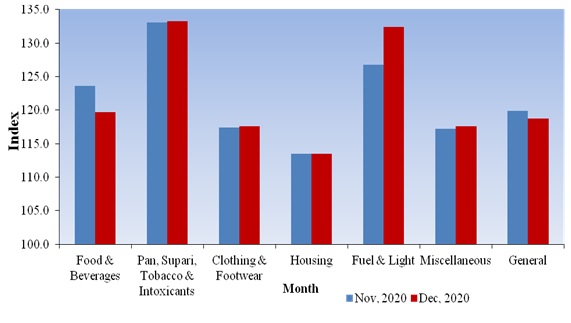
All-India CPI for Industrial Workers (2016=100) for December, 2020 decreased to 118.8 points compared to 119.9 points for November, 2020.
In percentage terms, it went down by 0.92% w.r.t. previous month mainly due to Food group items having a share of 39.17% in the total weight which recorded a fall of 3.16% between these two months. During the period, decrease in prices of food items viz. Rice, Poultry (Chicken), Orange, Brinjal, Cabbage, Cauliflower, Carrot, Chillies Green, Ginger, Onion, Peas, Potato, Tomato, etc. had greater impact.
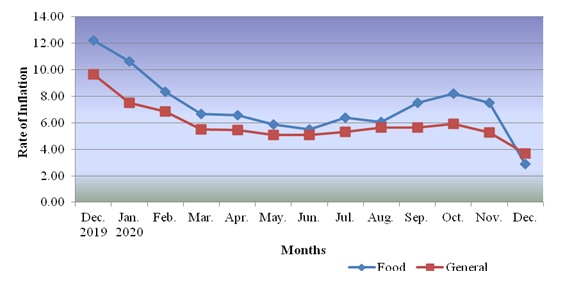
Year-on-year inflation based on all-items stood at 3.67 per cent for December, 2020 as compared to 5.27 per cent for the previous month and 9.63 per cent during the corresponding month of the previous year. Similarly, Food inflation stood at 2.89 per cent against 7.48 per cent of the previous month and 12.22 per cent during the corresponding month a year ago.
The All-India CPI-IW for December, 2020 decreased by 1.1 points and stood at 118.8 (one hundred eighteen and point eight). On 1-month percentage change, it decreased by (-) 0.92per cent between November and December, 2020compared to (+) 0.61 per cent increase between corresponding months of previous year.
The maximum downward pressure in current index came from Food & Beverages group contributing (-) 1.53 percentage points to the total change. At item level, Rice, Poultry (Chicken), Orange, Brinjal, Cabbage, Cauliflower, Carrot, Chillies Green, Ginger, Onion, Peas, Potato, Tomato, etc. are responsible for the decline in index. However, this decline was checked by Soyabean Oil, Mustard Oil, Sunflower Oil, Tea Leaf, Cooking Gas, Petrol, etc., putting upward pressure on the index.
At centre level, Ramgarh recorded the maximum decrease of 6points. Among others, 4 points decrease was observed in 3centres,3 points in 7 centres,2 points in 29centres and 1 point in 24centres. On the contrary, Solapur recorded a maximum increase of 2 points. Among others, 1 point rise was observed in5centres.Rest of 18centres’ indices remained stationary.
Year-on-year inflation based on all-items stood at 3.67 per cent for December, 2020 as compared to 5.27 per cent for the previous month and 9.63 per cent during the corresponding month of the previous year. Similarly, Food inflation stood at 2.89per cent against 7.48per cent of the previous month and 12.22 per cent during the corresponding month a year ago.
Y-o-Y Inflation based on CPI-IW (Food and General)
All-India Group-wise CPI-IW for Novemberand December, 2020
Sr. No.
Groups
Nov, 2020
Dec, 2020
I
Food & Beverages
123.6
119.7
II
Pan, Supari, Tobacco & Intoxicants
133.1
133.3
III
Clothing & Footwear
117.4
117.6
IV
Housing
113.5*
113.5*
V
Fuel & Light
126.8
132.4
VI
Miscellaneous
117.2
117.6
General Index
119.9
118.8
*Rounded up from second decimal place.
Speaking about the latest index, Shri Santosh Gangwar, Minister of State (I/C) for Labour and Employment said,the fall in inflation during December month is mainly due to food items which experienced a significant fall in retail prices on account of rise in supply. He added that the fall in inflation would imply increased purchasing power in the hands of Working class families.
Shri DPS Negi, Director General of Labour Bureau while releasing the index said,the fall in index during December, 2020 and fall in inflation rate are in line with other price indices compiled and released by other Government agencies.
He further said that it is mainly due to Food & Beverages group contributing (-) 1.53 percentage points to the total change. Among items, Rice, Poultry (Chicken), Orange, Brinjal, Cabbage, Cauliflower, Carrot, Chillies Green, Ginger, Onion, Peas, Potato, Tomato, etc. are responsible for the decline in index.
The next issue of CPI-IW for the month of January, 2021 will be released on Friday 26thFebruary, 2021. The same will also be available on the office website www.labourbureaunew.gov.in.
The Labour Bureau, an attached office of the M/o Labour & Employment, has been compiling Consumer Price Index for Industrial Workers every month on the basis of retail prices collected from 317 markets spread over 88 industrially important centres in the country. The index is compiled for 88 centres and All-India and is released on the last working day of succeeding month.
TN G.O.Ms.No.27 : Enhancement of monetary limit for purchase of cars and two wheelers – Revision of eligibility criteria
Government of Tamil Nadu
2021
Finance [Salaries] Department
G.O.Ms.No.27, Dated 20th January 2021
(Saarvari, Thai-7, Thiruvalluvar Aandu-2052)
ABSTRACT
Loans and Advances – Conveyance Advance – Enhancement of monetary limit for purchase of motor cars and motorized two wheelers – Revision of eligibility criteria – Orders Issued.
In the Government Order first, second, third and fourth read above, orders were issued fixing the quantum of advance for the purchase of conveyance and revising the eligibility criteria.
2. The Public (Special-B) department has requested the Finance department to study the feasibility of increasing the ceiling of the Motor Car Advance now being sanctioned to Government servants as one of the better methods of increasing the consumption in the economy.
3. The Government, after careful consideration has decided to enhance the quantum of advance for purchase of motor cars and motorized two wheelers. Accordingly Government direct that the quantum of advance for purchase of new motor car be enhanced as indicated below:
Levels of Pay of the Government Employee
Maximum Amount
Level 28 and above (Pay Band 4 and
above) & All India Service Officers
Rs.14 lakhs
Level 21 to Level 27 (Pay Band 3)
Rs.10 lakhs
Level 10 to Level 20 (Below Pay Band 3 till
Grade Pay of Rs.2,800/-)
Rs.6 lakhs
4. Government also order that in respect of motorized two-wheelers, the existing distinctions based on the capacity of the engine be hereby dispensed with and all regular Government employees in time scale of pay shall be eligible for a uniform maximum ceiling of Rs.1,00,000/- (Rupees one lakh only) for all categories of motorized two-wheelers
5. The revised norms will be subject to the following conditions:
a) If the actual value of the car or two wheeler purchased is below the ceilings prescribed above, the admissible advance will be restricted to the cost of the vehicle including taxes, registration and insurance.
b) As already done in the case of two-wheelers, no advance shall be given for the purchase of second hand motor cars.
c) The revised ceilings prescribed above are applicable for the year 2020-2021. For every subsequent year, the ceiling shall be automatically enhanced by 5% over the previous year.
d) The period of recovery of the advance and the other rules and regulations for sanction of conveyance advance shall remain unchanged.
6. Necessary amendment to Tamil Nadu Financial Code Volume-I will be issued separately.
(BY ORDER OF THE GOVERNOR)
S.KRISHNAN
ADDITIONAL CHIEF SECRETARY TO GOVERNMENT
Extension of deadline for issuance of Manual Pass to Railway Employees – AIRF writes to Railway Board
No.AIRF/82 Dated: January 27, 2021
The Chairman-Cum-CEO,
Railway Board,
New Delhi
Dear Sir,
Sub: Extension of deadline for issuance of Manual Pass to Railway Employees
Ref.: Railway Board’s letter No.PC-VII/2020/HRMS/6 dated 22.01.2021
Kindly call for AIRF’s communication bearing even number dated January 20, 2021, wherein a number of problems and discrepancies in issuances of Railway Passes/PTOs through e-office have already been forwarded to Railway Board.
Railway Board vide their letter supra dated 22.01.2021 have though extended the deadline for issuance of Manual Passes/PTOs up to 28.02.2021, however, it is firm opinion of this Federation(AIRF) that, this time limit is not sufficient to address the problems and discrepancies, already pointed out in Federation(AIRF)’s earlier letter dated 20.01.2021.
AIRF, therefore, desires that, issuance of Manual Passes/PTOs to Railway Employees should be continued simultaneously until the issues pointed in our letter dated 20.01.2021 are amicably resolved, so that, Serving and Retired Railway Employees are not subjected to undue hardship on this account.
Limited Transfer Facility for all categories of Gramin Dak Sevaks (GDS)
No.17-31/2016-GDS
Government of India
Ministry of Communications
Department of Posts
(GDS Section)
Dak Bhawan, Sansad Marg,
New Delhi-110001
Dated. 22.01.2020
Office Memorandum
Subject : Limited Transfer Facility for all categories of Gramin Dak Sevaks (GDS).
The undersigned is directed to convey approval of Competent Authority on the following guidelines to regulate the Limited Transfer facility of Gramin Dak Sevaks in suppression of all previous orders:-
1. Conditions of Transfer
(i) The maximum number of chances to. be provided for male GDSs is ONE only and TWO for female GDSs.
(ii) The transfer will be at his/her own request and own cost to a vacant post at his/her place of choice to his/her/spouse home village or home division or a place recommended for medical treatment.
(iii) A minimum engagement period of TWO years from the date of regular engagement on GDS Post will be mandatory for male GDS, before transfer request can be entertained.
(iv) A minimum engagement period of ONE year from the date of regular engagement on GDS post will be mandatory for female GDS.
(v) For PwD GDS and GDS having PwD dependents/Mentally retarded dependents, a minimum engagement period of ONE year from the date of regular engagement on GDS Post will be mandatory.
(vi) Transfer request of GDS who are under put off duty or against whom any disciplinary action, Police case or Court case is pending will not be entertained.
(vi) Past engagement period will be counted for assessing the eligibility for appearing in departmental examination as well as for annual increment. GDS will not have any claim to go back to the previous engagement /recruitment Unit/Division in any circumstances.
(viii) When a GDS is transferred at higher own request and the transfer is approved by the competent authority, she/he will rank junior in the seniority list of the new unit, to all the GDS of that unit who exist in the seniority list on the date on which the transfer is ordered. except in case of transfer within the same engagement/recruitment Sub Division/Unit /Division.
(ix) Mutual Exchange facility can be provided to all GDS on completion of ONE year (for Female GDS) and TWO years (for Male GDS) engagement period as the case may be.
(x) The GDS can be transferred on his/her request in following circumstances:-
(a) BPM Level 2 to BPM Level-2 in TRCA slab 3
(b) BPM Level-1 to BPM Level-1 in TRCA slab-2.
(c) ABPM/Dak Sevaks Level-2 to ABPM/Dak Sevaks Level-2 in TRCA stab-2.
(d) ABPM/Dak Sevaks Level-1 to ABPM/Dak Sevaks Level-1 in TRCA slab-1.
(e) BPM Level-1 to ABPM/Dak Sevak Level-2(Postal/RMS) in same TRCA slab.
(f) ABPM/Dak Sevak Level-2 (Postal) to BPM Level-1 in the same TRCA slab provided that, the GDS has to make accommodation arrangement for managing BO as per standard prescribed for BO and fulfilling the condition of educational qualification. Computer certificate etc. prescribed by the Department from time to time. Before joining as BPM Level-1, he/she has to undergo prescribed training for BPM.
(g) Request transfer of ABPM/Dak Sevak from Postal to RMS in the same TRCA stab.
(h) Transfer from RMS to Postal i.e. from Dak Sevak to ABPM/Dak Sevak in the same TRCA level. However, Dak Sevak from RMS should not be transferred to Postal Dn as BPM.
(xi) There will not be any drop in TRCA slab on account of a request transfer and numbers of increments earned by GDS will be retained
(xii) All request transfers are to be considered subject to condition that verification formalities viz (Caste, Education and Police verification report etc.) should have been completed.
2. Competent Authority
The transfer of GDS will be approved by Regional PMG, if the transfer is within the Region and by the Head of the Circle, if the transfer is within the Circle The approval of two concerned Head of Circle will be required, if the transfer is between two Circles.
3. Process of Transfer
(i) Application for transfer should be called for during April -June of every year.
(ii) An application will be submitted to the Divisional Head on a prescribed Proforma attached herewith as Annexure-I. The application will be submitted through head of the recruitment/engagement Unit/ Division duly recommended.
(iii) Divisional Head will submit all the applications to approving authority through proper channel with factual report and recommendations.
(iv) A separate register in prescribed Proforma attached herewith as Annexure-II is to be maintained at Circle Office/Regional Office/Divisional Office for recording transfer requests of all categories of GDS.
(v) All the applications received will be arranged in order of seniority from the date of engagement of GDS and the orders for transfer may be issued during July.
4. The above instructions will come into effect from the date of issue of this O.M.
5. Hindi version will follow.
(S.B Vyavahare)
Assistant Director General (GDS-PCC)
Recovery of dues other than Government dues from the retirement benefits of BSNL VRS-2019 Scheme retired employees
BHARAT SANCHAR NIGAM LIMITED
(A Govt. of India Enterprise)
Corporate Office
Pension Section, 5th floor Bharat Sanchar Bhawan
H.C. Mathur Lane, New Delhi-110001
No.48-2/2020-Pen (B)
Dated: 20-01-2021
To
All Heads of Circles/Telecom Districts/ Regions/Projects/
Telecom Stores/Telecom Factories & Other Administrative Offices
Bharat Sanchar Nigam Limited
Sub : Recovery of dues other than Government dues from the retirement benefits of BSNL VRS-2019 Scheme retired employees – regarding.
Sir,
I am directed to refer to this Office letter of even no. dated 29/09/2020, wherein guidelines to recover due amount from the BSNL retirees, other than those retired under BSNL VRS-2019 Scheme has been issued. This is in accordance with the instructions issued vide DOT letter No.1/ misc/ Pen/ Issues/ BSNL/ DDG(Accts)/ 2019-Part(2)/2525 to 2958 dated 24/08/2020.
2. After issuance of the aforesaid letter, the guidelines to recover dues from the BSNL VRS-2019 retirees, who have been occupying BSNL accommodation after retirement, from their terminal benefits were under consideration.
3. Now, with the approval of the Competent Authority, it has been decided to recover the dues from the 2019 BSNL VRS optees, who are still in occupation of BSNL accommodation and also from those who have not submitted “No Dues Certificate” (NDC) in the following manner till they submit NDC after vacation of quarters :-
i) The amount of Leave Encashment payable by BSNL to the BSNL VRS-9019 retiree will be withheld;
ii) The remaining 8% of Ex-Gratia amount payable to BSNL VRS-2019 retiree will be withheld;
iii) Recovery will be made from the amount of reimbursement of Outdoor/Indoor Medical claims submitted by the retiree;
iv) Recovery will be made from the amount of reimbursement of LTC/TA claims submitted by the retiree;
v) Recovery will be made from the amount of reimbursement of Mobile Handset/ Briefcase / Bag/News Paper claims etc. Submitted by the retiree.
4. In this regard, the Unit/Branch, dealing with the allotment of BSNL Quarters may be asked to send Notice/ reminders to the concerned retirees for submitting the “No Dues Certificates” (NDC). After receiving the NDC, only the withheld amount in respect of the concerned retiree may be released by the Circle.
5. Further, as per the Clause 3,B 4 & 5 of Public Premises (Eviction of Unauthorised Occupants) Act, 1971, Estate Officer is having full powers to issue Show Cause Notice to the Retired Employees, who were unauthorizedly occupying the Residential Accommodation, stating “Why an order of eviction should not be made within a period of three working days”. Hence, Estate Officers of the Circles are required to take necessary action, accordingly.
6. Estate Officers of the Territorial Circles may take extra care to collect the details of the staff quarters in merged Units in their concerned Circle either through REM in ERP or otherwise and take necessary action to evict the Unauthorised occupants under the provisions of the powers vested with them as per the “Eviction of Unauthorised Premises Act of 1971”.
7. The Estate Officers of the Circle/SSA are responsible for any loss caused to BSNL, if they do not exercise the powers vested with them. Suitable action may also be initiated to recover the outstanding dues, if any, from the Unauthorised occupants. Action taken in this regard may be intimated to this Office from time to time.
8. All the Heads of Circles/Administrative Units of BSNL are, therefore, “requested to take necessary action, in accordance with the aforesaid guidelines.
Yours faithfully,
(Sudhanshu Shekhar Ray)
Asstt. General Manager (Estt.)
Copy to :-
1. PPS to CMD, BSNL
2. PS to Dir (HR)/Dir (F)/Dir (Ent.)/Dir (CFA)/Dir (CM), BSNL Board
3. Sr. GM (Estt.)/GM (Pers.)/GM (Admn)/GM (CA) BSNL CO
4. BSNL CO Intranet Portal/Guard File