PENSION FUND REGULATORY AND DEVELOPMENT AUTHORITY B-14/A, Chhatrapati Shivaji Bhawan. Qutub Institutional Area, Katwaria Sarai, New Delhi-110016
CIRCULAR
CIR No.: PFRDA/2020/19/SUP-CRA/8
Date: June 5, 2020
To
All stakeholders under NPS including nodal officers/POPs
NPS withdrawal process at the time of difficulties caused by Covid 19 pandemic
NPS withdrawals including partial withdrawal are allowed as defined under NPS exit regulations. NPS Subscribers who intend to withdraw are required to submit the duly filled-up withdrawal forms along with the Supporting documents to the associated Nodal officers/ Points of Presence (POP) for processing their request.
2. Post submission of withdrawal documents by the Subscribers, it is the responsibility of Nodal officers/ POPs to check the genuineness of documents and verify the identity of Subscriber before authorizing their withdrawal requests in the CRA system. Upon authorization, withdrawal requests are executed in the CRA system to allow lump sum and the subscribers’ information is shared with Annuity Service Provider (ASP) for issuing annuity. Subsequently, Nodal officers/ POPs submit physical withdrawal documents to CRAs for storage and record keeping.
3. In the current Covid – 19 pandemic situation and the challenges, considering that the Subscribers may not be in a position to submit the physical exit documents, the Nodal offices/ POPs are advised to accept the scanned and self-certified images of documents through digital means as a special case and process their requests. The requests can be received from the registered email ids of Subscribers/Nodal officers. POPs/Nodal officer shall Carry out and be responsible for due diligence before authorizing the withdrawal request.
4. The existing facility to upload the withdrawal related documents in CRA system while initiating ‘online withdrawal’ request can be used quite extensively by subscribers/ nodal officer/POPs. The documents thus uploaded help in instantaneous Processing of lump sum and enable ASP to issue annuity based on the documents already uploaded.
5. The above process needs to be adopted on an exception basis and the one time exemption is allowed only till 30th June 2020. The Nodal officers/ POPs need to ensure that the duly authorized and completed documents reach the respective CRA by end of 31st July 2020.
6. This circular is issued under section 14 of PFRDA Act 2013 and is available at PFRDA’s website (www.pfrda.org.in) under the Regulatory framework and in “Circular” sections of CRA/POP under intermediaries.
GOVERNMENT OF WEST BENGAL FINANCE DEPARTMENT AUDIT BRANCH
No. 1828-F(J) NB Date: 1st June, 2020
MEMORANDUM
Subject: State Government Employees Group Insurance cum Savings Scheme, 1987 – Table of Benefits under Savings Fund for the year of cessation of Membership 2020-2021.
In continuation of this Department’s Memo No. 4114-F(J)WB dated 19.11.2019, the undersigned is directed to say that a new table of benefits showing accumulation of savings fund under the above mentioned scheme corresponding to a unit subscription of Rs. 10/- (Rupees Ten) only per month has been drawn up for the period from 01.05.2020 to 31.07.2020 in matching with the Central Government Employees Group Insurance Scheme, 1980 circulated under GOI’s OM No. 7(2)/EV/2016 dated 13.08.2019.
2. A copy of the said table is enclosed herewith as ready-reckoner. The figures have been worked out on the basis of the rate of interests as follows:-
From
To
Interest p.a. (compounded quarterly)
From
To
Interest p.a. (compounded quarterly)
01.11.1987
31.10.2001
12%
01.02.2018
30.04.2018
7.9%
01.11.2001
31.10.2002
11%
01.05.2018
31.10.2018
7.8%
01.11.2002
31.10.2003
9.5%
01.02.2018
30.04.2018
7.9%
01.11.2003
31.10.2004
9%
01.05.2018
31.10.2018
7.8%
01.11.2004
31.10.2012
8.0%
01.11.2018
30.04.2019
7.6%
01.11.2012
31.10.2013
8.6%
01.05.2019
31.07.2019
7.6%
01.11.2013
31.10.2014
8.8%
01.08.2019
30.04.2020
8%
01.11.2014
31.10.2017
8.7%
01.05.2020
31.07.2020
7.9%
01.11.2017
31.01.2018
8.0%
The mortality rate continues to remain unchanged.
3. The amounts shown in the table are applicable (with the fractions) for one unit and to be rounded off after calculating the final amount payable.
4. The amounts shown in the table are applicable to a member of Group-D category. Corresponding amounts for the member of higher groups may be calculated proportionately.
5. It is assumed that subscriptions have fully been realized from salary up to the month in which a member ceases to be in service, failing which the same shall be deducted with interest from his/her entitlement.
Additional Secretary to the Government of West Bengal
S-11011/09/2019/ Addl. DDG(HQ)/CGHS
Government of India
Ministry of Health & Family Welfare
Department of Health & Family Welfare
Directorate General of CGHS
Nirman Bhawan, New Delhi
Dated the 3rd June , 2020.
OFFICE MEMORANDUM
Sub: Notification of CGHS rates for 25 Investigations
***
With reference to the above mentioned subject the undersigned is directed to draw attention to the Office Memorandum No S.11045/36/2012-CGHS(HEC) dated 01.10.2014 vide which CGHS package rates for various treatment procedures and investigations were notified by the Government for Health Care Organizations (HCOs) empanelled under CGHS and refer to the OM of even number dated 14.01.2020 vide which CGHS rates have been notified for 15 investigations and procedures and to state that it is now decided to notify CGHS package rates rates for another 25 investigations and their inclusion in CGHS rate list as per the details given under:
No.
Name of Investigations
Recommended Rates (in Rupees)
1.
Anti-smooth muscle antibody test(ASMA)
1460/-
2.
C ANCA-IFA
1,500/-
3.
p ANCA-IFA
1,500/-
4.
ACE
1,000/-
5.
EBUS(Endo Brachia! Ultrsound) – TBNA (Using New Needle)
18,370/-
6.
ENA (Quantitative)
4,600/-
7.
Chromogranine A
5000/-
8.
Fecal Calprotectin
2,730/-
9.
C3-COMPLEMENT
650/-
10.
C4-COMPLEMENT
650/-
11.
Geneexpert test
1035/-
12.
DJ- stent removal
8,700/-
13.
PFT/(spirometry with DLCO)
500/-
14.
EUS (Endoscopic Ultrasound) guided FNAC (Using New Needle)
15,000/-
15.
CT Urography
4,500/-
16.
Video Laryngoscopy
6,000/-
17.
CT Angio-Neck vessels
6,000/-
18.
H1 N1 (RT-PCR)
1,084/-
19.
Erythropoietin level
2 ,000/-
20.
Anti HEV lgM
1,000/-
21.
anti HAV lgM
750/-
22.
HbsAg quantitative
650/-
23.
Typhidot lgM
400/-
24.
Hepatitis S Core AntibodyHScAS level(Hepatitis S Core lgM antibody)
480/-
25.
Anti Hbs
650/-
2. The rates for investigations from S.No 1 to S No. 25 are for NASL/NASH accredited HCOs. The rates for non- NASL/ non- NASH Accredited HCOs shall be 15% less.
3. These rates come into force from the date of issue.
4. This issues with the concurrence of Integrated Finance Division of Ministry of Health & Family Welfare vide CD No 460 dated 02/06/2020.
Clarifications on Certain Issues/Anomalies in 7th CPC pertaining to Qualifications, Pay Scales, Service Conditions, Career Advancement Schemes (CAS)/promotions etc. for Teachers and other Academic Staff of Technical Institutions (Degree/Diploma)
F. No. 61-3/RIFD/7thCPC/2016-17:— In exercise of the powers conferred under sub-section (i) of Section 23 read with Section 10 (g), (h) and (i) of the All India Council for Technical Education Act, 1987 (52 of 1987), the All India Council for Technical Education makes the following regulations:
I. Short title, Applications and Commencement:
(a) These Regulations may be called All India Council for Technical Education Clarifications on certain issues / anomalies in 7th CPC pertaining to Qualifications, Pay Scales, Service Conditions Career Advancement Schemes(CAS)/promotions etc. for Teachers and other Academic Staff of Technical Institutions (Degree/Diploma), 2020.
(b) These shall apply to Technical Institutions conducting technical educations and such other courses/programs and area notified by the Council from time to time.
(c) These clarifications may be read in continuation of the norms / guidelines prescribed in the main Regulations dated 1st March 2019 issued by AICTE.
AICTE had received several representations seeking clarifications on certain issues arising out of the implementation of AICTE Regulations No. 61-1/RIFD/7th CPC/2016-17 dated 1st March 2019 on revised Pay Scales, Service Conditions and Minimum Qualifications for the Teachers and other Academic Staff in Technical Institutions (Degree & Diploma) Regulations, 2019.
Clarifications on the issues arising out of implementation of 7th CPC AICTE Notification dated 1st March 2019 (Degree & Diploma) are given below:
Sr.No.
Issue
Clarification
1.
The post of workshop superintendent in Diploma level institutions is not included in AICTE Notification dated 01.03.2019 whereas the same has been included in degree notification dated 01.03.2019. The post of Workshop Superintendent should be at par with the Head of Department at Diploma Institution.
AICTE notification dated 05.03.2010 has treated workshop superintendents in diploma level institutions at par with Lecturers for upward mobility.Accordingly, the post of workshop superintendents in diploma level institutions will continue to be at par with Lecturers for the benefits of promotion applicable to Lecturers in the Notification dated 01.03.2019. For the purpose of clarity, the entry pay, levels and mode of recruitment for the post of workshop superintendent is as given in the Table-1 below.
However, the fundamental requirement of this entitlement is the parity in the qualifications with those of lecturers. Workshop Superintendents shall also be eligible to be selected as HoD and Principals through direct recruitment.
TABLE – 1 Cadre Structure and Mode of Appointment
Sr. No.
Designations of Teaching Faculty
Entry Pay (Rs.)
Level
Mode of Appointment
1
Workshop Superintendent
56,100/-
9A
Direct Recruitment
2
Workshop Superintendent
57,700/-
10
Promotion / Direct Recruitment
3
Workshop Superintendent (Senior Scale)
68,900/-
11
Promotion
4
Workshop Superintendent (Selection Grade-I)
79,800/-
12
Promotion
5
Workshop Superintendent (Selection Grade-II)
1,31,400/-
13A1
Promotion
2.
Pay, qualifications and promotion channel for a cadre of librarians working in Diploma Institutions are not included in the AICTE notification dated 1st March 2019.
It is proposed that the similar structure as that of lecturer and workshop superintendent be followed for the cadre of Librarians in Diploma Institutions. However, the requirement of qualifications, trainings, number of years of service and other criteria will be required to be met at par with lecturers.
3.
There is a discrepancy in the grant of non- compounded advance increment on acquiring Ph.D. Degree for Assistant Professor. The Junior Assistant Professor who joins after 01.01.2016 will get a higher salary than the person who joined earlier than him before 01.01.2016. This discrepancy needs to be removed.
CCS Rules take care of such anomaly.In such cases the stepping up should be done with effect from the date of promotion or appointment of the junior Government servant and will be subject to the following conditions, namely:
(a) Both the junior and the senior Government servants should belong to the same cadre and the posts in which they have been promoted are identical in the same cadre;(b) The level in the Pay Matrix of the lower and higher posts in which they are entitled to draw pay should be identical.
(c) The anomaly is directly as a result of the application of the provisions of Fundamental Rule 22(I)(a)(1) read with rule 13 of CCS (RP) Rules, 2016. For example, if the junior officer was drawing more pay in the existing pay structure than the senior by virtue of any advance increments granted to him, the provisions of this sub-rule should not be invoked to step up the pay of the senior officer.‖
(DoPT letter no. 4/3/2017-Estt. (Pay-I) dated 26th October, 2018.
4.
In pay matrix table (for Diploma institutions) the figures from cell No. 20 onwards does not increase @ 3% in pay.
The pay matrix table for Diploma institutions has been amended and the same is enclosed as Annexure- I.
5.
In Section 2.4 of the Notification (Diploma), the advantage of bunching of increments is missing.
The benefit of bunching may be extended to diploma level faculty.
Section 2.4 for Diploma teachers will be applicable as below.
2.4 Pay Matrix and Fixation of Revised PayFor Fixation of pay of an Employee in the Pay Matrix as of 1st January 2016, the existing pay (Pay in Pay Band plus Academic Grade Pay) in the pre-revised structure as on 31st December, 2015 shall be multiplied by a factor of 2.57, rounded off to the nearest Rupee. The figure so arrived at, will be located at that level in the Pay Matrix and if such an identical figure corresponds to any cell in the applicable level of the Pay Matrix, the same shall be the pay, and if no such cell is available in the applicable level, the pay shall be fixed in the immediate next higher cell in that applicable level of the Pay Matrix. If the figure arrived at in this manner is less than the first cell on that level, then the pay shall be fixed at the first cell on that level of Pay Matrix.
In cases where in revision of pay, the pay of Government Servant drawing pay at two or more stages in pre-revised Pay Band and Grade Pay or scale, as the case may be, get fixed at same Cell in the applicable Level in the new Pay Matrix, one additional increment shall be given for every two stages bunched and the pay of Government Servant drawing higher pay in the pre –revised structure shall be fixed at the next vertical cell in the applicable level as per Ministry of Finance, Department of Expenditure OM No. 1- 6/2016-IC dated 7th September 2016.
6.
Pay fixation in case of promotion is included in the degree notification, whereas the same is not included in Diploma notification. This may be included in Diploma notification also
Para 2.7 of AICTE Notification dated 01.03.2019 (Degree) dealing with pay fixation in case of direct recruitment/ promotion shall be applicable to diploma institutions which is reproduced below.Pay Fixation in the case of Direct Recruitment / Promotion:
The pay of employees appointed by direct recruitment on or after the 1st day of January 2016 shall be fixed at the minimum pay or the first cell in the level, applicable to the post to which such employee is appointed. In case of promotion, the candidate would be given a notional increment in his existing Level of Pay, by moving him/her to the next higher cell at that level. The pay shown in this cell would now be located in the new level corresponding to the post to which candidate has been promoted. If a cell identical with that pay is available in the new level, that cell shall be the new pay; otherwise the next higher cell at that level shall be the new pay of the employee. If the pay arrived at in this manner is less than the first cell in the new level, then the pay shall be fixed on the first cell of that level.
7.
Consideration regarding change of nomenclature of designation of Diploma faculty as an Assistant Professor, Associate Professor and Senior Associate Professor etc. The AICTE notification dated 01.03.2019 is silent on this issue.
No.
8.
To accord relaxation of FDP, industrial training, 360° feedback scores for granting of CAS benefits for those faculty members who are working in diverted capacity as this has not been included in para 6.6 of AICTE Notification dated 01.03.2019 (Degree/Diploma).
Relaxation in terms of FDP, Industrial training and 360° feedback and research publication requirement may be extended for faculty members working in diverted capacity for not more than a period of 3 years. However, having ACRs consistently above “Very Good” is necessary.
9.
The Clauses 1.4 (c) and 1.4 (d) of AICTE Notification dated 1st March 2019 are contradictory to each other and there is confusion about the crucial date of eligibility for CAS promotion under 6th CPC.
The clause 1.4 (d) of AICTE notification should be deleted.
10.
Whether the candidate having three years Bachelor degree in HMCT is eligible for the teaching post?
The candidates / incumbents having qualification of three years Bachelor degree in HMCT along with the other qualifications and experience as mentioned in the AICTE Gazette Notification dated 1st March 2019 are eligible for the purpose of recruitment and promotion under CAS provided that the candidate has confirmed admission in 3 years Bachelor’s programme in HMCT before publication of AICTE notification dated 1st March 2019 and produce an evidence of this admission. However, in all other cases qualifications published in AICTE Gazette dated 1st March 2019 shall be referred.
11.
What will be the constitution of the selection committee for the post of Assistant Professor, Associate Professor and Professor at University ?
The composition of the selection committee for promotion as well as direct recruitment to the post of Assistant Professor, Associate Professor and Professor at University will be same as mentioned in Annexure-II, clause-I(a) at page 42 of Gazette Notification dated 1st March 2019.It may now be read as below:
I. For University Faculty Members: (a) The Selection Committee for promotion as well as direct recruitment to the post of Assistant Professor, Associate Professor and Professor in the University shall have the following composition:(i) The Vice Chancellor or Acting Vice-Chancellor to be the Chairperson of the Selection Committee.
(ii) Three experts in the concerned subject nominated by the Vice Chancellor or Acting Vice Chancellor out of the panel of names approved by the relevant statutory body of the university concerned.
(iii) Dean of the concerned Faculty, wherever applicable.
(iv) Head / Chairperson of the Department / School
(v) An academician nominated by the Visitor / Chancellor, wherever applicable.
(vi) An academician representing SC / ST / OBC / Minority / Women / Differently-abled categories to be nominated by the Vice Chancellor or Acting Vice-Chancellor, if any of the candidates representing these categories is the applicant and if any of the above members of the selection committee does not belong to that category.
(b) To constitute the quorum for the meeting, minimum five members out of which at least two must be from out of the three subject-experts.
12.
For promotion to the post of Senior Professor, one of the requirements is to have at least one patent awarded OR development of at least one MOOC course on a national platform.However, it is not clear as to what will be the distribution of credits / weightages to individual faculty members developing MOOCs jointly for their consideration of promotion as Senior Professor.
Those who do not have patent in their name have an option of developing a MOOCs course on a national platform.It is clarified that, MOOCs jointly developed by 2 teachers is acceptable and each of the faculties developing a course jointly will get full credit / weightage if they develop a minimum of 20 hrs of MOOCs independently.
13.
Is the option for teachers available to either choosing to take promotion under the existing rules or as per the provisions in the notification under 7th CPC as published by AICTE on 1st March 2019?
The criteria for promotions laid down under these Regulations shall be effective from the date of notification of these Regulations. However, to avoid hardship to those faculty members who have already qualified or are likely to qualify shortly under the existing regulations, a choice may be given to them, for being considered for promotions under the existing Regulations. This option can be exercised by Degree and Diploma teachers, both but only within three years from the date of notification of these Regulations.
14.
There is no column existing in the Pay Matrix Table in respect of Diploma Level Technical Institutions as published in AICTE notification dated 1st March 2019 for fixing the Pay of Principals and other faculty members already drawing the pay in the AGP of 10000. Please suggest the table.
An appropriate column of the pay matrix table presented by 7th CPC for central government employees may be used.
Disclaimer: Notification Language
The notification is published in English and Hindi languages. Utmost care is taken to translate notification from English to Hindi. However, in case of any kind of discrepancy in interpretation, English version shall prevail.
The Union Public Service Commission held a special meeting today to review the prevailing situation due to COVID-19. Taking notice of the opening of lockdown and progressive relaxations being announced by the Central Government and various States, the Commission decided to issue a revised schedule of Examinations/ Recruitment Tests (RTs). Details of the revised calendar of Examinations/ RTs have been published on the UPSC website.
The Commission also decided to resume personality tests for the remaining candidates of Civil Services Examination 2019 from 20th July, 2020. Candidates will be informed individually.
Recruitment Test for the posts of EO/AO in the Employees’ Provident Fund Organization earlier scheduled to be held on the October 04, 2020 has been deferred. New date for conduct of this RT will be published on the website of the Commission at the time of issue of calendar of Examinations/ Recruitment Tests for 2021.
सिविल सेवा परीक्षा 2019 के शेष उम्मीदवारों के व्यक्तित्व परीक्षण (साक्षात्कार) 20 जुलाई 2020 से होंगे
वर्तमान में जारी कोविड-19 महामारी के कारण उत्पन्न स्थिति की समीक्षा के लिए आज संघ लोक सेवा आयोग (यूपीएससी) की एक विशेष बैठक आयोजित की गई। लॉकडाउन खुलने और केंद्र सरकार एवं राज्य सरकारों द्वारा घोषित की जा रही उत्तरोत्तर ढील पर गौर करते हुएआयोग ने परीक्षाओं/भर्ती परीक्षाओं(आरटी) की संशोधित सारिणी जारी करने का निर्णय लिया है। परीक्षाओं/भर्ती परीक्षाओं के संशोधित कैलेंडर का विवरणयूपीएससी की वेबसाइट पर प्रकाशित किया गया है।
आयोग ने सिविल सेवा परीक्षा 2019 के शेष उम्मीदवारों के व्यक्तित्व परीक्षण (साक्षात्कार) 20 जुलाई 2020 से शुरु करने का भी निर्णय लिया है। उम्मीदवारों को व्यक्तिगत रूप से सूचित किया जाएगा।
कर्मचारी भविष्य निधि संगठन में ईओ/एओ पदों के लिए पहले 04 अक्टूबर, 2020 को निर्धारित की गई भर्ती परीक्षा स्थगित कर दी गई है। भर्ती परीक्षा आयोजित करने की नई तिथि 2021 के लिए परीक्षाओं/भर्ती परीक्षाओं का कैलेंडर जारी किए जाने के समय आयोग की वेबसाइट पर प्रकाशित की जाएगी।
MoD initiates dialogue with OFB employees associations on corporatisation of OFB
A High Level Official Committee (HLOC) of Department of Defence Production (DDP), Ministry of Defence (MoD) has taken initiative to commence dialogue with employees’ federations/unions to address their concerns regarding corporatisation of Ordnance Factory Board (OFB) here today.
The Committee, headed by Additional Secretary (DDP) Shri V L Kantha Rao along with senior MoD and Army officials, held a host meetings through video conferencing with three such associations – Confederation of Defence Recognised Associations (CDRA), Indian Ordnance Factories Gazetted Officers Association (IOFGOA) & National Defence Group-B Gazetted Officers Association (NDGBGOA) wherein, the intent of the Government to implement aforesaid decision with involvement of all the stakeholders was conveyed and suggestions were invited from the association members on ways to safeguard the benefits/interests of employees in terms of wages, salary, retirement benefits, health facilities and other service matters, etc, while converting OFB into one or more 100 per cent Government owned corporate entities.
Suggestions were also sought on their concern regarding future orders and budgetary support needed from the Government for the new corporate entity/entities.
The discussions in the meeting took place in a cordial atmosphere. The request of the associations to hold more meetings with all OFB employees’ federations/unions participating together was considered by the Committee and it was assured that the engagement with the Federations/Unions will be continued.
As part of the Atmanirbhar Bharat package, the Government had announced on May 16, 2020 that it would improve autonomy, accountability and efficiency in ordnance supplies by corporatisation of OFB.
Employees’ associations were represented by CDRA President Shri B K. Singh and General Secretary Shri B B Mohanty. The IOFSGOA was represented by its General Secretary Shri S B Chaubey and General Treasurer Shri M A Siddiqui while NGDBGOA was represented by its President Shri M Barik and General Secretary Jaigopal Singh.
रक्षा मंत्रालय द्वारा ओएफबी कर्मचारियों के संगठनों के साथ ओएफबी के निगमीकरण पर वार्ता
रक्षा मंत्रालय (एमओडी) के रक्षा उत्पादन विभाग (डीडीपी) की एक उच्च स्तरीय आधिकारिक समिति (एचएलओसी) ने आज यहां आयुध निर्माणी बोर्ड (ओएफबी) के निगमीकरण के बारे में उनकी चिंताओं को दूर करने के लिए कर्मचारियों के संघों/ संगठनो के साथ बातचीत के शुरुआत की पहल की है।
श्री वी एल कंठा राव, अतिरिक्त सचिव (डीडीपी) की अध्यक्षता वाली समिति ने रक्षा मंत्रालय और सेना के वरिष्ठ अधिकारियों के साथ मिलकर, इस प्रकार के तीन संघों- कंफेडरेशन ऑफ डिफेंस रिकॉग्नाइज्ड एसोसिएशन (सीडीआरए), इंडियन ऑर्डनेंस फैक्ट्रीज गजेटेड ऑफिसर्स एसोसिएशन (आईओएफजीओए) और नेशनल डिफेंस ग्रुप-बी गजेटेड ऑफिसर्स एसोसिएशन (एनडीजीबीजीओए) के साथ वीडियो कॉफ्रेंस के माध्यम से बैठक की मेजबानी की, जिसमें सभी हितधारकों को उनकी भागीदारी के साथ पूर्वकथित निर्णय को लागू करने वाली सरकार की मंशा से अवगत कराया गया और संगठन के सदस्यों से तनख़्वाह, वेतन, सेवानिवृत्ति लाभ, स्वास्थ्य सुविधाएं और अन्य सुविधाओं के संदर्भ में कर्मचारियों के लाभ/हितों की रक्षा और अन्य सेवा मामलों के लिए सुझाव आमंत्रित किए गए, जबकि ओएफबी को एक या शतप्रतिशत सरकारी स्वामित्व वाले कॉरपोरेट संस्थाओं में परिवर्तित किया जा रहा है। नए कॉर्पोरेट इकाई/ संस्थाओं के लिए भविष्य में सरकार के आदेशों और आवश्यक बजटीय समर्थन के संदर्भ में उनकी चिंताओं पर भी सुझाव मांगे गए।
सौहार्दपूर्ण वातावरण में बैठक में चर्चा की गई। संघों द्वारा सभी ओएफबी कर्मचारी परिसंघों/ यूनियनों के साथ और ज्यादा बैठकें करने अनुरोध पर समिति द्वारा विचार किया गया और यह आश्वासन दिया गया कि परिसंघों/ यूनियनों के साथ मेल-जोल जारी रखा जाएगा।
सरकार ने 16 मई, 2020 को आत्मानिर्भर भारत पैकेज के एक भाग के रूप में यह घोषणा की थी कि ओएफबी का निगमीकरण करके आयुध आपूर्ति में स्वायत्तता, जवाबदेही और दक्षता में सुधार किया जाएगा।
कर्मचारी संघों का प्रतिनिधित्व सीडीआरए के अध्यक्ष, श्री बी के सिंह और महासचिव, श्री बी बी मोहंती द्वारा किया गया। आईओएफएसजीओए का प्रतिनिधित्व इसके महासचिव, श्री एस बी चौबे और सामान्य कोषाध्यक्ष, श्री एम ए सिद्दीकी ने किया, जबकि एनजीडीबीजीओए का प्रतिनिधित्व इसके अध्यक्ष, श्री एम बारिक और महासचिव, जयगोपाल सिंह ने किया।
F.No.11013/9/2014-Estt.A. III
Government of India
Ministry of Personnel, Public Grievances and Pensions
(Department of Personnel and Training)
North Block, New Delhi
Dated the 5th June, 2020
OFFICE MEMORANDUM
Subject : Counting of the limitation period for the diverse purposes under CCS (CCA) Rules, 1965, CCS (Pension) Rules, 1972 regarding.
The undersigned is directed to refer to OM of even number dated 30 March, 2020 whereby, considering the unprecedented situation of lockdown w.e.f. 24th March, 2020, the period of lockdown was decided to be excluded from the time-limits prescribed in various Rules/instructions. While in the initial periods of lockdown, the Government offices were directed to work either with skeletal staff or with 1/3rd of its strength, DoPT’s extant instructions provide for attendance of 100% officers of the level of DS & above and 50% below DS on all working days. Ministry of Home Affairs vide its Order dated 30th May, 2020 has also issued instructions for phase-wise reopening of prohibited activities outside the containment zone. In view of this, it has now been decided that the exclusion of lockdown period w.e.f. 24th March, 2020 shall cease to have further effect with the issue of this O.M. Therefore, after exclusion of lockdown period, action as per time-lines provided under various Rules/instructions may be completed within the period as explained in paras 2 & 3 of O.M. dated 30th March, 2020 referred above.
Sd/-
(Umesh Kumar Bhatia)
Deputy Secretary to the Govt. of India
2. Consequent upon the outbreak of COVID-19, and considering the unprecedented situation of the Lockdown w.e.f. 24th March 2020, it may not be feasible to adhere to the timelines prescribed in the said Rules and to the instructions issued under the Rules. It has accordingly been decided not to count the period of the Lockdown for the purposes of adherence to the prescribed timelines, including those listed above. For example, if the due date for completing a process/work/event at the start of the Lockdown falls after 20 days, then the due date will get postponed by the number of Lockdown days and the same number (20) of days will be available to complete the work after the Lockdown is lifted.
3. However, after the Lockdown is lifted, if the time left to complete the task is less than 15 days, then the processes may be allowed to be completed within 15 days
F.No.11013/9/2014-Estt.A.III
Government of India
Ministry of Personnel, Public Grievances and Pensions
(Department of Personnel and Training)
North Block, New Delhi
Dated the 5th June, 2020
OFFICE MEMORANDUM
Subject: Preventive measures to be taken to contain the spread of Novel Coronavirus (COVID-19) – Attendance regarding.
The undersigned is directed to refer to OM of even number dated the 17th March, 2020, 18th May, 2020 and 19th May, 2020 whereby advisory for well-being of Government employees and attendance in Government offices with staggered timings were issued by Department of Personnel & Training (DoPT).
2. Kind attention is also drawn to Ministry of Home Affairs’ Order dated 30.05.2020 whereby ‘Additional Directives for Work Places’ have been prescribed. Further, the Ministry of Health & Family Welfare (MoH&FW) on 4th June, 2020 has issued Standard Operating Procedure on preventive measures to contain spread of COVID-19 in workplace settings (copy enclosed).
3. It is emphasized that strict adherence to the practices of social distancing norms and health & hygiene practices, as enunciated in these guidelines, is of paramount importance and the Government servants as responsible employees should abide by these practices so that the Government offices function in the most efficient manner in the given situation. All the Ministries/Departments/offices as well as the Central Government employees are, therefore, directed to ensure strict compliance of instructions issued by DoPT as well as MHA and MoH&FW.
sd/-
(Umesh Kumar Bhatia)
Deputy Secretary to the Govt. of India
Government of India Ministry of Health & Family Welfare
SOP on preventive measures to contain spread of COVID-19 in offices
1. Background
Offices and other workplaces are relatively close settings, with shared spaces like work stations, corridors, elevators & stairs, parking places, cafeteria, meeting rooms and conference ha lls etc. and COVID-19 infection can spread relatively fast among officials, staffs and visitors.
There is a need to prevent spread of infection and to respond in a timely and effective manner in case suspect case of COVID-19 is detected in these settings, so as to limit the spread of infection.
2. Scope
This document outlines the preventive and response measures to be observed to contain the spread of COVID-19 in office settings. The document is divided into the following sub sections
(i) Generic preventive measures to be followed at all times
(ii) Measures specific to offices
(iii) Measures to be taken on occurrence of case(s)
(iv) Disinfection procedures to be implemented in case of occurrence of suspect/confirmed case.
Offices in containment zones shall remain closed except for medical & essential services. Only those outside containment zones will be allowed to open up.
3. Generic preventive measures
Persons a bove 65 years of age, persons with comorbidities, pregnant women are advised to stay at home, except for essential and health purposes. Office management to facilitate the process.
The generic preventive measures include simple public health measures that are to be followed to reduce the risk of infection with COVID-19. These measures need to be observed by all (employees and visitors) at all times. These include:
Individuals must maintain a minimum distance of 6 feet in public places as far as feasible.
Use of face covers/masks to be mandatory.
Practice frequent hand washing with soap {for at least 40-60 seconds) even when hands are not visibly dirty. Use of alcohol-based hand sanitizers {for at least 20 seconds) can be made wherever feasible.
Respiratory etiquettes to be strictly followed. This involves strict practice of covering one’s mouth and nose while coughing/sneezing with a tissue/handkerchief/flexed elbow and disposing off used tissues properly.
Self-monitoring of health by all and reporting any illness at the earliest to the immediate supervisory officer.
Spitting shall be strictly prohibited.
Installation & use of Aarogya Setu App by employees.
4. Specific preventive measures for offices:
Entrance to have mandatory hand hygiene (sanitizer dispenser) and thermal screening provisions.
Only asymptomatic staff/visitors shall be allowed.
Any officer and staff residing in containment zone should inform the same to supervisory officer and not attend the office till containment zone is denotified. Such staff should be permitted to work from home and it will not be counted as leave period.
Drivers shall maintain social distancing and shall follow required dos and don’ts related to COVID-19. It shall be ensured by the service providers/ officers/ staff that drivers residing in containment zones shall not be allowed to drive vehicles.
There shall be provision for disinfection of the interior of the vehicle using 1% sodium hypochlorite solution/ spray. A proper disinfection of steering, door handles, keys, etc. should be taken up.
Advise all employees who are at higher risk i.e. older employees, pregnant employees and employees who have underlying medical conditions, to take extra precautions. They should preferably not be exposed to any front-line work requiring direct contact with the public. Office management to facilitate work from home wherever feasible.
All officers and staff / visitors to be allowed entry only if using face cover/masks. The face cover/mask has to be worn at all times inside the office premises.
Routine issue of visitors/temporary passes should be suspended and visitors with proper permission of the officer who they want to meet, should be allowed after . being properly screened.
Meetings, as far as feasible, should be done through video conferencing.
Posters/standees/AV media on preventive measures about COVID-19 to be displayed prominently.
Staggering of office hours, lunch hours/coffee breaks to be done, as far as feasible.
Proper crowd management in the parking lots and outside the premises – duly following social distancing norms be ensured.
Valet parking, if available, shall be operational with operating staff wearing face covers/ masks and gloves as appropriate. A proper disinfection of steering, door handles, keys, etc. of vehicles should be taken up.
Any shops, stalls, cafeteria etc., outside and within the office premises shall follow social distancing norms at all times.
Specific markings may be made with sufficient distance to manage the queue and ensure social distancing in the premises.
Preferably separate entry and exit for officers, staff and visitors shall be organised.
Proper cleaning and frequent sanitization of the workplace, particularly of the frequently touched surfaces must be ensured.
Ensure regular supply of hand sanitisers, soap and running water in the washrooms.
Required precautions while handling supplies, inventories and goods in the office shall be ensured.
Seating arrangement to be made in such a way that adequate social distancing is maintained.
Number of people in the elevators shall be restricted, duly maintaining social distancing norms.
For air-conditioning/ventilation, the guidelines of CPWD shall be followed which inter alia emphasises that the temperature setting of all air conditioning devices should be in the range of 24-30°C, relative humidity should be in the range of 40- 70%, intake of fresh air should be as much as possible and cross ventilation should be adequate.
Large gatherings continue to remain prohibited.
Effective and frequent sanitation within the premises shall be maintained with particular focus on lavatories, drinking and hand washing stations/areas.
Cleaning and regular disinfection (using 1% sodium hypochlorite) of frequently touched surfaces (door knobs, elevator buttons, hand rails, benches, washroom fixtures, etc.) shall be done in office premises and in common areas
Proper disposal of face covers I masks I gloves left over by visitors and/or employees shall be ensured.
In the cafeteria/canteen/dining halls:
Adequate crowd and queue management to be ensured to ensure social distancing norms.
Staff I waiters to wear mask and hand gloves and take other required precautionary measures.
The seating arrangement to ensure a distance of at least 1meter between patrons as far as feasible.
In the kitchen, the staff to follow social distancing norms.
5. Measures to be taken on occurrence of case(s):
Despite taking the above measures, the occurrence of cases among the employees working in the office cannot be ruled out. The following measures will be taken in such circumstances:
i. When one or few person(s) who share a room/close office space is/are found to be suffering from symptoms suggestive of COVID-19:
a. Place the ill person in a room or area where they are isolated from others at the workplace. Provide a mask/face cover till such time he/she is examined by a doctor.
b. Immediately inform the nearest medical facility (hospital/clinic) or call the state or district helpline.
c. A risk assessment will be undertaken by the designated public health authority (district RRT/treating physician) and accordingly further advice shall be made regarding management of case, his/her contacts and need for disinfection.
d. The suspect case if reporting very mild/mild symptoms on assessment by the health authorities would be placed under home isolation.
e. Suspect case, if assessed by health authorities as moderate to severe, will be treated as per health protocol in appropriate health facility.
f. The rapid response team of the concerned district shall be requisitioned and will undertake the listing of contacts.
g. The necessary actions for contact tracing and disinfection of work place will start once the report of the patient is received as positive. The report will be expedited for this purpose.
ii. If there are large numbers of contacts from a pre-symptomatic / asymptomatic case, there could be a possibility of a cluster emerging in workplace setting. Due to the close environment in workplace settings this could even be a large cluster (>15 cases). The essential principles of risk assessment, isolation, and quarantine of contacts, case referra l and management will remain the same. However, the scale of arrangements will be higher.
iii. Management of contacts:
The contacts will be categorised into high and low risk contacts by the District RRTas detailed in the Annexure I.
The high-risk exposure contacts shall be quarantined for 14 days.
These persons shall undergo testing as per ICMR protocol.
The low risk exposure contacts shall continue to work and closely monitor their health for next 14 days.
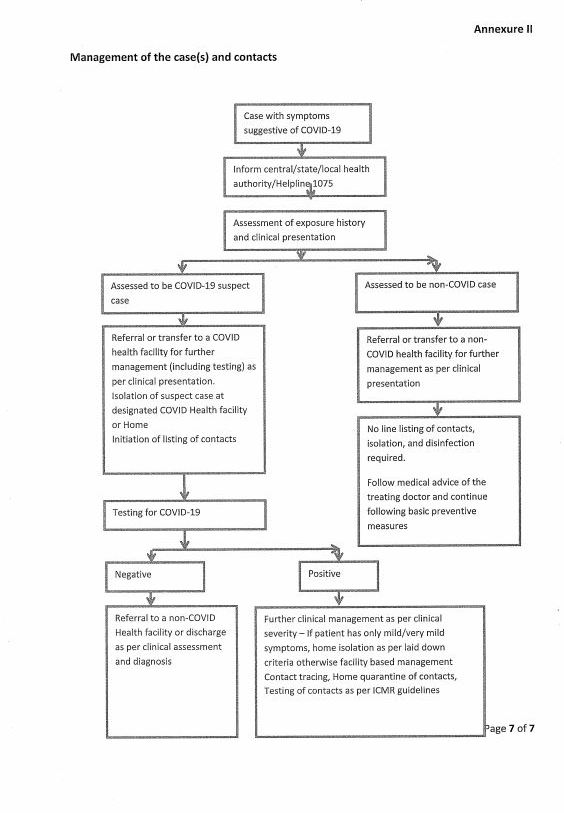
The flowchart for management of contact/ cases is placed at Annexure – II.
6. Closure of workplace
If there a re one or two cases reported, the disinfection procedure will be limited to places/areas visited by the patient in past 48 hrs. There is no need to close the entire office building/halt work in other areas of the office and work can be resumed after disinfection as per laid down protocol.
However, if there is a larger outbreak, the building/block will have to be closed for 48 hours after thorough disinfection. All the staff will work from home, till the building/block is adequately disinfected and is declared fit for re-occupation.
7. Disinfection Procedures in Offices
Detailed guidelines on the disinfection as already issued by Ministry of Health & Family Welfare as available on their website shall be followed.
Annexure I
Risk profiling of contacts
Contacts are persons who have been exposed to a confirmed case anytime between 2 days prior to onset of symptoms (in the positive case) a nd the date of isolation (or maximum 14 days after the symptom onset in the case).
High-risk contact
Touched body fluids of the patient (respiratory tract secretions, blood, vomit, saliva, urine, faeces; e.g. being coughed on, touching used paper tissues with a bare hand)
Had direct physical contact with the body of the patient including physical examination without PPE
Touched or cleaned the linens, clothes, or dishes of the patient.
Lives in the same household as the patient.
Anyone in close proximity (within 1 meter) of the confirmed case without precautions.
Passengers in close proximity (within 1 meter) in a conveyance with a symptomatic person who later tested positive for COVID-19 for more than 6 hours.
Low-risk contact
Shared the sa me space (worked in same room/similar) but not having a high-risk exposure to confirmed case of COVID-19.
Travelled in same environment (bus/train/flight/any mode of transit) but not having a high-risk exposure.
PENSION FUND REGULATORY AND DEVELOPMENT AUTHORITY
8-14/A, Chhatrapati Shivaji Bhawan,
Qutub Institutional Area,
Katwaria Sarai, New Delhi-110016
Ph : 011-26517501, 26517503, 26133730
Fax : 011-26517507
Website ·. www.pfrda.org.in
CIRCULAR
PFRDA/17/08/11/0031/2017-SUP-SG
01st June 2020
Subject : Choice of Pension Funds and Investment Pattern in Tier I of NPS for the Government subscribers employed with State Governments (SG), State Autonomous Bodies (SABs) & Central Autonomous Bodies (CABs)
A. This has reference to the Gazette Notification F. No. 1/3/2016-PR. dated 31-01- 2019 issued by Dept. of Financial Service (DFS), Ministry of Finance (MoF), pursuant to which the Authority vide its circular no PFRDA/2019/12/REG-PF/1 dated 08th May 2019, introduced the choice of the pension fund and investment pattern in the Tier I of the NPS for the employees of the Central Government.
B. The following were introduced by Central Government through the DFS Gazette Notification ( Annexure 1) mentioned supra
I. Enhancement in Government Co- Contribution – The monthly contribution of 10 percent of the Basic Pay plus Dearness Allowance (DA) to be paid by the employee and 14 percent of the Basic Pay plus DA by the Central Government.
IL Compensation For Non-Deposit Or Delayed Deposit Of Contributions in the following cases:
1. where the NPS contributions were deducted from the salary of the Government employee but the amount was not remitted to CRA system or was remitted late;
2. where the NPS contributions were not deducted from the salary of the Government employee;
3. where the Government contributions were not remitted to CRA system or were remitted late (irrespective whether the employee contributions were deducted or not),
III. Choice of Pension Fund And Investment Pattern In Tier-I Of NPS as under:
1. Choice of Pension Fund: The Government subscriber shall be allowed to choose any one of the pension funds including Private sector pension funds. They can change their option once in a year. However, the current provision of combination of Public Sector Pension Funds will be available as default option for existing as well as new Government subscriber.
2. Choice of Investment Pattern: The following options for investment choices shall be offered to Government subscribers
(i) Default Scheme: The existing scheme in which funds are allocated among three Public Sector undertaking fund managers shall continue as default scheme for both existing and new subscribers.
(ii) Scheme G: Employees who prefer returns with comparatively less amount of risk shall be given an option to invest 100% of the funds in Govt. securities. (Scheme G)
(iii) Auto Choice Life Cycle Funds: Employees preferring better returns with comparatively higher risk shall be given the options of the following Life Cycle based schemes-
a) Conservative Life Cycle Fund with maximum exposure to equity capped at 25%- LC-25 Scheme.
b) Moderate Life Cycle Fund with maximum exposure to equity capped a 50 LC- 50 Scheme
The Government subscribers may exercise one of the above choices of Investment pattern twice in a financial year.
IV. Implementation of choices to the legacy corpus : Transfer of huge legacy corpus in respect of the Government subscribers from the existing Pension Funds is likely to impact the market. It may be practically difficult for the PFRDA to allow Government subscribers to change the Pension Funds or investment pattern in respect of the accumulated corpus, in one go. Therefore, for the present, change in the Pension Funds or investment pattern is allowed in respect of the incremental flows only.
v. Transfer of Legacy corpus in reasonable time frame : PFRDA shall draw up a scheme in due course for transfer of accumulated corpus as per new choices of Government subscribers in a reasonable time frame of say five years. Once PFRDA draws up this scheme, change in Pension Funds or investment pattern shall be allowed in respect of the accumulated corpus in accordance with that scheme.
VI. For investment option of Default scheme as per para B.III 2 (i) above, all other terms and conditions as contained in the investment guidelines issued by the Authority dated 03.06.2015 for NPS Schemes (Applicable to Scheme CG, Scheme SG, Corporate CG and NPS Lite Schemes and APY) and subsequent amendments made thereto shall be applicable.
VII. Further, for investment options as per para B.III 2 (ii) or B.III 2.(iii) (a) and (b) above, all other terms and conditions as contained in the investment guidelines issued by the Authority dated 04.05.2017 in respect of NPS Schemes {Other than Govt. Sector (CG & SG), Corporate CG, NPS Lite and APY} and subsequent amendments made thereto shall apply.
C. It has been brought to the notice of the Authority that while some of the State Governments (SGs) I SABs/ CABs have either partially or wholly adopted the provisions of Gazette Notification F. No.1/3/2016-PR. dated 31-01-2019 issued by Dept. of Financial Service (DFS), Ministry of Finance (MoF), the others have been seeking clarifications on the same. It is, therefore, clarified that the State Governments ( SGs) I SABs/ CABs are free to adopt the provisions of the said Gazette notifications on their own volition , based on their own internal approvals and notifications , without seeking the Authority’s approval.
D. This circular is issued in exercise of powers of the Authority under sub-clause (b) of sub-section (2) of Section 14 read with Section 23 of the PFRDA Act, 2013 and sub regulation (1) of Regulation 14 of the PFRDA (Pension Fund) Regulations, 2015.