Z 15025112/2020/DIR/CGHS
Government of India
Ministry of Health & Family Welfare
Directorate General of CGHS
Nirman Bhawan, New Delhi
Dated the 29th May , 2020.
OFFICE MEMORANDUM
Sub: Reimbursement of cost of OPD Medicines: Special Sanction in view of COVID-19- till 31st July 2020- regarding
***
In view of the Corona Virus Disease(COVID-19) , all out efforts are made by the Government to contain its impact by instituting measures at community as well as at individual level.
2. In this regard the undersigned is directed to draw attention is the OM of even number dated 27.03.2020 and 29.04.2020 vide which an option has been provided to CGHS beneficiaries getting medicines for Chronic diseases , to purchase medicines based on the prescription held (prescribed by CGHS Medical Officers/CGHS Specialists /other Govt. Specialists/ Specialist of empanelled hospital) till 31st May 2020, irrespective of Non-Availability certificate from CGHS or otherwise. However, several representations are received in the Ministry seeking extension of the period in view of the continued ‘Lock Down’.
3. The matter has been reviewed by the Ministry it is now decided that CGHS beneficiaries getting medicines for Chronic diseases shall be permitted to purchase medicines based on the prescription held (prescribed by CGHS Medical Officers/CGHS Specialists /other Govt. Specialists/ Specialist of empanelled hospital) till 31st July 2020 on the same conditions as per the earlier OM dated 27.03.2020. It is also clarified that the CGHS Wellness Centres are functional and CGHS beneficiaries also have the option to collect medicines through CGHS Wellness Centres as per normal practice, instead of purchasing from market.
4 Issued with the approval of Integrated Finance Division, MoHFW vide CD No 430 dated 29.05.2020.
All government offices will be permitted to operate with 15% strength or minimum 15 members, whichever is more, the state govt said
The state government said that come 8 June, all private offices can operate with up to 10% strength as per requirement, with remaining persons working from home
After announcing several guidelines and relaxations amid the extension of lockdown in the state till 30 June, 2020, Maharashtra government laid out certain specific guidelines for its employees working in public and private offices, which will open in a phased manner.
In its ‘Mission Begin Again’ guidelines in accordance to the Centre’s Unlock plan 1.0, the state said that in phase 1, which will commence from 3 June, all government offices will be permitted to operate with 15% strength or minimum 15 members, whichever is more. The state government said that come 8 June, all private offices can operate with up to 10% strength as per requirement, with remaining persons working from home.
“All employees and visitors at the government offices will be screened by a thermal scanner before entering the premises. All employees will have to wear a 3-ply or surgical mask while working in the office all the time,” said the state government in its order.
“Windows of the offices will be kept open throughout the day for ventilation. The employee would have to maintain three feet distance from other employees while working,” it added.
In other instructions, the government said: “Employees are advised not to touch their nose, eye and mouth to avoid infection. The lift buttons shall be sanitised thrice in a day with sodium hypochlorite.”
“All other office equipment like printer, scanner, computer, etc shall be sanitised with an alcohol-based sanitiser,” it added.
Ministry of Home Affairs (MHA) on Saturday announced that the lockdown will continue in containment zones till 30 June and only essential activities will be allowed in those areas.
Meanwhile, with 2,940 new Covid-19 cases getting reported in Maharashtra in the last 24 hours, the state’s virus count reached 65,168 on Saturday.
With 99 more deaths reported in the last 24 hours, the state’s death toll stood at 2,197, said the state’s health department.
1,084 Covid-19 patients recovered in Maharashtra on Saturday, taking total number of discharged patients to 28,081. Maharashtra is the hardest-hit state by the pandemic in India.
BSNL to claim “recoupment of leave encashment” related to the DoT period.
When the DoT recruited employees were absorbed in BSNL, the leave earned during their DoT service was also carried forward. Hence, when the employees absorbed from the DoT retired, the leave encashment for the portion of the leave earned during the DoT service, should have been paid by the DoT. However, this did not happen. The entire Leave Encashment amount was paid by the BSNL. At that time itself, the unions and associations raised this issue and claimed settlement by the DoT. However, it was not accepted by the DoT. The BSNL Management also did not pursue this issue with the government. But, now, the BSNL Management has decided to claim recoupement of whatever amount it has paid to the employees, as Leave Encashment, for the leave accumulated as on 01.10.2000. BSNLEU, strongly supports this move being taken the BSNL Management. The Union, together with the AUAB, will take the needful action to settle this issue.
NTPC accelerates Learning & Development Opportunities for 19000 Employees and their family members during the Lockdown period
The Maharatna collaborates with World Bank, ‘Art of Living’ and other external entities via L&D sessions
Certifications offered on successful completion of training
NTPC, India’s largest power producer and the Central PSU under Ministry of Power, has offered learning opportunities to its 19,000-plus employees and their family members. To meet the requirements of the lockdown imposed due to COVID 19 pandemic, NTPC Learning and Development (L&D) strategy has been customised for enriching employees through intensive digitisation and online training, enabling them to avail these services from anywhere.
Moreover, company has collaborated with the World Bank to offer its staff an opportunity to be part of a rigorous online technical course, attending virtual classes, giving assessments and, eventually, obtaining certifications.
Power Management Institute – NTPC’s apex L&D centre – has conducted 250-plus training sessions in diverse disciplines ranging from technical, functional, health and safety. Besides, NTPC’s Regional Learning and Development Centres located in power plant projects have created almost 100-plus online learning opportunities.
The Maharatnais determined to keep nurturing its staff via continuous learning sessions while simultaneously revamping and customising methodologies for specialised scenarios. The company realises the need for upskilling even during crises. Therefore, another unique collaboration – the ‘45-Day Learning Challenge’ – offers its staff thorough learning for 45 days in varied disciplines such as Technical, Finance and HR, earning them certifications once completed from home.
There are other collaborations too with external agencies providing state-of-the-art sessions. A holistic wellness programme is being continuously run in association with the ‘Art of Living’. Employees and family members of all ages can participate, helping them stay strong and focused during these turbulent times. Similarly, a special six-month initiative, ‘Snehal 2.0’, based on counselling services via EAP (Employee Assistance Programmes) has been extended to employees’ family members. Available round-the-clock, the EAP service is confidential and offered to select users only.
Likewise, classes are being held on power plant essentials such as Turbine, Boiler, Water Chemistry, Renewable Energy and other significant O&M (Operations & Maintenance) areas through in-house as well as guest faculties. The new learning methodologies include connecting via online forums, webinars, an internally-developed mobile application ‘Samvaad’ as well as leveraging the Internet and its internal learning portal.
EPFO released Rs 868 crore pension along with Rs 105 crore arrear on account of restoration of commuted value of pension.
On the recommendation of Central Board of Trustees (EPFO), the Government of India accepted one of the long standing demands of workers to allow restoration of commuted value of pension after 15 years. Earlier there was no provision for restoration of commuted pension and the pensioners continued to receive reduced pension on account of commutation lifelong.This is a historical step for the benefit of pensioners under EPS-95.
EPFO has more than 65 lakhs pensioners catered through its 135 regional offices. EPFO officers and staff battled all odds during this Covid-19 lockdown period and processed pension payment for May,2020 to ensure credit of pension in the bank account of pensioners on schedule.
Z.15025/17/2020/DIR/CGHS/
Govt. of India
Min. of Health & Family Welfare
Directorate General of CGHS
545-A Nirman Bhawan, New Delhi.
Dated the 29th May , 2020
OFFICE ORDER
Subject : Extension of Validity of CGHS Card in view of the Corona Virus (COVID-19) Infection
***
In view of the Corona Virus Disease (COVID-19) , all out efforts are made by the Government to contain its impact by instituting measures at community as well as at individual level. Guidelines for maintaining social distancing between individuals have already been issued by the Government.
2. In the spirit of above guidelines, the undersigned is directed to draw kind attention to the Office Order of even number dated 1.4.2020 and 27.04.2020 vide which the validity of CGHS Cards expiring on 31st March 2020 and thereafter has been extended in respect of CGHS pensioner beneficiaries contributing on annual basis and Central Government serving employees superannuating on 31.03.2020 and thereafter as per the details given under:
i. In case of CGHS pensioner beneficiaries, who contribute the subscription on annual basis and whose CGHS cards are valid till 31st March 2020 and thereafter , the validity period shall be extended till 31st July 2020 in the Data Base, by the Additional Directors City/ HQ (in Delhi) on the basis of request received over e-mail from such beneficiaries. A paper print-out may be signed and scanned copy of the same shall be sent to the beneficiary by e-mail , with a direction to submit the relevant documents and subscription before 31st July 2020.
ii. Similarly, if a request is received by e-mail from serving employees, who superannuated on 31.03.2020 and thereafter and are not in receipt of PPO, the CGHS Card may be converted as pensioner CGHS Card and validity period extended to 31st July 2020. A paper print-out may be signed and scanned copy of the same shall be sent to the beneficiary by e-mail with a direction to submit the relevant documents and subscription before 31st July 2020. Additional Director City/ HQ (in Delhi) will verify the date of superannuation from CGHS database before processing the request. If a Govt Servant superannuating on 31.03.20 and thereafter was not a member of CGHS during service then he will have to submit a proof of superannuation.
iii. The period of extension will be included when the card validity is regularized on depositing the subscription (including the subscription for the extended period).
iv. That these relaxations are being made to help the CGHS beneficiaries in view of extraordinary conditions due to COVID 19 and will not be cited as a precedence in future.
No. 40-3/2020-DM-I(A)
Government of India
Ministry of Home Affairs
North Block, New Delhi-110001
Dated 30th May, 2020
ORDER
Whereas, an Order of even number dated 17.05.2020 was issued for containment of COVID-19 in the country, for a period upto 31.05.2020;
Whereas, in the exercise of the powers under section 6(2)(i) of the Disaster Management Act, 2005, National Disaster Management Authority (NDMA) has directed the undersigned to issue an order to extend the lockdown in Containment Zones upto 30.06.2020, and to re-open prohibited activities in a phased manner in areas outside Containment Zones;
Now therefore, in exercise of the powers, conferred under Section 10(2)(1) of the Disaster Management Act 2005, the undersigned hereby directs that guidelines, as Annexed, will remain in force upto 30.06.2020.
Union Home Secretary
and, Chairman, National Executive Committee (NEC)
Guidelines for Phased Re-opening (Unlock 1)
[As per Ministry of Home Affairs (MHA) Order No. 40-3/2020-DM-I (A) dated 30th May, 2020]
1. Phased re-opening of areas outside the Containment Zones
In areas outside Containment Zones, all activities will be permitted, except the following, which will be allowed, with the stipulation of following Standard Operating Procedures (SOPs) to be prescribed by the Ministry of Health and Family Welfare (MoHFW), in a phased manner:
Phase I
The following activities will be allowed with effect from 8 June, 2020:
(i) Religious places/ places of worship for public.
(ii) Hotels, restaurants and other hospitality services.
(iii) Shopping malls.
Ministry of Health & Family Welfare (MoHFW) will issue Standard Operating Procedures (SOPs) for the above activities, in consultation with the Central Ministries/ Departments concerned and other stakeholders, for ensuring social distancing and to contain the spread of COVID- 19.
Phase II
Schools, colleges, educational/ training/ coaching institutions etc., will be opened after consultations with States and UTs. State Governments/ UT administrations may hold consultations at the institution level with parents and other stakeholders. Based on the feedback, a decision on the re-opening of these institutions will be taken in the month of July, 2020.
MoHFW will prepare SOP in this regard, in consultation with the Central Ministries/ Departments concerned and other stakeholders, for ensuring social distancing and to contain the spread of COVID-19.
Phase III
Based on the assessment of the situation, dates for re-starting the following activities will be decided:
(i) International air travel of passengers, except as permitted by MHA.
(ii) Metro Rail.
(iii) Cinema halls, gymnasiums, swimming pools, entertainment parks, theatres, bars and auditoriums, assembly halls and similar places.
(iv) Social/ political/ sports/ entertainment/ academic/ cultural/ religious functions and other large congregations.
2. National Directives for COVID-19 Management
National Directives for COVID-19 Management, as specified in Annexure I, shall continue to be followed throughout the country.
Movement of individuals shall remain strictly prohibited between 9.00 pm to 5.00 am throughout the country, except for essential activities. Local authorities shall issue orders, in the entire area of their jurisdiction, under appropriate provisions of law, such as under Section 144 of CrPC, and ensure strict compliance.
4. Lockdown limited to Containment Zones
(i) Lockdown shall continue to remain in force in the Containment Zones till 30 June, 2020.
(ii) Containment Zones will be demarcated by the District authorities after taking into consideration the guidelines of MoHFW.
(iii) In the Containment Zones, only essential activities shall be allowed. There shall be strict perimeter control to ensure that there is no movement of people in or out of these zones, except for medical emergencies and for maintaining supply of essential goods and services. In the Containment Zones, there shall be intensive contact tracing, house-to-house surveillance, and other clinical interventions, as required. Guidelines of MoHFW shall be taken into consideration for the above purpose.
(iv) States/ UTs may also identify Buffer Zones outside the Containment Zones, where new cases are more likely to occur. Within the buffer zones, restrictions as considered necessary may be put in place by the District authorities.
5. States/ UTs, based on their assessment of the situation, may prohibit certain activities outside the Containment zones, or impose such restrictions as deemed necessary.
6. Unrestricted movement of persons and goods
(i) There shall be no restriction on inter-State and intra-State movement of persons and goods. No separate permission/ approval/ e-permit will be required for such movements.
(ii) However, if a State/ UT, based on reasons of public health and its assessment of the situation, proposes to regulate movement of persons, it will give wide publicity in advance regarding the restrictions to be placed on such movement, and the related procedures to be followed.
(iii) Movement by passenger trains and Shramik special trains; domestic passenger air travel; movement of Indian Nationals stranded outside the country and of specified persons to travel abroad; evacuation of foreign nationals; and sign-on and sign-off of Indian seafarers will continue to be regulated as per SOPs issued.
(iv) No State/ UT shall stop the movement of any type of goods/ cargo for cross land-border trade under Treaties with neighbouring countries.
7. Protection of vulnerable persons
Persons above 65 years of age, persons with co-morbidities, pregnant women, and children below the age of 10 years are advised to stay at home, except for essential and health purposes.
8. Use of Aarogya Setu
(i) Aarogya Setu enables early identification of potential risk of infection, and thus acts as a shield for individuals and the community.
(ii) With a view to ensuring safety in offices and work places, employers on best effort basis should ensure that Aarogya Setu is installed by all employees having compatible mobile phones.
(iii) District authorities may advise individuals to install the Aarogya Setu application on compatible mobile phones and regularly update their health status on the app. This will facilitate timely provision of medical attention to those individuals who are at risk.
9. Strict enforcement of the guidelines
(i) State/ UT Governments shall not dilute these guidelines issued under the Disaster Management Act, 2005, in any manner.
(ii) All the District Magistrates shall strictly enforce the above measures.
10. Penal provisions
Any person violating these measures will be liable to be proceeded against as per the provisions of Section 51 to 60 of the Disaster Management Act, 2005, besides legal action under Section188 of the 1PC, and other legal provisions as applicable. Extracts of these penal provisions are at Annexure II.
Union Home Secretary
and, Chairman, National Executive Committee
Annexure I
National Directives for COVID-19 Management
1. Face coverings: Wearing of face cover is compulsory in public places; in workplaces; and during transport.
2. Social distancing: Individuals must maintain a minimum distance of 6 feet (2 gaz ki doori) in public places.
Shops will ensure physical distancing among customers and will not allow more than 5 persons at one time.
3. Gatherings: Large public gatherings/ congregations continue to remain prohibited.
Marriage related gatherings : Number of guests not to exceed 50.
Funeral/ last rites related gatherings : Number of persons not to exceed 20.
4. Spitting in public places will be punishable with fine, as may be prescribed by the State/ UT local authority in accordance with its laws, rules or regulations.
5. Consumption of liquor, pawn, gutka, tobacco etc.in public places is prohibited.
Additional directives for Work Places
6. Work from home (WfH): As far as possible the practice of WfH should be followed.
7. Staggering of work/ business hours will be followed in offices, work places, shops, markets and industrial & commercial establishments.
8. Screening & hygiene: Provision for thermal scanning, hand wash and sanitizer will be made at all entry and exit points and common areas.
9. Frequent sanitization of entire workplace, common facilities and all points which come into human contact e.g. door handles etc., will be ensured, including between shifts.
10. Social distancing: All persons in charge of work places will ensure adequate distance between workers, adequate gaps between shifts, staggering the lunch breaks of staff, etc.
Annexure II
Offences and Penalties for Violation of Lockdown Measures
A. Section 51 to 60 of the Disaster Management Act, 2005
51. Punishment for obstruction, etc.- Whoever, without reasonable cause –
(a) obstructs any officer or employee of the Central Government or the State Government, or a person authorised by the National Authority or State Authority or District Authority in the discharge of his functions under this Act; or
(b) refuses to comply with any direction given by or on behalf of the Central Government or the State Government or the National Executive Committee or the State Executive Committee or the District Authority under this Act,
shall on conviction be punishable with imprisonment for a term which may extend to one year or with fine, or with both, and if such obstruction or refusal to comply with directions results in loss of lives or imminent danger thereof, shall on conviction be punishable with imprisonment for a term which may extend to two years.
52. Punishment for false claim. – Whoever knowingly makes a claim which he knows or has reason to believe to be false for obtaining any relief, assistance, repair, reconstruction or other benefits consequent to disaster from any officer of the Central Government, the State Government, the National Authority, the State Authority or the District Authority, shall, on conviction be punishable with imprisonment for a term which may extend to two years, and also with fine.
53. Punishment for misappropriation of money or materials, etc. Whoever, being entrusted with any money or materials, or otherwise being, in custody of, or dominion over, any money or goods, meant for providing relief in any threatening disaster situation or disaster, misappropriates or appropriates for his own use or disposes of such money or materials or any part thereof or wilfully compels any other person so to do, shall on conviction be punishable with imprisonment for a term which may extend to two years, and also with fine.
54. Punishment for false warning.- Whoever makes or circulates a false alarm or warning as to disaster or its severity or magnitude, leading to panic, shall on conviction, be punishable with imprisonment which may extend to one year or with fine.
55. Offences by Departments of the Government.-(1) Where an offence under this Act has been committed by any Department of the Government, the head of the Department shall be deemed to be guilty of the offence and shall be liable to be proceeded against and punished accordingly unless he proves that the offence was committed without his knowledge or that he exercised all due diligence to prevent the commission of such offence.
(2) Notwithstanding anything contained in sub-section (1), where an offence under this Act has been committed by a Department of the Government and it is proved that the offence has been committed with the consent or connivance of, or is attributable to any neglect on the part of, any officer, other than the head of the Department, such officer shall be deemed to be guilty of that offence and shall be liable to be proceeded against and punished accordingly.
56. Failure of officer in duty or his connivance at the contravention of the provisions of this Act. Any officer, on whom any duty has been imposed by or under this Act and who ceases or refuses to perform or withdraws himself from the duties of his office shall, unless he has obtained the express written permission of his official superior or has other lawful excuse for so doing, be punishable with imprisonment for a term which may extend to one year or with fine.
57. Penalty for contravention of any order regarding requisitioning.-If any person contravenes any order made under section 65, he shall be punishable with imprisonment for a term which may extend to0 one year or with fine or with both.
58. Offence by companies.-(1) Where an offence under this Act has been committed by a company or body corporate, every person who at the time the offence was committed, was in charge of, and was responsible to, the company, for the conduct of the business of the company, as well as the company, shall be deemed to be guilty of the contravention and shall be liable to be proceeded against and punished accordingly:
Provided that nothing in this sub-section shall render any such person liable to any punishment provided in this Act, if he proves that the offence was committed without his knowledge or that he exercised due diligence to prevent the commission of such offence.
(2) Notwithstanding anything contained in sub-section (1), where an offence under this Act has been committed by a company, and it is proved that the offence was committed with the consent or connivance of or is attributable to any neglect on the part of any director, manager, secretary or other officer of the company, such director, manager, secretary or other officer shall also, be deemed to be guilty of that offence and shall be liable to be proceeded against and punished accordingly.
Explanation. For the purpose of this section
(a) “company” means anybody corporate and includes a firm or other association of individuals; and
(b) “director”, in relation to a firm, means a partner in the firm.
59. Previous sanction for prosecution. – No prosecution for offences punishable under sections 55 and 56 shall be instituted except with the previous sanction of the Central Government or the State Government, as the case may be, or of any officer authorised in this behalf, by general or special order, by such Government.
60. Cognizance of offences. No court shall take cognizance of an offence under this Act except on a complaint made by-
(a) the National Authority, the State Authority, the Central Government, the State Government, the District Authority or any other authority or officer authorised in this behalf by that Authority or Government, as the case may be; or
(b) any person who has given notice of not less than thirty days in the manner prescribed, of the alleged offence and his intention to make a complaint to the National Authority, the State Authority, the Central Government, the State Government, the District Authority or any other authority or officer authorised as aforesaid.
B. Section 188 in the Indian Penal Code, 1860
188. Disobedience to order duly promulgated by public servant.—Whoever, knowing that, by an order promulgated by a public servant lawfully empowered to promulgate such order, he is directed to abstain from a certain act, or to take certain order with certain property in his possession or under his management, disobeys such direction, shall, if such disobedience causes or tends to cause obstruction, annoyance or injury, or risk of obstruction, annoyance or injury, to any person lawfully employed, be punished with simple imprisonment for a term which may extend to one month or with fine which may extend to two hundred rupees, or with both; and if such disobedience causes or trends to cause danger to human life, health or safety, or causes or tends to cause a riot or affray, shall be punished with imprisonment of either description for a term which may extend to six months, or with fine which may extend to one thousand rupees, or with both.
Explanation.-It is not necessary that the offender should intend to produce harm, or contemplate his disobedience as likely to produce harm. It is sufficient that he knows of the order which he disobeys, and that his disobedience produces, or is likely to produce, harm.
Illustration
An order is promulgated by a public servant lawfully empowered to promulgate such order, directing that a religious procession shall not pass down a certain street. A knowingly disobeys the order, and thereby causes danger of riot. A has committed the offence defined in this section.
PENSION FUND REGULATORY AND DEVELOPMENT AUTHORITY B-14/A, Chhatrapati Shivaji Bhawan, Qutub Institutional Area, Katwaria Sarai, New Delhi-110016
CIRCULAR
CIR No.: PFRDA/2020/18/SUP-CRA/7
Date : May 27, 2020
To,
All stakeholders under National Pension System (NPS)
Subject: Additional Modes of e-NPS exit
eNPS offers ease of online opening of NPS account in a paperless manner. Henceforth, it has been decided to provide additional option to e-NPS subscribers to exit also from NPS through an online process. This option of exit shall be applicable for both i.e. for pre-mature as well as normal exit, in terms of provisions of the PFRDA (Exit and Withdrawal under National Pension System) Regulations 2015. The process would be implemented = shortly.
2. Under the existing offline process, the e-NPS subscriber has to approach the Bank-Point of Presence (POP) to get his withdrawal request processed by shifting his NPS account through inter-Sector Shifting (ISS) from ‘e NPS’ to the ‘Bank- POP’. Thereafter the NPS withdrawal forms along with the specified documents are required to be submitted to the Bank-POP for authorization, to enable CRA toproceed with the exit process.
3. The proposed online process of e-NPS exit would be akin to the existing online e-NPS platform already in use for opening NPS accounts by customers of Bank-POPs. In the proposed online exit process, the KYC of e-NPS subscribers shall be verified by the respective Bank POPs where these subscribers have their existing banking relationship. Banks shall also be eligible for payment of processing fees.
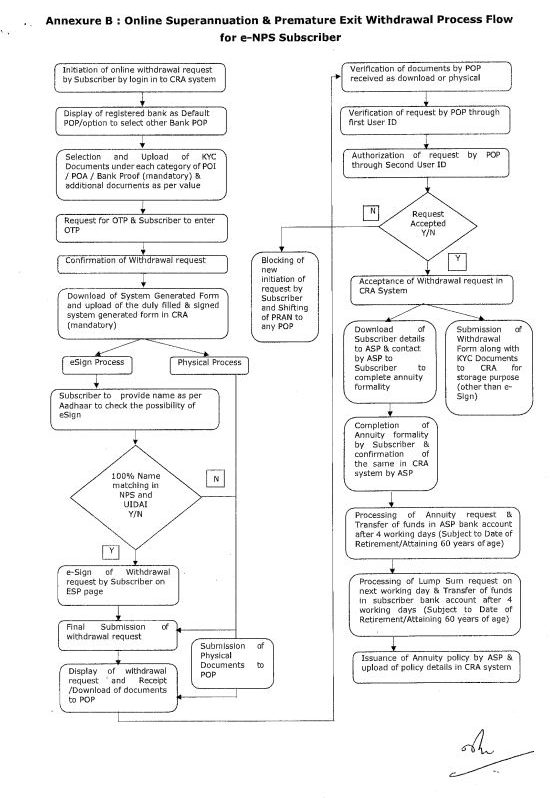
4. Central Record Keeping Agencies (CRAs) have been advised to develop online ‘e NPS exit functionality’ in co-ordination with Banks to facilitate the online process of exit of e NPS subscribers who are also the customers of those Banks. The process flow is provided at the Annexure A and B. The claims arising due to death of NPS Subscribers shall be handled off line by NPS Trust.
5. This circular is issued in exercise of powers conferred under section 14 of PFRDA Act 2013 and is available at PFRDA’s website (www.pfrda.org.in) under the Regulatory framework and in “Circular” sections of CRA, POPs and NPST under intermediaries.
(K Mohan Gandhi)
General Manager
Annexure -A
e-NPS withdrawal process
A. Normal/Premature exit under e-NPS:
a. An option will be available in the respective CRA website for the subscriber to submit withdrawal request. For this purpose, limited access would be provided on CRA Website to the subscriber to provide withdrawal request details and upload scanned documents.
b. The subscriber shall provide details of bank account, address etc. and upload scanned copies of his KYC documents and bank account proof.
c. The option of e-sign shall be provided to make the process paperless.
d. Once withdrawal request is successfully submitted online by the subscriber with e-sign, KYC documents shall be displayed online to Bank-POP for verification. The verification of the documents would be done by the Subscriber’s bank.
e. Once verified, the exit would be processed by the CRA. |
B. Exit from e-NPS due to death:
a. The nominee/claimants can also opt to submit the exit form to NPS Trust with the required documents after verification of his KYC by his bank. Tne nominee has to get a Bank’s KYC confirmation on bank’s letterhead containing the photo and signature of the nominee.
b. The Bank’s letter needs to be signed with seal by the designated bank official where the nominee has the bank account and where the claimants would like to receive the lump sum and/ or annuity and submit the same to NPS Trust.
c. Post receipt of duly verified documents in the manner as given in b. above, NPS Trust will authorize the withdrawal request after due diligence and after satisfying themselves about the veracity of the claim.
d. Address of NPS Trust:
National Pension System Trust,
3rd Floor, Chhatrapati Shivaji Bhawan,
B-14/A, Qutab Istitutional Area,
New Delhi -— 110016
C. Fees for processing e NPS exits to Bank-POPs
Banks shall get a fee @ 0.125% of the total NPS corpus (Minimum amount of Rs.125/- and maximum Rs, 500/-). These proposed charges to Bank— PoPs would be applicable for both online/offline KYC verification process related to eNPS exits.
D. Important Information:
The above process of e NPS exits co-exist along with the existing modes of handling of e- NPS exits.
Annexure B:
Online Superannuation & Premature Exit Withdrawal Process Flow for e-NPS Subscriber
In the Government Order first read above, among other economy measures, orders were issued to the effect that there will be a total ban on creation of new posts, with guidelines on creation of new posts in exceptional cases.
2. In the Government Order second read above, due to severe financial constraints, complete ban on creation of new posts in all Departments had been imposed, and to fill the same by re-deployment for operational purposes.
3. Considering, the prevailing situation of COVID – 19 in the State and the compelling need to regulate expenditure on emoluments, Government direct that
i) there shall be a total ban on creation of new posts in all Departments;
ii) Recruitment against existing vacant entry level posts including through compassionate ground appointment shall continue, with the approval of Staff Committee; and
iii) Promotions and recruitment by transfer shall continue as per existing procedure.
Consumer Price Index for Industrial Workers (CPI-IW) – April, 2020
The All-India CPI-IW for April, 2020 increased by 3 points and stood at 329 (three hundred and twenty nine). On 1-month percentage change, it increased by (+) 0.92 per cent between March and April, 2020 compared to (+) 0.97 per cent increase between corresponding months of previous year.
The maximum upward pressure in current index came from Food group contributing (+) 2.43 percentage points to the total change. At item level, Rice, Wheat, Wheat Atta, Arhar Dal, Moong Dal, Mustard Oil, Fish Fresh, Goat Meat, Poultry (Chicken), Brinjal, Cabbage, Cauliflower, French Bean, Green Coriander Leaves, Lady’s Finger, Palak, Potato, Radish, Tomato, Banana, Lemon, Mango (Ripe), Sugar, Cooking Gas, etc. are responsible for the increase in index. However, this increase was checked by Garlic, Onion, Parval, Petrol, Flowers/Flower Garlands, etc., putting downward pressure on the index.
Year-on-year inflation based on all-items stood at 5.45 per cent for April, 2020 as compared to 5.50 per cent for the previous month and 8.33 per cent during the corresponding month of the previous year. Similarly, Food inflation stood at 6.56 per cent against 6.67 per cent of the previous month and 4.92 per cent during the corresponding month an year ago.
At centre level, Doom-Dooma Tinsukia recorded the maximum increase of 14 points followed by Salem (12 points) and Surat (10 points). Among others, 9 points increase was observed in 2 centres, 8 points in another 2 centres, 7 points in 3 centres, 6 points in 2 centres, 5 points in 5 centres, 4 points in another 5 centres, 3 points in 11 centres, 2 points in 10 centres and 1 point in 18 centres. On the contrary, Chhindwara, Vadodara, Bhilai, Yamunanagar and Jamshedpur recorded a decrease of 1 point each. Rest of 12 centres’ indices remained stationary.
The indices of 33 centres are above All-India Index and 44 centres’ indices are below national average. The index of Rourkela centre remained at par with All-India Index.
The next issue of CPI-IW for the month of May, 2020 will be released on Tuesday 30th June, 2020. The same will also be available on the office website www.labourbureaunew.gov.in.



 Facebook
 Twitter
 Telegram