Notional increment / re-fixation of pensionary benefits as per Hon’ble Madras High Court Order in WP No. 15732/2017
F.No.A-23011/36/2013-Ad.IIA
Government of India
Ministry of Finance
Department of Revenue
Central Board of Indirect Taxes and Customs
North Block, New Delhi,
Dated the 18 October, 2019.
To,
All Pr. Chief Commissioners/ Chief
Commissioners/ Director General under CBIC,
Subject : Grant of notional increment / re-fixation of pensionary benefits as per Hon’ble Madras High Court Order in WP No. 15732/2017 in the case of Sh. P.Ayyamperumal – regarding.
Sir/Madam,
1. I am directed to inform that the Order dated 15.09.2017 of the Hon’ble High passed in the matter of P. Ayyamperumal ‘s case (WP No. 15732/ 2017) is in personam and not in in rem. Therefore, the CBIC has implemented the High Court’s order in personam after dismissal of review petition filed in the Supreme Court. for petitioner only which would not be quoted as precedent in future.
2. A number of cases on the similar grounds are pending at various fora . and similar demands from other similarly placed officers could also arise after Hon’ble Supreme Court’s Order dated 08.08.2019 in R.P.(C) No. 1731/2019. Keeping this in mind, a request was made to DoPT seeking their opinion about the future course of action to be taken in case pertaining to similarly placed applicants and non-applicants.
3. DoPT has now informed that Deptt. of Legal Affairs have observed that:
“It is very clear that the judgment of Hon’ble High Court of Madras passed in the matter of Sh. P.Ayyamperumal is in personam and not in rem.”
4. Based on the above, Do.PT has informed that in so far as other similar cases are concerned, the same may be defended on following grounds:-
4.1 In so far as P. Ayyamperumal case is concerned , it is stated that the judgment of Hon’ble High Court of Madras is in personam.
4.2 Further, the case of Sh. M Balasubramaniam referred by Hon’ble High Court in it’s judgment in P. Ayyamperumal case is related to Fundamental Rules of Tamilnadu Government whereas P. Ayyamperumal case relates to Central Government Rules.
4.3. It is relevant to mention here that in a similar matter, Hon’ble High Court of Andhra Pradesh at Hyderabad in year 2005, in C. Subbarao case, has inter-alia observed as under:
In support of the above observations, the Division Bench also placed reliance on Banerjee case (supra). We are afraid, the Division Bench was not correct in coming to the conclusion that being a reward for unblemished past service, Government servant retiring on the last day of the month would also be entitled for increment even after such increment is due after retirement. We have already made reference to all Rules governing the situation. There is no warrant to come to such conclusion. Increment is given (See Article 43 of CS Regulations) as a periodical rise to a Government employee for the good behavior in the service. Such increment is possible only when the appointment is “Progressive Appointment ” and it is not a universal rule. Further, as per Rule 14 of the Pension Rules, a person is entitled for pay, increment and other allowances only when he is entitled to receive pay from out of Consolidated Fund of India and continues to be in Government service. A person who retires on the last working day would not be entitled for any increment falling due on the next day and payable next day thereafter (See Article 151 of CS Regulations), because he would not answer the tests in these Rules. Reliance placed on Banerjee case (supra) is also in our considered opinion not correct because, as observed by us, Banerjee case (supra) does not deal with increment, but deals with enhancement of DA by the Central Government to pensioners. Therefore, we are not able to accept the view taken by the Division Bench. We accordingly overrule the judgment in Malakondaiah case (supra).
4.4 In addition, subsequent to the judgment of Hon’ble High Court of Madras in P. Ayyamperumal’s case, Hon’ble CAT Madras Bench vide its orders dated 19.03.2019 in 0.A. No. 310/00309/ 2019 and O.A. No. 310/00312/ 2019 and Order dated 27.03.2019 in O.A. No. 310/00026/ 2019 has also dismissed the similar requests related with notional increment for pensionary benefits.
5. Accordingly , it is requested that all the pending/future court cases on the similar issue should be defended/ dealt with adequately on the above lines.
Yours faithfully,
(A.K. Mishra)
Under Secretary to the Government of India
Travelling Allowance (TA) to the Railway Employees who performed 17th Lok Sabha 2019 Election duties
GOVERNMENT OF INDIA MINISTRY OF RAILWAYS (RAILWAY BOARD)
CIRCULAR
Sub : Payment of Travelling Allowance (TA) to the Officer/staff for duties performed during election to the General Election to the 17th Lok Sabha, 2019.
It has been decided to permit payments of Travelling Allowance to the Officers/Staff of Railway Board who have performed election duty in various capacities for the conduct of General Election to the 17th Lok Sabha, 2019.
Accordingly, concerned Officers/Staff who wish to claim T.A. may submit their TA Bills in triplicate mentioning the date-wise details of the election duties performed, duly certified by the respective ARO/RO/Sector Officer/SDM (Election)/Nodal Officer of concerned District Election Office as per the Proforma obtainable from G Branch for arranging payments. It may be noted that the TA may be claimed by the Officers/Staff who have performed long duration duties as payable for their ‘to & fro’ official journey from their temporary Headquarters only whereas TA may be claimed by the Officers/Staff who have performed short duration duties for their ‘to & fro’ journey on official duty as payable from their permanent Headquarters i.e. Railway Board provided that no official vehicle was provided to them for performing these duties.
F.No. 14-3/2016-PAP
Government of India
Ministry of Communication
Department of Posts
(Establishment Division)/P.A.P. Section
*****
Dak Bhawan, Sansad Marg,
New Delhi — 110 001.
Dated 24th October, 2019
To
1. All Chief Postmasters General/ Postmasters General
2. Chief General Manager, BD Directorate/Parcel Directorate/ PLI Directorate
3. Director RAKNPA/ GM CEPT/ Directors of All PTCs,
4. Addl. Director General, Army Postal Service, R.K. Puram, New Delhi
5. All General Managers (Finance)/ DAP/ DDAP
Sub : Payment of Dearness Allowance to Gramin Dak Sevaks (GDS) effective from 01.07.2019 onwards — reg.
Consequent upon grant of another installment of Dearness Allowance with effect from 1st July, 2019 to the Central Government Employees vide Government of India, Ministry of Finance, Department of Expenditure’s O.M. No. 1/3/2019-E-II (B) dated 14.10.2019, duly endorsed vide this Department’s letters No. 8-1/2016-PAP dated 15.10.2019, the Gramin Dak Sevaks (GDS) have also become entitled to the payment of Dearness Allowances on basic TRCA at the same rates as applicable to Central Government Employees with effect from 01.07.2019. It has, therefore, been decided that the Dearness Allowance payable to the Gramin Dak Sevaks shall be at the same rates as payable to Central Government Employees i.e. @ 17% (percent) with effect from the 1st July, 2019.
2. The expenditure on this account shall be debited to the Head “Salaries” under the relevant head of account and should be met from the sanctioned grant.
3. This issues with the concurrence of Integrated Finance Wing vide their Diary No.106/FA/2019-CS dated 23.10.2019.
(S.B.Vyavahare)
Assistant Director General (Estt.)
Union Cabinet approves revival plan of BSNL and MTNL and in-principle merger of the two
Spectrum of 4G to be allocated to the Telecom PSEs Funding through capital infusion of over Rs 20,000 Crore Sovereign guarantee for long term bonds of Rs 15,000 Crore Union Government to bear cost of attractive VRS
The Union Cabinet today approved the proposal for revival of BSNL and MTNL by administrative allotment of spectrum for 4G services, debt restructuring by raising of bonds with sovereign guarantee, reducing employee costs, monetisation of assets and in-principle approval of merger of BSNL & MTNL.
The following was approved by the cabinet:-
Administrative allotment of spectrum for 4G services to BSNL and MTNL so as to enable these PSUs to provide broadband and other data services. The said Spectrum will be funded by the Government of India by capital infusion in these PSUs at a value of Rs 20,140 Cr in addition; the GST amount of Rs 3,674 Cr to this spectrum value will also be borne by the Government of India through Budgetary resources. By using this spectrum allotment, BSNL and MTNL will be able to deliver 4G services, compete in the market and provide high speed data using their vast network including in rural areas.
BSNL and MTNL will also raise long-term bonds of Rs 15,000 Cr for which sovereign guarantee will be provided by the Government of India (GoI). With the said resources, BSNL and MTNL will restructure their existing debt and also partly meet CAPEX, OPEX and other requirements.
BSNL and MTNL will also offer Voluntary Retirement to their employees, aged 50 years and above through attractive Voluntary Retirement Scheme (VRS), the cost of which will be borne by the Government of India through budgetary support. The ex-gratia component of VRS will require Rs. 17,169 Cr in addition, GoI will be meeting the cost towards Pension, Gratuity and Commutation. Details of the scheme will be finalised by BSNL/MTNL.
BSNL and MTNL will monetise their assets so as to raise resources for retiring debt, servicing of bonds, network upgradation, expansion and meeting the operational fund requirements.
In-principle merger of BSNL and MTNL
It is expected that with the implementation of said revival plan, BSNL and MTNL will be able to provide reliable and quality services through its robust telecommunication network throughout the country including rural and remote areas.
Employees Compensation Act 1923 (8 of 1923) and payment of Extraordinary Pension/Family Pension – Railway Board
GOVERNMENT OF INDIA (BHARAT SARKAR)
MINISTRY OF RAILWAYS (RAIL MANTRALAYA)
(RAILWAY BOARD)
No.2012/F(E)III/1(3)/14
New Delhi, Dated: 15.10.2019
The GMs/PFAs,
All Zonal Railways/Production Units.
Sub: Applicability of Employees Compensation Act 1923 (8 of 1923) and payment of Extraordinary Pension/Family Pension.
*****
In terms of the provisions contained in the extant Rule (2) of the Railway Services (Extraordinary Pension) Rules, 1993, these rules apply to all railway servants, other than those to whom the Employees compensation Act, 1923 (8 of 1923) applies (subject to para 6 of Schedule III) whether their appointment is permanent or temporary, on the scale of pay or fixed pay or piece-work rates who are under the rule making control of the President of India. However, these rules are not applicable to railway servants appointed on or after the 1st day of January, 2004.
2. Despite the aforesaid express provisions, it has come to the notice of the Board that these rules are not being complied with, strictly, on the Zonal Railways and the benefits under Railway Services (Extraordinary Pension) Rules, 1993 have been given in some cases, despite being governed by the Employees Compensation Act, 1923. This has set in a wrong precedent and similar benefits have claimed by other railway servants before various courts and and whereby the court has settled such cases in person am in their favour. Some of such cases have also been examined in consultation with Department of Pension & Pensioners Welfare (DOP&PW), DOP&PW has viewed this seriously.
3. In order that instances as stated in Para (2) above do not arise in future, Railways are advised to be more careful in dealing with cases governed under Railway Services (Extraordinary Pension) Rules, 1993 and ensure strict compliance of these rules.
(G.Priya Sudarsani)
Director Finance (Estt.),
Railway Board.
MACPS Important DOPT Order : Consolidated Guidelines for the Central Government Employees
No.35034/3/2015-Estt.(D) Government of India Ministry of Personnel, Public Grievances and Pensions (Department of Personnel and Training)
North Block, New Delhi -110001
Dated the 22nd October, 2019
OFFICE MEMORANDUM
SUBJECT:- CONSOLIDATED GUIDELINES REGARDING MODIFIED ASSURED CAREER PROGRESSION SCHEME FOR THE CENTRAL GOVERNMENT CIVILIAN EMPLOYEES.
The Seventh Central Pay Commission in Para 5.1.44 of its report, recommended that Modified Assured Career Progression Scheme (MACPS) will continue to be administered at 10, 20 and 30 years as before. In the new Pay matrix, the employees will move to the immediate next Level in the hierarchy. As per the recommendations, the Scheme will be available to all posts, including Group “A” posts, whether isolated or not. However, Organised Group “A” Services will not be covered under the Scheme. In other words, MACPS will continue to be applicable to all employees up to HAG level, except members of Organised Group ‘A’ Services.
2. The Government has considered the recommendations of the Seventh Central Pay Commission for continuation of MACPS and has accepted the same. The MACPS will continue to be administered at 10, 20 and 30 years as before. Under the Scheme, the employee will move to immediate next Pay Level in the new Pay Matrix.
3. The Scheme shall continue to be applicable to all regularly appointed Group “A”(except officers of the Organised Group “A” Services), “B”; and “C” Central Government Civilian Employees. Casual employees, including those granted ‘temporary status’ and employees appointed in the Government on adhoc or contract basis shall not qualify for benefits under the aforesaid Scheme. The details of the MACP Scheme and conditions for grant of the financial upgradation under the Scheme are given in Annexure-I.
4. A Screening Committee shall be constituted in each Department to consider the case for grant of financial upgradations under the MACP Scheme. The Screening Committee shall consist of a Chairperson and two members. The members of the Committee shall comprise officers holding posts which are at least one level above the level in which the MACP is to be considered and not below the rank of Under Secretary equivalent in the Government. The Chairperson should generally be a level above the members of the Committee.
5. In cases where the Appointing Authority is the President and the Screening Committee is constituted in the Secretariat of the Ministry/Department, then the power to approve the recommendations of the Screening Committee is delegated to the Secretary of such Ministry or Department. In cases where the Appointing Authority is the President and the Screening Committee is constituted in an organization (for e.g., field office, attached/subordinate office, etc), then the power to approve the recommendations of the Screening Committee is delegated to the Head of such organization. In all other cases, the power to approve the recommendations of the Screening Committee shall be with the Appointing Authority.
6. In order to prevent undue strain on the administrative machinery, the Screening Committee shall follow a time-schedule and meet twice in a financial year Accordingly, cases maturing during the first-half of a particular financial year (April-September) shall be taken up for consideration by the Screening Committee meeting in the first week of January. Similarly, the Screening Committee meeting in the first week of July shall process the cases that would be maturing during the second-half of the financial year (October-March).
7. In so far as persons serving in the Indian Audit and Accounts Departments are concerned, these orders issue after consultation with the Comptroller and Auditor General of India.
8. Any interpretation/clarification of doubt as to the scope and meaning of the provisions of the MACP Scheme shall be given by the Department of Personnel and Training (Establishment-D). The MACP Scheme continues to be effective from 01.09.2008.
9. No stepping up of pay in the level would be admissible with regard to junior getting more pay than the senior on account of pay fixation under MACP Scheme.
10. Hindi version will follow.
(A. Bhattacharya)
Deputy Secretary to the Govt. of India
Annexure I
O.M. No.35034/3/2015-Estt.(D) dated 22.10.2019
1. There shall be three financial upgradations under the MACPS, counted from the direct entry grade on completion of 10, 20 and 30 years services, respectively, or 10 years of continuous service in the same Level in Pay Matrix, whichever is earlier.
2. The MACPS envisages merely placement in the immediate next higher level in the hierarchy of the Pay Matrix as given in PART A of Schedule of the CCS (Revised Pay) Rules, 2016. Thus, the level at the time of financial upgradation under the MACPS can, in certain cases where regular promotion is not between two successive Pay Levels, be lower than what is available at the time of regular promotion. In such cases, the higher level attached to the next promotion post in the hierarchy of the concerned cadre/organisation will be given only at the time of regular promotion.
3. The financial upgradations under the MACPS would be admissible up-to level 15 in the Pay Matrix, corresponding to the Higher Administrative Grade (HAG).
4. (i) Benefit of pay fixation available at the time of regular promotion shall also be allowed at the time of financial upgradation under the Scheme [as prescribed in Para 13 of CCS(Revised Pay Rules), 2016].
(ii) There shall, however, be no further fixation of pay at the time of regular promotion if it is in the same pay level as granted under MACPS.
(iii) However, at the time of actual promotion if it happens to be in a post carrying higher pay level than what is available under MACPS, then he shall be placed in the level to which he is promoted at a cell in the promoted level equal to the figure being drawn by him on account of MACP. If no such cell is available in the level to which promoted, he shall be placed at the next higher cell in that level. The employee may have an option to get this fixation done either on the date of promotion or w.e.f. the date of next increment as per the option to be exercised by him.
5. Promotions earned/upgradation granted under the MACP Scheme in the past to those grades which are in the same Level in the Pay Matrix due to merger of pay scales/upgradations of posts recommended by the Seventh Pay Commission shall be ignored for the purpose of granting upgradations under Modified ACPS. The benefit of merger will accrue w.e.f. the date of notification of the Recruitment Rules for the relevant post.
6. Fixation of pay on grant of financial upgradation under MACPS on or after 01.01.2016 shall be made as per Rule 13 of CCS (RP) Rules, 2016 issued vide Department of Expenditure notification dated 25th July, 2016 and in terms of provisions contained in DoP&T OM No. 13/02/2017-Estt.(Pay-I) dated 27.07.2017.
6.1 In cases where financial upgradation had been granted to Government Servants in the next higher Grade Pay in the hierarchy of Grade Pays as per the provisions of the MACP Scheme of 19th May, 2009, but whereas as a result of the implementation of Seventh CPC’s recommendations, substantive post held by him in the hierarchy of the cadre has been upgraded by granting a higher Pay Level, in such cases the MACP already granted to him prior to 7th CPC shall be refixed in the revised pay structure at the next higher level of Pay Matrix. To illustrate, in the case of Postal Inspector (GP 4200/-) in Department of Posts, who was granted 1st MACP in the Grade. Pay of Rs. 4600/- in PB-2, he will now be granted (grade pay of Rs 4800 in the pay band PB-2) Level 8 of the Pay Matrix consequent upon upgradation of the post of Postal Inspector from GP of Rs. 4200 to GP of Rs. 4600/Level 7 in the Pay Matrix. However, all the financial upgradations under the Scheme should be done strictly in accordance with the hierarchy of Levels in the Pay Matrix as notified vide CCS (Revised Pay) Rules, 2016.
7. With regard to fixation of his pay on grant of promotion/financial upgradation under MACP Scheme, a Government servant has an option under FR22 (1) (a) (1) to get his pay fixed in the higher post/ Pay Level either from the date of his promotion/upgradation or from the date of his next increment viz. 1st July or 1st January, subject to provisions in the Scheme.
8. Promotions earned in the post carrying same Pay Level in the promotional hierarchy as per Recruitment Rules shall be counted for the purpose of MACPS.
9. ‘Regular service’ for the purposes of the MACPS shall commence from the date of joining of a post in direct entry grade on a regular basis either on direct recruitment basis or on absorption/re-employment basis. Service rendered on casual, adhoc/contract basis before regular appointment on pre-appointment training shall not be taken into reckoning. However, past continuous regular service in same/another Central Government Department in a post carrying same pay level in the Pay Matrix prior to regular appointment in a new Department, without a break, shall also be counted towards qualifying regular service for the purposes of MACPS only (and not for the regular promotions). However, benefits under the MACPS in such cases shall not be considered till the satisfactory completion of the probation period in the new post.
10. Past service rendered by a Central Government employee in a State Government/Statutory Body/Autoriomous body/Public Sector organization, before appointment in the Central Government shall not be counted towards Regular Service.
11. ‘Regular service’ shall include all periods spent on deputation/foreign service, study leave and all other kinds of leave, duly sanctioned by the competent authority.
12. The MACPS shall also be applicable to work charged employees, if their service conditions are comparable with the staff of regular establishment.
13. Existing time-bound promotion scheme, including in-situ promotion scheme, or any other kind of promotion scheme existing for a particular category of employees in a Ministry/Department or its offices, may continue to be operational for the concerned category of employees, if it is decided by the concerned administrative authorities to retain such Schemes, after necessary consultations or they may switch-over to the MACPS. However, these Schemes shall not run concurrently with the MACPS.
14. The MACPS is directly applicable only to Central Government Civilian employees. The Scheme may be extended to employees of Central Autonomous/Statutory Bodies under the administrative control of a Ministry/Department subject to fulfillment of conditions prescribed in DOPT’s OM No. 35034/3/2010-Estt.(D) dated 03.08.2010.
15. If a financial upgradation under the MACPS is deferred and not allowed after 10 years in a level, due to the reason of the employees being unfit or due to departmental proceedings, etc., this would have consequential effect on the subsequent financial upgradation which would also get deferred to the extent of delay in grant of first financial upgradation.
16. On grant of financial upgradation under the Scheme, there shall be no change in the designation, classification or higher status. However, financial and certain other benefits which are linked to the pay drawn by an employee such as HBA, allotment of Government accommodation shall be permitted.
17 (i). For grant of financial upgradation under the MACP Scheme, the prescribed Benchmark shall be ‘Very Good’, for all levels. This shall be effective for upgradations under MACPS falling due on or after 25.07.2016 and the revised benchmark shall be applicable for the APARs for the year 2016-17 and subsequent years.
17(ii). While assessing the suitability of an employee for grant of MACP, the Departmental Screening Committee (DSC) shall assess the APARs in the reckoning period. The benchmark for the APARs for the years 2016-17 and thereafter shall be ‘Very Good’. The benchmark for the years 2015-16 and earlier years shall continue be as per the MACP guidelines issued vide DoPT O.M. dated 19.05.2009:
“The financial upgradation would be non-functional basis subject to fitness in the hierarchy of grade pay within the PB-I. Thereafter for upgradation under the MACPS the benchmark of ‘good’ would be applicable till the grade pay of Rs. 6600/- in PB-3. The benchmark will be ‘Very Good’ for financial upgradation to the grade pay of Rs. 7600 and above.”
For example, if a particular MACP falls due on or after 25.07.2016, the following benchmarks for APARs are applicable:
APAR for the year
Benchmark grading for MACP
for Level 11 and below
Benchmark grading for MACP for
Level 12 and above
20 13-14 and earlier years
Good
Very Good
20 14-15
Good
Very Good
2015-16
Good
Very Good
2016-17
Very Good
Very Good
2017-18 and
subsequent years
Very Good
Very Good
18. In the matter of disciplinary/ penalty proceedings, grant of benefit under the MACPS shall be subject to rules governing normal promotion. Such cases shall, therefore, be regulated under the provisions of the CCS (CCA) Rules, 1965 and instructions issued thereunder.
19. The MACPS contemplates merely placement on personal basis in the immediate higher Pay Level /grant of financial benefits only and shall riot amount to actual/functional promotion of the employees concerned. Therefore, no reservation orders/roster shall apply to the MACPS, which shall extend its benefits uniformly to all eligible SC/ST employees also. However, the rules of reservation in promotion shall be ensured at the time of regular promotion. For this reason, it shall not be mandatory to associate members of SC/ST in the Screening Committee meant to consider cases for grant of financial upgradation under the Scheme.
20. Financial upgradation under the MACPS shall be purely personal to the employee and shall have no relevance to his seniority position. As such, there shall be no additional financial upgradation for the senior employees on the ground that the junior employee in the grade has got higher pay/ Level under the MACPS. However, in cases where a senior Government servant granted MACP to a higher Grade Pay before the 1st day of January, 2016 draws less pay in the revised pay structure than his junior who is granted MACP to the higher Level on or after the 1st day of January, 2016, the pay of senior Government servant in the revised pay structure shall be stepped up to an amount equal to the pay as fixed for his junior in that higher post and such stepping up shall be done with effect from the date of MACP of the junior Government servant subject to the fulfillment of the following conditions, namely:-
(a) both the junior and the senior Goverment servants belong to the same cadre and they are in the same pay Level on grant of MACP;
(b) the existing pay structure and the revised pay structure of the lower and higher posts in which they are entitled to draw pay are identical;
(c) the senior Government servants at the time of grant of MACP are drawing equal or more pay than the junior;
(d) the anomaly is directly as a result of the application of the provisions of Fundamental Rule 22 or any other rule or order regulating pay fixation on such grant of MACP in the revised pay structure:
Provided that if the junior officer was drawing more pay in the existing pay structure than the senior by virtue of any advance increments granted to him, the provisions of this sub rule shall not be invoked to step up the pay of the senior officer.
21. Pay drawn in the level of Pay Matrix under the MACPS shall be taken as the basis for determining the terminal benefits in respect of the retiring employee.
22. In case an employee is declared surplus in his/her organisation and appointed in the same pay-scale or lower scale of pay in the new organization, the regular service rendered by him/her in the previous organisation shall be counted towards the regular service in his/her new organisation for the purpose of giving financial upgradation under the MACPS.
23. In case of transfer ‘including unilateral transfer on request’, regular service rendered in previous organisation/office shall be counted alongwith the regular service in the new organisation/office for the purpose of getting financial upgradations under the MACPS. However, financial upgradation under the MACPS shall be allowed in the immediate next higher Pay Level in the Pay Matrix as given in CCS (Revised Pay) Rules, 2016. Wherever an official, in accordance with terms and conditions of transfer on own volition to a lower post, is reverted to the lower Post/ Grade from the promoted Post/ Pay Level before being relieved for the new organisation/office, such past promotion in the previous organisation/ office will be ignored for the purpose of MACPS in the new organisation/office.
24. If a regular promotion has been offered but was refused by the employee before becoming entitled to an upgradation under the scheme, no financial upgradation shall be allowed as the employee has not stagnated due to lack of opportunities. If, however, financial upgradation has been allowed due to stagnation and the employees subsequently refuse the promotion, it shall not be a ground to withdraw the financial upgradation. He shall, however, not be eligible to be considered for further financial upgradation till he agrees to be considered for promotion again and in such case, the second or next financial upgradation shall also be deferred to the extent of period of debarment due to the refusal of promotion.
25. Cases of persons holding higher posts purely on adhoc basis shall also be considered by the Screening Committee alongwith others. They may be allowed the benefit of financial upgradation on reversion to the lower post.
26. Employees on deputation need not revert to the parent Department for availing the benefit of financial upgradation under the MACPS. They may exercise a fresh option to either draw pay in the level of Pay Matrix attached to the post held by them on deputation or the pay in the pay level admissible to them under the MACPS, whichever is beneficial. In case, the employee opts to draw pay in the pay level admissible to him/her under the MACPS, the deputation (duty) allowance shall be regulated in terms of the instructions issued by DoPT vide O.M. No.2/11/2017-Estt.(Pay II) dated 24.11.2017, as amended from time to time.
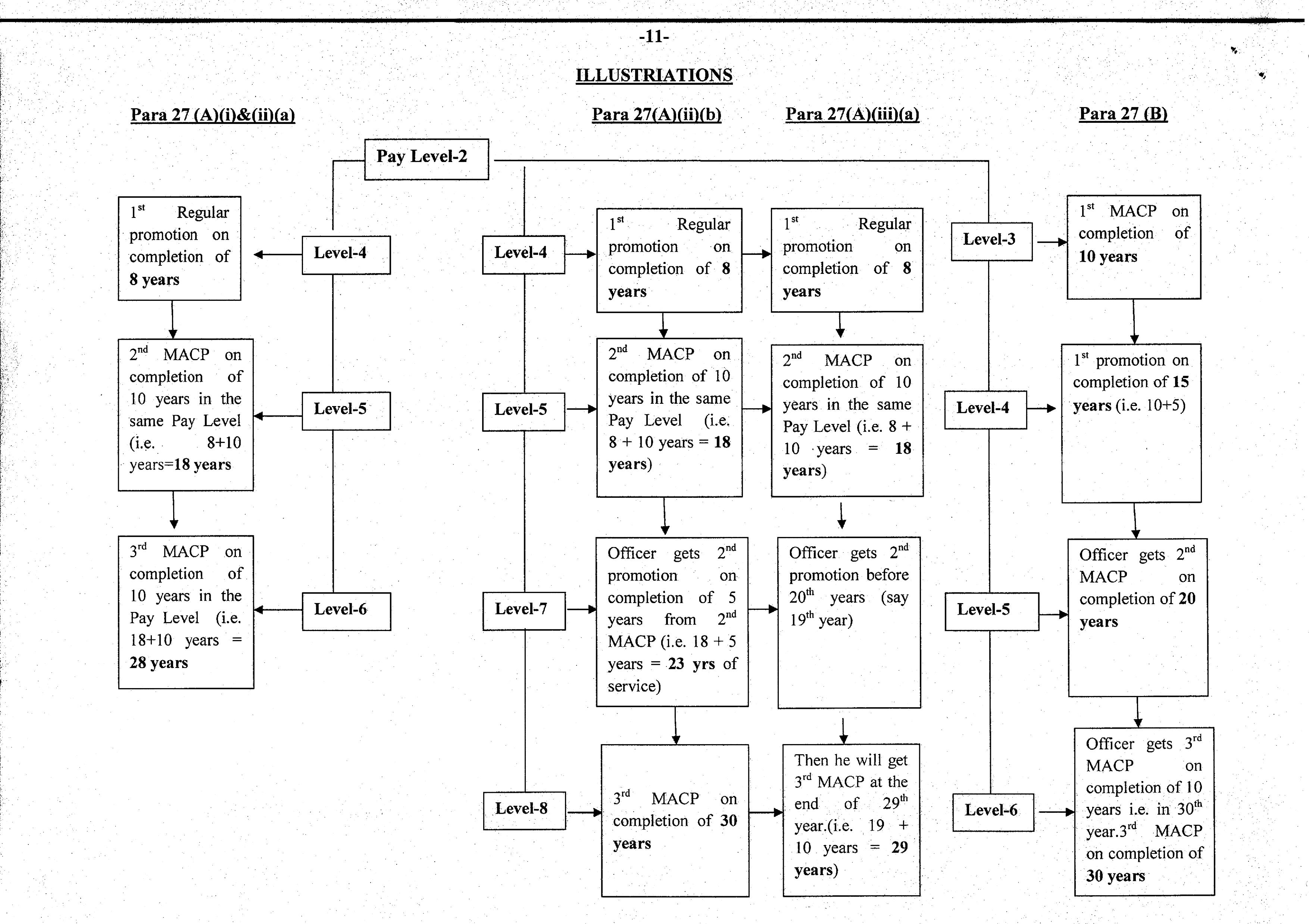
27. Illustrations
A. (i) If a Government servant in Level 2 gets his first regular promotion in the Level 4 on completion of 8 years of service and then continues in the Level for further 10 years without any promotion then he would be eligible for 2nd financial upgradation under the MACPS in the Level 5 after completion of 18 years (8+10 years).
(ii) (a) In case he does not get any promotion thereafter, then he would get 3rd financial upgradation in the Level 6 on completion of further 10 years of service i.e. after 28 years (8+10+10)..
(ii) (b) However, if he gets 2nd promotion after 5 years of further service to the grade say in the Level 7 [i.e. on completion of 23 years (8+10+5 years)], then he would get 3rd financial upgradation in Level 8 after completion of 30 years. (iii)(a) If he gets 2nd promotion before 20th year (say 19th year), then he gets 3rd MACP, at the end of 29th year, (i.e. 10 years from 2nd promotion) provided he does not get 3rd promotion.
(iii)(b) If he gets 2nd promotion after 20th year (say in 23rd year), and there is no 3rd promotion before 30 years, then he may be allowed 3rd MACP at the end of 30 years.
B. If a Government servant in Level 2 is granted 1st financial upgradation under the MACPS on completion of 10 years of service in the Level 3 and 5 years later he gets 1st regular promotion in Level 4, the 2nd financial upgradation under MACPS (in the next level w.r.t. level held by Government servant) will be granted in Level 5 on completion of 20 years of service. On completion of 30 years of service, he will get 3rd MACP in the Level
6. However, if two promotions are earned before completion of 20 years, only 3rd financial upgradation would be admissible on completion of 10 years of service in Level from the date 2n promotion or at 30th year of service, whichever is earlier
C. If a Government servant has been granted either two regular promotions or 2nd financial upgradation under the ACP Scheme of August, 1999 after completion of 24 years of regular service then only 3rd financial upgradation would be admissible to him under the MACPS on completion of 30 years of service provided that he has not earned third promotion in the hierarchy.
Eligibility of Person with Disabilities (PwD) candidates to appear in LDCE for Inspector Posts
No. 7-17/2008-SPN-II
Government of India
Ministry of Communications
Department of Posts
(Personnel Division)
Dak Bhawan, Sansad Marg
New Delhi — 110 001
Dated : 18th October, 2019
To,
1. All Chief Postmasters General / Postmasters General
2. Chief General Manager, BD Directorate / Parcel Directorate / PLI Directorate
3. Director, RAKNPA / GM, CEPT / Directors of all PTCs
4. Addl. Director General, Army Postal Service, New Delhi
5. All General Managers (Finance) / Directors Postal Accounts / DDAP
Subject : Eligibility of Person with Disabilities (PwD) candidates to appear in LDCE for Inspector Posts.
Sir/Madam,
I am directed to refer to above mentioned subject and to say that vide Department’s O.M. no. 12-10/2017-SCT dated 01st April, 2019, post of Inspector Posts has been identified suitable for Persons with following benchmark disabilities
Low Vision (LV), Hard of hearing (HH), One Arm (OA), One Leg Old, One Arm and One Leg (OAOL), Leprosy cured, Dwarfism, Acid attack victim.
Multiple disabilities from amongst disabilities mentioned above.
2. Prior to identification of Inspector Posts suitable for PwD, such candidates were not allowed to appear in the LDCE for Inspector Posts. However, with identification of Inspector Posts suitable for PwDs, it has been decided to allow PwD candidates with identified disabilities to appear in LDCE for Inspector Posts. However, It may be noted that at present reservation is not available to PwD candidate for promotion to higher level posts.
3. This may be brought to the notice of all concerned.
Transfer of Gramin Dak Sevak (GDS) on Administrative / Vigilance Ground – Implementation
No.17-31/2016-GDS
Government of India
Ministry of Communications
Department of Posts
(GDS Section)
Dak Bhawan, Sansad Marg,
New Delhi – 110001
Dated: 21.10.2019
Office Memorandum
Subject :Implementation of recommendations on Transfer of Gramin Dak Sevak (GDS) on Administrative/Vigilance Ground.
The undersigned is directed to refer to Rule 3-A (iv) of GDS regarding transfer of GDS from one post/unit to another post/unit in public interest specified in Rule 3-A (iv) of GDS (Conduct and Engagement) Rules, 2011.
2. After taking into consideration the recommendation of Kamlesh Chandra Committee on transfer of Gramin Dak Sevak on Administrative/Vigilance Ground, the Competent Authority has approved the following substitution in Rule 3-A (iv) of GDS (Conduct and Engagement) Rules, 2011 containing the transfer of GDS on Administrative/Vigilance Ground:-A. Transfer on these grounds shall be a rarest exception and should not be done in a routine manner.
B. Transfer on vigilance ground:-
(i) GDS revoked from put off duty, ordinarily should not ordinarily be posted on the same post and should be transferred to any other vacant post.
(ii) GDS against whom there are regular complaints substantiated by documentary evidence should be considered for transfer under vigilance ground.
C. Transfer on Administrative ground:-
(i) Non-improvement in delivery of services rendered by Department to member of public by a GDS supported by documentary evidences. Before applying this condition, engaging authority shall ensure that, sufficient opportunity has been given in writing to GDS to improve.
(ii) Abolition of post being held by GDS due to closure of office / redeployment of post. Under this condition to the extent feasible, GDS shall be transferred to a place/office after taking into consideration the preference given by the GDS in writing.
D. Conditions of transfer of GDS:-
(i) BPM Level 2 to BPM Level-2 in TRCA slab-3.
(ii) BPM Level-1 to BPM Level-1 in TRCA slab-2.
(iii) ABPM/Dak Sevaks Level-2 to ABPM/Dak Sevaks Level – 2 in TRCA slab-2.
(iv) BPM Level-1 to ABPM /Dak Sevak Level- 2 in TRCA slab- 2.
(v) ABPM/Dak Sevaks Level-1 to ABPM/Dak Sevaks Level-1 in TRCA slab-1.
(vi) There will not be any drop in TRCA slab on account of transfer and number of increments earned by GDS will be retained if no such penalty has been awarded to GDS.
(vii) In order to avoid long dislocation, GDS may be transferred within jurisdiction of Sub Division to the extent possible, otherwise within Division or within Region.
(viii) While transferring GDS BPM Level 2, it may be ensured that, GDS BPM is transferred to the BO in level 2 which is located in Gram Panchayat Accommodation, Building owned by Central Govt. or by State Government such as Schools or Offices as far as practicable.
(ix) BPM/ABPMs/Dak Sevak shown at para 2-D-(iii), (iv) & (v) may also be transferred from Post Offices to RMS Units in the same TRCA Level. Dak Sevak from RMS units should not be transferred to Postal units.
E. Committee for Transfer and Placement :-
(i) Transfer within a Sub Division shall be considered by a committee comprising Head of Division, ASP (HQ)/ Office Superintendent of Divisional office and concerned Sub Divisional head.
(ii) Transfer within the Division shall be considered by a committee comprising Head of Division, ASP (HQ)/ Office Superintendent of Divisional office and concerned Sub Divisional heads of both the Sub Division where GDS is working and where he/she is being transferred.
(iii) Transfer within the Region shall be considered by a committee comprising Divisional Heads of both the Divisions, Sub Divisional head concerned and another Sub Divisional head of the concerned Division.
(iv) Committee shall not recommend transfer of a GDS on administrative / vigilance grounds, to a post to which request of the GDS is pending under Limited Transfer facility available to them.
F. Process of Transfer:-
(i) In case of transfer within the Region the case with full details shall be referred to PMG.
(ii) In case of transfer of GDS within Division or within sub division also, as the case may be, prior approval of Regional PMG should be taken by the Divisional Head.
(iii) Divisional Head shall order transfer of a GDS only after approval of the minutes of Transfer and Placement Committee by Regional PMG as mentioned in 2 E (i) & (ii). Reason for any deviation from recommendations of the committee shall be recorded in file. In case of vacancy of ASP/OS/Sub Division head, the senior most ASP/IP may be included as member of the Committee.
3. The above instructions shall come into effect from the date of issue of this 0.M.
4. Hindi version will follow.
(SB Vyavahare)
Assistant Director General (GDS/PCC)
Special concession to CG employees in Kashmir Valley – DOP Clarification
No.5-2/2017-PAP
Government of India
Ministry of Communications
Department of Posts
(Establishment Division)
P.A.P. Section
Dak Bhawan, Sansad Marg,
New Delhi – 110001
Dated 22nd October, 2019.
To
The Chief Postmaster General,
J & K Circle,
Srinagar 190001.
Sub : Special concession to Central Government employees working in Kashmir Valley in attached/subordinate offices or PSUs falling under the Control of Central Government – Clarification.
Kindly refer to your office letters no. 22-6/A&P/2016 dated 26.04.2019 and 22-6/A&P/2014/KW dated 29.04.2019 regarding admissibility of additional HRA for the employees who are residing their families outside Kashmir valley and payment of per diem allowance and messing allowance in addition to their TA entitlements during tour and training respectively.
2. The matter has been referred to Department of Personnel & Training. The Department further forwarded the cases to Department of Jammu & Kashmir Affairs, Ministry of Home Affairs. The clarification / comments given by the Deptt. of J&K Affairs are reproduced as under:
According to DoPT’s OM dated 08.01.2019, additional HRA and other concessions are given to civilian employees posted to Kashmir Valley on the conditions given at para I(A)(i) to (iv) in the Annexure to DoPT’s OM dated 08.01.2019. Similarly, entitlements to per dim allowance and messing allowance are given at pars I(B) and para II in the Annexure to DoPT’s OM dated 08.01.2019.
As per the conditions for additional HRA and other concessions, per diem allowance and messing allowance etc. issued vide DoPT’s OM dated 08,01.2019, the issue of payment of diem allowance and messing allowance in addition to the TA entitlements during tour and training are not allowed.
3. Accordingly, I am directed to convey that the Competent Authority has not approved the proposal of payment of diem allowance and messing allowance in addition to the TA entitlements during tour and training in Kashmir Valley and additional. HRA is given as per fulfillment of conditions given above.
Government Employees of UT of Jammu & Kashmir and UT of Ladakh to get all 7th CPC Allowances from 31st October 2019
After the Parliament passed the Jammu and Kashmir Reorganization Bill, 2019, Prime Minister, Shri Narendra Modi addressed the nation on 8th August, 2019, wherein he announced that all the financial facilities being given to the employees of other Union Territories (UT), as per the recommendations of 7th CPC, would soon be extended to the employees of UT of Jammu & Kashmir and UT of Ladakh.
Accordingly, Union Home Minister, Shri Amit Shah has approved the proposal of payment of all 7th CPC allowances to the Government employees of UT of Jammu & Kashmir and UT of Ladakh, which shall come into existence from 31st October, 2019. Union Home Ministry has issued orders in this regard. The move will benefit 4.5 lakh Government employees, who are working in the existing State of Jammu & Kashmir and will become the employees of UT of Jammu & Kashmir and UT of Ladakh from 31st October, 2019.
The annual financial implication of 7th CPC allowances like Children Education Allowance, Hostel Allowance, Transport Allowance, LTC, Fixed Medical Allowance etc. in respect of 4.5 lakh Government employees of existing State of Jammu & Kashmir shall be Rs. 4800 crore tentatively:

 Facebook
 Twitter
 Telegram