Home Blog Page 355

Regulation of pay on imposition of a penalty under CCS (CCA) Rules, 1965

Regulation of pay on imposition of a penalty under CCS (CCA) Rules, 1965

No: 11012/15/2016-Estt A-III
Government of India
Ministry of Personnel, Public Grievances and Pensions
Department of Personnel & Training
Establishment A-III Desk

North Block, New Delhi – 110001
Dated June 18, 2019

OFFICE MEMORANDUM

Subject: Regulation of pay on imposition of a penalty under CCS (CCA) Rules, 1965.

The Undersigned is directed to say that the following penalties prescribed in the Rule 11 of CCS (CCA) Rules, 1965, have a bearing on the pay of the officer:

11. Penalties

Minor Penalties –

(iii)(a) reduction to a lower stage in the time-scale of pay by one stage for a period not exceeding three years, without cumulative effect and not adversely affecting his pension.

(iv) withholding of increments of pay;

Major Penalties –

(v) save as provided for in clause (iii) (a), reduction to a lower stage in the time-scale of pay for a specified period, with further directions as to whether or not the Government servant will earn increments of pay during the period of such reduction and whether on the expiry of such period, the reduction will or will not have the effect of postponing the future increments of his pay

(vi) reduction to lower time-scale of pay, grade, post or Service for a period to be specified in the order of penalty, which shall be a bar to the promotion of the Government servant during such specified period to the time-scale of pay, grade, post or Service from which he was reduced, with direction as to whether or not, on promotion on the expiry of the said specified period –

(a) the period of reduction to time-scale of pay, grade, post or service shall operate to postpone future increments of his pay, and if so, to what extent; and

(b) the Government servant shall regain his original seniority in the higher time scale of pay , grade, post or service;

2. Vide Central Civil Services (Revised Pay) Rules, 2016 notified vide notification No. GSR 721(E) dated 25.07.2016, the present system of Pay Bands and Grade Pays have been dispensed with qnd a new system of pay matrix as specified under Part A of Schedule of Central Civil Service (Revised Pay) Rules, 2016 have been introduced. The status of the employee so far determined by Grade Pay, will now be determined by Level in the Pay Matrix. Further, as per Rule 10 (1) of the CCS (Revised Pay) Rules, 2016, there are two dates for grant of increment namely, 1st January and 1st July of every year, instead of the existing date of 1st July.

3. As per clause 3 of the Central Civil Services (Revised Pay) Rules, 2016 ‘Level’ is defined as under:

‘Level’ in the Pay Matrix shall mean the Level corresponding to the existing Pay Band and Grade pay or Scale specified in Part A of the Schedule.”

4. In the light of Implementation of the Revised (Pay) Rules, 2016, the regulation of pay on imposition of these penalties, is discussed in the subsequent paras:

A. Reduction to a lower stage of pay by one stage {Rule 11( iii a)}

On imposition of a penalty under this Rule, the pay would be fixed at the next upper vertical cell in the same level in the pay matrix. In other words, in case of reduction by one stage, the revised pay would be the pay drawn in the same level at the stage before the last increment.

Note: The above mentioned penalty cannot be imposed on a Government Servant drawing pay at the minimum of the Level.

B. Withholding of increment {Rule 11(iv)}

As already noted in para 2 above, increment is granted either on 1st January or 1st July of every year, as per the eligibility. Therefore, on imposition of penalty of withholding of increment, the next increment(s) due after the date of imposition of the penalty would be withheld. In case where penalty of withholding of multiple increments is imposed, increments due on 1st January or 1st July, as the case may be, in the subsequent years would similarly be withheld. The increment would be restored at the end of the period for which the penalty is imposed. The increments will be given on notional basis without arrears and without affecting date of next increment on restoration of increment.

This also applies to cases where the penalty is imposed for part of a year. For instance, if the penalty of withholding of one increment for six months is imposed on a Government servant in October 2017, then withholding of increment will be on following manner:

C. Reduction to a lower stage in the time-scale of pay for a specified period Rule [11(v)]

The process of imposition of penalty of reduction by one stage under Rule 11(iii a) explained above shall be repeated for every additional stage of reduction to the lower vertical cell in the same level of pay in the Pay Matrix.

Note 1: It is not permissible to impose a penalty under this rule if the pay after imposition of the penalty would fall below the first cell of the same Level.

Note 2: Disciplinary Authority may weigh all factors before deciding upon the quantum of penalty i.e. the number of stage by which the pay is to be reduced.

D. Reduction to lower time-scale of pay under Rule 11(vi)

In the case of imposition of penalty of reduction to lower time-scale of pay, the pay of the Government servant would be reduced to the stage of pay he/she would have drawn had he/she continued in the lower post for the period of penalty. The mode of fixation of pay in this case is similar to reversing the mode of fixation of pay on promotion.

However, Disciplinary Authority has the power, in terms of FR 28, to indicate the pay which the Government servant on whom a penalty of reduction in rank has been imposed, would draw.

It may also be noted that a Government servant cannot be reduced in rank to a post not held earlier by him in the cadre.

For example:

(i) A direct recruit Assistant Section Officer cannot be reduced to the lower rank like SSA/JSA.

(ii) A Government servant holding any post like LDC/ Tax Assistant etc. who qualifies as Assistant Section Officer as a Direct Recruit and is later promoted as Section Officer cannot be reduced to the rank, which was earlier held by him before ASO (DR) but only to that of an Assistant Section Officer.

5. Some illustrations on pay fixation on the above cases are annexed.

6. In so far as the personnel serving in Indian Audit and Accounts Department are concerned, these instructions are being issued after consultation with the Comptroller and Auditor General of India.

7. Hindi version will follow.

(Satish Kumar)
Under Secretary to the Govt. of India

Signed Copy

Restricted Holiday List 2020 for Central Government Employees

Restricted Holiday List 2020 for Central Government Employees

F.No.12/1/2019-JCA-2 – DOPT Order – Click here 

Annexure I – Holiday list 2020 – Click here

Annexure II

LIST OF RESTRICTED HOLIDAYS DURING THE YEAR 2020 FOR ADMINISTRATIVE OFFICES OF CENTRAL GOVERNMENT LOCATED AT DELHI / NEW DELHI

Restricted Holiday List 2020


S.No. Holiday Date Saka Date Day
SAKA ERA 1941
1 New Year’s Day January 01 Pausha 11 Wednesday
2 Guru Gobind Singh’s Birthday January 02 Pausha 12 Thursday
3 Lohri January 13 Pausha 23 Monday
4 Makar Sankranti/ Pongal January 15 Pausha 25 Wednesday
5 Basant Panchami/ Sri Panchami January 30 Magha 10 Thursday
6 Guru Ravi Das’s Birthday February 09 Magha 20 Sunday
7 Swami Dayananda Saraswati Jayanti February 18 Magha 29 Tuesday
8 Shivaji Jayanti February 19 Magha 30 Wednesday
9 Maha Shivaratri February 21 Phalguna 02 Friday
10 Holika Dahan/ Dolyatra March 09 Phalguna 19 Monday
11 Hazarat Ali’s Birthday March 09 Phalguna 19 Monday
SAKA ERA 1942
12 Chaitra Sukladi / Gudi Padava/ Ugadi / Cheti Chand March 25 Chaitra 05 Wednesday
13 Master Sunday April 12 Chaitra 23 Sunday
14 Vaisakhi/ Vishu April 13 Chaitra 24 Monday
15 Mesadi/ Vaisakhadi (Bengal) / Bahag Bihu (Assam) April 14 Chaitra 25 Tuesday
16 Guru Rabindranath’s Birthday May 08 Vaisakha 18 Friday
17 Jamat Ul-Vida May 22 Jyaishtha 01 Friday
18 Rath Yatra June 23 Ashadha 02 Tuesday
19 Raksha Bandhan August 03 Sarvana 12 Monday
20 Janmashtami (Smarta) August 11 Sarvana 20 Tuesday
21 Parsi New Year’s day/ Nauraj August 16 Sravana 25 Sunday
22 Vinayaka Chaturthi/ Ganesh Chaturthi August 22 Sravana 31 Saturday
23 Onam or Thiru Onam Day August 31 Bhadra 09 Monday
24 Dussehra (Maha Saptami) (Additional) October 23 Kartika 01 Friday
25 Dussehra (Maha Ashtami) (Maha Navmi)(Additional) October 24 Kartika 02 Saturday
26 Vijay Dashmi (Bengal, Kerala) October 26 Kartika 04 Monday
27 Maharishi Valmiki’s Birthday October 31 Kartika 09 Saturday
28 Karaka Chaturthi (Karwa Chouth) November 04 Kartika 13 Wednesday
29 Naraka Chaturdasi November 14 Kartika 23 Saturday
30 Govardhan Puja November 15 Kartika 24 Sunday
31 Bhai Duj November 16 Kartika 25 Monday
32 Pratihar Shashthi or Surya Shashthi (Chhath Puja) November 20 Kartika 29 Friday ·
33 Guru Teg Bahadur’s Martyrdom Day November 24 Agrahayana 03 Tuesday
34 Christmas Eve December 24 Pausha 03 Thursday

Holiday List 2020 for Central Government Employees

Holiday List 2020 for Central Government Employees

F.No.12/1/2019-JCA-2 – DOPT Order – Click here 

Annexure II – Restricted Holiday List 2020 – Click here

Annexure I 

LIST OF HOLIDAYS DURING THE YEAR 2020 FOR ADMINISTRATIVE OFFICES OF CENTRAL GOVERNMENT LOCATED AT DELHI / NEW DELHI

Holiday List 2020

S.No. Holiday Date Saka Date Day
1941 SAKA ERA
1 Republic Day January 26 Magha 06 Sunday
2 Holi March 10 Phalguna 20 Tuesday
1942 SAKA ERA
3 Ram Navami April 02 Chaitra 13 Thursday
4 Mahavir Jayanti April 06 Chaitra 17 Monday
5 Good Friday April 10 Chaitra 21 Friday
6 Budha Purnima May 07 Vaisakha 17 Thursday
7 Id-ul-Fitr May 25 Jyaishtha 04 Monday
8 Id-ul-Zuha (Bakrid) August 01 Sarvana 10 Saturday
9 Janmashtami August 12 Sarvana 21 Wednesday
10 Independence Day August 15 Sarvana 24 Saturday
11 Muharram August 30 Bhadra 08 Sunday
12 Mahatma Gandhi’s Birthday October 02 Asvina 10 Friday
13 Dussehra October 25 Kartika 03 Sunday
14 Milad-un-Nabi or Id-e-Milad (Birthday of Prophet Mohammad) October 30 Kartika 08 Friday
15 Diwali (Deepavali) November 14 Kartika 23 Saturday
16 Guru Nanak’s Birthday November 30 Agrahayana 09 Monday
17 Christmas Day December 25 Pausha 04 Friday

Periodic review of CG Employees under FR 56(j)/(I) and Rule 48 of CCS (Pension) Rules, 1972

Periodic review of CG Employees under FR 56(j)/(I) and Rule 48 of CCS (Pension) Rules, 1972

No.25013/3/2019-Estt.A-IV
Government of India
Ministry of Personnel, Public Grievances & Pensions
Department of Personnel & Training
Establishment A-IV Desk

North Block, New Delhi
New Delhi 20th June, 2019

OFFICE MEMORANDUM

Subect :— Strengthening of administration — Periodic review of Central Government Employees under Fundamental Rule (FR) 56(j)/(I) and Rule 48 of CCS (Pension) Rules, 1972

The undersigned is directed to refer to this Department’s O.M No.25013/1/2013-EsttA dated 21.3.2014, OM No.25013/1/2013-Estt.A-IV dated 11.9.2015, 11.03.2016 and 10.8.2017 for periodic review of Central Government Employees for strengthening of administration under Fundamental Rule (FR) 560)41) and Rule 48 of CCS(Pension) Rules, 1972.

2. The detailed guidelines on the above subject are already in public domain at http://dopt.gov.in under `Notifications’–> `OM & Orders’ -> Establishment -> Premature Retirement.

3. All Ministries/Departments are requested to undertake the periodic reviews in letter and spirit, including in public sector undertakings (PSUs)/Banks and Autonomous institutions, under their administrative control. Department of Public Enterprises will also compile and countercheck with all concerned Ministries/Departments.

4. The Ministries/Departments should ensure that the prescribed procedure like forming of opinion to retire a Government employee prematurely in public interest is strictly adhered to, and that the decision is not an arbitrary one, and is not based on collateral grounds as per the order of the Hon’ble Supreme Court in case of U0/ & Col. J.N.Sinha [1571 SCR (1) 791].

5. All the Ministries/Departments shall furnish a report to DoP&T in the format given below by 15th day of each month starting from 15th July, 2019. Department of Public Enterprises are requested to also compile and countercheck the data with all concerned administrative Ministries/Departments in respect of PSUs before furnishing the report to DoP&T.

Number of employees to be reviewed under FR 56 (i) group-wise (A/B/C) Number of employees reviewed under FR 56 (j) groupwise (A/B/C) Number of employees reviewed and against whom FR 56 (j) invoked/recommended group-wise (A/B/C) Number of employees retired prematurely under FR 56 (j) group-wise (A/B/C)
1 2 3 4

(Surya Narayan Jha)
Under secretary to the Government of India

Signed Copy

Withdrawal of resignation of Central Government Servants appointed after 31.12.2003 covered under the NPS

Withdrawal of resignation of Central Government Servants appointed after 31.12.2003 covered under the National Pension System (NPS)

No.28035/2/2014-Estt.(A)
Government of India
Ministry of Personnel, Public Grievances and Pensions
Department of Personnel & Training

North Block, New Delhi – 110 001
Dated: 10th June, 2019

Office Memorandum

Subject : Withdrawal of resignation of Central Government Servants appointed after 31.12.2003 covered under the National Pension System (NPS) – reg.

The undersigned is directed to say that instructions on the procedure to be followed for ‘Resignation from Service’ have been provided vide Ministry of Home Affairs O.M.No.39/6/57-Ests.(A) dated 06.05.1958, Department of Personnel & Training (DoPT) O.M.No.28034/25/87-Estt(A) dated 11.02.1988, No.28034/4/94-Estt.(A) dated 31.05.1994 and No.28035/2/2007-Estt.(A) dated 04.02.2007. Para 5 of DoPT O.M. dated 11.02.1988 referred to above, provides the procedure for withdrawal of resignation as governed by Rule 26 (4) to (6) of Central Civil Services (Pension) Rules, 1972. References are being received from Ministries/Departments on the request for withdrawal of resignation by Government servants appointed after 31.12.2003 and for whom CCS(Pension) Rules are not applicable. The matter of withdrawal of resignation of Government servants of Central Civil Services/Posts, appointed after 31.12.2003 who are covered under the National Pension System (NPS) and for whom CCS (Pension) Rules, 1972 is not applicable has been considered in this Department and with the approval of the competent authority, it has been decided that the following guidelines/instructions may be followed while considering the request for withdrawal of resignation of the aforesaid Government Servants.

2. The appointing authority may permit a person to withdraw his resignation in the public interest on the following conditions, namely:

(a) that the resignation was tendered by the Government Servant for some compelling reasons which did not involve any reflection on his integrity. efficiency, or conduct and the request for withdrawal of the resignation has been made as a result of a material change in the circumstances which originally compelled him to tender the resignation.

(b) that during the period intervening between the date on which the resignation became effective and the date from which the request for withdrawal was made, the conduct of the person concerned was in no way improper;

(c) that the period of absence from duty between the date on which the resignation became effective and the date on which the person is allowed to resume duty as a result of permission to withdraw the resignation is not more than ninety days;

(d) that the post, which was vacated by the Government servant on the acceptance of his resignation or any other comparable post, is available.

3. Request for withdrawal of a resignation shall not be accepted by the appointing authority where a Government Servant resigns his service or post with a view to taking up an appointment in or under a private commercial company or in or under a corporation or company wholly or substantially owned or controlled by the Government or in or under a body controlled or financed by the Government.

4. When an order is passed by the appointing authority allowing a person to withdraw his resignation and to resume duty, the order shall be deemed to include the con donation of interruption in service for the purpose.

5. No withdrawal from NPS corpus shall be permissible within a period of 90 days from the date on which the resignation becomes effective. i.e the resignation is accepted by the competent authority and the Government servant is relieved of his duties. However, the aforesaid condition shall not be applicable in case of death of the government servant after the resignation becomes effective.

6.The provision for withdrawal of resignation shall not be applicable for temporary Government Servants.

7. Above guidelines/instructions will be applicable only for the Government Servants appointed on central civil service/posts after 31.12.2003 who are covered under the National Pension System (NPS) and for whom CCS (Pension) Rules,1972 is not applicable. Further, these guidelines/instructions will be applicable till the time the statutory rules regarding withdrawal of resignation for such Government Servants are notified.

8. This O.M. shall be prospective and cases already settled shall not be opened.

9. this issues in consultation with the office of comptroller and Auditor general of India.

10. It is requested to bring it to the notice of all concerned for strict compliance.

(Kabindra Joshi)
Director

Signed Copy

Relaxation to travel by air to visit NER, J&K and A&N

Relaxation to travel by air to visit NER, J&K and A&N

No. 31011/3/2018-Estt.(A-IV)
Government of India
Ministry of Personnel, Public Grievances and Pensions
Department of Personnel and Training
Establishment A-IV Desk
***

North Block, New Delhi-110 001
Dated: June 20, 2019

OFFICE MEMORANDUM

Subject :- Central Civil Services (Leave Travel Concession) Rules, 1988 – Relaxation to travel by air to visit North East Region, Jammu & Kashmir and Andaman & Nicobar – clarification reg.

The undersigned is directed to refer to this Department’s O.M. of even no. dated 20.09.2018 regarding the relaxation to travel by air on LTC to visit North-East Region (NER), Jammu & Kashmir (J&K) and Andaman & Nicobar Islands (A&N) and to say that as per para 2(v) of the aforesaid O.M., Government employees non-entitled to travel by air are allowed air travel in Economy class subject to maximum fare limit of LTC-80 fare in the following sectors:

(a) Between Kolkata/Guwahati and any place in NER.
(b) Between Kolkata/ChennaiNisakhapatnam and Port Blair.
(c) Between Delhi/Amritsar and any place in J&K.

Journey for these non-entitled employees from their Headquarters up to Kolkata/ Guwahati/ Chennai/ Visakhapatnam/ Delhi/ Amritsar is to be undertaken as per their entitlement.

2. In this regard, several references/RTI applications are received in this Department seeking clarification regarding settlement of LTC claims where a non-entitled Government employee directly travels by air from his Headquarters to the destination in North-East Region (NER), Jammu & Kashmir (J&K) and Andaman & Nicobar Islands (A&N) as opposed to their entitlement.

Also Check : DOPT Orders on LTC

3. The matter has been examined in this Department in consultation with Department of Expenditure. It has been decided that cases of direct air travel by a non-entitled Government employee on LTC from his Headquarters to the place of visit in NER/J&KJ A&N under the special dispensation scheme, may be regulated as per their rail and air entitlement allowed under the special dispensation scheme of travel by air as under:

“Entitled class rail fare from the Headquarters/place of posting to the nearest relevant railhead (i.e. Kolkata/Guwahati/Delhi/Amritsar/Chennai/ Visakhapatnam) based on the place of visit (in NER/J&K/A&N) + LTC-80 Economy class air fare from the same railhead to the place of visit in NER/J&K/A&N; or the actual air fare from the Headquarters to the place of visit, whichever is less.”

4. In their application to the staff serving in the Indian Audit and Accounts Department, this order issues after consultation with Comptroller & Auditor General of India.

(Surya Narayan Jha)
Under Secretary to the Govt. of India
Signed Copy

NFIR requests Railway Board to prioritize for resolving PNM Pending Items

NFIR requests Railway Board to prioritize for resolving PNM Pending Items

NFIR

No. NFIR/PNM/113

Dated: 10/06/2019

The Member (Staff),
Railway Board,
New Delhi

Dear Sir,

Sub: NFIR PNM pending items – quick redressal of issues – reg.

Although PNM meeting under your chairmanship was held on 25th & 26th April, 2019 and subsequently the pending PNM Items relating to PC-I Directorate were also discussed on 04th June, 2019 in a special meeting, many items are continued to remain unresolved. Many pending PNM Items can also be settled by issuing fomral orders as the demands are within the parameters of norms and logic.

NFIR has also sent fresh PNM Agenda to the Railway Board on 29th May, 2019 as the Federation is eager for formal meetings in quick succession for sorting out the staff grievances through serious dialogue. Some of the demands listed in the fresh Agenda can also be agreed to, straightaway and orders issued by Railway Board without waiting for discussion. The Federation’s request is that the PNM Items which can be agreed without waiting for formal discussion need to be identified and decisions communicated by the Board and this initiative would motive employees.

NFIR, therefore, requests your kind intervention to see that the Railway Board gives greater priority for resolving PNM Items soon. Federation may kindly be replied of steps initiated on this specific proposal.

Yours faithfully,
(Dr.M.Raghavaiah)
General Secretary

Source: NFIR

Leave encashment to officers appointed on contract in various posts under Government

Leave encashment to officers appointed on contract in various posts under Government

No.14028/1/2019-Estt.(L)
Government of India
Ministry of Personnel, Public Grievances and Pensions
Department of Personnel and Training

Date: 20th June, 2019

Office Memorandum

Subject : Leave encashment to officers appointed on contract in various posts under Government – regarding

The undersigned is directed to say that the leave terms of the officers appointed on contract in various posts under the Government are governed by DoPT’s OM No.12016/3/84-Estt. (L) dated 12.04.1985 which was subsequently amended vide OMs No. 12016/1/90-Estt. (L) dated 05.07.1990, No.12016/2/99-Estt(L) dated 12.07.1999 and No. 12016/5/2009-Estt.(L) dated 31.01.2011.

2. Para 2 of the OM dated 12.04.1985 prescribed the limit of encashment of earned leave upto a maximum period of 180 days during the contract period of such officers which was amended vide OMs dated 05.07.1990 and 12.07.1999 thereby increasing the maximum permissible encashment limit of earned leave upto 240 days and 300 days respectively. Para 3 of the above OM dated 12.04.1985 prescribed that the total earned leave for which encashment may be allowed together with the earned leave or full pay leave for which encashment had been allowed in previous appointments, if any, under the Government is not more than 180 days which was subsequently increased to 240 days and 300 days vide OMs dated 05.07.1990 and 12.07.1999 respectively.

3. It has been observed that many times the Government appoints officers on contract for a specified period in public interest keeping in view their professional or scientific/ technical expertise and this restriction of 300 days may act as a disincentive especially for those who have highly specialized professional or scientific/ technical skills to join the government in various posts on contract basis for a specified period.

4. Now, it has been decided in consultation with Department of Expenditure that the officers who are appointed on contract in various posts under the Central Government will be allowed encashment of earned leave at their credit on the date of termination of contract, subject to the condition that for each completed year of service put in by him in the post in. such contract appointment, not more than 10 days benefit of earned leave encashment shall be permissible. While calculating the encashment of leave in such a contract appointment, the number of days of leave for which encashment had been allowed in previous appointment, if any, under the Government shall not be taken into account. The relevant provisions relating to earned leave encashment as contained in para 2 and 3 of DoPT’s OM No.12016/3/84-Estt.(L) dated 12.04.1985 as amended vide OMs dated 05.07.1990, 12.07.1999 and 31.01.2011 stand further amended accordingly.

5. The above amendments will be effective with effect from the date of issue of this OM.

(Sandeep Saxena)
Under Secretary to the Government of India

Signed Copy

Central Government Offices Holiday List 2020 – DOPT ORDER

Central Government Offices Holiday List 2020 – DOPT ORDER

F.No.12/1/2019-JCA-2
Government of India
Ministry of Personnel, Public Grievances and Pensions
(Department of Personnel and Training)
Establishment (JCA-2) Section

North Block, New Delhi
Dated the 18 June, 2019

OFFICE MEMORANDUM

Subject : Holidays to be observed in Central Government Offices during the year 2020- reg.

It has been decided that the holidays as specified in the Annexure-I to this O.M. will be observed in all the Administrative Offices of the Central Government located at Delhi/ New Delhi during the year 2020. In addition, each employee will also be allowed to avail himself / herself of any two holidays to be chosen by him/ her out of the list of Restricted Holidays in Annexure – II.

2. Central Government Administrative Offices located outside Delhi / New Delhi shall observe the following holidays compulsorily in addition to three holidays as per para 3.1 below:

  1. REPUBLIC DAY
  2. INDEPENDENCE DAY
  3. MAHATMA GANDHI’S BIRTHDAY
  4. BUDDHA PURNIMA
  5. CHRISTMAS DAY
  6. DUSSEHRA (VIJAY DASHMI)
  7. DIWALI (DEEPAVALI)
  8. GOOD FRIDAY
  9. GURU NANAK’S BIRTHDAY
  10. IDU’L FITR
  11. IDU’L ZUHA
  12. MAHAVIR JAYANTI
  13. MUHARRAM
  14. PROPHET MOHAMMAD’S BIRTHDAY (ID-E-MILAD)

3.1. In addition to the above 14 Compulsory holidays mentioned in para 2, three holidays shall be decided from the list indicated below by the Central Government Employees Welfare Coordination Committee in the State Capitals, if necessary, in consultation with Coordination Committees at other places in the State. The final list applicable uniformly to all Central Government offices within the concerned State shall be notified accordingly and no change can be carried out thereafter. It is also clarified that no change is permissible in regard to festivals and dates as indicated.

  1. AN ADDITIONAL DAY FOR DUSSEHRA
  2. HOLI
  3. JANAMASHTAMI (VAISHNAVI)
  4. RAM NAVAMI
  5. MAHA SHIVRATRI
  6. GANESH CHATURTHI / VINAYAK CHATURTHI
  7. MAKAR SANKARANTI
  8. RATH YATRA
  9. ONAM
  10. PONGAL
  11. SRI PANCHAMI / BASANT PANCHAMI
  12. VISHU/ VAISAKHI / VAISAKHADI / BHAG BIHU / MASHADI UGADI / CHAITRA SUKLADI / CHETI CHAND / GUDI PADAVA / 1st NAVRATRA / NAORAZ/CHHATH POOJA/KARVA CHAUTH.

3.2 No substitute holiday should be allowed if any of the festival holidays initially declared subsequently happens to fall on a weekly off or any other non-working day or in the event of more than one festivals falling on the same day.

4. The list of Restricted Holidays appended to this O.M. is meant for Central Government Offices located in Delhi / New Delhi. The Coordination Committees at the State Capitals may draw up separate list of Restricted Holidays keeping in view the occasions of local importance but the 9 occasions left over, after choosing the 3 variable holidays in para 3.1 above, are to be included in the list of restricted holidays.

5.1 For offices in Delhi / New Delhi, any change in the date of holidays in respect of Idu’l Fitr, Idu’l Zuha, Muharram and Id-e-Milad , if necessary, depending upon sighting of the Moon, would be declared by the Ministry of Personnel, Public Grievances and Pensions after ascertaining the position from the Govt. of NCT of Delhi (DCP, Special Branch, Delhi Police).

5.2 For offices outside Delhi / New Delhi, the Central Government Employees Welfare Coordination Committees at the State Capitals are authorised to change the date of holiday, if necessary, based on the decision of the concerned State Governments / Union Territories, in respect of Idu’l Fitr, Idu’l Zuha, Muharram and Id-e-Milad.

5.3 It may happen that the change of date of the above occasions has to be declared at a very short notice. In such a situation, announcement could be made through P.I.B/ T.V./ A.I R./ Newspapers and the Heads of Department / Offices of the Central Government may take action according to such an announcement without waiting for a formal order, about the change of date.

6. During 2019, Diwali (Deepavali) falls on Saturday, November 14, 2020 (Kartika 23). In certain States, the practice is to celebrate the occasion a day in advance, i.e., on “Naraka Chaturdasi Day”. In view of this, there is no objection if holiday on account of Deepavali is observed on “Naraka Chaturdasi Day (in place of Deepavali Day) for the Central Government Offices in a State if in that State that day alone is declared as a compulsory holiday for Diwali for the offices of the State Government.

7. Central Government Organisations which include industrial, commercial and trading establishments would observe upto 16 holidays in a year including three national holidays viz. Republic Day, Independence Day and Mahatma Gandhi’s birthday, as compulsory holidays. The remaining holidays / occasions may be determined by such establishments/ organisations themselves for the year 2020, subject to para 3.2 above.

8. Union Territory Administrations shall decide the list of holidays in terms of Instructions issued in this regard by the Ministry of Home Affairs.

10. In respect of Banks, the holidays shall be regulated in terms of the extant instructions issued by the Department of Financial Services, Ministry of Finance.

11. Hindi version will follow.

(Juglal Singh)
Deputy Secretary to the Govt. of India

Signed Copy

Annexure I – Holiday List 2020

Annexure II – Restricted Holiday List 2020

Grant of Special Casual Leave for the Purpose of Blood Donation

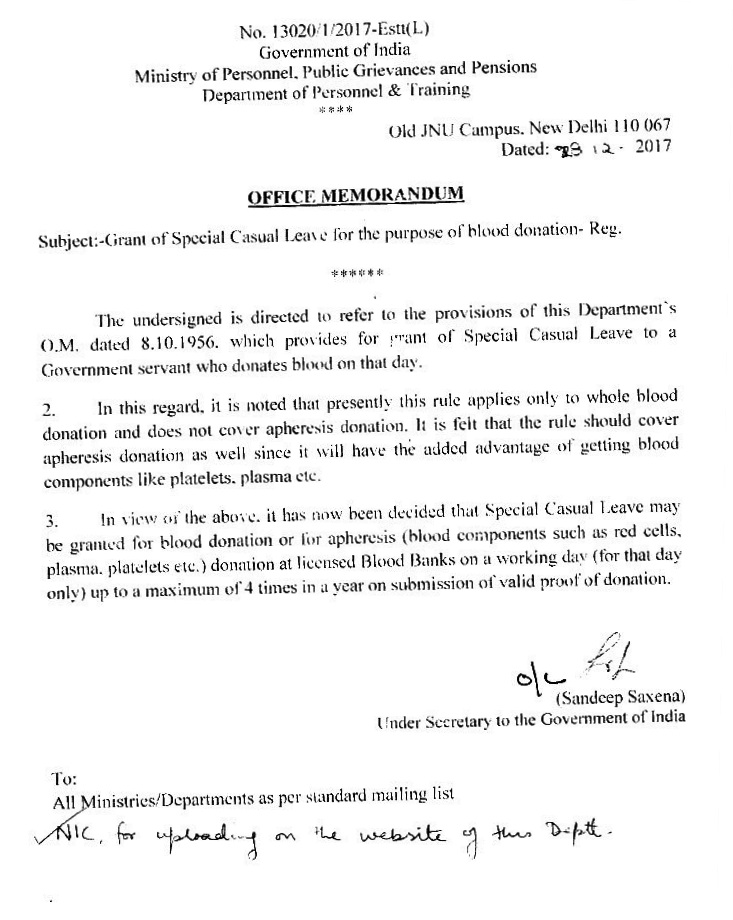
No.13020/1/2017-Estt(L)
Government of India
Ministry of Personnel, Public Grievances and Pensions
Department of Personnel and Training

Old JNU Campus, New Delhi 110 067
Dated: 28.12.2017

Office Memorandum

Subject: Grant of Special Casual Leave for the Purpose of Blood Donation – Reg.

The undersigned is directed to refer to the provisions of this Department’s O.M. dated 8.10.1956, which for grant of Special Casual Leave to a Government servant who donates blood on that day.

2. In this regard, it is noted that presently this rule applies only to whole blood donation and does not cover apheresis donation. It is felt that rule should cover apheresis donation as well since it will have the added advantage of getting blood components like platelets, plasma etc.

3. In view of the above, it has now been decided that Special Casual Leave may be granted for blood donation or for apheresis (blood components such as red cells, plasma, platelets etc.) donation at licensed Blood Banks on a working day (for that day only) up to a maximum of 4 times in a year on submission of valid proof of donation.

(Sandeep Saxena)
Under Secretary to the Government of India)

Source : Confederation

blood_donation

Just In