Special concessions to CG employees working in Kashmir Valley in attached/subordinate offices or PSUs falling under the control of Central Government
No.18016/3/2018 -Estt.(L)
Government of India
Ministry of Personnel, Public Grievances & Pensions
(Department of Personnel & Training)
***
New Delhi, the 8th January, 2019
OFFICE MEMORANDUM
Subject : Special concessions to Central Government employees working in Kashmir Valley in attached/subordinate offices or PSUs falling under the control of Central Government.
The undersigned is directed to refer to this Department’s O.M. No. 18016/1/2016-Estt.(L) dated 11th December, 2016 on the subject mentioned above and to state that it has been decided by the competent authority to extend the package of concessions/ incentives to Central Government employees working in Kashmir Valley for a further period of two years w.e.f. 01.01.2018. The package for two years is as per Annexure.
2. The package of incentives is uniformly applicable to all Ministries/ Departments and PSUs under the Government of India and they should ensure strict adherence to the rates prescribed in the package. The concerned Ministry/ Department may ensure implementation and monitoring of the package in conformity with the approved package, and therefore, all court cases in which verdicts are given contrary to the package would have to be contested by the Ministries/Departments concerned.
(Sandeep Saxena)
Under Secretary to the Government of India
Government has decided to grant Adhoc Bonus equivalent to 30 days emoluments on a base of 30 days a month to all ‘C’ and ‘D’ Group regular and temporary Government employees, employees of Local Bodies and Aided Educational Institutions including teachers on regular time scales of pay for the accounting year 2017-2018.
2. In the Government Order read above, orders were issued to grant Ad-hoc Bonus for the Accounting Year 2016-2017 equivalent to 30 days emoluments subject to a ceiling of Rs.3,000/- to ‘C’ and ‘D’ Group regular and temporary Government employees, employees of Local Bodies in Government aided educational institutions. Accordingly, Government direct that all regular and temporary Government employees who are on regular time scales of pay, employees of Local Bodies and Aided Educational Institutions including teachers on regular time scales of pay in ‘C’ and ‘D’ groups be paid Ad-hoc Bonus equivalent to 30 days emoluments on a base of 30 days a month for the financial year 2017-2018.
3. The Ad-hoc Bonus shall be computed on the basis of actual emoluments as on 31st March 2018. The amount of ad-hoc bonus shall be calculated as if monthly emoluments were Rs.3,000/- per month. In respect of those drawing pay in the pre-revised / revised scales of pay, the calculation of Ad-hoc bonus shall be based on the emoluments drawn subject to the upper ceiling of Rs.3,000/- (Rupees Three Thousand only) per month. The upper ceiling limit shall be applicable irrespective of whether the emoluments are drawn in the pre-revised or revised scales of pay.
4. Government also direct that the Special Ad-hoc Bonus of Rs.1,000/- (Rupees One Thousand only) be paid to full-time and part-time employees paid from contingencies at fixed monthly rates, employees on consolidated pay/special time scale of pay including employees in Nutritious Meal Programme/ Integrated Child Development Service (ICDS) Scheme (Anganwadi Workers /Mini Anganwadi Workers), Village Assistants, Panchayat Secretaries on special time scales of pay under Rural Development and Panchayat Raj Department, Contract employees, Temporary Assistants on contract basis, employees on daily wages and the employees partly worked on daily wages and subsequently brought under regular establishment and worked continuously for atleast 240 days or more during the accounting year 2017-2018.
5. The above orders on payment of Ad-hoc Bonus / Special Ad-hoc Bonus shall not be applicable to the Government employees in Groups ‘A’ and ‘B’ including All India Service Officers and Officers governed by University Grants Commission (UGC)/ All India Council for Technical Education (AICTE) / Indian Council of Agricultural Research (ICAR) Regulations.
6. The ‘C’ and ‘D’ Group deputationists from the State Government service working in Corporations / Boards / Joint Sector companies who are not in receipt of bonus / exgratia payment from the undertakings concerned are eligible for the benefit of Ad-hoc Bonus / Special Ad-hoc Bonus.
7. The Ad-hoc Bonus/Special Ad-hoc Bonus sanctioned above shall be admissible subject to the conditions prescribed in the Annexure to this order.
8. The expenditure on Ad-hoc Bonus/Special Ad-hoc Bonus shall be debited to the sub-detailed head “04. Other Allowances” under the detailed head “01. Salaries” or the detailed head “02. Wages” as the case may be, under the relevant service head of the department concerned. 9. This order shall also apply to the employees of Local Bodies, Over Head Tank Operators and Sweepers working in Rural Development and Panchayat Raj Department.
(BY ORDER OF THE GOVERNOR)
K.SHANMUGAM
ADDITIONAL CHIEF SECRETARY TO GOVERNMENT
ANNEXURE
[G.O.Ms.No.5, Finance (Allowances) Department, Dated 8th January 2019]
(i) The emoluments for purposes of Ad-hoc Bonus under these orders shall be worked out on the basis of basic pay, special pay and dearness allowance as on 31st March, 2018 and in the case of employees remaining on the pre-revised scales of pay the emoluments shall be worked out on the basis of basic pay, dearness pay, personal pay, special pay and dearness allowance as on 31st March, 2017. House Rent Allowance, City Compensatory Allowance and other Compensatory Allowances shall not be included. The eligible Government servants as groups only C and D shall be as ordered in G.O.Ms.No.303, Finance (Pay Cell) Department, Dated: 11-10-2017.
(ii) The employees who were in service on 31st March 2018 and have rendered a full year of service from 1st April 2017 to 31st March 2018 shall be eligible for the full amount of Ad-hoc Bonus sanctioned in this Order at the rate of 30/30 days of emoluments.
(iii) The employees who have rendered service of six months and above, but less than a year during 2017-2018 shall be eligible for proportionate amount of Ad-hoc Bonus. For the purpose of this rule, period less than 15 days shall be ignored and fifteen days and above shall be treated as a full month of service.
(iv) The Ad-hoc Bonus shall be rounded to the nearest rupee, i.e., fraction of 50 paise and above shall be rounded to the next higher rupee and fraction below 50 paise shall be ignored.
(v) The period of service for the purpose of computing Ad-hoc Bonus shall include all leave other than the extraordinary leave without Allowances. In the case of employees who were on extraordinary leave without allowances / Half Pay / Study Leave without pay during the month of March 2018, the Ad-hoc Bonus shall be determined based on the emoluments last drawn before proceeding on leave.
(vi) In the case of employees under suspension at any time, during 2017-2018 Subsistence allowances paid during suspension shall not be treated as emoluments. Such an employee may be paid Ad-hoc Bonus / Special Ad-hoc Bonus as and when the period of suspension is treated as duty. In other cases, the period of suspension shall be excluded for the purpose of Ad-hoc Bonus/Special Ad-hoc bonus. In the case of suspension, if any, after 31st March 2018 there shall be no bar for the payment of Ad-hoc Bonus / Special Ad-hoc Bonus.
(vii) Employees who retired on superannuation / Voluntary retirement / died in harness / invalidated from service, etc., prior to 31st March 2018 are eligible for Ad-hoc Bonus / Special Ad-hoc Bonus on the basis of actual service, subject to provision in para (iii) above.
(viii) Superannuated employees who were re-employed are eligible for Ad-hoc Bonus / Special Ad-hoc Bonus provided the period of service prior to and after re-employment taken together is not less than six months, subject to provision in para (ii) and (iii) above. In such cases, the eligibility period has to be worked out separately for the period prior to and after re-employment. The total amount admissible, for the period prior to superannuation and for the period after reemployment shall be restricted to the maximum admissible Ad-hoc Bonus / Special Ad-hoc Bonus; and
(ix) Employees who have rendered service of six months and above in Group ‘C’ are eligible for proportionate Ad-hoc Bonus only. If an employee rendered less than six months of service in Group ‘C’ and more than six months in Group ‘B’, he shall not be eligible for Ad-hoc Bonus.
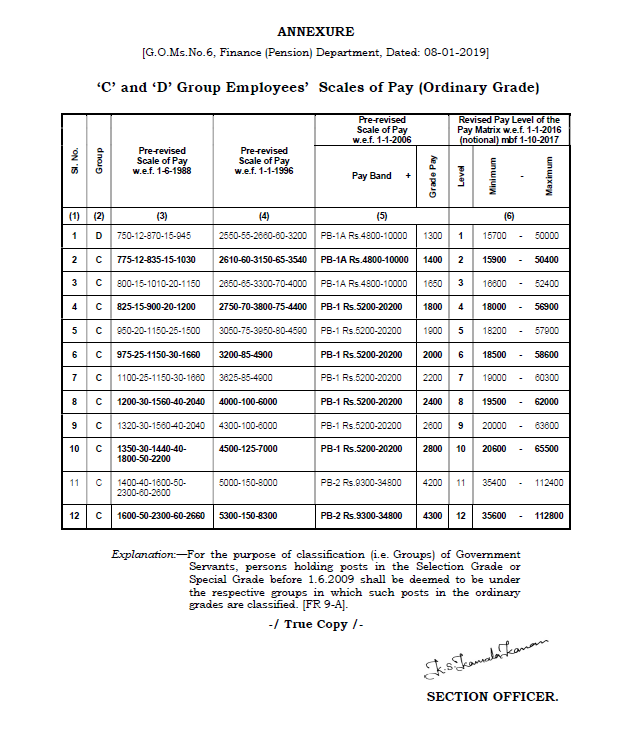
The Government sanction a lump sum Pongal Prize amount of Rs.500/- (Rupees Five Hundred only) to all Government Pensioners those who retired from the categories of ‘C’ and ‘D’ Group (‘C’ and ‘D’ Group of Scales of Pay (Ordinary Grade) is annexed to this order) including all ‘C’ and ‘D’ Group of Pensioners of Aided Educational Institutions, Local Bodies, Ex-Village Establishment (Ex-Village Officers and Village Servants / Assistants), ad-hoc Pensioners of all categories (Pensioners those who are drawing special pension of Rs.2,000/- with effect from 1-10-2017 i.e. Noon Meal Organisers, Anganwadi Workers, Mini Anganwadi Workers, Cooks, Cook Assistants, Anganwadi Helpers, Panchayat Secretaries, Village Librarian, Sweepers / Sanitary Workers / Scavengers, Plot Watchers, Anti-poaching Watchers, Police Station Cleaners, Ayah) and to all Family Pensioners irrespective of the Groups from which the Pensioners / Deceased Government employee had retired / died while in service.
2. This order shall also be applicable to all ‘C’ and ‘D’ Group provisional pensioners. The Pongal Prize amount shall not be admissible to those employees who retire on or after 08-01-2019 and to the families of those employees who die in harness on or after 08-01-2019.
3. Those who have retired / died in harness during the period from 01-10-2017 to 07-01-2019 are not eligible for the Pongal Prize amount if they are paid Adhoc Bonus as per the orders issued in the Government Order second read above. For this purpose, the Pension Disbursing Officers shall obtain non-drawal certificates from the departments concerned before making payment to these Pensioners.
4. This order is not applicable to the following categories of pensioners:-
(i) Special Pensioners such as Ulema Pensioners, State Freedom Fighters Pensioners and Social Pension for Scholars and Eminent persons, etc.
(ii) Family Pensioners who are appointed on compassionate grounds if adhoc bonus / special adhoc bonus is paid to them as applicable to the employees in service.
(iii)All Pensioners who retired from Group ‘A’ and ‘B’ posts including All India Service Officers and Officers governed by University Grants Commission (UGC) / All India Council for Technical Education (AICTE) / Indian Council of Agricultural Research (ICAR) Regulations.
5. The Government also direct that the procedure indicated below shall be followed for disbursement of Pongal Prize amount in respect of Pensioners / Family Pensioners coming under the Pension Pilot Scheme.
(i) In respect of those Pensioners / Family Pensioners to whom pension / family pension is sent by Money order at Government cost, the Pongal prize amount also shall be sent by Money Order at the Government cost.
(ii) In respect of Pensioners / Family Pensioners to whom pension / family pension is paid through Banks,
(a) In Pension Pay Office, Chennai and District Treasuries / Sub-Treasuries where the cheque system of payment of bills / Electronic Clearing System is in vogue, the Pension Pay Officer, Chennai and District Treasury Officers / Sub Treasury Officers are permitted to issue cheques and send the cheques to the respective paying branches of the bank with a covering list of Pensioners / Family Pensioners for crediting the amount to the pensioners’ / family pensioners’ savings bank account.
(b)As regards Banking Sub-Treasuries where the cheque system of payment of bills / Electronic Clearing System is not in vogue, the Sub-Treasury Officers are permitted to get Banker’s cheque / Bank draft and send them to the respective Pensioners for crediting the amount to the pensioners’ / family pensioners’ savings bank account.
6. In respect of Pensioners / Family Pensioners coming under the Public Sector Bank Scheme, all Public Sector Banks are authorised to credit the lumpsum amount to the C & D pensioners to the pensioners’ / family pensioners’ account.
7. In respect of Pensioners / Family Pensioners for whom expenditure is met from State Consolidated Fund, the expenditure shall be debited to the following Head of Account:
“2071. Pensions and Other Retirement Benefits – 01. Civil – 800. Other Expenditure – State’s Expenditure – AF. Pongal Prize to Pensioners and Family Pensioners – 27. Pensions – 09. Others (D.P.C. 2071 01 800 AF 2799)”.
In respect of payment of Pongal Prize to Ex-Village Officers, the expenditure shall be debited to the following Head of Account:-
“2071. Pensions and Other Retirement Benefits – 01. Civil – 800. Other Expenditure – State’s Expenditure – AK. Other Expenditure – Pongal Prize to Ex-Village Officers – 27. Pensions – 09. Others (D.P.C. 2071 01 800 AK 2799)”
8. In respect of Pensioners (‘C’ and ‘D’ Group) / Family Pensioners of Local Bodies for whom expenditure is met from the fund maintained by the Director of Local Fund Audit or Municipal Funds, as the case may be, the expenditure shall be met from the respective funds. In respect of Special Pensioners of Noon Meal Organisers, Anganwadi Workers, Mini Anganwadi Workers, Cooks, Cook Assistants and Anganwadi Helpers, the Block Development Officers / Child Development Project Officer concerned shall debit the expenditure under the head of account mentioned in para-7 above.
9. The Pongal Prize amount sanctioned above shall be paid to the eligible Pensioners / Family Pensioners and Ex-Village Officers immediately.
10. Necessary provisions have been made under the relevant head of account in Budget Estimate 2018-2019.
(BY ORDER OF THE GOVERNOR)
K.SHANMUGAM
ADDITIONAL CHIEF SECRETARY TO GOVERNMENT
Confederation thanked and congratulated the Central Government employees for their massive participation and for making the two days nationwide strike a resounding success
HISTORIC TWO DAYS ALL INDIA STRIKE COMMENCED
THUNDERING SUCCESS IN CENTRAL GOVT EMPLOYEES SECTOR
OUTBURST OF ANGER & PROTEST AGAINST CENTRAL GOVERNMENT
***
CONFEDERATION OF CENTRAL GOVT EMPLOYEES & WORKERS
CENTRAL HEAD QUARTERS
1ST FLOOR, NORTH AVENUE POST OFFICE BUILDING, NEW DELHI-110 001.
PRESS STATEMENT
Dated 8th January, 2019
About thirteen (13) lakhs Central Govt. Employees commenced nationwide two days strike today (8th January 2019) as per the call given by Confederation of Central Government Employees & Workers. The main demand of the strike is “Scrap New Contributory Pension Scheme (NPS) & Restore Old Pension Scheme (OPS)”. In fact, the share market oriented NPS is nothing but “No Pension Scheme”. The strike is also to express the anger and protest of the Central Government employees and Pensioners against the betrayal of the NDA Government by not honouring the assurances given by Group of Ministers headed by Sri. Rajnath Singh, Home Minister, to leaders of the National Joint Council of Action (NJCA) on 30th June 2016 that the Minimum Pay and Fitment formula will be increased. Even after a lapse of two and a half years, the BJP Government has not implemented the assurance. The indefinite strike from 11th July 2016 was withdrawn believing the assurance.
Other demands include :
Grant of Option-I parity to Pensioners,
Grant of HRA arrears from 01-01-2016,
Grant of MACP promotion from 01-01-2006 and removal of bench mark,
Filling up of vacant posts,
Civil Servant status to Gramin Dak Sevaks,
Regularization of Casual/Contract Workers,
Grant of equal pay for equal work and parity in pay scales,
Revision of wages and pension of Autonomous body employees and Pensioners,
Stop outsourcing, downsizing, contractorization, corporatization, privatization and closure of Government
departments and functions,
Removal of 5% condition on compassionate appointments,
Grant of five assured career progression and
Stop attack on trade union rights.
In Postal department about five lakhs employees participated in the strike all over the country under the banner of two major Postal Federations viz, NFPE & FNPO. 1,55,000 Post Offices and about 400 RMS offices remained closed. Gramin Dak Sevaks of rural post offices also went on strike. Delivery work also affected as Postmen joined the strike.
In Income Tax Department the strike is total in all the States. Work of all Income Tax Offices came to a stand still. Employees of Audit & Accounts department, Civil Accounts, Atomic Energy, Geological Survey of India, Customs and Central Excise, Survey of India, Botanical Survey of India, Central Ground Water Board, Postal Accounts, Indian Space Research Organisation (ISRO), Printing and Stationery, Indian Bureau of Mines (IBM), AGMARK, Central Government Health Scheme (CGHS), Medical Stores Depots, Film Division of India, Indian Council for Medical Research, Indian Council for Agricultural Research, Central Food Processing Laboratory, Census Department, National Sample Survey Organisation (NSSO), Defence Accounts, Rehabilitation Department, Central Public Works Department (CPWD), Canteen Employees, Institute of Physics, LNCPE, Sree Chitra Tirunal Institute of Medical Sciences, Employees Provident Fund Organisation (EPFO), Passport Department, Zoological survey of India, Patent Office, Central Drug Laboratory, NATMO, National Library, Marketing Inspection, Commercial Intelligence, Homeopathy and various other autonomous and Scientific Research Institutions participated in the nationwide strike.
Strike is total in Kerala, West Bengal, Tamilnadu, Maharashtra, Karnataka, Odisha, Telangana, Andhra Pradesh, Chattisgarh, Jharkhand, Assam, North Eastern States including Tripura. 70 to 80% participation in Uttar Pradesh, Madhya Pradesh, Punjab, Haryana and Rajasthan. 60 to 70% strike in Uttarakhand, Bihar, Delhi, Himachal Pradesh, Gujrat and J & K.
Solidarity demonstrations were conducted by Central Government Pensioners Organizations in various states.
National Secretariat of the Confederation thanked and congratulated the Central Government employees for their massive participation and for making the two days nationwide strike a resounding success National Secretarial called upon the entire employees to continue the strike on 9th January also.
(PUBLISHED IN PART I SECTION 1 OF GAZETTE OF INDIA)
F.NO. 5(1)-B(PD)/2018
Government of India
Ministry of Finance
Department of Economic Affairs
(Budget Division)
New Delhi, the 03 January, 2019
RESOLUTION
It is announced for general information that during the year 2018-2019, accumulations at the credit of subscribers to the General Provident Fund and other similar funds shall carry interest at the rate of 8% (Eight percent) w.e.f. 1st January, 2019 to 31st March, 2019. This rate will be in force w.e.f.1st January, 2019. The funds concerned are:
1. The General Provident Fund (Central Services).
2. The Contributory Provident Fund (India).
3. The All India Services Provident Fund.
4. The State Railway Provident Fund.
5. The General Provident Fund (Defence Services).
6. The Indian Ordnance Department Provident Fund.
7. The Indian Ordnance Factories Workmen’s Provident Fund.
8. The Indian Naval Dockyard Workmen’s Provident Fund.
9. The Defence Services Officers Provident Fund.
10. The Armed Forces Personnel Provident Fund.
2. Ordered that the Resolution be published in Gazette of India.
The erstwhile Ministry of Welfare had constituted the Expert Committee and on its basis Department of Personnel and Training has issued Office Memorandum Vide No.36033/3/2004-Estt. (Res) dated 9th March, 2004 on the subject “Revision of Income criteria to exclude socially advanced persons/sections (Creamy Layer) from the purview of reservation for Other Backward Classes (OBCs)”. In the Office Memorandum dated 08th September 1993, and for the category VI of the Schedule, the following explanations were also mentioned:-
Income from salaries or agricultural land shall not be clubbed;
The income criteria in terms of rupee will be modified taking into account the change in its value every three years. If the situation, however, so demands, the interregnum may be less.
In para 27 of the Report, the Expert Committee of 1993 had observed the following:
“In addition to the above, we have to say that the income/wealth test governs categories IV, VB and VC as stated earlier. For the remaining categories, namely I, II,III and VA, specific criteria have been laid down; however, if in these categories, any person, who is not disentitled to benefit of reservation, has income from other sources or wealth, which will bring him within the criterion under Item No.VI, then he shall be disentitled to reservation, in case his income-without clubbing his income from salaries or agricultural land – or his wealth is in excess or cut-off points prescribed under the income/wealth criteria.”
From the reading of para-27 of the Expert Committee Report, it is clear that the Explanation (i) given below to Category VI of Schedule to OM dated 08.09.1993, that income from salaries or agricultural land shall not be clubbed would be applicable only in respect of category VI(b). Hence as per provision of O.M. dated 08.09.1993, the salary of the parents of the candidates, who are working in PSUs, PSBs etc., was taken into account for determining their Creamy Layer status, till such time the equivalence vis-à-vis Government posts is established.
The erstwhile National Commission for Backward Classes (NCBC) in 2011 had recommended Rs. 9 lakh for Rural and Rs. 12 lakh for Urban for income limit for creamy layer.
In the year of 2015, the erstwhile National Commission for Backward Classes had recommended Rs. 15 lakh for income limit for Creamy layer.
The Cabinet in 2004 had decided to follow the Consumer Price Index (CPI) principle which has been adopted and not the formula recommended by NCBC.
This information was given by Minister of State for Social Justice and Empowerment Shri Krishan Pal Gurjar in a written reply in Lok Sabha today.
The Government has constituted a Commission under article 340, on 2nd October, 2017, to examine the issues of the sub-categorization of Other Backward Classes with the following terms of reference:
To examine the extent of inequitable distribution of benefits of reservation among the castes or communities included in the broad category of Other Backward Classes with reference to such classes included in the Central List;
To work out the mechanism, criteria, norms and parameters in a scientific approach for sub-categorisation within such Other Backward Classes; and
To take up the exercise of identifying the respective castes or communities or sub-castes or synonyms in the Central List of Other Backward Classes and classifying them into their respective sub-categories.
The composition of the Commission is as follows:-
(i) Chairperson
Justice (Retd.) G. Rohini, Chief Justice (Retd.), Delhi High Court.
(ii) Member
Dr. J.K. Bajaj, Director, Centre for Policy Studies, New Delhi.
(iii)Member (Ex-officio)
Director, Anthropological Survey of India, Kolkatta.
(iv) Member (Ex-officio)
Registrar General and Census Commissioner, India
The Commission to Examine Sub-categorization of Other Backward Classes was to initially submit its report in twelve weeks from the date of assumption of charge by the Chairperson. Since considerable time was taken up in obtaining the data and thereafter in analyzing of the data, the tenure of the Commission has been extended from time to time and last till 31.05.2019 vide a Gazette Notification dated 29.11.2018 with the approval of Cabinet and President.
The issue of survey is under consideration in the Commission to Examine Sub-categorization of Other Backward Classes
The Government is implementing the following educational empowerment and economic development Schemes for Other Backward Classes (OBCs): –
(i) Pre-Matric scholarship for Other Backward Classes.
(ii) Post-Matric scholarship for Other Backward Classes.
(iii) Construction of Hostels for OBC Boys and Girls.
(iv) Assistance for Skill Development of Other Backward Classes (OBCs)/Denotified and Semi-Nomadic Tribes (DNTs)/ Economically Backward Classes (EBCs to voluntary organizations working for the welfare of OBCs.
Free Coaching Scheme for SC and OBC Students.
(vi) Dr. Ambedkar Scheme of Interest subsidy on educational loan for overseas studies for Other Backward Classes (OBCs) and EBCs.
This information was given by Minister of State for Social Justice and Empowerment Shri Krishan Pal Gurjar in a written reply in Lok Sabha today.
Reservation in admission of students belonging to Scheduled Castes (SCs), Scheduled Tribes (STs) and Other Backward Classes (OBCs) in Central Educational Institutions established, maintained or aided by the Central Government is enforced through the Central Educational Institutions (Reservation in Admissions) Act, 2006 as amended from time to time. At present there is no proposal under consideration of Government to enact legislation for implementing reservation in services under the Central Government and its Public Sector Undertakings.
The policy of reservation in services is administered through executive instructions. The Hon’ble Supreme Court in the case of Indira Sawhney vs. Union of India (W.P. No. 930 of 1990) has held that these instructions have the force of law.
This information was given by Minister of State for Social Justice and Empowerment Shri Vijay Sampla in a written reply in Lok Sabha today
[TO BE PUBLISHED IN THE GAZETTE OF INDIA, EXTRAORDINARY, PART II, SECTION 3, SUB – SECTION (i)1
Government of India
Ministry of Personnel, Public Grievances and Pensions
Department of Pension and Pensioners’ Welfare
NOTIFICATION
New Delhi, the 4th January, 2019.
G S R(E). — In exercise of the powers conferred by the proviso to article 309 read with clause (5) of article 148 of the Constitution and after consultation with the Comptroller and Auditor-General of India in relation to persons serving in the Indian Audit and Accounts Department, the President hereby makes the following rules further to amend the Central Civil Services (Pension) Rules, 1972, namely:-
1. Short Title and Commencement:-
(1) These rules may be called the Central Civil Services (Pension) Amendment Rues, 2018.
(2) They shall come into force on the date of their publication in the Official Gazette.
2. In the Central Civil Services (Pension) Rules, 1972 –
(i) in rule 38, for sub-rule (1) and sub-rule (2), the following sub-rules shall respectively be substituted, namely :-
”(1) The case of a Government servant acquiring a disability, where the provisions of section 20 of the Rights of Persons with Disabilities Act, 2016 (49 of 2016) are applicable, shall be governed by the provisions of the said section:
Provided that such employee shall produce a disability certificate from the competent authority as prescribed under the Rights of Persons with Disabilities Rules, 2017.
(2) If a Government servant, in a case where the provisions of section 20 of the Rights of Persons with Disabilities Act, 2016 (49 of 2016) are not applicable, retires from the service on account of any bodily or mental infirmity which permanently incapacitates him for the service, he may be granted invalid pension in accordance with rule 49:
Provided that a Government servant, who retires from service on account of any bodily or mental infirmity which permanently incapacitates him for the service before completing qualifying service of ten years, may also be granted invalid pension in accordance with sub- rule (2) of rule 49 subject to the conditions that the Government servant-
(a) has been examined by the appropriate medical authority either before his appointment or after his appointment to the Government service and declared fit by such medical authority for Government service; and
(b) fulfils all other conditions mentioned in this rule for grant of invalid pension.”;
(ii) in rule 49, for sub-rule (2), the following sub-rule shall be substituted, namely: –
“(2) Subject to the proviso to sub-rule (2) of rule 38, in the case of a Government servant retiring in accordance with the provisions of these rules after completing qualifying service of not less than ten years, the amount of pension shall be calculated at fifty per cent of emoluments or average emoluments, whichever is more beneficial to him, subject to a minimum of nine thousand rupees per mensem and maximum of one lakh twenty five thousand rupees per mensem.”,
All India Strike on 8th and 9th January, 2019 – Instructions under CCS (Conduct) Rules, 1964
MOST IMMEDIATE
OUT TODAY
No.45018/1/2017-Vig.
Government of India
Ministry of Personnel, P.G. & Pensions
Department of Personnel & Training
North Block, New Delhi,
Dated the 08th January, 2019
Subject: All India strike for 08th and 9th January, 2019 – Instructions under CCS (Conduct Rules), 1964 – Regarding.
It has been brought to the notice of the Confederation of Central Government Employees and workers has decided to observe two day strike on 8th and 9th January, 2019 to protest against NPS and certain 7th CPC issues.
2. The instructions issued by the Department of Personnel and Training prohibit the Government servants from participating in any form of strike including mass casual leave, go slow etc. or any action that abet any form of strike/protest in violation of Rule 7 of the CCS (Conduct) Rules, 1964. Besides, in accordance with the proviso to Rule 17(1) of the Fundamental Rules, pay and allowances is not admissible to an employee for his absence from duty without any authority. As to the concomitant rights of an Association after it is formed, they cannot be different from the rights which can be claimed by the individual members of which the Association is composed. It follows that the right to form an Association does not include any guaranteed right to strike/protest. There is no statutory provision empowering the employees to go on strike. The Supreme Court has also agreed in several judgments that going on a strike is a grave misconduct under the Conduct Rules and that misconduct by the Government employees is required to be dealt with in accordance with law. Any employee going on strike in any form would face the consequences which, besides deduction of wages, may also include appropriate disciplinary action. Kind attention of all employees of this Department is also drawn to this Department’s O.M. No.33012/1/(s)/2008- Estt.(B) dated 12.9.2008, on the subject for strict compliance (enclosed as Annexure-A).
3. All officers are requested that the above instructions may be brought to the notice of the employees working under their control. All officers are also requested not to sanction Casual Leave or any other kind of leave to the officers and employees, if applied for, during the period of proposed strike, and ensure that the willing employees are allowed hindrance free entry into the office premises.
4. In case employees go on strike, all Divisional Heads are requested to forward a report indicating the number and details of employees, who are absent from duty on the day of str e i.e, 08.01.2019 and 09.01.2019.
(Juglal Singh)
Deputy Secretary to the Govt. of India
011-23092338