Sub: Processing of pending payments of Ex-Gratia and pensionary benefits including leave encashment in respect of VRS-2019 retirees-reg.
It has been observed that some circles have been facing difficulties due to restrictions built into the ERP/SAP system while processing of pending payments of Ex-Gratia and Leave encashment in respect of VRS-2019 retirees. These restrictions were put in place in the ERP/SAP system in order to prevent any un-authorized/wrong payments in respect of VRS-2019 retirees against whom complaint regarding fake caste certificate was pending. The restrictions were also necessary in view of the fact that payment of terminal benefits in respect of large number of cases of VRS-2019 retirees were required to be settled.
2. Now very few cases are pending where release of retirement benefits in respect of VRS-2019 retirees are required to be executed as and when the retirees become eligible for payment of such benefits. Therefore, the general restrictions incorporated in the ERP system have now been removed. However, it is now imperative that the release of withheld payments to VRS-2019 retirees are made by the Circles only after carefully ascertaining regarding eligibility for such payment as per extant rules. The responsibility of ensuring correctness/genuineness of payment shall be solely with the concerned circles.
3. In this regard, it is requested that the authorization allowed for processing of payments in respect of VRS-2019 retirees may be reviewed and only those officers, who are directly involved in the process may be allowed due authorization in ERP system. Further, in case of any change in last pay drawn due to re-fixation of pay on any ground, it may be ensured that the calculation of Ex-Gratia, leave encashment and other retirement benefits in respect of VRS-2019 retirees are approved by the IFA of the concerned circle.
[Sanjeev Kumar] Asstt. General Manager (Estt I)
To, All Heads of Telecom Circles & All Heads of Other Administrative Units, Bharat Sanchar Nigam Limited
IRTSA Memorandum to DOPT – Grant of annual increment (as due on 1st July / 1st January) for the pensionary benefits
INDIAN RAILWAYS TECHNICAL SUPERVISORS’ ASSOCIATION
No:IRTSA/Memo-10
Date:27.02.2024
The Secretary, Department of Personnel & Training, Ministry of Personnel, PG and Pensions. Government of India, North Block, New Delhi – 110 001
Respected Sir,
Sub: Grant of annual increment (as due on 1st July/1st January) for the pensionary benefits to those employees who have retired/retiring on 30th of June/31st December before drawing the same.
Ref: 1) Our earlier memorandum No.IRTSA/Memo/10, dated 13.01.2024. 2) Ministry of Information & Broadcasting letter No.F.N.A-56011/1/2021-BAP, dated 12.02.2024.
1) We once again draw your kind attention on the issue of grant of annual increment (as due on 1st July/1st January) for the pensionary benefits to those employees who had retired (retiring) on 30th of June/31st December before drawing the same.
2) The Hon’ble Supreme court gave judgement to grant one annual increment to the original writ petitioners earned on the last day of their service for rendering their services preceding one year from the date of retirement. The Supreme Court said all the intervention applicants are entitled to get the same relief.
3) The judgements of various High Courts & Supreme Court are based on legal grounds quoted therein & have universal application and as such the same should be applied to all similarly placed retired/ retiring employees irrespective of the fact whether they were original applicants or intervenors or whether they had gone to court/s or not.
4) Ministry of Information & Broadcasting vide letter No.F.N.A-56011/1/2021-BAP, dated 12.02.2024 in consultation with DoPT issued following orders,
a) To extend the benefit of grant of annual increment along with all consequential benefits to applicants (in legal case) and report to court.
b) To extend the benefit of grant of annual increment along with all consequential benefits to all the similarly placed employees (who retired from service a day before i.e. on 30th June / 31st December) to avoid further litigations (pending litigations and litigations that may arise in future on similar matter) causing disproportionate diversion of Government resources.
5) It is therefore once again requested that, necessary orders may please be issued by DoPT for grant of annual increment (as due on 1st July/1st January) for the pensionary benefits to those employees who have retired/retiring on 30th of June/31st December before drawing the same.
Thank you in anticipation
K.V.RAMESH General Secretary, IRTSA 9003149578
Copy to: 1) Secretary, Administrative Reforms, Public Grievances, Pensions & Pensioners Welfare, 5th Floor, Sardar Patel Bhawan, Parliament Street, New Delhi – 110001. 2) Secretary Railway Board, 227-Rail Bhavan, Raisina Road, New Delhi – 110001.
IRTSA Memorandum to Finance Minister: Formation of 8th Central Pay Commission
INDIAN RAILWAYS TECHNICAL SUPERVISORS’ ASSOCIATION
No:IRTSA/Memo-7
Date:26.02.2024
Smt. Nirmala Sitaraman Hon’ble Minister for Finance
Respected Madam, Vanakkam.
Sub: Formation of 8th Central Pay Commission.
1) Central Pay Commissions are being constituted at regular intervals of ten years, “to examine, review, evolve and recommend changes regarding the principles that should govern the emoluments’ structure including pay, allowances and other facilities/benefits, in cash or kind, as well as the specialized needs of various Departments, agencies and services, in respect of Central Government employees”.
2) 3rd, 4th and 5th CPCs recommended for constituting permanent machinery to undertake periodical review of the pay, allowances and conditions of service of the Central Government employees.
3) 6th CPC recommended for implementing its recommendations w.e.f. 01.01.2006, ten years period since the implementation of 5th CPC.
4) 7th CPC recommended that the pay matrix may be reviewed periodically without waiting for the long period of ten years. (Gist of recommendations of 3rd, 4th. 5th, 6th and 7th CPC about formation of permanent machinery / next pay commission is given in the annexure)
5) Since the implementation of 7th CPC recommendations w.e.f. 01.01.2016, many changes have taken place in Government functioning, performance & size of Indian economy, GDP growth, quantum of various tax collections, role of various government departments, inflation pattern, erosion of real wages due to inflation, condition of service, role of private sectors in public utilities and government’s regulation over them, number of employees in each department, number of employees covered under National Pension Scheme (NPS), considerable reduction in poverty, changes in consuming pattern of employees & general public, etc.
6) There are many legal cases pending across the country in various courts regarding anomalies in pay level, increment, pay fixation, promotions, MACPS, retirement benefits, etc, consuming precious time of Courts and affecting efficiency of Government functioning.
7) Efficiency in public services should not be compromised for any reasons. There should be a continuous improvement in quality of public service and scope for administrative reforms. New pay commission needs to be constituted for elimination of disparities/anomalies in salaries between different group of employees and for the reasons explained above. Sufficient time should be given to the Pay Commission to study all principles relating to pay & allowance, working conditions, promotional avenue, classification of posts, etc and to hear the views of every stakeholder including staff side.
8) It is therefore requested to constitute 8th Central Pay Commission immediately to enable it to have sufficient time to give comprehensive recommendations to clear all existing anomalies and without giving room for future anomalies.
Thanking you, with regards,
K.V. RAMESH General Secretary, IRTSA 9003149578
Copy: 1) The Union Finance Secretary, Government of India. 2) The Secretary, Department of Personnel & Training. 3) CRB & CEO, Railway Board, Ministry of Railways.
Annexure
Recommendations of various Pay Commissions on the “Need for continuing machinery for pay revision”
3rd CPC
3rd CPC recommended for creation of a standing Body on Pay and Cadre Management.
“Our experience has convinced us that the system of periodically revising the pay structure and conditions of service of the Central Government employees on the recommendations of Pay Commission is not a very satisfactory one. We feel that even broad judgements in these matters should be based on analysis of the relevant data. This is not possible when a Pay Commission is required to make recommendations on the pay scales and conditions of service for such a large number of employees within a limited period. ………….. We would, therefore, suggest the creation of a standing Body on Pay and Cadre Management”
4th CPC
4th CPC recommend for forming a permanent machinery to undertake periodical review of the pay, allowances and conditions of service of the Central Government employees.
“If we may venture to say so, the work of a pay commission is laborious and .takes time. Moreover pay commissions come at intervals of 10 years or so. A great many changes take place in the meantime both in regard to the system of pay determination and the promotion policies, etc. Such changes take place quite fast in the case of compensatory allowance and other similar payments. An allowance which is considered sufficient today may not be reasonable if changes take place quickly. It is therefore necessary that there should be a permanent machinery to undertake periodical review of the pay, allowances and conditions of service of the Central Government employees. That will also enable Government to oversee the implementation of its pay policy in an effective, systematic and coordinated manner …… We suggest that Government may set up such a body which should be responsible for maintaining and updating the basic data on pay and allowances of Government employees and to review the pay scales and rates of allowances and other related matters”.
5th CPC
5th CPC recommended for annual pay revision by a permanent pay commission with a constitutional provision.
In the free market liberalised economy there is a strong need for continuing machinery for pay revision as recommended by Fifth Pay Commission as per Para 99 of Summary of Recommendations:
“Need for continuing machinery for pay revision: The Commission has recommended that pay revision should, in future, be entrusted to a Permanent Pay Commission drawing its authority from a Constitutional provision, whose recommendations should have a binding character. Pay should be revised annually as in other countries. As an alternative, it has been suggested that dearness allowance should be converted into dearness pay every time the cost of living rises by 50% over the base level. This would imply a revision of pay every 4 to 5 years. The final option is to have a decennial exercise as at present, but with fixed dates. The Commission has suggested that the date of constitution of the next Pay Commission should not be later than 01.01.2003, and the date of implementation of its recommendations should be 01.01.2006, irrespective of when its report is submitted”.
6th CPC
6th CPC accepted the principle of regular interval of 10 years between two pay commissions.
Pay scales recommended by the Fifth Central Pay Commission were implemented from 1/1/1996. The Fifth CPC had also recommended that the date of implementation of the recommendations by the Sixth Central Pay Commission should be pre-determined as 1/1/2006.
7th CPC
7th CPC recommended for periodical review of pay matrix without waiting for long 10 years.
“It is also recommended that the matrix may be reviewed periodically without waiting for the long period of ten years. It can be reviewed and revised on the basis of the Aykroyd formula which takes into consideration the changes in prices of the commodities that constitute a common man’s basket, which the Labour Bureau at Shimla reviews periodically. It is suggested that this should be made the basis for revision of that matrix periodically without waiting for another Pay Commission”.
Performance Appraisal Report (PAR) of IDAS officers – CGDA ORDER
Office of the Controller General of Defence Accounts Ulan Batar Road, Palam, Delhi Cantt. – 110010
No.: AN-I/PAR/2023-24
Date: 28/02/2024
IMPORTANT CIRCULAR (THROUGH WEBSITE & WAN)
To, All PCDA / CDA offices
Sub: Performance Appraisal Report (PAR) of IDAS officers
At present, generation & completion of PARs in respect of IDAS officers is decentralized. In this system, there have been some instances of delay in PAR generation, selection of incorrect forms, incorrect mapping of workflow etc.
2. To avoid these issues, it has been decided to generate all the PARS for the year 2023-24 and onwards centrally by this HQrs. If any PAR for the year 2023-24 has already been generated by the Controller offices, it will remain valid and will be processed by the PAR manager concerned only as done earlier.
3. In view of the above, it is requested to forward the requisite details as per Annexure-1 & 2 latest by 05/03/2024 so that the PARs for the year 2023-24 can be generated within the timelines. The details (in excel sheet) and the forwarding (duly seen by the PCDA/ CDA) may kindly be sent via email on [email protected]. Kindly do not forward any hardcopy in this regard.
(Navpreet Kaur) Sr. Dy. CGDA (Admin)
Copy to: All IDAS officers – For information please.
Cabinet approves PM-Surya Ghar: Muft Bijli Yojana for installing rooftop solar in One Crore households
Households to get 300 units of electricity free every month
The Union Cabinet, chaired by the Prime Minister Shri Narendra Modi, has approved PM-Surya Ghar: Muft Bijli Yojana with a total outlay of Rs.75,021 crore for installing rooftop solar and providing free electricity up to 300 units every month for One Crore households. The Prime Minister had launched the scheme on 13th February, 2024.
The major highlights of the scheme include:
Central Financial Assistance (CFA) for Residential Rooftop Solar
The scheme provides a CFA of 60% of system cost for 2 kW systems and 40% of additional system cost for systems between 2 to 3 kW capacity. The CFA will be capped at 3 kW. At current benchmark prices, this will mean Rs 30,000 subsidy for 1 kW system, Rs 60,000 for 2 kW systems and Rs 78,000 for 3 kW systems or higher.
The households will apply for subsidy through the National Portal and will be able to select a suitable vendor for installing rooftop solar. The National Portal will assist the households in their decision-making process by providing relevant information such as appropriate system sizes, benefits calculator, vendor rating etc.
Households will be able to access collateral-free low-interest loan products of around 7% at present for installation of residential RTS systems up to 3 kW.
Other Features of the Scheme
A Model Solar Village will be developed in each district of the country to act as a role model for adoption of rooftop solar in rural areas,
Urban Local Bodies and Panchayati Raj Institutions shall also benefit from incentives for promoting RTS installations in their areas.
The scheme provides a component for payment security for renewable energy service company (RESCO) based models as well as a fund for innovative projects in RTS.
Outcome and Impact
Through this scheme, the households will be able to save electricity bills as well as earn additional income through sale of surplus power to DISCOMs. A 3 kW system will be able to generate more than 300 units a month on an average for a household.
The proposed scheme will result in addition of 30 GW of solar capacity through rooftop solar in the residential sector, generating 1000 BUs of electricity and resulting in reduction of 720 million tonnes of CO2 equivalent emissions over the 25-year lifetime of rooftop systems.
It is estimated that the scheme will create around 17 lakh direct jobs in manufacturing, logistics, supply chain, sales, installation, O&M and other services.
Availing Benefits of PM-Surya Ghar: Muft Bijli Yojana
The Government has launched a massive campaign since the launch of the scheme for raising awareness and generating applications from interested households. Households can register themselves on https://pmsuryaghar.gov.in to avail benefits under the scheme.
Consumer Price Index for Industrial Workers (2016=100) – January, 2024
TheLabour Bureau, an attached office of the M/o Labour & Employment, has been compiling Consumer Price Index for Industrial Workers every month on the basis of retail prices collected from 317 markets spread over 88 industrially important centres in the country. The index is compiled for 88 centres and All-India and is released on the last working day of succeeding month. The index for the month of January, 2024is being released in this press release.
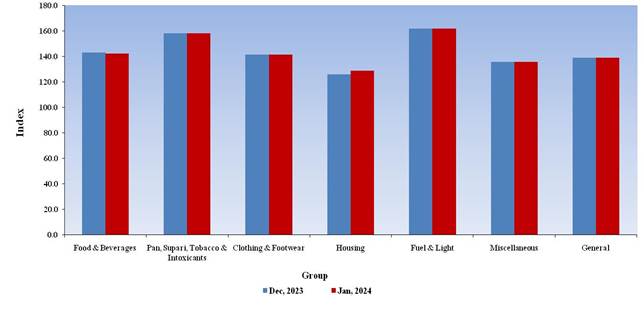
The All-India CPI-IW for January, 2024 increased by 0.1 point and stood at 138.9 (one hundred thirty eight point nine). On 1-month percentage change, it increased by 0.07 per cent with respect to previous month compared to increase of 0.38 per cent recorded between corresponding months a year ago.
The maximum upward pressure in current index came from Housing group contributing 0.48 percentage points to the total change. At item level, House rent, Ladies Suiting, Casual wear, Saree Cotton, Woolen Sweater/Pull-over, Plastic/PVC Shoes, Tailoring Charges/Embroidery, Chewing Tobacco, Foreign/Refined Liquor, Pan Masala, etc. are responsible for the rise in the index. However, this increase was largely checked by Onion, Potato, Tomato, Brinjal, Ginger, Peas, Cabbage, Cauliflower, French Beans, Lady’s Finger, Banana, Grapes, Papaya, Pomegranate, Coconut Fresh with Pulp, Kerosene Oil, Charcoal, etc. putting downward pressure on the index.
At centre level, Raniganj recorded a maximum increase of 4.2 points followed by Ramgarh with 2.5 points. Among others, 7 centres recorded increase between 1 to 1.9 points, 38 centres between 0.1 to 0.9 points. On the contrary, Guwahati and Tripura recorded a maximum decrease of 1.7 points each. Among others, 7 centres recorded decrease between 1 to 1.4 points, 30 centres between 0.1 to 0.9 points. Rest of two centres’ index remained stationary.
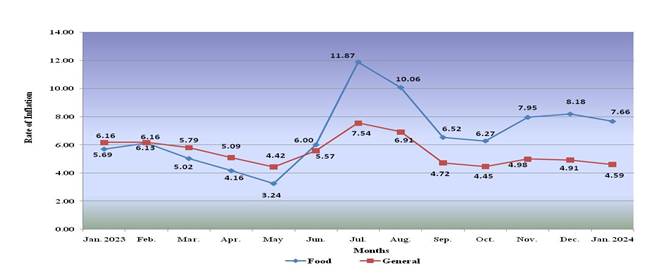
Year-on-year inflation for the month stood at 4.59 per cent compared to 4.91 per cent for the previous month and 6.16 per cent during the corresponding month a year before. Similarly, Food inflation stood at 7.66 per cent against 8.18 per cent of the previous month and 5.69 per cent during the corresponding month a year ago.
Y-o-Y Inflation based on CPI-IW (Food and General)
All-India Group-wise CPI-IW for December, 2023 and January, 2024
Sr. No.
Groups
December, 2023
January, 2024
I
Food & Beverages
142.8
141.9
II
Pan, Supari, Tobacco & Intoxicants
157.8
158.0
III
Clothing & Footwear
141.1
141.4
IV
Housing
125.7
128.4
V
Fuel & Light
161.8
161.8
VI
Miscellaneous
135.5
135.5
General Index
138.8
138.9
CPI-IW: Groups Indices
The next issue of CPI-IW for the month of February, 2024 will be released on Thursday, 28th March, 2024. The same will also be available on the office website www.labourbureau.gov.in.
Banks & Post offices will now help ECI step-up voter education and outreach ahead of Lok Sabha Elections 2024
ECI messaging will reach a wide audience through 1.6 lakh bank branches, over 2 lakh ATMs & 1.55 lakh Post Offices across the country
In a first-of-its-kind initiative, Election Commission of India (ECI) today signed a Memorandum of Understanding (MoU) with two prominent organizations, the Indian Banks’ Association (IBA) and the Department of Posts (DoP) to amplify its voter outreach and awareness efforts ahead of the forthcoming General Elections to Lok Sabha 2024. The initiative is in continuation of ECI’s untiring efforts to enhance electoral awareness in the country. Notably, ECI had recently signed an MoU with the Ministry of Education to formally integrate electoral literacy into the educational curriculum of schools and colleges. The MoU was signed today in the presence of Chief Election Commissioner Shri Rajiv Kumar and Election Commissioner Shri Arun Goel. Sh Vineet Pandey Secretary, Department of Posts Shri Sunil Mehta, Chief Executive, IBA and other officials from Department of Posts, IBA and ECI were present on the occasion.
As part of the MoU, IBA & DoP with its members and affiliated institutions/units will extend support in promoting voter education through their extensive network on a pro-bono basis, employing various interventions to empower citizens with knowledge about their electoral rights, processes, and steps for registration and voting.
Key highlights of the MoU include:
Members and affiliated institutions/units will display voter education messages prominently on their websites, directing visitors to learn more about the electoral process.
Voter education content will be disseminated through various promotional channels such as social media and customer outreach platforms of member institutions, ensuring widespread awareness among stakeholders and the public.
Voter education messages will be displayed in the form of posters, flex, and hoardings at office infrastructure/premises at major locations, reaching customers at key touchpoints.
All member institutions under IBA & DoP will establish Voter Awareness Fora to engage employees and customers in discussions and initiatives related to voter education.
Sensitize about training module on SVEEP in the regular orientation Programmes of employees of IBA & DoP.
The Department of Posts will affix a special cancellation stamp (bearing voter education messages) on the postal articles.
Despite successfully managing and conducting elections by the Election Commission over the years in fair and peaceful way along with a significant increase in participation of the electors, there is also a concern that around 30 crore electors (out of 91 crore), did not cast their votes in General Election to Lok Sabha 2019. The voting percentage was 67.4%, which the Commission has taken as a challenge to improve upon.
This collaboration with IBA and Department of Posts, signifies a significant step towards strengthening democracy by empowering citizens with knowledge and awareness about their electoral rights and responsibilities. Through concerted efforts, both organizations are committed to fostering a culture of informed and active participation in the electoral process.
Background: The Indian Banks’ Association (IBA), formed on September 26, 1946, started with 22 members and now has a strong network of 247 members across the country. Public sector banks are in lead with 90,000+ branches and 1.36 lakh ATMs followed by 42,000+ branches of Private Sector Banks with 79,000+ ATMs. Regional Rural Banks contribute 22,400+ branches, while Small Finance & Payment Banks operate around 7000 branches and 3000+ ATMs. Foreign Banks maintain 840 branches and 1,158 ATMs, and Local Area Banks have 81 branches. The cumulative number of the branches are 1.63 lakh+ with 2.19 lakh+ ATMs across the country.
For more than 150 years, the Department of Posts (DoP) has been the backbone of the country’s communication and has played a crucial role in the country’s social economic development. With more than 1,55,000 post offices, the DoP has the most widely distributed postal network in the world.
Income Tax Department Identifies Mismatches in Interest and Dividend Income Reporting
Implementation of e-Verification Scheme-2021
The Income Tax Department has identified certain mismatches between the information received from third parties on interest and dividend income, and the Income Tax Return (ITR) filed by taxpayers. In many cases, taxpayers have not even filed their ITR.
In order to reconcile the mismatch, an on-screen functionality has been made available in the Compliance portal of the e-filing website https://eportal.incometax.gov.in for taxpayers to provide their response. At present, the information mismatches relating to Financial Years 2021-22 and 2022-23 have been displayed on the Compliance portal. The taxpayers are also being made aware of the mismatch through SMS and emails as per details available with the Department.
Those taxpayers who have already registered on the e-filing website, can navigate to Compliance portal directly after logging into their account. Details of mismatches identified will be available under the ‘e-Verification’ tab.
Taxpayers who are not registered on the e-filing website have to register themselves on the e-filing website to view the mismatch. For registration, the “Register” button on the e-filing website can be clicked and the relevant details can be provided therein. After successful registration, the e-filing account can be logged into and the Compliance portal can be navigated to view the mismatches.
The on-screen functionality is self-contained and will allow the taxpayers to reconcile the mismatch on the portal itself by furnishing their response. No document is required to be furnished. This is a pro-active step taken by the Department to reach out to the taxpayers and provide them an opportunity to respond to the communication in a structured manner. It is clarified that the said communication is not a notice.
In case the taxpayer has disclosed the interest income in the ITR under the line item ‘Others’ in the Schedule OS, s/he need not respond to the mismatch pertaining to the interest income. The said mismatch shall be resolved on its own and will be reflected in the portal as ‘Completed’.
The taxpayers who are unable to explain the mismatch may consider the option of furnishing an Updated Income Tax Return if eligible, to make good any under reporting of income.
Timelines for Service Delivery through e-HRMS 2.0 Portal: DOPT O.M 26.02.2024
F.NO. 3/1/2024-e-HRMSv2.0 Government of India Ministry of Personnel, Public Grievances & Pension (Department of Personnel & Training)
North Block, New Delhi Dated: 26th February, 2024
OFFICE MEMORANDUM
Sub: Timelines for Service Delivery through e-HRMS 2.0 Portal-reg.
The undersigned is directed to state that the e-HRMS 2.0 portal facilitates seamless digital working environment and streamlines the disposal mechanism of various human resource services as expeditiously as possible. Any kind of applications with respect to leave, claims and reimbursements etc that are provided to the Government employees as per the applicable and extant rules/guidelines/instructions can now be disposed of through various modules of e-HRMS in an easy and transparent manner at the click of a button.
2. In order to make the said Portal more employee centric and as a Good Governance initiative, simplification of processes has been attempted in the HR Management System, wherever applicable. After various rounds of discussions and lot of deliberations, it has been decided to fix certain timelines for the simple processes for the ease and benefit of the employees.
3. In this connection, this is to inform all the Ministries/Departments/Organization (MDOs), that auto approvals and escalations to next level is being incorporated for specified timelines for the following services/modules provided through e-HRMS portal for effective implementation of e-HRMS 2.0:
The attached Annexures I, II,III are enumerative and descriptive for the reference and understanding of all.
4. This issues with the approval of Secretary (P).
(Oruganti Phani) Under Secretary to the Goyérnment of India Tel: 23040379
To, All MDOs on-boarded onto e-HRMS 2.0 (Through e-HRMS Portal and DOPT’s website)
Annexure – I
I. Timelines with regard to leaves due and admissible and Study Leave A. Where Admin is not involved in approval channel
S. N.
Type of Leave
No. of Days (leave)
Proposed timelines for decision at R.O./C.O. level
Total Time
e-HRMS Division’s Remark Existing rules
RO
CO
1
Casual Leave
≤3
3
–
3 working days (Auto- approval)
Reason: It should not normally be granted for more than 5 days at a time. This is not any regular kind of leave. The absence in this category may be either anticipated or not anticipated. Considering the nature of CL, Suitable provision for auto-approval/forward may be inserted on the e-HRMS
>3 and <=5
3
3
6 working days (Auto-forwarding & Auto approval)
Implementation: If the employee requests Casual Leave up to 3 days, then the Reporting Officer should take appropriate decision on the request within 3 working days otherwise the leave request shall be deemed approved.
Further, if the period of casual leave exceeds 3 days (upto 5 days), the request would be automatically forwarded to the CO if no decision is taken at RO level for 3 working days. The Controlling Officer needs to take a decision on the request within next 03 working days otherwise the leave request shall be deemed approved.
2
EL
≤5
3
3
6 working days (Auto- forwarding & auto- approval)
Maximum Accumulation of EL: 300+15.
Reason: If the employee requests for EL for a short period of 5 days (excluding prefix/suffix of holidays), a decision on the same in a maximum of 6 working days would be fair. Hence, auto-forward after 3 working days at RO level and deemed approval after 3 working days at CO level is recommended.
If the employee requests EL for more than 05 days, it affects the office work for a longer period. As per the existing guidelines, the maximum EL grant limit is 180 days at a time. Therefore. Automatic approval is not convenient in this situation. However, auto forward facility may be included at the RO level to avoid delay in taking decisions in this regard.
implementation:
If the employee requests EL for a shorter period I.e. up to 05 days, an appropriate decision (approve / disapprove / forward) on the request can be taken by the concerned R.O./C.O. in a time bound manner. The request shall be auto forwarded to C.O. if no decision is taken at R.O. level for 3 working days. Further, if no decision is taken at C.O. level, then it shall be deemed approved and balance updated.
5+
3
3
6 working days (Auto- forwarding only)
If the period of EL exceeds 05 days, the RO has to take appropriate decision on the request within 03 working days of receipt of the request otherwise the request should be automatically forwarded to the CO. The Controlling Officer has to take a decision on the request within next 03 working days otherwise it will be part of the pendency report.
3
HPL (Only in case of private affairs)
≤5
3
3
6 working days
Rule: may be granted on medical certificate or on private affairs.
Reason: as mentioned for EL.
5+
3
3
6 working
Implementation: same as days EL
B. Where Admin is involved in approval channel:
S. N.
Type of Leave
No. of Days (leave)
Proposed timelines for decision at R.O./C.O. /Admin level
Total time
e-HRMS Division’s Remark Existing rules
RO
CO
Admin
4.
Commuted Leave (on Medical Certificate)
–
3
3
9
15
Rule: not exceeding half the amount of half pay leave due may be granted. When commuted leave is granted, twice the amount of such leave shall be debited against the half pay leave due.
Reason: The Commuted Leaves are granted on production of Medical Certificate. Admin Division check and verify that the Medical Certificate and other documents attached for this purpose are in line with existing guidelines. Further, the request for commuted leave is submitted after the employee returns from leaves taken for medical reasons. Therefore, decision can be taken on requests for Commuted leaves in a time bound manner. Timelines for each level involve in the approval channel may be inserted for this purpose.
Implementation: An appropriate decision should be taken within 03 days of receipt of the request by the R.O. otherwise the request should be automatically forwarded to the CO. The CO has to take a decision on the request within next 03 days otherwise it should be automatically forwarded to Admin.
No auto-approval.
5.
Commuted leave (for an approved course of study)
—
3
3
9
15
Rule: a maximum of 180 days
Reason: The Commuted Leaves are granted for an approved course of study certified to be in the public interest by the leave sanctioning authority. Admin Division has to check and verify the details in this regard.
Implementation: as mentioned for Commuted leave on Med. Certificate at point 04 above.
6.
Leave not due (on medical certificate)
—
3
3
9
15
Rule: Leave Not Due shall be limited to the half pay leave he is likely to earn thereafter. Leave Not Due shall be debited against the half pay leave the Government servant may not earn subsequently.
Reason: same as mentioned against Commuted Leave (on Medical Certificate).
Implementation: same as mentioned against Commuted Leave (on Medical Certificate).
7
EOL (only in (case of prior approval)
—
3
3
15
21
Rule: EOLGranted in special circumstances.
Reason: EOL are granted when no other leave is admissible or Govt. Servant applies in writing for grant of EOL. Sometimes EOL are also granted to regularize the service period of employee from back date. In case of prior approval, appropriate decision can be taken by the concerned RO/CO/Admin in a time bound manner, therefore, timeline for EOL may be framed.
Implementation:
An appropriate decision should be taken within 03 days of receipt of the request by the RO. Otherwise the request should — be automatically forwarded to the CO. The CO has to take a decision on the request within next 03 days otherwise it should be automatically forwarded to Admin.
No auto-approval.
8.
Study Leave
—
3
3
15
21
Reason:Study Leaves are forwarded to Admin Division through R.O. and C.O.
Admin Division has to check and verify the relevant details. Admin Division also obtains IFD’s concurrence,
Administrative approval of Competent authority, Cadre Clearance for this purpose.
Implementation: An appropriate decision should be taken within 03 days of receipt of the request by the R.O. otherwise the request should be automatically forwarded to the CO. The CO has to take a decision on the request within next 03 days, otherwise it should be automatically forwarded to Admin.
No auto approval.
Annexure -II
II. Timelines for Reimbursement/Allowance: –
S No
Module
Proposed timelines for decision
e-HRMS Division’s Remark
L-1
L-2
Approval + Sanction Order
Total time
1.
Newspaper
3
3
3
9
Reason: The practice of getting of monthly reimbursement of Newspaper on production of Newspaper bills has been abolished. A certificate to the effect that expenditure has been incurred on newspaper shall be provided by the officers on half yearly basis (Jan to June or July to Dec.) to the office for reimbursement. It appears that an appropriate decision on the newspaper reimbursement request may be taken in a time bound manner. Therefore, a time limit should be set for this purpose.
Implementation: An appropriate action should be taken within 03 days of receipt of the request by the Dealing hand (L1). The request should be processed till issue of sanction order within 9 days of its receipt otherwise it will be part of the pendency report.
2.
Telephone
3
3
3
9
Reason: The amount shall be reimbursed on submission of bills‘ receipt by the concerned officer (as per entitlement). It appears that the request may be settled in a time bound manner.
Implementation: Same as mentioned for Newspaper Reimbursement.
3.
CEA
5
3
3
11
The amount of CEA is fixed. Govt. Servant should produce a certificate for this purpose. The request may be disposed of in a time bound manner.
Implementation: An appropriate action should be taken within 05 days of receipt of the request by the Dealing hand (L1). The request should be processed till issue of sanction order within 11 days of its receipt otherwise it will be part of the pendency report.
4.
Medical
5
3
3
11
Reason: The request for Medical Reimbursement may be settled in a time bound manner. Therefore. timeline for this purpose may be framed.
Implementation: Same as in CEA
Annexure- III
III. Timelines for Advances and LTC Module –
A. LTC Module-
The system allows LTC request only if leave(s) for LTC has been sanctioned before submitting the LTC request.
S. N
Module
Proposed timelines for decision
Total Time
DOPT’s Remark
L-1
L-2
Approval + Issue of Sanction Order
1.
Leave Encashment
4
2
2
8
A Government servant may be permitted to encash earned leave up to ten days at the time of availing of LTC.
Implementation:
An appropriate action should be taken within 04 days of receipt of the request by the Dealing hand/L-1. The request should be processed till issue of sanction order within 8 days of receipt of the request otherwise it will be part of the pendency report.
2.
LTC request (with or without Advance)
4
2
2
8
Implementation:
Same as Leave Encashment
3.
LTC Claim
4
2
2
8
Implementation:
Same as Leave Encashment
B. Advances
S. N
Module
Proposed timelines for decision
Total Time
DOPT’s Remark
L-1
L-2
Approval and Issue of Sanction Order
1.
Computer Advance
5
3
3
11
Implementation:
An appropriate action should be taken within 05 days of receipt of the request by the Dealing hand (L-1). The request should be processed till issue of sanction order within 11 days of receipt of the request otherwise it will be part of the pendency report.
Revised List of CGHS package rates for General Surgery
F No Z15025/8/2023/DIR/CGHS Govt. of India Min. of Health & Family Welfare Department of Health & Family Welfare Directorate of CGHS
CGHS Bhawan, RK Puram –Sector-13, New Delhi. Dated the February 1st, 2024
OFFICE MEMORANDUM
Subject: Revision of CGHS package rates for General Surgery – regarding
I am directed to convey the approval of the Competent Authority for the revision of CGHS package rates for General Surgery as per the details given below:
(all figures are in Rupees)
S No
Code
CGHS Treatment/Procedure/ Investigation List
Revised CGHS Rates for NABH accredited Hospitals
Revised CGHS Rates for Non- NABH accredited Hospitals
Phimosis correction / Paraphimosis reduction / Circumcision Under LA
6000
5100
9
16
Injection /Sclerotherapy / Banding of Haemorrhoids
700
595
10
17
Injection for Varicose Veins
700
595
11
18
Urinary bladder Catheterisation
700
595
12
19
Dilatation of Urethral stricture
2300
1955
13
20
Incision & Drainage under local Anaesthesia (Large)
2300
1955
14
371
Suturing of small wounds
1250
1060
15
372
Secondary suture of wounds
4000
3400
16
373
Debridement of wounds
1500
1275
17
374
Removal Of Foreign Bodies- without C-ARM
1500
1275
18
375
Excision of Cervical Lymph Node under LA
3100
2635
19
376
Excision of Axillary Lymph Node under Gl Anaesthesia
7900
6715
20
377
Excision of Inguinal Lymph Node under LA
3000
2550
21
381
Trucut Needle Biopsy (Including Needle)
3500
2975
22
390
Haemorrhoidectomy
30000
25500
23
391
Stappler haemorrhoidectomy
43700
37145
24
393
Varicose vein Surgery- Trendelenburg operation with suturing or ligation
23000
19550
25
420
Congenital Diaphragmatic Hernia
40000
34000
26
421
Hiatus Hernia Repair- Abdominal
33000
28050
27
422
Hiatus Hernia Repair-Transthoracic
33000
28050
28
423
Exploratory Laparotomy (open)
25000
21250
29
424
Epigastric Hernia Repair
25000
21250
30
427
Inguinal Hernia Herniorrhaphy
26000
22100
31
428
Inguinal Hernia – Hernioplasty-
32000
27200
32
429
Femoral Hernia Repair
32000
27200
33
441
Cholecystectomy
24000
20400
34
442
Cholecystectomy & Exploration of CBD
33000
28050
35
444
Operation for Hydatid Cyst of Liver
27000
22950
36
446
Hepatic Resections (Lobectomy /Hepatectomy)
33000
28050
37
449
Appendicectomy
19000
16150
38
455
including exploratory Laparotomy
47500
40375
39
460
Excision of Small Intestine Fistula
45000
38250
40
463
Operations of the Duplication of the Intestines – including exploratory Laparotomy
41000
34850
41
469
Terminal Colostomy
30000
25500
42
470
Closure of Colostomy
30000
25500
43
471
Right Hemi-colectomy
32000
27200
44
472
Left Hemi-colectomy
32000
27200
45
473
Total Colectomy
40000
34000
46
476
Fissure in Ano with Internal sphinctrectomy with fissurectomy.
32000
27200
47
477
Fissure in Ano – Fissurectomy
29000
24650
48
478
Rectal Polyp-Excision
13700
11645
49
479
Fistula in Ano – High Fistulectomy
35000
29750
50
480
Fistula in Ano – Low Fistulectomy
23000
19550
51
482
Prolapse Rectum – Rectopexy
14000
11900
52
483
Prolapse Rectum – Grahams Operation
Deleted
Deleted
53
485
Excision of Pilonidal Sinus (open)
22000
18700
54
486
Excision of Pilonidal Sinus with closure
25000
21250
55
491
Radio ablation of varicose veins (RFA Ablation)
8500
7225
56
492
Laser ablation of varicose veins
40000
34000
57
502
Laparoscopic Cholecystectomy
33000
28050
58
503
Laparoscopic Appedicectomy
30000
25500
59
504
Laparoscopic Hernia – inguinoplasty (including Tacker and Mesh)
35000
29750
60
509
Other Major Surgery-Abdomen/GI Surgery
Deleted
Deleted
61
510
Other Minor Surgery-Abdomen/GI Surgery
Deleted
Deleted
2. These package rates are applicable in all CGHS Cities.
3 . These rates are in supersession of the hitherto existing CGHS package rates for the above items. The other terms and conditions of empanelment shall remain unchanged.
4. The revised package rates shall be applicable from the date of issue and shall be valid till further orders.
5. This issues with the approval of the Competent Authority and concurrence of the Integrated Finance Division, Ministry of H&FW vide CD No. 3186 dated 01.02.2024.