Minimum wage and fitment formula for Central Government Employees
Comrade,
The 7th CPC while calculating the minimum wage of Central Government Employees has arrived at Rs 18,000/- the 7th CPC has erred in prescribing provision to cover education, recreation, ceremonies, festivals and medical expenses has been moderated to 15 percent against the provision of 25% . Supreme Court’s ruling in the Raptakos Brett Vs Workmen case of 1991 , the Hon’ble Supreme Court delivered a historic judgement and directed that children’s education, medical requirement, minimum recreation including festivals/ceremonies, provision for old age, marriage etc. should further constitute 25% of the minimum wage and be used as a guide in fixation of minimum wage.
The Hon’ble Minister of Labour & Employment Shri Bandaru Dattatreyaji in his press statement on 24-September-2016 has stated in Understanding Minimum Wages and Bonus articleas follows.
“The norms recommended by the Indian Labour Conference, in 1957, fox fixing the minimum wages are: (a) consumption units for one wage earner; (b) minimum food requirements of 2700 calories per average Indian adult; (c) clothing requirements of 72 yards per annum per family; (d) rent corresponding to the minimum area provided for under Government’s Industrial Housing Scheme; and (e) fuel, lighting and other miscellaneous items of expenditure to constitute 20% of the total minimum wage.
In 1991, the Hon’ble Supreme Court delivered a historic judgement and directed that children’s education, medical requirement, minimum recreation including festivals/ceremonies, provision for old age, marriage etc. should further constitute 25% of the minimum wage and be used as a guide in fixation of minimum wage.”
If this provision is alone adopted should have been adopted by the 7th CPC, the minimum wage would have increased by more than 10% and worked out to Rs 20,000/-. The fitment formula will work out to 2.86. If the entire minimum wage is recalculated based on actual retail prices as on July 2015 without applying average of 12 months and correct methodology the minimum wage would be Rs 26,000/ and fitment formula would be around 3.5 . The minister statement should be applied by the Government in true spirits and the minimum wage and fitment formula should be enhanced accordingly.
Applicability of Railway services (Revised Pay) Rules, 2008 to persons re-employed in Railway Service after retirement from Defence forces
Government of India(Bharat Sarkar)
Ministry Of Railways (Rail Mantralaya)
(Railway Board)
No.2015/E(LR)I/NM 1-20
New Delhi, dt. 20-09-2016
The General Managers,
South Central Railway, Secunderabad
Western Railway, Mumbai
Sub: Applicability of Railway services (Revised Pay) Rules, 2008 to persons re-employed in Railway Service after retirement from Defence forces
A Meeting to discuss the above mentioned subject with the Federation (NFIR) has been fixed for the afternoon of 27.09.2016 in Board’s office.
General Secretary/NFIR vide his letter dated 09.09.2016 has advised that the following representatives will be participating in the discussions and has requested to grant Special CL and Passes to them.
1. Shri B.Chandra Sekhar Reddy, (IG 110207) working under SSE/ER/LGD Carriage workshop lalaguda, south central railway, secunderabed.
2. Shri Yesbir singh (PF No.13844803) working under SSE/T/D Net?BCT, Sr.DSTE/HQ, Divisional Office, Mumbai, Western Railway.
It is requested that above representatives may be advised to attend the meeting and facilities of Special Casual Leave & Pass be extended to S/Shri B.Chandra Sekhar Reddy and Yesbir Singh as requested by General Secretary/NFIR as a Special case.
Government of India
Ministry of Railways
(Railway Board)
RBA No. 67/2016
No. 2016/AC-11/21/8
New Delhi, dated 21.09.2016
FA&CAO
Zonal Railways/PUS
Sub: Implementation of the recommendations of 7th CPC – Revision of Post-2016 pension cases.
Ref: Railway Board’s letter No. 2016/F(E)/III/1/ (1)8 dated 12.08.2016.
The detailed instruction for revision of the settlement dues as well as pension/family pension of railway servants who retired/died in harness on or after 01.01.2016 has been issued vide above referred letter. Necessary modifications in ARPAN software has already been done and is ready for deployment. Similar modifications in IPAS software have also been processed by CRIS. The scheme for revision of the cases whether settled through ARPAN/IPAS as mentioned below may be adopted uniformly across the railways for timely completion of the revision process.
A. Revision of Post-2016 cases already settled through ARPAN:
(a) Revision of settlement clues as well as revision of PPOs will be carried out in ARPAN- Revision Module.
B. Revision of Post-2016 cases already settled through IPAS:
(a) Payment of revised settlement dues will be made through IPAS- Settlement Module.
(b) Revised particulars (IPAS data) along with Pensioners Photograph (scanned image) and complete Family details will be uploaded to ARPAN data base.
(c) Revised PPOs based on updated IPAS details, will be issued from ARPAN.
e_PPO scheme for revised PPOs in ARPAN in also under development and testing. The Zonal railways/PUs will be intimated in due course for its implementation.
Employees Provident Fund Organisation
(Ministry of Labour & Employment, Govt. of India)
Head Office
Bhavishya Nidhi Bhawan, 14-Bhikaji Cama Place, New Delhi – 110066
No. Manual/Amendment/2011/16854
Date 23 SEP 2016
To
All ACC (Zones)
All Regional P.F. Commissioners
In-charge of Regional/Sub Regional Offices.
Sub: Introduction of Declaration Form (New Form No. 11) to replace existing Form No – 11 (New).
Sir/Madam,
In exercise of power conferred on the Central Provident Fund Commissioner under para 36(7) read alongwith the provisions of para 34 & 57 of EPF Scheme 1952 and para 24 of the Employees‘ Pension Scheme. I995 hereb orders replacement of erstwhile Form No. 11(New) with the Declaration Form (New Form No. 11) placed at Annexure-I. The copy of the order issued by the Central P.F. Commissioner, in this regard, is enclosed for kind information.
2. The Declaration Form New Form No. 11 will also replace Form No. 13 in all such cases where existing member to the Provident Fund makes a request for transfer of his fund availing the facility of UAN.
3. The members who have been allotted UAN and where KYC details have been digitally verified by the previous employer are not required to fill separate Form No. 13. Rest of the employees will continue to fill Form No. 13 alongwith New Form No. 11.
4. The employees/employers can access fillable Declaration Form (New Form No. 11) on the member portal which will be pre-filled with all the relevant information already in our database.
Yours faithfully.
(M. Narayanappa)
ACC(F&A)
Encl: As above.
Employees Provident Fund Organisation
(Ministry of Labour & Employment, Govt. of India)
Head Office
Bhavishya Nidhi Bhawan, 14-Bhikaji Cama Place, New Delhi – 110066
No. Manual/Amendment/2011/16854
Date: 23 Sep 2016
ORDER
In the matter of Introduction of Declaration Form (New Form No.-11) to replace the existing Form No.-11 (New)
1. Employees‘ Provident Fund Organisation has embarked upon its next phase of e-governance reforms with a view to make its services available to its stakeholders in an I efficient and transparent manner. EPFO has implemented the allotment of Universal Account Number (UAN) to its subscribers and to seed the UAN with Aadhar. PAN and Bank account details. The Online Transfer Claim Portal (OTCP) has also been made functional. It is now possible for subscribers. who have acivated UAN with KYC details. to submit claims directly to EPFO without the intervention of employers.
2. In exercise of powers conferred under para 36(7) of the Employees‘ Provident Funds Scheme, 1952 read with paras 34 and 57 of the Employees‘ Provident Funds Scheme, 1952 and para 24 of Employees‘ Pension Scheme, 1995, the introduction of Declaration Form [New Form No. 11] in place of the existing Form No.-11 (New) is ordered with immediate effect. This order is in supersession of order No. Manual/Amendrnent/2011/30992 dated 02.01.2015 issued in this regard.
3. The Declaration Form [New Form No.-11] will also replace Form No.-13 in all such cases where existing member of the Provident Fund makes a request for transfer of his fund availing the facility of Universal Account Number (UAN).
(Dr. V.P. Joy)
Central Provident Fund Commissioner
DA & Linking Factor – What’s expected? – DA Announcement and linking factor explored.
As you all know that DA is calculated based on AICPIN. AICPIN is calculated based on the inflation and the cost of living in various cities. So, what’s going to happen in 7th Pay Commission, let’s read.
In Pay Commission III, the base year was used as (1960 =100).
In 4th Pay Commission, the DA was decided to pay twice a year and also for calculating the DA value the percentage increase in the 12 monthly average of All India Consumer Price Index (base 1960). Also the base year was (1982=100) as the base year.
In 5th Pay Commission, the DA was decided based on (1982=100) as the base year.
In 6th Pay Commission, the DA was decided based on (2001=100) as the base year.
In 7th Pay Commission, should we expect to have the base year as (2011=100)?
When the DA calculation change happened from base year 1982 to base year as 2001, there were a steep increase in the DA percentage, this is because the cost of living has increased multifold and also various cities and items was also included while calculating the real DA.
So, what’s been recommend in the 7th CPC Report
“Keeping in mind that the present formulation of DA has worked well over the years, and there are no demands for its alteration, the Commission recommends continuance of the existing formula and methodology for calculating the Dearness Allowance.
and also check out the gazette notification changes where the linking factor has been included as on AICPIN value as 2016.
Though in (2001=100) the linking factor was 4.63, this lead to the calculation of DA with the average index as 115.76 as per 2005. For example, (2005 , 12 Month Average Index – 536, so the linking factor as per record was 4.63).
As you all now understand that the linking factor play a major role in getting the DA value, but the linking factor for year 2016 .
I was not able to find this data in Labour Bureau . We assume that if the linking factor of 2016 used, then we expect to get a higher DA percentage (assumption). This means it would be a real DA value as it would include various cities and the current inflation and CPI.
We hope that when the results are out they would be using the linking factor of 2016 as the gazette notification has this mentioned. Normally the DA announcement is release in September 1st week or 2nd week and hope this is announced shortly.
Payment of 78 days PLB @ Rs.7000 p.m to Railway Staff
AIRF All India Railwaymen’s Federation
No. AIRF/24(C)
Dated; September 26, 2016
Dear Comrades
The Addl. Member Staff Railway Board, Shri Anand Mathur, has intimated today, i.e. 26.09.2016, AIRF leadership that, Railway Board’s orders for Restructuring of Technicians, to which an agreement was arrived at in Full Board Meeting held on 22.07.2016, will be issued in this week, and payment of 78-day PLB @ Rs.7000 p.m. will be made to all the Group `C’ and `D’ railwaymen well before Pooja Festival.
A minimum wage is the lowest remuneration that employers may legally pay to workers or it is the price floor below which workers may not sell their labour.
The concept of minimum wages first evolved with reference to remuneration of workers in those industries where the level of wages was substantially low as compared to the wages for similar types of labour in other industries. As far back as 1928, the International Labour Conference of International Labour Organization, at Geneva, adopted a draft convention on minimum wages requiring the member countries to create and maintain a machinery whereby minimum rates of wages can be fixed for workers employed in industries in which no arrangements exist for the effective regulation of wages and where wages are exceptionally low. Also, at the Preparatory Asian Regional Labour Conference of International Labour Organisation held at New Delhi in 1947 and then at the 3rd session of the Asian Regional Labour Conference, it was approved that every effort should be made to improve wage standards in industries and occupations in Asian Countries, where they are still low. Thus, the need of a legislation for fixation of minimum wages in India received an impetus after World War II, on account of the necessity of protecting the interest of demobilized personnel seeking employment in industries.
The justification for statutory fixation of minimum wage is obvious. Such provisions which exist in more advanced countries are even necessary in India, where workers’ organizations are yet poorly developed and the workers’ bargaining power is consequently poor.
To provide for machinery for fixing and revision of minimum wages a draft Bill was prepared and discussed at the 7th session of the Indian Labour Conference in November, 1945. Thereupon the Minimum Wages Bill was introduced in the Central Legislative Assembly. The Minimum Wages Bill having been passed by the Legislature received the assent on 15th March, 1948. It came on the Statute Book as the Minimum Wages Act, 1948.
The Act provides for fixation by the appropriate Governments of minimum wages for employments covered by Schedule to the Act. The Central Government is the appropriate Government in respect of 45 scheduled employments in the Central Sphere. The minimum wages fixed for Central sphere are applicable to the scheduled employments in the establishments under the authority of Central Government, railway administrations, mines, oil-fields, major ports or any corporation established by a Central Act. Employments other than the scheduled employment for Central Sphere come under the purview of the State Government and accordingly State Government wages are applicable in such employments. The minimum wages for Central Sphere are revised from time to time based on the increase in Consumer Price Index effective from April and October.
According to Section 3(1)(b) of the Minimum Wages Act, 1948, “the appropriate government shall review at such intervals, as it may think fit, such intervals not exceeding five years, the minimum rates of wages so fixed and revise the minimum rates if necessary.
The norms recommended by the Indian Labour Conference, in 1957, fox fixing the minimum wages are: (a) consumption units for one wage earner; (b) minimum food requirements of 2700 calories per average Indian adult; (c) clothing requirements of 72 yards per annum per family; (d) rent corresponding to the minimum area provided for under Government’s Industrial Housing Scheme; and (e) fuel, lighting and other miscellaneous items of expenditure to constitute 20% of the total minimum wage.
In 1991, the Hon’ble Supreme Court delivered a historic judgement and directed that children’s education, medical requirement, minimum recreation including festivals/ceremonies, provision for old age, marriage etc. should further constitute 25% of the minimum wage and be used as a guide in fixation of minimum wage.
The Act envisages appointment of an Advisory Board, by the appropriate Government, for the purpose of advising the appropriate Government in the matter of fixing and revising minimum rates of wages.
The Central Government revises the wages in the scheduled employments from time to time in accordance with the provisions of the Minimum Wages Act, 1948. Draft Notifications for all the Scheduled Employments in the Central Sphere were issued on 1st September, 2016 simultaneously, in fact for the first time. The basic rate of minimum wages for an unskilled worker in the scheduled employment other than agriculture has been proposed at Rs.350 in Area ‘C’ from the current minimum wage (basic wage + variable dearness allowance) of Rs.246 resulting in an increase of about 42%. The basic rate of minimum wages for an unskilled worker in the scheduled employment “agriculture” has been proposed at Rs.300 in Area ‘C’ from the current minimum wage (basic wage + variable dearness allowance) of Rs.211 resulting in an increase of about 42%.
The proposed revision in the rates of basic minimum wages would indeed provide much needed solace to the labour fraternity.
Bonus
Bonus payment is an extra payment given for doing one’s job well also known as performance-related pay or pay for performance.
The practice of paying bonus in India appears to have originated during First World War when certain textile mills granted 10% of wages as war bonus to their workers in 1917. In certain cases of industrial disputes demand for payment of bonus was also included. In 1950, the Full Bench of the Labour Appellate Tribunal evolved a formula for determination of bonus. A plea was made to raise that formula in 1959. At the second and third meetings of the eighteenth Session of Standing Labour Committee (G.O.I) held in New Delhi in March/ April 1960, it was agreed that a Commission be appointed to go into the question of bonus and evolve suitable norms. A Tripartite Commission was set up by the Government of India to consider in a comprehensive manner, the question of payment of bonus based on profits to employees employed in establishments and to make recommendations to the Government. The Government of India accepted the recommendations of the Commission subject to certain modifications. To implement these recommendations the Payment of Bonus Act, 1965 was enacted, which came into force on 25-9-1965.
The objective of the Payment of Bonus Act, 1965 is to provide for the payment of bonus to the persons employed in certain establishments on the basis of profits or on the basis of production or productivity and for matter connected therewith.
It applies to (i) Every Factory; and (ii) Every other establishment in which 20 or more persons are employed on any day during an accounting year subject to the exemptions under section 32. Every employee shall be entitled to be paid by his employer in an accounting year, bonus, in accordance with the provisions of this Act, provided he has worked in the establishment for not less than thirty working days in that year. While the minimum bonus is 8.33% of the salary or wage earned by the employee during the accounting year, the maximum bonus is 20% of such salary or wage.
Two ceilings are available under the said Act generally known as eligibility limit and calculation ceiling respectively. Clause 13 of Section 2 of Payment of Bonus Act, 1965 defines an employee based on salary or wage per mensem. This is usually taken as the “eligibility limit” for computation of bonus. Similarly, Section 12 of the Payment of Bonus Act, 1965 provides for calculation of bonus of an employee based on salary or wage per mensem. This is known as “calculation ceiling”.
The two ceilings are revised from time to time to keep pace with the price rise and increase in the salary structure. At present, the calculation ceiling has been enhanced to Rs.7000 or the minimum wage for the scheduled employment, as fixed by the appropriate Government, whichever is higher and the eligibility limit has been enhanced to Rs.21,000/-.
Due to this revision, additional 55 lakh workers would be benefited. This would indeed, be a good gesture on the part of the Government towards the labour fraternity.
Introduction of “Advisory fee” under Regulation 15 of PFRDA (Retirement Adviser) Regulations, 2016
PENSION FUND REGULATORY AND DEVELOPMENT AUTHORITY
B-14/A, Chhatrapati Shivaji Bhawan,
Qutab Institutional Area,
Katwaria Sarai, New Delhi – 110 016.
PFRDA/36/R&S/RA/4
22nd September, 2016
To
All Stakeholders in the National Pension System
Subject: Introduction of “Advisory fee” under Regulation 15 of PFRDA (Retirement Adviser) Regulations, 2016.
1. This has reference to the Regulation no.15 of the PFRDA (Retirement Adviser) Regulations, 2016. Wherein the on-boarding fee of Rs.120/- and a fee of Rs.20/- per transaction or a maximum of Rs.100/- per annum, for subsequent services, have been stipulated.
2. Further to the abovementioned charges, it has been decided by the Authority that and advisory fee of 0.02% may also be charged from any existing subscriber, on their assets under management (AUM) of NPS or any other scheme regulated by PFRDA, on the date of advice, subject to a minimum of Rs.100/- and maximum Rs.1000/- per annum, for providing advice to the subscribers.
3. The scope of such advice being provided by the retirement advisers in any manner, either oral or in writing to the subscribers will be limited to asset allocation and choice of a Pension Fund Manager (PFM) for their financial assets under NPS or any other scheme regulated by PFRDA.
4. The advisory fee can be charged by Retirement Adviser (RA) only when subscriber has signed an agreement with the RA for providing advice, wherein the lower and upper limits of advisory fee, as specified by the Authority may be incorporated. No advisory fee shall be charged at the time of onboarding of the subscriber along with onboarding fee of Rs.120/-
5. The circular is being placed on PFRDA website at http://www.pfrda.org.in.
NFPE writes to Department on Extending CGHS facilities to Postal Pensioners
National Federation of Postal Employees
1st Floor North Avenue Post Office Building, New Delhi – 110 001
Ref:PF/CGHS/Pensioners
Dated: 23-09-2016
To
Shri B.V.Sudhakar
Secretary
Department Of Posts
Dak Bhawan, New Delhi – 110 001
Sir,
Sub: Extending CGHS facilities to Postal Pensioners – reg.
As you are aware, now the postal pensioners are not extended the facilities under CGHS. We have been taking up the case with the Government and also with the Department of Posts, but till date no favourable orders have been issued. In Kerala Postal Circle CGHS facility is extended to all postal pensioners also as per the judgment delivered by the Hon’ble High Court of Kerala, Ernakulam.
We have submitted memorandum to chairman 7th CPC also appealing to Consider out request judiciously and favourably. Fortunately, the 7th CPC has given the following favourable recommendations in its reports submitted to Government on 19.11.2015.
Para 9.5.18 – (ii)
“The commission recommends that remaining 33 Postal Dispensaries should be merged with CGHS. The Commission further recommends that all postal pensioners, irrespective of their participation in CGHS while in service, should be covered under CGHS after making requisite subscription”.
In view of the above unambiguous recommendation of the 7th CPC and also the judgment of the Kerala High Court which already stands implemented in Kerala State, I request you to take up the case with appropriate authorities so that orders will be issued at the earliest extending the facilities of CGHS to all postal Pensioner and thereby ending the suffering of lakhs of postal pensioners.
7th Pay Commission Commission includes the Officers and Employees of the Supreme Court
The Gazette of India
No. 302
New Delhi, Friday SEPTEMBER 23, 2016
SUPREME COURT OF INDIA
RESOLUTION
New Delhi, the 23rd September, 2016
No. F.6/2016-SCA(I).—The Seventh Central Pay Commission (Commission) was set up by the Government of India vide Resolution No. 1/1/2013-E.III (A), dated the 28th February, 2014. The Terms of Reference of the Commission also includes the Officers and Employees of the Supreme Court. The period for submission of report by the Commission was extended upto 31st December, 2015 vide Resolution No. 1/1/2013-E.III(A), dated the 8th September, 2015. The Commission, on 19th November, 2015, submitted its Report on the matters covered in its Terms of Reference as specified in the aforesaid Resolution dated the 28th February, 2014.
2. The Chief Justice of India, after consideration, has decided to accept the recommendations of the Commission in respect of the Officers and Employees of the Supreme Court in the manner as specified hereinafter.
3. The Chief Justice of India has accepted the Commission’s recommendations on Minimum Pay, Fitment Factor, Index of Rationalisation, Pay Matrix and general recommendations on pay without any material alteration in respect of Officers and Employees of the Supreme Court.
4. (1) The Pay Matrix, in replacement of the Pay Bands and Grade Pays as in force immediately prior to the notification of this Resolution, shall be as specified in Annexure I in respect of Officers and Employees of the Supreme Court.
(2) With regard to fixation of pay of the Officers and Employees of the Supreme Court in the new Pay Matrix as on 1st day of January, 2016, the existing pay (Pay in Pay Band plus Grade Pay) in the pre-revised structure as on 31st day of December, 2015 shall be multiplied by a factor of 2.57. The figure so arrived at is to be located in the Level corresponding to employee’s Pay Band and Grade Pay or Pay Scale in the new Pay Matrix. If a Cell identical with the figure so arrived at is available in the appropriate Level, that Cell shall be the revised pay, otherwise the next higher cell in that Level shall be the revised pay of the employee.
(3) After fixation of pay in the appropriate Level as specified in sub-paragraph (2) above, the subsequent increments in the Level shall be at the immediate next Cell in the Level. 5. There shall be two dates for grant of increment namely, 1st January and 1st July of every year, instead of existing date of 1st July; provided that an employee shall be entitled to only one annual increment on either one of these two dates depending on the date of appointment, promotion or grant of financial upgradation.
6. The Commission’s recommendations and Chief Justice of India’s decision thereon with regard to revised pay structure for Officers and Employees of the Supreme Court as specified at Annexure I and the consequent pay fixation therein as specified at Annexure II shall be effective from the 1st day of January, 2016. The arrears on this account shall be paid during the financial year 2016-2017.
7. The recommendations on Allowances (except Dearness Allowance) having been referred by the Government to a Committee which will submit its report within a period of four months, till a final decision on Allowances is taken based on the recommendations of the said Committee, all Allowances will continue to be paid to Supreme Court Officers and Employees at existing rates in existing pay structure, as if the pay had not been revised with effect from 1st day of January, 2016.
8. The recommendations of the Commission relating to interest bearing Advances as well as interest free Advances have been accepted with the exception that interest free Advances for Medical Treatment, Travelling Allowance for family of deceased, Travelling Allowance on tour or transfer and Leave Travel Concession shall be retained.
9. The recommendations of the Commission for increase in rates of monthly contribution towards Central Government Employees Group Insurance Scheme (CGEGIS) for various categories of employees having not been accepted, the existing rates of monthly contribution shall continue.
10. As requisite sanction for upgradation has been received and upgraded scale have already been implemented, the list of cases of upgradation of pay scales of posts recommended by Seventh Central Pay Commission in which no action is required is specified at Annexure-III.
11. The Chief Justice of India has approved for setting up of an Anomalies Committee by the Registry to examine individual, post-specific and cadre-specific anomalies arising out of implementation of the recommendations of the
Commission.
12. The Chief Justice of India wishes to place on record their appreciation of the work done by the Commission.
By Order and under the authority of Chief Justice of India.
M.V. RAMESH, Registrar(Admn.I)
Annexure I
PAY MATRIX
Pay Band
5200-20200
9300-34800
15600-39100
37400-67000
67000-79000
75500-80000
80000
90000
Grade Pay
1800
1900
2000
2400
2800
4200
4600
4800
5400
5400
6600
7600
8700
8900
10000
Level
1
2
3
4
5
6
7
8
9
10
11
12
13
13A
14
15
16
17
18
1
18000
19900
21700
25500
29200
35400
44900
47600
53100
56100
67700
78800
118500
131100
144200
182200
205400
225000
250000
2
18500
20500
22400
26300
30100
36500
46200
49000
54700
57800
69700
81200
122100
135000
148500
187700
211600
3
19100
21100
23100
27100
31000
37600
47600
50500
56300
59500
71800
83600
125800
139100
153000
193300
217900
4
19700
21700
23800
27900
31900
38700
49000
52000
58000
61300
74000
86100
129600
143300
157600
199100
224400
5
20300
22400
24500
28700
32900
39900
50500
53600
59700
63100
76200
88700
133500
147600
162300
205100
6
20900
23100
25200
29600
33900
41100
52000
55200
61500
65000
78500
91400
137500
152000
167200
211300
7
21500
23800
26000
30500
34900
42300
53600
56900
63300
67000
80900
94100
141600
156600
172200
217600
8
22100
24500
26800
31400
35900
43600
55200
58600
65200
69000
83300
96900
145800
161300
177400
224100
9
22800
25200
27600
32300
37000
44900
56900
60400
67200
71100
85800
99800
150200
166100
182700
10
23500
26000
28400
33300
38100
46200
58600
62200
69200
73200
88400
102800
154700
171100
188200
11
24200
26800
29300
34300
39200
47600
60400
64100
71300
75400
91100
105900
159300
176200
193800
12
24900
27600
30200
35300
40400
49000
62200
66000
73400
77700
93800
109100
164100
181500
199600
13
25600
28400
31100
36400
41600
50500
64100
68000
75600
80000
96600
112400
169000
186900
205600
14
26400
29300
32000
37500
42800
52000
66000
70000
77900
82400
99500
115800
174100
192500
211800
15
27200
30200
33000
38600
44100
53600
68000
72100
80200
84900
102500
119300
179300
198300
218200
16
28000
31100
34000
39800
45400
55200
70000
74300
82600
87400
105600
122900
184700
204200
17
28800
32000
35000
41000
46800
56900
72100
76500
85100
90000
108800
126600
190200
210300
18
29700
33000
36100
42200
48200
58600
74300
78800
87700
92700
112100
130400
195900
216600
19
30600
34000
37200
43500
49600
60400
76500
81200
90300
95500
115500
134300
201800
20
31500
35000
38300
44800
51100
62200
78800
83600
93000
98400
119000
138300
207900
21
32400
36100
39400
46100
52600
64100
81200
86100
95800
101400
122600
142400
214100
22
33400
37200
40600
47500
54200
66000
83600
88700
98700
104400
126300
146700
23
34400
38300
41800
48900
55800
68000
86100
91400
101700
107500
130100
151100
24
35400
39400
43100
50400
57500
70000
88700
94100
104800
110700
134000
155600
25
36500
40600
44400
51900
59200
72100
91400
96900
107900
114000
138000
160300
26
37600
41800
45700
53500
61000
74300
94100
99800
111100
117400
142100
165100
27
38700
43100
47100
55100
62800
76500
96900
102800
114400
120900
146400
170100
28
39900
44400
48500
56800
64700
78800
99800
105900
117800
124500
150800
175200
29
41100
45700
50000
58500
66600
81200
102800
109100
121300
128200
155300
180500
30
42300
47100
51500
60300
68600
83600
105900
112400
124900
132000
160000
185900
31
43600
48500
53000
62100
70700
86100
109100
115800
128600
136000
164800
191500
32
44900
50000
54600
64000
72800
88700
112400
119300
132500
140100
169700
197200
33
46200
51500
56200
65900
75000
91400
115800
122900
136500
144300
174800
203100
34
47600
53000
57900
67900
77300
94100
119300
126600
140600
148600
180000
209200
35
49000
54600
59600
69900
79600
96900
122900
130400
144800
153100
185400
36
50500
56200
61400
72000
82000
99800
126600
134300
149100
157700
191000
37
52000
57900
63200
74200
84500
102800
130400
138300
153600
162400
196700
38
53600
59600
65100
76400
87000
105900
134300
142400
158200
167300
202600
39
55200
61400
67100
78700
89600
109100
138300
146700
162900
172300
208700
40
56900
63200
69100
81100
92300
112400
142400
151100
167800
177500
ANNEXURE II
Statement showing the recommendations of the Seventh Central Pay Commission on Pay relating to Officers and Employees in Group ‘A’, ‘B’ and ‘C’ and Hon’ble Chief Justice of India’s decisions thereon.
I. Pay Fixation in revised Pay Structure:
Sl. No.
Recommendation of the Seventh Central Pay Commission
Decision of the Chief Justice of India
1
Minimum pay in Supreme Court with effect from 01.01.2016 at Rs.18000 per month (Para 4.2.13 of the Report)
Accepted
2
Pay Matrix comprising two dimensions having horizontal range in which each level corresponds to a “functional role in the hierarchy” with number assigned 1, 2, 3 and so on till 18 and “vertical range” denoting “pay progression”. These indicate the steps of annual financial progression (Para 5.1.21 of the Report)
Accepted
3
On recruitment, an employee joins at a particular level and progresses within the level as per the vertical range. The movement is usually on an annual basis, based on annual increments till the time of their next promotion. (Para 5.1.22 of the Report)
Accepted
4
The fitment factor of 2.57 to be applied uniformly for all
employees. (Para 5.1.27 of the Report)
Accepted
5
Pay of employees to be fixed in the revised Pay Structure in the manner laid down in Paras 5.1.28 and 5.1.29 of the Report
Accepted
6
In case of upgrading of posts recommended by the Commission, the pay may be fixed in revised Pay Structure in manner laid down in Para 5.1.30 of the Report.
Accepted
7
Pay of direct recruits will start at the minimum pay corresponding to the Level to which recruitment is made, which will be the first cell of each Level in the Matrix (Para 5.1.32 of the Report)
Accepted
8
On promotion, pay of employees to be fixed in the manner laid down in Para 5.1.33 of the Report
Accepted
II. Annual Increments:
Sl. No.
Recommendation of the Seventh Central Pay Commission
Decision of the Chief Justice of India
1
The manner of drawal of annual increment to be as laid down in Para 5.1.53 of the Report
Accepted
III. Modified Assured Career Progression Scheme:
Sl. No.
Recommendation of the Seventh Central Pay Commission
Decision of the Chief Justice of India
1
MACP will continue to be administered at 10, 20 and 30 years as before. In the new Pay Matrix, the employee will move to immediate next Level in hierarchy. Fixation of pay will follow the same principle as that for a regular promotion in the Pay Matrix. MACPS will continue to be applicable to all employees up to Higher Administrative
Grade (HAG) level except members of Organised Group ‘A’ Services. (Para 5.1.44 of the Report)
Accepted
2
Benchmark for performance appraisal for promotion and financial upgrdation under MACPS to be enhanced from “Good” to “Very Good”. (Para 5.1.45 of the Report)
Accepted in principle subject to
such modification as CJI may consider appropriate in the matter
3
Withholding of annual increments in the case of those employees who are not able to meet the benchmark either for MACP or a regular promotion within the first 20 years of their service. (Para 5.1.46 of the Report)
Accepted
IV. Dearness Allowance:
Sl. No.
Recommendation of the Seventh Central Pay Commission
Decision of the Chief Justice of India
1
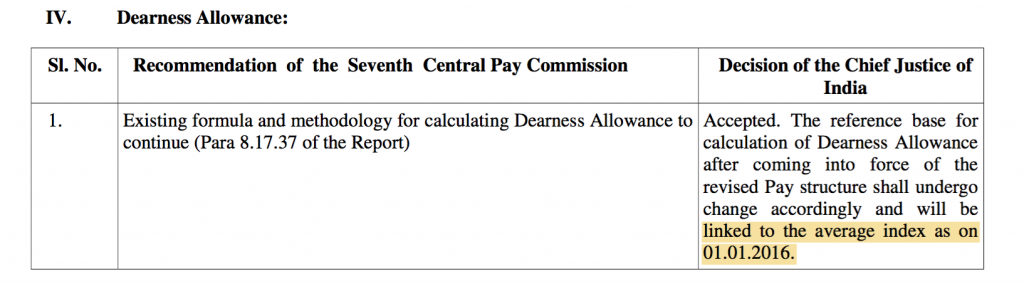
Existing formula and methodology for calculating Dearness Allowance to continue (Para 8.17.37 of the Report)
Accepted. The reference base for
calculation of Dearness Allowance after coming into force of the revised Pay structure shall ndergo change accordingly and will be linked to the average index as on 01.01.2016.
List of cases of upgradation of pay scales of posts recommended by Seventh Central Pay Commission in which no action is required as the posts have already been upgraded vide
SCI Resolution No. 32 dated 25.01.2016
Sl. No.
Name of the Post (Para No. of Report of Seventh Central Pay Commission
Existing Pay Band/Pay Scale
Existing Grade Pay
Pay Band recommended by Seventh Central Pay Commission
Grade Pay recommended by Seventh Central Pay Commission
I
II
III
IV
V
VI
1
Junior Court Assistant (12.14)
5200-20200
(PB-1)
2800
9300-34800
(PB-2)
4200
2
Court Assistant, Accountant, Cashier and Personal Assistant (12.17)
9300-34800
(PB-2)
4200
9300-34800
(PB-2)
4600
3
PS to Additional Registrar, Senior Personal Assistant, Senior Court Assistant, Court Associate, Editor of Paper Books, Assistant Librarian,
Proof Reader, Assistant Accounts Officer (Concurrent Audit) & Building Supervisor (12.20)
(i) 9300-34800
(PB-2)
(ii) 9300-34800
(PB-2)
[On completion of
4 years service]
(i) 4600
(ii) 5400
(i) 9300-34800
(PB-2)
(ii) PB-2
[On completion of 4
years service]