8th Central Pay Commission – Filling up of 40 posts on deputation basis – FINMIN O.M
F.No, A-11011/1/2023-Ad.1 Government of India Ministry of Finance Department of Expenditure Admn. I Section
North Block, New Delhi, Dated: 17th April, 2025
VACANCY CIRCULAR
Subject:- Filling up of posts in 8th Central Pay Commission on deputation basis – reg.
It is proposed to fill up the 35 posts in 8th Central Pay Commission on deputation basis. These posts are to be staffed for the period from the date of constitution of the 8th CPC till the closure of the Commission.
2. The appointments to the 8th CPC will be governed by the regular norms prescribed by DoPT from time to time. It is requested to circulate this requirement among the relevant officials and personnel in your organization. The post-wise eligibility criteria are enclosed.
3. Nominations/ applications, in the attached proforma along with the supporting documents i.e. APAR of five years, Vigilance Clearance etc. should be sent to this Department to the following address through proper channel:
Sh. Ranjit Kumar Jha, Under Secretary (Admn.1), Department of Expenditure, Ministry of Finance, Room No. 225-E, North Block, New Delhi-110001 (email: ranjitk.jha[at]nic.in)
5. This is an open-ended circular, meaning that applications will be considered on a continuous basis until all vacancies are filled. Therefore, it is requested to submit the duly filled/ verified applications at the earliest.
(Avinash K. Nilankar) Director (Admin.) Tel: 23092689
Dearness Relief from Jan 2025 to Central Govt Pensioners : DOPPW Order
No. 42/02/2024-P&PW(D) Government of India Ministry of Personnel, Public Grievances & Pensions Department of Pension & Pensioners’ Welfare
3rd Floor, Lok Nayak Bhawan Khan Market, New Delhi-110003 Date :- 11th April, 2025
OFFICE MEMORANDUM
Sub: – Grant of additional installment of Dearness Relief (DR) to Central Govt. Pensioners/Family Pensioners- revised rate effective from 01.01.2025-reg.
The undersigned is directed to refer to this Department’s OM No. 42/02/2024-P&PW(D) dated 30.10.2024 on the subject mentioned above and to state that the President is pleased to decide that the Dearness Relief admissible to Central Government Pensioners/Family Pensioners shall be enhanced from the existing rate of 53% to 55% of the basic pension/family pension (including additional pension/family pension) w.e.f 01st January, 2025.
2. These rates of DR will be applicable to the following categories:-
(i) Civilian Central Government Pensioners/Family Pensioners including Central Govt. absorbee pensioners in PSU/Autonomous Bodies in respect of whom orders have been issued vide this Department’s OM No. 4/34/2002-P&PW(D)Vol.II dated 23.06.2017 for restoration of full pension after expiry of commutation period of 15 years.
(ii) The Armed Forces Pensioners/Family Pensioners and Civilian Pensioners/Family Pensioners paid out of the Defence Service Estimates.
(iii) All India Service Pensioners/Family Pensioners.
(iv) Railway Pensioners/Family Pensioners.
(v) Pensioners who are in receipt of provisional pension
(vi) The Burma Civilian Pensioners/Family Pensioners and Pensioners/families of displaced Government Pensioners from Burma/ Pakistan, in respect of whom orders have been issued vide this Department’s OM No. 23/3/2008-P&PW/(B) dated 11.09.2017.
3.The payment of Dearness Relief involving a fraction of a rupee shall be rounded off to the next higher rupee.
4.Other provisions governing grant of DR in respect of employed family pensioners and re-employed Central Government Pensioners will be regulated in accordance with the provisions contained in Rule 02 of CCS (Pension) Rules, 2021 and this Department’s OM No. 45/73/97-P&PW (G) dated 02.07.1999 as amended from time to time. The provisions relating to regulation of DR where a pensioner is in receipt of more than one pension will remain unchanged.
5.In the case of retired Judges of the Supreme Court and High Courts, necessary orders will be issued by the Department of Justice Separately.
6.It will be the responsibility of the pension disbursing authorities. including the nationalized banks, etc. to calculate the quantum of DR payable in each individual case.
7.The offices of Accountant General and authorised Pension Disbursing Banks are requested to arrange payment of Dearness Relief to Pensioners/Family Pensioners on the basis of these instructions without waiting for any further instructions from the Comptroller and Auditor General of India and the Reserve Bank of India in view of letter No. 528- TA, II/34-80-II dated 23/04/1981 of the Comptroller and Auditor General of India addressed to all Accountant Generals and Reserve Bank of India Circular No. GANB No. 2958/GA-64 (ii) (CGL)/81 dated the 21st May, 1981 addressed to State Bank of India and its subsidiaries and all Nationalised Banks.
8.In so far as the Persons serving in Indian Audit and Accounts Department are concerned, these orders are issued in consultation with the Comptroller and Auditor General of India, as mandated under Article 148(5) of the Constitution of India.
9.This issues in accordance with the Ministry of Finance, Department of Expenditure’s OM No. 1/1(1)/2025-E.II(B) dated 02.04.2025.
Hindi version will follow.
(Divya A.B.) Director to the Government of India
All Ministries/Departments of the Government of India
Chief Secretaries and AGs of all States/UTs.
CMDs/CPPCs of all authorised Pension Disbursing Banks
C&AG of India, UPSC, etc. as per standard endorsement list.
Dearness Relief Order in the 5th CPC series effective from July 2024 to CPF beneficiaries
No. 42/02/2024-P&PW (D) भारत सरकार कार्मिक, लोक शिकायत और पेंशन मंत्रालय (पेंशन एवं पेंशन भोगी कल्याण विभाग)
तीसरी मंजिल, लोकनायक भवन खान मार्केट, नई दिल्ली-110003 दिनांक: 11.04.2025
OFFICE MEMORANDUM
विषय: – Grant of Dearness Relief in the 5th CPC series effective from 01.07.2024 to CPF beneficiaries in receipt of basic ex-gratia payment-reg
The undersigned is directed to refer to this Department’s OM 42/02/2024-P&PW(D) dated 09.08.2024 and to say that the President is pleased to decide that the Dearness Relief admissible to the CPF beneficiaries in receipt of basic ex-gratia payment in the 5th CPC series shall be enhanced w.e.f 01.07.2024 in the following manner:-
i. The surviving CPF beneficiaries who have retired from service between the period 18.11.1960 and 31.12.1985. and are entitled to basic ex-gratia @ Rs.3000, Rs.1000, Rs.750 & Rs.650 for Group A, B, C & D respectively w.e.f 4th June,2013 vide OM No. 1/10/2012-P&PW(E) dtd. 27th June, 2013 shall now be entitled to enhanced Dearness Relief from 443% of the basic ex-gratia to 455% of the basic ex-gratia w.e.f 01.07.2024.
ii. The following categories of CPF beneficiaries shall be entitled to enhanced Dearness Relief from 435% of the basic ex-gratia to 447% of the basic ex-gratia w.e.f 01.07.2024:-
(a) The widows and eligible dependent children of the deceased CPF beneficiary who had retired from service prior to 01.01.1986 or who had died while in service prior to 01.01.1986 and are entitled to revised ex-gratia @ Rs.645/-p.m w.e.f 04 June, 2013 vide OM No 1/10/2012-P&PW(E) dated 27th June,2013.
(b) Central Government employees who had retired on CPF benefits before 18.11.1960 and are in receipt of Ex-gratia payment of Rs. 654/-, Rs.659/-, Rs.703/- and Rs.965/-.
2. Payment of DR involving a fraction of a rupee shall be rounded off to the next higher rupee.
3. It will be the responsibility of the pension disbursing authorities, including the nationalized Danks, etc. to calculate the quantum of DR payable in each individual case.
4. In so far as the persons serving in Indian Audit and Accounts Department are concerned, these orders are issued in consultation with the Comptroller and Auditor General of India, as mandated under Article 148(5) of the Constitution of India.
5. This issues in pursuance of Ministry of Finance, Department of Expenditure’s OM No. 1/6(2)/2024-E.1l(B) dated O7th November, 2024.
6.Hindi version will follow.
(सोनिका खट्टटर) अवर सचिव, भारत सरकार
All Ministries/Departments of the Government of India
C&AG of India, UPSC. etc. as per standard endorsement list.
Chief Secretaries and AGs of all States/UTs.
CMDs/CPPCs of all authorised Pension Disbursing Banks
Dearness Allowance to Gramin Dak Sevaks from Jan 2025 : Dept of Posts O.M
F.N. PP-14/1/2021-PAP भारत सरकार /Government of India संचार मंत्रालय / Ministry of Communications डाक विभाग / Department of Posts
डाक भवन, संसद मार्ग Dak Bhawan, Sansad Marg, नई दिल्ली/ New Delhi -110001. Dated: 04-04-2025
To,
All Chief Postmasters General/ Postmasters General
Chief General Manager, BD Dte/Parcel Dte/ PL! Directorate
Director RAKNPA/ GM CEPT/ Directors of All PTCs, 4, Addl. Director General, Army Postal Service, R.K. Puram, New Delhi
All General Managers (Finance)/ DAP/ DDAP
Sub: Payment of Dearness Allowance to Gramin Dak Sevaks (GDS) effective from 01.01.2025 onwards -reg.
Consequent upon grant of another installment of Dearness Allowance with effect from 1st January, 2025 to the Central Government Employees vide Government of India, Ministry of Finance, Department of Expenditure’s O.M. No. 1/1(1)/2025-E.11.(B) dated 02.04.2025, duly endorsed vide this Department’s letters No. PP-08/2/2021-PAP dated 02.04.2025, the Gramin Dak Sevaks (GDS) have also become entitled to the payment of Dearness Allowances on basic TRCA at the same rates as applicable to Central Government Employees with effect from 01.01.2025. It has, therefore, been decided that the Dearness Allowance payable to the Gramin Dak Sevaks shall be at the same rates as payable to Central Government Employees i.e. @ 55% (percent) with effect from the 1st January, 2025.
भारत सरकार, वित्त मंत्रालय, व्यय विभाग के कार्यालय ज्ञापन संख्या 1/1(1)/2025-E.II.(B) दिनांक 02.04.2025 के माध्यम से केंद्रीय सरकार कर्मचारियों को 1 जनवरी, 2025 को महंगाई भत्ते की एक और किस्त दिए जाने के परिणामस्वरूप, ग्रामीण डाक सेवक (GDS) भी, 01.01 .2025 से, केंद्रीय सरकार कर्मचारियों के लिए लागू समान दरों पल टीआरसीए पर महंगाई भत्ते के भुगतान के हकदार बन गए हैं। इसलिए, यह निर्णय लिया गया है कि ग्रामीन डाक सेवकों को देय महंगाई भत्ता 01.01.2025 से केंद्रीय सरकार कर्मचारियों के लिए देय दर यानि टीआरसीए के 55% (प्रतिशत), के समान होगा।
2. The expenditure on this account shall be debited to the Head “Salaries” under the relevant head of account and should be met from the sanctioned grant.
इस खाते पर व्यय संबंधित खाते के शीर्षक के तहत “वेतन” शीर्षक से डेबिट किया जाएगा और स्वीकृत अनुदान से पूरा किया जाएगा।
3. This sanction issues with the approval of the competent authority. The advice of Internal Finance/ Integrated Finance was conveyed vide Diary No.03/2025-26/FA-CS(P) dated 04.04.2025
यह मंजूरी आंतरिक वित्त / एकीकृत वित्त कि सलाह Diary No.03/2025-26/FA-CS(P) dated 04.04.2025 के अनुसार सक्षम प्राधिकरण की मंजूरी के अनुमोदन से जारी की जाती है।
Digitally signed by RAVI PAHWA Date: 04-04-2025 Director (GDS)
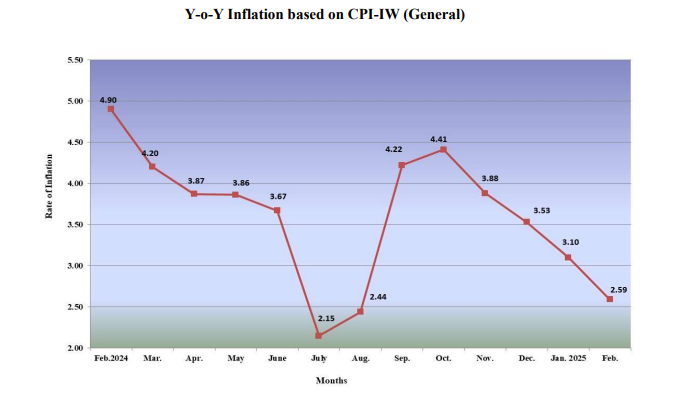
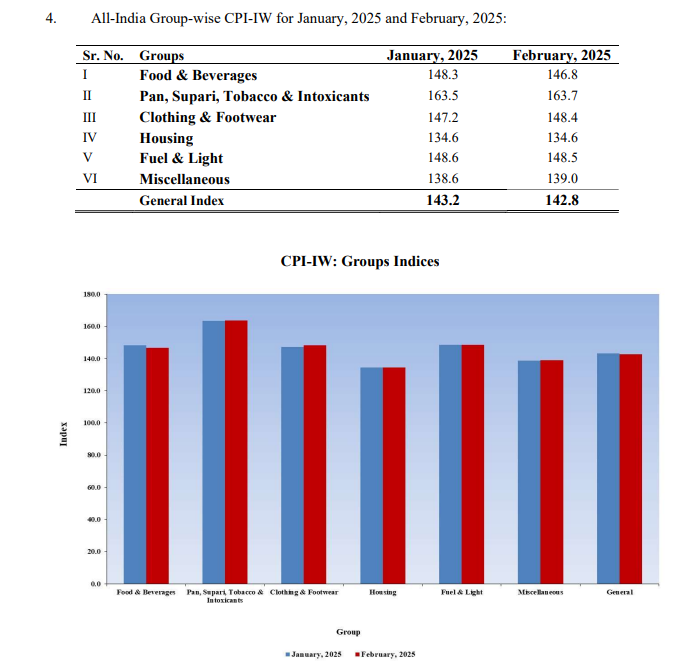
Consumer Price Index for Industrial Workers (2016=100) – February, 2025
1. Labour Bureau, an attached office of the M/o Labour & Employment, has been compiling Consumer Price Index for Industrial Workers every month on the basis of retail prices collected from 317 markets spread over 88 industrially important centres in the country. The index for the month of February, 2025 is being released in this press release.
2. The All-India CPI-IW for February, 2025 decreased by 0.4 point and stood at 142.8 (one hundred forty two point eight).
Rate of Interest on House Building Advance for Central Government Employees for FY 2025-26
I-17015/2(2)/2024/H.III (e-9126778)/69 Government of India Ministry of Housing & Urban Affairs (Housing-III-Section)
Nirman Bhawan, New Delhi Dated: 27th March, 2025
OFFICE MEMORANDUM
Subject : – Rate of Interest on House Building Advance (HBA) for Central Government Employees for FY 2025-26-reg.
In pursuance of Department of Economic Affairs, Ministry of Finance OM No 2(2)-B(PD)/2025 dated 24.03.2025, the interest rate applicable on House Building Advance Sanctioned to Central Government Employees for the financial] year 2025-26 (from 1st April 2025 to 31st March 2026) will remain unchanged at 7.44% until further orders.
2. This issues with the approval of Competent Authority.
(Manoj Kumar Jha) Under Secretary to the Govt. of India Tel: 23061476 Email ID: manojk.jha[at]nic.in
To All the Central Government Ministries/Departments
Copy for information to: 1.PS to Hon’ble Minister, Ministry of Finance, North Block, New Delhi. 2.PS to Hon’ble_ Minister, Ministry of Housing & Urban Affairs, Nirman Bhawan, New Delhi. 3.PS to Hon’ble Minister of State, Ministry of Housing & Urban Affairs, Nirman Bhawan, New Delhi. 4.SO (IT Cell) with a request to upload it in e-office and on website of Ministry of Housing & Urban Affairs.
Allowing female AIS officers/pensioners to nominate her child/children for family pension: DOPT O.M
No.25014/01/2024-AIS-II(Pension) Government of India Ministry of Personnel, Public Grievances & Pensions Department of Personnel and Training
North Block, New Delhi Dated 28 March, 2025
To
The Chief Secretaries of All States/Union Territories
Subject:- Allowing female AIS officers/pensioners to nominate her child/children for family pension in precedence to her husband in the event of marital discord leading to filing of divorce proceedings in a Court of Law or filing of a case under Protection of Women from Domestic Violence Act or Dowry Prohibition Act or Indian Penal Code.
Sir/Ma’am,
I am directed to say that, as per Rule 22 of All India Services (Death-cum-Retirement Benefits) Rules, 1958, if a deceased member of service or pensioner is survived by a spouse, family pension is first granted to the spouse, and the children and other family members become eligible for family pension, on their turn, only after the spouse of the deceased member of service/pensioner becomes ineligible for family pension or dies.
2. In pursuance of Department of Pension & Pensioners’ Welfare (DOP&PW) vide O.M. No.1/1(1)/2023-P&PW(E) dated 01.01.2024 (copy enclosed), it has been decided that in case divorce proceedings in respect of a female member of service/female pensioner are pending in a Court of Law, or the female member of service/female pensioner has filed a case against her husband under Protection of Women from Domestic Violence Act or under Dowry Prohibition Act or under Indian Penal Code, such female member of service/female pensioner may make a request for grant of family pension after her death to her eligible child/children, in precedence to her husband. The provisions of the aforementioned O.M. dated 01.01.2024 of Department of Pension & Pensioners’ Welfare are hereby extended mutatis mutandis to members of All India Services.
Enclosed: (1) OM No: No.1/1(1)/2023-P&PW(E) Dated: 1/1/2024
Yours faithfully,
Sd/- (Bhupinder Pal Singh) Under Secretary to Government of India
Difference of UPS from OPS and NPS: Rajya Sabha QA
GOVERNMENT OF INDIA MINISTRY OF FINANCE DEPARTMENT OF FINANCIAL SERVICES
RAJYA SABHA UNSTARRED QUESTION NO. 3440
ANSWERED ON TUESDAY, 01 APRIL, 2025/ 11 CHAITRA, 1947 (SAKA)
DIFFERENCE OF UPS FROM OPS AND NPS
3440. Shri Parimal Nathwani:
Will the Minister of Finance be pleased to state:
(a) the details of how the new Unified Pension Scheme (UPS) differs from the Old Pension Scheme (OPS) and/or the National Pension Scheme (NPS);
(b) the details of State Governments who have shown interests to implement the same in their respective States for their employees; and
(c) whether the Central Government mulls extending additional financial support etc to the State Governments that adopt the UPS, if so, the details thereof?
ANSWER MINISTER OF STATE FOR FINANCE (SHRI PANKAJ CHAUDHARY)
(a) Unified Pension Scheme (UPS) has been notified by the Government on 24.01.2025, as an option under National Pension System (NPS) with the objective of providing assured monthly payout after retirement to the Central Government employees covered under the NPS.
UPS is defined contribution scheme with elements of defined benefit. It relies on the regular and timely accumulation and investment of applicable contributions (from both the employee and the employer) for assured payout to the employees.
The Old Pension Scheme is a defined benefit non-contributory scheme, fully funded by Government. It is applicable to Central Government employees who have joined the service on or before 31.12.2003 The National Pension System (NPS) is a defined contribution-based scheme with market linked returns for post-retirement benefits. It is applicable to Central Government employees, except armed forces, who have joined the service on or after 01.01.2004
(b) and (c) The regulation of service conditions of State Government employees falls under the administrative domain of respective State Governments.
Mahila Samman Savings Certificate Scheme : No New Deposits from April 1, 2025 – Dept of Posts
SB Order No. 03/2025
No. FS-13/01/2023-FS-DOP भारत सरकार/Government of India संचान मंत्रालय/Ministry of Communications डाक विभाग /Department of Posts वित्तीय सेवाएं प्रभाग / (Financial Services Division)
Dak Bhawan, New Delhi – 110001 Dated: 28.03.2025
To
All Heads of Circles / Regions
Subject: Mahila Samman Savings Certificate Scheme (MSSC) – Reg.
2. Department of Economic Affairs, Ministry of Finance vide letter no. 14/1/2019-NS-Part (1) dated 27.03.2025 has informed that, in accordance with the prevailing guidelines and notifications concerning the Mahila Samman Savings Certificate scheme (MSSC), the scheme will remain effective only until 31st March 2025. After this date, no new deposits shall be accepted under the scheme.
3. The undersigned is directed to request all the Circles to circulate it to all concerned for information, guidance and necessary action. Same may also be placed on the notice board of all Post Offices in public area.
4. This issues with the approval of competent authority.
Yours faithfully,
Encl: As above.
Sd/- (Devender Kumar Sharma) Assistant Director (SB-II)
Chatgpt and other AI Tools for Government Work: No Specific Prohibition, Subject to Due Diligence : Raya Sabha QA
GOVERNMENT OF INDIA MINISTRY OF PERSONNEL, PUBLIC GRIEVANCES AND PENSIONS (DEPARTMENT OF PERSONNEL & TRAINING)
RAJYA SABHA UNSTARRED QUESTION NO. 3153 (ANSWERED ON 27.03.2025)
USE OF CHATGPT APP AND OTHER SIMILAR APPS FOR GOVERNMENT WORK
3153. SHRI RAMJI LAL SUMAN: Will the PRIME MINISTER be pleased to state:
(a) whether it is a fact that officials of various departments are using ChatGPT and other such apps to draft letters and create other reports;
(b) if so, whether this is allowed; and
(c) whether the use of such apps is in the national interest in terms of confidentiality?
ANSWER MINISTER OF STATE IN THE MINISTRY OF PERSONNEL, PUBLIC GRIEVANCES AND PENSIONS AND MINISTER OF STATE IN THE PRIME MINISTER’S OFFICE (DR. JITENDRA SINGH)
(a): The Ministry of Personnel, Public Grievances and Pensions does not maintain any data regarding the use of any AI applications by officials of various departments.
(b): There is no specific prohibition on the use and adoption of AI-based tools by any Government Departments as this is an emerging technology with great potential in various citizen oriented web-applications. However, government functionaries are expected to exercise due diligence and caution to ensure safety, security and confidentiality of public information while using any digital technology or platforms.
(c): The use of any application, tool or website by government officials is governed in terms of cyber security guidelines and Departmental Security instructions issued by the Ministry of Electronics and Information Technology (MeitY), Ministry of Home Affairs and other relevant authorities.