Consumer Price Index for Industrial Workers (2016=100) โ September, 2025
1. Labour Bureau, an attached office of the M/o Labour & Employment, has been compiling Consumer Price Index for Industrial Workers every month on the basis of retail prices collected from 317 markets spread over 88 industrially important centres in the country. The index for the month of September, 2025 is being released in this press release.
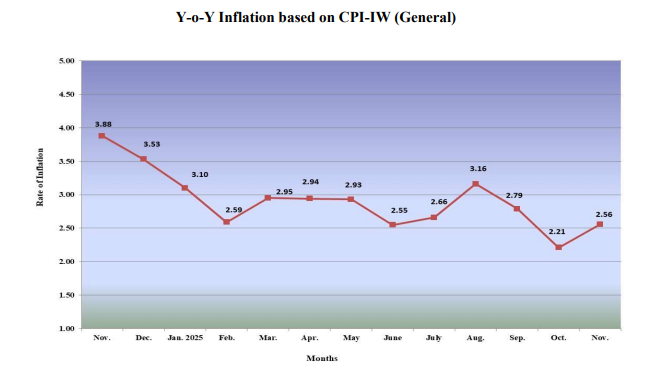
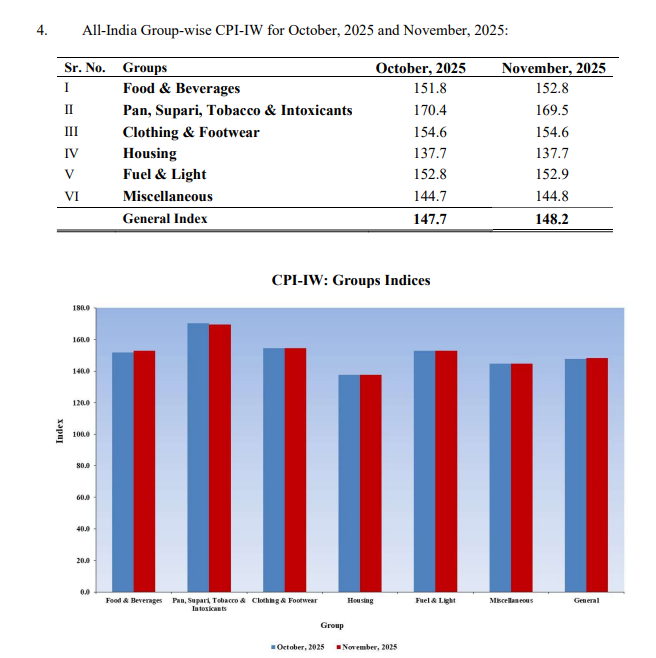
2. The All-India CPI-IW for September, 2025 increased by 0.2 point and stood at 147.3 (one hundred forty-Seven point Three).
3. Year-on-year inflation for the month of September, 2025 stood at 2.79% as compared to 4.22% in September, 2024.
Ensuring efficiency in bill payments and timely processing of pensionย cases : CGA O.M
No. M-114/6/2024/CGA/CF. No 17509/3407 O/o Controller General of Accounts Ministry of Finance Department of Expenditure (Oversight and Monitoring Cell)
Sub: โ Ensuring efficiency in bill payments and timely processing of pension cases -reg.
The undersigned is directed to say that the efficiency and timely disposal of bills and pension cases is one of the core responsibilities of all the Ministries/Departments/Offices under CGA Organisation. Any delay in such matters not only affects the efficiency and accountability of this organisation but also hampers the service delivery which undermines the credibility of the financial management system.
2. All Pr. CCA/CCAs/CAs(Independent) are, therefore, requested to keep a close watch on the functioning of PAOs under their control and issue necessary instructions/advisories from time to time to ensure strict compliance with the extant rules/instructions while passing bills and processing pension cases. Further, emphasis should be on the following points:
All bills, particularly pension cases and related payments, must be disposed of within the prescribed timelines.
Piecemeal objections should not be raised. Any objection, if unavoidable, must be specific, justified and strictly based on relevant rules and regulations.
PAQOs must act as facilitators by guiding and advising departmental offices for smooth processing of claims.
A standardized checklist should be circulated by each Pr.CCA/CCA/CA(Independent) to Departmental Authorities to prevent unnecessary or avoidable return of bills/pension cases.
Delays which cannot be justified under rules are to be strictly avoided and accountability may be ensured in cases of lapse.
Pensionary benefits must be recorded in service book at each stage (Issue, Payment, Recovery).
Pensionary benefits should be released only to the concerned Pensioner/Family Pensioner.
3.The above guidelines will help to strengthen the efficiency and accountability of all the Ministries/Departments/Offices under CGA Organisation. This may please be ensured by all the Pr.CCA/CCA/CA (Independent) that these standing instructions must be compiled by all the concerned.
4.This issues with the approval of Controller General of Accounts.
Sr. Accounts Officer Oversight and Monitoring Cell (OMC
เคตเคฟเคทเคฏเค โ Grant of Dearness Relief in the 5th CPC series effective from 01.01.2025 to CPF beneficiaries in receipt of basic ex-gratia payment-reg.
The undersigned is directed to refer to this Departmentโs ะะ 42/02/2024-P&PW(D) dated 11.04.2025 and to say that the President is pleased to decide that the Dearness Relief admissible to the CPF beneficiaries in receipt of basic ex-gratia payment in the 5th Cะ ะก series shall be enhanced w.e.f. 01.01.2025 in the following manner:-
The surviving CPF beneficiaries who have retired from service between the period 18.11.1960 and 31.12.1985, and are entitled to basic ex-gratia @ Rs.3000, Rs.1000, Rs.750 & Rs.650 for Group A, B, C & D respectively w.e.f 4th June, 2013 vide OM No. 1/10/2012-P&PW(E) dt. 27th June, 2013 shall now be entitled to enhanced Dearness Relief from 455% of the basic ex-gratia to 466% of the basic ex-gratia w.e.f. 01.01.2025. The following categories of CPF beneficiaries shall be entitled to enhanced Dearness Relief from 447% of the basic ex-gratia to 458% of the basic ex-gratia w.e.f. 01.01.2025:-
(a) The widows and eligible dependent children of the deceased CPF beneficiary who had retired from service prior to 01.01.1986 or who had died while in service prior to 01.01.1986 and are entitled to revised ex-gratia @ Rs.645/-p.m w.e.f 04 June, 2013 vide OM No 1/10/2012-P&PW(E) dated 27th June, 2013.
(b) Central Government employees who had retired on CPF benefits before 18.11.1960 and are in receipt of Ex-gratia payment of Rs. 654/-, Rs.659/-, Rs.703/- and Rs.965/-.
2. Payment of DR involving a fraction of a rupee shall be rounded off to the next higher rupee.
3. It will be the responsibility of the pension disbursing authorities, including the nationalized banks, etc. to calculate the quantum of DR payable in each individual case.
4. In so far as the persons serving in Indian Audit and Accounts Department are concerned, these orders are issued in consultation with the Comptroller and Auditor General of India, as mandated under Article 148(5) of the Constitution of India.
5. This issues in pursuance of Ministry of Finance, Department of Expenditureโs OM No. 1/1(3)/2025-E.II(B) dated 02nd April, 2025.
Submission of life certificates by both the parents in case of enhanced family pension payable to them under CCS (EOP) Rules: DOPPW Clarification
เคซเคพ.เคจ. 1/11/2025-P&PW(F) (11190) เคญเคพเคฐเคค เคธเคฐเคเคพเคฐ Government of India เคเคพเคฐเฅเคฎเคฟเค, เคฒเฅเค เคถเคฟเคเคพเคฏเคค เคเคฐ เคชเฅเคเคถเคจ เคฎเคเคคเฅเคฐเคพเคฒเคฏ Ministry of Personnel, PG & Pensions เคชเฅเคเคถเคจ เคเคตเค เคชเฅเคเคถเคจเคญเฅเคเฅ เคเคฒเฅโเคฏเคพเคฃ เคตเคฟเคญเคพเค Department of Pension & Pensionersโ Welfare
3rd Floor, Lok Nayak Bhavan. Khan Market, New Delhi, Dated the 28th October, 2025
OFFICE MEMORANDUM
Subject: Clarification regarding submission of life certificates by both the parents in case of enhanced family pension payable to them under CCS (EOP) Rules, 1939 / 2023 -submission of Life Certificate โ reg.
Department of Pension & Pensionersโ Welfare (DoPPW) has been receiving references seeking information / clarification regarding enhanced family pension payable to parents under Categories โDโ & โEโ of CCS (EOP) Rules, 1939 / Categories โCโ & โDโ of CCS (EOP) Rules, 2023.
2. The Rule position with reference to the payment of enhanced family pension to parents under CCS (EOP) Rules is as under:
i. Family Pension for Categories โDโ and โEโ, Rule (2)(4) of Schedule-II of CCS (EOP) Rules, 1939 provides as under:
โ(4) When the Government servant dies as a bachelor or as a widower without, children, dependent pension shall be admissible to the parents without reference to pecuniary circumstances, at the rate of 75% of pay last drawn by the deceased Government servant for both parents and at the rate of 60% of pay last drawn by the deceased Government servant for a single parent and on the death of one parent dependent pension at the latter rate shall be admissible to the surviving parent.โ
ii. Eligibility of members of the family for grant of family pension under Category โCโ and Category โDโ. Rule 12 (5) of revised CCS (EOP) Rules, 2023 stipulates that-
โ(a) Where a deceased Government servant is not survived by a widow or widower or a child eligible for family pension or if the widow or widower and all children cease to he eligible for family pension, family pension shall be payable to parents for life-
(ii) under Category: โยฐCโ and Category โDDโ, at the rate of seventy five per cent of the family pension entitled ta a widow if both parents are alive and at the rate of sixty per cent of the family pension entitled to a widow if only one parent is alive.
(b) The family pension, wherever admissible to parents will be payable to the mother of the deceased Government servant failing which to the father of the deceased Government servant.
Payment of family pension to parents in Category โCโ & Category โDยฐ shall be without reference to the amount of their income from other sources.โ
3. The enhanced family pension in the above cases is @75% if both parents are alive and @ 60% if only one parent is alive. Presently, there is no provision for submission of Life Certificates by both the parents in CCS (Pension) Rules for receiving family pension at enhanced rate in such cases. Hence. in the absence of such provision in rules, life certificates are not being submitted by both the parents resulting in continuation of payment of enhanced family pension at higher rate even after the death of one of the parents in few cases.
4. In view of above, it has been decided that henceforth Life Certificates in the cases as referred above will be submitted by both the parents every year to avoid the overpayment in case of demise of one of the parents.
5. The contents of this Office Memorandum may please be given wide publicity and brought to the notice of all concerned.
(เคฆเคฟเคฒเฅเคช เคเฅเคฎเคพเคฐ เคธเคพเคนเฅ) / (Dilip Kumar Sahu) เค เคตเคฐ เคธเคเคฟเคต, เคญเคพเคฐเคค เคธเคฐเคเคพเคฐ/ Under Secretary to the Govt.of India Tele. No. 011-24641627
To. All Ministries/Departments/Organisations. (As per standard list)
Smt. Justice Ranjana Prakash Desai, a former Judge of the Supreme Court of India, has been appointed as the Chairperson of the 8th Central Pay Commission (CPC). This significant appointment marks a historic moment, as she becomes the first woman ever to head a Central Pay Commission.
The Central Pay Commission is an administrative mechanism set up by the Government of India to review and recommend changes regarding the salary structure, allowances, and other benefits for all central government employees, including personnel of the Armed Forces.
Justice Desai’s appointment brings her considerable judicial experience, administrative expertise, and deep understanding of public service matters to this crucial role. Her leadership will be pivotal in shaping the recommendations of the 8th CPC, which will impact the financial well-being and service conditions of millions of central government staff.
Distinguished Career and Previous Roles
Prior to this role, Justice Desai’s career has been distinguished by several high-profile appointments:
Supreme Court Judge: She served as a Judge of the Supreme Court of India, retiring in 2014.
Press Council of India: She was the first woman Chairperson of the Press Council of India (PCI).
Delimitation Commission: She successfully headed the Delimitation Commission for Jammu and Kashmir and other northeastern states.
To handle a complex task of national importance like the 8th CPC, the government recognized her for her impartiality, integrity, and significant administrative capacity.
Composition of the 8th Central Pay Commission (8th CPC) – Latest Update
The 8th Central Pay Commission (8th CPC) has officially been constituted following the approval of its Terms of Reference (ToR) by the Union Cabinet on Tuesday. This marks the formal start of the process to revise the salaries, allowances, and pensions for Central Government employees and pensioners.
The 8th CPC will function as a temporary advisory body and its full composition, approved by the Cabinet, is as follows:
Role
Name
Current/Former Designation
Chairperson
Justice Ranjana Prakash Desai
Former Judge of the Supreme Court of India
Part-Time Member
Professor Pulak Ghosh
Professor (IIM Bangalore)
Member-Secretary
Pankaj Jain
Secretary, Petroleum and Natural Gas
Key Details and Timeline
Mandate: The Commission’s primary mandate is to examine the current pay structure and recommend changes.
Deadline: The panel has been given 18 months from its date of constitution to submit its comprehensive report. It may also submit interim reports on specific issues.
Impact: The recommendations of the 8th CPC are set to benefit approximately 50 lakh serving central government employees and around 69 lakh pensioners.
Areas of Review: The Commission will consider a wide range of factors, including economic conditions, fiscal prudence, the impact on state government finances, and comparative pay structures in the private sector and Central Public Sector Undertakings (CPSUs).
Cabinet approves Terms of Reference (TOR) of 8th Central Pay Commission
The Union Cabinet, chaired by the Prime Minister Shri Narendra Modi, today approved the Terms of Reference of 8th Central Pay Commission.
The 8th Central Pay Commission will be a temporary body. The Commission will comprise of one Chairperson; One Member (Part Time) and one Member-Secretary. It will make its recommendations within 18 months of the date of its constitution. It may consider, if necessary, sending interim reports on any of the matters as and when the recommendations are finalized. While making the recommendations the Commission will keep in view the followings:
i. The economic conditions in the country and the need for fiscal prudence;
ii. The need to ensure that adequate resources are available for developmental expenditure and welfare measures;
iii. The unfunded cost of non-contributory pension schemes;
iv. The likely impact of the recommendations on the finances of the State Governments which usually adopt the recommendations with some modifications; and
v. The prevailing emolument structure, benefits and working conditions available to employees of Central Public Sector Undertakings and private sector.
Background:
The Central Pay Commissions are periodically constituted to go into various issues of emoluments structure, retirement benefits and other service conditions of Central Government employees and to make recommendations on the changes required thereon. Usually, the recommendations of the pay commissions are implemented after a gap of every ten years. Going by this trend, the effect of the 8th Central Pay Commission recommendations would normally be expected from 01.01.2026.
The Government had announced formation of the 8th Central Pay Commission in January, 2025 to examine and recommend changes in the Salaries and other benefits of Central Government employees.
Procedure for joining / relieving of GDS on transfer under Rule-3 in the new APT 2.0 environment – SOP
17-31/2016-GDS(Pt.I) เคญเคพเคฐเคค เคธเคฐเคเคพเคฐ /Government of India เคธเคเคเคพเคฐ เคฎเคเคคเฅเคฐเคพเคฒเคฏ /Ministry of Communication เคกเคพเค เคตเคฟเคญเคพเค /Department of Posts (เคเฅเคกเฅเคเคธ เค เคจเฅเคญเคพเค) /GDS Section
เคกเคพเค เคญเคตเคจ, เคธเคเคธเคฆ เคฎเคพเคฐเฅเค, Dak Bhawan, Sansad Marg, เคจเค เคฆเคฟเคฒเฅเคฒเฅ /New Delhi โ 110001. Dated: 23 October 2025
To
All Chief Postmasters General
General Manager, CEPT Bangalore/CEPT Unit at Hyderabad.
Subject: Procedure for joining/ relieving of GDS on transfer under Rule-3 in the new APT 2.0 environment- Standard Operating Procedure (SOP).
Sir/ Madam,
With the upgradation of Rule-3 transfer portal under APT 2.0, the relieving and joining process of GDS after their transfer approval will be handled through the portal online. Also, the option to submit a cancellation request, if any, has to be submitted through the online portal, from the Rule-3 Transfer Cycle Oct/Nov-2025 onwards.
2. Accordingly, the Standard Operating Procedure (SOP) to deal with the relieving/ joining process of GDS (On-Request / Mutual Transfer) is enclosed herewith in Annexure-A. The SOP covers the following: โ
(i) Cases where Disciplinary/Criminal proceedings are initiated after the transfer is approved or the list has been published, but before actual relieving of the GDS.
(ii) Relieving of Female GDS on Maternity Leave.
(iii) Manner to deal with the mutual transfer involving promotion/ resignation/ voluntary discharge/ termination/ removal/ dismissal/ compulsory discharge/ Death of either of the GDSs
(iv) Standardised format for issuance of relieving and joining orders by the Circle/Division, specifically since the transfers are now being approved through the online portal (Annexure-I & II)
3. CEPT is requested to make necessary provisions in the Rule-3 portal in alignment with the guidelines, with a request to upload the SOP on the GDS Rule-3 Portal for the information of all concerned. Accordingly, all Circles are requested to bring this SOP to the knowledge of all Divisional/Sub Divisional Heads and monitor activities pertaining to the GDS Transfer process, as contained in the SOP at the Circle level and ensure strict compliance as well as its implementation in the letter and spirit.
These issues with the approval of the competent authority.
Settlement of Family Pension between two wives of a Government Servant or Pensioner under CCS Rules 2021 : DOPPW Clarification
No 1/1(33)/2024-P&PW(E)/9629 Government of India Ministry of Personnel, PG & Pension Department of Pension & Pensioners’ Welfare
3rd Floor, Loft Nayak Bhavan, Khan Market, New Delhi, Dated the 27th October., 2025
OFFICE MEMORANDUM
Subject : Settlement of Family Pension between two wives of a Government Servant or Pensioner under Central Civil Services (Pension) Rules, 2021 reg.
The undersigned is directed to refer to this Department’s O.M. of even number dated 10.10.2024. As stated earlier, the Department of Pension and Pensioners’ Welfare (DoPPW) has notified the Central Civil Services (Pension) Rules, 2021 and Rule 50 of the Central Civil Services (Pension) Rules, 2021 deals with payment of family pension on death of a Government servant/pensioner
2. In accordance with Rule 50 (6) of the CCS (Pension) Rules, 2021, the family pension shall be payable to the members of the family of the deceased Government Servant or pensioners in the Following order
i.Subject to provisions of sub-rule (8), widow or widower, (including a post-retiral spouse and judicially separated wife or husband).
ii .Subject to provisions of sub-rale (9), children (including adopted children, step children and children horn after retirement of the pensioner).
iii. subject to provisions of sub-rule (10), dependent parents (including adoptive parents) of the deceased Government servant or pensioner,
iv. subject to provisions of sub-rule (11), dependent siblings (i.e. brother or sister) o the deceased Government servant or pensioner, suffering from a mental or physical disability
3. Whereas the Explanation to Rule 50(6) (1) of the CCS (Pension) Rules, 2021 states that – For the purpose of this rule ‘widow’ and ‘widower’ shall mean a spouse, legally wedded to the deceased Government servant or the pensioners
4. Whereas Rule 50(8)(e) of the CCS (Pension) Rules, 2021 states that-
Where the deceased Government servant or pensioner is survived by more widow than one,. the family pension shall be paid to the widows in equal shares and on the death or ineligibility of a widow, her share of the family pension shall become payable to her child or children who fulfil the eligibility conditions mentioned in sub-rule (9).
5. The position with reference to the legality of marriage / spouse was clarified. However. this Department still receives many references seeking clarification on these points. In order to avoid time in decision making, the rule position is re-iterated. Having second wife when the first wife is alive is against the provisions of Hindu Marriage Act, 1955 and also contradictory to the provisions of CCS (Pension) Rules, 2021. For the administrative authority,. it is very important to have application of mind while examining such cases and interpreting the Rules. For any disputes arising out of them, the replies / briefs for the tribunals / courts need to be suitably prepared in accordance with the provisions of CCS (Pension) Rules and extant guidelines.
6. All Ministries/Departments are requested to follow the process of consultation with Department of Legal Affairs before arriving at decision regarding Settlement of Family Pension between two wives under Central Civil Services (Pension) Rules, 2021. Such cases must be brought to the notice of the officer dealing with the pensioners’ benefits in the respective Ministry/Department by the attached/subordinate offices etc.
Enhanced Rate of Family Pension Death after Retirement cases: DOPPW Clarification O.M dt 27.10.2025
No, 1/1(90)12024-P&PW(E)-Part(1)/10344 Governinent of India Ministry of Personnel, PG & Pensions Department of Pension & Pensioners’ Welfare
3rd Floor., Lok Nayak Bhavan. Khan Market, New Delhi, Dated the 27th October, 2025
OFFICE MEMORANDUM
Subject Clarification regarding Enhanced Rate of Family Pension Death after Retirement cases โ reg.
Department of Pension & Pensioners’ Welfare (DoPPW) has been receiving few references/RTI applications etc. seeking information / clarification regarding Enhanced Rate of Family Pension after death of government employee after retirement
2. In this connection, it may be stated that as per Rule 50(2)(a) (iii) of CCS (Pension) Rules! 2021, the family pension after the death of Government employee is granted to the eligible family members of the employee at enhanced rate as under:
“(2)(a)(iii): In the event of death of a Government servant after reiirement, the family pension shall be payable for a period of seven years, or. for a period up to the date on which the retired deceased Government servant would haves. attained the age of sixty-seven years had he survived, whichever is less.
3. There are some references seeking clarification on the calculation of this period where the age of retirement is more than 60 years like the age of retirement of Central Health Service (CHS) doctors is 65 years and the officer retires at the age of 65 and dies unfortunately before 67. It is clarified that the provisions of Rule 50 (2)(a)(iii) is applicable in all cases i.e. whether the retirement age is 60 or 65 years. In all such cases, the enhanced family pension is payable for a period of seven years, or for a period up to the date on which the retired deceased Government servant would have attained the age of sixty-seven years had he survived, whichever is less.