Parliament passes bill to raise maternity leave to 26 weeks
Maternity Benefit (Amendment) Bill, 2016 passed in the Parliament
The Bill seeks to increase maternity leave available to working women from the current 12 weeks to 26 weeks for the first two children
The Lok Sabha has passed the Maternity Benefit (Amendment) Bill, 2016 today. The Bill had already been passed by the Rajya Sabha during the Winter Session. With this, the Bill stands passed in the Parliament.
The Bill seeks to amend the Maternity Benefit Act, 1961 to provide for the following:-
(i) Maternity leave available to the working women to be increased from 12 weeks to 26 weeks for the first two children.
(ii) Maternity leave for children beyond the first two will continue to be 12 weeks.
(iii) Maternity leave of 12 weeks to be available to mothers adopting a child below the age of three months as well as to the “commissioning mothers”. The commissioning mother has been defined as biological mother who uses her egg to create an embryo planted in any other woman.
(iv) Every establishment with more than 50 employees to provide for crèche facilities for working mothers and such mothers will be permitted to make four visits during working hours to look after and feed the child in the crèche.
(v) The employer may permit a woman to work from home if it is possible to do so.
(vi) Every establishment will be required to make these benefits available to the women from the time of her appointment.
The Minister of Women and Child Development, Smt. Maneka Gandhi thanked the Minister for Labour and Employment, Shri Bandaru Dattatreya for taking up the demand of lakhs of women across the country and for having steered the Bill through Rajya Sabha as well as the Lok Sabha. In her message to the working women, Smt. Gandhi congratulated the women who are planning to have a child and has stated that the Ministry of Women and Child Development will continue to work for the empowerment of women.
The amendments in the Bill were taken up following the request by the WCD Minister to the Hon’ble Labour Minister to bring about these changes so that a working woman gets time to exclusively breast-feed her child for 6 months after the birth. This period also enables the working mother to recuperate herself before she goes to back to work. In her communication to the Labour Ministry, the WCD Minister had also highlighted the concerns of commissioning and adopting mothers who also require maternity leave.
With a view to facilitate transfer from recognised provident funds to the National Pension System (NPS), Clause (iv) in Rule 8 of Part A of the Fourth Schedule to the Income Tax Act has been inserted through the Finance Act 2016 so as to provide exemption from taxation to one time portability from a recognised provident fund to the NPS. Further, a sub clause (v) to section 10(13) of Income Tax act has been inserted so as to provide for the exemption from tax to any payment from an approved superannuation fund by way of transfer to the account of the employee under NPS referred to in section 80CCD and notified by the Central government. With introduction of this provision in the said clause, transfer of funds of an assesse employee from his existing superannuation fund to a pension account under National Pension System (NPS), is not liable to be treated as income of such assesse for the said Assessment Year.
Accordingly, in case the subscriber is interested to get his recognised provident fund/superannuation fund transferred to NPS, he may follow the below mentioned process:
1. The subscriber should have an active NPS Tier I account which can be opened either through the employer (where NPS is implemented) by filling up the prescribed subscriber registration form or through the Points-of-Presence(POPs) (Banks/non-banks entities registered as POPs with PFRDA) or online through eNPS on the NPS Trust website www.nrstrust.org.in
2. The subscriber presently under Govt./Private Sector employment is required to approach the recognised provident fund/Superannuation Fund Trust through the current employer by giving request for transfer of his recognised provident fund / superannuation fund to his NPS account.
3. The Recognised Provident fund/Superannuation Fund Trust may initiate transfer of the Fund as per the provisions of the Trust Deed read with the provisions of the Income Tax Act, 1961.
4. The Recognised Provident fund/Superannuation Fund may issue the cheque/draft in the name of :
In Case of Govt. employee: Nodal Office Name (PAO or CDDO Name)<> Employee Name<> PRAN (12 Digit No.)
5. In case of Subscriber presently under Private Sector including All Citizen Model: POP (Name of the POP) Collection Account-NPS Trust<>Subscriber Name<>PRAN (12 Digit No.)
6. In case of Government Employee, the employee should request the recognised provident fund/ Superannuation Fund to issue a letter to his present employer mentioning that the amount is being transferred from the recognised provident fund/ superannuation fund to be credited in the NPS Tier I account of the employee.
7. The Present employer/POP i.e. nodal office shall while uploading the fund may mention the transfer from recognised provident fund/ superannuation fund in the remarks column while uploading it through Arrears mode. The upload may be made as per the request letter of the ex-employer.
8. In case of Private Sector employee including subscriber covered under All Citizen model, the employee should request the recognised provident fund/ Superannuation Fund to issue a letter to his present employer/POP as the case may be mentioning that amount is being transferred from the recognised provident fund/ superannuation fund to be credited in the NPS account of the employee/individual Tier I account.
9. The POP will get the amount collected and the same may be uploaded by the POP in the NPS account of the subscriber.
It may be noted that as per the provisions of the Income Tax Act, 1961 the amount so transferred from recognised provident fund/Superannuation Fund to NPS is not treated as income of the current year and hence not taxable. Further, the transferred recognised provident fund/superannuation fund will not be treated as contribution of the current year by employee/employer and accordingly the subscriber would not make IT claim of contribution for this transferred amount.
Dearness Relief to CPF beneficiaries in receipt of ex-gratia payment w.e.f. 01.01.2016.
GOVERNMENT OF INDIA
MINISTRY OF RAIWLAYS
(Railway Board)
S.No.PC-VI/375
No.PC-VI/2009/A/DR/1
RBE No.16/2017
New Delhi, datd 28.02.2017
The General Managers/CAO(R)
All Indian Railways & PUs
(As per standard mailing list)
Sub: Grant of Dearness Relief to CPF beneficiaries in receipt of ex-gratia payment w.e.f. 01.01.2016.
A copy of office Memorandum No.42/06/2016-P&PW(G), dated 03.05.2016, of Ministry of Personnel, Public Grievances & Pensions (Department of Pension & Pensioners’ welfare) on the above subject is sent herewith for your information and necessary action.
2. In Pursuance of the enhanced rates of ex-gratia to the surviving SRPF(C) retirees issued vide Board’s letter No.F(E)III/98/PN1/Ex-Gr./3 dated 15.11.2006, para 1(i) of DoP&PW’s O.M. dated 03.05.2016 may be read as under:-
‘The surviving Group A,B,C and D SRPF (contributory) beneficiaries who had retired from service during the period from 01.04.1957 to 31.12.1985 and have been sanctioned enhanced slab-wise ex-gratia @ Rs.3000/-, Rs.1000/-, Rs.650/- per month respectively w.e.f 01.11.2006, in lieu of uniform rate of Rs.600/- p.m are entitled to Dearness Relief Rs.245% w.e.f. 01.01.2016.”
3. A concordance of various instructions and orders referred to in the enclosed office memorandum with reference to corresponding Railway instructions is indicated below:-
S.No
Para No, and Date of OM
No and date of Deptt. of Pension & Pensioners’ welfare’s 0.M.
No. & date of Corresponding orders issued by Railway Board.
1
Para-1 of OM dt,03.05.2016
OM No.42/10/2014-P&PW (G) dated 28.10.2015
PC-V/2009/A/DR/1 dated 13.05.2016
2
Para-1 of OM dt.03.05.2016
OM No.45/52/97-P&PW (G) dated 16.12.97
F(E)III/97/PN1/EX-Gr/3 dated 31.12.1997
4. This issues with the concurrence of the Finance Directorate of the Ministry of Railways.
Last date of submission of Digital Life Certificate through Jeevan Pramaan Patra extended upto 31st March 2017
EPF & MP Act, 1952 made applicable to all staff employed in ECHS on contractual basis
A single page composite claim form in death cases replaces Form 20, form 5-IF and Form 10-D
Noticing that many pensioners are yet to submit Aadhaar authenticated Jeevan Pramaan as life certificate for continuation of drawal of pension, the EPFO has further extended the last date of submission of Digital Life Certificate through Jeevan Pramaan Patra upto 31st March 2017. Earlier the last date was 28th February 2017.
Members and pensioners of the Employees’ Pension Scheme, 1995 are required to furnish Aadhaar number by 31st March 2017. In case a member has not been allotted Aadhaar Number, a copy of Aadhaar Enrolment ID slip is required to be attached for settlement of claim under EPS, 1995, namely for pension processing and monthly pension payments. Aadhaar number however is not required in case a member of pension scheme having less than 10 years of service chooses to withdraw by making an application in Form 10-C.
An Employee Enrolment Campaign-2017, started by EPFO on January 1st 2017 to cover left out workers, continues upto 31st March 2017. Under the scheme:-
· The employee’s share of contributions if not deducted by the employer is waived.
· Nominal damages to be paid by the employer, in respect of the employees for whom declaration has been made under this campaign, is at the rate of Rupee One per annum.
· Administrative charges have been waived.
Even though the EPF & MP Act, 1952 does not differentiate between casual, contractual and regular employees, it was noted that a large number of contractual employees hired by principal employer including those by the government departments, PSU and autonomous Organizations have remained out of coverage under EPFO. It is the duty of the principal employer to ensure compliance of their outsourced / regular / contract / casual / daily wager to the schemes under EPF Act.
To ensure coverage of workers, principal employers have been advised to ensure that their contractors are registered with EPFO before award of any contract or making any payments. EPFO provides relevant information in this regard to principal employers online.
A health care scheme called ECHS was formulated by Ministry of Defence for its ex-servicemen. The contractual workers of ECHS till now were deprived of the social security benefits under EPFO. The ECHS now has been brought under the ambit of the EPF Act. Ministry of Defence has issued necessary directions to the ECHS for enrolling their contractual staff. Similarly, all eligible workers engaged by contractors working with Military Engineering Services (MES) and Indian Railways have also being requested to ensure coverage of contractual employees under EPFO.
Towards continuous strive to bring increased conveniences and efficiency, a single page Composite Claim Form (Aadhar) replaces Forms No. 19 (UAN), 10C (UAN) & 31(UAN) for subscribers seeding their Aadhar number with UAN. This can be submitted without the attestation of employers. For subscribers who are yet to seed Aadhaar and Bank details with their UAN, a new Composite Claim Form (Non-Aadhar) replaces the existing Forms No. 19, 10C & 31.
In addition, a Composite Claim Form in death cases replaces the existing Forms No, 20, 5-IF and 10-D. The claimants can apply for claim of Provident Fund, Insurance Fund and monthly pension through this single page composite claim form in case of death of a member.
International Womens Day Greetings from Confederation Women’s Committee
MARCH 8th – INTERNATIONAL WOMENS DAY
Dear comrades,
Its my pleasure to greet you all on International Womens Day.
Today is an occasion to mark, to observe, to acknowledge, to appreciate and to salute the wonderful roles that women play in making this world a habitable, liveable, lovable place of living. We see women as scientists, politicians, doctors, software engineers, advocates, financial analysts; in media, fashion, entertainment, tax administration, police, sports, business management, industry. In every field, we have stellar examples of women achievers.
This is not an easy journey to start, or to continue.
As a tiny fledgling bundle of joy, eager to emerge into this world from the mother’s womb, girl children in many households still suffer from the existential threat of female foeticide or infanticide. It’s not a coincidence that there are only 940 females in India for 1000 males (2011 census). As she grows up, quite often, not only in rural areas but in urban too, girl children are deprived of education. Unrelenting education campaigns are yet to weed out the stigma in many households about educating girls. Even if the stigma is dispensed with, if there is a boy child and a girl child in a family that can educate only one of them, boy is sent to school. In lower economic strata, girls are looked upon as home keepers, and domestic help supplements, or petty employable commodities, for petty wages, even from their childhood. They are subjected to abuse and violence. Even in upper economic strata, in homes, in societies, in media, in films, girls are victims of wrong stereotypes.
In spite of such deprivations, disadvantages and discriminations, it’s amazing that girl children, from all kinds of economic strata, braving many odds, have grown into achievers, in different fields, trailing a blaze of success.
President of Intel India, IBM India; Chairmen/CEOs/ MDs of SBI, ICICI Bank, Axis Bank, Standard Chartered Bank, Cap Gemini, Britannia Industries, Wockhardt Hospitals, Lupin, National Stock Exchange, CRISIL, LIC; Country Heads of Morgan Stanley India, Facebook India, Hewlett Packard India, Diageo, Bank Of America Meryll Lynch, Accenture India are all women. Women scientists played a major role in the historic ISRO’s 104 satellite launch. Our sportsmen who saved the blushes in Olympics are sportswomen – PV Sindhu, Sakshi Malik, Dipa Karmakar. 19 women got Padmasri’s last year. Women have arrived to claim their rightful share of achievement. We need to celebrate their achievements. Project them. Make them icons of inspiration, for generations to derive energy from.
At the same time, we should be aware about the vast sea of women who are still shackled to the pathos of poverty, unemployment, illiteracy, lack of opportunities for a sustainable livelihood.
I saw a picture in a newspaper – a village bus stand – two grown up daughters along with their father / mother, about to board a bus. Father was a farmer or a wage earner, who lost his livelihood. They are migrating to city, in search of livelihood. The picture haunts me – I wonder – what happened to that family, those girls – in a city which is new to them, a city where they have to find a place to live, find work, with no resources to bank upon. What if they couldn’t? This is not the story of the girls in the picture alone, this is the story of thousands of girls from families ravaged by poverty, loss of livelihood; cornered, uprooted and thrown into an unknown arena of exploitation. As I think more and more about it, it makes me agitated more and more, to fight for the safeguards that women should be guaranteed – the most important being the right to education. Women should be enabled with education, with skills – with employable skills -at various ages and stages of life, so that they are endowed with the skill-set to earn decent livelihood. To save themselves from exploitation.
The task doesn’t stop there. Once women gain employment, they should be endowed with right to equality, right against discrimination in workplace. Women should be assured dignity of labour, equal wages, beneficial facilities and additional safeguards which compensate for their lack of level playing field. These safeguards and benefits should be made statutory, institutionalised, and implemented thoroughly. Because these are the safeguards that we have achieved through ages of fighting. We should make relentless fight for safegaurds that we are yet to achieve. We should be very vigilant. Because there will always be attempts to mock, sneer, and trample on the safeguards and the genuine benefits that we rightfully deserve.
In this context, I am reminded about an interview given by Anima Patil Sabale, a scientist – astronaut select, working at Intelligent Systems Division at NASA Ames Research Centre. She said : I wake up at 4 am everyday, cook lunch, pack lunches for everyone, lay out breakfast and clothes for the boys and then come to work. After I leave work, I travel for an hour to get home. My boys come home from school then I can help them with their homework, do the dishes and start cooking.
This is the story of everyone of us. Whether we are an astronaut in NASA or a scientist in ISRO, or a researcher in DRDO or an auditor in AG’s office or an Inspector in Incometax or an executive in a bank or a clerk in Civil Defence or a staff member of Indian Post or an announcer in AIR, or a surveyor in Geological Survey; name any job, any cadre, in any department, the story is the same. A woman is always an eco-system, balancing multiple roles, multiple commitments, at multiple places of work – both in office and also at home. There might be CL, EL etc in office, but there is not a single CL or EL in house. Good health or bad health, the tasks of bringing up children, and other home-making works don’t give any break. These realities necessitate the additional safeguards.
Comrades, we have travelled a long road, but we also have a long road ahead. Women need to be in more leadership positions, women should stand up as role models. Women should help other women grow, and women should form a strong bond of unity.
This day is a reminder of the road ahead, the enormity of the tasks that still stare at us. This day is a day to resolve, to rededicate ourselves to the task of women emancipation and empowerment.
UNO declared the campaign slogan as “Women in the changing World of Work : Planet 50=50 by 2030’, for gender equality. The theme for this year’s International Women’s day is rightfully coined as “Be Bold for Change”. On this occasion, as Chairperson of the Women’s Committee of the Central Government Employees and Workers, I call upon everyone to join hands and give a clarion call – Yes, we will make it happen.
Believe in yourself.
Sd/-
(Usha Bonepalli)
Chairperson,
Women’s Committee,
Confederation of Central Government Employees and Workers,
New Delhi.
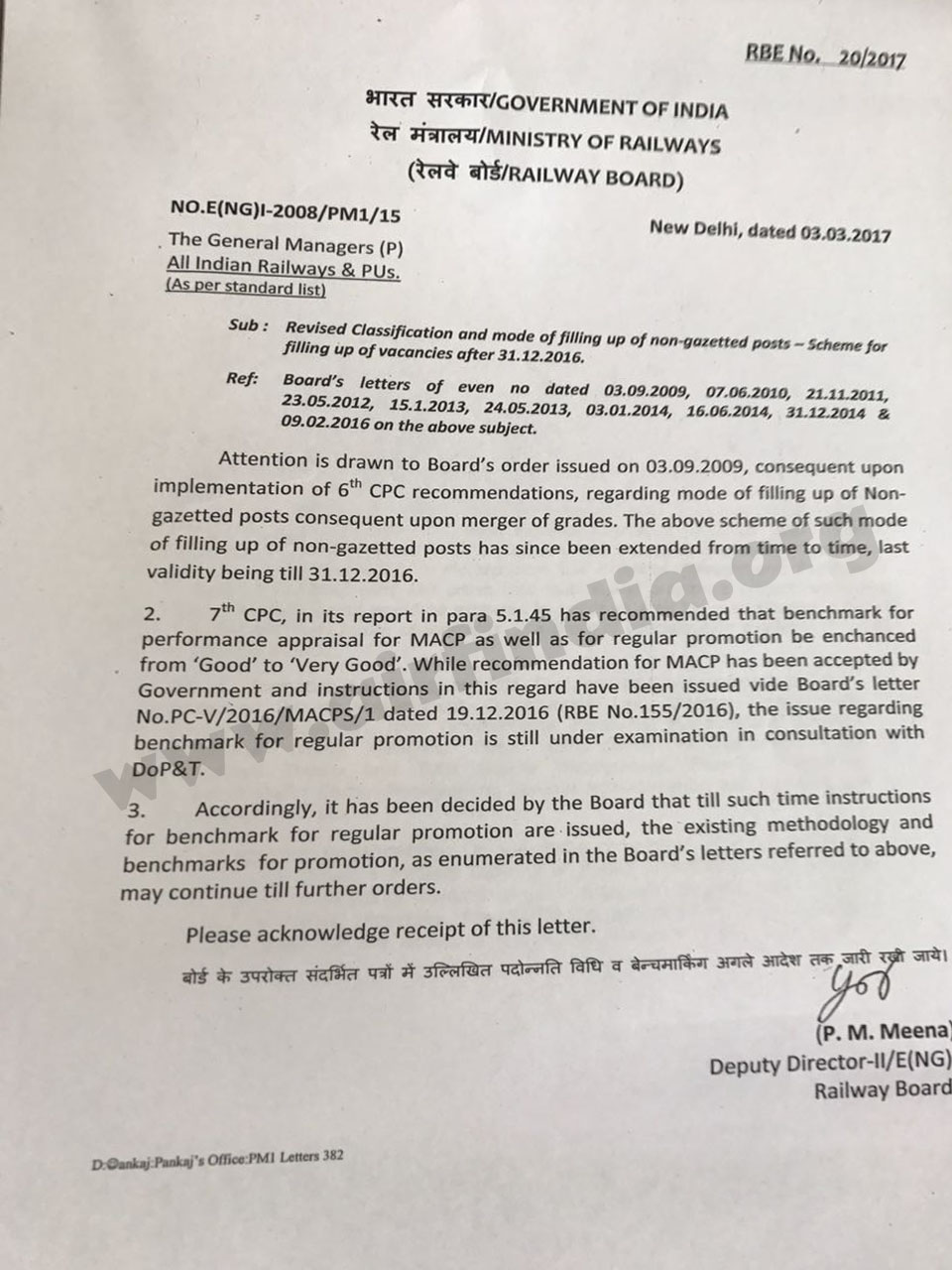
Revised classification and mode of filling up of non-gazetted posts
Performance appraisal for MACP
RBE No.20/2017
GOVERNMENT OF INDIA
MINISTRY OF RAILWAYS
RAILWAY BOARD
No.E(NG)I-2008/PM1/15
New Delhi, dated 03.03.2017
The General Managers (P)
All Indian Railways & PUs.
(As per standard list)
Sub: Revised classification and mode of filling up of non-gazetted posts – Scheme for filling up of vacancies after 31.12.2016.
Ref: Board’s letters of even no dated 03.09.2009, 07.06.2010, 21.11.2011, 23.05.2012, 15.1.2013, 24.05.2013, 03.01.2014, 16.06.2014, 31.12.2014 & 09.02.2016 on the above subject.
Attention is drawn to Board’s order issued on 03.09.2009, consequent upon implementation of 6th CPC recommendations, regarding mode of filling up of Non-gazetted posts consequent upon merger of grades. The above scheme of such mode of filling up of non-gazetted posts has since been extended from time to time, last validity being till 31.12.2016.
2. 7th CPC, in its report in para 5.1.45 has recommended that benchmark for performance appraisal for MACP as well as for regular promotion be enhanced from ‘Good” to ‘Very Good’. While recommendation for MACP has been accepted by Government and instructions in this regard have been issued vide Board’s letter No.PC-V/2016/MACPS /1 dated 19.12.2016 (RBE No.155/2016), the issue regarding benchmark for regular promotion is still examination in consultation with DoP&T.
3. Accordingly, it has been decided by the Board that till such time instructions for benchmark for regular promotion are issued, the existing methodology and benchmarks for Promotion, as enumerated in the Board’s letters referred to above, may continue till further orders.
GPF liberalization of provisions for withdrawals – Amendment Order
Amendment to the provisions of General Provident Fund (Central Service) Rules 1960 – liberalization of provisions for withdrawals from the Fund by the subscribers – regarding
No.3/2/2017-P&PW(F)(ii)
Ministry of Personnel, PG & Pensions
Department of Pension & Pensioners’ Welfare
Desk-F
3rd Floor, Lok Nayak Bhavan,
Khan Market, New Delhi-11 0003
Dated the 7th March, 2017.
OFFICE MEMORANDUM
Subject: Amendment to the provisions of General Provident Fund (Central Service) Rules 1960 – liberalization of provisions for withdrawals from the Fund by the subscribers – regarding.
The General Provident Fund (Central Service )Rules came into force in 1960 and Rule 15 of the said rules provide for withdrawals by the subscribers. Some amendments have been made from time to time to address the concerns raised by the subscribers. However, the provisions, largely remain restrictive. There is a felt need to liberalize provisions, raise limits and simplify the procedure.
2. The provisions in the rules have been reviewed and it has now been decided to permit withdrawals from the fund by the subscriber for the following purposes:
(i) Education – This will include primary, secondary and higher education, covering all streams and institutions,
(ii) Obligatory Expenses viz. betrothal, marriage, funerals, or other ceremonies of self or family members and dependants,
(iii) Illness of self, family members or dependants,
(iv) Purchase of consumer durables.
3. It has been decided to permit withdrawal of upto twelve months payor three-fourth of the amount standing at credit, whichever is less. For illness, the withdrawal may be allowed upto 90% of the amount standing at credit of the subscriber. A subscriber may seek withdrawal after completion of ten years of service.
(v) Housing including building or acquiring a suitable-house or a ready-built flat for his-residence,
(vi) Repayment of outstanding housing loan,
(vii) Purchase of house site for building a house,
(viii) Constructing a house on a site acquired,
(ix) Reconstructing or making additions on a house already acquired,
(x) Renovating, additions or alterations of ancestral house.
4. A subscriber may be allowed to withdraw upto ninety percent of the amount standing at credit for the above purposes. It is also decided do away with the present instructions which lay down that subsequent to the sale of house for which GPF withdrawal has been availed, the amount. withdrawn has to be deposited back. GPF withdrawal for housing purpose will no longer be linked with the limits prescribed under HBA rules. A subscriber may be permitted to avail the facility at any time during his service.
(xi) Purchase of motor car/motor cycle/ scooter etc. or repayment of loan already taken for the purpose,
(xii) Extensive repairs /overhauling of motor car,
(xiii)Making deposit to book a motor car/motor cycle/scoter, moped etc.
5. A subscriber may be permitted to withdraw three- fourth of the amount standing at credit or cost of the vehicle, whichever is less for the above purposes. Withdrawal for the above purpose will be permitted after completion of 10 years of service.
6. Presently, withdrawal of upto 90% of balance without assigning reasons is allowed for Government servants who are due for retirement on superannuation within a year. It is proposed that this may be allowed for upto two years before superannuation.
7. In all cases of withdrawal from the fund by the subscriber, the declared Head of Department is competent to sanction withdrawal. No documentary proof will be required to be furnished by the subscriber. A simple declaration form by the subscriber explaining the reasons for withdrawal would be sufficient.
8. As per the GPF(CS) Rule 1960, no time limit has been prescribed for sanction and payment of withdrawal amount. Therefore, it has been decided to prescribe a maximum time limit of fifteen days for sanction and payment of withdrawal from the Fund. In case of emergencies like illness etc., the time limit maybe restricted to seven days.
9. Necessary amendment to the GPF(Central Service)Rules 1960, giving effect to the above provisions will be issued in due course.
10. In so far as persons serving in Indian Audit and Accounts Department are concerned, these orders issue in consultation with the Comptroller and Auditor General of India.
11. This issues with approval of Department of Expenditure, vide their ID No. 4(1 )/EV/2017 dated 28.02.2017.
PFRDA clarification on transfer of amount from Recognized PF & Superannuation Fund to NPS
Clarification by Pension Fund Regulatory and Development Authority (PFRDA) on transfer of amount from Recognized Provident Fund & Superannuation Fund to National Pension Scheme (NPS)
In the budget of 2016-17, the Government had announced that the subscribers from recognised Provident Funds and Superannuation Funds would be able to transfer their corpus from these funds to National Pension System (NPS) without any tax implication.
With the NPS gaining momentum vis-à-vis other retirement products and a number of queries being raised on the transfer of amounts from recognised Provident/Superannuation Funds to NPS, Pension Fund Regulatory and Development Authority (PFRDA) has clarified the process through a circular dated 06.03.2017.
Accordingly, in case the subscriber is interested to get his/her recognised Provident Fund/Superannuation Fund transferred to NPS, he/she needs to follow the below mentioned process:
1. The subscriber should have an active NPS Tier I account which can be opened either through the employer (where NPS is implemented) or through the Points-of-Presence (POPs) or online through eNPS on the NPS Trust website www.npstrust.org.in
2. The subscriber presently under Government/Private Sector employment should approach the recognised Provident Fund/Superannuation Fund Trust through the current employer by giving request for transfer to his/her NPS account.
3. The Recognised Provident Fund/Superannuation Fund Trust may initiate transfer of the Fund as per the provisions of the Trust Deed read with the provisions of the Income Tax Act, 1961.
4. The Recognised Provident fund/Superannuation Fund may issue the cheque/draft in the name of:
a) In case of Government employee: Nodal Office Name (PAO or CDDO Name) <> Employee Name<> PRAN (12 Digit No.)
b) In case of subscriber presently under Private Sector including All Citizen Model: POP (Name of the POP) Collection Account-NPS Trust<>Subscriber Name<>PRAN (12 Digit No.)
5. In case of Government or Private Sector employee, the employee should request the recognised Provident Fund/Superannuation Fund to issue a letter to his present employer mentioning that the amount is being transferred from the recognised Provident Fund/Superannuation Fund to be credited in the NPS Tier I account of the employee which would be recorded by the present employer or POP as the case may be, while uploading the amount.
It may be noted here that as per the provisions of the Income Tax Act, 1961 the amount so transferred from recognised Provident Fund/Superannuation Fund to NPS is not treated as income of the current year and hence not taxable. Further, the transferred recognised Provident Fund / Superannuation Fund will not be treated as contribution of the current year by employee / employer and accordingly the subscriber would not make Income Tax claim of contribution for this transferred amount.
7th CPC Pay Matrix Anomaly – NFIR letter to Railway Board
No.IV/NFIR/7 CPC (Imp)/2016/R.B./part I
Dated: 06/03/2017
The Secretary (E),
Railway Board,
New Delhi
Dear Sir,
Sub: Implementation of 7th CPC Pay Matrics – Pay fixation to staff – Anomaly resulting less pay to senior in comparison with junior – reg.
Ref: Notification issued by the Railway Ministry vide RBE No.90/2016 – Rule 10(2) therof.
***********
NFIR desires to bring to the notice of the Railway Board, the anomalous situation arisen pursuant to sub-para (2) of Rule 10 of the Notification issued by the Railway Board vide RBE No.90/2016. A case on North Western Railway is cited below as example:-
Mr.X and Y have been working as SSE in the Loco Workshop, Ajmer in GP 4600/- (Level 7). Mr. X is senior to Mr. Y.
Both X & Y have been drawing pay equal to Rs.60,400/- on 1st July 2016. Both the employees are due for financial upgradation benefit under MACPS in the month of February 2017.
Mr.X has been given financial upgradation under MACPS and his pay when fixed in Level 8 comes to Rs.62,200/-. His next increment is due on 1st January 2018 when his pay will raise to 64,100/-.
Mr.Y has been denied financial upgradation due to ‘Good ACR’ for the year 2014. His pay on lst July 2017 will be Rs. 62,200/- in Level 7 which will be equal to Mr. Y’s pay as on 1st July 2017.
When Mr.Y becomes fit for financial upgradation under MACPS sometime between July and December 2017, then his pay will be 64,100/- in Level 8 which will be equal to the pay of Mr.X in January 2018. Subsequently, when Mr.Y will be given next increment in January 2019 ultimately Mr. X will lag behind by six months despite being senior.
The position mentioned above clearly reveals that senior has been put to loss by way of drop in emoluments. This needs to be remedied to do justice to senior employees.
NFIR, therefore, requests the Railway Board to examine the case in the light of above illustration and take necessary action for rendering justice to senior staff in whose case, the drop in emoluments has taken place. Federation may also be apprised of Board’s response early.
Yours faithfully,
sd/-
(Dr.M.Raghavaiah)
General Secretary
All India Services (Death-Cum-Retirement-Benefits) Amendment Rules, 2017
MINISTRY OF PERSONNEL, PUBLIC GRIEVANCES AND PENSIONS
(Department of Personnel and Training)
NOTIFICATION
New Delhi, the 27th February, 2017
G.S.R. 170(E).—In exercise of the powers conferred by sub-section (1) read with sub-section (IA) of section 3 of the All India Services Act, 1951 (61 of 1951), the central Government, after consultation with the Governments of the States concerned, herby makes the following rules, further to amend the All India Services (Death-Cum-RetirementBenefits) Rules, 1958, namely :-
1 (1) These rules may be called the All India Services (Death-Cum-Retirement-Benefits) Amendment Rules, 2017.
(2) They shall be deemed to have come into force from the date of their publication in the official Gazette.
2. In the All India Services (Death-Cum-Retirement-Benefits) Rules, 1958 in rule 16, after sub-rule (2A), the following sub-rules shall be inserted, namely :-
“(2B) (a) The notice of voluntary retirement given in writing by the member of the service under sub-rule (2) and (2A), may be withdrawn by the member of service.
(b) Request for withdrawal of notice of voluntary retirement shall be submitted to the Competent Authority within the period specified in the said notice.
(2C) Where a notice of voluntary retirement is given by a member of service under sub-rule (2) and the competent authority does not issue any order before the expiry of the period specified in the said notice, the voluntary retirement shall become effective from the date of expiry of the said period. Provided that, where no order is issued by the competent authority, then after the expiry of the period specified in the notice, the Central Government may issue orders.
(2D) For the purpose of this rule the expression ‘competent authority’ shall mean the authority which is empowered to accept notice of voluntary retirement under sub-rules (2) and (2A).”.
[F. No. 24012/04/2016.AIS-II(Pension)]
KAVITHA V. PADMANABHAN, Dy. Secy. (S&V)