Missing entries in GPF accumulation of subscriber: DOPPW O.M 18.08.2022
No. 3/7/2020-P&PW (F)/6728 Government of India Ministry of Personnel, P.G. & Pensions Department of Pension & Pensionโ Welfare (Desk-F)
3rd Floor, Lok Nayak Bhawan, Khan Market, New Delhi,
Dated: 18.08.2022
OFFICE MEMORANDUM
Subject: โ Missing entries in GPF accumulation of subscriber regarding.
The undersigned is directed to say that this Department has been receiving representations/grievances from retired government servants for inaccurate and delayed GPF settlement alongwith interest, on their retirement, due to frequent instances of missing credits in their GPF accounts. The missing credits in GPF were reported mostly by subscribers, who during their service moved from one establishment to another or were assigned foreign deputation and also by officers of All India Services, who proceeded on deputation outside their cadres. Therefore, this Department vide OM of even number dated 17.07.2020 issued instructions in respect of GPF accounts for greater transparency and also to avoid missing entries in GPF accumulation, etc. A copy of the OM dated 17.07.2020 is attached.
2. In this connection, the instructions issued in this Departmentโs OM dated 17.07.2020 are reiterated and all Ministries/Departments and their Attached and Subordinate Offices are requested to bring these instructions to the notice of all concerned for strict compliance.
3. This issues with the approval of competent authority in the Department.
1. All Ministries/Departments, Government of India 2. Controller & Accountant General of India 3. Controller General of Accounts 4. All Accountant General (State) 5. NIC, DoP&PW: for uploading on website of this Department.
Grant of 60 days Special Maternity Leave in case of death of a child soon after birth/stillbirth
No.13018/1/2021-Estt.(L) Government of India Ministry of Personnel, Public Grievances & Pensions Department of Personnel and Training (Estt.-Leave Section)
Old JNU Campus, New Delhi Dated the 2nd September, 2022
OFFICE MEMORANDUM
Subject: Grant of 60 days Special Maternity Leave in case of death of a child soon after birth / stillbirth โ regarding.
This Department has been receiving several references/ queries requesting for clarification pertaining to grant of leave / maternity leave in case of death of a child soon after birth/Stillbirth. The matter has been considered in consultation with Ministry of Health and Family Welfare. Keeping in view the potential emotional trauma caused due to stillbirth or death of a child soon after birth, which has a far-reaching impact on the motherโs life, it has now been decided to grant a Special Maternity Leave of 60 days to a female Central Government servant in case of death of a child soon after birth / stillbirth on the following conditions;
(i) In case a Maternity Leave has already been availed by a female Central Government servant and her leave continues till the date of expiry of child soon after birth / stillbirth, the maternity leave already availed till death of the child may be converted into any other kind of leave available in her leave account without insisting for a medical certificate and a Special Maternity Leave of 60 days may be granted from the date of expiry of child soon after birth / Stillbirth.
(ii) In case the maternity leave has not been availed by a female Central Government servant, 60 days of Special Maternity Leave may be granted from the date of expiry of child soon after birth / stillbirth.
(iii) The condition for death of a child soon after birth may be defined as up to 28 days after birth.
(iv) A baby born with no signs of life at or after 28 weeks of gestation may be defined as Stillbirth.
(v) The benefit of Special Maternity Leave shall be admissible only to a female Central Government servant with less than 2 surviving children and for child delivery only in an authorized hospital.
(vi) โAuthorized Hospitalโ is defined as Government Hospital or Private Hospital empanelled under Central Government Health Scheme (CGHS). In case of emergency delivery in non-empanelled private hospital, production of emergency certificate is mandatory.
3. These orders shall be applicable to Government employees appointed to the civil services and posts in connection with the affairs of the Union of India in terms of Rule 2 of the CCS (Leave) Rules 1972 with effect from the date of issue of this O.M. The past cases, wherever settled in respective Ministries / Departments need not be reopened.
(Sunil Kumar) Under Secretary to the Government of India
To
All the Ministries/ Departments of Government of India
PMO/Cabinet Secretariat
PS to MoS(PP)
PSO to Secretary (Personnel)
Sr.Technical Director, NIC, DoPT โ with a request for uploading on the website of this Department.
No. A-27018/02/2022-Estt.(AL) Government of India Ministry of Personnel, PG & Pensions Department of Personnel & Training ***
Old JNU Campus, New Delhi Dated 02.09.2022
OFFICE MEMORANDUM
Subject: Consolidated instructions on Risk Allowance to Central Government employees.
Consequent upon the decision taken by the Government on the recommendations made by the 7th Central Pay Commission on the subject of Risk Allowance and with the approval of D/o Expenditure, the rates of Risk Allowance were revised vide this Department O.M. No.- A-27018/01/2017-Estt.(AL) dated 03.11.2020. Risk Allowance with revised rates has been payable from the date of issue of above mentioned OM with all other conditions envisaged in the OM No. 21012/4/88-Allowances dated 22.08.1988. However, for the purpose of ease of access, it has been decided to issue consolidated instructions on the subject of Risk Allowance to Central Government employees.
2. Risk Allowance is presently given to Central Government employees engaged in hazardous duties or whose work will have a deleterious effect on health over a period of time.
i. For determining the categories of staff exposed to risk in employment the following criteria may be adopted:-
those engaged in duties involving greater hazards or whose health is liable to be adversely affected progressively over a long period of time because of the particular avocation, and
Sweepers/Safaiwalas engaged in cleaning of underground drains, sewer lines, those working in trenching grounds and Infectious Diseases Hospitals.
ii. The existing categories of Government servants who are in receipt of Risk Allowances may continue to get the same, at revised rates (w.e.f. 03.11.2020) as under:-
Sl.No.
Categories of employees
Revised Rates in Rupees per Month
1
Unskilled workers
90
2
Semi-skilled workers
135
3
Skilled workers
180
4
Supervisors
225
5
Non-gazetted officers engaged in Nitro Glycerine preparation
405
6
Gazetted officers engaged in Nitro Glycerine
675
7
Danger Building Officers
900
iii. Where a category of Government servants in a Department is in receipt of Risk Allowance, similar categories of Government servants in other Ministries/ Departments shall also be considered for grant of Risk Allowance under similar conditions, e.g. Safaiwalas/Sanitary Cleaners working in underground drains, sewer lines, infectious diseases hospitals etc.
iv. The Risk Allowance will not be treated as โPayโ for any purpose.
3. Proposal for inclusion of any new category fulfilling the criteria as indicated above may be processed by the concerned Ministries in consultation with their Associate Finance and the Department of Personnel & Training. Further in identifying such categories, Staff Side of the Departmental Council (JCM) may also be consulted.
4. It has also been decided that Ministries/Departments may work out suitable welfare schemes for periodical medical check-up of the staff exposed to risk in their job to ensure their good health.
(Sunil Kumar) Under Secretary to the Government of India
Entitlement of leave, Leave Encashment, Study Leave, Paternity Leave, Child Care Leave: FAQs CCS Leave Rules, 1972
ย
Updated on 30.08.2018
This is in supersession of FAQs No. 21011/08/2013-Estt(AL)&No.I-11020/1/2014-ย Estl(AL)ย uploadedย in DOPTโs website on 25.03.2013 & 28.04.2015 in respect of theย CCS (Leave) Rules 1972.
Establishmentย (Leave)ย Section,ย DoPT
General entitlement of leave
Sl. No.
Frequently Asked Question
Answer
1.
What is the maximum period of leave of any kind which can be allowed to a Government servant? What is the impact if such limit is exceeded?
No Government servant shall be granted leave of any kind for a continuous period of 5 years {Rule 12(1)). Normally, absence from duty, with or without leave, for a continuous period exceeding 5 years other than on foreign service, implies that such Government servant has deemed to have resigned from Government service. {Rule 12(2))
2.
What are the leave entitlements of Govt. servants serving in a vacation Department?
Rule 28 of the CCS (Leave) Rules, 1972, regulates the grant of Earned Leave for persons serving in the Vacation Department. Vide Notification dated 11.12.2018, which came into force w.e.f. 14.12.2018, amendments have been made under Rule 28 & 29. The said rules provide for as follows.
โ(a) The leave account of every Government servant (other than a military officer) who is serving in a Vacation Department shall be credited with earned leave, in advance in two installments of five days each on the first day of January and July of every calendar year.
(b) In respect of any year in which a Government Servant avails a portion of the vacation, he shall be entitled to additional earned leave in such proportion of twenty days, as the number of days of vacation not taken bears to the full vacation, provided the total earned leave credited shall not exceed thirty days in a calendar year.
(c) If, in any year, the Government servant does not avail any vacation, earned leave will be as per Rule 26instead of clauses (a) and (b).โ;
For the purpose of this rule, the term `yearโ shall be construed not as meaning a calendar year in which duty is performed but as meaning twelve months of actual duty in a Vacation Department.
A Government servant entitled to vacation shall be considered to have availed himself of a vacation or a portion of a vacation unless he has been required by general or special order of a higher authority to forgo such vacation or portion of a vacation: Provided that if he has been prevented by such order from enjoying more than fifteen days of the vacation, he shall be considered to have availed himself of no portion of the vacation.
When a Government servant serving in a Vacation Department proceeds on leave before completing a full year of duty, the earned leave admissible to him shall be calculated not with reference to the vacations which fall during the period of actual duty rendered before proceeding on leave but with reference to the vacation that falls during the year commencing from the date on which he completed the previous year of duty.
As per Rule 29(1) The half pay leave account of every Government servant (other than a military officer and a Government servant serving in a Vacation Department) shall be credited with half pay leave in advance, in two installments of ten days each on the first day of January and July of every calendar year.
Leave Encashment with LTC
3.
Whether encashment of leave is allowed after LTC is availed?
Sanction of leave encashment should, as a practice, be done in advance, at the time of sanctioning the LTC. However, ex-post facto sanction of leave encashment on LTC may be considered by the sanctioning authority as an exception in deserving cases within the time limit prescribed for submission of claims for LTC.
4.
What is the limit of leave encashment while availing LTC by Government servant, dependents or spouse within the same block year?
The Government servants governed by the CSS (Leave) Rules, 1972 and entitled to avail LTC may encash earned leave up to 10 days at the time of availing both types of LTCs., i.e., `Hometownโ and `Anywhere in Indiaโ. However, when the one and the same LTC is being availed of by the Government Servant and his family members separately in a block year, encashment of leave would be restricted to one occasion only.
5.
Whether leave encashment should be revised on retrospective revision of pay/D.A?
In terms of 38-A of CCS(Leave) Rules, encashment of EL alongwith LTC is to be calculated on pay admissible on the date of availing LTC and DA admissible on that date. If pay or DA admissible has been revised with retrospective effect, going by the rule the Govt. servant would be entitled to encashment of Leave on the revised rates.
Whether earned leave encashment allowed by the State Governments, PSUs, Autonomous Bodies to Govt. servant prior to his joining the Central Govt. is to be taken into account while calculating ceiling of leave encashment on his superannuation and retirement from Central Govt.?
Encashment of EL allowed by the State Governments, Public Sector Undertakings/Autonomous Bodies for services rendered therein need not be taken into account for calculating the ceiling of 300 days of Earned leave to be encashed as per CCS (Leave) Rules.
7.
Whether cash equivalent of leave salary in case of permanent absorption in PSU/Autonomous Body is permissible?
A Government servant who has been permitted to be absorbed in a Corporation/Company wholly or substantially owned or controlled by Central/State Government shall be suo motu granted cash equivalent of leave salary of earned leave at his credit on the date of absorption subject to a maximum of 300 days (being calculated as per provisions of rule 39) {Rule 39-D) Permanent absorption under the rule shall mean such appointment for which the Government servant applied through proper channel and resigned from Government service for taking up of such appointment โ {Note below rule 39-D โ Notification No. 13026/3/2011-Estt.(L) dated 28-03-2012 )
Leave Encashment on Suspension/Dismissal/Removal
8.
Whether leave encashment can be sanctioned to a Govt. servant on his superannuation while under suspension?
Leave encashment may be allowed in such cases. However, Rule 39(3) of CCS (Leave) Rules, 1972 allows withholding of leave encashment in the case of a Govt. servant who retires from service on attaining the age of superannuation while under suspension or while disciplinary or criminal proceedings are pending against him, if in view of the authority there is a possibility of some money becoming recoverable from him on conclusion of the proceedings against him. On conclusion of the proceedings he/she will become eligible to the amount so withheld after adjustment of Government dues, if any.
9.
Whether leave encashment can be sanctioned to a Govt. servant on his dismissal/removal, from service?
A government servant, who is dismissed / removed from service, ceases to have any claim to leave at his credit from the date of such dismissal, as per rule 9(1). Hence he is not entitled to any leave encashment.
Interestย onย Leave Encashment
10.
Whether interest is payable on delayed payment of leave encashment dues?
No. There is no provision in the CCS (Leave) Rules 1972 for payment of interest on leave encashment.
Studyย Leave
11.
What is the maximum amount of study leave which can be availed?
The maximum amount of study leave for other than CHS officers is restricted to twenty four months during the entire service period and ordinarily it can be allowed for upto twelve months at a time. (Rule 51(1)}. For CHS officers the ceiling is for 36 months for acquiring PG qualifications. (Rule 51(2)}.
12.
Whether study leave can be clubbed with other leave?
Yes. Study leave may be combined with other kinds of leave, but in no case shall be grant of this leave in combination with leave, other than extraordinary leave involve a total absence of more than twenty-eight months generally and thirty-six months for the courses leading to PhD. degree from the regular duties of the Government servant. (Rule 54)
13.
What is the validity period of bond to be executed by the Government servant while proceeding on study leave?
Government servant is required to execute a bond to serve the Government for a period of three years after expiry of study leave. For CHS officers the period is five years. {Rule 50(5)(iii)}.
14.
Whether a Govt. servant who has been granted study leave may be allowed to resign to take up a post in other Ministries/ Department of the Central Govt. within the bond period?
As per rule 50(5) (iii), a Govt. servant has to submit a bond to serve the Govt. for a period of 3 years. As the Govt. servant would still be serving Government in a Department other than parent Department, he may be allowed to submit his resignation to take up another post within the Central Govt. if he had applied for the post through proper channel.
Paternityย Leave for Child Adoption/Child Adoption Leave
15.
How is a child defined for the purpose of grant of Paternity Leave for Child Adoption/Child Adoption Leave
As per notes below rules 43AA and 43B โChildโ for the purpose will include a child taken as ward by the Government servant, under the Guardians and Wards Act, 1890 or the personal law applicable to that Government servant, provided such a ward lives with the Government servant and is treated as a member of the family and provided such Government servant has, through a special will, conferred upon that ward the same status as that of a natural born childโ.
Childย Careย Leave
16.
Whether women employees of Public Sector undertakings/ Bodies etc. are entitled to CCL?
Orders issued by DOPT are notย suo motuย applicable to the employees of Central Public Sector Undertakings/ Autonomous Bodies, Banks, etc. It is for the PSUs/ Autonomous Bodies to decide the applicability of the rules/instructions issued for the central Government employees to their employees in consultation with their Administrative Ministries.
17.
Whether Govt. servant can be permitted to leave station/go abroad while on CCL?
Child care leave is granted to a woman employee to take care of the needs of the minor children. If the child is studying abroad or the Government servant has to go abroad for taking care of the child she may do so subject to other conditions laid down for this purpose.
18.
What is the intention behind the instruction that CCL is to be treated like EL and sanctioned as such?
The intention is that CCL should be availed with prior approval of leave sanctioning authority and that the combination of CCL with other leave, if any, should be as per the restriction on EL. โ The restriction of the limit of 180 days at a stretch as applicable in the case of EL will not apply in case of CCL.
19.
What are the prevailing provisions of CCL under CCS (Leave) Rules, 1972
ย
( Rule 43-C).
โ(1) Subject to the provisions of this rule, a female Government servant and single male Government servant may be granted child care leave by an authority competent to grant leave for a maximum period of seven hundred and thirty days during entire service for taking care of two eldest surviving children, whether for rearing or for looking after any of their needs, such as education, sickness and the like.โ;
โ(3) Grant of child care leave to a female Government servant and a single male Government servant under sub- rule (1) shall be subject to the following conditions, namely: โ
(i) it shall not be granted for more than three spells in a calendar year;
(ii) in case of a single female Government servant, the grant of leave in three spells in a calendar year shall be extended to six spells in a calendar year.
(iii) it shall not ordinarily be granted during the probation period except in case of certain extreme situations where the leave sanctioning authority is satisfied about the need of child care leave to the probationer, provided that the period for which such leave is sanctioned is minimal.
(iv) child care leave may not be granted for a period less than five days at a time.
(4) During the period of child care leave, a female Government servant and a single male Government servant shall be paid one hundred percent of the salary for the first three hundred and sixty-five days, andย at eighty percent of the salary for the next three hundred and sixty-five days.
Explanation.ย โSingle Male Government Servantโ means โ an unmarried or widower or divorcee Government servant.โ;
Setting up of Search Committees/Search-cum-Selection Committees
No.AB.14017/24/2022-Estt.(RR) Government of India Ministry of Personnel, Public Grievances and Pensions, Department of Personnel and Training
Dated the 31st August, 2022
OFFICE MEMORANDUM
Subject: Setting up of Search Committees/Search-cum-Selection Committees โ regarding
The undersigned is directed to say that this Departmentโs OM NO. AB- 14017/11/2004-Estt.(RR) dated 30.7.2007, containing consolidated instructions on constitution of Search-cum-Selection Committees containing the circumstances under which such Committees are to be constituted and the guidelines to be adopted while constituting these Committees and subsequent OMs issued on the said subject, details of which are given in Appendix to this O.M., have been reviewed and it has been decided to issue a comprehensive Office Memorandum containing the principles and guidelines to be followed by all concerned while setting up Search Committees and Search-cum-Selection Committees (for posts in autonomous organizations)
2. Accordingly, in supersession of all the OMs mentioned in the Appendix, consolidated and revised instructions on constitution of Search Committees and Search-cum-Selection Committees is attached as Annexure to this Office Memorandum.
3. All Ministries/ Departments are requested to bring the above guidelines to the notice of all concerned.
4. Hindi version will follow.
(A Bhattacharya) Deputy Secretary to Govt. of India
Annexure to No. AB-14017/24/2022-Estt.(RR) dated 31.8.2022
Constitution of Search Committees and Search-cum-Selection Committees in respect of posts, other than those which are governed by separate instructions issued by Office of Establishment Officer, Department of Personnel and Training.
The following instructions contain the principles to be kept in view, while setting up Search Committees/Search-cum-Selection Committees, including posts in autonomous and statutory bodies, other than those which are under the purview of Appointments Committee of the Cabinet (ACC) and for which separate instructions have been issued by the Office of Establishment Officer, Department of Personnel and Training.
2. Search Committees for posts in Central Government
In accordance with the guidelines of this Department, immediately after a post is created, the Recruitment Rules for the same should be framed, if the post is likely to continue for one year or more. Action to fill up the post, as per the provisions in the Recruitment Rules, has to be initiated as the procedure of Search Committee cannot be a substitute for the normal recruitment process.
2.1 Situations in which Search Committees may be constituted for posts under the Central Government and their composition.
The post involved should not fall under the purview of the UPSC.
Since, as a rule, appointments in the Central Government are to be made on the basis of open advertisement, this requirement has to be followed without fail, and it is only in situations where advertisement may not result in adequate response, that a Search Committee should normally be appointed.
Constitution of Search Committees cannot be a substitute for advertisement of posts and their role is only to supplement the recruitment effort through advertisements.
Search Committees should be constituted only for sufficiently senior posts i.e. posts in Level-13 and above, which require specialized scientific/technical knowledge and experience.
The composition of the Search Committee needs to be approved by the Department of Personnel and Training in each case, if the post proposed to be filled by this procedure is in Pay Level โ 14 and above.
The Committee should be chaired by the Secretary of the Ministry/Department concerned. Where it is constituted for a Secretary-level post, a senior and distinguished academician may be invited to chair the Committee. However, wherever retired Secretaries to Govt. of India are eligible to apply for the post, Cabinet Secretary shall be the Chairperson of Search Committee/Search-cum Selection Committee.
The Committee should normally consist of not more than 5 members including the Chairman.
Where serving officers of Government, Autonomous Bodies, PSEs etc. are nominated as Members, they should be at least one level above the post to which appointment is being made.
No person who is a recipient of grants/funding from the Ministry concerned or who is closely related to a recipient should be proposed as a Member of the Committee.
The composition of the Committee should be well-balanced. At least one Expert Member should be nominated having acknowledged expertise in the field of specialization relevant to the post for which the Committee is being constituted.
At least half the number of Members should be from outside the Ministry/Department, which administers the post.
The tendency, repeatedly to rely on the same experts for several recruitments over long periods of time, is to be avoided. It is necessary to infuse fresh blood in such Committees in order to ensure that they identify the right candidate for the post.
In some cases, the Recruitment or Statutory Rules themselves prescribe com position of Search Committee/Search-cum Selection Committee. It should be ensured that each time the Committee is to be constituted, it should strictly comply with the composition provided in the Rules. Wherever it is necessary, amendments to the Rules may be carried out to ensure that the composition of the Committee is in conformity with these instructions.
2.2 Other Conditions
A minimum period of at least four weeks may be given to the candidates to apply in response to the circular/advertisement for appointment to such posts.
The Search Committees/Search-cum-Selection Committees should preferably recommend a panel of names, in the order of merit, unless only a single candidate has been found suitable for the post.
The panel recommended by the Committee will remain valid for one year. The panel recommended by the Committee will have to be accepted in toto by the Ministry/Department. Any deviation in such matters will require the prior approval of ACC.
If no selection is made from the panel within the period of one year, the Committee shall be constituted afresh to recommend a fresh panel. Such a Committee may also consider the names of persons recommended in the earlier panel.
Where the post falls under the purview of ACC, scrapping of the panel would require prior approval of ACC.
Where the composition of the Search Committee is to be approved by the Department of Personnel and Training, Ministries/Departments are to submit their proposal for constitution of the Committee through an e-mail to the Director/Deputy Secretary/Under Secretary, Department of Personnel and Training dealing with the subject of Search Committee/ Search-cum-Selection Committee.
The proposal should be accompanied by a duly filled in Check-list (as per format in para 6), copy of the Statutory/Recruitment Rules containing composition of the Committee or mode of appointment, brief Profile of the Expert Member(s), previous approval of Department of Personnel and Training to the Committee for the said post etc.
3. Search-cum-Selection Committees for posts in autonomous/statutory bodies etc.
3.1 Situations in which Search-cum-Selection Committees may be constituted for posts under statutory/autonomous bodies and their composition.
Each Ministry/Department shall constitute a Search-cum-Select ion Committee, with the concurrence of the Department of Personnel and Training, for (a) post of Chief Executive irrespective of the Pay Level and (b) posts below Chief Executive in Pay Level โ 14 and above.
The post involved should not fall under the purview of the UPSC.
Constitution of the Committee cannot be a substitute for advertisement of posts and therefore such posts have to be advertised and the Committee would only supplement the recruitment effort through advertisements.
The Committee should preferably be chaired by the Secretary of the administrative Ministry/Department concerned. In case, it is not found feasible, Chairperson of the Committee should be a distinguished person of sufficiently high standing commensurate with the level of the post for which selection is to be recommended by the Committee. For posts in Level- 14, the Chairperson of the Committee should preferably be an officer from the administrative Ministry/Department in Pay Level-15 or above (eg. Additional Secretary /Special Secretary).
Wherever retired Secretaries to Govt. of India are eligible to apply for the post, Cabinet Secretary shall be the Chairperson of Search-cum Selection Committee.
The Committee should normally consist of not more than five members including the Chairman.
The composition of the Committee should be well-balanced. At least one Expert Member, preferably two Expert Members, should be nominated having acknowledged expertise in the field of specialization relevant to the post for which the Committee is being constituted.
At least half the number of Members should be from outside the Ministry/Department, which administers the post, including organisations under the administrative control of the Ministry/ Department.
Where serving officers of Central Government, PSEs, Statutory /Autonomous Bodies, Research Institution, University etc. are nominated as Members, they should be at least one level above the post to which appointment is being made.
Where an officer retired from the Central Government, PSE, Statutory/Autonomous Body, Research Institution, University etc. is nominated as a Member, the Pay Level from which retired would not be relevant. However, such a retired official may be included only as an Expert Member, provided he/she has acknowledged expertise in the field of specialization relevant to the post for which selection is to be made.
No person who is a recipient of grants/ funding from the Ministry/Department concerned or who is closely related to a recipient should be proposed as a Member of the Committee.
The tendency, repeatedly to rely on the same experts for several recruitments over long periods of time, is to be avoided. It is necessary to infuse fresh blood in such Committees in order to ensure that they identify the right candidate for the post.
In some cases, the Recruitment or Statutory Rules themselves prescribe composition of Search Committee/Search-cum Selection Committee. It should be ensured that each time the Committee is to be constituted, it should strictly comply with the composition provided in the Rules. Where the composition is not provided in the Statutory Rules or Recruitment Rules/Regulations for the post involved, amendments to the Rules may be carried out by the administrative Ministry/Department to ensure that the composition of the Committee is provided in the Rules itself.
All appointments, which are covered by specific statutes, are to be carried out on the basis of the statutory provisions. Wherever the statutes provide for appointment to a post with the approval of the Central Government, the appointment to the post of Chief Executives in Pay Level โ 14 and above, will be within the purview of ACC and the Search-cum-Selection Committee mechanism envisaged in these instructions will apply.
Extension in tenure of persons other than the Chief Executives shall also be considered by the Search-cum-Selection Committee and its recommendations shall be accepted by the Ministry/Department. Any proposal to reject the recommendations will require the approval of the ACC. Authority for approval of extension in tenure of Chief Executives will rest with the ACC.
3.2 Other Conditions
A minimum period of at least four weeks may be given to the candidates to apply in response to the circular/advertisement for appointment to such posts. The vacancy shall be given wide publicity through open advertisement, publication in leading newspapers/ periodicals, circulation among various Ministries/ Departments/State Governments/Autonomous Bodies/Research Institutes etc., as also made available on the website of the Ministry/Department.
The Search-cum-Selection Committee should preferably recommend a panel of names, in the order of merit, unless only a single candidate has been found suitable for the post.
The panel recommended by the Committee will remain valid for one year. The panel recommended by the Committee will have to be accepted in toto by the Ministry/Department. Any deviation in such matters will require the prior approval of ACC.
If no selection is made from the panel within the period of one year, the Committee shall be constituted afresh to recommend a fresh panel. Such a Committee may also consider the names of persons recommended in the earlier panel.
Where the post falls under the purview of ACC, scrapping of the panel would require prior approval of ACC.
Where the composition of the Search-cum-Selection Committee is to be approved by the Department of Personnel and Training, Ministries/Departments are to sยทubmit their proposal for constitution of the Committee through an e-mail to the Director/Deputy Secretary/Under Secretary, Department of Personnel and Training dealing with the subject of Search Committee/Search-cum-Selection Committee.
The proposal should be accompanied by a duly filled in Check-list (as per format in para 6), copy of the Statutory/Recruitment Rules containing composition of the Committee or mode of appointment, brief Profile of the Expert Member(s), previous approval of Department of Personnel and Training to the Committee for the said post etc.
4. All autonomous institutions, which are not set up under their own statutes, shall modify their Memoranda and Articles of Association, Bye-laws etc. in order to incorporate fully these guidelines. The institutions shall report compliance to the Department of Personnel and Training through the administrative Ministry/Department along with copies of their revised Memoranda/Articles of Association, Bye-laws etc. These institutions, thereafter, shall not be required to take approval of Department of Personnel and Training each time for the Search-cum-Selection Committee constituted by them. The institutions shall, however, send a copy of the Search-cum-Selection Committees constituted by them to the Department of Personnel and Training.
5. Vide GSR 109(E) dated 12.2.2020, Department of Revenue has notified the Tribunal, Appellate Tribunal and other Authorities [Qualifications, Experience and other Conditions of Service of Members] Rules, 2020. Schedule to these Rules contain the specific composition of Search-cum-Selection Committee for posts of Chairman, President, Presiding Officer, Vice-Chairperson, Vice-President, and Members (eg. Judicial, Administrative etc.) of 19 Tribunals mentioned therein. Prior approval of Department of Personnel and Training would not be required to be obtained for constitution of Search-cum-Selection Committee, for the posts in these 19 Tribunals mentioned in the Schedule to the aforesaid Rules.
6. Format of Check-list to accompany the proposal for constitution of ScSC:
1.
Whether the post for which the Search-cum- Selection Committee is being constituted is outside of the purview of UPSC.
Yes/No
2.
Whether the post is in Pay Level โ 14 [Pay Band- 4, Rs. 37400-67000/- with Grade Pay of Rs. 10000/-] and above.
Yes/No[indicate the Pay Level of the Post]
3.
Whether the Committee consists of not more than 5 members including the Chairperson.
Yes/No
4.
Whether the Composition has the approval of Minister-in-Charge of the Administrative Ministry/ Department
Yes/No
5.
Whether at least half the number of Members are from outside the Ministry/ Department, including organizations under the administrative control of the Ministry/Department
Yes/No[If no, give reasons]
6.
The Members nominated to the Search-cum- Selection Committee, who are serving in Central Government, PSEs, Statutory/Autonomous Bodies, Research Institution, University etc. are at least one level above the post for which the Committee is being constituted
Yes/No[indicate the Pay Level of Chairperson/Members]
7.
The Member(s) included as Expert Member has acknowledged expertise in the field of specialization relevant to the post for which Committee is being constituted
Yes/No
8.
Brief Profile of the Expert Member(s) who is/are being nominated to the Committee
[to be enclosedJ
9.
Statutory/Recruitment Rules governing appointment to the post
[copy to be enclosed]
APPENDIX TO O.M. NO. AB-14017/24/2022-Estt. (RR) DATED 31.8.2022
Sl.No.
Office Memorandum No. and date
Brief Subject
1.
AB .14017/11/2004-Estt. (RR) dated 30.7.2007
Setting up of Search Committees/Search-cum- Selection Committees
2.
AB.14017/11/2004-Estt. (RR) dated 25.5.2009
Setting up of Searchย Committees/Search-cum- Selectionยท Committees
3.
AB.14017/11/2004-Estt.(RR) dated 17.7.2012
Setting up of Search Committees/Search-cum- Selection Committees
4.
AB.14017/11/2004-Estt.(RR) dated 21.10.2015
Setting up of Search Committees/Search-cum- Selection Committees
5.
AB.14017/11/2004-Estt.(RR) dated 6.4.2016
Setting up of Search Committees/Search-cum- Selection Committees
6.
AB .14017/5/2020-Estt. (RR) dated 15.5.2020
Setting up of Search Committees/Search-cum- Selection Committees
DOPT instructions on booking of Air Tickets on Government Account for LTC
F. No. 31011/12/2022-Estt.A-IV Government of India Ministry of Personnel, Public Grievances & Pensions Department of Personnel & Training Establishment A-IV Desk
North Block, New Delhi. Dated 29th August, 2022
OFFICE MEMORANDUM
Subject: Instructions on booking of Air Tickets on Government Account in respect of Leave Travel Concession (LTC) โ regarding.
The undersigned is directed to refer to the above mentioned subject and to state that in view of the disinvestment of Air India and the consolidated instructions issued consequently by Department of Expenditure vide O.M. No. 19024/03/2021-E.IV dated 16.06.2022, which is also applicable in case of air journey in respect of LTC, it has been decided that:
i. In all cases of air travel in respect of LTC, air tickets shall be purchased only from the three Authorized Travel Agents (ATAs), namely:
(a) M/s Balmer Lawrie & Company Limited (BLCL), (b) M/s Ashok Travels & Tours (ATT), (c) Indian Railways Catering and Tourism Corporation Ltd. (IRCTC).
ii. The choice of the travel agent for booking of ticket from the three authorized travel agents is left open to the Ministry/Department and the official in case of self booking, based on convenience and service quality. No agency charges/convenience fees will be paid to these ATAs.
iii. Government employees are to choose flight having the Best Available Fare on their entitled travel class which is the Cheapest Fare available, preferably for Non-stop flight in a given slot, mentioned below, at the time of booking. They are to retain the print-out of the concerned webpage of the ATAs having flight and fare details for the purpose of the settlement of the LTC claims.
(a) On the day of travel in the desired 3 hoursโ slot of following time band โ 00:00 hours to 03:00 hours, 03:00 hours to 06:00 hours, 06:00 hours to 09:00 hours, 09:00 hours to 12:00 hours, 12:00 hours to 15:00 hours, 15:00 hours to 18:00 hours, 18:00 hours to 21:00 hours, 21:00 hours to 24:00 hours.
(b) With provision of optimizing within a 10% price band, for convenience and comfort.
iv. Employees are encouraged to book flight tickets at least 21 days prior to the intended date of travel on LTC, to avail the most competitive fares and minimize burden on the exchequer.
v. Employees are also encouraged to avoid unnecessary cancellations. Cancellations made less than 24 hours before intended travel on LTC, will require the submission of a self-declared justification by the employee. All the three ATAs have been directed to provide zero/nil cancellation charges. Till then, cancellation charges are to be reimbursed for all cases where cancellation was due to the circumstances/reasons beyond the control of Government employee.
vi. Employees should preferably book only one ticket for each leg of intended travel on LTC. Holding of more than one ticket is not allowed.
vii. While tickets may be arranged by the office through the travel agent, employees are encouraged to make ticket booking digitally through the Self Booking Tool/online booking website/portal of these 3 ATAs only. Employees must register their official Government Email-Id with these three agencies to book their air tickets digitally through above modes for travel by any airlines.
viii. In case of unavoidable circumstances, where the booking of ticket is done from unauthorized travel agent/website, the Financial Advisors of the Ministry /Department and Head of Department not below the rank of Joint Secretary in subordinate/attached offices are authorized to grant relaxation.
ix. No Mileage Points will be generated against travel on Government account.
Provisions for Advances
(i) Government employees entitled for air travel, may apply for LTC advance with the print-out of the concerned webpage of authorized travel agency having suitable flight and fare details while tracking the fare of the flight under the three hour time slot, as mentioned at Para l{iii)(a) above, at least 30 days prior to the intended date of journey.
(ii) Government employees not entitled for air travel and wish to travel by air but not under the Special Dispensation Scheme, may apply for LTC advance with reference to Rail/Bus fare.
(iii) Those Government employees who are not entitled for air travel but who wish to travel by air under the Special Dispensation Scheme, may apply for LTC advance with reference to Rail/Bus fare from their Headquarters/place of posting up to Kolkata/Guwahati/ Chennai/Visakhapatnam/Delhi/Amritsar plus air fare (indicated in print-out of the concerned webpage of authorized travel agency having suitable flight and fare details) from the relevant railhead in Kolkata/ Guwahati/ Chennai/ Visakhapatnam/ Delhi/ Amritsar till the place of visit in North East Region/Union Territory of Jammu & Kashmir/ Union Territory of Andaman & Nicobar/Union Territory of Ladakh.
Provisions for Reimbursements
(i) In case, at the time of actual booking of the ticket after receiving the advance, there is any difference in fare owing to the time gap between request for advance and grant of advance, the difference in fare will be adjusted at the time of settlement of LTC claim.
(ii) In all cases wherein the non-entitled Government employees travel by air under Special Dispensation Scheme directly from their Headquarters/place of posting to the place of visit in NER/J&K/A&N/Ladakh, the Government employees must take the print-out of the concerned webpage having flight and fare details of the flight for relevant railhead viz. Kolkata/ Guwahati/ Delhi/ Amritsar/ Chennai/ Vishakhapatnam to the place of visit viz. NER or UT of J&K or UT of Ladakh or UT of A&N within the same time-slot where the direct flight has been booked for the purpose of reimbursement. In case the flight tickets are not available in the same slot, the print out of the details of the flights available in the next slot may be retained.
In such cases, the reimbursement will be restricted to the actual air fare for the direct journey or the fare entitled under Special Dispensation Scheme, whichever is less.
(iii) Government employees not entitled for air travel and wish to travel by air but not under the Special Dispensation Scheme, are also required to book their air ticket through only the three ATAs mentioned above irrespective of booking time limit. However, the reimbursement will be restricted to the actual air fare or the entitled train/bus fare for the shortest route, whichever is less
(Satish Kumar) Under Secretary to the Government of India
To All Secretaries of Ministries! Departments (As per Standard List)
Sanction for Holding and Elective Office by a Government Servant: DOPT Latest Instructions
Updated on 31.08.2022
Government of India Ministry of Personnel, Public Grievances and Pensions Department of Personnel & Training *****
SANCTION FOR HOLDING AN ELECTIVE OFFICE BY A GOVERNMENT SERVANT
Department of Personnel & Training has issued various instructions on sanctions for holding an elective office by the Central Government employees under Rule 15 of the Central Civil Services (Conduct) Rules, 1964. The essence of various instructions in the matter has been summarized in the following paras for guidance and better understanding: โ
1. No Government servant shall, except with the previous sanction of the Government, hold an elective office, or canvass for a candidate or candidates for an elective office, in any body, whether incorporated or not.
2. The entire time of the Government servants should be available to the Government and no activities unconnected with his official duties should be allowed to interfere with the efficient discharge of his duties. However, the question of permitting Government servants to hold elective office can be considered, subject to the Administrative Authority satisfying itself that this will not interfere in any manner with the discharge of official duties by the Government servant concerned.
3. There were certain instances where the Government servants continued to hold elective offices in various capacities for unduly long periods. In some cases, where bye-laws of these bodies placed restrictions on the number of consecutive terms a person may hold in an office, Government servants were reported to have either got themselves re-elected after a gap or had got a family member/ close relative elected as a surrogate in order to keep control of such bodies. In such cases, Government servants were not bestowing adequate attention upon their official duties and, as a result, such Government servants also developed vested interests, particularly if the body was involved in commercial activities, directly or indirectly.
4. As per the policy of the Government, a Government servant is allowed to hold elective office in any body, whether incorporated or not, for a period of two terms or for a period of 5 years, whichever is earlier. However, a prior sanction would be required when a Government servant contests an election in such a body. In cases where the Government servants have assumed charge of elected posts prior to 5th August 2019, they may be allowed to complete the full period of their current tenure, except in cases where there are charges of corruption and adverse audit paras, etc. The Competent Authority is required to keep in mind all the relevant factors while granting permission under Rule 15(1)(c) of the CCS (Conduct) Rules, 1964.
5. Notwithstanding the above, a Government servant, may without the previous sanction of the Government,
take part in the registration, promotion or management (not involving the holding of an elective office) of a literary, scientific or charitable society or of a club or similar organization, the aims or objects of which relate to the promotion of sports, cultural or recreational activities, registered under the Societies Registration Act, 1860 (21 of 1860), or any other law for the time being in force; or
take part in the registration, promotion or management (not involving the holding of an elective office) of a co-operative society substantially for the benefit of Government servant, registered under the Coยญ-operative Societies Act, 1912 (2 of 1912), or any other law for the time being in force.
Provided that โ
he shall discontinue taking part in such activities if so directed by the Government; and
his official duties shall not suffer thereby and he shall, within a period of one month of his taking part in such activity, report to the Government giving details of the nature of his participation.
6. List of the OMs mentioned in this document is annexed.In case any reference to the relevant OM is required, the same may be accessed from the Archive Section of DoPTโs website.
AICPIN for July 2022: Consumer Price Index for Industrial Workers
AICPIN for July 2022 | Expected DA from Jan 2023
GOVERNMENT OF INDIA MINISTRY OF LABOUR & EMPLOYMENT LABOUR BUREAU
F.No. 5/1/2021-CPI
`CLEREMONT’, SHIMLA-171004 DATED: 31 August, 2022
Press Release
Consumer Price Index for Industrial Workers (2016=100) – July, 2022
The Labour Bureau, an attached office of the M/o Labour & Employment, has been compiling Consumer Price Index for Industrial Workers every month on the basis of retail prices collected from 317 markets spread over 88 industrially important centres in the country. The index is compiled for 88 centres and All-India and is released on the last working day of succeeding month. The index for the month of July, 2022 is being released in this press release.
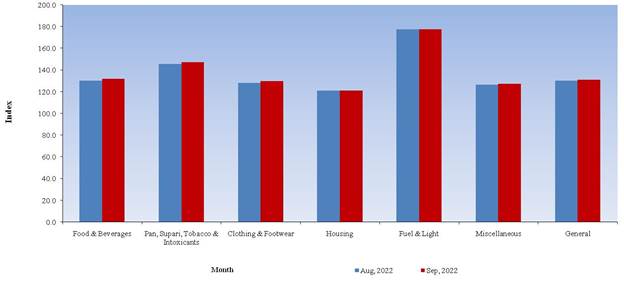
The All-India CPI-IW for July, 2022 increased by 0.7 points and stood at 129.9 (one hundred twenty nine point nine). On 1-month percentage change, it increased by 0.54 per cent with respect to previous month compared to an increase of 0.90 per cent recorded between corresponding months a year ago.
The maximum upward pressure in current index came from Housing group contributing 0.37 percentage points to the total change. At item level Cooking Gas, Electricity Domestic, Potato, Onion, Gourd, Mango, Banana, Chillies Dry, Cooked Meal, Wheat, Wheat Atta, Arhar Dal, Tur Dal etc. are responsible for the rise in index. However, this increase was largely checked by Tomato, Poultry Chicken, Soyabeen oil, Sunflower Oil, Mustard oil, Palm Oil, Rice, Apple, Lemon, Radish, Garlic, Drum Stick etc. putting downward pressure on the index.
At centre level, Udham Singh Nagar recorded a maximum increase of 3.8 points followed by Jalpaiguri and Jalandhar with 3.3 and 3.2 points respectively. Among others, 9 centres recorded increase between 2 to 2.9 points, 32 centres between 1 to 1.9 points and 24 centres between 0.1 to 0.9 points. On the contrary, Salem recorded a maximum decrease of 4.1 points. Among others, 2 centers recorded decrease between 2 to 2.9 points, 3 centers between 1 to 1.9 points and 11 centres between 0.1 to 0.9 points. Rest of 3 centres’ indices remained stationary.
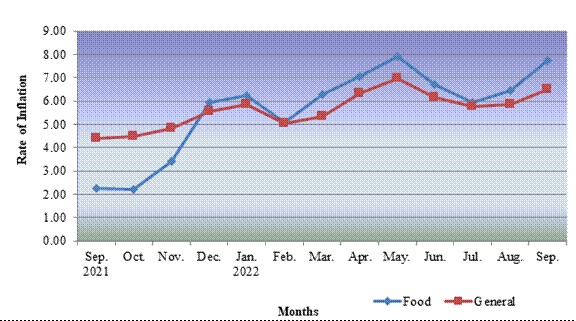
Year-on-year inflation for the month stood at 5.78 per cent compared to 6.16 per cent for the previous month and 5.26 per cent during the corresponding month a year before. Similarly, Food inflation stood at 5.96 per cent against 6.73 per cent of the previous month and 4.91 per cent during the corresponding month a year ago.
The next issue of CPI-IW for the month of August, 2022 will be released on Friday, 30th September, 2022. The same will also be available on the office website www.labourbureaunew.gov.in.
Calendar for Cadre Review of Central Group A Services
IMMEDIATE
File No. I-11019/18/2022-CRD Government of India Ministry of Personnel, Public Grievances & Pensions Department of Personnel and Training (Cadre Review Division)
Third Floor, Lok Nayak Bhawan, New Delhi- 110003. Dated: 26th August 2022
OFFICE MEMORANDUM
Sub: Calendar for Cadre Review of Central Group โAโโ Services.
The undersigned is directed to refer to this Departmentโs O.M. of even number dated 14.02.2022 vide which a Calendar was issued for cadre review of Central Group โAโ Services indicating the month by which the complete cadre review proposal should be submitted by the concerned CCAs to DoPT positively. Further, reference is invited to the assurances given by the representatives of the CCAs in the meetings held earlier with the undersigned from time-to-time, the last meeting of which was held on 24th May 2022. Despite the assurances, some CCAs have not submitted the cadre review proposal.
2. In this regard, it has now been decided to fix a date for submission of long pending cadre review proposals by the CCA concerned as scheduled in Annexure-I. All the CCAs are, therefore, requested to ensure compliance for submission of complete cadre review proposal of the Service/Cadre by the indicated date No further request for extension of date for submission of proposal would be entertained.
3. This has approval of Secretary (P)
(Dr. Harmit Singh Pahuja) Deputy Secretary to the Govt. of India Tel: 24624893
To
The Secretaries of the Ministry/Department concerned.