Data Entry Operator (DEO): Pay Level-4(Rs. 25,500-81,100) and Level-5 (Rs. 29,200-92,300).
Data Entry Operator, Grade ‘A’: Pay Level-4 (Rs. 25,500-81,100)
Vacancies
Tentative vacancies: There are approx. 4500 vacancies. However, firm vacancies will be determined in due course. Updated vacancies, if any, along with Post-wise & category-wise vacancies will be made available on the website of the Commission (https://ssc.nic.in> Candidate’s Corner> Tentative Vacancy) in due course. Candidates may note that State-wise/ Zone-wise vacancies are not collected by the Commission
Age Limit (As on 01-01-2022):
Age limit for the posts is 18-27 years as on 01-01-2022 i.e. Candidates born not before 02-01-1995 and not later than 01-01-2004 are eligible to apply
Permissible relaxation in upper age limit for different categories (Ref the attached PDF )
Payment of DA Arrears and restoration of commuted value of Pension: NCJCM Meeting
Shiva Gopal Mishra Secretary
National Council (Staff Side) Joint Consultative Machinery for Central Government Employees 13-C, Ferozshah Road, New Delhi – 110001
No.NC/JCM/2022/DA
Dated: December 5, 2022
All Constituents of the NC/JCM Dear Comrades,
Sub: Brief of the meeting held with the Spl. Secty.(Pers.), Deptt. of Exp., Govt. of India
A meeting was held today with the Special Secretary(Pers.), Deptt. of Exp., Government of India, on Agenda Item No.27/SC/22(D/o Exp.) of the Standing Committee of the NC/JCM regarding payment of the arrears of Dearness Allowance.
After prolonged discussions it has been agreed by the DoE that they will examine the issue once again and will consult the MoF on the subject.
Staff Side also discussed the issue of commutation of pension as per our agenda item. Staff Side demanded that, restoration of full pension after deduction of commuted value of the pension should be done after completion of 12 years instead of 15 years. It has been informed by the Ministry of Pension that the case been sent to the DoE after the last meeting of the Standing Committee of National Council(JCM). Special Secretary, (Pers.), Deptt. of Exp.. agreed to examine the issue and do the needful.
In the said meeting, apart from the undersigned, Leader Staff Side was also present.
DOPPW’s Nationwide Campaign for Submission of Digital Life Certificates by Pensioners successfully completed all over the country
Till 30th November, 2022, a total of 30.34 lakh central government pensioners has been used DLC successfully, in which 2.82 lakh DLC has been created through Face authentication
The Department of Pension & Pensioners’ Welfare, Ministry of Personnel, Public Grievances and Pensions, Government of India this year has launched a nation-wide campaign for promotion of Digital Life Certificate for Central Government pensioners. The objective of this Nation-wide campaign is to promote the use of Face Authentication technology and DLC thereby ensuring transparency and Ease of Usage. All the registered Pensioners’ Associations, Pension Disbursing Banks, Ministries of Government of India and CGHS Centers had been directed to promote the Digital Life Certificate/Face Authentication Technique for giving Life Certificate by organizing special camps for ‘Ease of Living’ of pensioners.
Due to increasing awareness, the popularity of Face authentication is gaining popularity and has been able to provide a huge relief especially to the aged and infirm elderly population. Till 30th November, 2022, a total of 30.34 lakh central government pensioners has been used DLC successfully, in which 2.82 lakh DLC has been created through Face authentication.
To promote the campaign, State Bank of India and in certain cities the Punjab National Bank joined hands with the Department and provided the Camp venues in different cities. Different officials of DoPPW have been nominated at different cities to oversee the progress of the Campaign. During 1-30 November, 2022, special awareness camps have been organized in different cities all over India from Srinagar in the North to Nagercoil (Kanyakumari District) in the South and from Guwahati in the East to Ahmedabad in the West. Specific cities covered in this Campaign are Delhi (Hauzkhas, Pankha Road, Chanakyapuri, Jangpura) , Noida, Chandigarh, Mohali, Srinagar (J&K), Nagpur, Pune (Maharashtra), Allahabad, Jammu, Jalandhar, Gwalior (MP), Thrissur (Kerala), Madurai, Nagercoil, Vadodara, Ahmedabad, Guwahati (Assam), Hyderabad, Ambernath , Mumbai, Bhubaneshwar , Balasore, Cuttack (Orissa), Thiruvanthapuram, Jaipur, Chennai, Karaikal , Puducherry , Dehradun, Jagadari (Haryana), Hoogly, Howrah, Kolkata, Ranchi, Bangalore, Gulbarga, Mysuru. The nation-wide campaign was conducted by the officials of DoPPW with the help of State Bank of India (SBI) & Punjab National Bank (PNB), who sponsored the campaign sites. The campaign saw the active participation of registered Central Government Pensioner Associations, the representatives of IPPB, UIDAI, NIC as well as CGDA in every city.
In order to overcome the challenge of certain pensioners not being able to give DLC due to fading bio-metrics the Department of Pension engaged with MeiTY to develop a face-recognition technology system based on Aadhaar database whereby it is possible to give LC from any Android based smart phone. As per this facility, the identity of a person is established through face recognition techniqueand DLC gets generated. This breakthrough technology, launched in November 2021, reduced the dependence of pensioners on external bio-metric devices and made the process more accessible and affordable to masses by leveraging smartphone-based technology. This was a milestone achievement in ensuring ‘Ease of Living’ of the elderly. The Face Authentication Technology was launched in November 2021 after extensive pilot runs by by Dr. Jitendra Singh, the Union Minister of State (PP) of the Ministry of Personnel, Public Grievances and Pensions.
Based on the feedback received of the Face Authentication App developed for this purpose, NIC was quick to respond and incorporate the same. For example, the life certificate could be opened in the App after receiving an OTP and downloading the same. But because of feedback received from pensioners, the Life Certificate can be accessed immediately after entering the OTP. The State Bank of India officials at all locations came out in full strength to promote the campaign and their officials were seen enthusiastically participated even on holidays. Similarly, the participation by the Registered Pensioners’ Associations was exemplary and their representatives helped in spreading awareness about the Face Authentication technique of LC.
The campaign was widely appreciated by the pensioners residing in different parts of country. The campaign was widely covered by the newspapers and Doordarshan all over the country. During 1-30 November, 2022, Department of Pension & Pensioners’ Welfare has disseminated 532 tweets from its Twitter account during the period. Beside this other stakeholder of this campaign have re-tweeted 605 tweets during the period. Five videos were uploaded by the Department on its YouTube page. Two videos in Hindi and English have been uploaded on the official youtube channel of the department – DOPPW_INDIA OFFICIAL explaining the process of submitting the Life Certificate through Face Authentication Technique in simple language.
Submission of Life Certificates is an important activity to be carried out by pensioners every year in the month of November (with special provision for pensioners aged 80 years and above to submit their Life Certificates in the month of October) to ensure continuity of their pension. In the traditional mode, pensioners had to present themselves before the Pension Disbursing Authority for physical submission of their Life Certificate which entailed waiting at the bank branches in queues for this purpose. This was found inconvenient for the old, ailing and infirm pensioners. Further, there was no mechanism for the pensioners to get a status regarding updation of their Life Certificates in the records of the Pension Disbursing Authority.
To enhance ‘Ease of Living’ of Central Government pensioners, Department of Pension & Pensioners’ Welfare has been promoting Digital Life Certificate i.e. Jeevan Pramaan extensively. Initially submission of DLCs using biometrics was commenced. The Department roped in the 50 registered Pensioners’ Associations in different cities to promote DLCs. The Department further associated the Indian Post & Payment Bank (IPPB) to include DLC among one of the door-step services provided through the agency of its Gramin Dak Sevaks, numbering more than 1,90,000. Pension disbursing Banks were also asked to adopt the methodology of video based KYV method of Life Certification and a consortium of 12 Banks asked to provide door-step service for DLC. In order to prevent super senior pensioners aged 80 years and above, DoPPW issued orders permitting this age group to give their LC from October 1 itself in order to provide them an exclusive window and avoid rush at various pension disbursing bank branches. Indian Embassies/Consulates were advised to assist Pensioners living overseas who can now also give a DLC by receiving an OTP on their email.
2. Subsequently queries have been received from various field units regarding modalities to be followed while implementing the aforesaid orders. The queries have been examined in consultation with concerned directorates of Railway Board and clarified as under:-
S. No.
Point
Clarification proposed to be issued
(i)
Modalities to be adopted while granting upgradation
There is no change in the classification or functional responsibilities/duties performed with respect to the upgraded posts in Level-8 and Level-9. As such, the upgraded posts may be classified as Non selection and may be filled up on the basis of seniority, scrutiny of service records and Confidential Reports, without holding any written tests and / or viva voce. The extant instructions issued by Establishment Directorate in this regard may please be referred.
(ii)
Whether Vigilance/D&A clearance will be applicable on upgradation in Level-8
The extant practice being followed for promotion in level-7 in respect of Vigilance/D&A Clearance will be applicable for upgradation from Level-7 to Level-8 and Level-8 to Level-9 as per extant instructions
(iii)
Provision of Reservation
Reservation will apply as per extant rules.
(iv)
While determining the number of posts for the purpose of upgradation, the entire cadre strength of a category has to be taken into consideration or not.
Yes, while determining the number of posts for upgradation, the permanent regular cadre strength of that particular category in Level-7 (excluding surplus & supernumerary posts) has to be taken into consideration.
As regards, counting of temporary posts for the purpose of determining the cadre strength, only those temporary posts which are in operation for at least three years may also be taken into account. This will be subject to certification that these posts are meant for regular activities which will continue and not for any sporadic requirements.
These orders will not be applicable to ex-cadre work- charged posts which will continue to be based on worth. of charge.
(v)
The procedure to be adopted for future direct recruitment.
Since all the posts in three grades remain in Group ‘C’ and there is no change in designation, for the purpose of calculation of -vacancies for Direct Recruitment, the vacancies occurring in all three grades i.e. Level-7, Level-8, Level-9 (non-functional) will be taken altogether. However, Direct Recruitment will only be made in the grade of Level-7.
(vi)
Whether any minimum services required for upgradation to Level-8 which is being materialised w.e.f. 01.12.2022.
Minimum residency period as per extant rules as prescribed for promotion to non selection posts would be applicable for up gradation to Level-8. Further probationers will not be eligible for the benefit of up gradation.
(vii)
Whether any rounding off post is to be adopted while upgrading the number of post.
Only the whole number may be taken for the purpose of granting upgradation.
To illustrate further, if the cadre is of 675 posts, while granting the upgradation to 50% post the number comes to 337.5 posts. In this case the number of 337.5 may not be rounded off to 338 but the whole number of 337 may be taken into consideration for operating in the upgraded in the Level-8 and remaining 338 posts will be operated in Level-7.
(viii)
Whether rounding off has to be adopted while deciding the matching saving.
While calculating the matching savings, number of posts equivalent to the money value required, are required to be surrendered.
To illustrate further, in case the number of posts is required to be surrendered is coming in fractions (for example 7.2), if it is decided to surrender only 7 posts, the equivalent money value can not be arrived at. Hence, the figure may be rounded off to 8 and the surplus value generated against surrender-of 8 posts may be transferred to the vacancy bank for future utilization.
The illustration issued along with RBE No. 155/2022 stands modified to this extent.
(ix)
If number of posts equivalent to the money value are not available for surrender, whether upgradation can be granted
In this scenario, upgradation may be granted to the posts which are available for surrender. For granting the benefit of upgradation to the remaining posts, point 4(iv)(Annexure-II) under RBE No. 155/2022 may be referred to.
(x)
Inclusion of SSE Drawing/Design etc. in Civil and Electrical in the list.
It has already been mentioned in the letter RBE No. 155/2022 that certain categories exist in certain Railways only. Hence the identically placed categories under the broad designation of SSE such as SSE(Drawing/Design) etc. in Level-7 under Engineering Departments are part of the upgradation as per RBE No. 155/2022.
(xi)
Inclusion of Commercial Inspectors and Sr. Wagon Movement Inspectors working in Level-7.
It has already been specified in the letter RBE No. 155/2022 that certain designations exist in certain Railways only. Since, categories of Commercial Supdt. and Traffic Inspector in Level-7 has already been granted the benefit, identically placed categories of Traffic/Commercial departments in Level-7 are part of the upgradation as per RBE No. 155/2022.
(xii)
Whether upgradation to Level-8 and further to Level-9 (non-functional) in terms of Board’s instructions RBE No. 155/2022 are to be reckoned for the purpose of MACPS.
Yes. As every financial upgradation has to be counted and offset against the financial upgradation under MACPS in terms of extant instructions for regulation of MACPS.
2. This issues in consultation with Estt.(NG) and E(SCT) Directorate of Railway Board and with the approval of Competent Authority.
AICPIN for October 2022: Expected DA from Jan 2023
Consumer Price Index for Industrial Workers for October 2022 released
All-India CPI-IW for October, 2022 increased by 1.2 points and stood at 132.5
TheLabour Bureau, an attached office of the Ministry Labour and Employment, has been compiling Consumer Price Index for Industrial Workers every month on the basis of retail prices collected from 317 markets spread over 88 industrially important centres in the country. The index is compiled for 88 centres and All-India and is released on the last working day of succeeding month. The index for the month of October, 2022was released today
The All-India CPI-IW for October, 2022 increased by 1.2 points and stood at 132.5 (one hundred thirty two point five). On 1-month percentage change, it increased by 0.91 per cent with respect to previous month compared to an increase of 1.30 per cent recorded between corresponding months a year ago.
The maximum upward pressure in current index came from Food & Beverages group contributing 0.76 percentage points to the total change. At item level, Rice, Wheat, Wheat Atta, Buffalo Milk, Poultry/Chicken, Cauliflower, Cabbage, Onion, Potato, Tomato, Peas, Chillies dry, Biscuits, Vada, Idli, Dosa, Cooked Meals, Tea cup, Doctor’s fee etc. are responsible for the rise in index. However, this increase was largely checked by Apple, Banana, Fish fresh, Palm Oil, Mustard oil, Cotton seed Oil, Sunflower Oil, Chillies Green, Brinjal, Orange, French Bean, Electricity Domestic etc. putting downward pressure on the index.
At centre level, Ludhiana recorded a maximum increase of 3.6 points. Among others, 4 centres recorded increase between 3 to 3.4 points, 14 centres between 2 to 2.9 points, 29 centres between 1 to 1.9 points and 25 centres between 0.1 to 0.9 points. On the contrary, Doom-Dooma Tinsukia and Haldia recorded a maximum decrease of 1.3 points each. Among others, 2 centers recorded decrease between 1 to 1.2 points, 8 centres between 0.1 to 0.9 points. Rest of three centers index remained stationary.
Year-on-year inflation for the month stood at 6.08 per cent compared to 6.49 per cent for the previous month and 4.52 per cent during the corresponding month a year before. Similarly, Food inflation stood at 6.52 per cent against 7.76 per cent of the previous month and 2.20per cent during the corresponding month a year ago.
Y-o-Y Inflation based on CPI-IW (Food and General)
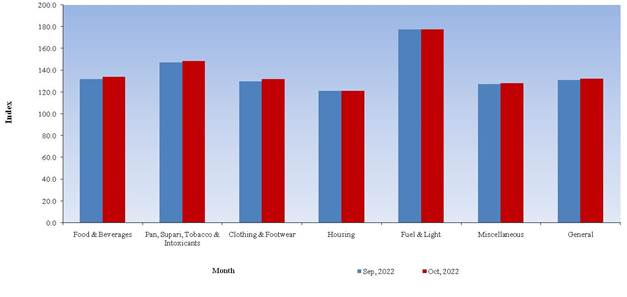
All-India Group-wise CPI-IW for September, 2022and October, 2022
Sr. No.
Groups
September, 2022
October, 2022
I
Food & Beverages
131.9
133.9
II
Pan, Supari, Tobacco & Intoxicants
147.3
148.5
III
Clothing & Footwear
129.7
131.9
IV
Housing
121.0
121.0
V
Fuel & Light
177.8
177.8
VI
Miscellaneous
127.5
128.4
General Index
131.3
132.5
CPI-IW: Groups Indices
The next issue of CPI-IW for the month of November, 2022 will be released on Friday, 30th December, 2022. The same will also be available on the office website www.labourbureaunew.gov.in.
फा.सं 1/2/2022(JCM)-पी & पी डब्ल्यू (ई) कार्मिक, लोक शिकायत तथा पेंशन मंत्रालय पेंशन और पेंशनभोगी कल्याण विभाग
तीसरा तल, लोक नायक भवन खान मार्केट, नई दिल्ली-110003 दिनांक 18th नवंबर, 2022
कार्यालय ज्ञापन
विषय: Holding of Pension Adalat -reg.
The undersigned is directed to Say that in the meeting of Standing Committee of National Council (JCM) held on 22.09.2022 under the chairmanship of Secretary, DoPT, the staff side mentioned that Pension Adalats are not being conducted by the various Ministries/Departments regularly and whenever such Adalats are held no information is given to the pensioners. The chairman of the Standing Committee of National Council (JCM) directed that a calendar for holding Pension Adalats should be issued by all Ministries/Departments within a period of one month and a copy of the calendar be provided to the office bearer of the staff side.
2. Accordingly all Ministries/Departments are hereby advised to draw up calendar for holding Pension Adalats in accordance with the guidelines issued by this Department vide OM dated 25.03.2011 (copy enclosed) and send the calendar to the office bearer of the staff side of the JCM within a month, under intimation to this Department. It is also advised that advance intimation may be given to the pensioners as per the enclosed guidelines, well before the date of Pension Adalat and the calendar be displayed on the website of the Ministry/Department/Organization, as the case may be. A representative of the concerned Pension Disbursing Banks may also be invited for the Pension Adalats. This may be treated as MOST URGENT.
(डी.पी. सिंंह) भारत सरकार के सचिव टेलीफोन:011-24644632
सेवा में, 1. All Ministries/Departments 2. All Pension Disbursing Banks
Paid Holiday to Govt Employees on 5th Dec 2022: Bye-Elections in 6 Assembly Constituencies of Odisha, Rajasthan, Bihar, Chhattisgarh and UP
F. No. 12/1/2022-JCA Government of India Ministry of Personnel, Public Grievances and Pensions (Department of Personnel & Training) Establishment (JCA) Section *****
North Block, New Delhi Dated: 18th November, 2022
OFFICE MEMORANDUM
Subject: Bye-Elections in 6 Assembly Constituencies of Odisha, Rajasthan, Bihar, Chhattisgarh and Uttar Pradesh and 1 (one) Parliamentary Constituency of Uttar Pradesh – Grant of paid holiday to employees on the day of poll – regarding
The undersigned is directed to state that, as informed by the Election Commission of India, vide their letter No. 78/EPS/2022 dated 14.11.2022, Bye -Elections in 6 Assembly Constituencies of Odisha, Rajasthan, Bihar, Chhattisgarh and Uttar Pradesh and 1 (one) Parliamentary Constituency of Uttar Pradesh, are scheduled to be held as under:-
Schedule for Bye-Elections in Parliamentary Constituency announced by the Election Commission of India is as under:
Sl. No.
Name of State
Parliamentary Constituency No. & Name
Date of Poll
Day
1
Uttar Pradesh
21-Mainpuri (PC)
05.12.2022
Monday
Schedule for Bye-Elections in Assembly Constituencies of various States announced by the Election Commission of India is as under:
Sl. No.
Name of State
Assembly Constituency No. & Name
Date of Poll
Day
1.
Odisha
01-Padampur
05.12.2022
Monday
2.
Rajasthan
21-Sardarshahar
05.12.2022
Monday
3.
Bihar
93-Kurhani
05.12.2022
Monday
4.
Chhattisgarh
80-Bhanupratappur (ST)
05.12.2022
Monday
5.
Uttar Pradesh
37-Rampur
05.12.2022
Monday
2. In this regard, it is stated that the guidelines have been issued by this Department, vide OM No. 12/ 14/99-JCA, dated 10.10.2001, regarding closure Of Central Government Offices and grant of paid holiday to all concerned, including the daily wage/ casual workers, on the date of general-election. It is reiterated that all the Central Government Offices and the Central Industrial Establishments, shall remain closed in the notified areas, where general-election to the Parliamentary Constituency and State Legislative Assembly Constituencies are to be conducted, on the date of Poll. The employees concern shall be granted paid holiday on the date of Poll to enable them to exercise their right to vote.
Implementation of Revised format of PPO Booklet (CAM-52): CPAO
GOVERNMENT OF INDIA DEPARTMENT OF EXPENDITURE CENTRAL PENSION ACCOUNTING OFFICE TRIKOOT-II, BHIKAJI CAMA PLACE, NEW DELHI-110066
CPAO/IT&Tech/PFMS/84 (P.F.)/2022-23/11144/202
18.11.2022
Office Memorandum
Subject: Implementation of Revised format of PPO Booklet (CAM-52)
Office of Controller General of Accounts vide its correction slip No. 10 issued under reference TA-2-01001/2/2021-TA-II/327 dated 30.03.2021 replaced the existing form- 52 (PPO Booklet) with the revised one attached therewith. Thereafter other correction slips No. 19, 22 and 27 were also issued on the subject.
2. It has been observed from the cases received in this Office that the revised format of PPO as amended by O/o CGA is not being used by the Pay and Account Offices while sending the Pension Payment Order booklets to CPAO. This is causing problems in capturing of data in CPAO as prescribed in revised format of PPO.
3. All Pr. CCAs/CCAs/CAs are requested to direct their respective PAOs to ensure the revised format of PPO and all amendments issued by the O/o CGA on the cited subject are duly complied with while sending the pension cases to CPAO.
This issues with the approval of the Chief Controller (Pensions).
(Dr. N Shravan Kumar) Controller of Accounts
To, All Pr.CCAs/CCAs/CAs
Copy to NIC (CPAQ) for information and making necessary amendments for data capturing as per revised format of PPO Booklet (CAM-52).
Processing of Pension/Family Pension cases where arrears of pension are paid before the finalization of pension/family pension case: CPAO
GOVERNMENT OF INDIA MINISTRY OF FINANCE DEPARTMENT OF EXPENDITURE CENTRAL PENSION ACCOUNTING OFFICE TRIKOOT-II, BHIKAJI CAMA PLACE, NEW DELHI-110066 PHONES : 26174596, 26174456, 26174438
CPAO/IT&Tech/Corres. with PAO/35 (Vol-II)/2022-23/6824/199
15.11.2022
OFFICE MEMORANDUM
Sub:- Processing of Pension/Family Pension cases where arrears of pension are paid before the finalization of pension/family pension case – reg.
Central Pension Accounting Office (CPAO) has been receiving some pension/family pension cases where hand written remarks in respect of payment of arrears of pension/family pension etc. are added in the print of e-PPO, which is not a correct method to process pension/family pension cases as the data of physical PPO and e-PPO do not match with each other. This may also result in duplicate/double payments by Banks. Pension cases pertaining to those employees who are getting provisional pension by PAO or the arrears of pension were paid by PAO are required to be processed manually and the PPO number should be obtained from the CPAO. This issue has already been addressed vide this Office OM No. CPAO/IT& Tech/PFMS/84 (P.F.)/2020-21/85 dated 06.09.2021 and a proforma was provided to obtain the PPO number from CPAO.
2. It is also intimated that these types of pension/family pension cases received in this Office cannot be processed for payment of pension but will be returned to respective PAOs. This will result in delayed pension payment which further leads to hardship to pensioners.
3. In view of above, all the Pr. CCAs/CCAs/CAs/AGs are requested to issue instructions to PAOs under their control to follow the prescribed procedure while processing pension cases of similar nature.
This issues with the approval of the Chief Controller (Pensions).
Sr. Accounts Officer (IT & Tech)
To,
All Pr. CCAs/CCAs/CAs/AGs (as per list)
Copy to:
GIFMIS, O/o CGA, Mahalekha Niyantrak Bhawan E-Block, GPO Complex, INA, New Delhi-110023. PS to CC (P), CPAO Sr. TD, NIC (CPAO) PAto CA, CPAO PA to Dy. CA
7th CPC Pay Structure upgradation of certain cadres for Railway Employees
GOVERNMENT OF INDIA (BHARAT SARKAR) MINISTRY OF RAILWAYS/RAIL MANTRALAYA (RAILWAY BOARD)
PC-VII No. 200
RBE No.155/2022
No. PC-VII/2019/RSRP/3
dated 17/11/2022
The General Manager/CAOs(R), All India Railways & Production Units, (As per mailing list)
Sub: – Upgradation of pay structure of certain cadres.
Consequent upon approval conveyed by Ministry of Finance vide their ID Note No. 36(1)/E.III(B)/2015 dated 01.11.2022, the President has now accorded his approval for upgrading the pay structure of certain Group ‘C’ cadres of Ministry of Railways detailed in the list enclosed as Annexure-I in following manner :-
(i) Upgradation of 50% posts from Level-7 (PB-2/GP-4600)/Group `C’ to Level-8 (PB-2/GP-4800)/Group
(ii) Further upgradation of these 50% posts in Level-8 (PB-2/GP-4800)/Group ‘C’ to Level-9 (PB-2/GP-5400)/Group ‘C’ on non-functional basis after 4 years of service in Level-8(PB-2/GP-4800).